
Руководства

Ознакомьтесь с правилами эксплуатации вашего автомобиля Toyota, изучив электронную версию руководства.
На данной странице представлены следующие типы руководств:
- Общее руководство для владельца
- Руководство по мультимедиа и навигации
- Руководство по вождению в условиях бездорожья
Corolla
- Руководство для владельца
- Руководство по эксплуатации навигационной и мультимедийной систем
Camry
- Руководство для владельца
- Руководство по эксплуатации навигационной и мультимедийной систем
Toyota C-HR
- Руководство для владельца
- Руководство по эксплуатации навигационной и мультимедийной систем
RAV4
- Руководство для владельца
- Руководство по эксплуатации навигационной и мультимедийной систем
Highlander
- Руководство для владельца
- Руководство по эксплуатации навигационной и мультимедийной систем
Fortuner
- Руководство для владельца
- Руководство по эксплуатации навигационной и мультимедийной систем
Land Cruiser Prado
- Руководство для владельца
- Руководство по эксплуатации навигационной и мультимедийной систем
- Руководство по вождению в условиях бездорожья
Land Cruiser 300
- Руководство для владельца
Land Cruiser 200
- Руководство для владельца
- Руководство по эксплуатации навигационной и мультимедийной систем
Hilux
- Руководство для владельца
- Руководство по эксплуатации навигационной и мультимедийной систем
Alphard
- Руководство для владельца
- Руководство по эксплуатации навигационной и мультимедийной систем
Hiace
- Руководство для владельца
- Руководство по эксплуатации навигационной и мультимедийной систем
Руководства по эксплуатации платформы Яндекс.Авто
Яндекс.Авто* — это несколько полезных сервисов с единым интерфейсом и голосовым управлением.
Руководство для Camry (PDF) Руководство для RAV4 (PDF)
*ООО «ЯНДЕКС» является правообладателем товарного знака «Яндекс» и программы «Яндекс.Авто» (0+).
Платформа Яндекс.Авто доступна на автомобилях Toyota Camry, произведенных с 23.08.2016 по 08.06.2018 и Toyota RAV4, произведенных с 29.11.2016 по 22.11.2019.
Найти дилера Записаться на сервис Заказать обратный звонок
СМОТРИТЕ ТАКЖЕ

МОДЕЛЬНЫЙ РЯД
Узнавайте больше о моделях Toyota, ознакомившись со справочными материалами по модели.
РЕГЛАМЕНТ ТО
Узнайте подробнее о регламенте и записи на ТО, а также о возможности провести первое техническое обслуживание для вашего автомобиля Toyota бесплатно.
УСЛОВИЯ ГАРАНТИИ
Узнайте про гарантийный срок на новый автомобиль Toyota у Официального дилера. Гарантийный срок составит 3 года или 100 000 км пробега.
Где я могу найти номер VIN для моего Toyota?
Положение номера VIN различается среди марок автомобилей и моделей. Он может быть отпечатан на кузове автомобиля или указан на табличке. Рекомендуется обратиться к руководству по эксплуатации Toyota RAV4 (2020) для точной информации о месте нахождения номера VIN.
Как проверить давление в шинах моего Toyota RAV4 (2020)?
Вы можете проверить давление в шинах вашего Toyota RAV4 (2020) с помощью манометра для измерения давления в шинах. Рекомендуемое давление в шинах обычно указано на наклейке внутри двери водителя или в руководстве владельца.
Какое масло нужно моему Toyota RAV4?
Тип масла, необходимого вашему Toyota RAV4, зависит от типа двигателя. Обратитесь к руководству владельца для рекомендуемой вязкости и спецификации масла.
Что такое номер VIN?
Номер VIN, также известный как идентификационный номер автомобиля, служит уникальным идентификатором для каждого автомобиля. Для точного местоположения номера VIN рекомендуется обратиться к руководству по эксплуатации Toyota RAV4 (2020).
Где я могу найти информацию о гарантийном покрытии моего Toyota RAV4?
Информацию о гарантийном покрытии вашего Toyota RAV4 (2020) можно найти в гарантийном буклете, поставляемом с автомобилем. Обычно в нем содержится информация о сроке действия и охвате различных компонентов.
Когда мне следует запланировать техобслуживание для моего Toyota RAV4?
Регулярное техническое обслуживание необходимо для оптимальной производительности автомобиля. Подробности о частоте техобслуживания и конкретных задачах можно найти в инструкциях по техническому обслуживанию. Обычно крупное техобслуживание должно производиться каждые два года или после пробега 30 000 километров.
Как сбросить индикатор технического обслуживания на панели приборов моего Toyota RAV4?
Чтобы сбросить индикатор технического обслуживания на панели приборов вашего Toyota RAV4 (2020), следуйте инструкциям, описанным в руководстве по эксплуатации. Обычно это требует нажатия определенной комбинации кнопок в определенном режиме работы автомобиля.
С каким интервалом мне следует рассмотреть замену тормозной жидкости для моего Toyota RAV4?
Рекомендуется заменять тормозную жидкость в вашем Toyota RAV4 (2020) каждые два года.
Что делать, если загорается лампа контроля двигателя моего Toyota RAV4?
Если загорается лампа контроля двигателя вашего Toyota RAV4 (2020), это указывает на потенциальную проблему с автомобилем. Рекомендуется обратиться к квалифицированному механику для диагностики причины проблемы.
Как часто мне следует переключать шины на моем Toyota RAV4?
Периодическая перестановка шин помогает обеспечить равномерный износ и продлить срок службы шин. Обычно рекомендуется переключать шины каждые 6 000-8 000 километров или по указаниям в руководстве владельца Toyota RAV4 (2020).
Что делать, если разряжается аккумулятор моего Toyota?
Если разряжается аккумулятор вашего Toyota RAV4, вы можете запустить автомобиль, используя провода для запуска двигателя и другой автомобиль с заряженным аккумулятором. В противном случае вы можете вызвать помощь на дороге.
Что делать, если одна или несколько дверей отказываются открываться изнутри?
Если у вас возникают проблемы с открыванием дверей изнутри, вероятно, включена детская защелка. Способ отключения детской защелки зависит от марки и модели автомобиля.
Как программировать новый ключ для моего Toyota RAV4?
Для программирования нового ключа для вашего Toyota RAV4 обычно требуется следовать определенным инструкциям, описанным в руководстве пользователя, или обратиться за помощью в дилерский центр или к слесарю.
Какой рекомендуемый интервал для замены воздушного фильтра в моем Toyota RAV4?
Рекомендуемый интервал для замены воздушного фильтра в вашем Toyota RAV4 (2020) зависит от условий езды. Обычно рекомендуется проверять воздушный фильтр каждые 12 000-15 000 километров и заменять его при необходимости.
Доступно ли руководство для Toyota RAV4 (2020) на русском языке?
Нет, руководство для Toyota RAV4 (2020) доступно на английском языке.
RAV4_OM_OM0R024U_(U)
1
2
3
4
5
6
7
8
9
10
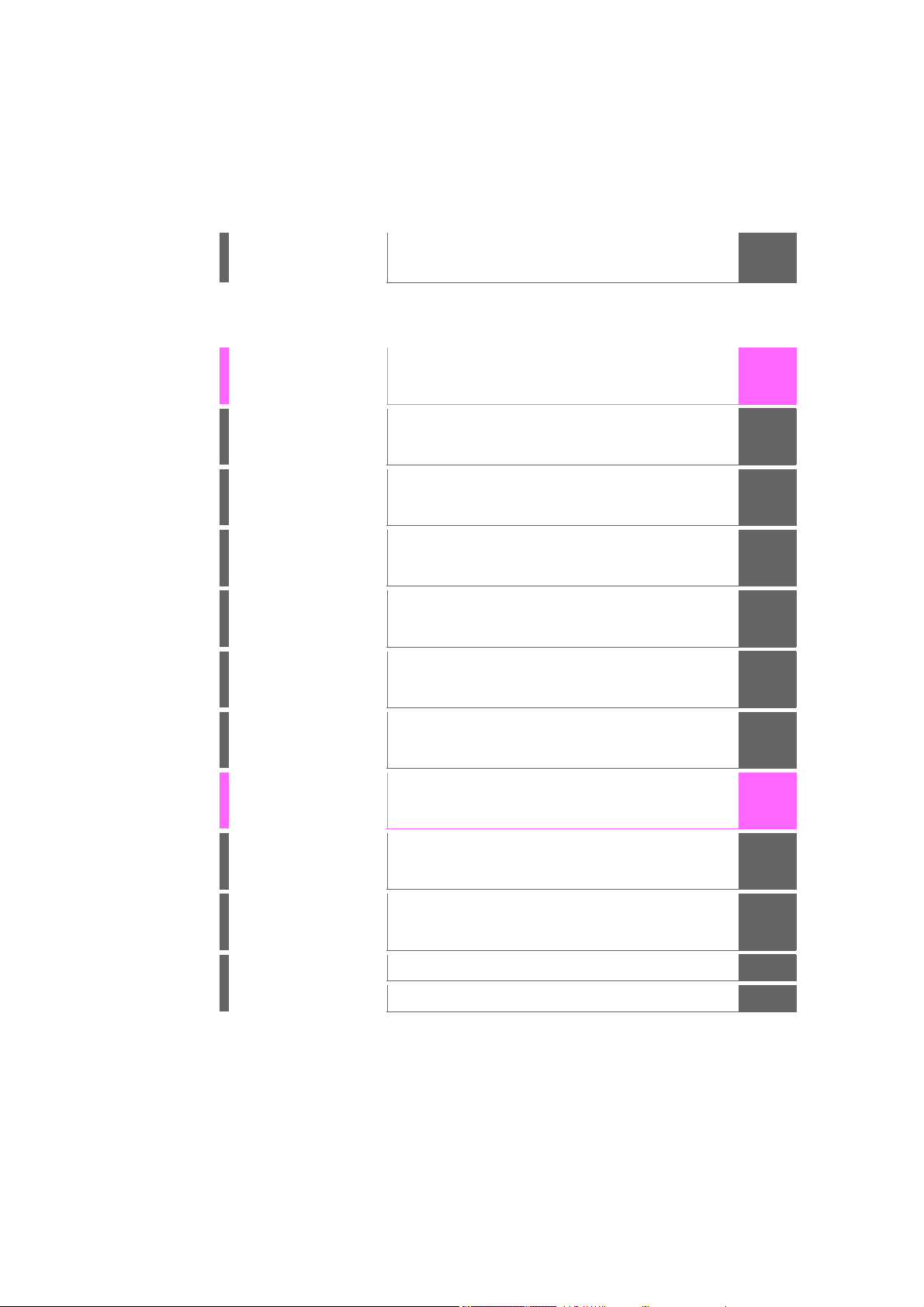
Pictorial index
Search by illustration
For safety
and security
Make sure to read through them
(Main topics: Child seat, theft deterrent system)
Vehicle status
information and
indicators
Reading driving-related information
(Main topics: Meters, multi-information display)
Before driving
Opening and closing the doors and windows,
adjustment before driving
(Main topics: Keys, doors, seats)
Driving
Operations and advice which are necessary for
driving
(Main topics: Starting engine, refueling)
Audio
Operating the Audio
(Main topics: Audio/visual, phone, Connected Services)
Interior features
Usage of the interior features
(Main topics: Air conditioner, storage features)
Maintenance
and care
Caring for your vehicle and maintenance
procedures
(Main topics: Interior and exterior, light bulbs)
When trouble
arises
What to do in case of malfunction and emergency
(Main topics: Battery discharge, flat tire)
Vehicle
specifications
Vehicle specifications, customizable features
(Main topics: Fuel, oil, tire inflation pressure)
For owners
Reporting safety defects for U.S. owners, and seat
belt and SRS airbag instructions for Canadian
owners
Index
Search by symptom
Search alphabetically
Pictorial index
Search by illustration
For safety
and security
Vehicle status
information and
indicators
Before driving
Driving
Audio
Interior features
Maintenance
and care
When trouble
arises
Make sure to read through them
(Main topics: Child seat, theft deterrent system)
Reading driving-related information
(Main topics: Meters, multi-information display)
Opening and closing the doors and windows,
adjustment before driving
(Main topics: Keys, doors, seats)
Operations and advice which are necessary for
driving
(Main topics: Starting hybrid system, refueling)
Operating the Audio
(Main topics: Audio/visual, phone, Connected Services)
Usage of the interior features
(Main topics: Air conditioner, storage features)
Caring for your vehicle and maintenance
procedures
(Main topics: Interior and exterior, light bulbs)
What to do in case of malfunction and emergency
(Main topics: 12-volt battery discharge, flat tire)
1
2
3
4
5
6
7
8
Vehicle
specifications
For owners
Index
RAV4-HV_OM_OM0R025U_(U)
Vehicle specifications, customizable features
(Main topics: Fuel, oil, tire inflation pressure)
Reporting safety defects for U.S. owners, and seat
belt and SRS airbag instructions for Canadian
owners
Search by symptom
Search alphabetically
9
10

2
TABLE OF CONTENTS
For your information………………. 8
Reading this manual…………….13
How to search……………………..14
Pictorial index ……………………..16
1
For safety and security
1-1. For safe use
Before driving……………….28
For safe driving …………….29
Seat belts…………………….31
SRS airbags…………………35
Front passenger occupant
classification system ……45
Exhaust gas precautions.. 50
1-2. Child safety
Riding with children……….51
Child restraint systems…..52
1-3. Emergency assistance
Safety Connect …………….67
1-4. Hybrid system
Hybrid system features ….72
Hybrid system precautions
…………………………………77
1-5. Theft deterrent system
Immobilizer system ……….82
Alarm…………………………..85
Vehicle status
2
information and
indicators
2-1. Instrument cluster
Warning lights and indicators
…………………………………88
Gauges and meters (with 4.2-
inch display) ……………….94
Gauges and meters (with 7-
inch display) ……………….98
Multi-information display 103
Energy monitor/consumption
screen……………………..113
3
Before driving
3-1. Key information
Keys …………………………122
3-2. Opening, closing and lock-
ing the doors
Side doors ………………… 128
Back door …………………. 134
Smart key system………. 148
3-3. Adjusting the seats
Front seats ………………..154
Rear seats………………… 155
Driving position memory 157
Head restraints………….. 160
3-4. Adjusting the steering
wheel and mirrors
Steering wheel…………… 162
Inside rear view mirror… 163
Digital Rear-view Mirror. 165
Outside rear view mirrors
……………………………… 174
3-5. Opening, closing the win-
dows and moon roof
Power windows …………. 176
Moon roof …………………. 179
Panoramic moon roof…. 182

TABLE OF CONTENTS
3
4
Driving
4-1. Before driving
Driving the vehicle……… 189
Cargo and luggage ……. 196
Vehicle load limits ……… 199
Trailer towing…………….. 200
Dinghy towing …………… 209
4-2. Driving procedures
Power (ignition) switch (vehi-
cles without smart key sys-
tem)……………………….. 210
Power (ignition) switch (vehi-
cles with smart key system)
……………………………… 212
EV drive mode ………….. 217
Hybrid transmission …… 219
Turn signal lever………… 223
Parking brake……………. 224
Brake Hold ……………….. 227
4-3. Operating the lights and
wipers
Headlight switch………… 229
AHB (Automatic High Beam)
……………………………… 232
Fog light switch …………. 235
Windshield wipers and
washer……………………. 235
Rear window wiper and
washer……………………. 238
4-4. Refueling
Opening the fuel tank cap
……………………………… 240
4-5. Using the driving support
systems
Toyota Safety Sense 2.0243
PCS (Pre-Collision System)
……………………………… 249
LTA (Lane Tracing Assist)
……………………………… 257
RSA (Road Sign Assist). 267
Dynamic radar cruise control
with full-speed range … 270
BSM (Blind Spot Monitor)
……………………………… 280
Intuitive parking assist… 290
PKSB (Parking Support
Brake)…………………….. 297
Parking Support Brake func-
tion (static objects) …… 302
Parking Support Brake func-
tion (rear-crossing vehicles)
……………………………… 308
Rear view monitor system
……………………………… 312
Toyota parking assist monitor
……………………………… 320
Panoramic view monitor 333
Driving mode select switch
……………………………… 365
Trail Mode …………………366
Driving assist systems… 368
4-6. Driving tips
Hybrid vehicle driving tips
………………………………
Winter
riving tips………. 377
d
Utility vehicle precautions
……………………………… 380
5
Audio
5-1. Basic function
Buttons overview……….. 385
Menu screen………………387
375
1
2
3
4
5
6
7
8
9
10

4
TABLE OF CONTENTS
Status icon ……………….. 388
“Setup” screen ………….. 390
5-2. Basic information before
operation
Initial screen……………… 391
Touch screen…………….. 392
Home screen…………….. 394
Entering letters and num-
bers/list screen operation
……………………………… 395
Screen adjustment …….. 398
Linking multi-information dis-
play and the system …. 399
5-3. Connectivity settings
Registering/Connecting a
Bluetooth
Setting Bluetooth
®
device ……. 400
®
details
……………………………… 404
®
Wi-Fi
Hotspot ………….. 412
5-4. Apple CarPlay/Android
Auto
®
Apple CarPlay
/Android Auto
……………………………… 417
5-5. Other settings
General settings………… 424
Voice settings……………. 428
Vehicle settings …………. 429
5-6. Using the audio/visual sys-
tem
Quick reference…………. 430
Some basics …………….. 431
5-7. Radio operation
AM/FM/SiriusXM (SXM) radio
……………………………… 435
5-8. Media operation
USB memory…………….. 442
iPod/iPhone (Apple CarPlay)
……………………………… 444
Android Auto………………447
Bluetooth
®
audio ……….. 448
5-9. Audio/visual remote con-
trols
Steering switches ………. 452
5-10.Audio settings
Setup……………………….. 454
5-11.Tips for operating the
audio/visual system
Operating information…. 456
5-12.Voice command system
operation
Voice command system 468
Command list ……………. 471
5-13.Phone operation (Hands-
free system for cellular
phones)
Quick reference…………. 475
Some basics……………… 476
Placing a call using the Blue-
®
tooth
hands-free system
……………………………… 480
Receiving a call using the
Bluetooth® hands-free sys-
tem …………………………483
Talking on the Bluetooth
®
hands-free system……. 484
®
Bluetooth
phone message
function…………………… 486
5-14.Phone settings
Setup……………………….. 491
5-15.What to do if… (Blue-
®
tooth
)
Troubleshooting…………. 501
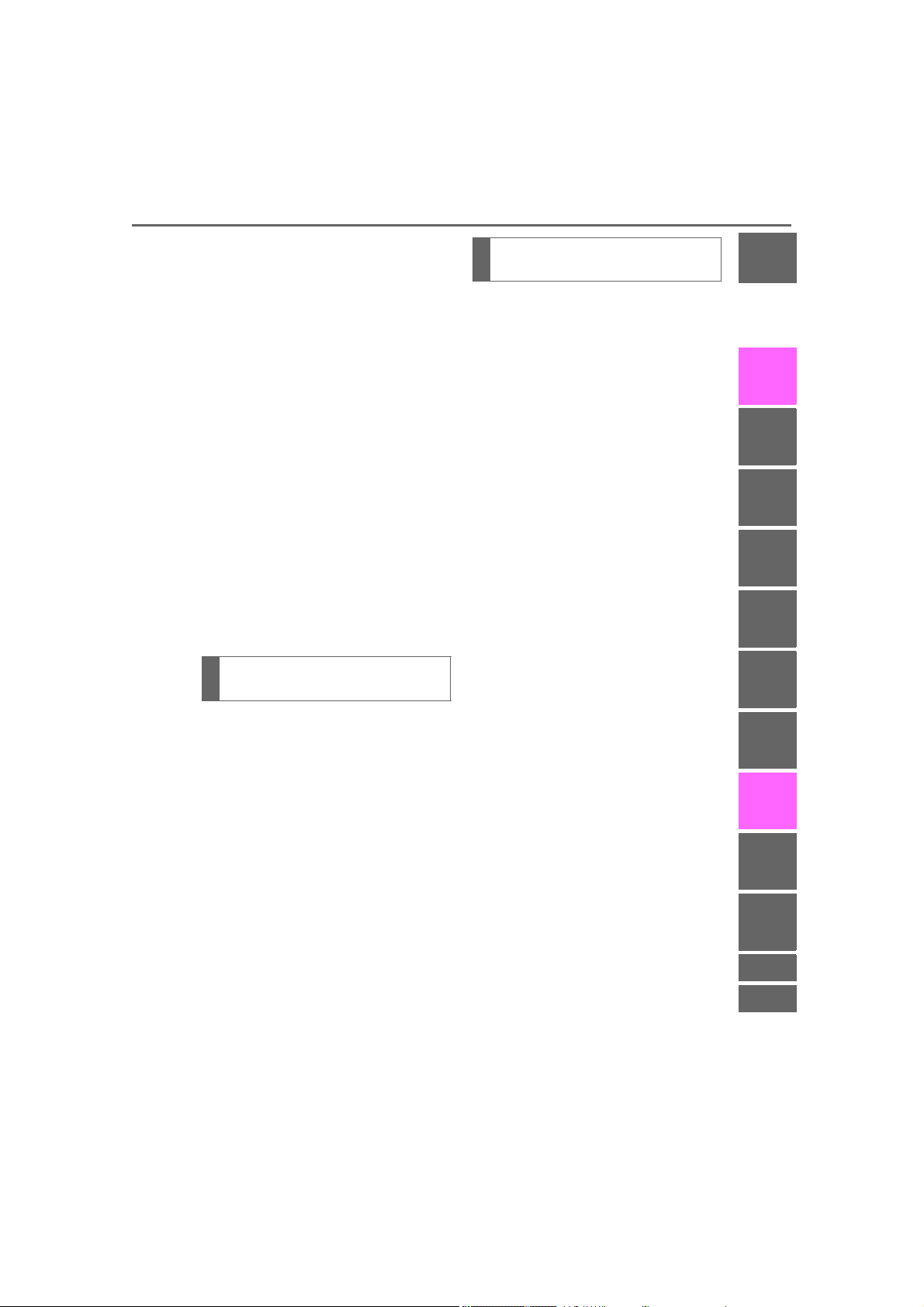
TABLE OF CONTENTS
5
5-16.Connected Services over-
view
Connected Services…… 505
Type A: Function achieved by
using a smartphone or DCM
……………………………… 506
Type B: Function achieved by
using DCM and the system
……………………………… 508
Type C: Function achieved by
using DCM ……………… 509
Type D: Function achieved by
using DCM and a smart-
phone …………………….. 512
5-17.Connected Services opera-
tion
Toyota Apps ……………… 514
5-18.Setup
Toyota Apps settings….. 518
6
Interior features
6-1. Using the air conditioning
system and defogger
Automatic air conditioning
system……………………. 520
Heated steering wheel/seat
heaters/seat ventilators527
6-2. Using the interior lights
Interior lights list………… 530
6-3. Using the storage features
List of storage features . 533
Luggage compartment fea-
tures ………………………. 537
6-4. Using the other interior fea-
tures
Other interior features … 542
Garage door opener…… 552
7
Maintenance and care
7-1. Maintenance and care
Cleaning and protecting the
vehicle exterior ………… 562
Cleaning and protecting the
vehicle interior …………. 565
7-2. Maintenance
Maintenance requirements
……………………………… 568
General maintenance…. 569
Emission inspection and
maintenance (I/M) programs
……………………………… 572
7-3. Do-it-yourself maintenance
Do-it-yourself service precau-
tions……………………….. 573
Hood………………………… 575
Positioning a floor jack .. 577
Engine compartment ….. 578
12-volt battery……………. 584
Tires …………………………586
Tire inflation pressure…. 600
Wheels ……………………..602
Air conditioning filter…… 604
Cleaning the hybrid battery
(traction battery) air intake
vent and filter ………….. 606
Wiper insert replacement
……………………………… 610
Wireless remote control/elec-
tronic key battery……… 613
Checking and replacing fuses
……………………………… 616
Light bulbs………………… 61
1
2
3
4
5
6
7
8
9
10
8

6
TABLE OF CONTENTS
8
When trouble arises
8-1. Essential information
Emergency flashers …… 628
If your vehicle has to be
stopped in an emergency
……………………………… 629
If the vehicle is trapped in ris-
ing water…………………. 630
8-2. Steps to take in an emer-
gency
If your vehicle needs to be
towed……………………… 631
If you think something is
wrong …………………….. 635
If a warning light turns on or a
warning buzzer sounds 636
If a warning message is dis-
played…………………….. 647
If you have a flat tire…… 651
If the hybrid system will not
start ……………………….. 660
If you lose your keys ….. 661
If the fuel filler door cannot be
opened …………………… 662
If the electronic key does not
operate properly (vehicles
with smart key system) 663
If the 12-volt battery is dis-
charged ………………….. 665
If your vehicle overheats 670
If the vehicle becomes stuck
……………………………… 674
9
Vehicle specifications
9-1. Specifications
Maintenance data (fuel, oil
level, etc.)……………….. 676
Fuel information…………. 685
Tire information …………. 687
9-2. Customization
Customizable features… 697
9-3. Initialization
Items to initialize………… 708
10
For owners
10-1.For owners
Reporting safety defects for
U.S. owners…………….. 710
Seat belt instructions for
Canadian owners (in
French)……………………711
SRS airbag instructions for
Canadian owners (in
French)……………………712
Index
What to do if… (Troubleshoot-
ing) ………………………..722
Alphabetical Index …….. 725
TABLE OF CONTENTS
7
1
2
3
4
5
6
7
8
9
10

8
For yo ur information
Main Owner’s Manual
Please note that this manual
applies to all models and
explains all equipment, including
options. Therefore, you may find
some explanations for equipment not installed on your vehicle.
All specifications provided in this
manual are current at the time of
printing. However, because of
the Toyota policy of continual
product improvement, we
reserve the right to make
changes at any time without
notice.
Depending on specifications,
the vehicle shown in the illustrations may differ from your vehicle in terms of equipment.
Noise from under vehicle
after turning off the hybrid
system
Accessories, spare parts
and modification of your
Toyota
A wide variety of non-genuine
spare parts and accessories for
Toyota vehicles are currently
available in the market. You
should know that Toyota does
not warrant these products and
is not responsible for their performance, repair, or replacement, or for any damage they
may cause to, or adverse effect
they may have on, your Toyota
vehicle.
This vehicle should not be modified with non-genuine Toyota
products. Modification with nongenuine Toyota products could
affect its performance, safety or
durability, and may even violate
governmental regulations. In
addition, damage or performance problems resulting from
the modification may not be covered under warranty.
Approximately five hours after
the hybrid system is turned off,
you may hear sound coming
from under the vehicle for several minutes. This is the sound
of a fuel evaporation leakage
check and, it does not indicate a
malfunction.
Installation of a mobile
two-way radio system
The installation of a mobile twoway radio system in your vehicle
could affect electronic systems
such as:
Hybrid system
Multiport fuel injection sys-
tem/sequential multiport fuel
injection system

9
Toyota Safety Sense 2.0
Anti-lock brake system
SRS airbag system
Seat belt pretensioner system
Be sure to check with your Toyota dealer for precautionary
measures or special instructions
regarding installation of a mobile
two-way radio system.
High voltage parts and cables
on the hybrid vehicles emit
approximately the same amount
of electromagnetic waves as the
conventional gasoline powered
vehicles or home electronic
appliances despite of their electromagnetic shielding.
Unwanted noise may occur in
the reception of the mobile twoway radio.
Vehicle data recording
The vehicle is equipped with
sophisticated computers that will
record certain data, such as:
• Engine speed/ Electric motor
speed (traction motor speed)
• Accelerator status
• Brake status
• Vehicle speed
• Operation status of the driving
assist systems
• Images from the front camera
(available only when certain
safety systems are activated,
which varies depending on
the vehicle specifications).
• Hybrid battery (traction battery) status
The recorded data varies
according to the vehicle grade
level and options with which it is
equipped.
These computers do not record
conversations or sounds, and
only record images outside of
the vehicle in certain situations.
Data Transmission
Your vehicle may transmit the data
recorded in these computers to
Toyota without notification to you.
Data usage
Toyota may use the data recorded
in this computer to diagnose malfunctions, conduct research and
development, and improve quality.
Toyota will not disclose the
recorded data to a third party
except:
• With the consent of the vehicle
owner or with the consent of the
lessee if the vehicle is leased
• In response to an official request
by the police, a court of law or a
government agency
• For use by Toyota in a lawsuit
• For research purposes where the
data is not tied to a specific vehicle or vehicle owner
Recorded image information
can be erased by your Toyota
dealer.
The image recording function can
be disabled. However, if the function is disabled, data from when the
system operates will not be avail-

10
able.
To learn more about the vehi-
cle data collected, used and
shared by Toyota, please visit
www.toyota.com/privacyvts/
.
Usage of data collected
through Safety Connect
(U.S.mainland only)
If your Toyota has Safety Connect and if you have subscribed
to those services, please refer to
the Safety Connect Telematics
Subscription Service Agreement
for information on data collected
and its usage.
To learn more about the vehi-
cle data collected, used and
shared by Toyota, please visit
www.toyota.com/privacyvts/
Event data recorder
This vehicle is equipped with an
event data recorder (EDR). The
main purpose of an EDR is to
record, in certain crash or near
crash-like situations, such as an
air bag deployment or hitting a
road obstacle, data that will
assist in understanding how a
vehicle’s systems performed.
The EDR is designed to record
data related to vehicle dynamics
and safety systems for a short
period of time, typically 30 seconds or less.
The EDR in this vehicle is
designed to record such data
as:
How various systems in your
vehicle were operating;
Whether or not the driver and
passenger safety belts were
buckled/fastened;
How far (if at all) the driver
was depressing the accelerator and/or brake pedal; and,
How fast the vehicle was trav-
eling.
These data can help provide a
better understanding of the circumstances in which crashes
and injuries occur.
NOTE: EDR data are recorded
by your vehicle only if a non-trivial crash situation occurs; no
data are recorded by the EDR
under normal driving conditions
and no personal data (e.g.,
name, gender, age, and crash
location) are recorded. However, other parties, such as law
enforcement, could combine the
EDR data with the type of personally identifying data routinely acquired during a crash
investigation.
To read data recorded by an
EDR, special equipment is
required, and access to the
vehicle or the EDR is needed. In
addition to the vehicle manufacturer, other parties, such as law
enforcement, that have the special equipment, can read the

11
information if they have access
to the vehicle or the EDR.
Disclosure of the EDR data
Toyota will not disclose the data
recorded in an EDR to a third party
except when:
• An agreement from the vehicle’s
owner (or the lessee for a leased
vehicle) is obtained
• In response to an official request
by the police, a court of law or a
government agency
• For use by Toyota in a lawsuit
However, if necessary, Toyota may:
• Use the data for research on
vehicle safety performance
• Disclose the data to a third party
for research purposes without
disclosing information about the
specific vehicle or vehicle owner
Scrapping of your Toyota
The SRS airbag and seat belt
pretensioner devices in your
Toyota contain explosive chemicals. If the vehicle is scrapped
with the airbags and seat belt
pretensioners left as they are,
this may cause an accident such
as fire. Be sure to have the systems of the SRS airbag and seat
belt pretensioner removed and
disposed of by a qualified service shop or by your Toyota
dealer before you scrap your
vehicle.
Perchlorate Material
Special handling may apply,
See www.dtsc.ca.gov/
hazardouswaste/perchlorate.
Your vehicle has components
that may contain perchlorate.
These components may include
the airbags, seat belt pretensioners, wireless remote control
batteries, and the batteries in
the tire pressure warning valve
and transmitters.
■ General precautions while
driving
Driving under the influence: Never
drive your vehicle when under the
influence of alcohol or drugs that
have impaired your ability to operate your vehicle. Alcohol and certain drugs delay reaction time,
impair judgment and reduce coordination, which could lead to an
accident that could result in death
or serious injury.
Defensive driving: Always drive
defensively. Anticipate mistakes
that other drivers or pedestrians
might make and be ready to avoid
accidents.
Driver distraction: Always give
your full attention to driving. Anything that distracts the driver, such
as adjusting controls, talking on a
cellular phone or reading can
result in a collision with resulting
death or serious injury to you,
your occupants or others.

12
■ General precaution regarding
children’s safety
Never leave children unattended
in the vehicle, and never allow
children to have or use the key.
Children may be able to start the
vehicle or shift the vehicle into
neutral. There is also a danger
that children may injure themselves by playing with the side
windows, the moon roof or the
panoramic moon roof, or other
features of the vehicle. In addition, heat build-up or extremely
cold temperatures inside the vehicle can be fatal to children.
13
Reading this manual
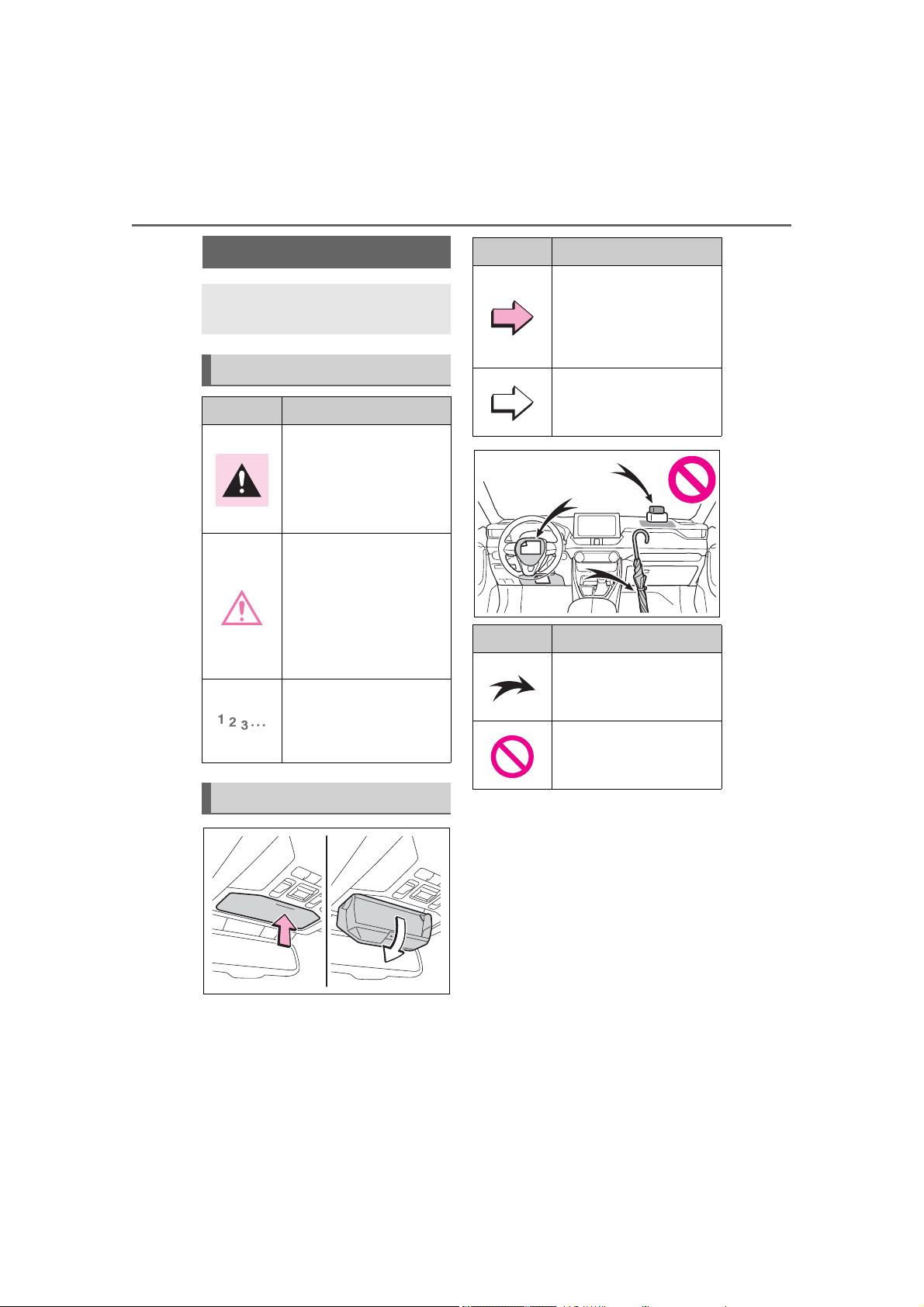
Explains symbols used in
this manual
Symbols in this manual
Symbols Meanings
WARNING:
Explains something
that, if not obeyed,
could cause death or
serious injury to people.
NOTICE:
Explains something
that, if not obeyed,
could cause damage to
or a malfunction in the
vehicle or its equipment.
Indicates operating or
working procedures.
Follow the steps in
numerical order.
Symbols in illustrations
Symbols Meanings
Indicates the action
(pushing, turning, etc.)
used to operate
switches and other
devices.
Indicates the outcome
of an operation (e.g. a
lid opens).
Symbols Meanings
Indicates the component or position being
explained.
Means Do not, Do not
do this, or Do not let
this happen.

14
How to search
■ Searching by name
Alphabetical index: P.725
■ Searching by installation
position
Pictorial index: P. 1 6
■ Searching by title
Table of contents: P. 2
■ Searching by symptom or
sound
What to do if… (Troubleshoot-
ing): P. 7 22

15
16
Pictorial index
Pictorial index
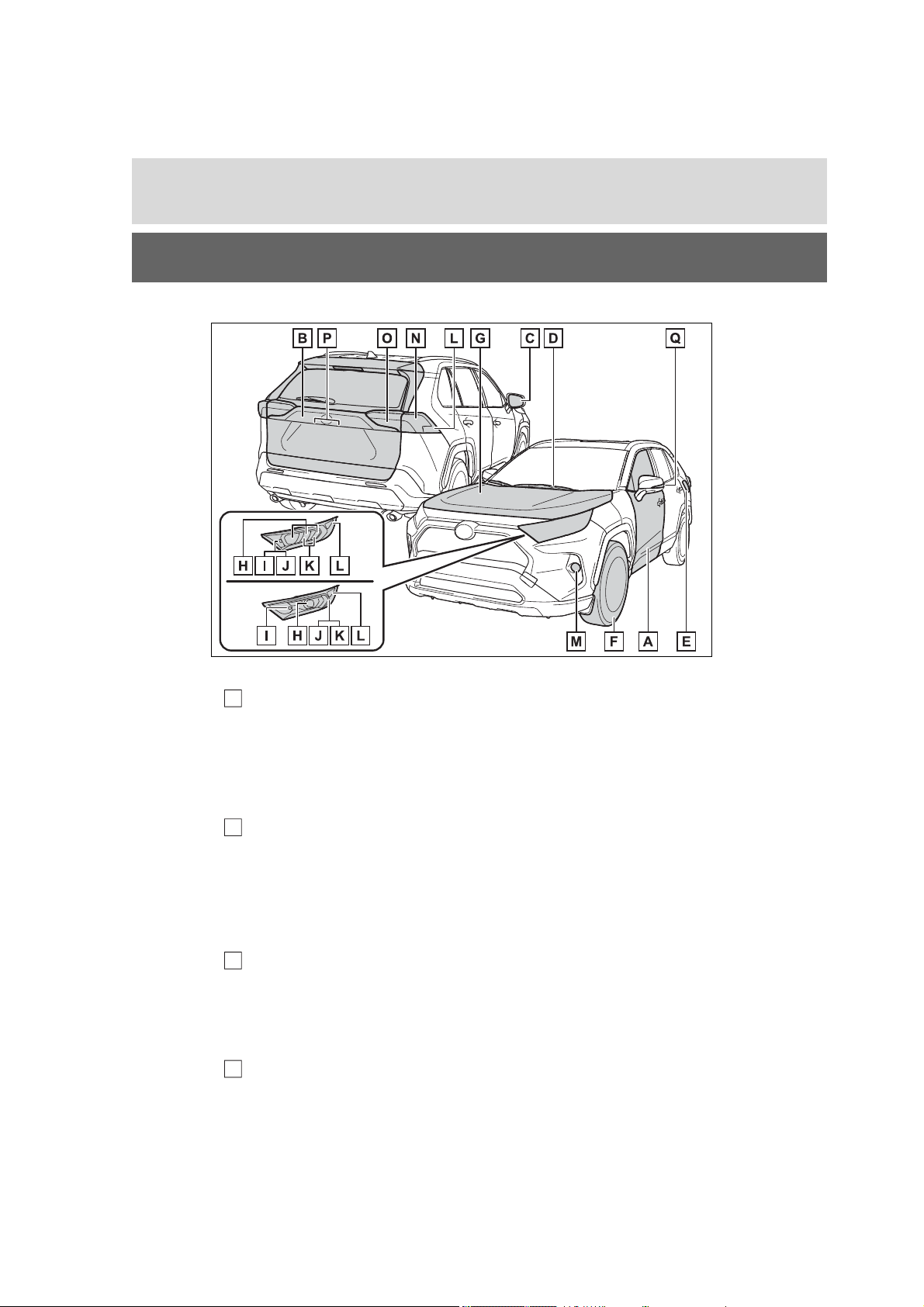
■Exterior
The shape of the headlights may differ depending on the grade, etc.
A
Side doors ……………………………………………………………….. P.128
Locking/unlocking ………………………………………………………. P.128
Opening/closing the side windows………………………………… P.176
Locking/unlocking by using the mechanical key ……….P.129, 663
Warning messages …………………………………………………….. P.647
B
Back door ………………………………………………………………… P.134
Locking/unlocking ………………………………………………………. P.135
Opening from inside the cabin
Opening from outside…………………………………………… P.136, 138
Warning messages …………………………………………………….. P.647
C
Outside rear view mirrors …………………………………………. P.174
Adjusting the mirror angle ……………………………………………. P.174
Folding the mirrors ……………………………………………………… P.174
Defogging the mirrors
D
Windshield wipers…………………………………………………….. P.235
*
………………………………………………… P.522
*
…………………………………….. P.138

Pictorial index
Precautions against winter season ……………………………….. P.377
To prevent freezing (windshield wiper de-icer)
*
……………….. P.525
Precautions against car wash
(Rain-sensing windshield wipers)
*
………………………………… P.563
Replacing the wiper insert …………………………………………… P.610
E
Fuel filler door ………………………………………………………….. P.240
Refueling method……………………………………………………….. P.240
Fuel type/fuel tank capacity …………………………………………. P.677
F
Tires…………………………………………………………………………. P.586
Tire size/inflation pressure …………………………………………… P.681
Winter tires/tire chain ………………………………………………….. P.377
Checking/rotation/tire pressure warning system
*
…………….. P.586
Coping with flat tires……………………………………………………. P.651
G
Hood………………………………………………………………………… P.575
Opening ……………………………………………………………………. P.575
Engine oil ………………………………………………………………….. P.678
Coping with overheat ………………………………………………….. P.670
Warning messages …………………………………………………….. P.647
17
Light bulbs of the exterior lights for driving
(Replacing method: P.618, Watts: P.684)
H
Headlights………………………………………………………………… P.229
I
Turn signal lights ……………………………………………………… P.223
J
Parking lights …………………………………………………………… P.229
K
Daytime running lights ……………………………………………… P.229
Side marker lights…………………………………………………….. P.229
M
Fog lights
*
………………………………………………………………… P.235
Stop lights/tail lights/turn signal lights……………….. P.223, 229
O
Tail lights………………………………………………………………….. P.229
Back-up lights

18
Shifting the shift lever to R …………………………………………… P.219
P
License plate lights…………………………………………………… P.229
Q
Side turn signal lights
*
: If equipped
Pictorial index
*
……………………………………………… P.223
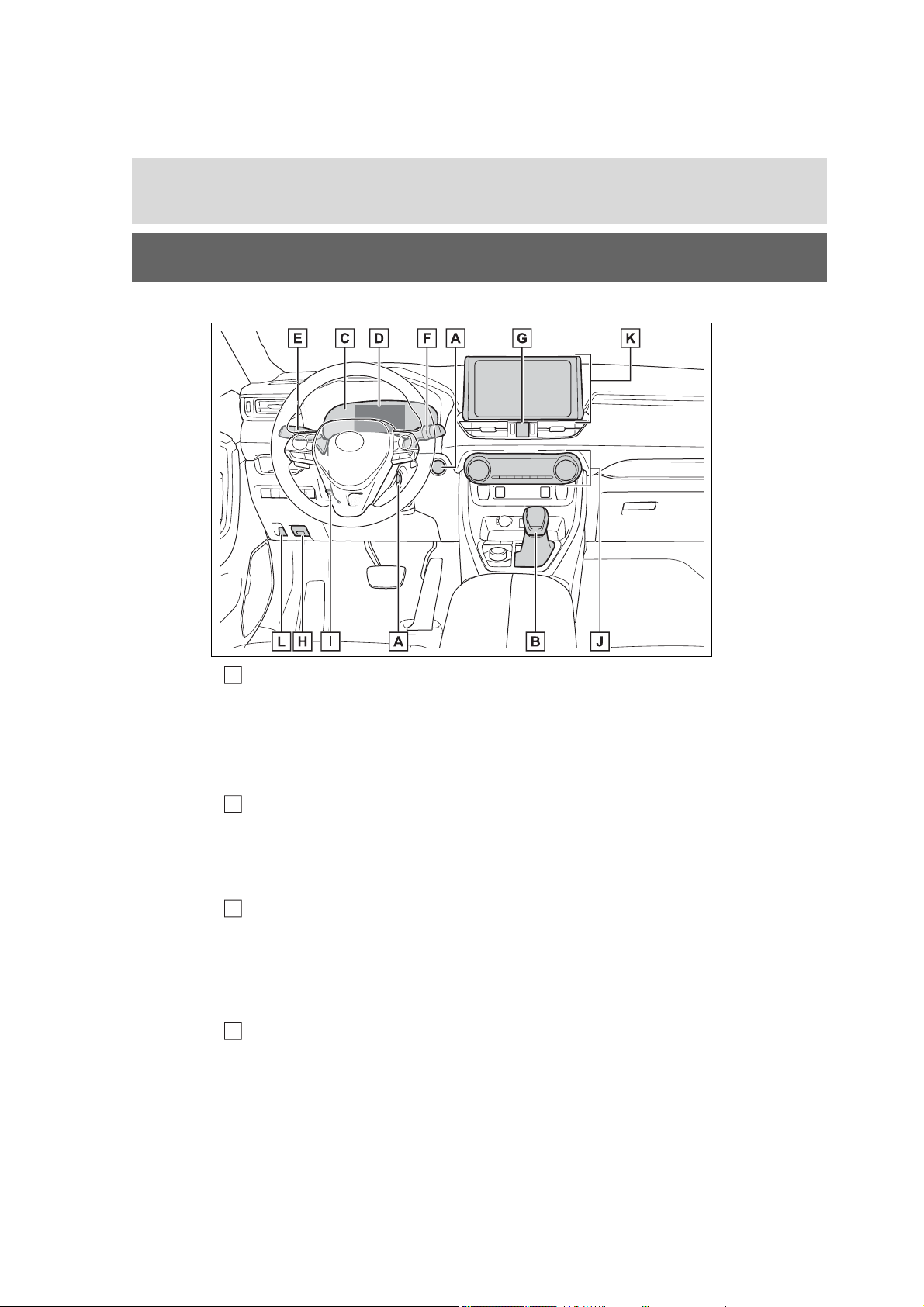
■Instrument panel
Pictorial index
19
A
Power switch …………………………………………………….. P.210, 212
Starting the hybrid system/changing the modes.. P.210, 212, 216
Emergency stop of the hybrid system……………………………. P.629
When the hybrid system will not start ……………………………. P.660
Warning messages …………………………………………………….. P.647
B
Shift lever…………………………………………………………………. P.219
Changing the shift position…………………………………………… P.220
Precautions against towing ………………………………………….. P.631
When the shift lever does not move………………………………. P.221
C
Meters ………………………………………………………………….. P.94, 98
Reading the meters/adjusting the instrument panel light
………………………………………………………………… P.94, 96, 98, 102
Warning lights/indicator lights ………………………………………… P.88
When the warning lights come on…………………………………. P.636
D
Multi-information display ………………………………………….. P.103
Display ……………………………………………………………………… P.103

20
Pictorial index
Energy monitor…………………………………………………………… P.113
When the warning messages are displayed …………………… P. 6 47
E
Turn signal lever……………………………………………………….. P.223
Headlight switch ………………………………………………………. P.229
Headlights/parking lights/tail lights/
license plate lights/daytime running lights………………………. P.229
Fog lights
F
Windshield wiper and washer switch…………………………. P.235
*1
………………………………………………………………… P.235
Rear window wiper and washer switch ……………………… P.238
Usage………………………………………………………………… P.235, 238
Adding washer fluid…………………………………………………….. P.583
Warning messages …………………………………………………….. P.647
G
Emergency flasher switch…………………………………………. P.628
Hood lock release lever…………………………………………….. P.575
I
Tilt and telescopic steering lock release lever……………. P. 1 62
Adjustment ………………………………………………………………… P.162
J
Air conditioning system ……………………………………………. P.520
Usage……………………………………………………………………….. P.520
Rear window defogger ………………………………………………… P.522
K
L
*1
:If equipped
*2
:Refer to “NAVIGATION AND MULTIMEDIA SYSTEM OWNER’S MAN-
*1
Audio
Audio Plus
Premium Audio
…………………………………………………………………….. P.385
*1, 2
*1, 2
Fuel filler door opener switch ……………………………………. P.241
UAL”.
Pictorial index
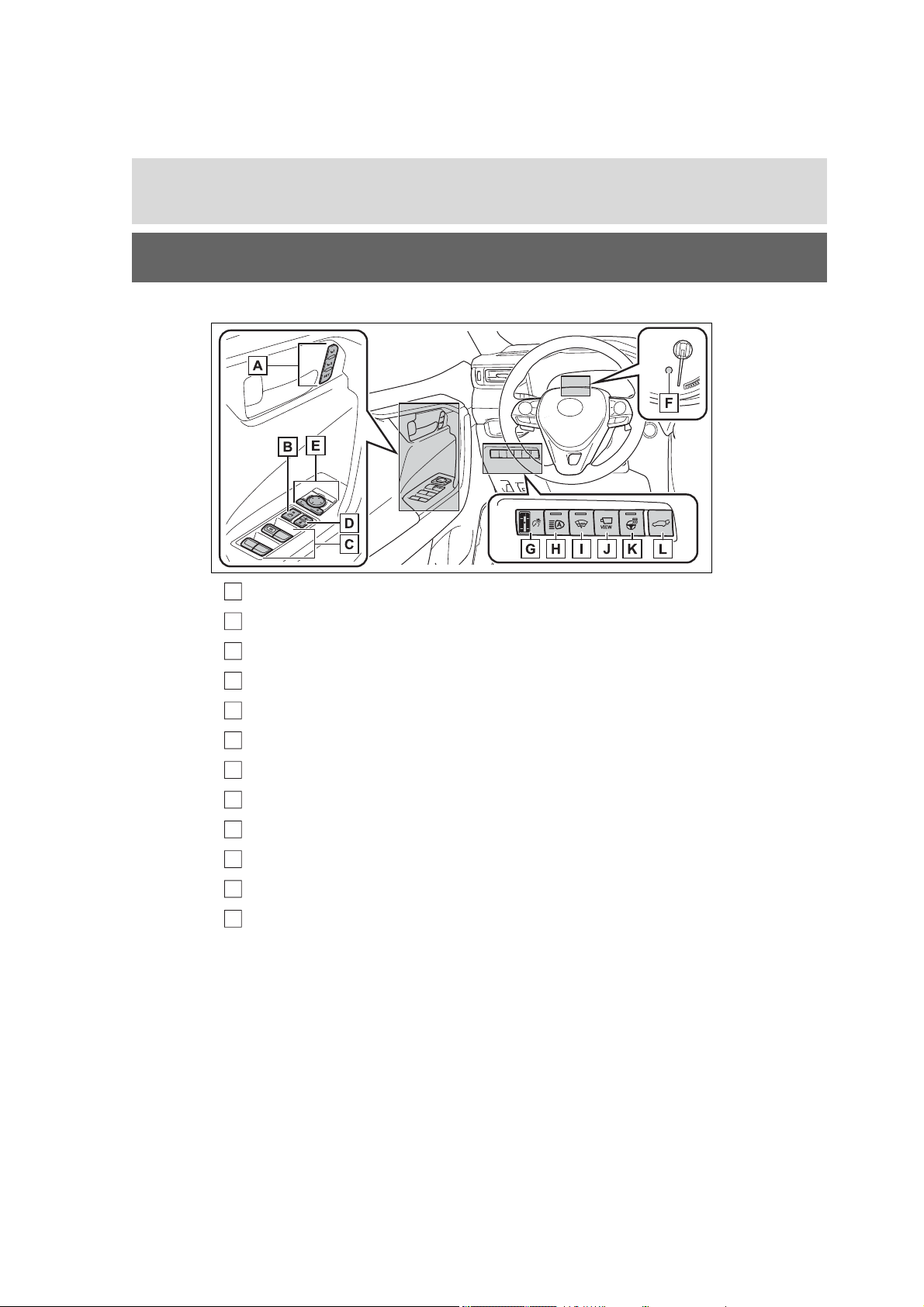
■Switches
A
Driving position memory switches*…………………………… P.157
B
Window lock switch ………………………………………………….. P.178
C
Power window switches……………………………………………. P.176
21
D
Door lock switches …………………………………………………… P.132
E
Outside rear view mirror switches …………………………….. P.174
“ODO TRIP” switch ……………………………………………… P.96, 101
G
Instrument panel light control dial ……………………….. P.96, 102
H
Automatic High Beam switch ……………………………………. P.232
I
Windshield wiper de-icer switch
J
Camera switch
K
Heated steering wheel switch
L
Power back door switch
*
: If equipped
*
………………………………. P.525
*
…………………………………………………………. P.335
*
…………………………………… P.527
*
…………………………………………… P.138
22
Pictorial index
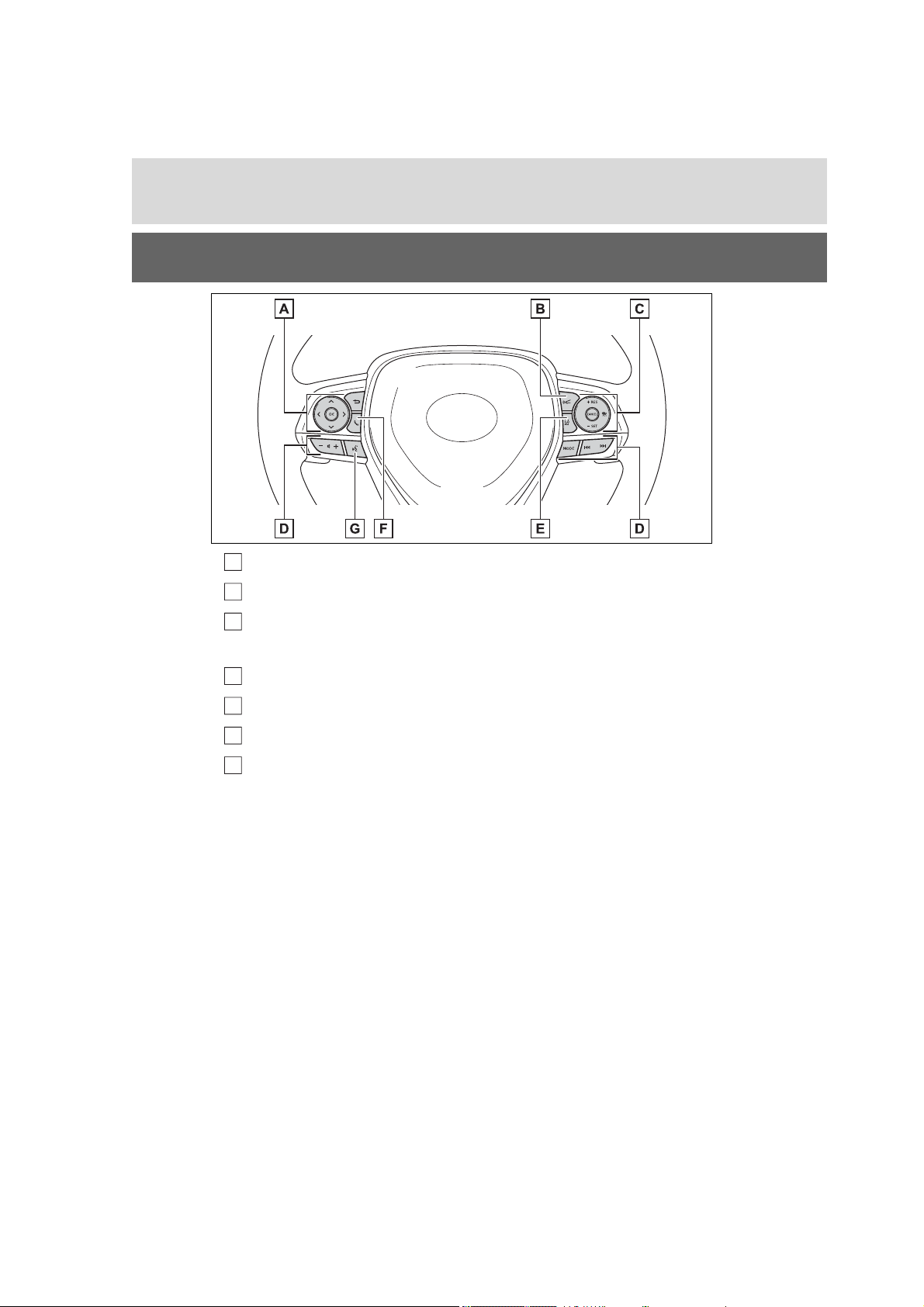
A
Meter control switches ……………………………………………… P.104
Vehicle-to-vehicle distance switch…………………………….. P.275
C
Cruise control switches
Dynamic radar cruise control with full-speed range …………. P.2 7 0
D
Audio remote control switches
*
………………………………… P.452
E
LTA (Lane Tracing Assist) switch ………………………………. P.257
*
Phone switch
G
Talk switch
*
: Vehicles with Audio Plus or Premium Audio, refer to “NAVIGATION AND
…………………………………………………………… P.478
*
………………………………………………………………. P.468
MULTIMEDIA SYSTEM OWNER’S MANUAL”.
Pictorial index
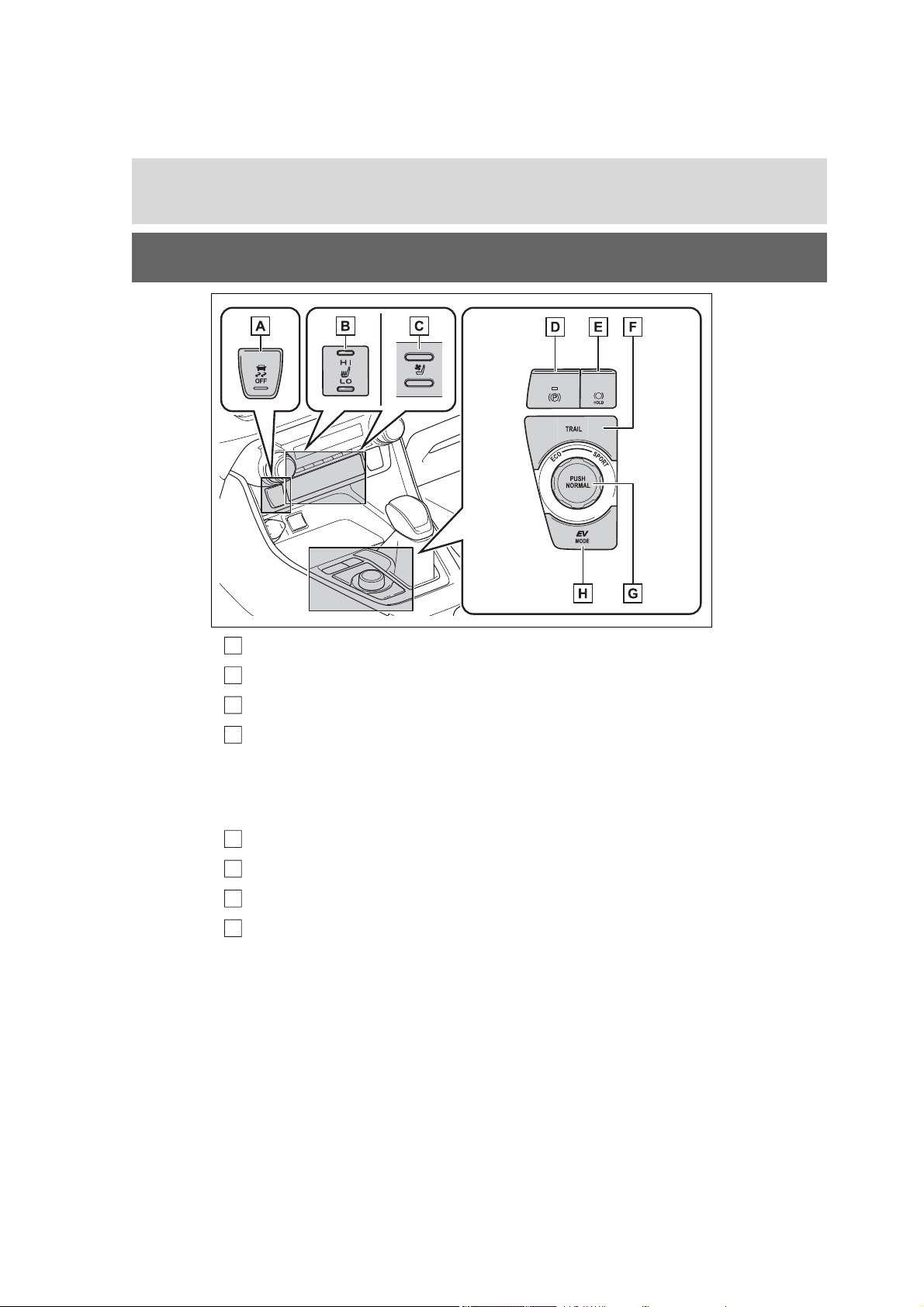
A
VSC OFF switch ……………………………………………………….. P.369
B
Front seat heater switches
C
Front seat heater/seat ventilator switches
*
……………………………………….. P.527
*
………………… P.528
23
D
Parking brake switch ………………………………………………… P.224
Applying/releasing………………………………………………………. P.224
Precautions against winter season ……………………………….. P.378
Warning buzzer/message …………………………………….. P.642, 647
E
Brake hold switch …………………………………………………….. P.227
Trail Mode switch ……………………………………………………… P.366
G
Driving mode select switch……………………………………….. P.365
H
EV drive mode switch ……………………………………………….. P.217
*
: If equipped
24
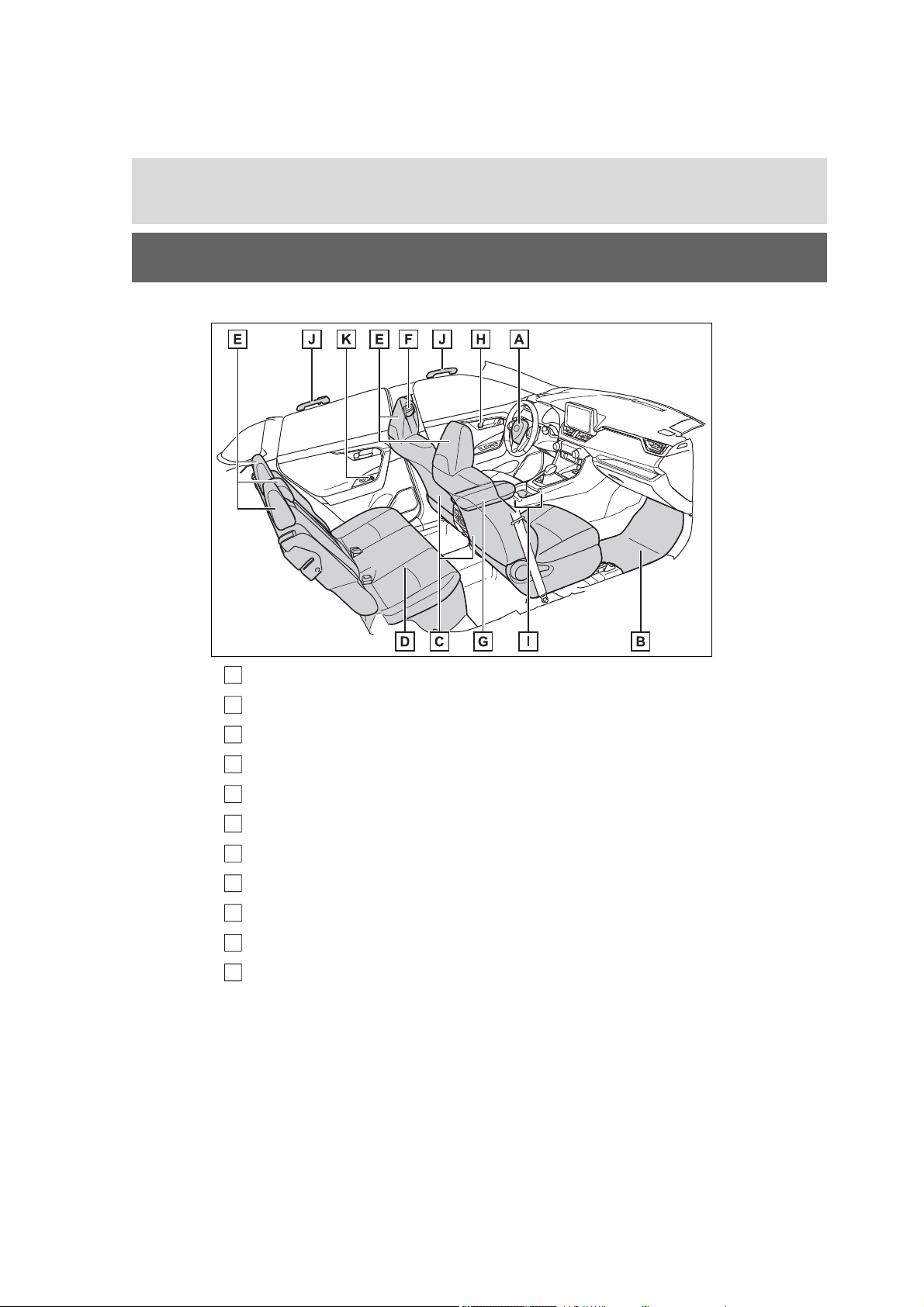
■Interior
Pictorial index
A
SRS airbags……………………………………………………………….. P.35
B
Floor mats………………………………………………………………….. P.28
Front seats……………………………………………………………….. P.154
D
Rear seats………………………………………………………………… P.155
E
Head restraints…………………………………………………………. P.160
F
Seat belts …………………………………………………………………… P.31
G
Console box …………………………………………………………….. P.534
H
Inside lock buttons …………………………………………………… P.132
I
Cup holders ……………………………………………………………… P.534
Assist grips ……………………………………………………………… P.551
K
Rear seat heater switches
*
: If equipped
*
………………………………………… P.527
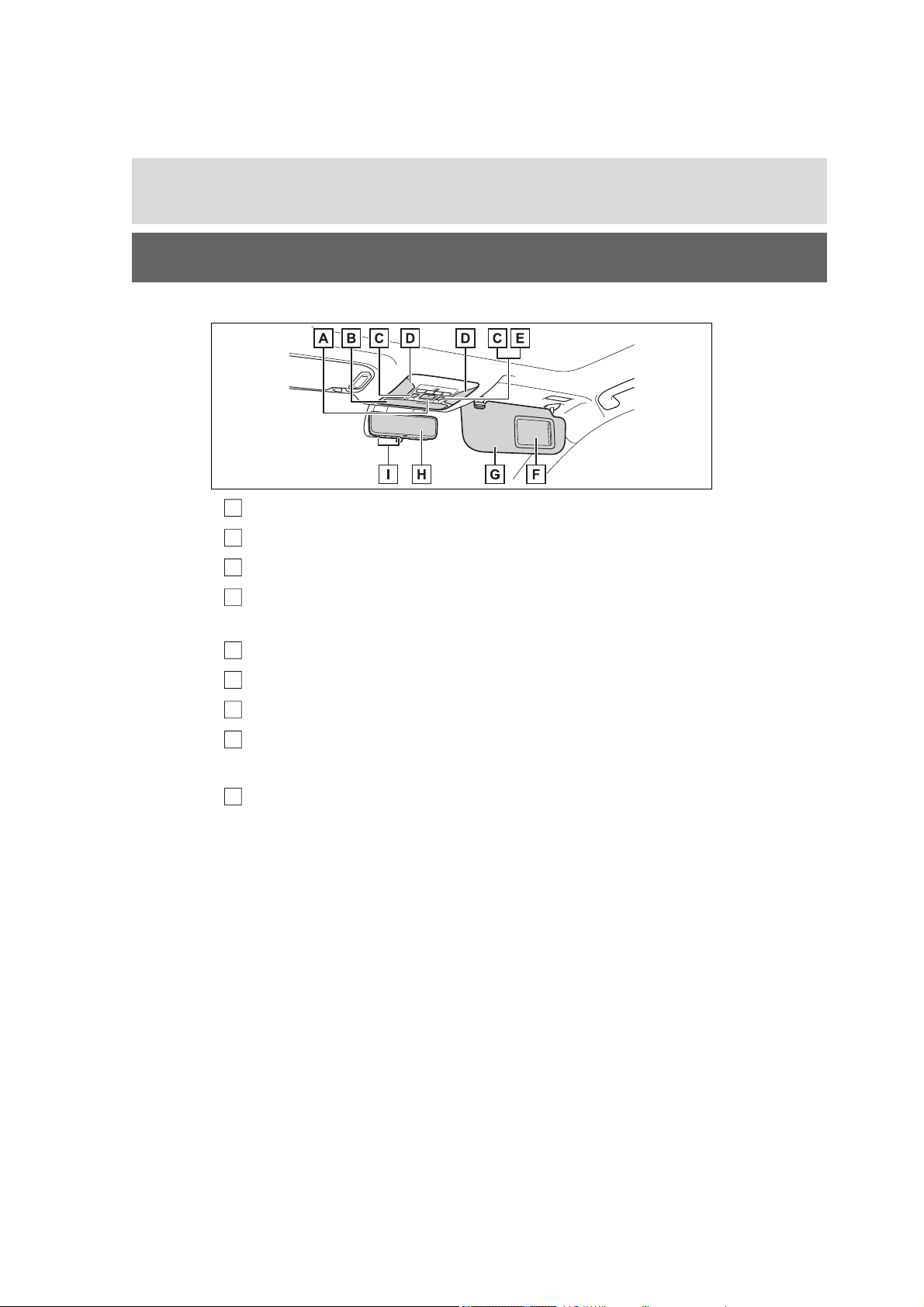
Pictorial index
■Ceiling
A
“SOS” button*1…………………………………………………………… P.67
Auxiliary box ……………………………………………………………. P.535
C
Moon roof switches
D
Interior lights
Personal lights …………………………………………………………. P.531
E
Electronic sunshade switch
*1
………………………………………………… P.179
*2
…………………………………………………………. P.530
*1
……………………………………. P.182
25
F
Vanity mirrors…………………………………………………………… P.542
G
Sun visors………………………………………………………………… P.542
H
Inside rear view mirror
Digital Rear-view Mirror
I
Garage door opener switches
*1
:If equipped
*2
:The illustration shows the front, but they are also equipped in the rear.
*1
……………………………………………. P.163
*1
………………………………………….. P.165
*1
…………………………………. P.552

26
Pictorial index

27
For safety and security
1-1. For safe use
Before driving……………..28
For safe driving …………..29
Seat belts…………………..31
SRS airbags……………….35
Front passenger occupant
classification system ….45
Exhaust gas precautions 50
1-2. Child safety
Riding with children……..51
Child restraint systems…52
1-3. Emergency assistance
Safety Connect …………..67
1-4. Hybrid system
Hybrid system features ..72
Hybrid system precautions
……………………………….77
1-5. Theft deterrent system
Immobilizer system ……..82
Alarm…………………………85
1
1
For safety and security
28
1-1.For safe use
1-1. For safe use
Before driving
Observe the following
before starting off in the
vehicle to ensure safety of
driving.
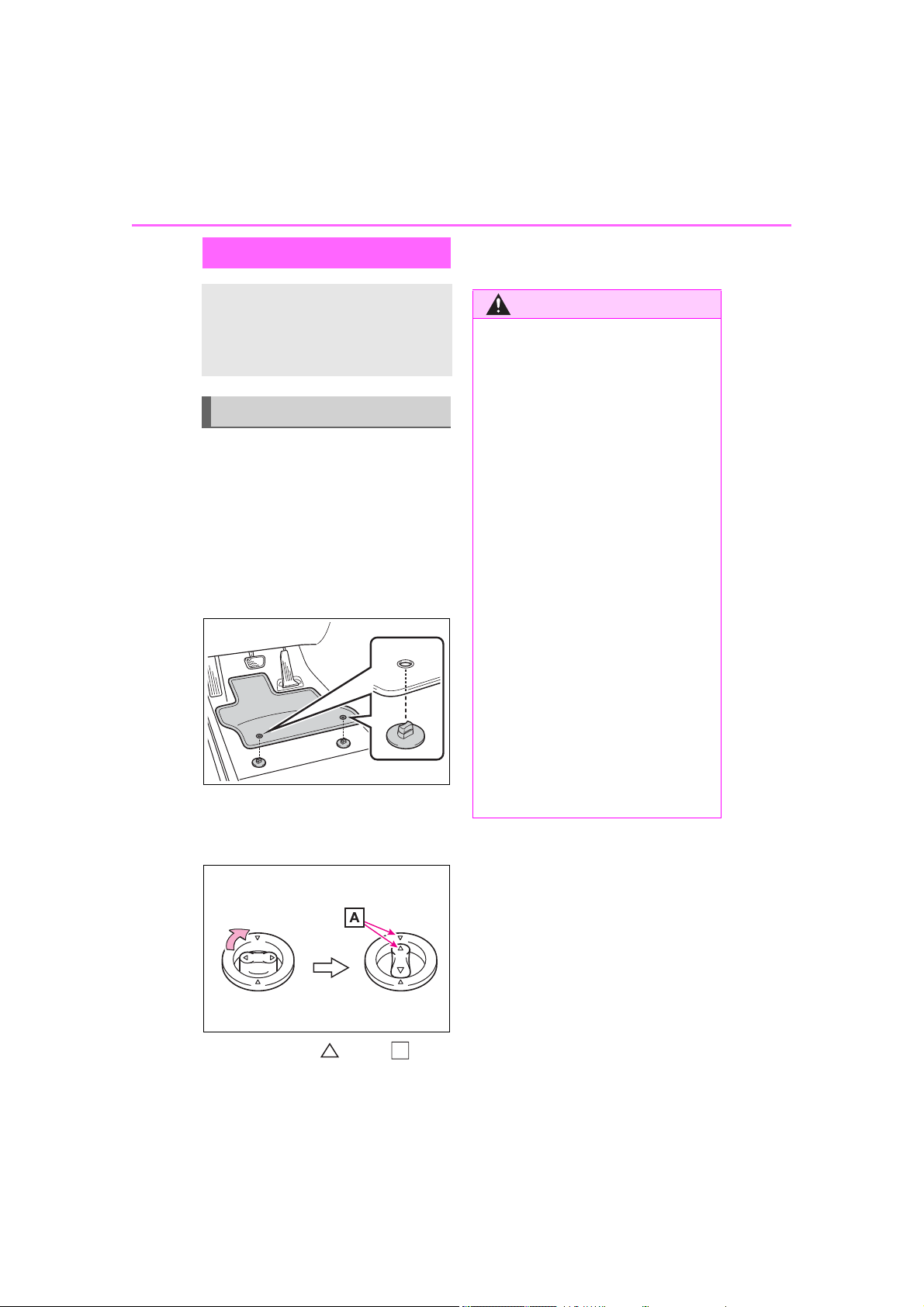
Installing floor mats
Use only floor mats designed
specifically for vehicles of the
same model and model year as
your vehicle. Fix them securely
in place onto the carpet.
1 Insert the retaining hooks
(clips) into the floor mat eyelets.
The shape of the retaining hooks
(clips) may differ from that shown in
the illustration.
Observe the following precautions.
Failure to do so may cause the
driver’s floor mat to slip, possibly
interfering with the pedals while
driving. An unexpectedly high
speed may result or it may
become difficult to stop the vehicle. This could lead to an accident, resulting in death or serious
injury.
■ When installing the driver’s
floor mat
● Do not use floor mats designed
for other models or different
model year vehicles, even if
they are Toyota Genuine floor
mats.
● Only use floor mats designed
for the driver’s seat.
2 Turn the upper knob of each
retaining hook (clip) to secure
the floor mats in place.
Always align the marks .
● Always install the floor mat
securely using the retaining
hooks (clips) provided.
● Do not use two or more floor
mats on top of each other.
● Do not place the floor mat bot-
tom-side up or upside-down.
■ Before driving
● Check that the floor mat is
securely fixed in the correct
place with all the provided
retaining hooks (clips). Be especially careful to perform this
check after cleaning the floor.
1-1. For safe use
For safe driving
For safe driving, adjust the
seat and mirror to an appropriate position before driving.
29
1
● With the hybrid system stopped
and the shift lever in P, fully
depress each pedal to the floor
to make sure it does not interfere with the floor mat.
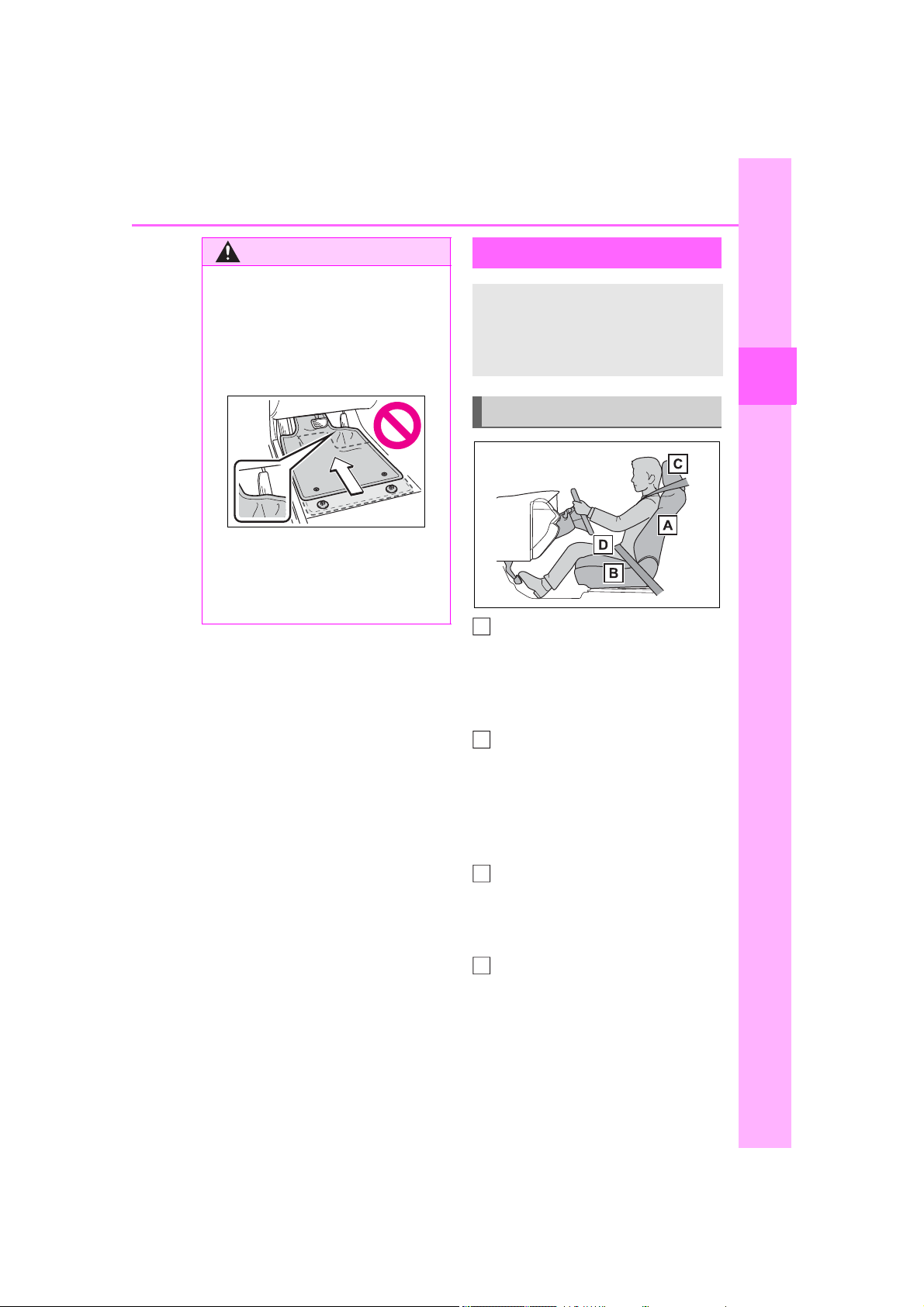
Correct driving posture
Adjust the angle of the seatback so that you are sitting
straight up and so that you do
not have to lean forward to
steer. (P.154)
Adjust the seat so that you
can depress the pedals fully
and so that your arms bend
slightly at the elbow when
gripping the steering wheel.
(P.154)
For safety and security
Lock the head restraint in
place with the center of the
head restraint closest to the
top of your ears. (P.160)
Wear the seat belt correctly.
(P.32)

30
Observe the following precautions.
Failure to do so may result in
death or serious injury.
● Do not adjust the position of the
● Do not place a cushion between
● Do not place anything under the
1-1. For safe use
driver’s seat while driving.
Doing so could cause the driver
to lose control of the vehicle.
the driver or passenger and the
seatback. A cushion may prevent correct posture from being
achieved, and reduce the effectiveness of the seat belt and
head restraint.
front seats.
Objects placed under the front
seats may become jammed in
the seat tracks and stop the
seat from locking in place. This
may lead to an accident and the
adjustment mechanism may
also be damaged.
properly wear the vehicle’s seat
belt. (P.52)
Adjusting the mirrors
Make sure that you can see
backward clearly by adjusting
the inside rear view mirror (if
equipped), Digital Rear-view
Mirror (if equipped) and outside
rear view mirrors properly.
(P.163, 165, 174)
● Always observe the legal speed
limit when driving on public
roads.
● When driving over long dis-
tances, take regular breaks
before you start to feel tired.
Also, if you feel tired or sleepy
while driving, do not force yourself to continue driving and take
a break immediately.
Correct use of the seat
belts
Make sure that all occupants are
wearing their seat belts before
driving the vehicle. (P.32)
Use a child restraint system
appropriate for the child until the
child becomes large enough to
Loading…
A system may be temporarily unavailable or there may be a malfunction in the system. Do not use the pre-collision system instead of normal braking operations under any circumstances. The pre-collision system is enabled and the system determines that the possibility of a frontal collision with a detected object is high.
This function is linked with dynamic radar cruise control with full-speed range and provides the required assistance by operating the steering wheel to keep the vehicle in its current lane. The illumination condition of the indicator informs the driver of the system operation status. Using the driving support systems tance of the steering assist function or lane centering function is operating.
Displayed when the multi-information display is switched to the driving support system information display. Indicates that steering assist of the lane centering function is operating by monitoring the position of a preceding vehicle. This function operates when all of the following conditions are met in addition to the operation conditions for the lane departure alert function.