
View the manual for the Pfaff performance 2058 here, for free. This user manual comes under the category sewing machines and has been rated by 2 people with an average of a 7.9. This manual is available in the following languages: English. Do you have a question about the Pfaff performance 2058?
Ask your question here
Frequently asked questions
Can’t find the answer to your question in the manual? You may find the answer to your question in the FAQs about the Pfaff performance 2058 below.
What size needle should I use?
Which size of needle you can best use depends on the thickness of the fabric you use. With a thick fabric you should use a thick needle. The packaging of your needle states for which substances your needle is suitable.
Why does the needle break while sewing?
There can be several causes for needle breakage:
— Not using the right needle for the right fabric
— The needle is set too low
— The fabric is not properly guided
— The bobbin case is not inserted correctly
How long does a sewing needle last?
Generally, a sewing needle lasts about 7 to 9 hours.
Is the manual of the Pfaff performance 2058 available in English?
Yes, the manual of the Pfaff performance 2058 is available in English .
Is your question not listed? Ask your question here
×
Сейчас вы находитесь в городе Москва
Выберите город, в который Вы хотите осуществить доставку
Доставка в
город Москва
: 25 июня
Основные характеристики
Местонахождение
Chicago, US
Инструкции по эксплуатации PFAFF Performance 2058 Цветная КОПИЯ Руководства пользователя — купить с доставкой в Россию и СНГ
Инструкции по эксплуатации PFAFF Performance 2058 Цветная КОПИЯ Руководства пользователя можно купить в нашем интернет-магазине с доставкой из Chicago, US в Россию и страны СНГ по цене 3690 руб.
Все товары из
категории «Руководства и инструкции» доставляются в соответствии с обозначенными правилами в разделе «Доставка».
Если у вас возникли вопросы по товару, оплате, гарантии или доставке до вашего населённого пункта — Закажите обратный звонок!.
Приобретая товар «PFAFF Performance 2058 Instructions User Guide Manual COLOR COPY» через SHOPOZZ, вы можете быть уверенны в том, что получите качественный продукт, предназначенный для продажи в Chicago, US.
Смотрите нас на
Секретные промокоды и доступы к зарубежным распродажам в нашей полезной рассылке
Вы успешно подписаны на рассылку!
-
Страница 1
The real passion for sewing! Owner’s manual[…]
-
Страница 2
This household sewing machine is designed to comply with IEC/EN 60335-2-28 and UL1594 IMPORT ANT SAFETY INS TRUCTIONS When using an electrical appliance, basic safety precautions should always be followed, including the following: Read all instructions before using this household sewing machine. D ANGER — T o reduce the risk of electric shock: • […]
-
Страница 3
Congr atulations! Congratulations on purchasing your new PFAFF® performance ™ 2058! Pfaff performance 2058 is the perfect companion for those who love to sew. It’s ease of use and unlimited features will free your creative engergies and turn your ideas into reality. Before you start, please spend some time reading these operating instructions.[…]
-
Страница 4
1:4 T able of content 1 2 3 4 Introduction Overview of your machine 1:9 Standard pr esser feet and accessories 1:10 Stitch chart 1:12 Lid 1:17 Carrying case 1:17 Sewing with free arm 1:17 Accessory tray 1:18 Prepar ations V oltage switch 2:2 Electrical connection 2:2 Connecting the foot control 2: 2 On/off switch 2:2 Presser foot lift 2:3 Changing […]
-
Страница 5
1:5 5 6 7 8 Decor ative sewing General notes on decor ative sewing 5:2 Combined borders 5:2 T win needle sewing 5:3 Cross stitch 5:3 T apering 5:4 Quilting 5:5 Free-motion sewing 5:9 Nostalgia/Heirloom 5:10 Stitch sequences Stitch sequences 6:2 Creating a new stitch sequence 6: 3 Altering the settings of a selected stitch 6:4 Editing a stitch seque[…]
-
Страница 6
1:6 Some fabrics have a lot of excess dye which can cause discoloration on other fabric but also on your sewing machine. This discoloring may be very dif fi cult or impossible to remove. Fleece and denim fabric, especially red and blue, often contain a lot of excess dye. If you suspect that your fabric/ready-to-wear garment contains a lot of exces[…]
-
Страница 7
Intr oduction[…]
-
Страница 8
1 2 3 4 5 6 7 8 9 10 11 12 13 14 15 16 17 18 19 20 21 22 23 24 25 26 27 28 29 30 31 33 32 34 35 36 37 1:8[…]
-
Страница 9
1:9 Introduction Overview of your machine 1. Pattern restart button 2. Sew slow button 3. Needle up/down button 4. Scroll buttons 5. Function fi eld buttons 6. Main menu button 7. Selection by number button 8. More options button 9. Info button/Context menu 10. Reverse sewing button 11. Touch screen 12. Handle 13. Handwheel 14. Connection socket, […]
-
Страница 10
1:10 Standard pr esser feet and accessories Rolled hem foot 3 mm with IDT, No. 7 Darning foot, No. 6 Blindhem and overlock foot with IDT, No. 3 Standard presser foot with IDT, No. 0A (attached on the machine upon delivery) Fancy stitch foot with IDT, No. 1A Fancy stitch foot, No. 2A Zipper foot with IDT, No. 4 Buttonhole foot, No. 5A[…]
-
Страница 11
1. 2. 3. 4. 5. 6. 10. 9. 8. 7. 1:11 Introduction Sensormatic buttonhole guide, No. 10 Edge guide Bulb remover/Needle plate changer 1. Bobbins 2. Spool cap medium (attached on the machine upon delivery) 3. Spool cap small 4. Spool cap large 5. Needle box 6. Felt pad 7. Stylus 8. Second spool holder 9. Seam ripper 10. Brush[…]
-
Страница 12
1:12 Stitch chart Stitch Description Application Utility stitches 1. Straight stitch with 19 needle positions For all straight stitch and topstitching jobs. Stitch length can be increased up to 6mm. 19 needle positions are available, for edge fi nishing or sewing in zippers. 2. Stretch triple straight stitch with 19 needle positions For reinforced[…]
-
Страница 13
1:13 Introduction 16. Elastic blindhem stitch For securing hems invisibly and fi nishing the edge on stretch fabrics. 17. Basting stitch For basting project pieces together. 19 needle positions are available. 18. Lightning stretch stitch For joining light weight stretch fabrics and decorative embellishment. Overlock stitches 30. Closed overlock st[…]
-
Страница 14
1:14 Buttonholes 53. Cross stitch buttonhole Decorative buttonhole for jackets and for embellishing other garments. 54. Eyelet buttonhole with pointed bartack Professional tailor’s buttonhole for denim jackets and trousers. 55. Rounded buttonhole with lengthwise tack Buttonhole for shirts, jackets and trousers. 56. Professional eyelet buttonhole […]
-
Страница 15
80 81 82 83 84 85 86 87 88 89 90 91 92 93 94 95 96 100 101 102 103 104 105 106 107 108 109 110 111 112 113 114 115 116 117 118 119 130 131 132 133 134 135 136 137 138 139 140 141 142 143 144 145 146 147 148 149 160 161 162 163 164 165 166 167 168 169 170 171 172 173 174 190 191 192 193 194 195 196 197 198 199 200 201 202 203 204 205 206 220 221 222[…]
-
Страница 16
240 241 242 243 244 245 246 247 248 249 250 251 252 253 254 255 256 257 258 259 260 261 262 263 264 265 266 267 268 269 270 271 272 273 274 275 276 277 278 279 290 291 292 293 294 295 296 297 298 299 300 301 302 303 304 305 306 307 308 309 310 311 312 313 314 315 316 317 318 319 330 331 332 333 334 335 336 337 338 339 340 341 342 343 1:16 Art stitc[…]
-
Страница 17
1:17 Introduction Lid Lift the lid to open. All stitches are displayed on the inside of the lid. Sewing with free arm In order to sew using the free arm, swing the accessory tray to the left and lift it up out of the hole. When replacing the accessory tray, insert the pin into the hole and swing the tray to the right to close until it is fl ush wi[…]
-
Страница 18
1:18 Accessory tr ay Open the accessory tray by placing your left index fi nger on the ridged area to the left side of the lid and pull it towards you. Arra nging the accessories The standard accessory feet are marked with numbers. Arrange the feet in the respective numbered compartments of the accessory tray. Put the remaining accessories in the […]
-
Страница 19
Pr epar ations[…]
-
Страница 20
2:2 V oltage switch 220V — 240V / 120V The sewing machine is set to the voltage 220 V — 240 V. To change the voltage to 120 V (US/Canada), you must set the voltage switch on the underside of the machine to 120 V. If you are unsure of the correct voltage for your country, please check with your authorized Pfaff dealer before plugging in your machine[…]
-
Страница 21
2:3 Prepar ations Changing the presser foot Turn off the on/off switch Snap off the presser foot Press the front part of the presser foot up and, at the same time the rear part down until it disengages from the presser foot holder. Presser foot lift The presser foot is raised manually by swinging the presser foot lift up to the right. It is lowered[…]
-
Страница 22
2:4 The ID T (Integr ated Dual F eed) For sewing any fabric precisely Pfaff provides the ideal solution: the Integrated Dual Feed, IDT system. As on industrial machines, the IDT feeds the fabric from the top and bottom at the same time at the same stitch length. The fabric is fed precisely. On light fabrics such as silk or rayon the dual feed preve[…]
-
Страница 23
2:5 A B A B Prepar ations Lowering the feed dogs For certain sewing work such as free-motion quilting, embroidery or darning, the feed dogs must be lowered. On your sewing machine there are two different methods for lowering the feed dogs, one on the outside of the machine and one inside the bobbin door. For either method: Raise the presser foot be[…]
-
Страница 24
2:6 C Bobbin winding Preparing the machine for bobbin winding Place an empty blue bobbin on the bobbin winder aligning the small rectangular hole on the bottom side of the bobbin with the small white pin of the bobbin winder. The Pfaff logo is facing up. Push the bobbin to the right. Note : The bobbin can only be wound if it is moved fully to the r[…]
-
Страница 25
2:7 A B Prepar ations Threading Place the thread into guide A from front to back and pull it counter- clockwise ABOVE the pre-tension disc B. Pull the thread under the thread guide C from back to front (see page 2:6). Wind the thread tail around the bobbin several times in a clockwise direction. Winding Turn on the machine. Hold the end of the thre[…]
-
Страница 26
2:8 D C Winding the bobbin through the needle It is possible to wind the bobbin even when the machine is threaded. Raise the presser foot to the up position. Pull the needle thread underneath the presser foot and up through the right-hand threading slot. Pull the thread under the thread guide C (from back to front). Place an empty blue bobbin on th[…]
-
Страница 27
2:9 A B Prepar ations Inserting the bobbin and bobbin case Turn off the on/off switch Swing away the accessory tray to see the bobbin door. Open it by pulling it towards you. Lift the latch of the bobbin case and pull the bobbin case out of the machine. Release the latch and take the empty bobbin out of the bobbin case. Inserting the bobbin case Li[…]
-
Страница 28
2:10 A B D F C E Threading your machine Turn off the on/off switch Raise the presser foot. Place the thread on the spool pin and fi t a spool cap, either the same size or slightly larger than the spool, on top of the spool. Using both hands, pull the thread into thread guide A from the front. Place the thread from the right underneath the pre-tens[…]
-
Страница 29
2:11 F E Prepar ations Integr ated needle threader In order to make threading the needle easier and quicker, use the Pfaff Integrated needle threader. Lower the presser foot. Pull the threader lever straight down with the handle. Reduce the pressure so the needle threader slowly moves upwards. At the same time the threader hook swivels out of the n[…]
-
Страница 30
2:12 Bringing up the bobbin thread Raise the presser foot. While holding the end of the needle thread, press the foot control so the needle moves down and up one time. Pull the needle thread to draw up the bobbin thread. Thread cutter Pull the threads from the back to the front over the thread cutter. Close the bobbin door and pull the top and bobb[…]
-
Страница 31
2:13 C Prepar ations Changing the needle Turn off the on/off switch To remove: Lower the presser foot and set the needle to its highest position. Loosen the needle screw and pull down on the needle to remove. To insert: The fl at side of the needle must face to the rear. Keep the presser foot down and insert the needle, pushing it up as far as it […]
-
Страница 32
2:14 Correct thr ead tension — How to get it Set the required amount of the needle thread tension using the markings on the tension dial. The normal thread tension for sewing is 4 — 5. For decorative stitches, darning or sewing buttonholes, the normal setting should be 3. The information system of your sewing machine gives you recommendations on th[…]
-
Страница 33
2:15 Prepar ations Electronic knee lift Your sewing machine comes with an electronic knee lift for regulating the presser foot height. It is useful when you need both of your hands to guide the fabric. 1. Push the knee lift, with the fl at side facing up, into the hole on the front baseplate of your machine. 2. Adjust the rectangular bar on the kn[…]
-
Страница 34
[…]
-
Страница 35
Oper ating your performance 2058[…]
-
Страница 36
1 4 3 2 5 6 7 8 9 3:2 Oper ating your machine Your sewing machine is easily operated by using the touch screen and the function buttons, located on the front of your machine. When you turn on your machine a welcome text appears on the display. Touch the screen to enter the main menu. The machine is now ready to sew and you can start selecting stitc[…]
-
Страница 37
3:3 Operating your performance 2058 Note: The needle height can also change with a short tapping on the foot-control. 4. Scroll buttons These buttons have following functions: • In the selection menu: Scroll through stitches and sequences by column or page. • In the sewing menu: Select the next or the previous stitch in numerical order. • In […]
-
Страница 38
6 3:4 Main menu When you have turned on your machine and touched the welcome screen the main menu appears. From here you enter the selection menus to select stitches by category or create your own stitches and stitch sequences. When you touch any of the icons on the screen new windows are opened for each menu. You can always go back to the main men[…]
-
Страница 39
3:5 Operating your performance 2058 Decorative stitches This menu includes a selection of decorative stitches suitable for embellishing garments or items for the home. They are sub-divided into eight different categories for ease of selection. • Hemstitches. Stitches 130-139. • Antique hand embroidery stitches. Stitches 140-149. • Scallop edg[…]
-
Страница 40
3:6 Selecting a stitch There are several ways to select a stitch: Selection by category Touch ”Utility stitches” from the main menu. This category contains 18 stitches that are suitable for utility sewing. You can browse one page at a time with the scroll buttons (4) or by touching the scroll bar (A) on the screen. By pressing the scroll button[…]
-
Страница 41
1 2 3 4 1 2 3 5 3:7 Operating your performance 2058 Sewing menu The sewing menu is divided into three sections: 1. Status bar, where the activated sewing functions are shown. The status bar is always active and automatically updated when a function is activated or deactivated. 2. Action fi eld, where the selected stitch is displayed. 3. Function ?[…]
-
Страница 42
3:8 For buttonhole and darning programs. In the darning programs (no. 74-75) the function is automatically activated. Use the reverse button (10) to determine the length of the fi rst seam. The following seams will automatically be sewn in the same length. Finish buttonholes manually. Use the function if the sensormatic buttonhole guide has not be[…]
-
Страница 43
3:9 Operating your performance 2058 the ”man” icon again and a mark will appear. This means the buttonhole is saved and you can repeat the buttonhole in the same size automatically. Touch the ”man” icon once more to deactivate the function. Note: If you fi nd that the buttonhole columns don’t look the same you can change the balance of t[…]
-
Страница 44
3:10 Twin needle safety. With this function, you reduce the width of your stitch in order to use a twin needle. To set the correct needle spacing of your twin needle, long touch the icon until a window appears. Set the needle spacing with the function fi eld buttons (5) and con fi rm by touching the window. The function remains active even after […]
-
Страница 45
3:11 Operating your performance 2058 Conte xt menu In the context menu you can alter the basic settings or functions for the sewing machine. Long touch the info button (9) to open the context menu. Press this button again to close the menu. The menu will also close when a dialogue window has been con fi rmed with ”ok” or ”esc”. If the cont[…]
-
Страница 46
3:12 Calibra tion (Available from main menu) If you touch an icon on the touch screen and it does not respond, or the function next to it is activated instead, the screen needs to be calibrated. Touch ”Calibration” and three circles appear in three of the corners. The circle in the upper left corner is fl ashing. Touch the area inside the fl […]
-
Страница 47
3:13 Operating your performance 2058 Stitch par ameters (Available from sewing menu) The stitch parameter function in your sewing machine lets you store your favorite settings for each stitch. You can adjust a stitch for a speci fi c fabric or application or just save the stitch settings you like to use. You can always go back to default settings […]
-
Страница 48
3:14 Revert to original settings (Available from main and stitch selection menus) This function will revert all custom settings for all stitches to the default settings, without deleting them. If the icon is touched the machine asks if you want to revert the settings. Touch “ok” or “esc” to con fi rm or reject. Note: If you revert to origi[…]
-
Страница 49
3:15 Operating your performance 2058 Info system Your sewing machine has an info system function to help you using the machine. The function can be called up at any time by pressing the info button (9). The info system includes instructions on preparing the machine for sewing, information on using the sewing functions and recommendations regarding […]
-
Страница 50
3:16 Information in the more options window When you press the info button (9) in the more options window you get information about the different sewing functions. The following functions are described: • Tie-off • Free-motion sewing • Raise presser foot • Single stitch • Twin needle • Patchwork program • Tapering • Straight stitch […]
-
Страница 51
Utility Sewing[…]
-
Страница 52
1 4 3 2 5 6 7 8 9 4:2 Getting started To begin sewing on your new sewing machine, do a straight stitch fi rst. When you turn on your machine a welcome text appears on the display. Tap the foot control and the straight stitch is automatically selected. Take a piece of fabric, fold it and place it under the presser foot. Engage the IDT. Line up the […]
-
Страница 53
4:3 Utility Sewing Str aight stitch — No 1 Stitch no. 1 is the basic straight stitch in center needle position. The stitch length can be increased up to 6mm. Your sewing machine has 19 needle positions that can be adjusted by the needle position icon and function fi eld buttons (5). Change the needle position of the straight stitch to sew in a zip[…]
-
Страница 54
B A 4:4 T opstitching — No 1 The straight stitch can be sewn in 19 different needle positions allowing you to guide the presser foot along the fabric edge for topstitching. The distance between the rows of topstitching is determined by the needle positions. Use the guide marks on the needle plate, or the edge guide to topstitch further from the fab[…]
-
Страница 55
B A 4:5 Utility Sewing Blindhem stitch — No 15 The blindhem stitch is used to make invisible hems on skirts, trousers and home dec projects. • Finish the edge of the hem. • Fold and press the hem allowance to the wrong side. • Fold the hem back on itself so approximately 3/8” (1 cm) of the fi nished edge extends beyond the fold. The wrong […]
-
Страница 56
4:6 Overlock stitches For elastic, knits and stretch fabrics, your sewing machine provides a selection of overlock stitches. These stitches join multiple layers of fabric and overcast them in one operation. These stitches can stretch and are more durable than standard stitches. Closed overlock stitch — No 31 When sewing fabrics that fray easily sel[…]
-
Страница 57
4:7 Utility Sewing Buttonholes There are 12 buttonhole styles built-in to your sewing machine. Each buttonhole is especially adapted for a particular use and fabric type. Your sewing machine is equipped with the sensormatic buttonhole guide and sensor technology to ensure that every buttonhole is sized accurately. Beautiful buttonholes can be sewn […]
-
Страница 58
4:8 Buttonhole with gimp cord Buttonholes that are sewn with gimp cord under the satin stitch columns are more stable, durable and professional looking. Use pearl cotton or regular gimp thread. • Insert the sensormatic buttonhole guide. • Place the center of a length of gimp cord over the metal hook extending from the center back of the buttonh[…]
-
Страница 59
4:9 Utility Sewing • Sew the right side of the buttonhole. • After the machine sews the fi rst few stitches of the curved end pull the gimp cords out of the metal hook with a straight stitch pin. Warning: Do not lift the presser foot from the fabric surface! • Gently pull the gimp cord on the left towards the rear until the loop is just in f[…]
-
Страница 60
4:10 Sewing on buttons — No 60 The Button sewing program no. 60 allows you to sew on two and four hole buttons easily. • Remove the presser foot and lower the feed dogs. (Make sure the IDT is disengaged). • Mark the button position on your fabric. Place the button on the marked fabric. • Turn the handwheel towards you and position the button […]
-
Страница 61
4:11 Utility Sewing Automatic darning — No 74 and 75 Stitches no. 74 and 75 is for strengthening damaged areas of fabric and repairing tears. • Stitch over the damaged area a little longer than your tear. • Press the reverse button (10); the machine fi nishes sewing the darning program and the darning length is saved. The saved darning length […]
-
Страница 62
A B 4:12 Free-motion darning – No 1 and 3 • Remove the standard presser foot. Make sure the needle is at its highest position. Carefully loosen the screw (A) until the cross hole (B) is accessible. Squeeze the darning foot gently together and guide the pin of the foot into the cross hole of the presser foot holder as far as it will go. The blac[…]
-
Страница 63
Decor ative Sewing[…]
-
Страница 64
1 4 3 2 5 6 7 8 9 5:2 Gener al notes on decorative sewing To enhance your own home textiles or garments your sewing machine offers you a wide variety of fancy and decorative stitches. Create a greater variety of embellishments by combining different patterns, colors and sizes. Use specialty decorative threads to enhance the lovely stitching. Always[…]
-
Страница 65
5:3 Decorative Sewing T win needle sewing Decorative effects can be achieved using a twin needle. The picture shows what beautiful borders can be created with just a little imagination! Twin needle sewing is particularly effective if you use decorative sewing threads in matching colors. • Change and thread the needle. See page 2:13 for how to thr[…]
-
Страница 66
5:4 T apering The tapering program for the zigzag stitch allows you to create stitches with an attractive, three-dimensional appearance, which are very easy to sew. Tapering increases or decreases the width of the zigzag stitch during sewing to create symmetric or asymmetric tapers. In stitch no. 3, the stitch width is altered from center needle po[…]
-
Страница 67
5:5 Decorative Sewing Quilting Quilting and patchwork are traditional techniques to make use of left- over fabric. Over the years it has developed into a creative hobby. Traditionally patchwork was sewn by hand. Today your creative ideas can be realized in a much shorter time with your sewing machine. A quilt consists of three layers, two layers of[…]
-
Страница 68
5:6 Stitch-in-the-Ditch One way to hold the quilt top, batting and back all together is using the ”Stitch-in-the-Ditch” method of quilting. Stitching-in-the-ditch means stitching in the seams in the quilt blocks. • Set your sewing machine with a straight stitch (no. 1), stitch length 2.5mm, center needle position and the IDT engaged. Use the […]
-
Страница 69
5:7 Decorative Sewing Quilt Appliqués Appliqués add a special touch to your quilt. There are many different ways to stitch appliqués to a quilt. One way is to add the appliqué to the block before the quilt is put together. • Set your sewing machine for a satin stitch. Choose stitch no. 10, stitch length 0.4 — 0.5mm, stitch width 3 – 6mm, pr[…]
-
Страница 70
5:8 Free-motion stippling Free-motion stippling not only keeps the top, batting and back together, but it also adds texture and design to your quilt. • Set your sewing machine for stippling with a straight stitch (no. 1) and the free-motion program. • Attach the darning foot No. 6 or the optional Open-toe Free-motion foot. • Pin baste your qu[…]
-
Страница 71
5:9 Decorative Sewing Free-motion sewing With Free-motion sewing you can create the most fantastic work. It is possible to sew just as you would draw with a pencil, using the various types of threads that are on the market today and your sewing machine. You can also vary the shade of your Free-motion sewing by sewing in different directions or patt[…]
-
Страница 72
5:10 Nostalgia/Heirloom Wing needle Sewing with a wing needle (a special needle with a wide, wing-like shaft) creates the look of hemstitching in woven natural fi ber fabrics by creating “holes” where the needle goes in and out of the fabric. • Replace the standard needle with a wing needle. • Choose any stitch that goes back and forth int[…]
-
Страница 73
Stitch sequences[…]
-
Страница 74
1 4 3 2 5 6 7 8 9 6:2 Stitch sequences Your sewing machine stores stitch and alphabet sequences in the memories of the machine. The sequence is stored and remains in the memory until you overwrite or delete it. You can store up to 99 stitches or letters in each of the 50 M-memories. Open the stitch sequence menu There are two ways to enter the stit[…]
-
Страница 75
A B CD F E 6:3 Stitch sequences Creating a new stitch sequence In the stitch sequence menu you can see the selected stitch in the preview fi eld (A). To insert the stitch to a sequence touch the icon m+. The stitch is added to the action fi eld (B), to the right of the cursor (D). To delete a stitch from the action fi eld touch m-. The stitch to[…]
-
Страница 76
A B 6:4 Altering the settings of a selected stitch If the preview fi eld (A) is active you can alter the settings of a single stitch before it is added to a sequence. Activate the preview fi eld (A) by touching it. The functions that can be used when altering the settings are displayed on the screen. Depending on the stitch type different functio[…]
-
Страница 77
6:5 Stitch sequences Mirroring a stitch sequence Select the entire sequence by pressing the pattern restart button (1). When the entire sequence is selected it is possible to mirror the whole sequence horizontal or vertical by touching the mirroring icons. Saving a stitch sequence When you have created a new stitch sequence and exit the stitch sequ[…]
-
Страница 78
6:6 Alphabets Your sewing machine can sew entire sequences of letters and words using any of the alphabets in the machine. All alphabets include uppercase letters, special characters and numbers. The Block and the Script alphabets also include lower case letters. The alphabet sequences are created in the alphabet sequence menu and added to the stit[…]
-
Страница 79
6:7 Stitch sequences Creating an alphabet sequence Touch the ”Alphabets” icon in the main menu. The alphabet menu opens. Select one of the fonts by touching it. This opens the alphabet sequence menu where you can start typing in your alphabet sequence. The standard alphabet and upper case letters are selected by default. Touch shift to switch t[…]
-
Страница 80
[…]
-
Страница 81
Stitch Cr eator[…]
-
Страница 82
B A C D E E 1 4 3 2 5 6 7 8 9 7:2 Stitch Creator With Stitch Creator you can customize and create your own stitches. You can add, erase, move and combine stitches directly on screen. Create a stitch of individually designed stitches or by using the 9mm stitches and alphabets. Your created stitch is stored and remains in the memory of the machine un[…]
-
Страница 83
7:3 Stitch Creator F unctions in the stitch creator menu Eraser. Touch this icon to delete one or more selected stitch points. Stitch selection menu. Touch this icon to open the stitch selection menu. Here you can add stitches that are already stored in your machine including previously created stitches. New stitch point. Touch this icon to add a n[…]
-
Страница 84
A 7:4 Creating a new stitch When you open the stitch creator menu the workspace is empty. A dotted line indicates the middle of the workspace. Placing single stitch points Touch the new stitch point icon (A) to place the starting point. A square point indicates the current selected stitch point. Touch the new stitch point icon (A) again and you hav[…]
-
Страница 85
5 7:5 Stitch Creator Touch s+ to add the stitch to Stitch Creator. The stitch appears individually on the workspace and is automatically selected. Touch the select stitch point icon to deselect the stitch. You can now edit every single stitch point of the stitch to make your own version of it or combine it with other stitches. Editing a stitch With[…]
-
Страница 86
Saving a stitch When you have created a new stitch and exit the stitch creator menu with the main menu button (6) your sewing machine asks you if you want to save your stitch. ”esc” closes without saving. The main menu opens. ”ok” closes and saves your stitch. The main menu opens. Note: If you touch the start sewing icon you can sew your st[…]
-
Страница 87
Maintenance[…]
-
Страница 88
8:2 Changing the needle plate Turn off the on/off switch Removal Raise the presser foot. Position the needle plate changer (bulb remover) as shown and press the needle plate up on the right, then on the left. It can now be easily removed. Replacing Place the needle plate against the rear edge of the cut-out then press down at the front until you he[…]
-
Страница 89
8:3 Maintenance Changing the lightbulb Turn off the on/off switch Disconnect the lead cord and the foot control plug from the machine. Remove the accessory tray. The lightbulb is located inside the sewing machine near the needle threader. Bulb remov al Push the bulb remover, as shown in the fi gure, up as far as it will go. Turn the bulb half a ro[…]
-
Страница 90
8:4 Sewing problems and their solutions Problem/Cause Remedy The machine skips stitches The needle is not properly inserted. Push needle fully up. Flat side facing the back. Wrong needle is in use. Use needle system 130/705 H. Needle is bent or blunt. Insert a new needle. The machine is not properly threaded. Check how the machine is threaded. Need[…]
-
Страница 91
8:5 Maintenance Problem/Cause Remedy The machine does not feed or feeds irregulary Sewing lint has collected between the feed dogs. Remove needle plate, remove lint with brush. Feed dogs are lowered. Raise feed dogs. The machine is running with dif fi culty There are thread remnants in the hook. Remove the threads. The machine does not sew the sel[…]
-
Страница 92
8:6 Buttonholes 1:13–1:14, 3:5, 4:7–4:9 Inserting the sensormatic buttonhole guide 4:7 programming 3:8-3:9 tips 4:9 with gimp cord 4:8 Buttonhole foot 1:10, 4:7–4:9 attaching 4:7 Buttons sewing on 4:10 Button sewing program 1:14 C Calibration 3:12 Carrying case 1:17 Changing the lightbulb 8:3 Changing the needle 2:13 Changing the needle plate[…]
-
Страница 93
8:7 Decorative bartack 1:14 Decorative buttonhole with triangle tack 1:14 Decorative sewing 5:2-5:10 Decorative stitches 1:15-1:16, 3:5 Delete all 3:14 Delete all created stitches 3:14 Delete all parameters 3:14 Delete all stitch sequences 3:14 Denim bartack 1:14 Density 3:7 Disengaging the IDT 2:4 E Edge guide 1:11 Elastic blindhem stitch 1:13 Ela[…]
-
Страница 94
8:8 Ornamental stitches 1:16, 3:5 Overlock stitches 1:13, 3:4, 4:6 Overview of your machine 1:9 P Package contents 8:10 Patchwork program 5:5 Pattern length 3:7 Pattern restart 3:2 Presser feet 1:10 Presser foot lift 2:3 Presser foot raise 3:2, 3:9, 3:12 Problems and solutions 8:4–8:5 Professional eyelet buttonhole 1:14 Programmable darning stitc[…]
-
Страница 95
8:9 Stitch length 3:7 Stitch parameters 3:13 Stitch point 7:2 mirroring 7:5 moving 7:5 placing 7:4 Stitch sequences 3:5, 6:2–6:8 Add a stitch to a sequence 3:7 Adding sewing functions 6 :4 Altering the settings 6 :4 Creating a new sequence 6 :3 Editing 6 :4 Mirroring 6 :5 Saving 6 :5 Select stitches 6 :3 Stitch sequence menu 6:2 Stitch settings 3[…]
-
Страница 96
8:10 Tie-off 3:9 Top stitching 4:4 Touch screen 3:2 Cleaning 8:2 Calibration 3:12 Contrast 3:12 Triple stretch stitch 1:12 Twin needle safety 3:10 Twin needle sewing 5:3 Tying the Quilt 5:6 U Utility sewing 4:2-4:12 Utility stitches 1:12–1:13, 3:4, 4:3–4:5 V Version 3:14 Voltage switch 2:2 W Welcome screen 3:12 Wing Needle 5:10 Z Z-Zigzag stitc[…]
-
Страница 97
Please note that on disposal, this product must be safely recycled in accordance with relevant National legislation relating to electrical/electronic products. If in doubt please contact your retailer for guidance T echnical data Dimensions (w x h x d) 408 x 290 x 187mm Weight 8.3 kg Nominal voltage (reversible) 220-240V/120V Power consumption 85 W[…]
-
Страница 98
• 413 11 66 — 26D • Inhouse production • © 2007 VSM Group AB • All statements v alid at time of printing • Printed in Sweden on environmental friendly paper • VSM Group AB • SE-561 84 Husk varna • SWEDEN www .pfaff.com The real passion for sewing![…]
The real passion for sewing!
Owners manual
This household sewing machine is designed to comply with IEC/EN 60335-2-28 and UL1594
IMPORTANT SAFETY INSTRUCTIONS When using an electrical appliance, basic safety precautions should always be followed, including the following:
Read all instructions before using this household sewing machine.
DANGER — To reduce the risk of electric shock: A sewing machine should never be left unattended when plugged in. Always unplug this sewing machine from
the electric outlet immediately after using and before cleaning.
Always unplug before relamping. Replace bulb with same type rated 5 Watt.
WARNING — To reduce the risk of burns, re, electric shock, or injury to persons: Do not allow to be used as a toy. Close attention is necessary when this sewing machine is used by or near
children or inrm person.
Use this sewing machine only for its intended use as described in this manual. Use only attachments recommended by the manufacturer as contained in this manual.
Never operate this sewing machine if it has a damaged cord or plug, if it is not working properly, if it has been dropped or damaged, or dropped into water. Return the sewing machine to the nearest authorized dealer or service center for examination, repair, electrical or mechanical adjustment.
Never operate the sewing machine with any air openings blocked. Keep ventilation openings of the sewing machine and foot controller free from the accumulation of lint, dust, and loose cloth.
Keep ngers away from all moving parts. Special care is required around the sewing machine needle.
Always use the proper needle plate. The wrong plate can cause the needle to break.
Do not use bent needles.
Do not pull or push fabric while stitching. It may deect the needle causing it to break.
Switch the sewing machine off (0) when making any adjustment in the needle area, such as threading needle, changing needle, threading bobbin, or changing presser foot, etc.
Always unplug the sewing machine from the electrical outlet when removing covers, lubricating, or when making any other user servicing adjustments mentioned in the instruction manual.
Never drop or insert any object into any opening.
Do not use outdoors.
Do not operate where aerosol (spray) products are being used or where oxygen is being administrated.
To disconnect, turn all controls to the off (0) position, then remove plug from outlet.
Do not unplug by pulling on cord. To unplug, grasp the plug, not the cord.
SAVE THESE INSTRUCTIONS
Congratulations! Congratulations on purchasing your new PFAFF performance 2058! Pfaff performance 2058 is the perfect companion for those who love to sew. Its ease of use and unlimited features will free your creative engergies and turn your ideas into reality.
Before you start, please spend some time reading these operating instructions. You will soon discover how easy it is to use your Pfaff performance 2058.
Give free rein to your imagination and discover your own passion for sewing together with one of the greatest sewing machines in the world — performance 2058 from Pfaff.
1:4
Table of content
1
2
3
4
Introduction Overview of your machine 1:9 Standard presser feet and accessories 1:10 Stitch chart 1:12 Lid 1:17 Carrying case 1:17 Sewing with free arm 1:17 Accessory tray 1:18
Preparations Voltage switch 2:2 Electrical connection 2:2 Connecting the foot control 2:2 On/off switch 2:2 Presser foot lift 2:3 Changing the presser foot 2:3 The IDT (Integrated Dual Feed) 2:4 Lowering the feed dogs 2:5 Bobbin winding 2:6 Inserting the bobbin and bobbin case 2:9 Threading your machine 2:10 Integrated needle threader 2:11 Bringing up the bobbin thread 2:12 Thread cutter 2:12 Changing the needle 2:13 Threading the twin needle 2:13 Correct thread tension — How to get it 2:14 Electronic knee lift 2:15
Operating your performance
Operating your machine 3:2 Function buttons 3:2 Main menu 3:4 Selection menus 3:4 Selecting a stitch 3:6 Sewing menu 3:7 Altering the stitch settings 3:7 More options for sewing 3:9 Context menu 3:11 Info system 3:15
Utility sewing Getting started 4:2 Straight stitch — No 1 4:3 Sewing in zippers — No 1 4:3 Three-step zigzag stitch — No 4 4:3 Topstitching — No 1 4:4 Basting stitch — No 17 4:4 Gathering with straight stitch — No 1 4:4 Blindhem stitch — No 15 4:5 Stretch Blindhem stitch — No 16 4:5 Rolled hem with straight stitch — No 1 4:5 Overlock stitches 4:6 Buttonholes 4:7 Sewing on buttons — No 60 4:10 Eyelets — No 59 4:10 Automatic darning — No 74 and 75 4:11 Free motion darning — No 1 and 3 4:12
1:5
5
6
7
8Decorative sewing General notes on decorative sewing 5:2 Combined borders 5:2 Twin needle sewing 5:3 Cross stitch 5:3 Tapering 5:4 Quilting 5:5 Free-motion sewing 5:9 Nostalgia/Heirloom 5:10
Stitch sequences Stitch sequences 6:2 Creating a new stitch sequence 6:3 Altering the settings of a selected stitch 6:4 Editing a stitch sequence 6:4 Saving a stitch sequence 6:5 Alphabets 6:6 Creating an alphabet sequence 6:7 Combine alphabet and stitch sequences 6:7
Stitch Creator Stitch Creator 7:2 Creating a new stitch 7:4 Add excisting stitches 7:4 Editing a stitch 7:5 Saving a stitch 7:6 Sewing a stitch 7:6
Maintenance Changing the needle plate 8:2 Cleaning 8:2 Changing the lightbulb 8:3 Sewing problems and their solutions 8:4
Index 8:6 Technical data 8:11 Package contents 8:11 Intellectual property 8:11
Table of content
1:6
Some fabrics have a lot of excess dye which can cause discoloration on other fabric but also on your sewing machine. This discoloring may be very difcult or impossible to remove.
Fleece and denim fabric, especially red and blue, often contain a lot of excess dye.
If you suspect that your fabric/ready-to-wear garment contains a lot of excess dye, always pre-wash it before sewing to avoid the discoloring.
1 2 3
4 5 6 7 8 9
10
11
12
13
14 15
16
17
18 19 20 21 22
23
24
25
26
27
28
29
30
31
33
32
34
35
36
37
1:8
1:9
Introduction
Overview of your machine 1. Pattern restart button
2. Sew slow button
3. Needle up/down button
4. Scroll buttons
5. Function eld buttons
6. Main menu button
7. Selection by number button
8. More options button
9. Info button/Context menu
10. Reverse sewing button
11. Touch screen
12. Handle
13. Handwheel
14. Connection socket, lead cord
15. Connection socket, foot control
16. On/off switch
17. Slide for lowering the feed dogs
18. Spool holder with spool cap
19. Lid with stitch chart
20. Hole for second spool holder
21. Thread cutter for bobbin winding
22. Bobbin winder
23. Bobbin door
24. Free arm
25. Needle plate
26. Thread cutter
27. Needle holder with retaining screw
28. Take-up lever
29. Thread guide
30. Knee lift attachment hole
31. Removable accessory tray
32. Presser foot holder with presser foot
33. IDT — Integrated Dual Feed
34. Integrated needle threader
35. Presser foot lifter
36. Threading slots
37. Needle thread tension
1:10
Standard presser feet and accessories
Rolled hem foot 3 mm with IDT, No. 7
Darning foot, No. 6
Blindhem and overlock foot with IDT, No. 3
Standard presser foot with IDT, No. 0A (attached on the machine upon delivery)
Fancy stitch foot with IDT, No. 1A
Fancy stitch foot, No. 2A
Zipper foot with IDT, No. 4
Buttonhole foot, No. 5A
1.
2.
3.
4.
5.
6.
10.9.8.7.
1:11
Introduction
Sensormatic buttonhole guide, No. 10
Edge guide
Bulb remover/Needle plate changer
1. Bobbins
2. Spool cap medium (attached on the machine upon delivery)
3. Spool cap small
4. Spool cap large
5. Needle box
6. Felt pad
7. Stylus
8. Second spool holder
9. Seam ripper
10. Brush
1:12
Stitch chart Stitch Description Application
U til
ity s
tit ch
es
1.
Straight stitch with 19 needle positions
For all straight stitch and topstitching jobs. Stitch length can be increased up to 6mm. 19 needle positions are available, for edge nishing or sewing in zippers.
2.
Stretch triple straight stitch with 19 needle positions
For reinforced seams, particulary on stretch fabrics, e.g. trouser seams, sportswear and work wear. Stitch length can be increased up to 6mm for decorative topstitching.
3.
Zigzag stitch For nishing seams, appliqu work, inserting lace etc.
4.
Three-step zigzag stitch Strong stitch for seam nishes, overcasting, sewing on elastic, darning tears and applying patches.
5.
Straight stitch reverse Program permanent reverse for decorative sequences. 19 needle positions are available.
6.
Elastic overcast stitch Use to seam and overcast on woven and stretch fabrics.
7.
Honeycomb stitch Elastic, decorative stitch for ornamental hem nishing on stretch fabric and decorative elastic application.
8.
Elastic stitch Strong stitch for seam nishes, sewing on elastic, darning tears and applying patches.
9.
Triple stretch stitch For sewing elastic on sportswear or swimwear. (Extremely durable seam for open-knit materials).
10.
Z-Zigzag stitch For nishing seams, inserting lace and particulary suitable for appliqu work thanks to its stitch density.
11.
Bridging stitch For bridging, decorative hemstitching and crazy quilting.
12.
Foundation elastic stitch For joining overlapped seams on bulky fabrics such as leathers and terry cloth.
13.
Cross hem stitch Provides a highly elastic, decorative seam for hems on sportswear and casual wear.
14.
Stretch triple zigzag stitch Elastic stitch for decorative hems and topstitching.
15.
Blindhem stitch For securing hems invisibly on woven fabrics.
1:13
Introduction
16.
Elastic blindhem stitch For securing hems invisibly and nishing the edge on stretch fabrics.
17.
Basting stitch For basting project pieces together. 19 needle positions are available.
18.
Lightning stretch stitch For joining light weight stretch fabrics and decorative embellishment.
O ve
rlo ck
s tit
ch es
30.
Closed overlock stitch For joining and overcasting stretch fabrics in one operation. The closed seam prevents fabric edges from fraying.
31.
Closed overlock stitch For joining and overcasting in one operation.
32.
Open overlock stitch For joining and overcasting stretch fabrics in one operation.
33.
Zigzag stitch, right or left needle position.
For appliqu, couching over cords and creating eyelets.
34.
Overlock stitch For joining and overcasting stretch fabrics in one operation.
35.
Light-knit fabric patching stitch
Use to mend light jersey knits. Also for a decorative hem and neckling nish.
36.
Closed overlock stitch For joining and overcasting stretch fabrics in one operation.
37.
Stretch knit overlock stitch Join and overcast open knit fabrics and jersey.
38.
Standard overlock stitch For joining and overcasting stretch fabrics in one operation.
39.
Reinforced overlock stitch For joining and overcasting fabrics. The knited edge reinforces and prevents fraying on the raw edge.
B ut
to nh
ol es 50.
Linen buttonhole Buttonhole for blouses, shirts and linen.
51.
Standard buttonhole Basic buttonhole for blouses and shirts, jackets and pillow closures.
52.
Stretch buttonhole Buttonhole for stretch fabrics.
1:14
B ut
to nh
ol es
53.
Cross stitch buttonhole Decorative buttonhole for jackets and for embellishing other garments.
54.
Eyelet buttonhole with pointed bartack
Professional tailors buttonhole for denim jackets and trousers.
55.
Rounded buttonhole with lengthwise tack
Buttonhole for shirts, jackets and trousers.
56.
Professional eyelet buttonhole
Buttonhole for denim jackets and trousers. Or as a decorative effect for kitchen or shower curtains. Add rings through the buttonholes to hang the curtains.
57.
Decorative buttonhole with triangle tack
Decorative buttonhole for jackets and for embellishing other garments.
58.
Round ends buttonhole Use for light weight garments or jackets.
59.
Eyelet Create eyelets for garments and home textiles. Also great for decorating nostalgia projects.
60.
Button sewing program For applying two-hole or four-hole buttons.
61.
Rounded buttonhole with pointed bartack
Buttonhole for shirts, jackets and trousers.
62.
Eyelet buttonhole with lengthwise bartack
Professional tailor’s buttonhole, for denim jackets and trousers. Or as a decorative effect for kitchen and shower curtains. Add rings through the buttonholes to hang the curtains.
63.
Rounded end buttonhole with crosswise tack
Buttonhole for shirts, jackets and trousers.
D ar
ni ng
a nd
b ar
ta ck
70.
Bartack For applying belt loops and reinforcing pockets.
71.
Denim bartack Decorative bartack for trousers and skirt pockets.
72.
Decorative bartack Decorative bartack for trousers and for reinforcing skirt vents.
73.
Stippling stitch Use for quilting and as a darning stitch for mending rips and tears.
74.
Programmable darning stitch For darning damaged areas.
75.
Programmable reinforced darning stitch
For darning and repairing damaged areas. Reinforced by horizontal stitches.
80 81 82 83 84 85 86 87 88 89 90 91 92 93 94 95 96
100 101 102 103 104 105 106 107 108 109 110 111 112 113 114 115 116 117 118 119
130 131 132 133 134 135 136 137 138 139
140 141 142 143 144 145 146 147 148 149
160 161 162 163 164 165 166 167 168 169 170 171 172 173 174
190 191 192 193 194 195 196 197 198 199 200 201 202 203 204 205 206
220 221 222 223 224 225 226 227 228 229 230 231 232 233 234 235 236 237 238 239
1:15
Introduction
Antique quilting
Cross stitches
Hem stitches
Antiqe hand embroidery stitches
Scallop edges
Satin stitches
Leaves and owers
240 241 242 243 244 245 246 247 248 249 250 251 252 253 254
255 256 257 258 259 260 261 262 263 264 265 266 267 268 269
270 271 272 273 274 275 276 277 278 279
290 291 292 293 294 295 296 297 298 299 300 301 302 303 304
305 306 307 308 309 310 311 312 313 314 315 316 317 318 319
330 331 332 333 334 335 336 337 338 339 340 341 342 343
1:16
Art stitches
Ornamental stitches
Fun stitches
1:17
Introduction
Lid Lift the lid to open. All stitches are displayed on the inside of the lid.
Sewing with free arm In order to sew using the free arm, swing the accessory tray to the left and lift it up out of the hole.
When replacing the accessory tray, insert the pin into the hole and swing the tray to the right to close until it is ush with the free arm of the sewing machine.
Carrying case Use the hard carrying case to protect your machine when transporting it. The machines integrated handle can be accessed through a slot in the top back of the case. There is a convenient storage compartment to hold the lead cord, foot control and instruction book.
1:18
Accessory tray Open the accessory tray by placing your left index nger on the ridged area to the left side of the lid and pull it towards you.
Arranging the accessories The standard accessory feet are marked with numbers. Arrange the feet in the respective numbered compartments of the accessory tray. Put the remaining accessories in the open spots like the picture to the right shows.
2:2
Voltage switch
220V — 240V / 120V The sewing machine is set to the voltage 220 V — 240 V. To change the voltage to 120 V (US/Canada), you must set the voltage switch on the underside of the machine to 120 V.
If you are unsure of the correct voltage for your country, please check with your authorized Pfaff dealer before plugging in your machine.
On/off switch When the on/off switch is switched on (switch function I) the sewing lightbulb lights up and the welcome screen appears on the touch screen.
The sewing machine is now ready to function.
0 = OFF
I = ON
Connecting the foot control Connect the plug of the foot control to the connection socket of the sewing machine.
The sewing speed is controlled by pressing the foot control.
The foot control type AT 0070 must be used for this sewing machine.
Electrical connection Connect the lead cord between the socket of the sewing machine and the wall outlet.
For the USA and Canada: This sewing machine has a polarized plug (one blade wider than the other). To reduce the risk of electric shock, this plug is intended to t in a polarized outlet only one way. If the plug does not t fully in the outlet, reverse the plug. If it still does not t, contact a qualied electrician to install the proper outlet.
DO NOT modify the plug in any way!
2:3
Preparations
Changing the presser foot
Turn off the on/off switch
Snap off the presser foot Press the front part of the presser foot up and, at the same time the rear part down until it disengages from the presser foot holder.
Presser foot lift The presser foot is raised manually by swinging the presser foot lift up to the right. It is lowered by swinging it down to the left. See page 3:9 on how to raise and lower your presser foot automatically.
Check that the presser foot is properly attached by raising the presser foot lift.
Snap on the presser foot Place the presser foot under the presser foot holder, so that when the presser foot lift is lowered the pins of the foot snap onto the presser foot holder.
2:4
The IDT (Integrated Dual Feed) For sewing any fabric precisely Pfaff provides the ideal solution: the Integrated Dual Feed, IDT system.
As on industrial machines, the IDT feeds the fabric from the top and bottom at the same time at the same stitch length. The fabric is fed precisely.
On light fabrics such as silk or rayon the dual feed prevents puckering of the seam.
The even feeding action also ensures perfect matching of checked and striped fabrics. The IDT keeps all layers of quilt projects aligned to prevent stretching of the top layers.
Disengaging the IDT Raise the presser foot. Hold the IDT with two ngers on either side of the black ribbed elbow. Press the IDT down, then release it slowly guiding it back and up away from you.
Engaging the IDT Raise the presser foot. Press the IDT down until it engages.
Important: For all work with the Integrated Dual Feed IDT, use presser feet with the center back cut-out.
2:5
A
B
A
B
Preparations
Lowering the feed dogs For certain sewing work such as free-motion quilting, embroidery or darning, the feed dogs must be lowered. On your sewing machine there are two different methods for lowering the feed dogs, one on the outside of the machine and one inside the bobbin door.
For either method:
Raise the presser foot before lowering the feed dogs. Push slide A or B to the left.
To bring the feed dogs back up move the slide to the right.
2:6
C
Bobbin winding
Preparing the machine for bobbin winding Place an empty blue bobbin on the bobbin winder aligning the small rectangular hole on the bottom side of the bobbin with the small white pin of the bobbin winder. The Pfaff logo is facing up.
Push the bobbin to the right.
Note: The bobbin can only be wound if it is moved fully to the right.
Winding the bobbin from the spool pin Place the sewing thread on the spool pin. Slide a spool cap rmly against the spool. Three different spools caps to accomodate any type of thread spool are included with your machine. Choose a spool cap that is the same size or slightly larger in diameter than the spool.
2:7
A
B
Preparations
Threading Place the thread into guide A from front to back and pull it counter- clockwise ABOVE the pre-tension disc B. Pull the thread under the thread guide C from back to front (see page 2:6). Wind the thread tail around the bobbin several times in a clockwise direction.
Winding Turn on the machine. Hold the end of the thread rmly and press the foot control. As soon as the bobbin is full the winding action will stop automatically. Push the bobbin to the left, cut the thread and remove the bobbin from the winder.
Winding from the second spool pin Insert the second spool pin in the hole provided. Place the sewing thread on the second spool pin.
Thread and wind in the same way as shown above.
2:8
D
C
Winding the bobbin through the needle It is possible to wind the bobbin even when the machine is threaded.
Raise the presser foot to the up position. Pull the needle thread underneath the presser foot and up through the right-hand threading slot.
Pull the thread under the thread guide C (from back to front).
Place an empty blue bobbin on the bobbin winder aligning the small rectangular hole on the bottom side of the bobbin with the small white pin of the bobbin winder. The Pfaff logo is facing up.
Wind the thread tail clockwise several times around the bobbin. Turn on the machine. Hold the thread tail rmly and press the foot control.
As soon as the bobbin is full the winding action will be stopped automatically. Push the bobbin to the left, cut the thread and remove the bobbin from the winder.
Pull the thread from left to right through the take-up lever D.
Important: The take-up lever must be at its highest position.
2:9
A
B
Preparations
Inserting the bobbin and bobbin case
Turn off the on/off switch
Swing away the accessory tray to see the bobbin door. Open it by pulling it towards you.
Lift the latch of the bobbin case and pull the bobbin case out of the machine. Release the latch and take the empty bobbin out of the bobbin case.
Inserting the bobbin case Lift latch E and push the bobbin case fully onto pin C of the sewing hook. Opening D of the bobbin case must face up.
Check: Pull the bobbin thread sharply. The bobbin case must not fall out of the hook.
Inserting the bobbin Insert the full bobbin (with the Pfaff logo facing towards the bobbin case) in the bobbin case. When doing so, pull the thread through slot A, then under tension spring B until it rests in the opening (see arrow).
Check: Hold the bobbin case with the bobbin facing towards you. When you pull the thread, the bobbin must turn clockwise.
2:10
A B
D
F
C E
Threading your machine
Turn off the on/off switch
Raise the presser foot. Place the thread on the spool pin and t a spool cap, either the same size or slightly larger than the spool, on top of the spool.
Using both hands, pull the thread into thread guide A from the front.
Place the thread from the right underneath the pre-tension disc B.
Now pass it through the tension disk C in the left threading slot.
Pull the thread down, around the stop D, into the right threading slot and up to the take-up lever E. The thread must be pulled into the take- up lever from left to right.
Pass the thread down in the right-hand threading slot.
Pull the thread from the side behind the left thread guide F.
2:11
F E
Preparations
Integrated needle threader In order to make threading the needle easier and quicker, use the Pfaff Integrated needle threader. Lower the presser foot. Pull the threader lever straight down with the handle.
Reduce the pressure so the needle threader slowly moves upwards. At the same time the threader hook swivels out of the needle eye and pulls the thread through the eye.
Release the end of the thread so a thread loop forms behind the needle. Release the threader and pull the rest of the thread end through the needle eye.
Threader hook F swivels through the needle eye. Bring the thread around hook E and back across the front of the needle eye. Hold the end of the thread taut and slide it up to catch the threader hook F.
2:12
Bringing up the bobbin thread Raise the presser foot. While holding the end of the needle thread, press the foot control so the needle moves down and up one time.
Pull the needle thread to draw up the bobbin thread.
Thread cutter Pull the threads from the back to the front over the thread cutter.
Close the bobbin door and pull the top and bobbin threads under the presser foot to the left.
2:13
C
Preparations
Changing the needle
Turn off the on/off switch
To remove: Lower the presser foot and set the needle to its highest position. Loosen the needle screw and pull down on the needle to remove.
To insert: The at side of the needle must face to the rear. Keep the presser foot down and insert the needle, pushing it up as far as it will go. Hold the needle and tighten the needle screw rmly.
Threading the twin needle
Turn off the on/off switch
Replace the sewing needle with a twin needle. Insert the second spool pin and place one spool of thread on each of the spool pins. On the vertical spool pin, place a spool cap and a felt pad underneath the spool of thread.
When threading make sure to pass one thread to the left and one thread to the right side of tension disk C.
Continue threading in the usual manner, making sure the threads do not twist together.
Pull one thread into the right thread guide above the needle, and the other thread into the left. Thread the needles.
Note: It is not possible to use the Integrated Needle Threader with a twin needle.
2:14
Correct thread tension — How to get it Set the required amount of the needle thread tension using the markings on the tension dial.
The normal thread tension for sewing is 4 — 5. For decorative stitches, darning or sewing buttonholes, the normal setting should be 3.
The information system of your sewing machine gives you recommendations on the touch screen for the correct needle thread tension for each stitch (see Information in the sewing menu page 3:15).
Thread tension For the best stitch appearance and durability make sure the needle and bobbin thread tensions are balanced with one another, i.e. the threads evenly meet between the two fabric layers.
The following is valid for general sewing work:
Bobbin thread is visible on the top side of the fabric:
The needle thread tension is too tight.
The needle thread tension must be reduced.
Top thread is visible on the underside of the fabric:
The needle thread tension is too loose.
The needle thread tension must be increased.
Note: For decorative stitches and buttonholes the top thread should be visible on the underside of the fabric.
2:15
Preparations
Electronic knee lift Your sewing machine comes with an electronic knee lift for regulating the presser foot height. It is useful when you need both of your hands to guide the fabric.
1. Push the knee lift, with the at side facing up, into the hole on the front baseplate of your machine.
2. Adjust the rectangular bar on the knee lift until it is positioned at a comfortable height for you.
If you press the knee lift to the right, the presser foot will raise. Now you can guide the fabric with both hands.
To remove the knee lift, pull it gently straight out of the hole.
Operating your performance 2058
1 4
3
2 5 6 7 8 9
3:2
Operating your machine Your sewing machine is easily operated by using the touch screen and the function buttons, located on the front of your machine.
When you turn on your machine a welcome text appears on the display. Touch the screen to enter the main menu.
The machine is now ready to sew and you can start selecting stitches, adjusting settings, activating sewing functions and creating your own stitches and stitch sequences.
When you touch the display, your sewing machine can help with pop- up messages and with the information system. Pop-up messages are closed simply by touching the message on the screen or pressing the foot control.
Function buttons 1. Pattern restart Press pattern restart to return to the starting point of a stitch or stitch sequence.
2. Sew slow Sew slow can be activated when you are in a sewing menu for a selected stitch. The function reduces sewing to half speed. An icon on the status bar indicates that the function is activated. Press the button again to deactivate the function.
3. Needle up/down Needle up/down can be activated when you are in a sewing menu for a selected stitch. Press the button to set the needle to automatically stay in the down position when you stop sewing. A window opens to set whether and how high the presser foot will raise when you take your foot off the foot control. You can choose between No, low (3mm), medium (6mm) and high (9mm). When you press the foot control again the presser foot is automatically lowered. This function is great for pivoting your fabric. An icon on the status bar indicates that the function is activated. Press the needle up/down button again to deactivate the function.
Check: If the screen is too dark or too light, you need to adjust the contrast. See page 3:12 for instructions.
3:3
Operating your performance 2058
Note: The needle height can also change with a short tapping on the foot-control.
4. Scroll buttons These buttons have following functions:
In the selection menu: Scroll through stitches and sequences by column or page.
In the sewing menu: Select the next or the previous stitch in numerical order.
In the stitch sequence menu: Move the cursor in the action eld or scroll through the stitches in the preview eld.
In the stitch creator menu: Move the selection point in the workspace stitch by stitch.
In the information system: Scroll through multiple pages.
5. Function eld buttons Touch stitch parameter icons (width, length, balance) and adjust the settings with these buttons.
6. Main menu button Press this button to go back to the main menu. Sometimes you may need to press the button more than once to close all open windows.
7. Selection by number button Open the stitch selection by number.
8. More options button Open the more options window for processing or modifying a selected stitch.
9. Info button/Context menu Press the button once to open the info system. Long touch the button to open the context menu.
10. Reverse sewing This button has the following functions:
Quick reverse: Press the button while sewing. The machine sews in reverse for as long as you hold the button.
Permanent reverse: Press the button before starting to sew. The machine sews in reverse until you press the button again. When the function is activated, a reverse sewing arrow appears on the touch screen.
If you have activated the tie-off program, tie-off at the end is initiated via this button.
In the patchwork, tapering and darning programs, you determine the length of the seams with this button.
When you are programming a buttonhole, you determine the length of the buttonhole seam with this button.
10
6
3:4
Main menu When you have turned on your machine and touched the welcome screen the main menu appears. From here you enter the selection menus to select stitches by category or create your own stitches and stitch sequences. When you touch any of the icons on the screen new windows are opened for each menu. You can always go back to the main menu by pressing the main menu button (6).
Selection menus
Utility stitches Stitches 1-18
This menu provides a selection of stitch types that you can use for a variety of sewing techniques.
Overlock stitches Stitches 30-39
This menu provides a selection of all stitch types suitable for overcasting or joining and overcasting in one operation.
Antique quilt stitches Stitches 80-96
This menu provides a selection of quilt stitches suitable for crazy patch quilting.
Cross stitches Stitches 100-119
Pre-programmed cross stitches allow you to create traditional borders. Individual cross stitches (110-119) allow you to program your own designs.
3:5
Operating your performance 2058
Decorative stitches This menu includes a selection of decorative stitches suitable for embellishing garments or items for the home.
They are sub-divided into eight different categories for ease of selection.
Hemstitches. Stitches 130-139.
Antique hand embroidery stitches. Stitches 140-149.
Scallop edges. Stitches 160-174.
Satin stitches. Stitches 190-206.
Leaves and owers. Stitches 220-239.
Art stitches. Stitches 240-279.
Ornamental stitches. Stitches 290-319.
Fun stitches. Stitches 330-343.
Buttonholes Stitches 50-63
This menu provides a selection of 12 different buttonhole styles, one automatic eyelet and one program for sewing on buttons. Each buttonhole style is designed for a specic application and fabric.
Darning and bartacks Stitches 70-75
This menu provides a selection of bartacks and darning stitches. The various bartacks are for reinforcing pocket corners, skirt plackets/slits and attaching belt loops. The fully automatic darning programs are for repairing damaged areas and darning tears or small holes.
Alphabets This menu provides a selection of four fonts: Script, Block, Outline and Cursive. The alphabets include numbers and symbols. The Script and Block alphabets include lower case letters.
Stitch sequence In this menu you can store your own stitch sequences. Select an empty M-memory to create and store a new stitch sequence, or a full memory to use or overwrite an already stored sequence. Your sewing machine can store up to 50 sequences.
Stitch Creator In this menu you can customize, create and store your own stitches. Select an empty S-memory to create and store a new stitch, or a full memory to use or overwrite an already stored stitch. Your sewing machine can store up to 30 stitches created in Stitch Creator.
3:6
Selecting a stitch There are several ways to select a stitch:
Selection by category Touch Utility stitches from the main menu.
This category contains 18 stitches that are suitable for utility sewing. You can browse one page at a time with the scroll buttons (4) or by touching the scroll bar (A) on the screen.
By pressing the scroll buttons (4) or by touching the scroll bar (A) on the screen you can continue to browse through all stitches.
You select a stitch by touching it on the screen and the sewing menu opens for that stitch.
Selection by number Press the selection by number button (7) to call up a stitch by number. A pop-up will open with a number pad.
Enter the stitch number and conrm by touching ok.
The eraser icon (B) deletes the right hand digit. If a stitch number that does not exist is entered, a pop-up message is displayed:
Invalid stitch number!
Touch the pop-up message to close it.
Direct selection When you are in the sewing menu for your selected stitch you can use the scroll buttons (4) to select a different stitch. Scroll back and forth through the stitches in numerical order. After the last stitch you will nd stitches created and stored in Stitch Creator.
B
A
1
2
3
4
1 2 3
5
3:7
Operating your performance 2058
Sewing menu The sewing menu is divided into three sections:
1. Status bar, where the activated sewing functions are shown. The status bar is always active and automatically updated when a function is activated or deactivated.
2. Action eld, where the selected stitch is displayed.
3. Function eld, with sewing functions and stitch parameter settings. The gure in the upper left corner of the function eld indicates the selected stitch number.
Icon status 1. Inactive, the function can not be activated.
2. Active, the function can not be deactivated.
3. Inactive, the function can be activated.
4. Active, the function is selected and can be deactivated.
Altering the stitch settings Needle position. For straight stitches. Touch the icon and move
the needle position with the function eld buttons (5). There are 19 needle positions available. The + button moves the needle in nine steps to the right. The — button moves the needle in nine steps to the left.
Stitch width. Touch the icon and change the stitch width with the function eld buttons (5).
Stitch length. Touch the icon and change the length of the stitch with the function eld buttons (5).
Pattern length. For decorative stitches, buttonholes, satin stitches, scalloped edges and some utility stitches. Touch the icon and increase or reduce the length of the stitch with the function eld buttons (5).
Balance. Touch the icon and ne tune the stitch balance with the function eld buttons (5).
Density. For satin stitches, scalloped edges and buttonholes. Touch the icon and change the stitch density with the function eld buttons (5), without changing the length of the pattern or buttonhole.
Side to side mirroring. Touch the icon to mirror a stitch or a sequence side to side.
End to end mirroring. Touch the icon to mirror a stitch or a sequence end to end.
Add a stitch to a sequence. The stitch sequence menu appears automatically by touching the icon.
3:8
For buttonhole and darning programs. In the darning programs (no. 74-75) the function is automatically activated. Use the reverse button (10) to determine the length of the rst seam. The following seams will automatically be sewn in the same length.
Finish buttonholes manually. Use the function if the sensormatic buttonhole guide has not been inserted.
If the settings are changed the font turns italic and a small arrow above or below the gures indicates if the settings are increased or decreased.
Note: If you exit a sewing menu, the settings are reset to default. For saving your own settings go to Stitch parameters in the context menu (see page 3:13).
Buttonhole programs Use the buttonhole foot no. 5A and the sensormatic buttonhole guide no. 10 to sew perfect buttonholes on all kinds of fabric. See page 4:7 for instructions on changing to the buttonhole foot and inserting the sensormatic buttonhole guide.
Buttonholes can be sewn in three different ways:
1. Enter the length directly on the screen in mm (recommended). Touch the pattern length icon and set the size of the buttonhole slit with the function eld buttons (5). The buttonhole will be sewn automatically to t the button.
2. Length setting while sewing. Touch the prog icon. Sew the forward buttonhole seam and press the reverse button (10) when you have reached the correct buttonhole size. A mark appears in the prog icon. The rest of the buttonhole will be nished automatically. The mark in the icon means that the buttonhole is automatically saved and can be repeated as many times as you wish. To program a different buttonhole length, without leaving the menu, you must rst touch the prog icon to remove the mark and then sew the new buttonhole. Touch the prog icon once more to deactivate and be able to choose other functions.
Note: If the sensormatic buttonhole guide has not been inserted you will have to nish the buttonhole manually by pressing the reverse button (10).
3. Finish buttonholes manually. If the sensormatic buttonhole guide has not been inserted the buttonhole can be nished manually. Activate man by touching the icon. The forward buttonhole column will be sewn in the length you enter on the screen. The reverse buttonhole column will be nished after you have pressed the reverse button (10). When the buttonhole is nished, touch
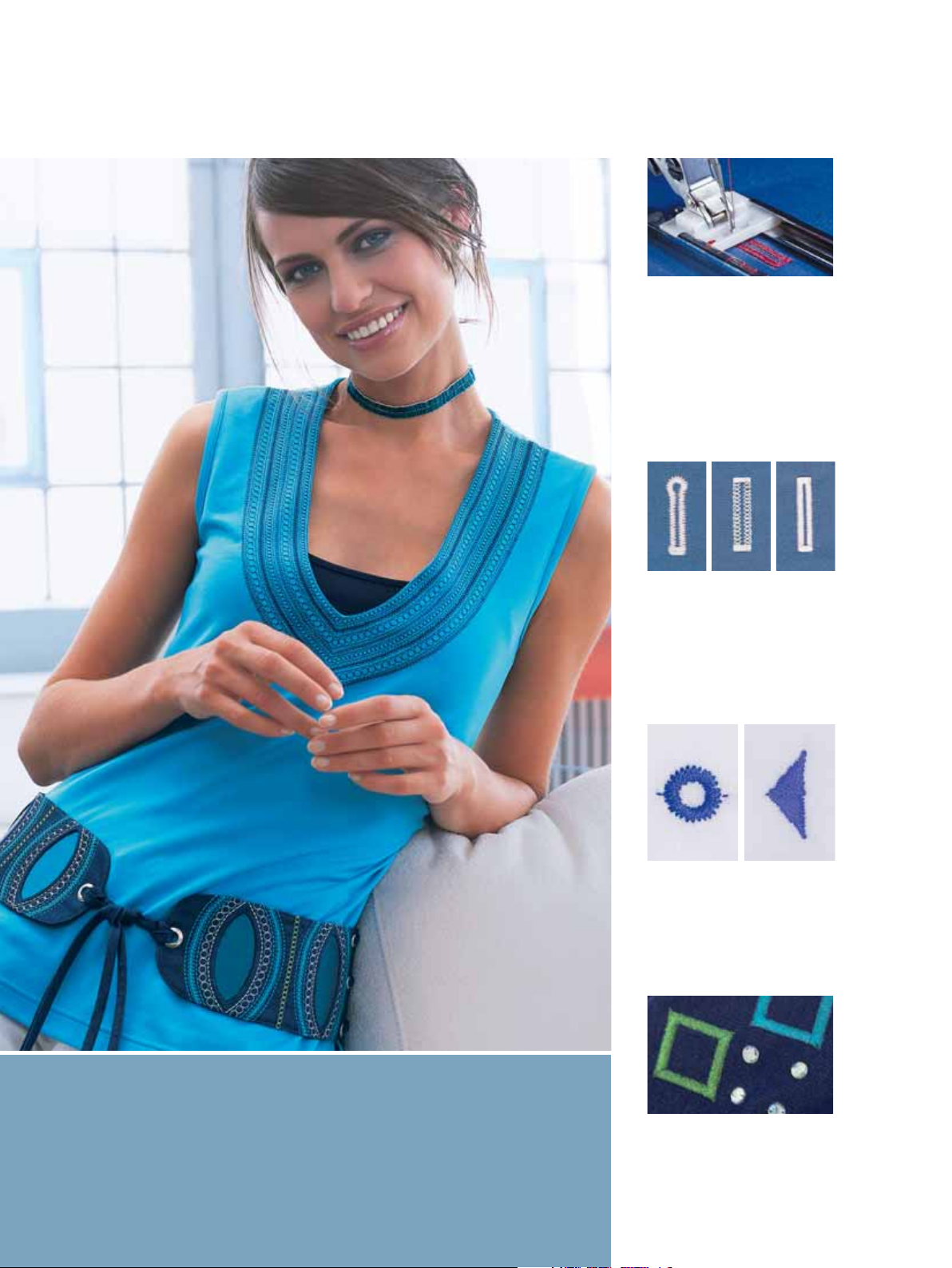
performance
Only from Pfaff!
The secret of perfect buttonholes is
the unique Sensormatic Buttonhole,
exclusively from Pfaff. It “feels” each
fabric. The result is consistent, even
buttonholes every time. The Pfaff
perfor mance
buttonhole to repeat it as often as
needed. It‘s the ultimate in sewing
convenience!
2058
lets you save your
2058
Choose from 12 different buttonholes,
including the professional Pfaff
perfor mance
No matter if you are sewing on fine
silk, heavy denim, or a pile fabric like
velvet – each buttonhole will be perfect.
Bartacks and eyelets!
perfor mance
smallest details, such as decorative
bartacks and eyelets!
2058
keyhole buttonhole.
2058
has even the
performance
2058
Tapering – the gradual narrowing
of a zigzag stitch – is a fantastic
method for forming precise points
and corners.
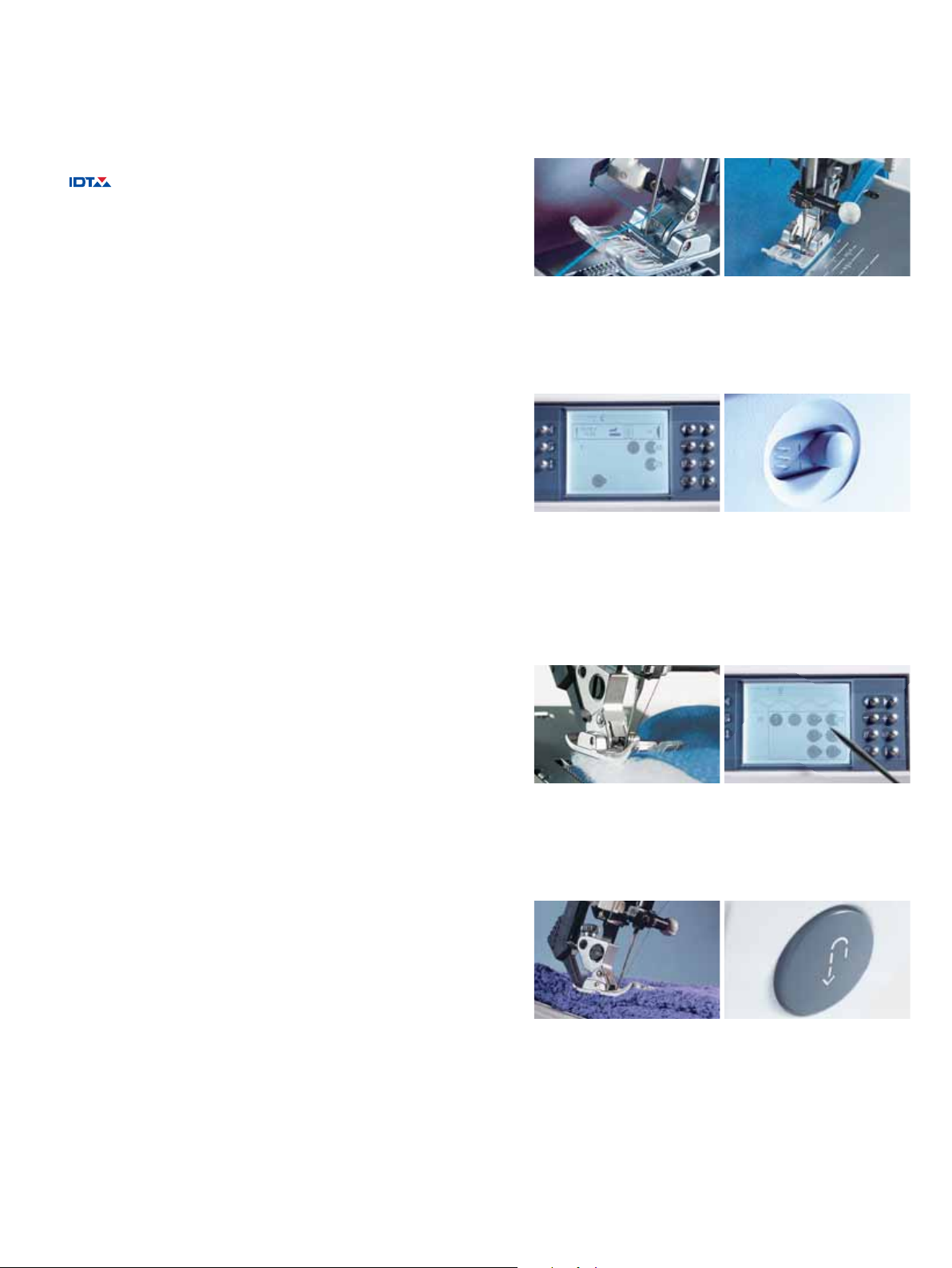
All features at a glance!
Only from Pfaff:
TM
– absolutely even fabric feed from both the top and bottom.
Only Pfaff has the IDT
Only from Pfaff: German Engineering and Innovative Design!
Large high resolution touch screen allows for easy access to stitches and functions.
Change the stitch length, or width and see the changes right before your eyes.
TM
built into the machine.
performance
“Single stitch” program – Program the exact number of stitches or stitch sequences
you want to sew. Sewing stops automatically after the last stitch and the seam is tied off.
“Tie off” program – Secure the beginning and end of the seam automatically!
“Needle up/down” program – The needle remains in the down position, while the
presser foot is automatically raised, for easy pivoting in any thickness of fabric.
“Patchwork” program – Sew your seam. The seam length will be remembered
so you can sew it over and over.
“Free-motion” program – for all of your stippling, free-motion and darning needs.
The correct presser foot height is automatically set for you.
“Twin needle” – The screen always shows when a twin needle can be used
for a stitch.
“Express Sequence” function – Test sew your stitch sequences with the
“Express Sequence” function.
performance
— 4 alphabets
— 241 utility and decorative stitches, including:
— 26 utility stitches
— 12 buttonholes
— 10 overlock stitches
— 129 decorative stitches
— 17 satin stitches
— 20 cross stitches (Patented by Pfaff! Combine on screen to form new patterns!)
— 17 quilt stitches (including 11 unique, antique quilt stitches)
— 10 hem stitches
2058
programs
2058
stitch package (including 9 mm wide stitches)
Easy needle threading!
No more searching for the needle’s
eye. Just lay the thread in place and
start sewing, thanks to the integrated
needle threader!
Information at the touch
of a button!
Just touch the Info button and
important sewing recommendations
appear in the window – such as the
recommended presser foot, how to
sew buttonholes and much more…
Many needle positions!
For precise topstitching, without
having to move the fabric. Perfect
for sewing zippers in place.
Lower the feed dogs from the
front of the machine!
Ideal for darning, free-motion
embroidery or quilting – the feed
dogs can be comfortably lowered
from the front of the machine.
Stitch Creator – Unique! Combine existing decorative stitches for exciting new
results and even create your own decorative stitches. This is creative fun at its best.
30 memories for the Stitch Creator!
Save your individual patterns and stitch sequences in one of 50 memories!
Use the Electronic Knee Lift to free your hands for easy guiding of garments,
quilts or any project. The presser foot is raised and lowered at your command.
Program the automatic presser foot lift directly on the touchscreen.
The presser foot is raised automatically when sewing stops!
“Sew slow“ function reduces speed when sewing gets difficult.
For each stitch the optimal settings for length and width are already set.
Settings can be adjusted if needed.
Mirror patterns for more stitch variety with the “Pattern mirroring” function.
All the stitches are clearly displayed inside the lid!
“Snap on” – fast change for presser feet and needle plates – simply
snap on and off!
Easily accessible thread cutter – easy to reach on the side of your
Bobbin winding through needle is so easy! No need to rethread.
Winding stops as soon as the bobbin is full.
Sew on buttons easily with the special button sewing function!
Large accessory tray in the swing-out compartment! The most common accessories
are included with the machine: Standard Presser Foot, Fancy Stitch Foot, Blindhem Foot,
Rolled Hem Foot, Edge Guide/Quilting Guide, Buttonhole Foot, Darning Foot, bobbins, etc.
Individual compartments keep everything handy.
An adhering base plate makes your
Hard cover! To protect your
performance
performance
2058
2058
when not in use.
stand securely in place.
performance
2058
.
Extra high presser foot
clearance!
High presser foot clearance makes
room for heavy fabrics or several
layers of fabric!
Constant needle piercing power!
Even when you sew slow, with thick
fabrics or through several layers of
fabric.
Easy operating with stylus!
Included with the machine as one
of many extra accessories!
Permanent reverse at the touch
of a button! Leave your hands free to
guide your project!
8 I 9