

Handbook
PEUGEOT TravEllEr
On-line handbook
Select one of the following means of access to view your handbook
on-line…
Find your handbook on the PeugeoT website, under
«MyPeugeoT».
This personal space offers advice and other useful information for
the care and maintenance of your vehicle.
Referring to the handbook on-line also gives you access to the latest information available, easily identied by the bookmark, associated with this
symbol:
Scan this code for direct access to your handbook.
If the «MyPeugeoT» function is not available on the PeugeoT public
website for your country, you can nd your handbook at the following
address:
http://public.servicebox.peugeot.com/ddb/
Select:
the language,
the vehicle, its body style,
the print edition of your handbook appropriate for the date of registration of
your vehicle.
This handbook has been designed to help you to make the most of
your vehicle in all situations and in complete safety.
Take the time to read through it so as to familiarise yourself with your
vehicle.
This handbook covers all of the variations in equipment available
across the whole range.
Your vehicle will be tted with only some of the equipment described
in this document, depending on its trim level, version and the
specication for the country in which it was sold.
The descriptions and illustrations are given as indications only.
Automobiles PeugeoT reserves the right to modify the technical
characteristics, equipment and accessories without having to update
this edition of the handbook.
This document forms an integral part of your vehicle.
Remember to pass it on to the new owner in the event of the sale of the vehicle.
Key
Welcome
Thank you for choosing this vehicle.
This handbook has been designed to enable
you to make the most of your vehicle in all
situations.
safety warning additional information contributes to the protection of the
environment

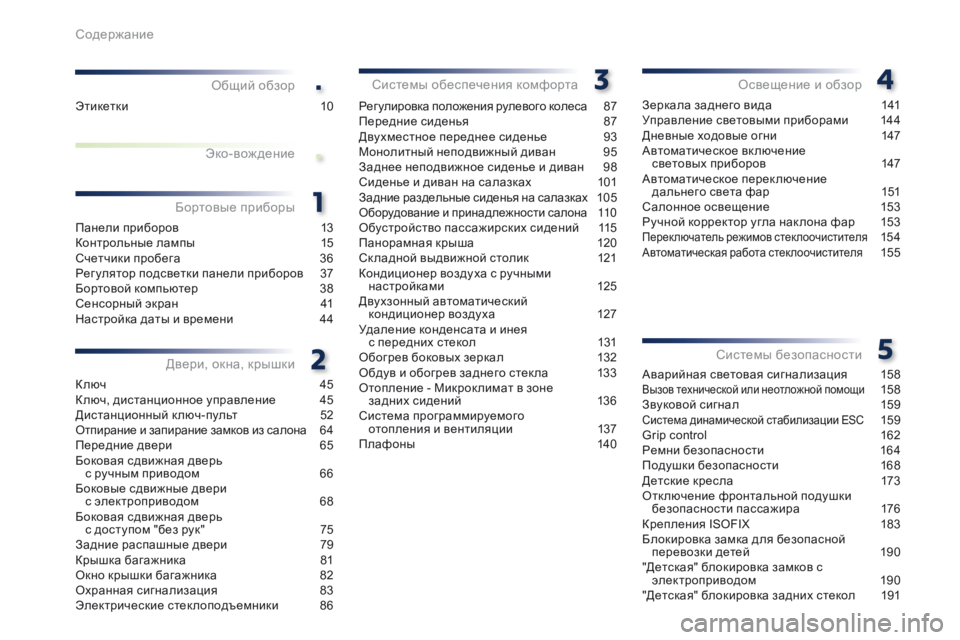
Contents
overview
Labels 10
eco-driving
.
.
Instruments
Instrument panels 13
Indicator and warning lamps 15
Distance recorders 36
Lighting dimmer 37
Trip computer 38
Touch screen 41
Setting the date and time 44
Access
Key 45
Key, remote control 45
«Keyless entry and Starting» 52
Locking / unlocking from inside 64
Front doors 65
Manual sliding side door(s) 66
electric sliding side door(s) 68
Hands-free sliding side door(s) 75
Side-hinged rear doors 79
Tailgate 81
Tailgate rear screen 82
Alarm 83
electric windows 86
ease of use and c o mfo rt Lighting and visibility
Steering wheel adjustment 87
Front seats 87
2-seat front bench seat 93
Fixed one-piece bench seat 95
Fixed rear seat and bench seat 98
Rear seat and bench seat on rails 101
Individual seat(s) on rails 105
Interior ttings 110
Seating area ttings 115
Panoramic sunroof 120
Folding and sliding table 121
Manual air conditioning 125
Dual-zone automatic air conditioning 127
Front demist — defrost 131
Door mirrors
demist — defrost 132
Rear screen
demist — defrost 133
Rear Heating — Air Conditioning 136
Programmable Heating / Ventilation 137
Courtesy lamps 140
Mirrors 141
Lighting control stalk 144
Daytime running lamps 147
Automatic illumination of headlamps 147
Automatic headlamp dipping 151
Interior mood lighting 153
Manual headlamp beam height adjustment 153
Wiper control stalk 154
Automatic rain sensitive wipers 155
Safety
Hazard warning lamps 158
emergency or assistance call 158
Horn 159
electronic stability
control (eSC) 159
grip control 162
Seat belts 164
Airbags 168
Child seats 173
Deactivating the passenger’s front airbag 176
ISoFIX mountings 183
Manual child lock 190
electric child lock 190
Child lock on rear windows 191

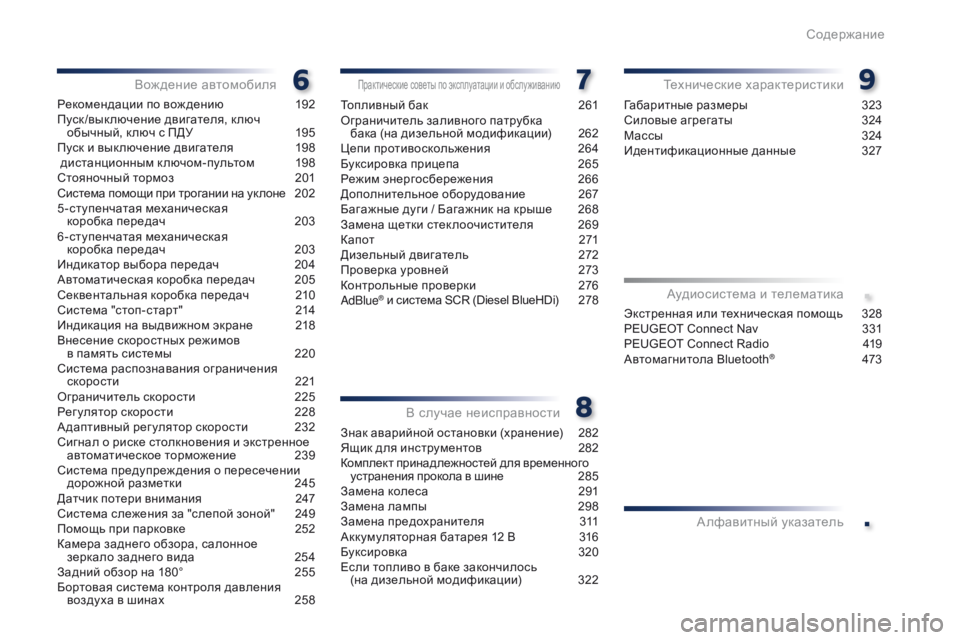
Contents
Driving Practical informatio n
Driving recommendations 192
Starting-switching off the engine,
manual key, remote control 195
Starting and switching off the engine, 198
«Keyless entry and Starting» 198
Parking brake 201
Hill start assist 202
5-speed manual gearbox 203
6-speed manual gearbox 203
gear shift indicator 204
Automatic gearbox 205
electronic gearbox 210
Stop & Start 214
Head-up display 218
Memorising speeds 220
Speed limit recognition 221
Speed limiter 225
Cruise control 228
Dynamic cruise control 232
Collision Risk Alert and Active
Safety Brake 239
Lane departure
warning system 245
Fatigue detection system 247
Blind spot monitoring system 249
Parking sensors 252
Reversing camera, interior mirror 254
180° rear vision 255
Under-ination detection 258
Fuel tank 261
Diesel misfuel prevention 262
Snow chains 264
Towing a trailer 265
energy economy mode 266
Accessories 267
Roof bars / Roof rack 268
Changing a wiper blade 269
Bonnet 271
Diesel engine 272
Checking levels 273
Checks 276
®
and SCR system
AdBlue
(BlueHDi Diesel) 278
In the event of a brea kdow n
Warning triangle (stowing) 282
Tool box 282
Temporary puncture
repair kit 285
Changing a wheel 291
Changing a bulb 298
Changing a fuse 311
12 V battery 316
Towing 320
Running out of fuel (Diesel) 322
Technical data
Dimensions 323
engines 324
Weights 324
Identication markings 327
Audio equipment and telematics
emergency or assistance 328
PeugeoT Connect Nav 331
PeugeoT Connect Radio 419
Bluetooth
®
audio system 473
Alphabetical index
.
.
Overview
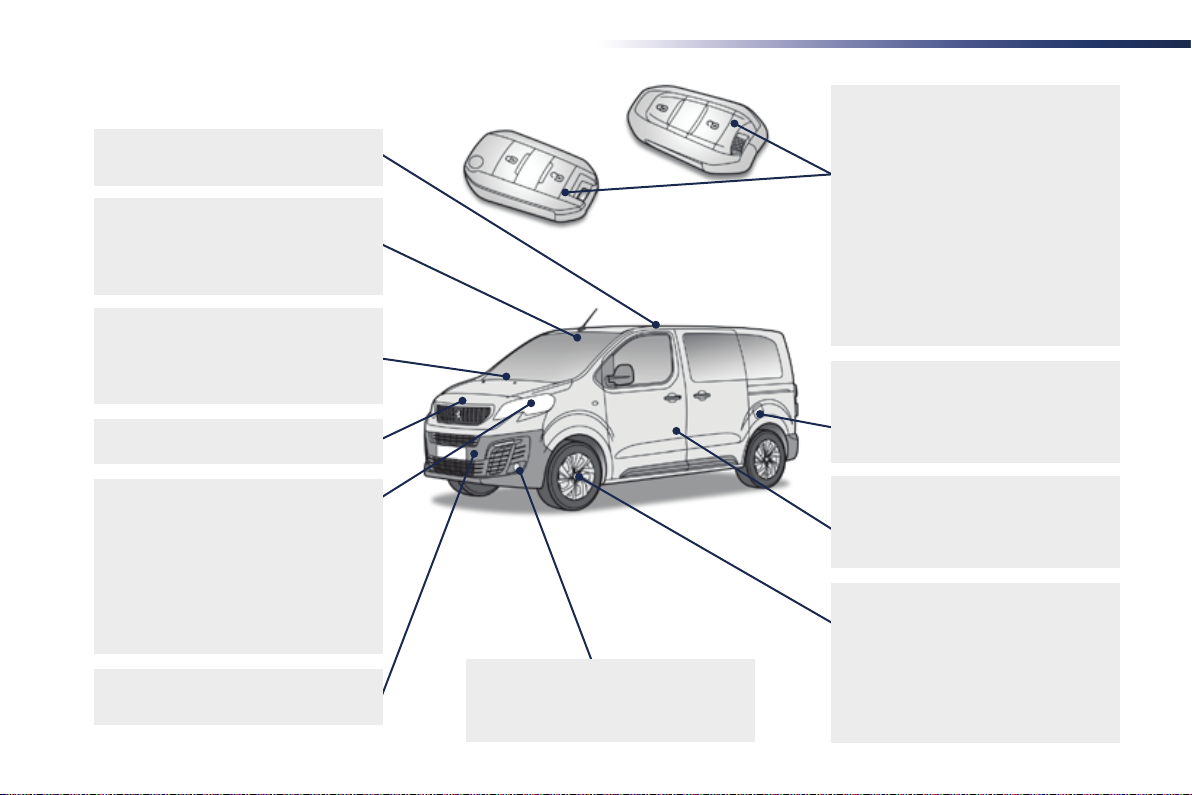
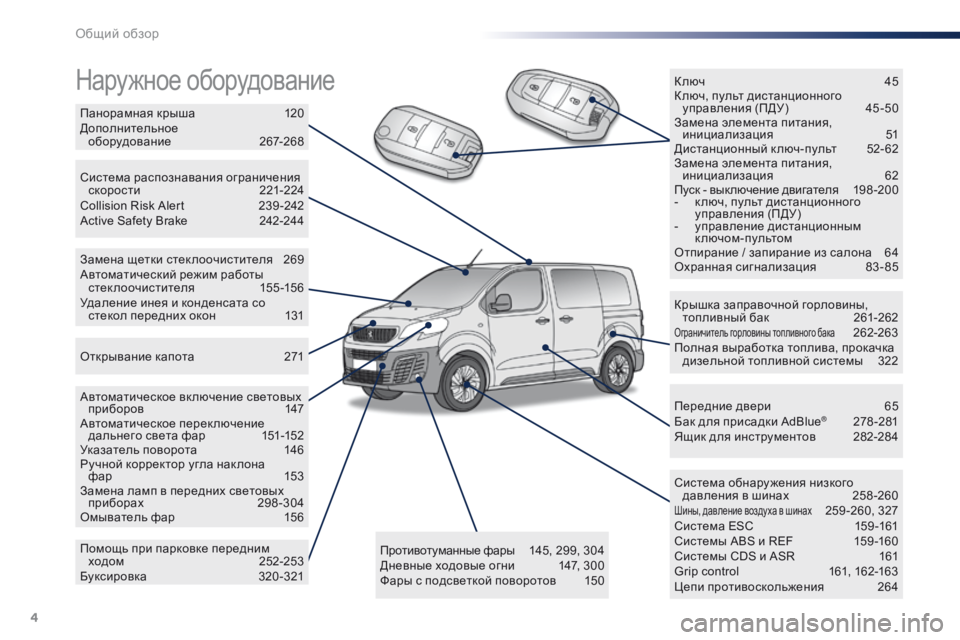
exterior
Panoramic sunroof 120
Accessories 267-268
Speed limit
recognition 221-224
Collision Risk Alert 239-242
Active Safety Brake 242-244
Changing a wiper
blade 269
Automatic wiping 155-156
Front demisting, defrosting 131
opening the bonnet 271
Automatic illumination of headlamps 147
Automatic headlamp
dipping 151-152
Direction indicators 146
Adjusting the headlamp
beam height 153
Changing front bulbs 298-304
Headlamp wash 156
Parking sensors 252-253
Towing 320-321
Front foglamps 145, 299, 304
Daytime running lamps 147, 300
Cornering lighting 150
Key 45
Key, remote control 45-50
Changing the battery, reinitialisation 51
Keyless entry
and Starting 52-62
Changing the cell battery,
reinitialisation 62
Starting — switching off the engine
— key, remote control
— Keyless entry and Starting
remote control
Locking — unlocking from inside 64
Alarm 83-85
Filler cap, fuel tank 261-262
Misfuel prevention 262-263
Running out of Diesel fuel,
priming 322
Front doors 65
®
tank 278-281
AdBlue
Tool box 282-284
under-inflation detection 258-260
Tyres, pressures 259-260, 327
eSC system 159-161
ABS, eBFD 159-160
DSC, ASR 161
grip control 161, 162-163
Snow chains 264
198-200
4
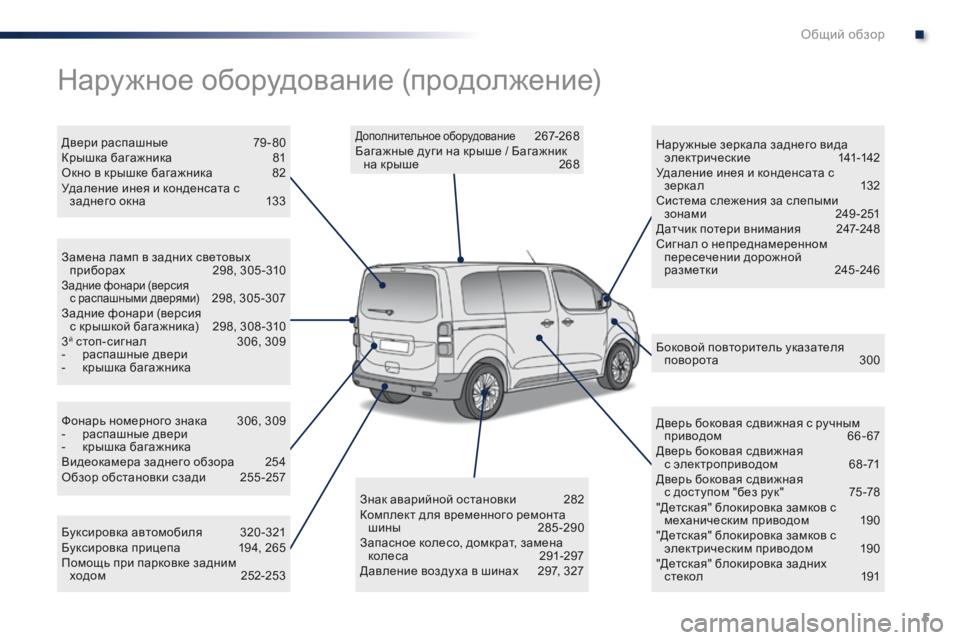
exterior (continued)
.Overview
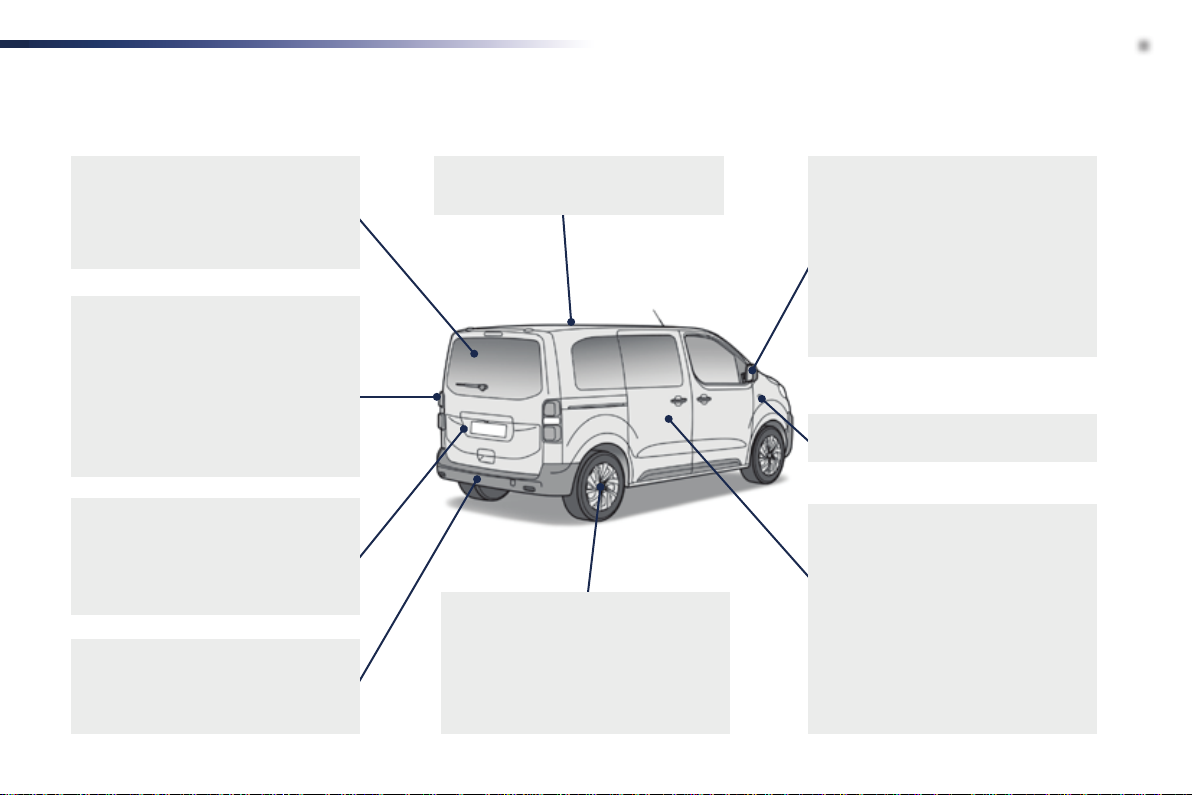
Side-hinged doors 79-80
Tailgate 81
Tailgate screen 82
Demisting-defrosting
the rear screen 133
Changing rear
bulbs 298, 305-310
Rear lamps
(side-hinged doors) 298, 305-307
Rear lamps
(tailgate) 298, 308-310
rd
brake lamp 306, 309
3
— side-hinged doors
— tailgate
Number plate lamp 306, 309
— side-hinged doors
— tailgate
Reversing camera 254
Rear vision 255-257
Towing 320-321
Trailer towbar 194, 265
Rear parking sensors 252-253
Accessories 267-268
Roof bars / Roof rack 268
Warning triangle 282
Temporary puncture
repair kit 285-290
Spare wheel, jack,
changing a wheel 291-297
Inflation, pressures 297, 327
electric door
mirrors 141-142
Demisting-defrosting
the mirrors 132
Blind Spot Monitoring
System 249-251
Fatigue detection system 247-248
Lane Departure Warning
System 245-246
Direction indicator side repeaters 300
Manual sliding side
door(s) 66-67
electric sliding side
door(s) 68-71
Hands-free sliding side
door(s) 75-78
Manual child lock 190
electric child lock 190
Rear window
child lock 191
5

Overview
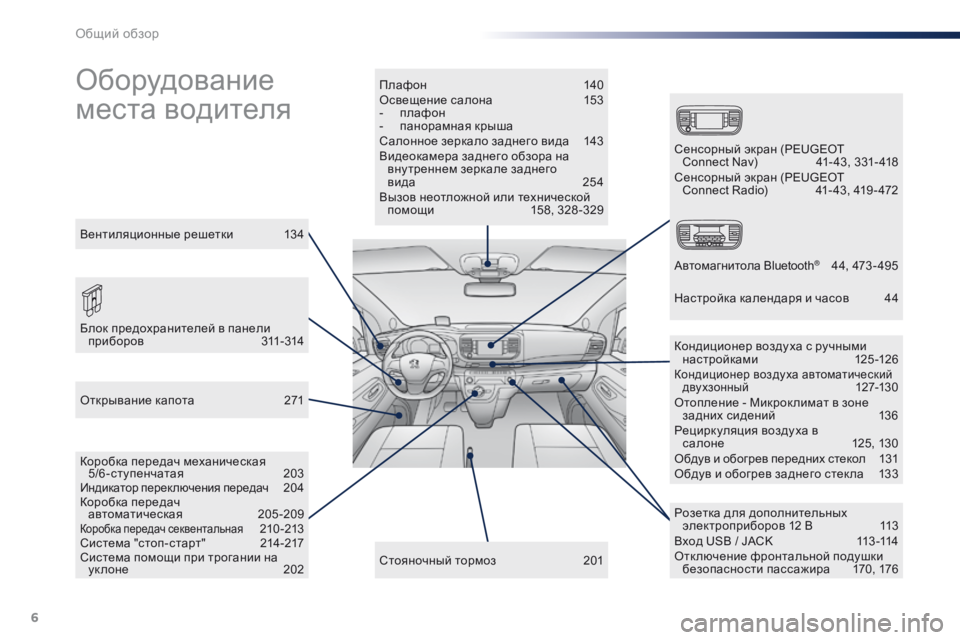
Instruments and
controls
Air vents 134
Dashboard fuses 311-314
opening the bonnet 271
5/6-speed manual gearbox 203
gear shift
indicator 204
Automatic gearbox 205-209
electronic gearbox 210-213
Stop & Start 214-217
Hill start assist 202
Courtesy lamps 140
Interior mood lighting 153
— courtesy lamp
— panoramic roof
Rear view mirror 143
Reversing camera
on interior mirror 254
emergency or assistance
call 158, 328-329
Parking brake 201
Touch screen (PeugeoT
Connect Nav) 41-43, 331-418
Touch screen (PeugeoT
Connect Radio) 41-43, 419-472
®
Bluetooth
Setting the date and time 44
Manual air conditioning 125-126
Dual-zone air
conditioning 127-130
Rear heating, air conditioning 136
Air recirculation 125, 130
Front demist — defrost 131
Rear screen demist — defrost 133
12 V accessory socket 113
uSB port — JACK auxiliary socket 113-114
Deactivating the passenger
front airbag 170, 176
audio system 44, 473-495
6
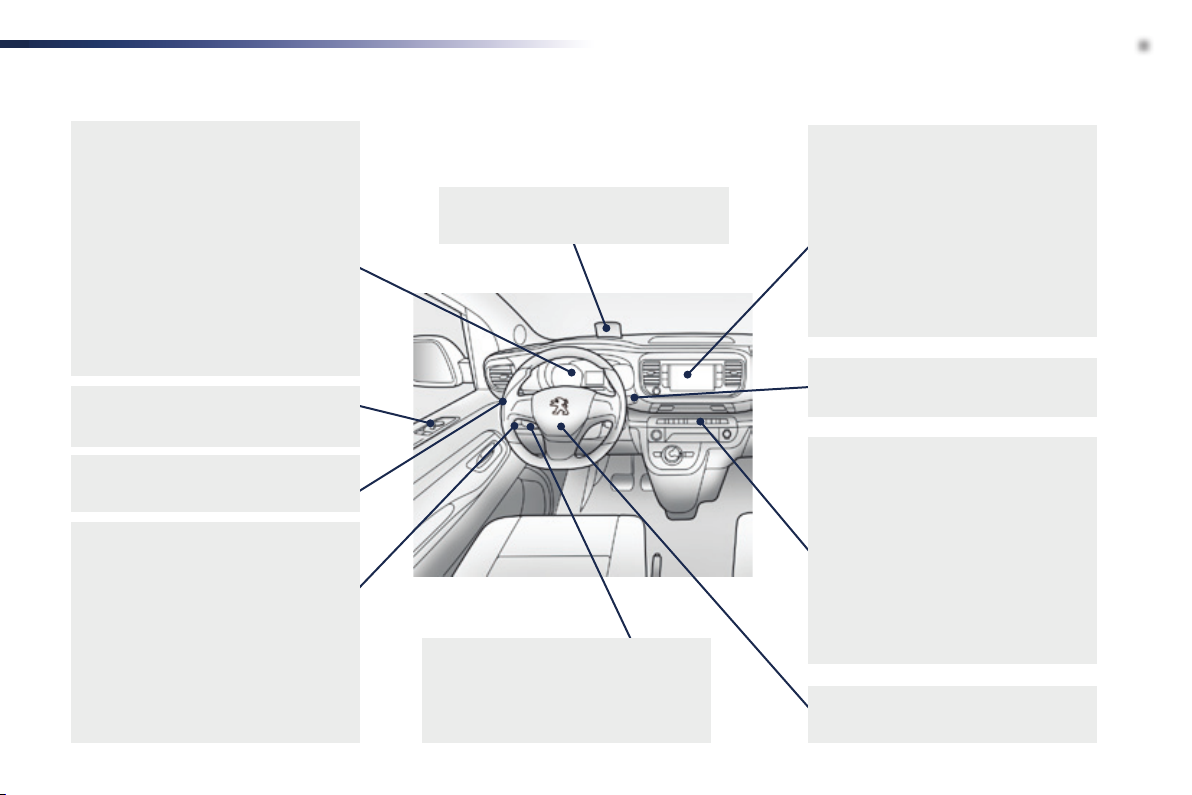
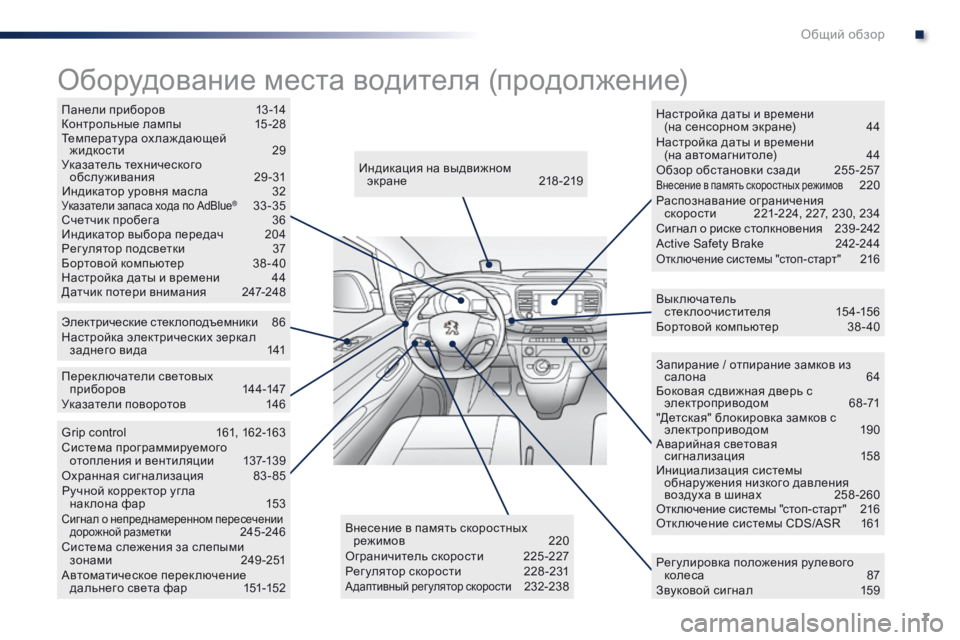
Instruments and controls (cont.)
Instrument panel 13-14
Warning lamps 15-28
Coolant temperature 29
Service indicator 29-31
oil level indicator 32
®
range indicators 33-35
AdBlue
Distance recorder 36
gear shift
indicator 204
Lighting dimmer 37
Trip computer 38-40
Setting the time and date 44
Fatigue detection system 247-248
electric windows 86
Adjusting the electric
mirrors 141
Head-up display 218-219
Setting the time and date (touch screen)
Setting the time and date (audio system)
Rear vision 255-257
Memorising speeds 220
Speed limit
recognition 221-224, 227, 230, 234
Collision Risk Alert 239-242
Active Safety Brake 242-244
Deactivating Stop & Start 216
Wiper control 154-156
Trip computer 38-40
44
44
.Overview
Lighting control 144-147
Direction indicators 146
grip control 161, 162-163
Programmable heating —
ventilation 137-139
Alarm 83-85
Adjusting the headlamp
beam height 153
Lane Departure
Warning System 245-246
Blind Spot Monitoring
System 249-251
Automatic headlamp
dipping 151-152
Memorising speeds 220
Speed limiter 225-227
Cruise control 228-231
Dynamic cruise control 232-238
Locking — unlocking from inside 64
electric sliding
door(s) 68-71
electric child lock 190
Hazard warning lamps 158
Reinitialising the
under-inflation detection 258-260
Deactivating Stop & Start 216
Deactivating the DSC/ASR
system 161
Adjusting the steering wheel 87
Horn 159
7
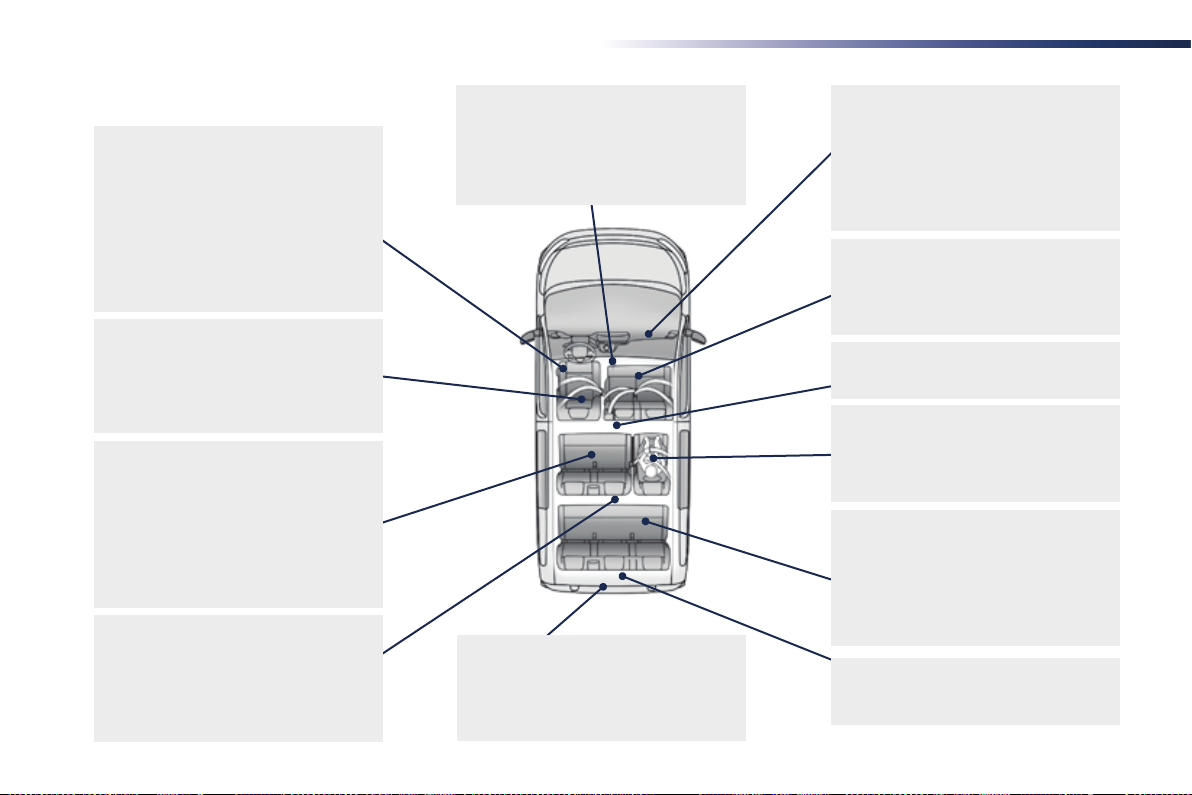
Overview
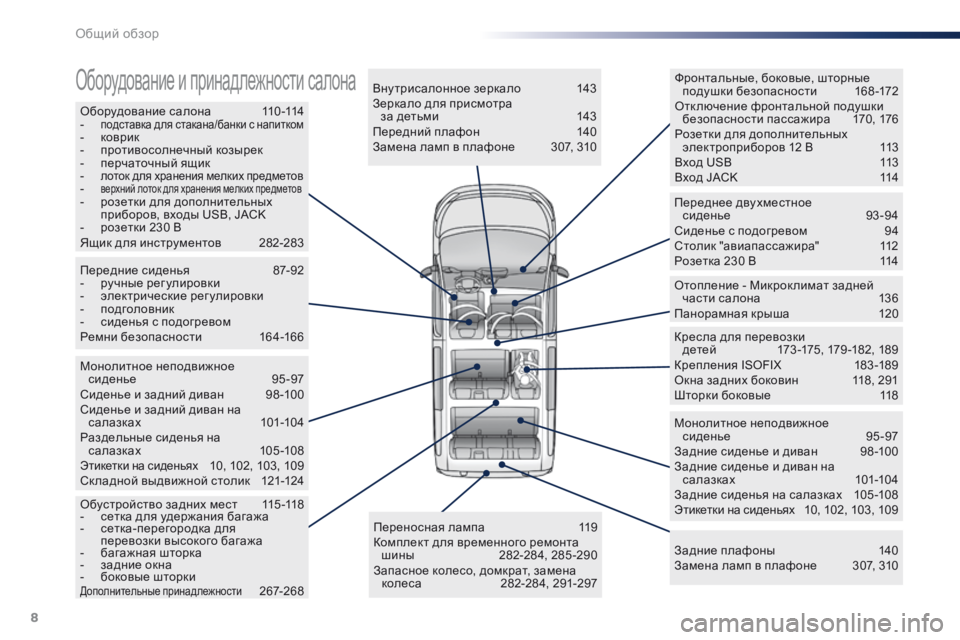
Interior
Interior fittings 110-114
— cup or can holder
— mats
— sun visors
— glove box
— storage box
— upper storage box
accessory socket, uSB port, JACK auxiliary socket
—
— 230 V sockets
Tool box 282-283
Front seats, adjustments, head restraint
— manual adjustments
— electric adjustments
— head restraints
— heated seats
Seat belts 164-166
Fixed one-piece bench seat 95-97
Rear seat and bench seat 98-100
Rear seat and bench
seat on rails 101-104
Individual rear
seat(s) on rails 105-108
Seat labels 10, 102, 103, 109
Sliding and folding table 121-124
Seating area fittings 115-118
— luggage retaining net
— high load retaining net
— load space cover
— rear windows
— side blinds
Accessories 267-268
87-92
Rear view mirror 143
Surveillance mirror 143
Front courtesy lamp 140
Changing courtesy
lamp bulbs 307, 310
Torch 119
Temporary puncture
repair kit 282-284, 285-290
Spare wheel, jack, changing
a wheel, tools 282-284, 291-297
Front, side, curtain
airbags 168-172
Passenger front airbag
deactivation 170, 176
12 V accessory sockets 113
uSB port 113
JACK auxiliary socket 114
2-seat front bench seat 93-94
Heated bench seat 94
Aircraft type table 112
230 V socket 114
Rear heating — air conditioning 136
Panoramic roof 120
Child seats 173-175, 179-182, 189
ISoFIX mountings 183-189
Rear side windows 118, 291
Side blinds 118
Fixed one-piece bench seat 95-97
Rear seat and bench seat 98-100
Rear seat and bench
seat on rails 101-104
Individual rear seat(s)
on rails 105-108
Seat labels 10, 102, 103, 109
Rear courtesy lamp 140
Changing courtesy
lamp bulbs 307, 310
8
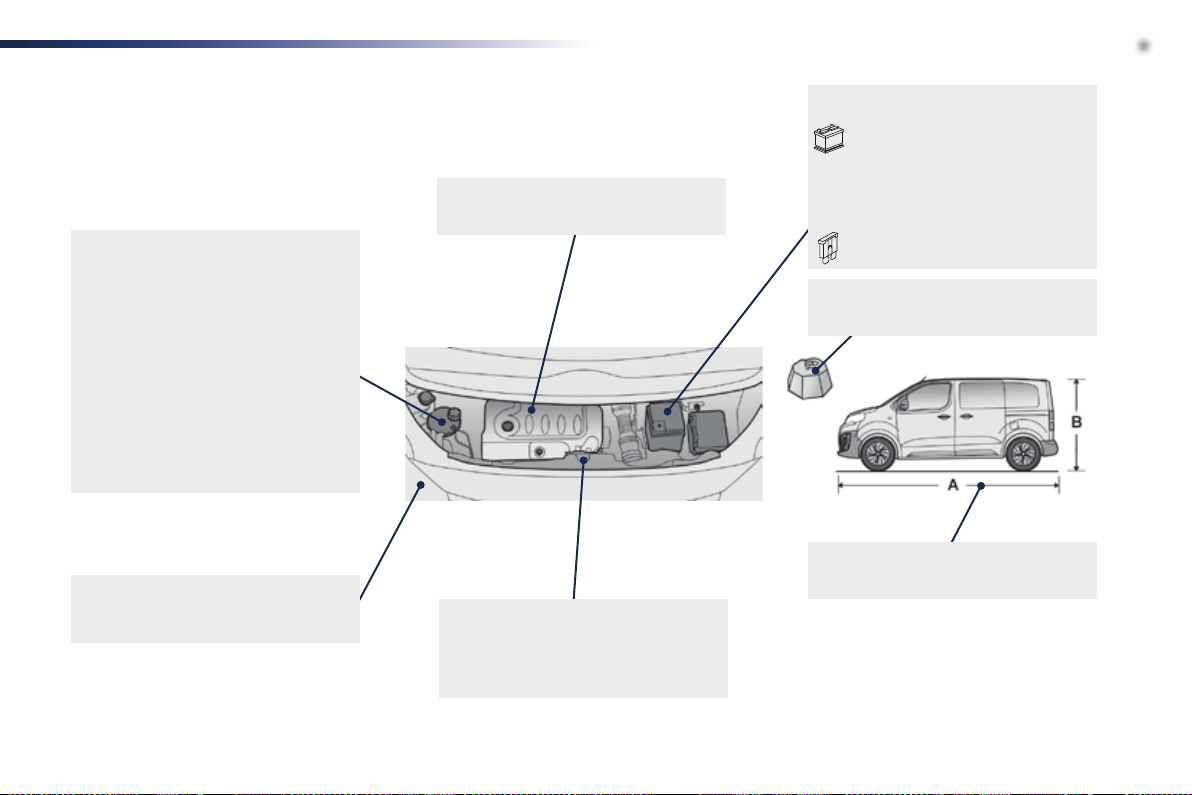
.Overview
Maintenance — Technical data
Running out of fuel,
(primimg pump) 322
Checking levels 273-275
— oil
— brake fluid
— power steering fluid
— coolant
— screenwash, headlamp wash fluid
— additive (Diesel with particle filter)
Checking components 276-277
— battery
— air filter — passenger
compartment filter
— oil filter
— particle filter
— brake pads — discs
Changing bulbs 298-310
— front
— rear
opening the bonnet 271
under the bonnet 272
engines 324-326
®
278-281
AdBlue
12V battery 316-320
Load reduction, economy mode 266
engine compartment
fuses 311-312, 315
Weights 324-326
Dimensions 323
Identification markings 327
9
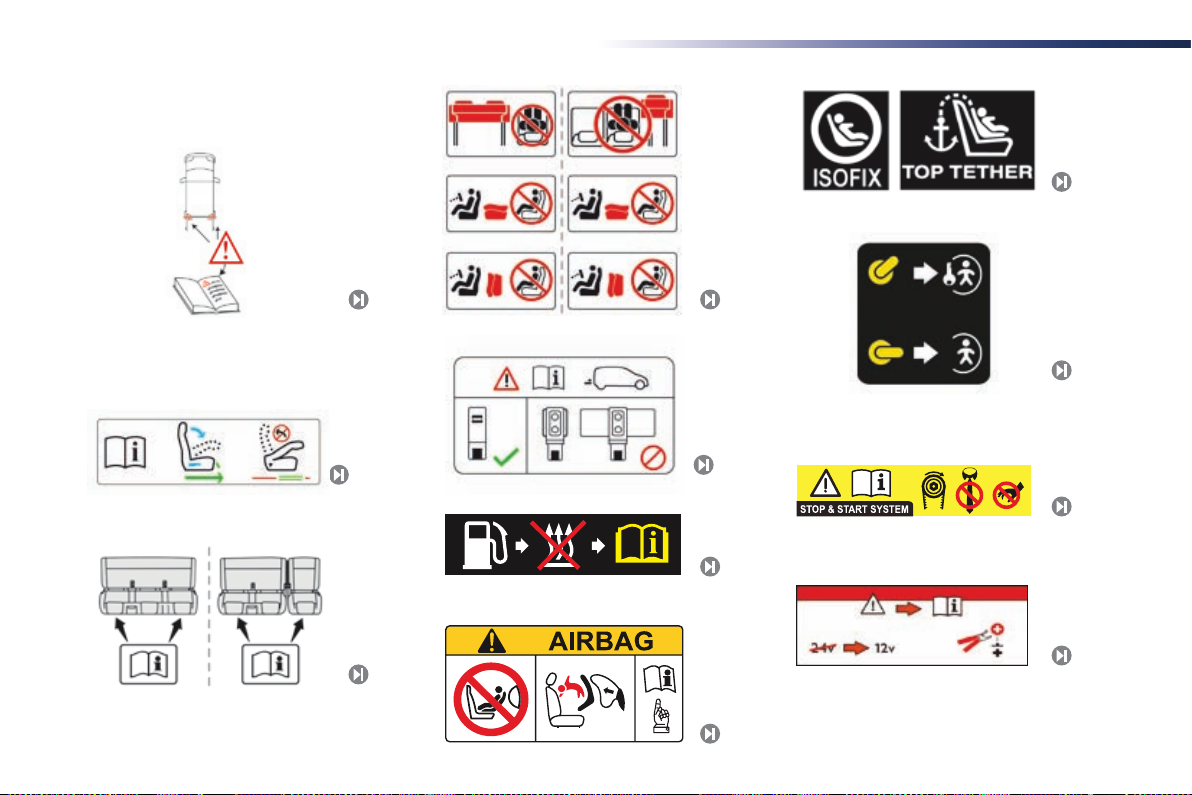
Overview
Labels
183
10
80
102-103
109
109
190
124
271
139
318
176

eco-driving
eco-driving is a range of everyday practices
that allow the motorist to optimise their fuel
consumption and Co
Optimise the use of your
gearbox
With a manual gearbox, move off gently and
change up without waiting. During acceleration
change up early.
With an automatic or electronic gearbox,
give preference to automatic mode and avoid
pressing the accelerator pedal heavily or
suddenly.
The gear shift indicator invites you to engage
the most suitable gear: as soon as the
indication is displayed in the instrument panel,
follow it straight away.
For vehicles fitted with an electronic or
automatic gearbox, this indicator appears only
in manual mode.
emissions.
2
Drive smoothly
Maintain a safe distance between vehicles, use
engine braking rather than the brake pedal,
and press the accelerator progressively. These
practices contribute towards a reduction in fuel
consumption and Co
to reduce the background traffic noise.
If your vehicle has cruise control, make use of
the system at speeds above 25 mph (40 km/h)
when the traffic is flowing well.
emissions and also help
2
Control the use of your
electrical equipment
Before moving off, if the passenger compartment
is too warm, ventilate it by opening the windows
and air vents before using the air conditioning.
Above 30 mph (50 km/h), close the windows and
leave the air vents open.
Remember to make use of equipment that can
help keep the temperature in the passenger
compartment down (sunroof and window bl inds. . .).
Switch off the air conditioning, unless it has
automatic regulation, as soon as the desired
temperature is attained.
.Eco-driving
Switch off the demisting and defrosting controls,
if not automatic.
Switch off the heated seat as soon as possible.
Switch off the headlamps and front foglamps
when the level of light does not require their
use.
Avoid running the engine before moving off,
particularly in winter; your vehicle will warm up
much faster while driving.
As a passenger, if you avoid connecting
your multimedia devices (film, music, video
game…), you will contribute towards limiting the
consumption of electrical energy, and so of fuel.
Disconnect your portable devices before
leaving the vehicle.
11

Eco-driving
Limit the causes of excess
consumption
Spread loads throughout the vehicle; place the
heaviest items in the bottom of the boot, as
close as possible to the rear seats.
Limit the loads carried in the vehicle and reduce
wind resistance (roof bars, roof rack, bicycle
carrier, trailer…). use a roof box in preference.
Remove roof bars and roof racks after use.
At the end of winter, remove snow tyres and refit
your summer tyres.
Observe the recommendations
on maintenance
Check the tyre pressures regularly, when cold,
referring to the label in the door aperture,
driver’s side.
Carry out this check in particular:
— before a long journey,
— at each change of season,
— after a long period out of use.
Don’t forget the spare wheel and the tyres on
any trailer or caravan.
Have your vehicle serviced regularly (engine
oil, oil filter, air filter, passenger compartment
filter…) and observe the schedule of operations
recommended in the manufacturer’s service
schedule.
With a BlueHDi Diesel engine, if the SCR
system is faulty your vehicle becomes polluting;
go to a PeugeoT dealer or a qualified
workshop without delay to have the emissions
of nitrogen oxides brought back to the legal
level.
When refuelling, do not continue after the third
cut-off of the nozzle to avoid any overflow.
At the wheel of your new vehicle, it is only after
the first 1 800 miles (3 000 kilometres) that you
will see the fuel consumption settle down to a
consistent average.
12
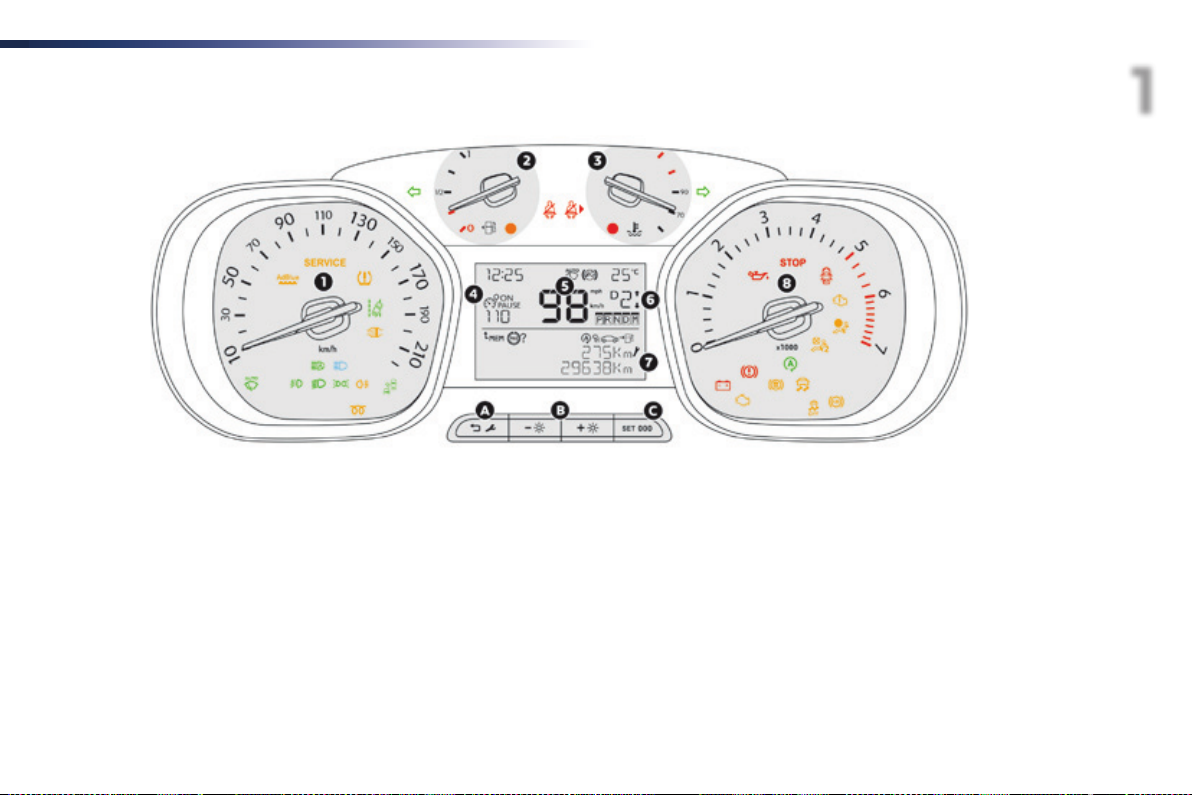
Instruments
LCD text instrument panel
Dials and screens Control buttons
1. Analogue speedometer (mph or km/h).
2. Fuel gauge.
3. engine coolant temperature gauge.
4. Cruise control or speed limiter settings.
5. Digital speedometer (mph or km/h).
6. gear shift indicator.
gear with an automatic or electronic
gearbox.
7. Service indicator, then total distance
recorder (miles or km), trip recorder (miles
or km), display of messages, …
8. Rev counter (x 1 000 rpm or tr/min).
A. Reset the service indicator.
Temporarily recall information on:
— servicing,
— remaining driving range with the
emissions fluid (AdBlue
B. Main lighting dimmer.
C. Reset the trip recorder.
1
®
).
13
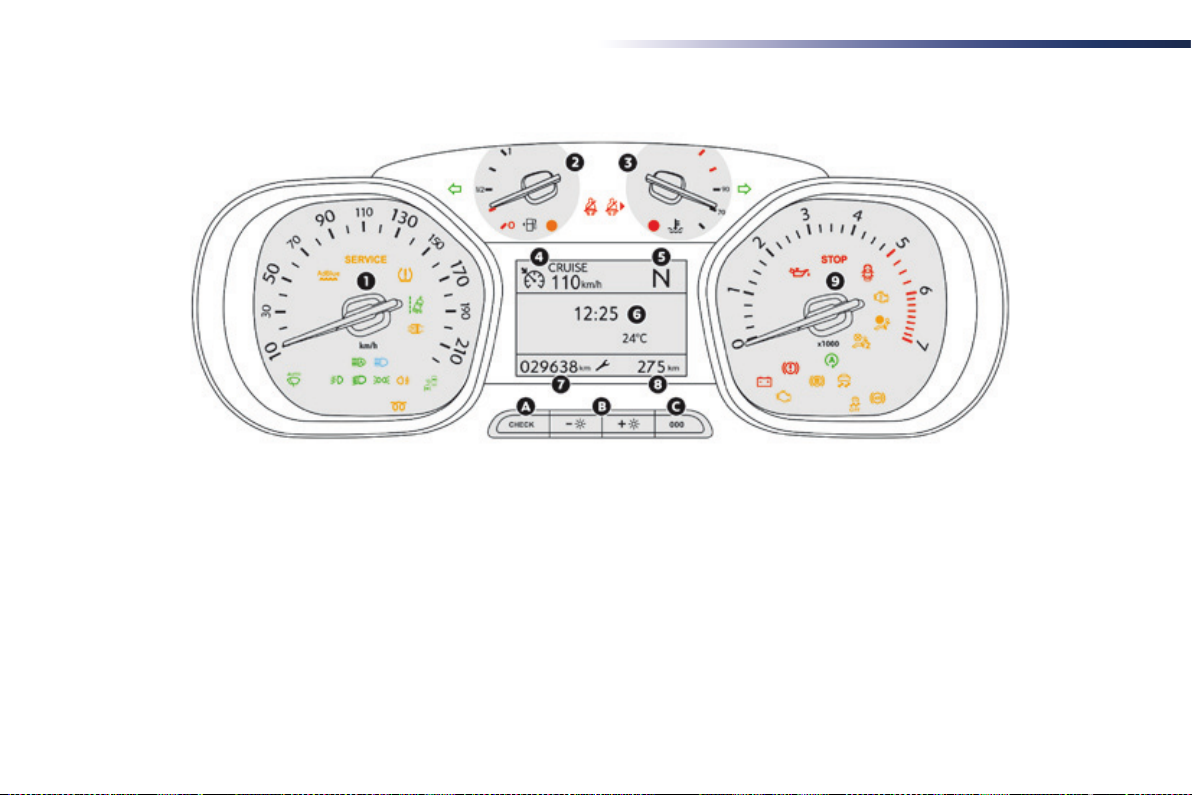
Instruments
Matrix instrument panel
Dials and screens Control buttons
1. Analogue speedometer (mph or km/h).
2. Fuel gauge.
3. engine coolant temperature gauge.
4. Cruise control or speed limiter settings.
5. gear shift indicator.
gear with an automatic or electronic
gearbox.
6. Display area: alert or state of function
messages, trip computer, digital
speedometer (mph or km/h), …
7. Service indicator, then total distance
recorder (miles or km).
These functions are displayed in turn when
the ignition is switched on.
8. Trip recorder (miles or km).
9. Rev counter (x 1 000 rpm or tr/min).
A. Reset the service indicator.
Display the alert log.
Recall information on:
— servicing,
— remaining driving range with the
emissions fluid (AdBlue
B. Main lighting dimmer.
C. Reset the trip recorder.
®
).
14
Instruments
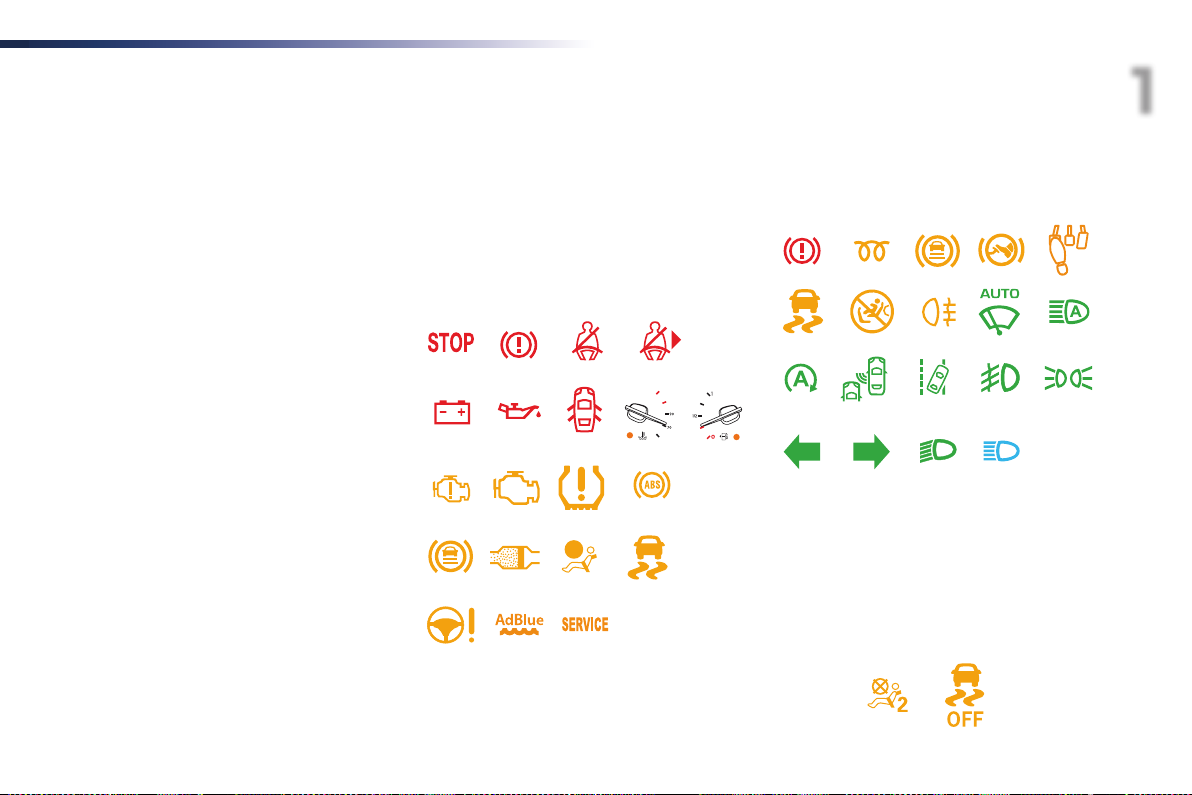
Indicator and warning lamps
Visual indicators informing the driver that
a system is in operation or is switched off
(indicator lamp), or has a fault (warning lamp).
When the ignition is switched on
Certain warning lamps come on for a few
seconds when the vehicle’s ignition is
switched on.
When the engine is started, these same
warning lamps should go off.
If they remain on, before moving off, refer to the
information on the warning lamp concerned.
Associated warnings
Certain warning lamps may come on in one of
two modes: fixed (continuous) or flashing.
only by relating the type of illumination to the
operation of the vehicle can it be determined
whether the situation is normal or a fault has
occurred. In the event of a fault, the illumination
of the warning lamp may be accompanied by
an audible signal and/or a message.
Warning lamps
When the engine is running or the vehicle is
being driven, illumination of one of the following
warning lamps indicates a fault which requires
action on the part of the driver.
Any fault resulting in the illumination of a
warning lamp must be investigated further
using the associated message.
If you encounter any problems, contact a
PeugeoT dealer or a qualified workshop.
Operation indicator lamps
If one of the following indicator lamps comes on
in the instrument panel and/or instrument panel
screen, this confirms that the corresponding
system has come into operation.
Deactivation indicator lamps
If one of the following indicator lamps comes
on, this confirms that the corresponding system
has been switched off intentionally.
This is may be accompanied by an audible
signal and the display of a message.
1
15
Instruments
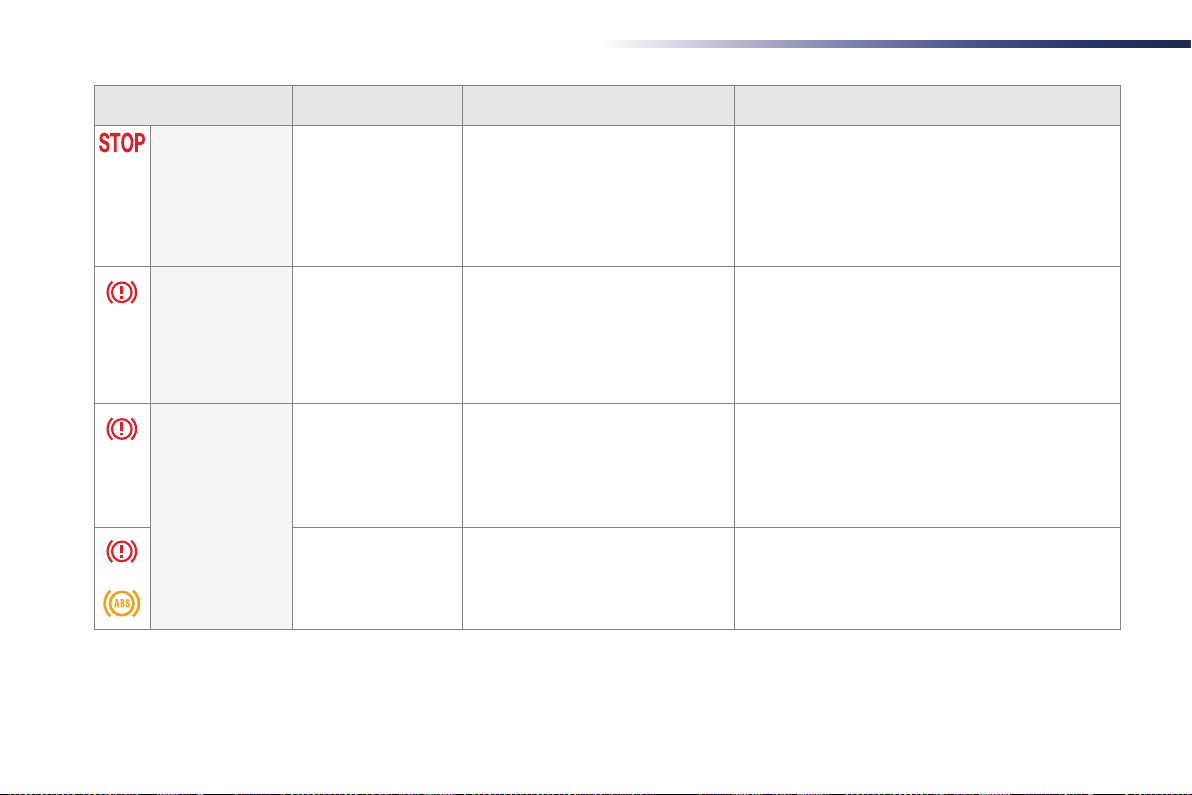
Warning / indicator lamp State Cause Action / Observations
STOP fixed, associated with
another warning lamp,
accompanied by an
audible signal and a
message.
Illumination of this warning lamp is
related to a serious fault detected
with the engine, the braking system,
the power steering, etc., or a major
electrical fault.
You must stop as soon as it is safe to do so.
Park, switch off the ignition and call a PeugeoT
dealer or a qualified workshop.
16
Parking brake fixed. The parking brake is applied or not
Braking fixed. The brake fluid level has dropped
fixed, associated
+
with the ABS warning
lamp.
properly released.
significantly.
The electronic brake force distribution
(eBFD) system has a fault.
Release the parking brake to switch off the warning
lamp, keeping your foot on the brake pedal.
observe the safety recommendations.
For more information on the Parking brake, refer to
the corresponding section.
You must stop as soon as it is safe to do so.
Top-up with brake fluid listed by PeugeoT.
If the problem persists, have the system checked by a
PeugeoT dealer or a qualified workshop.
You must stop as soon as it is safe to do so.
Have it checked by a PeugeoT dealer or a qualified
workshop.
Instruments
Warning / indicator lamp State Cause Action / Observations
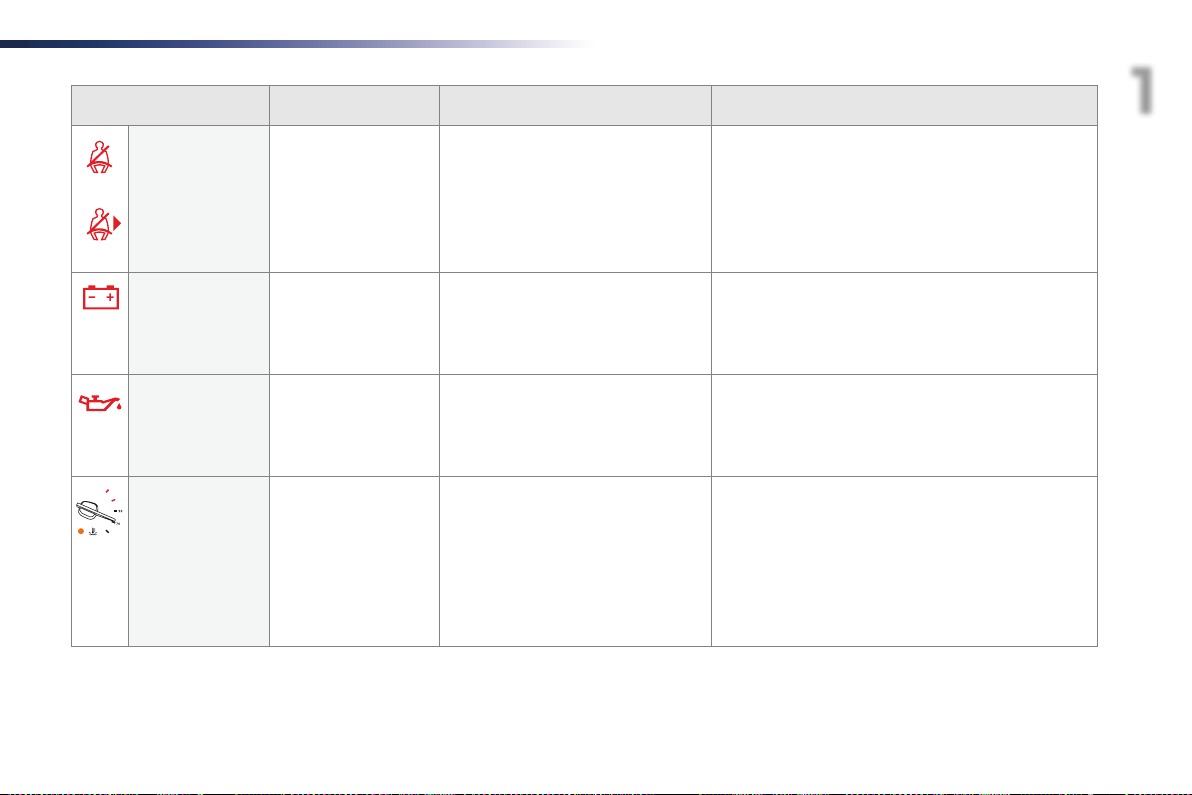
Seat belt(s)
not fastened /
unfastened
Battery charge* fixed. The battery charging circuit has a
Engine oil
pressure
Maximum
coolant
temperature
fixed
or flashing
accompanied by an
audible signal.
fixed. There is a fault with the engine
fixed with the needle
in the red zone.
A seat belt has not been fastened or
has been unfastened.
fault (dirty or loose terminals, slack or
cut alternator belt, …).
lubrication system.
The temperature of the cooling
system is too high.
Pull the strap then insert the tongue in the buckle.
The warning lamp should go off when the engine is
started.
If it does not go off, contact a PeugeoT dealer or a
qualified workshop.
You must stop as soon it is safe to do so.
Park, switch off the ignition and contact a PeugeoT
dealer or a qualified workshop.
You must stop as soon as it is safe to do so.
Wait until the engine has cooled down before toppingup the level, if necessary.
If the problem persists, contact a PeugeoT dealer or
a qualified workshop.
1
* Depending on the country of sale.
17
Instruments
Warning / indicator lamp State Cause Action / Observations
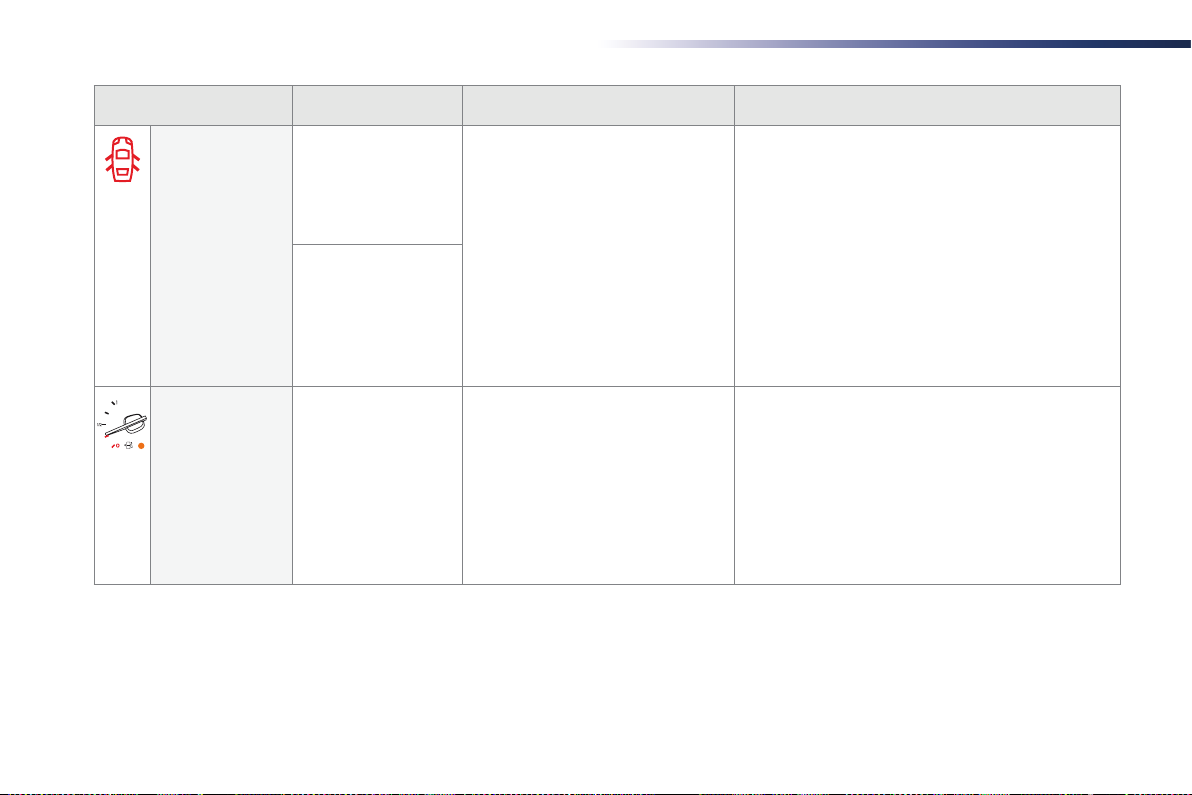
Door(s)
open
fixed, associated with
a message identifying
the door, if the speed
is below 6 mph
(10 km/h).
fixed, associated with
a message identifying
the door, together with
an audible signal if the
speed is above 6 mph
(10 km/h).
A front, side or rear door (side-hinged
rear door or tailgate) is still open.
If fitted to your vehicle, the tailgate
screen is still open.
Close the door in question.
If your vehicle has side-hinged rear doors and the
right hand door is still open, this will not be signalled
by this warning lamp.
18
Low fuel level fixed, with the needle
in the red zone.
When it first comes on there remains
less than 8 litres of fuel in the tank.
You must refuel as soon as possible to avoid running
out of fuel.
This warning lamp will come on every time the ignition
is switched on, until a sufficient addition of fuel is
made.
Fuel tank capacity: approximately 69 litres.
Never continue to drive until you run out of fuel as
this could damage the emission control and injection
systems.
Instruments
Warning / indicator lamp State Cause Action / Observations
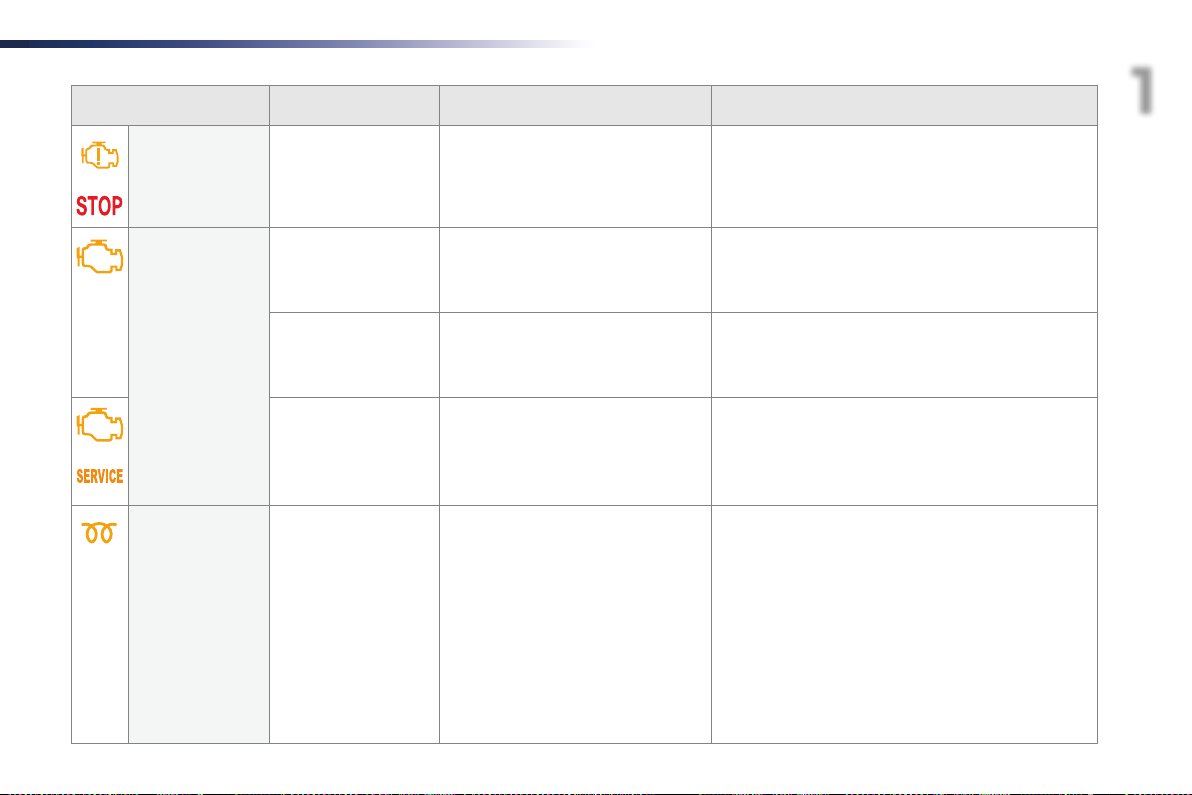
Engine
auto-diagnosis
system
+
Engine
auto-diagnosis
system
+
Diesel engine
pre-heating
fixed, associated with
the SToP warning
lamp.
fixed. The emission control system has a
flashing. The engine management system has
fixed, associated with
the SeRVICe warning
lamp.
fixed. The ignition switch is at
A major engine fault has been
detected.
fault.
a fault.
A minor engine fault has been
detected.
nd
the 2
position (igntion on).
or
The «START/STOP» button has been
pressed.
You must stop as soon as it is safe to do so.
Park, switch off the ignition and contact a PeugeoT
dealer or a qualified workshop.
The warning lamp should go off when the engine is started.
If it does not go off, contact a PeugeoT dealer or
qualified workshop without delay.
Risk of destruction of the catalytic converter.
Have it checked by a PeugeoT dealer or a qualified
workshop.
Have it checked by a PeugeoT dealer or a qualified
workshop.
Wait until the warning lamp goes off before starting.
once it goes off, starting is immediate, on condition that:
— the clutch pedal is pressed fully down with a manual
gearbox,
— pressure is maintained on the brake pedal with an
automatic or electronic gearbo x.
The period of illumination of the warning lamp is
determined by the ambient conditions (up to about thirty
seconds in extreme conditions).
If the engine does not start, switch the ignition off and
then on, wait until the warning lamp goes off again, then
start the engine.
1
19
Instruments
Warning / indicator lamp State Cause Action / Observations
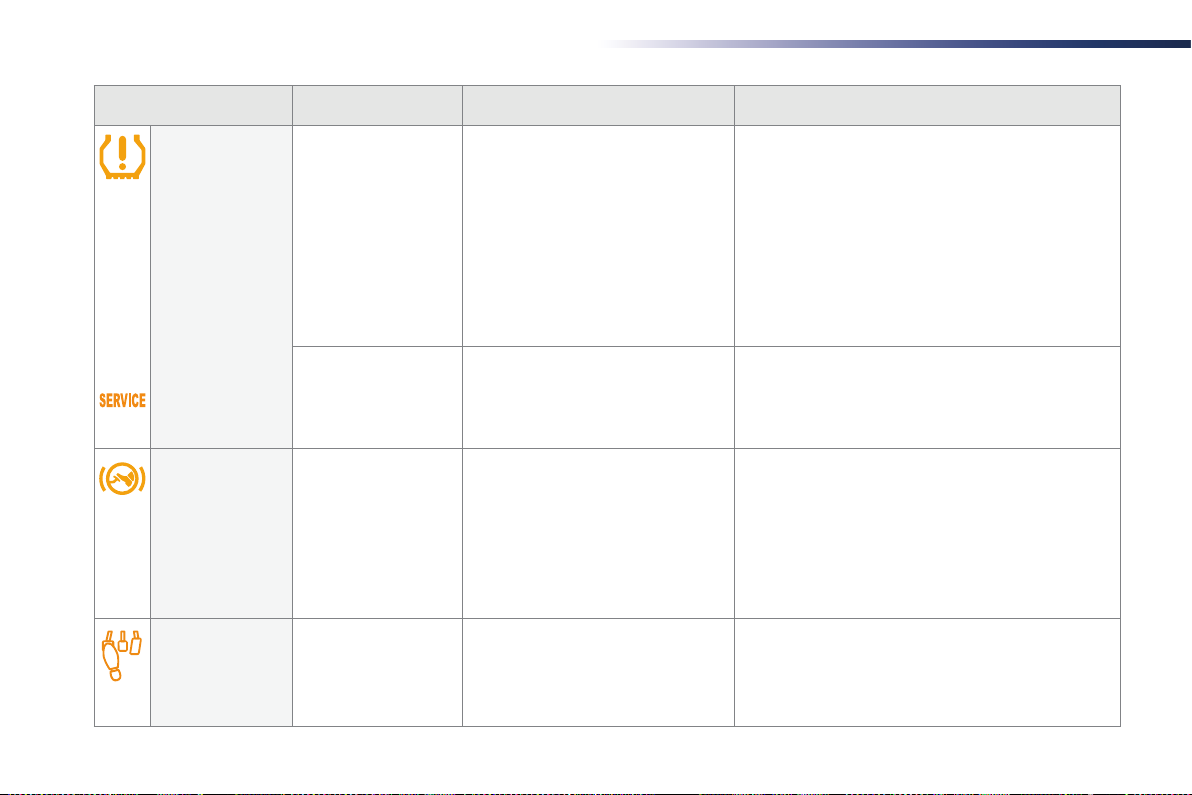
Under-inflation fixed, accompanied by
an audible signal and
a message.
The pressure in one or more tyres is
too low.
Check the tyre pressures as soon as possible.
This check should preferably be carried out when the
tyres are cold.
You must reinitialise the system after the adjustment
of one or more tyre pressures and after changing one
or more wheels.
For more information on Under-inflation detection,
refer to the corresponding section.
20
+ flashing then fixed,
Foot on the
brake pedal
Foot on the
clutch
accompanied by the
Service warning lamp.
fixed. The brake pedal must be pressed. With an automatic or electronic gearbox, press the
fixed. In the SToP mode of Stop & Start,
The system has a fault: the tyre
pressures are no longer monitored.
the change to START mode is denied
because the clutch pedal is not fully
down.
Check the tyre pressures as soon as possible.
Have the system checked by a PeugeoT dealer or a
qualified workshop.
brake pedal, engine running, before releasing the
parking brake, to release the selector lever and come
out of position P or N.
If you wish to release the parking brake without
pressing the brake pedal, this warning lamp will
remain on.
If your vehicle has a manual gearbox, you must
declutch fully to allow the change to engine START
mode.

Instruments
Warning / indicator lamp State Cause Action / Observations
Anti-lock
Braking System
(ABS)
Collision Risk
Alert / Active
Safety Brake
Particle filter
(Diesel)
fixed. The anti-lock braking system has a
flashing. The system is operating. The system brakes briefly so as to reduce the speed
fixed, accompanied
by a message and an
audible signal
fixed, accompanied by
a message.
fixed, accompanied
by an audible signal
message on the risk
of blockage of the
particle filter.
fixed, accompanied
by an audible signal
and and a message
that the particle filter
additive level is too
low.
fault.
The system has a fault. Have the system checked by a PeugeoT dealer or a
The system has been deactivated
(via the menu).
This indicates that the particle filter is
starting to become saturated.
This indicates the low level of the
additive reservoir.
The vehicle retains conventional braking.
Drive carefully at reduced speed and contact a
PeugeoT dealer or a qualified workshop without
delay.
of collision with the vehicle ahead.
qualified workshop.
For more information on the Collision Risk
Alert / Active Safety Brake system, refer to the
corresponding section.
As soon as driving conditions allow, regenerate the
filter by driving at a speed of at least 35 mph (60 km/h)
until the warning lamp goes off.
Have the reservoir topped-up as soon as possible by
a PeugeoT dealer or a qualified workshop.
1
21

Instruments
Warning / indicator lamp State Cause Action / Observations
Airbags on temporarily. This warning lamp comes on for a
few seconds when you turn on the
ignition, then goes off.
fixed. one of the airbag or seat belt
pretensioner systems has a fault.
This warning lamp should go off when the engine is
started.
If it does not go off, contact a PeugeoT dealer or a
qualified workshop.
Have them checked by a PeugeoT dealer or a
qualified workshop.
22
Passenger’s
front airbag
Passenger’s
front airbag
fixed in the seat belt
and front passenger’s
airbag warning lamps
display.
fixed. The control switch, located at the
The control switch, located at the
passenger’s end of the dashboard, is
set to the «OFF» position.
The passenger’s front airbag is
deactivated.
You can install a rearward facing
child seat, unless there is a fault with
the airbags (airbag warning lamp on).
passenger’s end of the dashboard, is
at the «ON» position.
The passenger’s front airbag is
activated.
In this case, do not install a rearward
facing child seat on the front
passenger seat.
Turn the control switch to the «ON» position to activate
the passenger’s front airbag; in this case, you must
not install a child seat in the rearward facing position
on this seat.
Turn the control switch to the «OFF» position to
deactivate the passenger’s front airbag.
You can install a rearward facing child seat, unless
there is a fault with the airbags (airbag warning
lamp on).
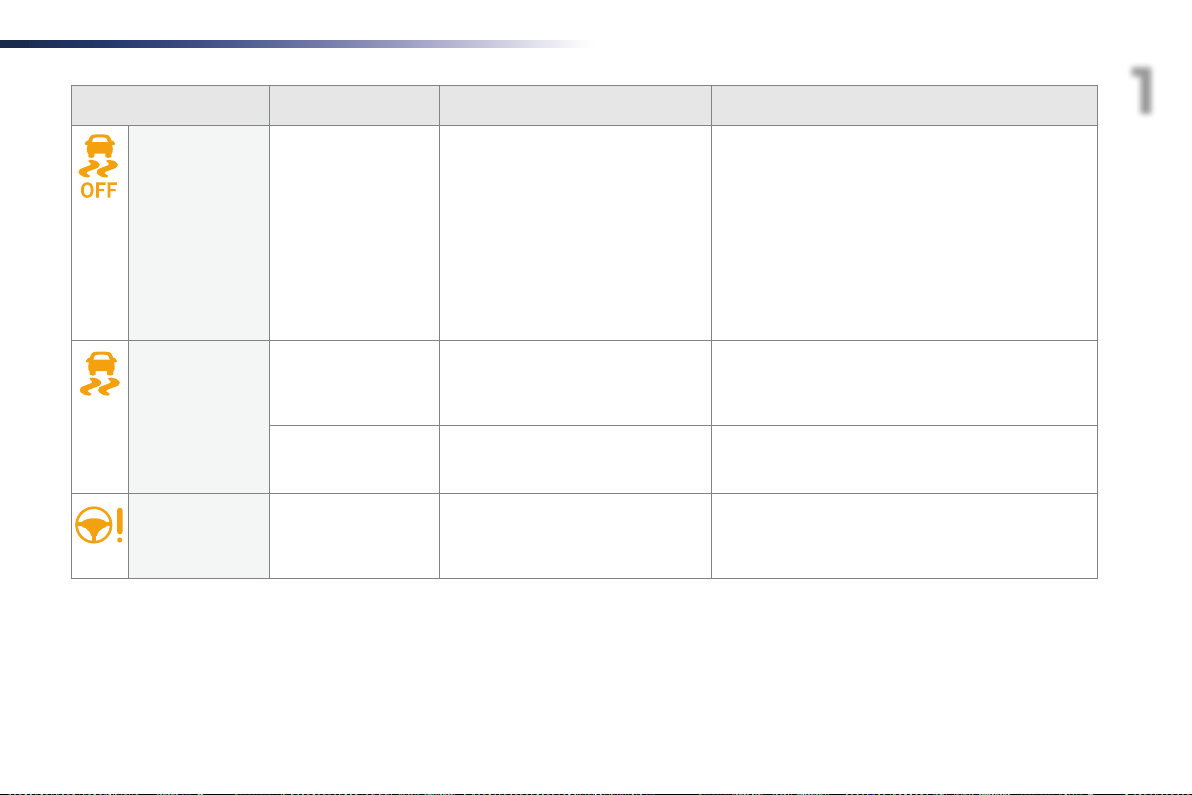
Instruments
Warning / indicator lamp State Cause Action / Observations
Dynamic
stability control
(DSC/ASR)
Dynamic
stability control
(DSC/ASR)
Power
steering
fixed. The button is pressed and the
indicator lamp comes on.
The DSC/ASR is deactivated.
DSC: dynamic stability control.
ASR: anti-slip regulation.
flashing. The DSC/ASR regulation is
operating.
fixed. The DSC/ASR system has a fault. Have the system checked by a PeugeoT dealer or a
fixed. The power steering has a fault. Drive carefully at reduced speed.
Press the button to activate the DSC/ASR. Its
indicator lamp goes off.
The DSC/ASR system is activated automatically when
the vehicle is started.
If deactivated, the system is reactivated automatically
from around 30 mph (50 km/h).
For more information on the Electronic stability
programme (ESC) and in particular, DSC/ASR, refer
to the corresponding section.
The system optimises traction and improves the
directional stability of the vehicle in the event of loss of
grip or trajectory.
qualified workshop.
Have it checked by a PeugeoT dealer or a qualified
workshop.
1
23
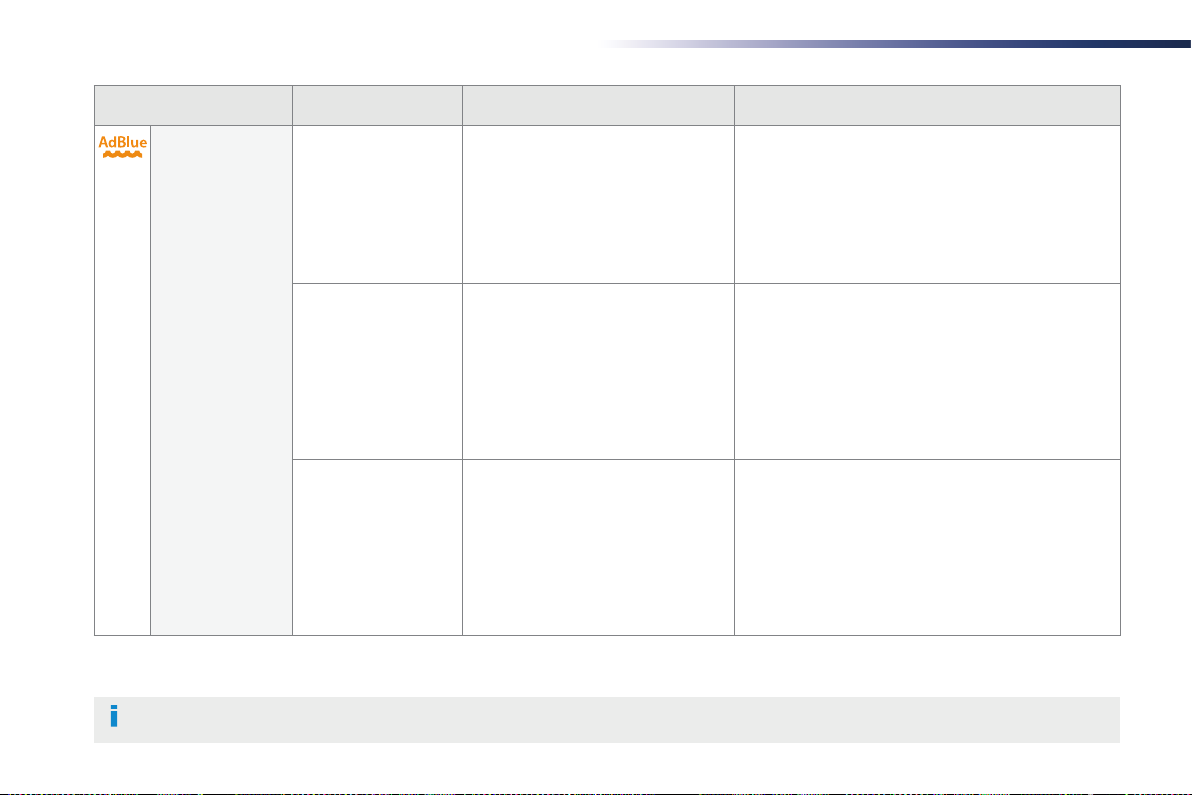
Instruments
Warning / indicator lamp State Cause Action / Observations
®
AdBlue
(BlueHDi Diesel)
fixed, on switching
on the ignition,
accompanied by an
The remaining driving range is
between 350 miles (600 km) and
1500 miles (2400 km).
Have the AdBlue
possible: go to a PeugeoT dealer or a qualified
workshop, or carry out this operation yourself.
®
tank topped-up as soon as
audible signal and a
message indicating
the remaining driving
range.
flashing, accompanied
by an audible signal
and a message
The remaining driving range is
between 0 and 350 miles (600 km).
You must top-up the AdBlue
breakdown: go to a PeugeoT dealer or a qualified
workshop, or carry out this operation yourself.
®
tank to avoid a
indicating the
remaining driving
range.
24
flashing, accompanied
by an audible signal
and a message
indicating that starting
is prevented.
The AdBlue
starting inhibition system required
by legislation prevents starting of the
engine.
®
tank is empty: the
To be able to start the engine, you must top-up the
®
AdBlue
tank: go to a PeugeoT dealer or a qualified
workshop, or carry out this operation yourself.
It is essential to add at least 3.8 litres of AdBlue
the fluid tank.
For topping-up the AdBlue® fluid or for more information on AdBlue®, refer to the corresponding section.
®
to

Instruments
Warning / indicator lamp State Cause Action / Observations
SCR emissions
control system
+
(BlueHDi Diesel)
+
fixed, on switching
on the ignition,
associated with the
SeRVICe and engine
diagnostic warning
lamps, accompanied
by an audible signal
and a message.
flashing, on switching
on the ignition,
associated with the
SeRVICe and engine
diagnostic warning
lamps, accompanied by
an audible signal and
a message indicating
the remaining driving
range.
flashing, on switching
on the ignition,
associated with the
SeRVICe and engine
diagnostic warning
lamps, accompanied
by an audible signal
and a message.
A fault with the SCR emissions
control system has been detected.
After confirmation of the fault with the
emissions control system, you can
drive for up to 650 miles (1 100 km)
before the engine starting inhibition
system is triggered.
You have exceeded the authorised
driving limit following confirmation
of a fault with the emissions control
system: the engine starting inhibition
system prevents starting of the
engine.
This alert disappears once the exhaust emissions
return to normal levels.
Contact a PeugeoT dealer or a qualified workshop
without delay, to avoid a breakdown.
To be able to start the engine, you must call on a
PeugeoT dealer or a qualified workshop.
1
25
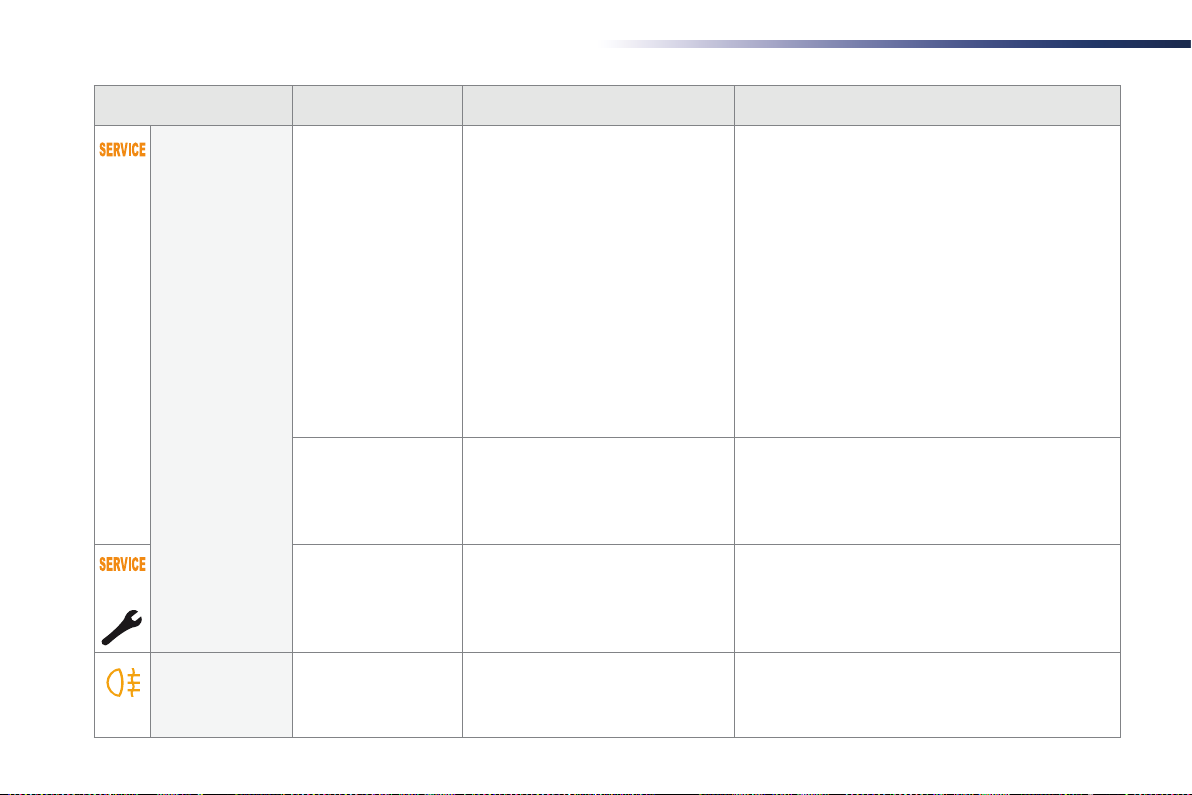
Instruments
Warning / indicator lamp State Cause Action / Observations
Service on temporarily. A minor fault has occurred for which
there is no specific warning lamp.
Identify the fault by means of the associated message,
for example:
— low engine oil level,
— low screenwash/headlamp wash fluid level,
— discharged remote control battery,
— low tyre pressures,
— saturation of the particle filter (FAP) on Diesel
vehicles.
— …
For more information on Checks and in particular the
particle filter, refer to the corresponding section.
For any other faults, contact a PeugeoT dealer or a
qualified workshop.
26
fixed. A major fault has occurred for which
fixed, associated with
+
Rear foglamps fixed. The rear foglamps are on. Turn the ring on the stalk rearward to switch off the
flashing and then fixed
display of the service
spanner.
there is no specific warning lamp.
The servicing interval has been
exceeded.
Identify the fault by reading the message and contact
a PeugeoT dealer or a qualified workshop.
only on BlueHDi Diesel versions.
Your vehicle must be serviced as soon as possible.
rear foglamps.

Instruments
Warning / indicator lamp State Cause Action / Observations
Automatic
wiping
Automatic
headlamp
dipping
Stop & Start fixed. When the vehicle stops (red lights,
Blind spot
monitoring
system
fixed. The wiper control has been pushed
fixed. The lighting control stalk is in the
flashes for a few
seconds, then goes
off.
fixed. The blind spot monitoring system has
down.
«AUTO» position, and the function
has been activated.
The main beam headlamps come
on if the exterior lighting and driving
conditions permit.
traffic jams, …) the Stop & Start system
has put the engine into SToP mode.
SToP mode is temporarily
unavailable,
or
START mode is invoked
automatically.
been activated.
Automatic front wiping is activated.
To deactivate automatic wiping, operate the control
stalk downwards or put the stalk into another position.
The camera, located at the top of the windscreen,
manages the operation of main beam, depending on
the ambient lighting and driving conditions.
For more information on Automatic headlamp
dipping, refer to the corresponding section.
The warning lamp goes off and the engine restarts
automatically in START mode, as soon as you want to
move off.
For more information on Stop & Start, refer to the
corresponding section.
For more information on the Blind spot monitoring
system, refer to the corresponding section.
1
27
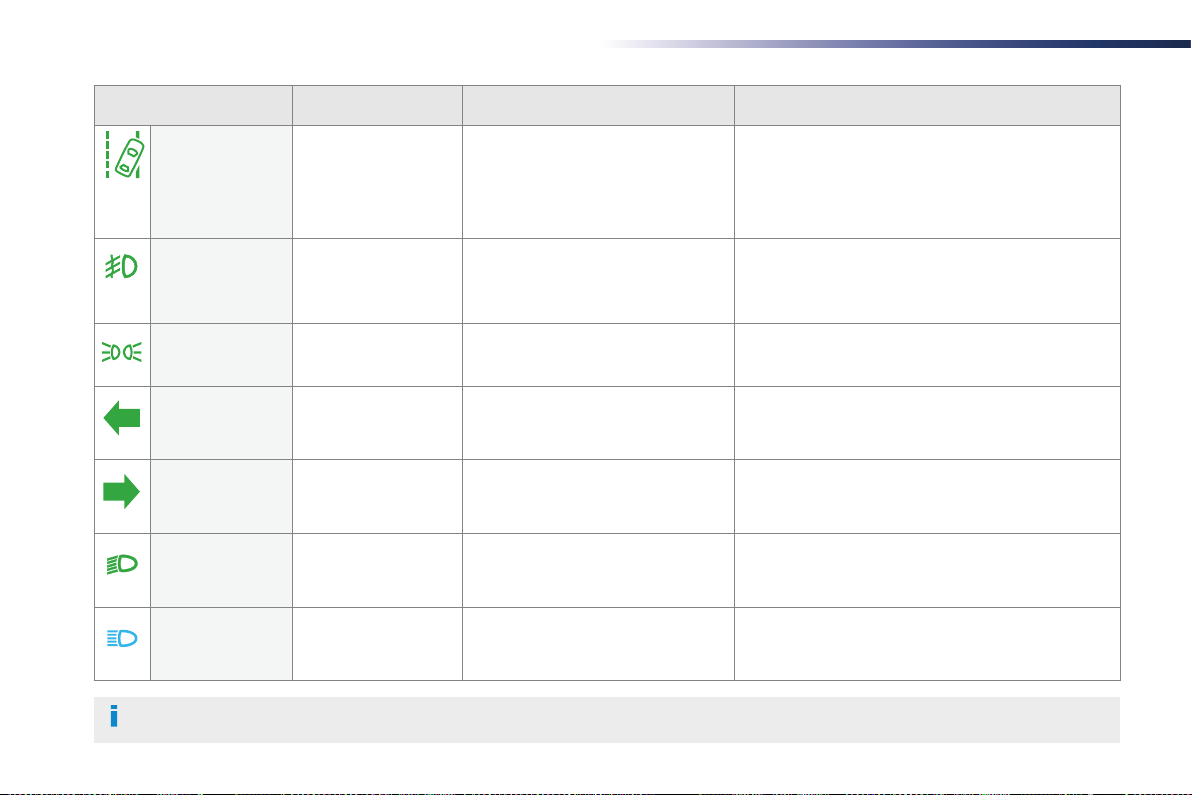
Instruments
Warning / indicator lamp State Cause Action / Observations
Lane departure
warning system
fixed. The lane departure warning system
has been activated.
The lane departure warning system is on.
For more information on the Lane departure warning
system, refer to the corresponding section.
28
Front
foglamps
Sidelamps fixed. The lighting stalk is in the
Left-hand
direction
indicator
Right-hand
direction
indicator
Dipped beam
headlamps
Main beam
headlamps
For more information on the Lighting control stalk, refer to the corresponding section.
fixed. The front foglamps are switched on
using the ring on the lighting control
stalk.
«Sidelamps» position.
flashing with buzzer. The lighting stalk has been pushed
down.
flashing with buzzer. The lighting stalk has been
pushed up.
fixed. The lighting stalk is in the «Dipped
beam headlamps» position.
fixed. The lighting stalk has been pulled
towards you.
Turn the ring on the lighting control stalk rearward
once to switch off the front foglamps.
Pull the stalk to return to dipped beam headlamps.
Loading…
Manual
View the manual for the Peugeot Traveller (2024) here, for free. This user manual comes under the category cars and has been rated by 5 people with an average of a 9.5. This manual is available in the following languages: English. Do you have a question about the Peugeot Traveller (2024)?
Ask your question here
Peugeot Traveller (2024) specifications
Below you will find the product specifications and the manual specifications of the Peugeot Traveller (2024).
The Peugeot Traveller (2024) is a minivan that offers ample space for passengers and cargo. It features a modern design with sleek lines and a comfortable interior. The vehicle is equipped with a range of safety features such as automatic emergency braking and lane departure warning system. The Peugeot Traveller (2024) is powered by a fuel-efficient engine that delivers good performance on the road. The minivan comes with a touchscreen infotainment system and connectivity options for smartphones. In terms of comfort, the Peugeot Traveller (2024) offers adjustable seating and climate control to ensure a pleasant ride for all occupants. Overall, the Peugeot Traveller (2024) is a practical and reliable option for families or businesses in need of a versatile transportation solution.
General
| Brand | Peugeot |
| Model | Traveller (2024) |
| Product | car |
| Language | English |
| Filetype | Manual (PDF) |
Frequently asked questions
Can’t find the answer to your question in the manual? You may find the answer to your question in the FAQs about the Peugeot Traveller (2024) below.
When does my Peugeot need maintenance?
Regular maintenance is necessary for every car. How often the car needs maintenance and what exactly needs to be done can be found in the maintenance instructions.
For major periodic service, this should generally be done every 2 years or after 30,000 kilometres.
One or more doors won’t open from the inside. Now what?
The lock is most likely set to the child safety lock so it cannot be opened from the inside. How to unset the child safety lock differs per brand and type.
My car radio does not turn on, now what?
If your car radio does not turn on, it will not receive any power. Check that the red wire is connected to the contact power supply and the yellow wire to the constant power supply.
How do I convert miles into kilometres?
1 mile equals 1.609344 kilometers and 1 kilometer equals 0.62137119 miles.
Where can I find the VIN number of my Peugeot?
The location of the VIN number of the car differs per brand and type of car.
The code may be stamped on the frame of the car or mounted on a plate. It is best to consult the manual of the Peugeot Traveller (2024)for the exact location of the VIN number.
When should I change the brake fluid of my Peugeot?
It is recommended to change the brake fluid every two years.
What is the difference between E10 and E5 petrol?
E10 petrol consists of up to ten per cent ethanol while E5 petrol will contain less than five per cent ethanol. As a result, the percentage of E10 petrol is lower than that of E5 petrol, making it less bad for the environment.
What is a VIN number?
The VIN number of a car is an identification number unique to each car. The abbreviation VIN therefore stands for Vehicle Identification Number.
Is the manual of the Peugeot Traveller (2024) available in English?
Yes, the manual of the Peugeot Traveller (2024) is available in English .
Is your question not listed? Ask your question here
Peugeot Traveller (2020)
Traveller-VP_en_Chap00_couv-imprimeur_ed01-2016
Handbook
User manual
View the manual for the Peugeot Traveller (2020) here, for free. This manual comes under the category cars and has been rated by 3 people with an average of a 8. This manual is available in the following languages: English. Do you have a question about the Peugeot Traveller (2020) or do you need help?
Ask your question here
Index
- Welcome
- Contents
- Overview
- Eco-driving
- Instruments
- Access
- Ease of use and comfort
- Lighting and visibility
- Safety
- Driving
- Practical information
- In the event of a breakdown
- Technical data
- Audio equipment and telematics
- Alphabetical index
- ADDITIONAL INFORMATION ON CHILD SEATS ERRATUM
- Bluetooth® audio system
- PEUGEOT Connect Radio
- Compatibility of fuels
Product Images (2)


Peugeot Traveller (2020) specifications
Below you will find the product specifications and the manual specifications of the Peugeot Traveller (2020).
The Peugeot Traveller is a minivan model manufactured by the French carmaker Peugeot. The 2020 version of the Traveller features a spacious interior, capable of seating up to eight passengers comfortably. The vehicle is equipped with a range of safety features such as airbags, stability control, and anti-lock brakes to ensure the well-being of its occupants.
In terms of performance, the Peugeot Traveller is available with a variety of engine options, including both gasoline and diesel variants. The vehicle offers a smooth and comfortable driving experience, making it ideal for long journeys or everyday commuting.
The exterior design of the Peugeot Traveller is sleek and modern, with a focus on aerodynamics and efficiency. The vehicle is available in a range of color options to suit individual preferences.
Overall, the Peugeot Traveller is a practical and reliable minivan that offers ample space for passengers and luggage. It is a suitable choice for families or businesses looking for a versatile and comfortable vehicle.
General
| Brand | Peugeot |
| Model | Traveller (2020) |
| Product | car |
| Language | English |
| Filetype | User manual (PDF) |
Questions & answers
Can’t find the answer to your question in the manual? You may find the answer to your question in the FAQs about the Peugeot Traveller (2020) below.
How do I adjust the seat position in my Peugeot Traveller (2020)?
A lever located on the side of the seat allows you to adjust the position of the seat. Pull it up to move the seat forward or backward, and release it to lock it into place.
How do I connect my phone to the car’s Bluetooth system?
On the car’s infotainment screen, go to the ‘Settings’ menu, then select ‘Bluetooth.’ Enable Bluetooth on your phone and search for available devices. Once you see your car’s name, select it and follow the prompts to pair your phone.
How do I activate the cruise control feature?
To activate the cruise control, find the control lever on the steering column. Press the lever down to the ‘ON’ position. Once activated, use the +/- buttons on the steering wheel to set your desired speed. Pulling the lever towards you will activate the cruise control system.
How can I adjust the temperature of the air conditioning?
Use the climate control panel located on the dashboard to adjust the temperature. Turn the dial or press the corresponding buttons to increase or decrease the desired temperature. You can also control the airflow direction and fan speed using these controls.
How do I open the tailgate of the Peugeot Traveller?
To open the tailgate, locate the release button on the key fob or on the driver-side door panel. Press the button to unlock and open the tailgate. Additionally, you can use the remote-controlled key fob to open the tailgate with the press of a button.
When does my Peugeot need maintenance?
Regular maintenance is necessary for every car. How often the car needs maintenance and what exactly needs to be done can be found in the maintenance instructions.
For major periodic service, this should generally be done every 2 years or after 30,000 kilometres.
One or more doors won’t open from the inside. Now what?
The lock is most likely set to the child safety lock so it cannot be opened from the inside. How to unset the child safety lock differs per brand and type.
My car radio does not turn on, now what?
If your car radio does not turn on, it will not receive any power. Check that the red wire is connected to the contact power supply and the yellow wire to the constant power supply.
How do I convert miles into kilometres?
1 mile equals 1.609344 kilometers and 1 kilometer equals 0.62137119 miles.
Where can I find the VIN number of my Peugeot?
The location of the VIN number of the car differs per brand and type of car.
The code may be stamped on the frame of the car or mounted on a plate. It is best to consult the manual of the Peugeot Traveller (2020)for the exact location of the VIN number.
When should I change the brake fluid of my Peugeot?
It is recommended to change the brake fluid every two years.
What is the difference between E10 and E5 petrol?
E10 petrol consists of up to ten per cent ethanol while E5 petrol will contain less than five per cent ethanol. As a result, the percentage of E10 petrol is lower than that of E5 petrol, making it less bad for the environment.
What is a VIN number?
The VIN number of a car is an identification number unique to each car. The abbreviation VIN therefore stands for Vehicle Identification Number.
Is the manual of the Peugeot Traveller (2020) available in English?
Yes, the manual of the Peugeot Traveller (2020) is available in English .
Is your question not listed? Ask your question here
Manufacturer: PEUGEOT, Model Year: 2016,
Model line: Traveller,
Model: Peugeot Traveller 2016
Pages: 528, PDF Size: 12.91 MB
Trending: ABS, Противотуманные фары, Ограничение скорости, ad blue, isofix, bluetooth, Горит постоянно одновременно с мигающей пиктограммой гаечног
Page 1 of 528
 Traveller-VP_ru_Chap00_couv-imprimeur_ed01-2016
Руководство по экспл\
уатации
PEUGEOT Trav E ll E r")
Page 2 of 528
Page 3 of 528
Page 4 of 528
Page 5 of 528
Page 6 of 528
Page 7 of 528
Page 8 of 528
Page 9 of 528
Page 10 of 528
- Load next 10 pages
Trending: service, child seat, запуск двигателя, ECO mode, airbag off, traction control, audio
View, print and download for free: Peugeot Traveller 2016 Инструкция по эксплуатации (in Russian), 528 Pages, PDF Size: 12.91 MB. Search in Peugeot Traveller 2016 Инструкция по эксплуатации (in Russian) online. CarManualsOnline.info is the largest online database of car user manuals. Peugeot Traveller 2016 Инструкция по эксплуатации (in Russian) PDF Download.
All product names, logos, and brands are property of their respective owners.
Privacy Policy | About Us & Contact
Где я могу найти номер VIN для моего Peugeot?
Положение номера VIN различается среди марок автомобилей и моделей. Он может быть отпечатан на кузове автомобиля или указан на табличке. Рекомендуется обратиться к руководству по эксплуатации Peugeot Traveller (2016) для точной информации о месте нахождения номера VIN.
Как проверить давление в шинах моего Peugeot Traveller (2016)?
Вы можете проверить давление в шинах вашего Peugeot Traveller (2016) с помощью манометра для измерения давления в шинах. Рекомендуемое давление в шинах обычно указано на наклейке внутри двери водителя или в руководстве владельца.
Какое масло нужно моему Peugeot Traveller?
Тип масла, необходимого вашему Peugeot Traveller, зависит от типа двигателя. Обратитесь к руководству владельца для рекомендуемой вязкости и спецификации масла.
Что такое номер VIN?
Номер VIN, также известный как идентификационный номер автомобиля, служит уникальным идентификатором для каждого автомобиля. Для точного местоположения номера VIN рекомендуется обратиться к руководству по эксплуатации Peugeot Traveller (2016).
Где я могу найти информацию о гарантийном покрытии моего Peugeot Traveller?
Информацию о гарантийном покрытии вашего Peugeot Traveller (2016) можно найти в гарантийном буклете, поставляемом с автомобилем. Обычно в нем содержится информация о сроке действия и охвате различных компонентов.
Когда мне следует запланировать техобслуживание для моего Peugeot Traveller?
Регулярное техническое обслуживание необходимо для оптимальной производительности автомобиля. Подробности о частоте техобслуживания и конкретных задачах можно найти в инструкциях по техническому обслуживанию. Обычно крупное техобслуживание должно производиться каждые два года или после пробега 30 000 километров.
Как сбросить индикатор технического обслуживания на панели приборов моего Peugeot Traveller?
Чтобы сбросить индикатор технического обслуживания на панели приборов вашего Peugeot Traveller (2016), следуйте инструкциям, описанным в руководстве по эксплуатации. Обычно это требует нажатия определенной комбинации кнопок в определенном режиме работы автомобиля.
С каким интервалом мне следует рассмотреть замену тормозной жидкости для моего Peugeot Traveller?
Рекомендуется заменять тормозную жидкость в вашем Peugeot Traveller (2016) каждые два года.
Что делать, если загорается лампа контроля двигателя моего Peugeot Traveller?
Если загорается лампа контроля двигателя вашего Peugeot Traveller (2016), это указывает на потенциальную проблему с автомобилем. Рекомендуется обратиться к квалифицированному механику для диагностики причины проблемы.
Как часто мне следует переключать шины на моем Peugeot Traveller?
Периодическая перестановка шин помогает обеспечить равномерный износ и продлить срок службы шин. Обычно рекомендуется переключать шины каждые 6 000-8 000 километров или по указаниям в руководстве владельца Peugeot Traveller (2016).
Что делать, если разряжается аккумулятор моего Peugeot?
Если разряжается аккумулятор вашего Peugeot Traveller, вы можете запустить автомобиль, используя провода для запуска двигателя и другой автомобиль с заряженным аккумулятором. В противном случае вы можете вызвать помощь на дороге.
Что делать, если одна или несколько дверей отказываются открываться изнутри?
Если у вас возникают проблемы с открыванием дверей изнутри, вероятно, включена детская защелка. Способ отключения детской защелки зависит от марки и модели автомобиля.
Как программировать новый ключ для моего Peugeot Traveller?
Для программирования нового ключа для вашего Peugeot Traveller обычно требуется следовать определенным инструкциям, описанным в руководстве пользователя, или обратиться за помощью в дилерский центр или к слесарю.
Какой рекомендуемый интервал для замены воздушного фильтра в моем Peugeot Traveller?
Рекомендуемый интервал для замены воздушного фильтра в вашем Peugeot Traveller (2016) зависит от условий езды. Обычно рекомендуется проверять воздушный фильтр каждые 12 000-15 000 километров и заменять его при необходимости.
Доступно ли руководство для Peugeot Traveller (2016) на русском языке?
Нет, руководство для Peugeot Traveller (2016) доступно на английском языке.