
Can You Chip In?
Dear Patron: Please don’t scroll past this. The Internet Archive is a nonprofit fighting for universal access to quality information. We build and maintain all our own systems, but we don’t charge for access, sell user information, or run ads. We’d be deeply grateful if you’d join the one in a thousand users that support us financially.
We understand that not everyone can donate right now, but if you can afford to contribute this Friday, we promise it will be put to good use. Our resources are crucial for knowledge lovers everywhere—so if you find all these bits and bytes useful, please pitch in.
Can You Chip In? Dear Patron: Please don’t scroll past this. The Internet Archive is working to keep the record straight by recording government websites, news publications, historical documents, and more. If you find our work useful, please pitch in.
Matrikon OPC Server for Allen Bradley
Page 23 of 49
4. M
ATRIKON
OPC E
XPLORER
Matrikon OPC Explorer is a general-purpose OPC client. It is included with all Matrikon OPC
Servers to ensure that users always have a reliable means to test the capabilities of the software.
Choose Matrikon OPC Explorer from the Start menu, directly under the Programs folder, to start
the program.
4.1 V
IEW
A
VAILABLE
OPC S
ERVERS
Matrikon OPC Explorer is an OPC client application. It connects to OPC server applications and
displays real-time values as they are received. When OPC Explorer starts up, it searches the
registry on the local computer and generates a list of program ID’s for available OPC servers. It
displays this list in a drop-down box at the top left-hand corner of
the window.
Every OPC server has a unique program ID. This is a human-
readable text string that is converted to a globally unique
identification number which COM then uses to identify the server.
Each server may have a version-specific program ID (with a
number appended to the end of the string), a version-independent
program ID (no number), or both. All Matrikon OPC Servers have
both types, but only the version- independent program ID shows up in the list.
If an error occurs during the communication session between OPC Explorer and an OPC server,
a message box appears explaining this. Click the Details button to get a more descriptive
explanation of the error. Deselect the “Disconnect Server” checkbox to ignore the error and
continue without disconnecting from the server. Choose Error Log from the View menu to
display a log of past errors. Right-click on the window and choose “Clear Log” to clear the log.
4.2 C
ONNECT TO AN
OPC S
ERVER
Select a program ID in the drop-down box. Choose Connect from the Server menu and then
choose either Local or Remote. The Local option will connect to a server running on the same
machine as the client while the Remote option will attempt to connect to an OPC server running
on another machine.
In the latter case, use the “Connect Remotely” dialog box to specify the remote machine. Remote
machines may be specified by UNC (i.e. “\\SYSDEV1”), DNS (i.e. “www.matrikon.com”), or IP
address (i.e. “198.162.0.1”). See the section on DCOM configuration for instructions on how to
configure OPC servers to receive remote connections.
COM will attempt to launch the OPC server if it is not currently running when the first client
attempts to connect to it. If the server runs as a local executable then COM will run it. If the
server runs as an NT service then COM will start it up.
Similarly, when the last client application disconnects from an OPC server, the server will shut
down. Matrikon OPC Servers wait for one minute before shutting down to avoid unnecessary
processing when client applications connect and disconnect frequently.
Министерство
общего и профессионального образования
РФ
Пензенский
государственный университет
Кафедра «Автоматика
и телемеханика»
Семенов А.Д.
Проектирование
систем управления
Методические
указания к практическим занятиям
по
курсу «Автоматизация проектирования
систем и средств управления»
2011
Задание
на
практическую работу
-
По указанию
преподавателя выбрать технологический
объект, для которого нужно спроектировать
систему управления. -
Составить
техническое задание на проектирование. -
Составить
календарный план работ по проектированию
системы. -
Утвердить
техническое задание и календарный план
работ у преподавателя. -
Составить
математическую модель технологического
объекта и всей системы в Simulink. -
Провести настройку
параметров регуляторов, обеспечивающих
заданное качество регулирования. -
Подключить входные
и выходные параметры системы к ОРС –
серверу. -
Убедится в
правильном приеме и передачи данных
ОРС – сервером. -
«Рисование»
статических частей мнемосхемы в Data
Rate. -
Заполнение
мнемосхем динамическими элементами. -
«Подключение»
к разработанной математической
модели системы к Data
Rate
через ОРС –
сервер. -
Отладка системы.
-
Комплектация
системы. -
Оформление
технической документации.
1.
Экспериментальные методы настройки
ПИД – регуляторов
Экспериментальные
методы настройки регуляторов заключаются
в проведении экспериментов на действующей
системе регулирования или ее модели с
последующим изменением параметров
регулятора по результатам экспериментов.
Наиболее распространенным из этих
методов является метод, разработанный
американскими учеными Циглером и
Никольсом [60].
Метод
незатухающих колебаний. В
работающей системе отключаются
интегральная и дифференциальная
составляющие регулятора путем установки
времени изодрома
и времени дифференцирования,
т.е. в системе используется в П-закон
регулирования.
Путем
последовательного увеличения
с
одновременной подачей небольшого
скачкообразного сигнала задания
добиваются возникновения в системе
незатухающих колебаний с периодом.
Это соответствует выведению системы
на границу колебательной устойчивости.
При возникновении данного режима работы
фиксируются значения критического
коэффициента усиления регулятораи периода критических колебаний в
системеПри появлении критических колебаний
ни одна переменная системы не должна
выходить на уровень ограничения.
По
значениям
ирассчитываются
параметры настройки модифицированного
ПИД-регулятора с передаточной функцией
. (9.5)
П
— регулятор: ;
ПИ
–регулятор:,;
ПИД
— регулятор: ,,.
Учитывая, что собственная частота
ОУ совпадает с критической частотойколебаний
замкнутой системы с П-регулятором,
величиныимогут быть определены по амплитуде и
периоду критических колебаний собственно
объекта управления.
В
том случае если выведение объекта на
границу колебательной устойчивости
нежелательно из — за возможности
возникновения аварийной ситуации или
к выпуску бракованной продукции
используется метод затухабщих колебаний.
Метод
затухающих колебаний. Применение
этого метода позволяет настраивать
регуляторы без выведения системы на
критические режимы работы. Также, как
и в предыдущем методе, для замкнутой
системы с П — регулятором, путем
последовательного увеличения
добиваются возникновения в системе
колебательного переходного процесса
с логарифмическим декрементом затухания.
Далее определяется период этих колебанийи значения постоянных интегрированияи дифференцированиярегулятора.
Для
ПИ-регулятора:
.
Для
ПИД-регулятора: ,.
После
установки вычисленных значений
ина регуляторе производится дополнительная
подстройка коэффициентадо получения исходного декремента
затухания,
что обычно приводит к уменьшениюна
20÷30 %. Аналогичный метод настройки
используется в адаптивных регуляторах
американской фирмы «Фоксборо».
OPC
(OLE for Process Control) — семейство программных
технологий, предоставляющих единый
интерфейс для управления объектами
автоматизации и технологическими
процессами.
Назначение
Стандарт
OPC
разрабатывался с целью сократить затраты
на создание и сопровождение приложений
промышленной автоматизации. В начале
90-х у разработчиков промышленного ПО
возникла потребность в универсальном
инструменте обмена данными с устройствами
разных производителей или по разным
протоколам обмена данными.
Суть
OPC
проста — предоставить разработчикам
промышленных программ универсальный
фиксированный интерфейс (то есть набор
функций) обмена данными с любыми
устройствами. В то же время разработчики
устройств предоставляют программу,
реализующую этот интерфейс (набор
функций).
Стандарты
OPC
— набор спецификаций стандартов. Каждый
стандарт описывает набор функций
определенного назначения. Текущие
стандарты:
OPC
DA
(Data
Access)
— основной и наиболее востребованный
стандарт. Описывает набор функций обмена
данными в реальном времени с ПЛК, РСУ,
ЧМИ, ЧПУ и другими устройствами.
OPC
AE
(Alarms
& Events)
— предоставляет функции уведомления
по требованию о различных событиях:
аварийные ситуации, действия оператора,
информационные сообщения и другие.
OPC
Batch
— предоставляет функции шагового и
рецептурного управления технологическим
процессом (в соответствии с стандартом
S88.01)
OPC
DX
(Data
eXchange)
— предоставляет функции организации
обмена данными между OPC-серверами
через сеть Ethernet.
Основное назначение — создание шлюзов
для обмена данными между устройствами
и программами разных производителей.
OPC
HDA
(Historical
Data
Access)
— в то время как OPC
Data
Access
предоставляет доступ к данным изменяющимся
в реальном времени, OPC
Historical
Data
Access
предоставляет доступ к уже сохраненным
данным.
OPC
Security
— определяет функции организации прав
доступа клиентов к данным системы
управления через OPC-сервер.
OPC
XML—DA
(XML—Data
Access)
— предоставляет гибкий, управляемый
правилами формат обмена данными через
SOAP
и HTTP.
OPC
UA
(Unified
Architecture)
— последняя по времени выпуска
спецификация, которая основана не на
технологии Microsoft
COM,
что предоставляет кросс-платформенную
совместимость.
Matrikon opc
Данный
свободно распространяемый программный
пакет состоит из трех частей:
-
MatrikonOPC
Analyzer -
MatrikonOPC
Explorer -
MatrikonOPC
Server for Simulation
-
MatrikonOPC
Analyzer
– утилита сбора системной информации.
Позволяет получить информацию о системе
(System
Information),
лог файлы (Log
Files),
конфигурационные файлы (Configuration
Files)
информацию о состоянии DCOM
в формате *.txt,
а так же их автоматическую упаковку в
zip-архив. -
MatrikonOPC
Explorer
– утилита, позволяющая находить и
подключаться к существующим OPC
– серверам, запущенным как на текущем
компьютере (local
host),
так и на любом компьютере в локальной
сети или сети интернет. -
MatrikonOPC
Server
for
Simulation
– утилита, позволяющая создавать
OPC-сервер.
Настройка
и
запуск
MatrikonOPC Server for Simulation и
MatrikonOPC Explorer.
Соседние файлы в папке Практика
- #
- #
- #
- #
- #
- #
Matrikon OPC Server fo
Allen Bradle
User Manual

Matrikon OPC Server for Allen Bradley
Matrikon OPC Server for Allen Bradley — User’s Manual
For additional information on this manual, this OPC server, or Matrikon, please contact:
Address: Matrikon
1800, 10405 Jasper Avenue
Edmonton, Alberta, Canada
T5J 3N4
Phone: 780-448-1010
Fax: 780-448-9191
Web: http://www.matrikon.com
Sales: drivers@matrikon.com
Support: support@matrikon.com
CONFIDENTIAL
The information contained herein is confidential and proprietary to Matrikon.
It may not be disclosed or transferred, directly or indirectly, to any third party without the
explicit written permission of Matrikon.
All rights reserved. No part of this document may be reproduced, stored in a retrieval system,
translated, or transmitted in any form or by any means, electronic, mechanical, photocopying,
recording, or otherwise, without prior written permission of Matrikon.
© Copyright 2001
Matrikon Inc.
Page 2 of 49

Matrikon OPC Server for Allen Bradley
TABLE OF CONTENTS
1. Introduction…………………………………………………………………………………………………………………………………………………………………………………………………………………………………….5
1.1 System Requirements………………………………………………………………………………………………………………………………………………………………………………………………………5
1.2 OPC Overview…………………………………………………………………………………………………………………………………………………………………………………………………………………….5
1.3 OPC Server Overview……………………………………………………………………………………………………………………………………………………………………………………………………6
2. Getting Started……………………………………………………………………………………………………………………………………………………………………………………………………………………………….7
2.1 Installation………………………………………………………………………………………………………………………………………………………………………………………………………………………….7
2.1.1 Matrikon OPC Server………………………………………………………………………………………………………………………………………………………………………………………………7
2.1.2 Standard OPC Proxy/Stubs………………………………………………………………………………………………………………………………………………………………………………..7
2.1.3 Standard OPC Server Browser………………………………………………………………………………………………………………………………………………………………………..8
2.1.4 Matrikon OPC Common Components………………………………………………………………………………………………………………………………………………………..8
2.1.5 Matrikon OPC Explorer………………………………………………………………………………………………………………………………………………………………………………………….8
2.1.6 Matrikon OPC Automation Component…………………………………………………………………………………………………………………………………………………….8
2.1.7 Installation Options……………………………………………………………………………………………………………………………………………………………………………………………….9
2.2 Licensing……………………………………………………………………………………………………………………………………………………………………………………………………………………………..9
2.3 Command-Line…………………………………………………………………………………………………………………………………………………………………………………………………………………9
3. Configuration……………………………………………………………………………………………………………………………………………………………………………………………………………………………….10
3.1 Starting Up………………………………………………………………………………………………………………………………………………………………………………………………………………………..10
3.2 Server Configuration…………………………………………………………………………………………………………………………………………………………………………………………………12
3.3 Allen Bradley ……………………………………………………………………………………………………………………………………………………………………………………………………………………14
3.4 Define an Allen-Bradley PLC…………………………………………………………………………………………………………………………………………………………………………………15
3.5 Alias Configuration…………………………………………………………………………………………………………………………………………………………………………………………………….16
3.6 Save the Configuration …………………………………………………………………………………………………………………………………………………………………………………………….18
3.7 DCOM Configuration…………………………………………………………………………………………………………………………………………………………………………………………………..19
3.8 Statistics…………………………………………………………………………………………………………………………………………………………………………………………………………………………….19
3.9 Options…………………………………………………………………………………………………………………………………………………………………………………………………………………………………19
3.9.1 General…………………………………………………………………………………………………………………………………………………………………………………………………………………………20
3.9.2 Logging…………………………………………………………………………………………………………………………………………………………………………………………………………………………20
3.9.3 Advanced…………………………………………………………………………………………………………………………………………………………………………………………………………………….22
3.10 Shutting Down……………………………………………………………………………………………………………………………………………………………………………………………………………….22
4. Matrikon OPC Explorer…………………………………………………………………………………………………………………………………………………………………………………………………………..23
4.1 View Available OPC Servers…………………………………………………………………………………………………………………………………………………………………………………23
4.2 Connect to an OPC Server……………………………………………………………………………………………………………………………………………………………………………………..23
4.3 Add OPC Groups…………………………………………………………………………………………………………………………………………………………………………………………………………….24
4.4 Add OPC Items………………………………………………………………………………………………………………………………………………………………………………………………………………..24
4.4.1 Item ID…………………………………………………………………………………………………………………………………………………………………………………………………………………………..25
4.4.2 Access Path……………………………………………………………………………………………………………………………………………………………………………………………………………….25
4.4.3 Browse the Server Address Space …………………………………………………………………………………………………………………………………………………………..25
4.4.4 Requested Data Type………………………………………………………………………………………………………………………………………………………………………………………….26
4.4.5 Active State……………………………………………………………………………………………………………………………………………………………………………………………………………….26
4.4.6 Validate the OPC Items……………………………………………………………………………………………………………………………………………………………………………………..26
4.5 Read Real-time Values……………………………………………………………………………………………………………………………………………………………………………………………26
4.5.1 Update Rate……………………………………………………………………………………………………………………………………………………………………………………………………………….26
Page 3 of 49

Matrikon OPC Server for Allen Bradley
4.5.2 Active State……………………………………………………………………………………………………………………………………………………………………………………………………………….26
4.5.3 Data Display………………………………………………………………………………………………………………………………………………………………………………………………………………26
4.5.4 I/O Method…………………………………………………………………………………………………………………………………………………………………………………………………………………..27
4.5.5 Time Bias……………………………………………………………………………………………………………………………………………………………………………………………………………………..27
4.5.6 Dead-band………………………………………………………………………………………………………………………………………………………………………………………………………………….28
4.5.7 Advise Log…………………………………………………………………………………………………………………………………………………………………………………………………………………..28
4.6 Write Control Values………………………………………………………………………………………………………………………………………………………………………………………………..28
4.7 Options………………………………………………………………………………………………………………………………………………………………………………………………………………………………..29
4.7.1 General…………………………………………………………………………………………………………………………………………………………………………………………………………………………29
4.7.2 Data Transfer……………………………………………………………………………………………………………………………………………………………………………………………………………29
4.7.3 Data Display………………………………………………………………………………………………………………………………………………………………………………………………………………29
4.7.4 COM………………………………………………………………………………………………………………………………………………………………………………………………………………………………….29
4.8 Save the Session…………………………………………………………………………………………………………………………………………………………………………………………………………29
5. Matrikon OPC Automation Component……………………………………………………………………………………………………………………………………………………………………..30
6. Troubleshooting………………………………………………………………………………………………………………………………………………………………………………………………………………………..31
Appendix A — Item ID Syntax……………………………………………………………………………………………………………………………………………………………………………………………………………33
6.1 Add Items…………………………………………………………………………………………………………………………………………………………………………………………………………………………..33
6.2 Read and Write Data………………………………………………………………………………………………………………………………………………………………………………………………….33
Appendix B — Performance………………………………………………………………………………………………………………………………………………………………………………………………………………34
Appendix C — Distributed COM (DCOM)……………………………………………………………………………………………………………………………………………………………………………………35
C.1 DCOM Configuration Utility………………………………………………………………………………………………………………………………………………………………………………………………35
C.2 Default Properties ………………………………………………………………………………………………………………………………………………………………………………………………………………….35
C.3 Security Permissions………………………………………………………………………………………………………………………………………………………………………………………………………….36
C.4 Server Identity………………………………………………………………………………………………………………………………………………………………………………………………………………………….38
C.5 Default Protocols……………………………………………………………………………………………………………………………………………………………………………………………………………………38
C.6 Remote Program ID……………………………………………………………………………………………………………………………………………………………………………………………………………….39
Appendix D — OPC Compliance………………………………………………………………………………………………………………………………………………………………………………………………………40
D.1 OPC Server Object…………………………………………………………………………………………………………………………………………………………………………………………………………………..40
D.2 OPC Group Object……………………………………………………………………………………………………………………………………………………………………………………………………………………40
D.3 Server Registration……………………………………………………………………………………………………………………………………………………………………………………………………………….41
Appendix E — OPC Quality Flags……………………………………………………………………………………………………………………………………………………………………………………………………..42
Appendix F — VARIANT Data Types……………………………………………………………………………………………………………………………………………………………………………………………….44
Appendix G — OPC I/O Methods………………………………………………………………………………………………………………………………………………………………………………………………………45
G.1 Synchronous Versus Asynchronous I/O………………………………………………………………………………………………………………………………………………………………..45
G.2 Device Versus Cache Reads…………………………………………………………………………………………………………………………………………………………………………………………..45
G.3 OPC DA 2.0 versus 1.0a Asynchronous I/O…………………………………………………………………………………………………………………………………………………………….46
Appendix H — Alias Configuration………………………………………………………………………………………………………………………………………………………………………………………………..47
H.1 Scaling Expressions………………………………………………………………………………………………………………………………………………………………………………………………………………47
H.2 Configuration CSV Format………………………………………………………………………………………………………………………………………………………………………………………………..48
Page 4 of 49

Matrikon OPC Server for Allen Bradley
1. INTRODUCTION
This document is the user’s manual for the Matrikon OPC Server for Allen-Bradley PLCs. This
server is an OPC™ compliant program that allows access to Allen-Bradley ™ PLC registers.
The product has the following features:
• Fully compliant with OPC™ Data Access Specification 1.0a;
• Allows access all standard files and to structured data files in Allen-Bradley™ PLC-5
and SLC-500 PLCs;
• Supports Allen-Bradley™ PLC-5 and SLC-500 PLCs;
• Provides flexible communications options using RS-LINX as the communications
manager;
• Requires minimal configuration after installation;
• Performs extensive error tracking and management; and
•
Includes Matrikon’s OPC Explorer for testing and configuration.
1.1 SYSTEM REQUIREMENTS
This Matrikon OPC Server has the following minimum system requirements:
• Intel Pentium II 200MHz Processor
• 64 MB RAM
• 25 MB hard drive space
• Microsoft Windows NT 4.0 Service Pack 5 (or higher)
The server has the following additional requirements:
• This should include any specific hardware. Including version and model numbers!!!
1.2 OPC OVERVIEW
OLE for Process Control (OPC) was designed to bridge Windows based applications and process
control hardware and software applications. It is an open standard that permits a consistent
method of accessing field data from plant floor devices. This method remains the same
regardless of the type and source of data.
OPC servers provide a method for many different software packages to access data from a
process control device, such as a PLC or DCS. Traditionally, any time a package needed access
data from a device, a custom interface, or driver, had to be written. The purpose of OPC is to
define a common interface that is written once and then reused by any business, SCADA, HMI,
or custom software packages.
Page 5 of 49

Matrikon OPC Server for Allen Bradley
Client
Application
Client
Application
Client
Application
OPC Interface
OPC
Server
Device A Device CDevice B
OPC
Server
Once an OPC server is written for a particular device, it can be reused by any application that is
able to act as an OPC client. OPC servers use Microsoft’s OLE technology (also known as the
Component Object Model, or COM) to communicate with clients. COM technology permits a
standard for real-time information exchange between software applications and process hardware
to be defined.
OPC
Server
1.3 OPC SERVER OVERVIEW
This OPC server follows the requirements of the OPC specificat ion to provide data access to an
OPC client. This server implements OPC Data Access (DA) version 1.0a and 2.0 of the OPC
custom interface.
Also, the server is optimized for high performance and uses multithreaded technology to provide
efficient response to client requests. This approach allows multiple clients to connect to and
effectively use the resources of a server.
This Matrikon OPC server requires very little configuration after installation. It manages its
communication automatically, providing optimal device polling with no additional configuration
required by the user. This provides a flexible and powerful method to access data that is still
simple to manage.
This OPC server (as all of Matrikon’s OPC servers) is guaranteed to be 100% compliant with the
OPC DA 1.0a and 2.0 specification. In addition, since our applications are sold world wide,
either by vendors or directly by Matrikon, we have developed a comprehensive set of standards
and tools to ensure that our interfaces are:
• Easy to use
• Robust
• Reliable
• Efficient
• Complete with error checking and recovery procedures
The focus of Matrikon is to develop strong long-term relationships with our clients. To that
extent we make it a priority to become familiar with both the business and technical
requirements of all our clients. This enables us to provide innovative services and solutions to
enhance the technology direction selected by our clients within the framework in place today. At
Matrikon we aim to provide solutions to meet your requirements.
Page 6 of 49

Matrikon OPC Server for Allen Bradley
2. GETTING STARTED
This section guides you through the process of setting up a Matrikon OPC Server for real-time
data access. Please follow the instructions carefully to avoid problems.
2.1 INSTALLATION
The installation program for a Matrikon OPC Server comes on either CD-ROM or 3½” floppy
disks. Insert the media in the drive and choose Add/Remove Programs from the Control Panel.
Click Install and follow the instructions from the Installation Wizard.
The installation program copies all necessary files to the target computer, registers the various
software components, and creates short-cut icons in the Start menu.
2.1.1 MATRIKON OPC SERVER
In addition to the standard Matrikon OPC Server files, the Matrikon OPC Server for Device
installs the following files. These files are installed by default in the
MATRIKON\OPC\AllenBradley directory under the Program Files folder.
Filename Description
OPCAllenBradley.EXE Matrikon OPC Server for AllenBradley Devices Executable
PSTCFGAllenBradley LIB.OCX Configuration Panels ActiveX Component
The version-independent program ID for the server is «Matrikon.OPC.AllenBradley «. The
version-specific program ID for this version of the server is «Matrikon.OPC.AllenBradley.1».
The Matrikon OPC Server for AllenBradley Devices uses a software key for licensing. Contact
Matrikon at drivers@matrikon.com to obtain the registration code for this server.
2.1.2 STANDARD OPC PROXY/STUBS
In compliance with OPC standards, Matrikon OPC Servers install and register the official OPC
proxy/stub DLL’s in the Windows NT SYSTEM32 directory. These files contain version
information so that they avoid overwriting newer files with outdated ones.
Filename Description
OPCPROXY.DLL
OPCCOMN_PS.DLL OPC Common 1.0 Interfaces Marshalling Library
OPC_AEPS.DLL OPC Alarms and Events 1.0 Interfaces Marshalling Library
OPC Data Access 2.0 and 1.0a Interfaces Marshalling
Library
Vendors were originally required to supply their own version of the OPC proxy/stub.
Unfortunately, this proved to cause conflicts between various versions of the DLL’s
when products from different vendors were installed on the same machine. To solve
this problem, the OPC Foundation created official DLLs and they now require that all
vendors install these instead. However, older OPC server installation programs may
still install the old DLLs, preventing new servers from functioning properly. If this
Page 7 of 49

Matrikon OPC Server for Allen Bradley
occurs, simply run a newer installation again to ensure that the official DLLs are
installed.
2.1.3 STANDARD OPC SERVER BROWSER
In compliance with OPC standards, Matrikon OPC Servers install and register the official OPC
Server Browser in the Windows NT SYSTEM32 directory. This file contains version
information to avoid overwriting a newer file with an outdated one. The installation program
also ensures that the Act iveX Interface Marshalling Library is on the target machine so that the
server functions properly.
Filename Description
ACTXPRXY.DLL ActiveX Interface Marshalling Library
OPCENUM.EXE OPC Server Browser
2.1.4 MATRIKON OPC COMMON COMPONENTS
Matrikon OPC Servers require the following files to function properly. These files are installed
by default in the MATRIKON\OPC\COMMON directory under the Program Files folder (except
for EXPREVAL.DLL, which is installed in the SYSTEM32 directory).
Filename Description
PSTCFG.EXE Matrikon OPC Server Configuration Client
PSTCFGPS.DLL Matrikon OPC Server Configuration Marshalling Library
OEM_Matrikon_OPC.DLL Matrikon OPC OEM Badge Library
EXPREVAL.DLL Expression Evaluation Library (for aliases)
2.1.5 MATRIKON OPC EXPLORER
Matrikon OPC Explorer is a general-purpose OPC client that is useful for testing the capabilities
of any OPC server. The file is installed by default in the MATRIKON\OPC\COMMON
directory under the Program Files folder. A shortcut icon for the program is added to the Start
menu (in the common group).
Filename Description
OPCEXPLORER.EXE Matrikon OPC Explorer (General-purpose OPC Client)
2.1.6 MATRIKON OPC AUTOMATION COMPONENT
The Matrikon OPC Automation Component enables developers to access OPC data from client
applications developed using Automation tools such as Visual Basic, VBA, and VB Script. This
component is installed by default in the MATRIKON\OPC\COMMON directory under Program
Files.
Filename Description
Page 8 of 49

Matrikon OPC Server for Allen Bradley
OPCDAAUTO.DLL Matrikon OPC Automation Component
2.1.7 INSTALLATION OPTIONS
Just before the installation program finishes, it offers two additional options. One option
specifies whether the server should be installed as an NT service instead of a local executable.
The other option provides a means to resto re the older “ProcessX.OPC.Device” program ID to
retain compatibility for clients that were coded to use earlier versions of the server.
2.2 LICENSING
Most Matrikon OPC Servers require some form of license criteria to be met in order to function
fully. Licensing for a particular server can use either a hardware key or a software key.
For servers requiring hardware licensing, a HASP hardware key coded to that particular program
can be purchased. This key must be securely fastened to the parallel port of the computer on
which the server is installed. It does not interfere with hardware keys from other vendors, nor
does it affect other normal parallel port applications, such as printing.
If a server uses hardware licensing, then the installation program will install a device driver for
HASP keys on the target system. When the server starts up, it will display a message box if it
does not detect the correct key. It will then function for a demonstration period of two hours
before “timing out”. At this point all devic e communication will cease.
For servers requiring software licensing, a special ten-digit number is supplied when the server is
purchased. This number must be entered in the Software Registration screen, available from the
About box for the server (see the section on configuration for instructions on how to access the
About box). The About box will include the words “UNREGISTERED COPY” if the number is
missing or incorrect.
2.3 COMMAND-LINE
The installation program registers the Matrikon OPC Server to run as either a local executable or
an NT service (based on user choices) and creates a shortcut in the Start menu. Use this shortcut
to invoke the configuration utility, which will in turn start up the server. For reference purposes,
the command-line parameters for the OPC server executable are as follows.
Parameter Description
/REGSERVER
–REGSERVER
/SERVICE
–SERVICE
/UNREGSERVER
–UNREGSERVER
Registers the OPC server to run as a local executable
(uninstalling the NT service if necessary).
Registers the OPC server to run as an NT service. By default
the service is set to run as the System account as an
interactive process.
Removes all registry entries for the OPC server (uninstalling
the NT service if necessary).
Starts up a copy of the OPC server as a local executable. It is
(no parameters)
preferable to start the server up from the configuration utility
or another OPC client instead of from the command line.
Page 9 of 49
Matrikon OPC Server for Allen Bradley
3. CONFIGURATION
Matrikon OPC Servers require a very small amount of configuration to function properly. This
section describes how to create a configuration for your OPC Server using the supplied PSTCFG
utility application. It begins with a generic discussion of using PSTCFG, and is followed by
specific details on configuring devices supported by this OPC Server.
3.1 STARTING UP
Choose the appropriate shortcut for the OPC server from the Start menu to invoke the PSTCFG
configuration utility. By default, the shortcut has the name “Matrikon OPC Server for Device”
and appears in “Matrikon OPC/Device” under the common section of the Programs folder.
If the OPC server is not currently running, then it will launch when the configuration utility is
started. If the server runs as a local executable, the splash screen is displayed and then a small
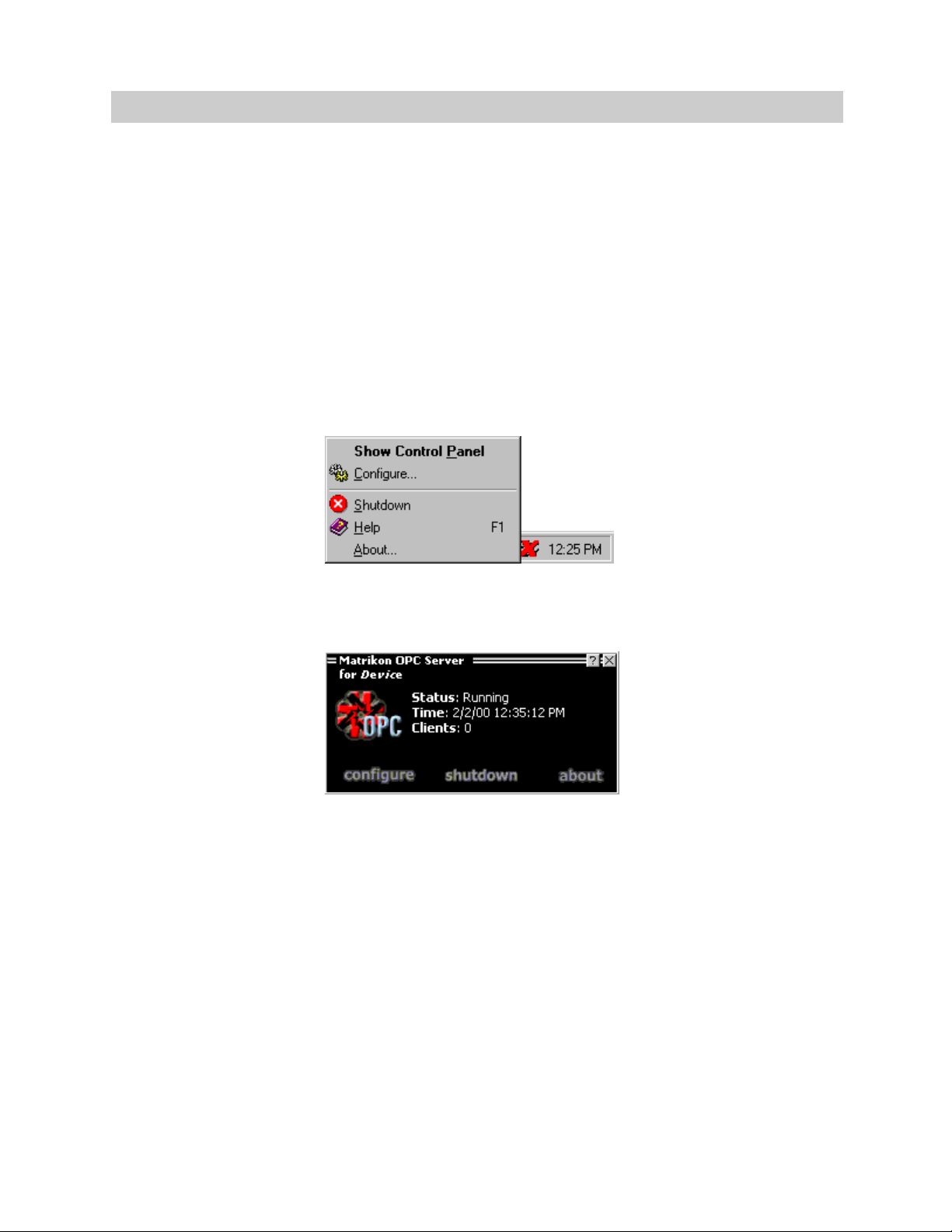
red X appears in the Tool Tray at the right-hand side of the Task Bar. Right-click on the X to
display the following menu.
Click “Show Control Panel” to display the control panel for the server. Double clicking on the X
accomplishes this as well. The control panel displays general statistics for the server, such as the
number of clients currently connected.
The control panel always stays on top of every other window on the desktop so that it can be
used to monitor the server at all times. Double-click on the title bar to make the control panel
“window shaded”. Click the X in the top right-hand corner to hide the control panel.
Click “configure” from the control panel or the pop-up menu to display the main configuration
window for the server. If the server runs as an NT service, the splash screen is not displayed, nor
does the X appear in the Tool Tray. Instead, the main configuration window is displayed
immediately.
Click “about” from the control panel, pop-up menu, or Help menu in the main configuration
window to display the Ab out Box for the server. The About Box contains the server name and
version number as well as other information about the software and Matrikon. It may also
contain a link to a software registration screen for servers that use software licensing.
The shortcut to the configuration utility has the following syntax for command -line options.
Page 10 of 49

Matrikon OPC Server for Allen Bradley
PSTCFG.EXE PSTCFGMatrikon.OPC.Device.# Matrikon.OPC
The second parameter specifies which OPC server is to be configured. A mechanism in
the utility prevents more than one copy of itself from connecting to the same OPC
server.
The main configuration window displays a tree-view of objects configured in the server. Select
an object to display its current configuration, which appears on the right -hand side of the
window.
If the server runs as a local executable, it will remain running even after the main configuration
window is closed, even if no clients are connected. Displaying the control panel or main
configuration window for the server will “lock” it so that it will not s hut down while
configuration is being performed.
If the server runs as an NT service, it will remain running so long as there are clients connected
to it. Closing the main configuration window will shut down the configuration utility, but will
not interfere with the normal operation of the server.
Page 11 of 49
Matrikon OPC Server for Allen Bradley
3.2 SERVER CONFIGURATION
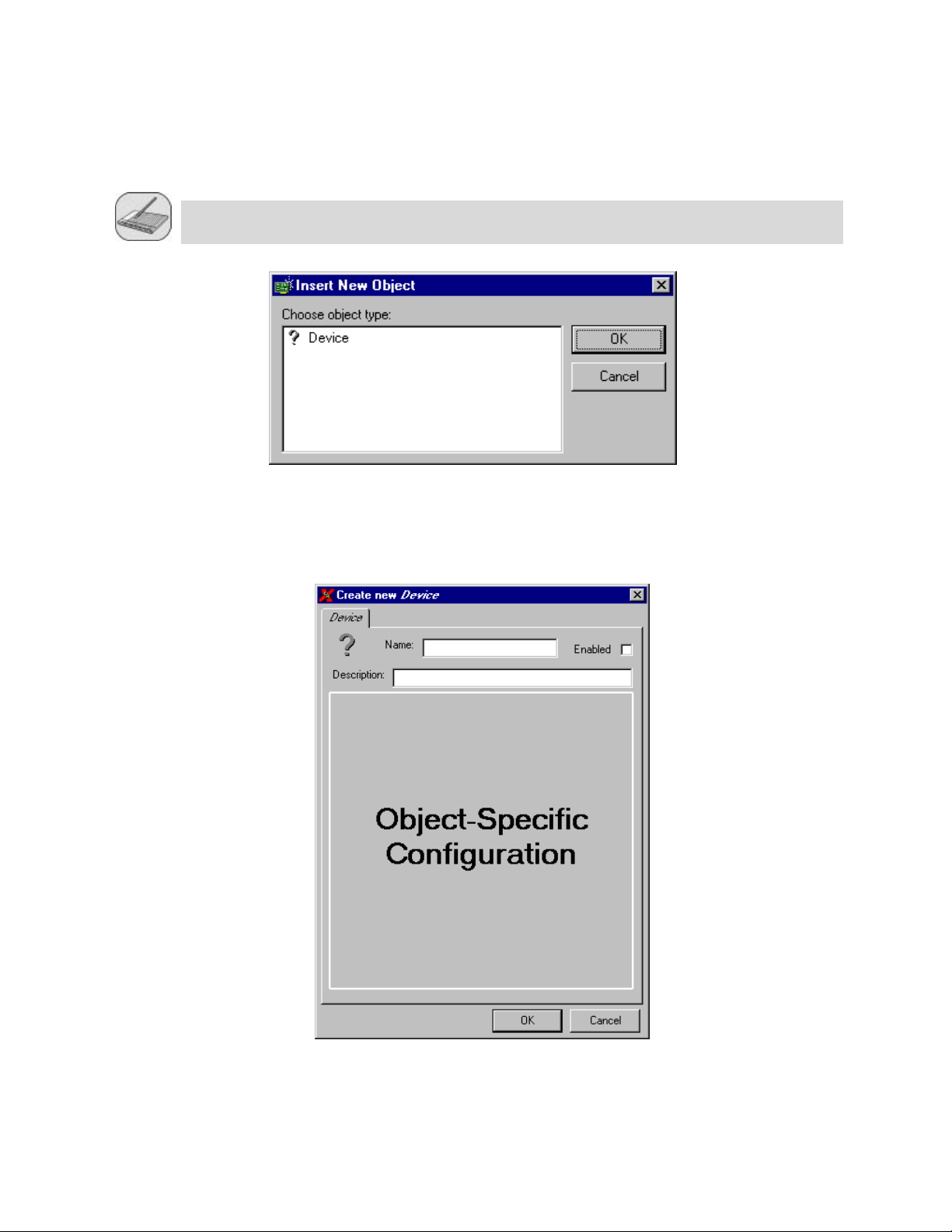
Select “Server Configuration” in the tree view and choose Define New… from the Edit menu.
The Insert New Object dialog box appears. Choose the desired type of object from the list and
click OK.
Different objects may be available depending on which object is currently selected in
the tree view.
Once an object is selected, its configuration panel appears. Each type of configurable object has
its own configuration panel allowing users to enter object-specific information. Change the
configuration settings as desired and press OK to create the object.
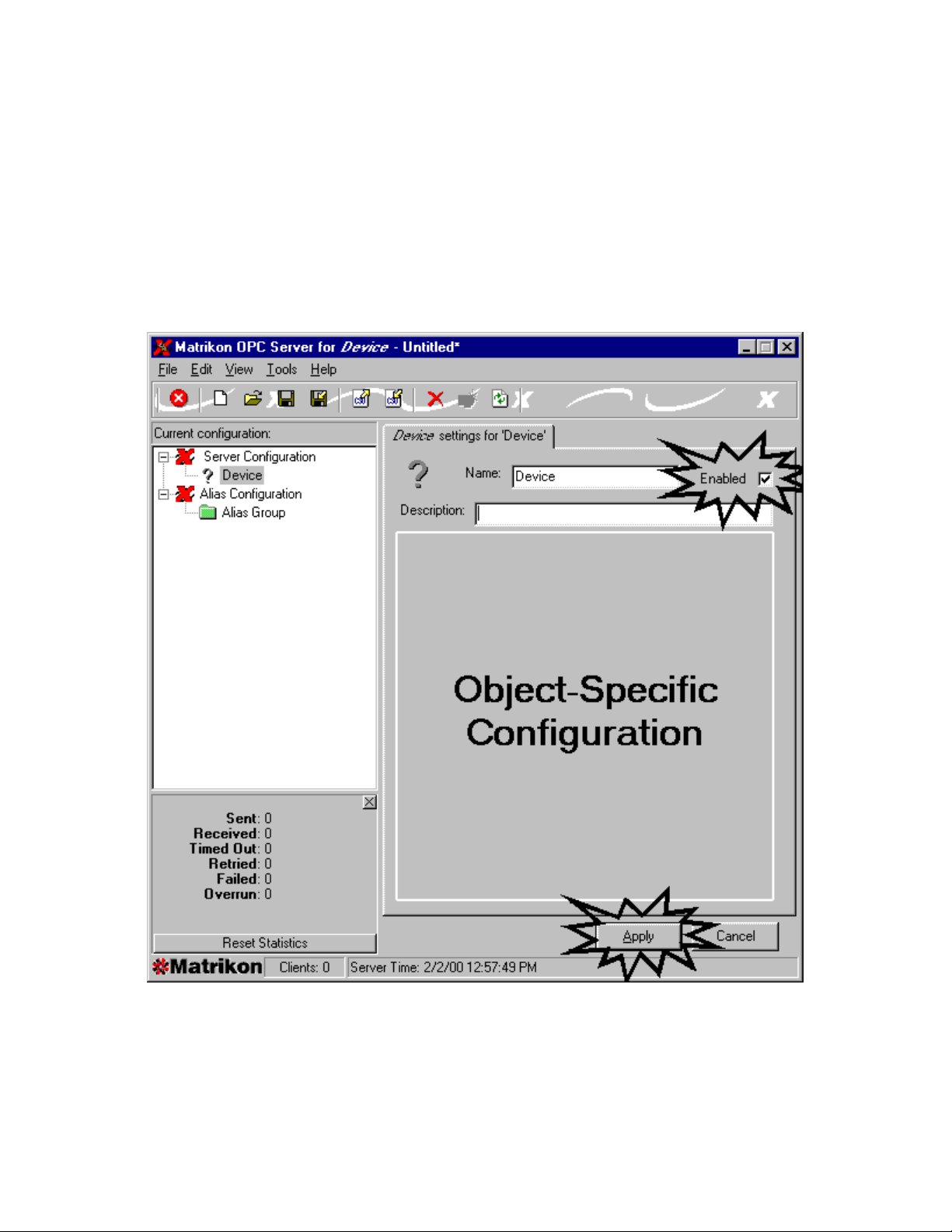
Three fields are common to all types of object: Name, Description, and Enabled. The Name field
specifies a unique name for the object. It is used later as part of any item ID’s that refer to data
Page 12 of 49
Matrikon OPC Server for Allen Bradley
items under this object. Object names are automatically converted to title case for display
purposes. The Description field can contain up to 63 characters of text for reference purposes.
The Enabled checkbox specifies whether or not communication should be enabled for an object.
Normally it should be checked. It may be useful to disable certain objects, especially if the
devices that they refer to are disconnected or malfunctioning, in order to improve the
performance of communication with the other objects. Real-time values are not available from
disabled objects.
Once an object is created, select it in the tree view and change the settings in its configuration
panel to alter its configuration. Click Apply to accept the changes, or Cancel to discard them. To
remove an object, select it in the tree view and choose Delete from the Edit menu.
It may be useful to change the default settings for a new object to avoid repetitive work. Choose
Defaults from the View menu in order to alter the default settings for available object types.
Simply edit the settings in the various configuration panels and choose OK. The next time an
object of a particular type is created, it will use these default settings for initial values.
Page 13 of 49
Matrikon OPC Server for Allen Bradley
The upcoming section contains further information on the specific types of objects available for
this OPC server, and how to configure them.
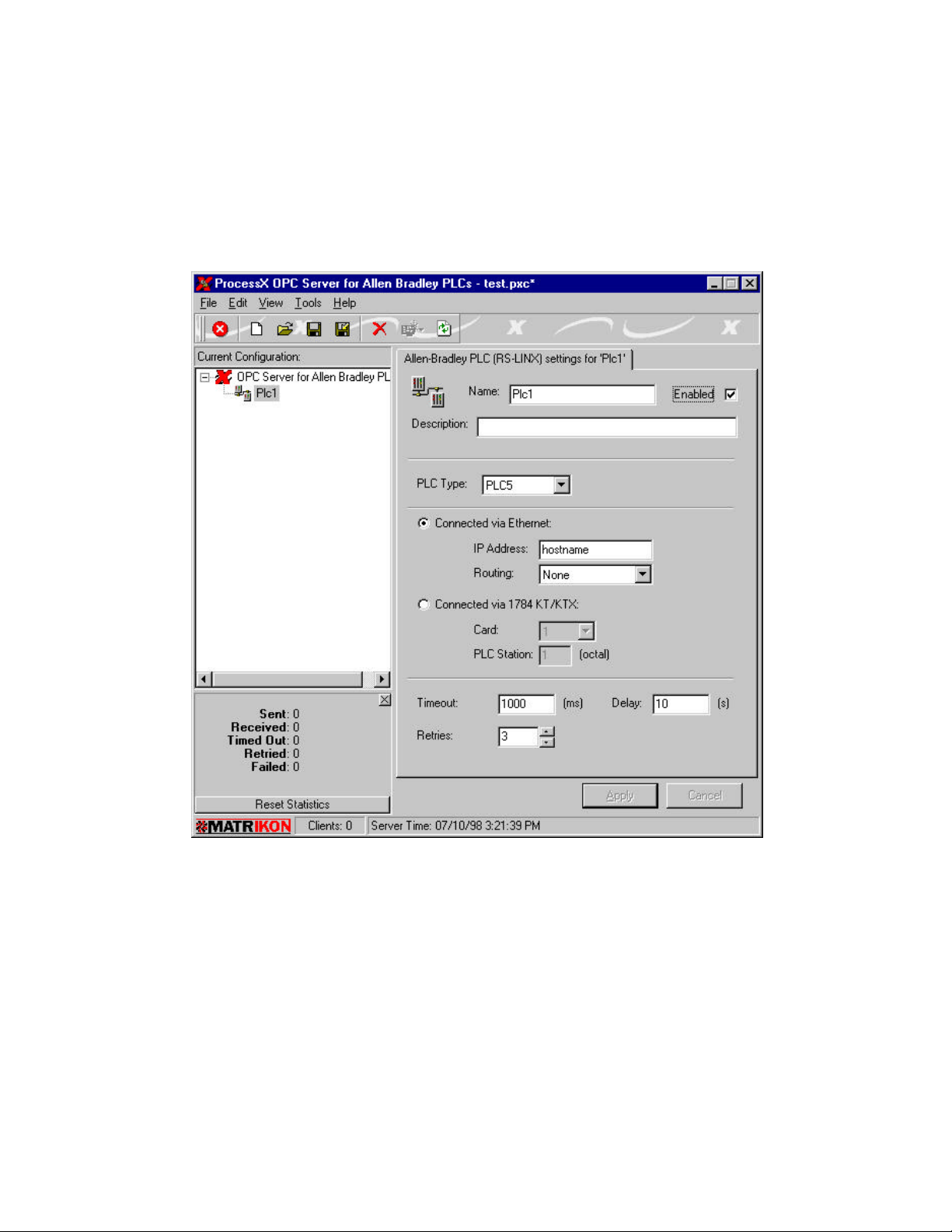
3.3 ALLEN BRADLEY
Click ‘configure’ on the control panel, or select ‘Configure…’ after right clicking on the tray
icon. This will show the configuration utility:
Page 14 of 49
Matrikon OPC Server for Allen Bradley
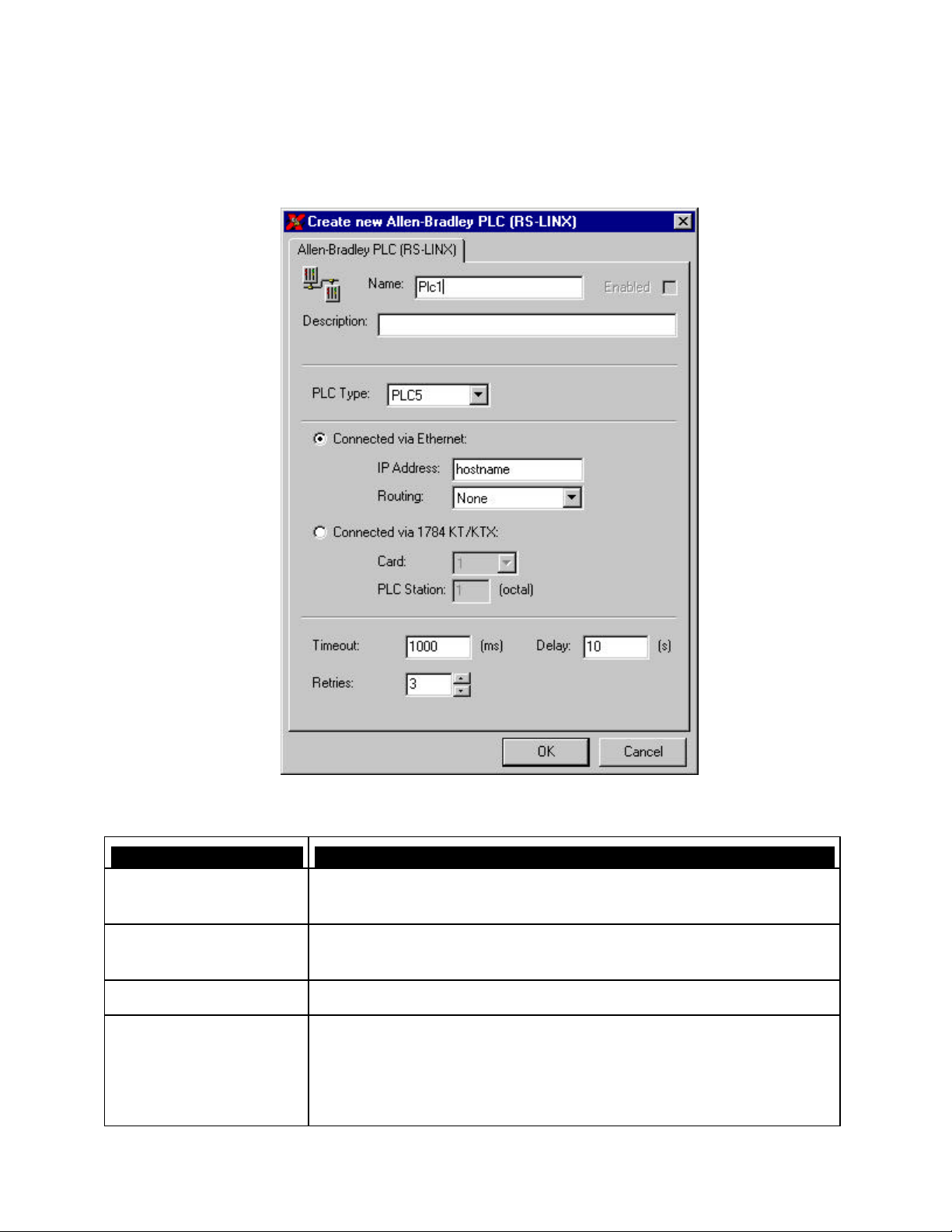
3.4 DEFINE AN ALLEN-BRADLEY PLC
Click ‘New’ on the ‘Edit’ menu to define a new PLC.
When defining an Allen-Bradley PLC, the following panel will appear:
The following table describes the settings found in this panel:
Setting Description
PLC Type
IP Address
Routing Select the routing type used by the Ethernet PLC.
Card Select the KT card to which the PLC is connected.
Page 15 of 49
Select the Allen-Bradley PLC type. If your specific PLC type does
not appear, select the closest matc h.
Enter the Hostname (found in the ‘hosts’ file or using a DNS server)
or the TCP/IP Address.
Additional types of connections can be used with this server by
specifying a card number that has been mapped in RS -LINX to a
‘virtual’ KT card. This procedure is described below.
Loading…
Transform your business with ProtoConvert’s innovative IoT solutions. Streamline operations, optimize performance, and unlock new opportunities with our tailored software and hardware solutions. Get started today and experience the power of IoT
- Skype
- Whtaspp
- Youtube
- Twiiter