
БОКОВЫЕ ЭФФЕКТЫ
Опыт клинических испытаний
Поскольку клинические испытания проводятся в широко варьирующихся условиях, частота побочных реакций, наблюдаемая в клинических испытаниях лекарственного средства, не может быть напрямую сопоставлена с частотой клинических испытаний другого лекарственного средства и может не отражать показатели, наблюдаемые на практике.
Воздействие в клиническом развитии включало приблизительно 2570, 2040 и 1220 пациентов с IBS-C или CIC, получавших LINZESS в течение 6 месяцев или дольше, 1 года или дольше и 18 месяцев или дольше, соответственно (не взаимоисключающие).
Демографические характеристики были сопоставимы между группами лечения во всех исследованиях.
Синдром раздраженного кишечника с запором (IBS-C)
Наиболее распространенные побочные реакции
Описанные ниже данные отражают воздействие LINZESS в двух плацебо-контролируемых клинических испытаниях с участием 1605 взрослых пациентов с IBS-C (триалы 1 и 2). Пациенты были рандомизированы для получения плацебо или 290 мкг LINZESS один раз в день натощак в течение до 26 недель. В таблице 1 представлена частота побочных реакций, о которых сообщалось, по меньшей мере, у 2% пациентов с IBS-C в группе лечения LINZESS, и частота, которая была выше, чем в группе плацебо.
Таблица 1: Наиболее распространенные побочные реакцииa в двух плацебо-контролируемых исследованиях (1 и 2) у пациентов с IBS-C
| Неблагоприятные реакции | LINZESS 290 мкг [N = 807] % |
Плацебо [N = 798] % |
| Желудочно-кишечный тракт | ||
| Диарея | 20 | 3 |
| Боль в животеb | 7 | 5 |
| Метеоризм | 4 | 2 |
| Вздутие живота | 2 | 1 |
| Инфекции и заражения | ||
| Вирусный гастроэнтерит | 3 | 1 |
| Расстройства нервной системы | ||
| Головная боль | 4 | 3 |
| a: Сообщается как минимум у 2% пациентов, получавших LINZESS, и с частотой, превышающей плацебо b:Термин «боль в животе» включает боль в животе, боль в верхней части живота и боль в нижней части живота. |
Диарея
Диарея была наиболее часто встречающейся побочной реакцией пациентов, получавших LINZESS, в объединенных центральных плацебо-контролируемых исследованиях IBS-C. В этих исследованиях 20% пациентов, получавших LINZESS, сообщили о диарее по сравнению с 3% пациентов, получавших плацебо. Тяжелая диарея была отмечена у 2% пациентов, получавших LINZESS, по сравнению с менее чем 1% пациентов, получавших плацебо, и у 5% пациентов, получавших LINZESS, была прекращена из-за диареи по сравнению с менее чем 1% пациентов, получавших плацебо. Большинство зарегистрированных случаев диареи начались в течение первых 2 недель лечения LINZESS.
Неблагоприятные реакции, приводящие к прекращению
В плацебо-контролируемых исследованиях у пациентов с IBS-C 9% пациентов, получавших LINZESS, и 3% пациентов, получавших плацебо, преждевременно прекращали из-за побочных реакций. В группе лечения LINZESS наиболее распространенными причинами прекращения лечения из-за побочных реакций были диарея (5%) и боль в животе (1%). Для сравнения, менее 1% пациентов в группе плацебо вышли из-за диареи или боли в животе.
Неблагоприятные реакции, приводящие к снижению дозы
В открытых долгосрочных исследованиях 2147 пациентов с IBS-C получали 290 мкг LINZESS ежедневно в течение 18 месяцев. В этих исследованиях у 29% пациентов была снижена доза или приостановлена вторично по отношению к побочным реакциям, большинство из которых были диареей или другими побочными реакциями GI.
Менее распространенные побочные реакции
Срочность дефекации, недержание кала, рвота и гастроэзофагальная рефлюксная болезнь были зарегистрированы у <2% пациентов в группе лечения LINZESS и с частотой, превышающей, чем в группе лечения плацебо.
Хронический идиопатический запор (CIC)
Наиболее распространенные побочные реакции
Описанные ниже данные отражают воздействие LINZESS в двух двойных слепых плацебо-контролируемых клинических испытаниях 1275 взрослых пациентов с CIC (Триалы 3 и 4). Пациенты были рандомизированы для получения плацебо или 145 мкг LINZESS или 290 мкг LINZESS один раз в день натощак в течение не менее 12 недель. В таблице 2 представлена частота побочных реакций, о которых сообщалось, по меньшей мере, у 2% пациентов с CIC в группе лечения LINZESS 145 мкг и при частоте, превышающей, чем в группе лечения плацебо.
Таблица 2: Наиболее распространенные побочные реакцииa в двух плацебо-контролируемых исследованиях (3 и 4) у пациентов с CIC
| Неблагоприятные реакции | LINZESS 145 мкг [N = 430] % |
Плацебо [N = 423] % |
| Желудочно-кишечный тракт | ||
| Диарея | 16 | 5 |
| Боль в животеb | 7 | 6 |
| Метеоризм | 6 | 5 |
| Вздутие живота | 3 | 2 |
| Инфекции и заражения | ||
| Инфекция верхних дыхательных путей | 5 | 4 |
| Синусит | 3 | 2 |
| a: Сообщается как минимум у 2% пациентов, получавших LINZESS, и с частотой, превышающей плацебо b:Термин «боль в животе» включает боль в животе, боль в верхней части живота и боль в нижней части живота. |
Безопасность дозы 72 мкг была оценена в дополнительном плацебо-контролируемом исследовании, в котором 1223 пациента были рандомизированы на LINZESS 72 мкг, 145 мкг или плацебо один раз в день в течение 12 недель (Испытание 5).
В исследовании 5 побочные реакции, которые возникали с частотой ≥ 2% у пациентов, получавших LINZESS (n = 411 в каждой группе LINZESS 72 мкг и 145 мкг) и с большей частотой, чем плацебо (n = 401), были:
- Диарея (LINZESS 72 мкг 19%; LINZESS 145 мкг 22%; плацебо 7%)
- Вздутие живота (LINZESS 72 мкг 2%; LINZESS 145 мкг 1%; плацебо <1%)
Диарея
В этом разделе обобщается информация из испытаний 3 и 4 (объединенные) и испытания 5, касающаяся диареи, наиболее часто встречающейся побочной реакции, о которой сообщалось у пациентов, получавших LINZESS, в плацебо-контролируемых исследованиях CIC.
Во всех исследованиях большинство зарегистрированных случаев диареи началось в течение первых 2 недель лечения LINZESS.
О тяжелой диарее сообщалось менее чем у 1% пациентов, получавших LINZESS 72 мкг (Trial 5), у 2% пациентов, получавших LINZESS 145 мкг (Trials 3 и 4; Trial 5), и менее 1% плацебо. -обработанные пациенты (Триалы 3, 4 и 5).
Неблагоприятные реакции, приводящие к прекращению
В плацебо-контролируемых исследованиях у пациентов с CIC, 3% пациентов, получавших 72 мкг (Суд 5) и между 5% (Суд 5) и 8% (Испытания 3 и 4) у пациентов, получавших 145 мкг LINZESS, преждевременно прекращается из-за побочных реакций по сравнению с менее чем 1% (Суд 5) и 4% (Испытания 3 и 4) пациентов, получавших плацебо.
У пациентов, получавших 72 мкг LINZESS, наиболее распространенной причиной прекращения лечения из-за побочных реакций была диарея (2% в суде 5) и у пациентов, получавших 145 мкг LINZESS, наиболее распространенными причинами прекращения лечения из-за побочных реакций была диарея (3% в испытании 5 и 5% в испытаниях 3 и 4) и боль в животе (1% в испытаниях 3 и 4). Для сравнения, менее 1% пациентов в группе плацебо вышли из-за диареи или боли в животе (Испытания 3 и 4; Испытание 5).
Неблагоприятные реакции, приводящие к снижению дозы
В открытых долгосрочных исследованиях 1129 пациентов с CIC получали 290 мкг LINZESS ежедневно в течение 18 месяцев. В этих исследованиях у 27% пациентов была снижена доза или приостановлена вторично по отношению к побочным реакциям, большинство из которых были диареей или другими побочными реакциями GI.
Менее распространенные побочные реакции
Срочность дефекации, недержание кала, диспепсия и вирусный гастроэнтерит были зарегистрированы менее чем у 2% пациентов в группе лечения LINZESS и с частотой, превышающей группу лечения плацебо.
Опыт постмаркетинга
Следующие побочные реакции были выявлены во время использования LINZESS после утверждения. Поскольку об этих реакциях сообщается добровольно из группы населения неопределенного размера, не всегда возможно надежно оценить их частоту или установить причинно-следственную связь с воздействием наркотиков.
Гематохезия, ректальное кровоизлияние, тошнота и аллергические реакции, крапивница или крапивница.
НАРКОТИКИ ВЗАИМОДЕЙСТВИЯ
Информация не предоставлена
Американское Управление по контролю качества продуктов питания и лекарственных препаратов одобрило Linzess (линаклотид) для лечения хронического идиопатического запора и синдрома раздраженного кишечника (СРК) с запорами у взрослых.
Linzess – препарат в форме капсул по 145 мкг линаклотида, принимаемых один раз в день натощак, как минимум за 30 минут до приема пищи. Linzess помогает избавиться от запоров, а также облегчить абдоминальные боли при СРК с запорами.
Безопасность и эффективность Linzess была оценена в двух двойных-спых клинических испытаниях. Для показания хронический идиопатический синдром препарат исследовался также в дозе 290 мкг, однако эта дозировка не была одобрена, т.к. не показала большую эффективность по сравнению с дозировкой 145 мкг.
Препарат не предназначен для применения у пациентов младше 17 лет.
1
0
Вас может заинтересовать
-
Минпромторг и миздравсоцразвития завершают работу над программой замещения дорогих импортных лекарств российскими
-
FDA одобрило первый препарат в капсулах для лечения рецидивирующего рассеянного склероза
-
Росиглитазон и Фенофибрат: риск развития лекарственного взаимодействия
-
Срок замены регистрационных удостоверений на медизделия будет продлен
-
Медицинская академия МЕДСИ открыла первый учебный год
IMPORTANT RISK INFORMATION
- Do not give LINZESS to children who are less than 2 years of age. It may harm them. LINZESS can cause severe diarrhea and your child could get severe dehydration (loss of a large amount of body water and salt).
- Do not take LINZESS if a doctor has told you that you have a bowel blockage (intestinal obstruction).
Before you take LINZESS, tell your doctor about your medical conditions, including if you are:
- Pregnant or plan to become pregnant. It is not known if LINZESS will harm your unborn baby.
- Breastfeeding or plan to breastfeed. You and your doctor should decide if you will take LINZESS and breastfeed.
Tell your doctor about all the medicines you take, including prescription and over-the-counter medicines, vitamins, and herbal supplements.
Side Effects
LINZESS can cause serious side effects, including diarrhea, which is the most common side effect and can sometimes be severe. Diarrhea often begins within the first 2 weeks of LINZESS treatment. Stop taking LINZESS and call your doctor right away if you get severe diarrhea during treatment with LINZESS.
Other common side effects of LINZESS in people with IBS-C and CIC include gas, stomach-area (abdomen) pain, and swelling, or a feeling of fullness or pressure in your abdomen (distention).
Call your doctor or go to the nearest hospital emergency room right away if you develop unusual or severe stomach-area (abdomen) pain, especially if you also have bright red, bloody stools or black stools that look like tar.
These are not all the possible side effects of LINZESS. For more information, ask your doctor or pharmacist.
Please see full Prescribing Information, including Boxed Warning, and Medication Guide.
You are encouraged to report negative side effects of prescription drugs to the FDA. Visit www.fda.gov/medwatch or call 1-800-FDA-1088.
If you are having difficulty paying for your medicine, AbbVie and Ironwood may be able to help. Visit AbbVie.com/myAbbVieAssist to learn more.
US-LIN-250020
LINZESS is available in a once-daily dose for the following indications1
For IBS-C in adults | 290 mcg
For IBS-C* ICD-10 Diagnosis Code
K58.12
For CIC in adults | 2 dosing options
For CIC* ICD-10 Diagnosis Code
K59.042
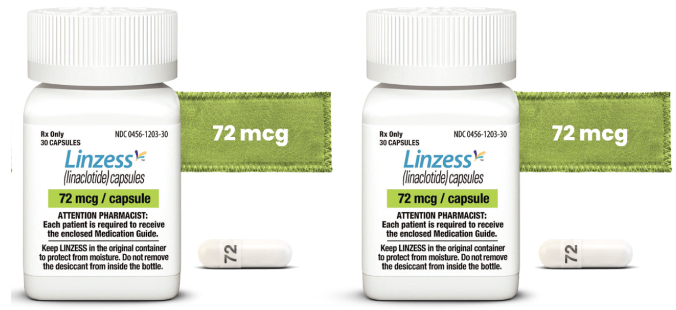
For functional constipation in pediatric patients 6 to 17 years of age | 72 mcg
For FC† ICD-10 Diagnosis Code
K59.042
Capsules shown not actual size. For adults with CIC, a dose of 72 mcg once daily may be used based on individual presentation or tolerability.
For informational purposes only. It is the responsibility of the healthcare provider to determine the appropriate code(s) for services provided to his or her patient. This information does not guarantee payment or coverage. Current as of April 2023.
*For adult patients.
† For pediatric patients 6 to 17 years of age.
CIC, chronic idiopathic constipation; FC, functional constipation; IBS-C, irritable bowel syndrome with constipation; ICD-10, International Classification of Diseases, Tenth Revision.
LINZESS should be taken1:
On an empty stomach and at least 30 minutes prior to a meal
At approximately the same time each day
Clinical considerations1
- Duration of use is not limited
- Dosing adjustments for patients with renal or hepatic impairment are not required
- No drug-drug interactions are anticipated
- Negligible systemic availability
INDICATIONS AND USAGE
LINZESS® (linaclotide) is indicated for the treatment of:
- irritable bowel syndrome with constipation (IBS-C) in adults
- chronic idiopathic constipation (CIC) in adults
- functional constipation (FC) in pediatric patients 6 to 17 years of age
IMPORTANT SAFETY INFORMATION
WARNING:
RISK OF SERIOUS DEHYDRATION IN PEDIATRIC PATIENTS LESS THAN 2 YEARS OF AGE LINZESS is contraindicated in patients less than 2 years of age; in nonclinical studies in neonatal mice, administration of a single, clinically relevant adult oral dose of linaclotide caused deaths due to dehydration.
Contraindications
- LINZESS is contraindicated in patients less than 2 years of age due to the risk of serious dehydration.
- LINZESS is contraindicated in patients with known or suspected mechanical gastrointestinal obstruction.
Warnings and Precautions
Risk of Serious Dehydration in Pediatric Patients Less Than 2 Years of Age
- LINZESS is contraindicated in patients less than 2 years of age. In neonatal mice, linaclotide increased fluid secretion as a consequence of age-dependent elevated guanylate cyclase (GC-C) agonism, which was associated with increased mortality within the first 24 hours due to dehydration. There was no age-dependent trend in GC-C intestinal expression in a clinical study of children 2 to less than 18 years of age; however, there are insufficient data available on GC-C intestinal expression in children less than 2 years of age to assess the risk of developing diarrhea and its potentially serious consequences in these patients.
Diarrhea
- In adults, diarrhea was the most common adverse reaction in LINZESS-treated patients in the pooled IBS-C and CIC double-blind placebo-controlled trials. The incidence of diarrhea was similar in the IBS-C and CIC populations. Severe diarrhea was reported in 2% of 145 mcg and 290 mcg LINZESS-treated patients and in <1% of 72 mcg LINZESS-treated CIC patients. In pediatric patients 6 to 17 years of age, diarrhea was the most common adverse reaction in 72 mcg LINZESS-treated patients in the FC double-blind placebo-controlled trial. Severe diarrhea was reported in one LINZESS-treated patient. If severe diarrhea occurs, dosing should be suspended and the patient rehydrated.
Common Adverse Reactions (incidence ≥2% and greater than placebo)
- In IBS-C or CIC adult patients: diarrhea, abdominal pain, flatulence, and abdominal distension.
- In FC pediatric patients: diarrhea.
Please see full Prescribing Information, including Boxed Warning, or visit https://www.rxabbvie.com/pdf/linzess_pi.pdf.
US-LIN-230215
References: 1. LINZESS [package insert]. North Chicago, IL: AbbVie Inc. 2. National Center for Health Statistics—ICD-10-CM. Centers for Disease Control and Prevention. ICD-10 search website. Accessed August 14, 2024. https://icd10cmtool.cdc.gov/?fy=FY2023
IMPORTANT SAFETY INFORMATION
WARNING:
RISK OF SERIOUS DEHYDRATION IN PEDIATRIC PATIENTS LESS THAN 2 YEARS OF AGE LINZESS is contraindicated in patients less than 2 years of age; in nonclinical studies in neonatal mice, administration of a single, clinically relevant adult oral dose of linaclotide caused deaths due to dehydration.
Contraindications
- LINZESS is contraindicated in patients less than 2 years of age due to the risk of serious dehydration.
IMPORTANT SAFETY INFORMATION
WARNING:
RISK OF SERIOUS DEHYDRATION IN PEDIATRIC PATIENTS LESS THAN 2 YEARS OF AGE LINZESS is contraindicated in patients less than 2 years of age; in nonclinical studies in neonatal mice, administration of a single, clinically relevant adult oral dose of linaclotide caused deaths due to dehydration.
Contraindications
- LINZESS is contraindicated in patients less than 2 years of age due to the risk of serious dehydration.
IMPORTANT SAFETY INFORMATION
WARNING:
RISK OF SERIOUS DEHYDRATION IN PEDIATRIC PATIENTS LESS THAN 2 YEARS OF AGE LINZESS is contraindicated in patients less than 2 years of age; in nonclinical studies in neonatal mice, administration of a single, clinically relevant adult oral dose of linaclotide caused deaths due to dehydration.
Contraindications
- LINZESS is contraindicated in patients less than 2 years of age due to the risk of serious dehydration.
IMPORTANT SAFETY INFORMATION
WARNING:
RISK OF SERIOUS DEHYDRATION IN PEDIATRIC PATIENTS LESS THAN 2 YEARS OF AGE LINZESS is contraindicated in patients less than 2 years of age; in nonclinical studies in neonatal mice, administration of a single, clinically relevant adult oral dose of linaclotide caused deaths due to dehydration.
Contraindications
- LINZESS is contraindicated in patients less than 2 years of age due to the risk of serious dehydration.
INDICATIONS AND USAGE
LINZESS® (linaclotide) is indicated for the treatment of:
- irritable bowel syndrome with constipation (IBS-C) in adults
- chronic idiopathic constipation (CIC) in adults
- functional constipation (FC) in pediatric patients 6 to 17 years of age
IMPORTANT SAFETY INFORMATION
WARNING:
RISK OF SERIOUS DEHYDRATION IN PEDIATRIC PATIENTS LESS THAN 2 YEARS OF AGE LINZESS is contraindicated in patients less than 2 years of age; in nonclinical studies in neonatal mice, administration of a single, clinically relevant adult oral dose of linaclotide caused deaths due to dehydration.
Contraindications
- LINZESS is contraindicated in patients less than 2 years of age due to the risk of serious dehydration.
- LINZESS is contraindicated in patients with known or suspected mechanical gastrointestinal obstruction.
Warnings and Precautions
Risk of Serious Dehydration in Pediatric Patients Less Than 2 Years of Age
- LINZESS is contraindicated in patients less than 2 years of age. In neonatal mice, linaclotide increased fluid secretion as a consequence of age-dependent elevated guanylate cyclase (GC-C) agonism, which was associated with increased mortality within the first 24 hours due to dehydration. There was no age-dependent trend in GC-C intestinal expression in a clinical study of children 2 to less than 18 years of age; however, there are insufficient data available on GC-C intestinal expression in children less than 2 years of age to assess the risk of developing diarrhea and its potentially serious consequences in these patients.
Diarrhea
- In adults, diarrhea was the most common adverse reaction in LINZESS-treated patients in the pooled IBS-C and CIC double-blind placebo-controlled trials. The incidence of diarrhea was similar in the IBS-C and CIC populations. Severe diarrhea was reported in 2% of 145 mcg and 290 mcg LINZESS-treated patients and in <1% of 72 mcg LINZESS-treated CIC patients. In pediatric patients 6 to 17 years of age, diarrhea was the most common adverse reaction in 72 mcg LINZESS-treated patients in the FC double-blind placebo-controlled trial. Severe diarrhea was reported in one LINZESS-treated patient. If severe diarrhea occurs, dosing should be suspended and the patient rehydrated.
Common Adverse Reactions (incidence ≥2% and greater than placebo)
- In IBS-C or CIC adult patients: diarrhea, abdominal pain, flatulence, and abdominal distension.
- In FC pediatric patients: diarrhea.
Please see full Prescribing Information, including Boxed Warning, or visit https://www.rxabbvie.com/pdf/linzess_pi.pdf.
US-LIN-230215
Dosing & Uses
AdultPediatric
Dosage Forms & Strengths
capsule
- 72mcg
- 145mcg
- 290mcg
Irritable Bowel Syndrome
Indicated for irritable bowel syndrome with constipation (IBS-C)
290 mcg PO qDay
Chronic Idiopathic Constipation
Indicated for chronic idiopathic constipation (CIC)
145 mcg PO qDay
72 mcg PO qDay may be used based on individual presentation
Dosage Modifications
Renal or hepatic impairment
- Not expected to affect clearance of linaclotide or its active metabolite because linaclotide metabolism occurs within gastrointestinal tract and plasma concentrations are not measurable following administration of recommended dosage
Dosage Forms & Strengths
capsule
- 72mcg
Functional Constipation
Indicated for treatment of functional constipation (FC) in pediatric patients aged 6-17 years
72 mg PO qDay
Dosage Modifications
Renal or hepatic impairment
- Not expected to affect clearance of linaclotide or its active metabolite because linaclotide metabolism occurs within gastrointestinal tract and plasma concentrations are not measurable following administration of recommended dosage
Adverse Effects
>10%
IBS-C
- Diarrhea (20%)
CIC
- Diarrhea (16-22%)
1-10%
IBS-C
- Abdominal pain (7%)
- Flatulence (4%)
- Headache (4%)
- Viral gastroenteritis (3%)
- Abdominal distension (2%)
- Severe diarrhea (2%)
- Defecation urgency (<2%)
- Fecal incontinence (<2%)
- Vomiting (<2%)
- Gastroesophageal reflux disease (<2%)
CIC
- Abdominal pain (7%)
- Flatulence (6%)
- Upper respiratory tract infection (5%)
- Sinusitis (3%)
- Abdominal distension (1-3%)
- Defecation urgency (<2%)
- Fecal incontinence (<2%)
- Dyspepsia (<2%)
- Viral gastroenteritis (<2%)
FC
- Diarrhea (4%)
Frequency Not Defined
FC
- Nausea
- Abdominal discomfort
- Dehydration
Postmarketing Reports
Hypersensitivity reactions: Anaphylaxis, angioedema, rash (including hives or urticaria)
Gastrointestinal reactions: Hematochezia, nausea, rectal hemorrhage
Warnings
Black Box Warnings
Risk of serious dehydration in pediatric patients <2 years
- Contraindicated in pediatric patients aged <2 years
- In nonclinical studies in neonatal mice, oral administration of a single, clinically relevant adult dose of linaclotide caused deaths due to dehydration
Contraindications
Patients aged <2 years due to risk of serious dehydration
Known or suspected mechanical gastrointestinal obstruction
Cautions
Pediatric risk
- Contraindicated in patients <2 years of age
- In neonatal mice, fluid secretion increased because of GC-C agonism resulting in mortality within the first 24 hr due to dehydration
- There was no age-dependent trend in GC-C intestinal expression in a clinical study of children 2 to <18 years of age; there are insufficient data available on GC-C intestinal expression in children aged <2 years to assess the risk of developing diarrhea and its potentially serious consequences in these patients
Diarrhea
- Diarrhea was the most common adverse reaction in clinical trials
- In postmarketing reports, severe diarrhea associated with dizziness, syncope, hypotension and electrolyte abnormalities (hypokalemia and hyponatremia) requiring hospitalization or IV fluid administration have been reported
- Diarrhea reported in pediatric patients 6-17 years with functional constipation receiving therapy
- If severe diarrhea occurs, suspend dosing and rehydrate
Pregnancy & Lactation
Pregnancy
Linaclotide and its active metabolite are negligibly absorbed systemically following oral administration, and maternal use is not expected to result in fetal exposure
Insufficient data available data on use in pregnant women to inform any drug-associated risk for major birth defects and miscarriage
Animal data
- No effects on embryofetal development were observed with oral administration of linaclotide in rats and rabbits during organogenesis at doses much higher than the maximum recommended human dosage
- Severe maternal toxicity associated with effects on fetal morphology were observed in mice
Lactation
Linaclotide and its active metabolite were not detected in the milk of lactating women; in adults, concentrations of linaclotide and its active metabolite were below the limit of quantitation in plasma following multiple doses of the drug
Maternal use of the drug is not expected to result in exposure to the drug or its active metabolite in breastfed infants; there is no information on effects on milk production; consider developmental and health benefits of breastfeeding along with the mother’s clinical need for therapy and any potential adverse effects on breastfed infant from the drug or from the underlying maternal condition
No lactation studies in animals have been conducted
Unknown whether negligible systemic absorption of linaclotide by adults will result in a clinically relevant exposure to breastfed infants
Pregnancy Categories
A: Generally acceptable. Controlled studies in pregnant women show no evidence of fetal risk.
B: May be acceptable. Either animal studies show no risk but human studies not available or animal studies showed minor risks and human studies done and showed no risk.
C: Use with caution if benefits outweigh risks. Animal studies show risk and human studies not available or neither animal nor human studies done.
D: Use in LIFE-THREATENING emergencies when no safer drug available. Positive evidence of human fetal risk.
X: Do not use in pregnancy. Risks involved outweigh potential benefits. Safer alternatives exist.
NA: Information not available.
Pharmacology
Mechanism of Action
Guanylate cyclase C (GC-C) agonist; activation of GC-C located on the luminal surface of intestinal epithelial cells leads to increased cyclic guanosine monophosphate (cGMP), anion secretion, fluid secretion, and intestinal transit
Appears to work topically rather than systemically; elevation in intracellular cGMP stimulates secretion of chloride and bicarbonate into the intestinal lumen, mainly through activation of the cystic fibrosis transmembrane conductance regulator (CFTR) ion channel, resulting in increased intestinal fluid and accelerated transit
Absorption
Minimal systemic absorption
Concentrations of linaclotide and its active metabolite in plasma are below the limit of quantitation after oral doses of 145 mcg or 290 mcg
Metabolism
Metabolized within the GI tract to its principal, active metabolite by loss of the terminal tyrosine moiety
Both linaclotide and the metabolite are proteolytically degraded within the intestinal lumen to smaller peptides and naturally occurring amino acids
Elimination
Excretion: 3-5% feces (parent compound) and virtually 100% of active metabolite
Administration
Oral Administration
Take on an empty stomach at least 30 minutes before first meal of the day, at approximately the same time each day
Swallow capsule whole; do not chew or crush
Missed dose
- Skip missed dose and take next dose at regular time; do not take 2 doses at the same time
Difficulty swallowing tablets
- May sprinkle capsule contents on applesauce or in water; not tested in other soft foods or liquids
-
Administration in applesauce
- Place 1 teaspoonful of applesauce at room temperature into a clean container
- Open capsule
- Sprinkle entire contents (beads) on applesauce
- Consume entire contents immediately; do not chew beads; do not store applesauce-beads mixture for later use
-
Administration in water
- Pour ~1 ounce (30 mL) of bottled water at room-temperature into clean cup
- Open capsule
- Sprinkle entire contents (beads) into water
- Gently swirl beads and water for at least 20 sec
- Swallow entire mixture of beads and water immediately
- Add another 30 mL of water to any beads remaining in cup, swirl for 20 seconds, and swallow immediately
- Do not store the bead-water mixture for later use
- Note: Drug is coated on surface of the beads and will dissolve off the beads into water; beads will remain visible and will not dissolve; therefore, it is not necessary to consume all beads to deliver complete dose
-
Nasogastric or gastric feeding tube administration in water
- Open capsule and empty the beads into clean container with 1 ounce (30 mL) of room-temperature bottled water
- Mix by gently swirling beads for at least 20 sec
- Draw-up beads and water mixture to an appropriately sized catheter-tipped syringe and apply rapid and steady pressure (10 mL/10 sec) to dispense syringe contents into the tube
- After administering the bead-water mixture, flush nasogastric/gastric tube with a minimum of 10 mL of water
- Note: It is not necessary to flush all the beads through to deliver complete dose
Storage
Store at 25ºC (77ºF); excursions permitted between 15-30ºC (59-86ºF)
Keep in the original container; do not subdivide or repackage
Protect from moisture
Do not remove desiccant from the container
Images
Patient Handout
A Patient Handout is not currently available for this monograph.
Formulary
FormularyPatient Discounts
Adding plans allows you to compare formulary status to other drugs in the same class.
To view formulary information first create a list of plans. Your list will be saved and can be edited at any time.
Adding plans allows you to:
- View the formulary and any restrictions for each plan.
- Manage and view all your plans together – even plans in different states.
- Compare formulary status to other drugs in the same class.
- Access your plan list on any device – mobile or desktop.
The above information is provided for general
informational and educational purposes only. Individual plans may vary
and formulary information changes. Contact the applicable plan
provider for the most current information.
View explanations for tiers and
restrictions
| Tier | Description |
|---|---|
| 1 | This drug is available at the lowest co-pay. Most commonly, these are generic drugs. |
| 2 | This drug is available at a middle level co-pay. Most commonly, these are «preferred» (on formulary) brand drugs. |
| 3 | This drug is available at a higher level co-pay. Most commonly, these are «non-preferred» brand drugs. |
| 4 | This drug is available at a higher level co-pay. Most commonly, these are «non-preferred» brand drugs or specialty prescription products. |
| 5 | This drug is available at a higher level co-pay. Most commonly, these are «non-preferred» brand drugs or specialty prescription products. |
| 6 | This drug is available at a higher level co-pay. Most commonly, these are «non-preferred» brand drugs or specialty prescription products. |
| NC | NOT COVERED – Drugs that are not covered by the plan. |
| Code | Definition |
|---|---|
| PA | Prior Authorization Drugs that require prior authorization. This restriction requires that specific clinical criteria be met prior to the approval of the prescription. |
| QL | Quantity Limits Drugs that have quantity limits associated with each prescription. This restriction typically limits the quantity of the drug that will be covered. |
| ST | Step Therapy Drugs that have step therapy associated with each prescription. This restriction typically requires that certain criteria be met prior to approval for the prescription. |
| OR | Other Restrictions Drugs that have restrictions other than prior authorization, quantity limits, and step therapy associated with each prescription. |
Non-Medicare Plans
Medicare Plans
From:
To:
The recipient will receive more details and instructions to access this offer.
By clicking send, you acknowledge that you have permission to email the recipient with this information.
From:
To:
The recipient will receive more details and instructions to access this offer.
By clicking send, you acknowledge that you have permission to email the recipient with this information.
Medscape prescription drug monographs are based on FDA-approved labeling information, unless otherwise noted, combined with additional data derived from primary medical literature.