
Black plate (1,1)
北米Model «A8180BE-A» EDITED: 2011/ 12/ 20
Foreword
Congratulations on choosing a SUBARU vehicle. This Owner’s
Manual has all the information necessary to keep your SUBARU in
excellent condition and to properly maintain the emission control
system for minimizing emission pollutants. We urge you to read
this manual carefully so that you may understand your vehicle and
its operation. For information not found in this Owner’s Manual,
such as details concerning repairs or adjustments, please contact
the SUBARU dealer from whom you purchased your SUBARU or
the nearest SUBARU dealer.
The information, specifications and il lustrations found in this
manual are those in effect at the time of printing. FUJI HEAVY
INDUSTRIES LTD. reserves the right to change specifications and
designs at any time without prior notice and without incurring any
obligation to make the same or similar changes on vehicles
previously sold. This Owner’s Manual applies to all models and
covers all equipment, including factory installed options. Some
explanations, therefore may be for equipment not installed in your
vehicle.
Please leave this manual in the vehicle at the time of resale. The
next owner will need the information found herein.
FUJI HEAVY INDUSTRIES LTD., TOKYO, JAPAN
is a registered trademark of FUJI HEAVY INDUSTRIES LTD.
*
C
Copyright 2012 FUJI HEAVY INDUSTRIES LTD.
Foreword
Congratulations on choosing a SUBARU vehicle. This Owner’s
Manual has all the information necessary to keep your SUBARU in
excellent condition and to properly maintain the emission control
system for minimizing emission pollutants. We urge you to read
this manual carefully so that you may understand your vehicle and
its operation. For information not found in this Owner’s Manual,
such as details concerning repairs or adjustments, please contact
the SUBARU dealer from whom you purchased your SUBARU or
the nearest SUBARU dealer.
The information, specifications and illustrations fo und in this
manual are those in effect at the time of printing. FUJI HEAVY
INDUSTRIES LTD. reserves the right to change specifications and
designs at any time without prior notice and without incurring any
obligation to make the same or similar changes on vehicles
previously sold. This Owner’s Manual applies to all models and
covers all equipment, including factory installed options. Some
explanations, therefore may be for equipment not installed in your
vehicle.
Please leave this manual in the vehicle at the time of resale. The
next owner will need the information found herein.
FUJI HEAVY INDUSTRIES LTD., TOKYO, JAPAN
is a registered trademark of FUJI HEAVY INDUSTRIES LTD.
C
*
Copyright 2012 FUJI HEAVY INDUSTRIES LTD.

This manual describes the following vehicle types.*
* The illustrated vehicle is one of the FORESTER series.

1
Warranties
& Warranties for U.S.A.
All SUBARU vehicles distributed by
Subaru of America, Inc. and sold at retail
by an authorized SUBARU dealer in the
United States come with the following
warranties:
. SUBARU Limited Warranty
. Emission Control Systems Warranty
. Emissions Performance Warranty
All warranty information, including details
of coverage and exclusions, is in the
“Warranty and Maintenance Booklet”.
Please read these warranties carefully.
& Warranties for Canada
All SUBARU vehicles distributed by
Subaru Canada, Inc. and sold at retail by
an authorized SUBARU dealer in Canada
come with the following warranties:
. SUBARU Limited Warranty
. Anti-Corrosion Warranty
. Emission Control Warranty
All warranty information, including details
of coverage and exclusions, is in the
“Warranty and Service Booklet”. Please
read these warranties carefully.
& Models with HID headlights
CAUTION
High Intensity Discharge (HID) headlights contain m ercury. For that
reason, it is necessary to remove
HID headlights before vehicle disposal. Once removed, please reuse,
recycle or dispose of the HID headlights as hazardous waste.
& Models without HID head-
lights
NOTE
This vehicle does not contain mercury
devices or parts.
How to use this Owner’s
Manual
& Using your Owner’s Manual
Before you operate your vehicle, carefully
read this manual. To protect yourself and
extend the service life of your vehicle,
follow the instructions in this manual.
Failure to observe these instructions may
result in serious injury and damage to your
vehicle.
This manual is composed of fourteen
chapters. Each chapter begins with a brief
table of contents, so you can usually tell at
a glance if that chapter contains the
information you want.
Chapter 1: Seat, seatbelt and SRS
airbags
This chapter informs you how to use the
seat and seatbelt and contains precautions for the SRS airbags.
Chapter 2: Keys and doors
This chapter informs you how to operate
the keys, locks and windows.
Chapter 3: Instruments and controls
This chapter informs you about the operation of instrument panel indicators and
how to use the instruments and other
switches.
– CONTINUED –

2
Chapter 4: Climate control
This chapter informs you how to operate
the climate control.
Chapter 5: Audio
This chapter informs you how to operate
your audio system.
Chapter 6: Interior equipment
This chapter informs you how to operate
interior equipment.
Chapter 7: Starting and operating
This chapter informs you how to start and
operate your SUBARU.
Chapter 8: Driving tips
This chapter informs you how to drive your
SUBARU in various conditions and explains some safety tips on driving.
Chapter 9: In case of emergency
This chapter informs you what to do if you
have a problem while driving, such as a
flat tire or engine overheating.
Chapter 10: Appearance care
This chapter informs you how to keep your
SUBARU looking good.
Chapter 11: Maintenance and service
This chapter informs you when you need
to take your SUBARU to the dealer for
scheduled maintenance and informs you
how to keep your SUBARU running
properly.
Chapter 12: Specifications
This chapter informs you about dimensions and capacities of your SUBARU.
Chapter 13: Consumer information and
Reporting safety defects
This chapter informs you about Uniform
tire quality grading standards and Reporting safety defects.
Chapter 14: Index
This is an alphabetical listing of all that’sin
this manual. You can use it to quickly find
something you want to read.
& Safety warnings
You will find a number of WARNINGs,
CAUTIONs and NOTEs in this manual.
These safety warnings alert you to potential hazards that could result in injury to
you or others.
Please read these safety warnings as well
as all other portions of this manual carefully in order to gain a better understanding of how to use your SUBARU vehicle
safely.
WARNING
A WARNING indicates a situation in
which serious injury or death could
result if the warning is ignored.
CAUTION
A CAUTION indicates a situation in
which inj ur y or damage to your
vehicle, or both, could result if the
caution is ignored.
NOTE
A NOTE gives information or suggestions how to make better use of your
vehicle.
& Safety symbol
You will find a circle with a slash through it
in this manual. This symbol means “Do
not”, “Do not do this”,or“Do not let this
happen”, depending upon the context.
3
& Abbreviation list
You may find several abbreviations in this
manual. The meanings of the abbreviations are shown in the following list.
Abbreviation Meaning
A/C Air conditioner
A/ELR
ABS Anti-lock brake system
AKI Anti knock index
ALR Automatic locking retractor
AT Automatic transmission
ATF Automatic transmission fluid
AWD All-wheel drive
DRL Daytime running light
EBD
ELR Emergency locking retractor
FWD Front-wheel drive
GAW Gross axle weight
GAWR Gross axle weight rating
GVW Gross vehicle weight
GVWR Gross vehicle weight rating
HID High intensity discharge
INT Intermittent
Automatic/Emergency locking
retractor
Electronic brake force distribution
Abbreviation Meaning
LATCH
LED Light emitting diode
LSD Limited slip differential
MIL Malfunction indicator light
MMT
MT Manual transmission
OBD On-board diagnostics
RON Research octane number
SRS
TIN Tire identification number
TPMS
Lower anchors and tethers for
children
Methylcyclopentadienyl manganese tricarbonyl
Supplemental restraint system
Tire pressure monitoring system
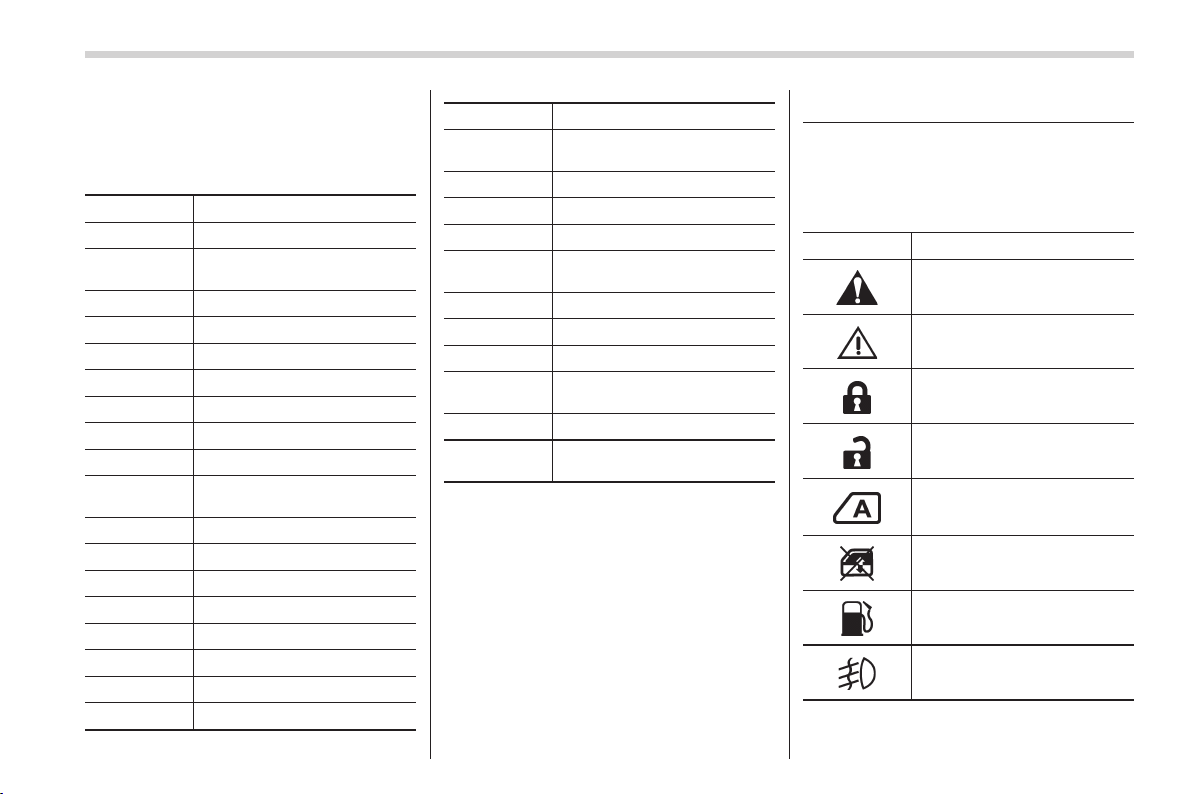
Vehicle symbols
There are some of the symbols you may
see on your vehicle.
For warning and indicator lights, refer to
“Warning and indicator lights” F21.
Mark Name
WARNING
CAUTION
Power door lock
Power door unlock
Power window with automatic
open (all models) and close (if
equipped) function
Passengers’ windows lock
and unlock
Fuel
Front fog lights
– CONTINUED –

4
Mark Name
Hazard warning flasher
Engine hood
Seat heater
Child restraint top tether anchorages
Child restraint lower anchorages
Horn
Wiper intermittent
Windshield washer
Windshield wiper mist (for
single wipe)
Rear window wiper
Mark Name
Lights
Tail lights, license plate light
and instrument panel illumination
Headlights
Turn signal
Illumination brightness
Fan speed
Instrument panel outlets
Instrument panel outlets and
foot outlets
Foot outlets
Windshield defroster and foot
outlets
Mark Name
Rear window defogger/Outside mirror defogger
Air recirculation
Engine oil
Washer
Door lock (Transmitter)
Door unlock (Transmitter)
Rear gate (Transmitter)
Rear window washer
Windshield defroster

5
Safety precautions when
driving
& Seatbelt and SRS airbag
WARNING
. All persons in the vehicle should
fasten their seatbelts BEFORE
the vehicle starts to move. Otherwise, the possibility of serious
injury becomes greater in the
event of a sudden stop or accident.
. To obtain maximum protection in
the event of an accident, the
driver and all passengers in the
vehicle should always wear seatbelts when the vehicle is moving.
The SRS (Supplemental Restraint
System) airbag does not do away
with the need to fasten seatbelts.
In combination with the seatbelts, it offers the best combined
protection in case of a serious
accident.
Not wearing a seatbelt increases
the chance of severe injury or
death in a crash even when the
vehicle has the SRS airbag.
. The SRS airbags deploy with
considerable speed and force.
Occupants who are out of proper
position when the SRS airbag
deploys could suffer very serious
injuries. Because the SRS airbag
needs enough space for deployment, the driver should always
sit upright and well back in the
seat as far f rom the steering
wheel as practical while still
maintaining full vehicle control
and the front passenger should
move the seat as far back as
possible and sit upright and well
back in the seat.
For instructions and precautions, carefully
read the following sections.
. For the seatbelt system, refer to “Seat-
belts” F1-12.
. For the SRS airbag system, refer to
“*SRS airbag (Supplemental Restraint
System airbag)” F1-33.
& Child safety
WARNING
. Never hold a child on your lap or
in your arms while the vehicle is
moving. The passenger cannot
protect the child from injury in a
collision, because the child will
be caught between the passenger and objects inside the vehicle.
. While riding in the vehicle, in-
fants and small children should
always be placed in the REAR
seat in an infant or child restraint
system which is appropriate for
the child’ s age, height and
weight. If a child is too big for a
child restraint system, the child
should sit in the REAR seat and
be restrained using the seatbelts.
According to accident statistics,
children are safer when properly
restrained in the rear seating
positions than in the front seating positions. Never allow a child
to stand up or kneel on the seat.
. Put children aged 12 and under in
the REAR seat properly restrained at all times in a child
restraint device or in a seatbelt.
– CONTINUED –

6
The SRS airbag deploys with
considerable speed and force
and can injure or even kill children, especially if they are 12
years of age and under and are
not restrained or improperly restrained. Because children are
lighter and weaker than adults,
their risk of being injured from
deployment is greater.
. NEVER INSTALL A REARWARD
FACING CHILD SEAT IN THE
FRONT SEAT. DOING SO RISKS
SERIOUS INJURY OR DEATH TO
THE CHILD BY PLACING THE
CHILD’S HEAD TOO CLOSE TO
THE SRS AIRBAG.
. Always turn the child safety locks
to the “LOCK” position when
children sit on the rear seat.
Serious injury could result if a
child accidentally opens the door
and falls out. Refer to “Child
safety locks” F2-19.
. Always lock the passenger’s win-
dows using the lock switch when
children are riding in the vehicle.
Failure to follow this procedure
could result in injury to a child
operating the power window. Refer to “Windows” F2-20.
. Never leave unattended children
in the vehicle. They could accidentally injure themselves or
others through inadvertent operation of the vehicle. Also, on
hot or sunny days, temperature
in a closed vehicle could quickly
become high enough to cause
severe or possibly fatal injuries
to them.
For instructions and precautions, carefully
read the following sections.
. For the seatbelt system, refer to “Seat-
belts” F1-12.
. For the child restraint system, refer to
“Child restraint systems” F1-22.
. For the SRS airbag system, refer to
“*SRS airbag (Supplemental Restraint
System airbag)” F1-33.
& Engine exhaust gas (carbon
monoxide)
WARNING
. Never inhale engine exhaust gas.
Engine exhaust gas contains
carbon monoxide, a colorless
and odorless gas which is dangerous, or even lethal, if inhaled.
. Always properly maintain the en-
gine exhaust system to prevent
engine exhaust gas from entering the vehicle.
. Never run the engine in a closed
space, such as a garage, except
for the brief time needed to drive
the vehicle in or out of it.
. Avoid remaining in a parked
vehicle for a lengthy time while
the engine is running. If that is
unavoidable, then use the ventilation fan to force fresh air into
the vehicle.
. Always keep the front ventilator
inlet grille free from snow, leaves
or other obstructions to ensure
that the ventilation system always works properly.
. If at any time you suspect that
exhaust fumes are entering the
vehicle, have the problem
checked and corrected as soon
as possible. If you must drive
under these conditions, drive
only with all windows fully open.
. Keep the rear gate closed while
driving to prevent exhaust gas
from entering the vehicle.

7
& Drinking and driving
WARNING
Drinking and then driving is very
dangerous. Alcohol in the bloodstream delays your reactions and
impairs your perception, judgment
and attentiveness. If you drive after
drinking – even if you drink just a
little – it will increase the risk of
being involved in a serious or fatal
accident, injuring or killing yourself,
your passengers and others. In
addition, if you are injured in the
accident, alcohol may increase the
severity of that injury.
Please don’t drink and drive.
Drunken driving is one of the most
frequent causes of accidents. Since alcohol affects all people differently, you may
have consumed too much alcohol to drive
safely even if the level of alcohol in your
blood is below the legal limit. The safest
thing you can do is never drink and drive.
However if you have no choice but to
drive, stop drinking and sober up completely before getting behind the wheel.
& Drugs and driving
WARNING
There are some drugs (over the
counter and prescription) that can
delay your rea ctions and impair
your perception, judgment and attentiveness. If you drive after taking
them, it may increase your, your
passengers’ and other persons’ risk
of being involved in a serious or
fatal accident.
If you are taking any drugs, check with
your doctor or pharmacist or read the
literature that accompanies the medication
to determine if the drug you are taking can
impair your driving ability. Do not drive
after taking any medications that can
make you drowsy or otherwise affect your
ability to safely operate a motor vehicle. If
you have a medical condition that requires
you to take drugs, please consult with
your doctor.
Never drive if you are under the influence
of any illicit mind-altering drugs. For your
own health and well-being, we urge you
not to take illegal drugs in the first place
and to seek treatment if you are addicted
to those drugs.
& Driving when tired or sleepy
WARNING
When you are tired or sleepy, your
reactions will be delayed and your
perception, judgment and attentiveness will be impaired. If you drive
when tired or sleepy, your, your
passengers’ and other persons’
chances of being involved in a
serious accident may increase.
Please do not continue to drive but
instead find a safe place to rest if you
are tired or sleepy. On long trips, you
should make periodic rest stops to refresh
yourself before continuing on your journey.
When possible, you should share the
driving with others.
– CONTINUED –
8
& Modification of your vehicle
CAUTION
Your vehicle should not be modified
other than with genuine SUBARU
parts and accessories. Other types
of modifications could affect its
performance, safety or durability,
and may even violate governmental
regulations. In addition, damage or
performance problems resulting
from modification may not be covered under warranties.
& Car phone/cell phone and
driving
WARNING
Do not use a car phone/cell phone
while driving; it may distract your
attention from driving and can lead
to an accident. If you use a car
phone/cell phone, pull off the road
and park in a safe place before
using your phone. In some States/
Provinces, only hands-free phones
may legally be used while driving.
& Driving with pets
Unrestrained pets can interfere with your
driving and distract your attention from
driving. In a collision or sudden stop,
unrestrained pets or cages can be thrown
around inside the vehicle and hurt you or
your passengers. Besides, the pets can
be hurt under these situations. It is also for
their own safety that pets should be
properly restrained in your vehicle. Restrain a pet with a special traveling
harness which can be secured to the rear
seat with a seatbelt or use a pet carrier
which can be secured to the rear seat by
routing a seatbelt through the carrier’s
handle. Never restrain pets or pet carriers
in the front passenger’s seat. For further
information, consult your veterinarian,
local animal protection society or pet
shop.
& Tire pressures
Check and, if n ecessary, adjust the
pressure of each tire (including the spare)
at least once a month and before any long
journey.
Check the tire pressure when the tires are
cold. Use a pressure gauge to adjust the
tire pressures to the values shown on the
tire placard. For detailed information, refer
to “Tires and wheels” F11-29.
WARNING
Driving at high speeds with excessively low tire pressures can cause
the tires to deform severely and to
rapidly become hot. A sharp increase in temperature could cause
tread separation, and destruction of
the tires. The resulting loss of
vehicle control could lead to an
accident.

9
& On-road and off-road driving
This vehicle is classified as a utility
vehicle. Utility vehicles have a significantly
higher rollover rate than other types of
vehicles. Your vehicle has a higher ground
clearance and higher center of gravity,
making it more likely to roll over than
ordinary passenger cars. It also handles
and maneuvers differently from other
passenger cars. For this reason, please
read carefully the following section and
follow the instructions and precautions in
order to prevent serious injury or death
due to loss of control, rollover and other
accidents. Refer to “On-road and off-road
driving” F8-6.
General information
& California proposition 65
warning
WARNING
Engine exhaust, some of its constituents, and certain vehicle components contain or emit chemicals
known to the State of California to
cause cancer and birth defects or
other reproductive harm. In addition, certain fluids in vehicles and
certain components of product wear
contain or emit chemicals known to
the State of California to cause
cancer and birth defects or other
reproductive harm.
& California Perchlorate Advi-
sory
Certain vehicle components such as airbag modules, seatbelt pretensioners and
keyless entry transmitter batteries may
contain perchlorate material. Special
handling may apply for service or vehicle
end of life disposal. See www.dtsc.ca.gov/
hazardouswaste/perchlorate.
& Noise from under the vehicle
NOTE
You may hear a noise from under the
vehicle approximately 5 to 10 hours
after the engine is turned off. However,
this does not indicate a malfunction.
This noise is caused by the operation
of the fuel evaporation leakage checking system and is normal. The noise
will stop after approximately 15 minutes.

————————————————————————————————————————
————————————————————————————————————————
————————————————————————————————————————
————————————————————————————————————————
————————————————————————————————————————
————————————————————————————————————————
————————————————————————————————————————
————————————————————————————————————————
————————————————————————————————————————
————————————————————————————————————————
————————————————————————————————————————
————————————————————————————————————————
————————————————————————————————————————

Table of contents
Seat, seatbelt and SRS airbags
Keys and doors
Instruments and controls
Climate control
Audio
Interior equipment
Starting and operating
Driving tips
In case of emergency
Appearance care
Maintenance and service
Specifications
Consumer information and Reporting safety defects
1
2
3
4
5
6
7
8
9
10
11
12
13
Index
14

12
Illustrated index
& Exterior
1) Engine hood (page 11-5)
2) Headlight switch (page 3-29)
3) Replacing bulbs (page 11-45)
4) Wiper switch (page 3-34)
5) Moonroof (page 2-24)
6) Roof rail (page 8-14)
7) Door locks (page 2-4)
 Tire pressure (page 11-31)
9) Flat tires (page 9-6)
10) Tire chains (page 8-11)
11) Front fog light switch (page 3-32)
12) Tie-down hooks (page 9-14)
13) Towing hook (page 9-14)
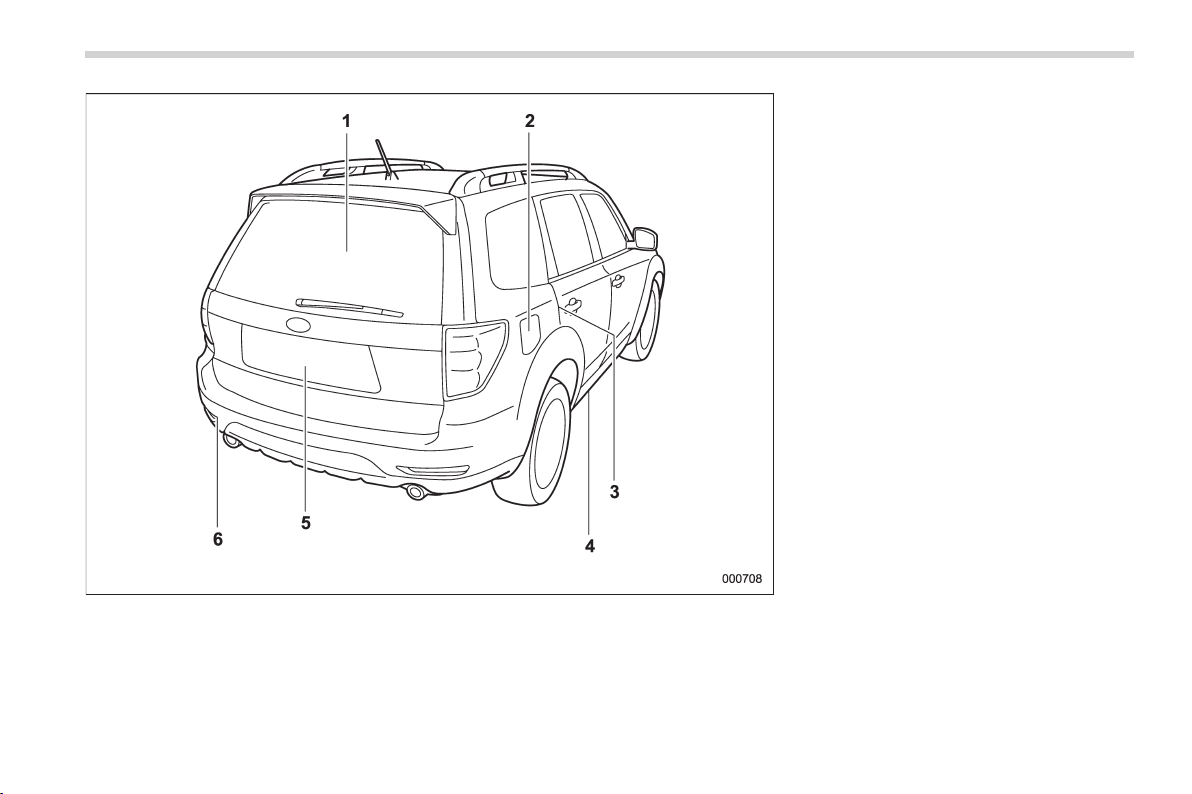
1) Rear window defogger button
(page 3-44)
2) Fuel filler lid and cap (page 7-3)
3) Child safety locks (page 2-19)
4) Tie-down hook (page 9-14)
5) Rear gate (page 2-23)
6) Towing hook (page 9-14)
13
– CONTINUED –

14
& Interior
! Passenger compartment area
1) Lower anchorages for child restraint
system (page 1-29)
2) Seatbelt (page 1-12)
3) Parking brake lever (page 7-29)
4) Front seat (page 1-2)
5) Rear seat (page 1-7)

1) Center console (page 6-5)
2) Cup holder (page 6-8)
3) Front power supply socket (page 6-9)
4) Glove box (page 6-5)
15
– CONTINUED –
16
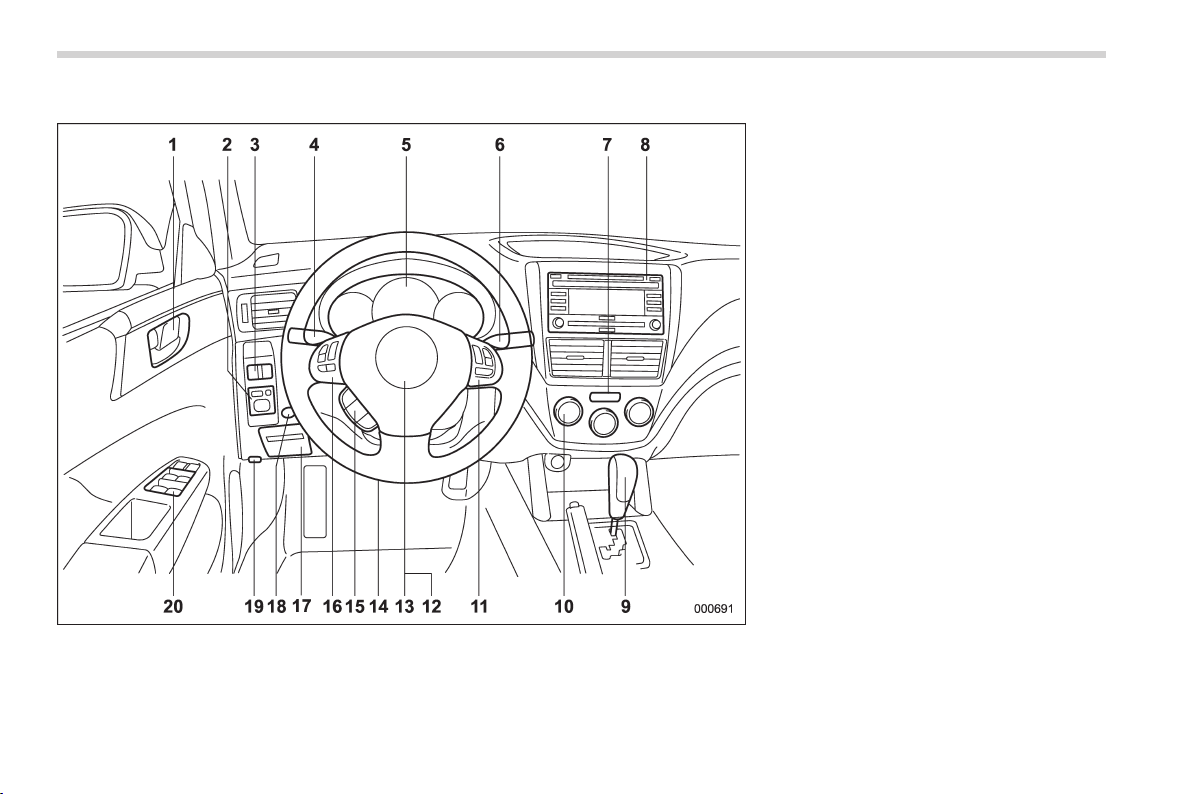
& Instrument panel
1) Door locks (page 2-4)
2) Outside mirror switch (page 3-43)
3) Illumination brightness control
(page 3-31)
4) Light control lever (page 3-29)
5) Combination meter (page 3-6)
6) Wiper control lever (page 3-33)
7) Hazard warning flasher switch (page 3-5)
Audio (page 5-1)
9) Shift lever (MT) (page 7-13)/
Select lever (AT) (page 7-15)
10) Climate control (page 4-1)
11) Cruise control (page 7-32)
12) Horn (page 3-47)
13) SRS airbag (page 1-33)
14) Tilt/telescopic steering (page 3-46)
15) Hands-free switches (page 5-42)
16) Audio control buttons (page 5-37)
17) Fuse box (page 11-44)
18) Vehicle Dynamics Control OFF switch
(page 7-27)
19) Hood lock release knob (page 11-5)
20) Power windows (page 2-20)

17
& Light control and wiper control levers/switches
1) Windshield wiper (page 3-34)
2) Mist (page 3-35)
3) Windshield washer (page 3-35)
4) Rear window wiper and washer switch
(page 3-35)
5) Wiper intermittent time control switch
(page 3-34)
6) Wiper control lever (page 3-33)
7) Light control switch (page 3-29)
Fog light switch (page 3-32)
9) Headlight ON/OFF (page 3-29)
10) Headlight flasher High/Low beam
change (page 3-30)
11) Turn signal (page 3-31)
– CONTINUED –

18
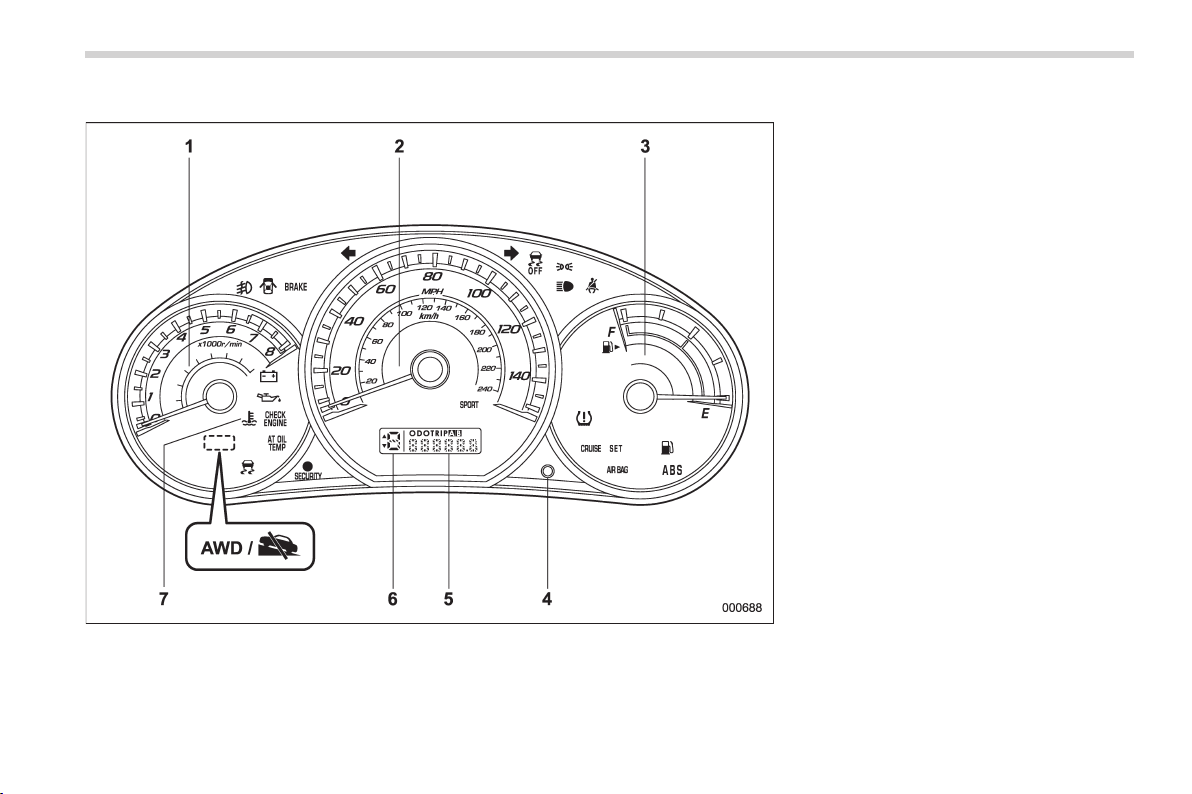
& Combination meter
! Type A
1) Tachometer (page 3-10)
2) Trip meter and odometer (page 3-8)
3) Select lever and gear position indicator
(page 3-24)
4) Speedometer (page 3-8)
5) Information display switching knob
(page 3-26)
6) ECO gauge (page 3-11)
7) Fuel gauge (page 3-10)
Temperature gauge (page 3-11)
9) Trip meter A/B selection and trip meter
reset knob (page 3-6)
19
! Type B (U.S.-spec. models)
1) Tachometer (page 3-10)
2) Speedometer (page 3-8)
3) Fuel gauge (page 3-10)
4) Trip meter A/B selection and trip meter
reset knob (page 3-6)
5) Odometer/Trip meter (page 3-8)
6) Select lever and gear position indicator
(AT models) (page 3-24)
7) Coolant temperature low indicator light/
Coolant temperature high warning light
(page 3-16)
– CONTINUED –

20
! Type B (except U.S.-spec. models)
1) Tachometer (page 3-10)
2) Speedometer (page 3-8)
3) Fuel gauge (page 3-10)
4) Trip meter A/B selection and trip meter
reset knob (page 3-6)
5) Odometer/Trip meter (page 3-8)
6) Select lever and gear position indicator
(AT models) (page 3-24)
7) Coolant temperature low indicator light/
Coolant temperature high warning light
(page 3-16)

21
& Warning and indicator lights
Mark Name Page
Seatbelt warning light 3-13
Front passenger’s seatbelt warning light
SRS airbag system
warning light
Front passenger’s fron-
/
tal airbag ON indicator
Front passenger’s fron-
/
tal airbag OFF indicator
CHECK ENGINE
warning light/Malfunction
indicator light
Coolant temperature low
indicator light (if
equipped)/Coolant temperature high warning
light (if equipped)
Charge warning light 3-17
Oil pressure warning
light
AT OIL TEMP warning
light (AT models)
3-13
3-14
3-15
3-15
3-15
3-16
3-17
3-17
Mark Name Page
/ ABS warning light 3-19
Brake system warning
/
light
Door open warning light 3-21
AWD warning light
(AT models)
Hill start assist warning
light (MT models)
Vehicle Dynamics Control warning light/Vehicle
Dynamics Control operation indicator light
Vehicle Dynamics Control OFF indicator light
Turn signal indicator
lights
High beam indicator light 3-24
Automatic headlight
beam leveler warning
light (models with HID
headlights)
3-20
3-21
3-21
3-22
3-23
3-24
3-21
Mark Name Page
Front fog light indicator
light (if equipped)
Security indicator light 3-23
Headlight indicator light 3-25
Cruise control indicator
light
Cruise control set indicator light
Low fuel warning light 3-21
Low tire pressure warning light
(U.S.-spec. models)
SPORT mode indicator
light (AT models)
3-25
3-24
3-25
3-18
3-24

22
Function settings
A SUBARU dealer can change the settings of the functions shown in the following table to meet your personal requirements. Contact
the nearest SUBARU dealer for details. If your vehicle is equipped with the genuine SUBARU DVD navigation system, the settings for
some of these functions can be changed using the navigation monitor. For details, please refer to the Owner’s Manual supplement for
the navigation system.
Item Function Possible settings Default setting
Alarm system Alarm system Operation/Non-operation Operation
Monitoring start delay time (after closure of
doors)
Impact sensor operation (only models with
shock sensors [dealer option])
Passive arming Operation/Non-operation Non-operation
Dome light/map lights illumination ON/OFF OFF
Remote keyless entry system Hazard warning flasher Operation/Non-operation Operation
Audible signal Operation/Non-operation Operation
Key lock-in prevention Key lock-in prevention Operation/Non-operation Operation
Remote engine start system
(dealer option)
Defogger and deicer system for
models with the automatic climate control system
Map light/Dome light Operation of map light/dome light OFF delay
Battery drainage prevention
function
Seatbelt warning Sounds a chime while driving Operation/Non-operation Operation
*: The setting can only be changed at a SUBARU dealer.
Horn chirp confirmation ON/OFF ON
Rear window defogger, outside mirror defogger and windshield wiper deicer
timer
Battery drainage prevention function* Operation/Non-operation Operation
0 second/30 seconds 30 seconds
Operation/Non-operation Non-operation
Operation for 15 minutes/
Continuous operation
OFF/Short/Normal/Long Long
Operation for 15 minutes

Seat, seatbelt and SRS airbags
Front seats………………………………………………….. 1-2
Manual seat ……………………………………………….. 1-3
Power seat (driver’s seat – if equipped) …………… 1-4
Head restraint adjustment……………………………… 1-5
Active head restraint ……………………………………. 1-6
Seat heater (if equipped) ……………………………… 1-6
Rear seats…………………………………………………… 1-7
Armrest …………………………………………………….. 1-8
Head restraint adjustment……………………………… 1-8
Reclining the seatback (if equipped) ………………. 1-10
Folding down the rear seatback…………………….. 1-10
Seatbelts ……………………………………………………. 1-12
Seatbelt safety tips……………………………………… 1-12
Emergency Locking Retractor (ELR) ………………. 1-13
Automatic/Emergency Locking Retractor
(A/ELR) …………………………………………………… 1-13
Seatbelt warning light and chime …………………… 1-13
Fastening the seatbelt …………………………………. 1-13
Seatbelt maintenance ………………………………….. 1-19
Front seatbelt pretensioners……………………….. 1-20
System monitors ……………………………………….. 1-21
System servicing ……………………………………….. 1-21
Precautions against vehicle modification ………… 1-22
Child restraint systems ………………………………. 1-22
Where to place a child restraint system………….. 1-23
Choosing a child restraint system …………………. 1-24
Installing child restraint systems with A/ELR
seatbelt ………………………………………………….. 1-25
Installing a booster seat………………………………. 1-28
Installation of child restraint systems by use of
lower and tether anchorages (LATCH) ………….. 1-29
Top tether anchorages ………………………………… 1-32
*SRS airbag (Supplemental Restraint
System airbag)………………………………………… 1-33
Models with SRS airbags and lap/shoulder
restraints for driver, front passenger, and
window-side rear passengers……………………… 1-33
SUBARU advanced frontal airbag system ……….. 1-37
SRS side airbag and SRS curtain airbag…………. 1-47
SRS airbag system monitors ………………………… 1-57
SRS airbag system servicing ……………………….. 1-58
Precautions against vehicle modification ………… 1-59
1

1-2 Seat, seatbelt and SRS airbags
Front seats
WARNING
. Never adjust the seat while driv-
ing to avoid loss of vehicle control and personal injury.
. Before adjusting the seat, make
sure the hands and feet of rear
seat passengers and cargo are
clear of the adjusting mechanism.
. After adjusting the seat, push it
slightly to make sure it is securely locked. If the seat is not
securely locked, it may move or
the seatbelt may not operate
properly.
. Do not put objects under the front
seats. They may interfere with
front seat locking and cause an
accident.
. Seatbelts provide maximum re-
straint when the occupant sits
well back and upright in the seat.
To reduce the risk of sliding
under the seatbelt in a collision,
the front seatbacks should be
always used in the upright position while the vehicle is running.
If the front seatbacks are not
used in the upright position in a
collision, the risk of sliding under
the lap belt and of the lap belt
sliding up over the abdomen will
increase, and both can result in
serious internal injury or death.
. The SRS airbags deploy with
considerable speed and force.
Occupants who are out of proper
position when the SRS airbag
deploys could suffer very serious
injuries. Because the SRS airbag
needs enough space for deployment, the driver should always
sit upright and well back in the
seat as far f rom the steering
wheel as practical while still
maintaining full vehicle control
and the front passenger should
move the seat as far back as
possible and sit upright and well
back in the seat.
WARNING
Put children aged 12 and under in
the rear seat properly restrained at
all times. The SRS airbag deploys
with considerable speed and force
and can injure or even kill children,
especially if they are 12 years of age
and under and are not restrained or
improperly restrained. Because children are lighter and weaker than
adults, their risk of being injured
from deployment is greater. For that
reason, we strongly recommend
that ALL children (including those
in child seats and those that have
outgrown child restraint devices) sit
in the REAR seat properly restrained at all times in a child

Seat, seatbelt and SRS airbags 1-3
restraint device or in a seatbel t,
whichever is appropriate for the
child’s age, height and weight. Secure ALL types of child restraint
devices (including forward facing
child seat) in the REAR seats at all
times.
NEVER INSTALL A REARWARD FACING CHILD SEAT IN THE FRONT
SEAT. DOING SO RISKS SERIOUS
INJURY OR DEATH TO THE CHILD
BY PLACING THE CHILD’S HEAD
TOO CLOSE TO THE SRS AIRBAG.
According to accident statistics,
children are safer when properly
restrained in the rear seating positions than in the front seating positions. For instructions and precautions concerning child restraint systems, refer to “Child restraint systems” F1-22.
& Manual seat
! Forward and backward adjustment
Pull the lever upward and slide the seat to
the desired position. Then release the
lever and move the seat back and forth to
make sure that it is securely locked into
place.
! Reclining the seatback
Pull the reclining lever up and adjust the
seatback to the desired position. Then
release the lever and make sure the
seatback is securely locked into place.
The seatback placed in a reclined position
can spring back upward with force when
the lever is pulled. While operating the
lever to return the seatback, hold the
seatback lightly so that it may be raised
back gradually.
– CONTINUED –

1-4 Seat, seatbelt and SRS airbags
WARNING
To prevent the passenger from sliding under the seatbelt in the event of
a collision, always put the seatback
in the upright position while the
vehicle is in motion. Also, do not
place objects such as cushions
between the passenger and the
seatback. If you do so, the risk of
sliding under the lap belt and of the
lap belt sliding up over the abdomen
will increase, and both can result in
serious internal injury or death.
! Seat cushion height adjustment
1) When the lever is pushed down, the seat
is lowered.
2) When the lever is pulled up, the seat
rises.
The height of the seat can be adjusted by
moving the seat cushion adjustment lever
up and down.
& Power seat (driver’s seat – if
equipped)
1) Seat position forward/backward con-
trol switch
To adjust the seat forward or backward,
move the control switch forward or
backward. During forward/backward ad-
Seat, seatbelt and SRS airbags 1-5
justment of the seat, you cannot adjust
the seat cushion angle or seat cushion
height.
2) Seat cushion angle control switch
To adjust the seat cushion angle, pull up
or push down the front end of the control
switch.
3) Seatback angle (reclining) control
switch
To adjust the angle of the seatback, tilt
the control switch forward or backward.
4) Seat height control switch
To adjust the seat height, pull up or push
down the rear end of the control switch.
5) Lumbar support control switch
To increase lumbar support, push the
front side of the switch. To decrease
lumbar support, push the rear side of the
switch.
WARNING
To prevent the passenger from sliding under the seatbelt in the event of
a collision, always put the seatback
in the upright position while the
vehicle is in motion. Also, do not
place objects such as cushions
between the passenger and the
seatback. If you do so, the risk of
sliding under the lap belt and of the
lap belt sliding up over the abdomen
will increase, and both can result in
serious internal injury or death.
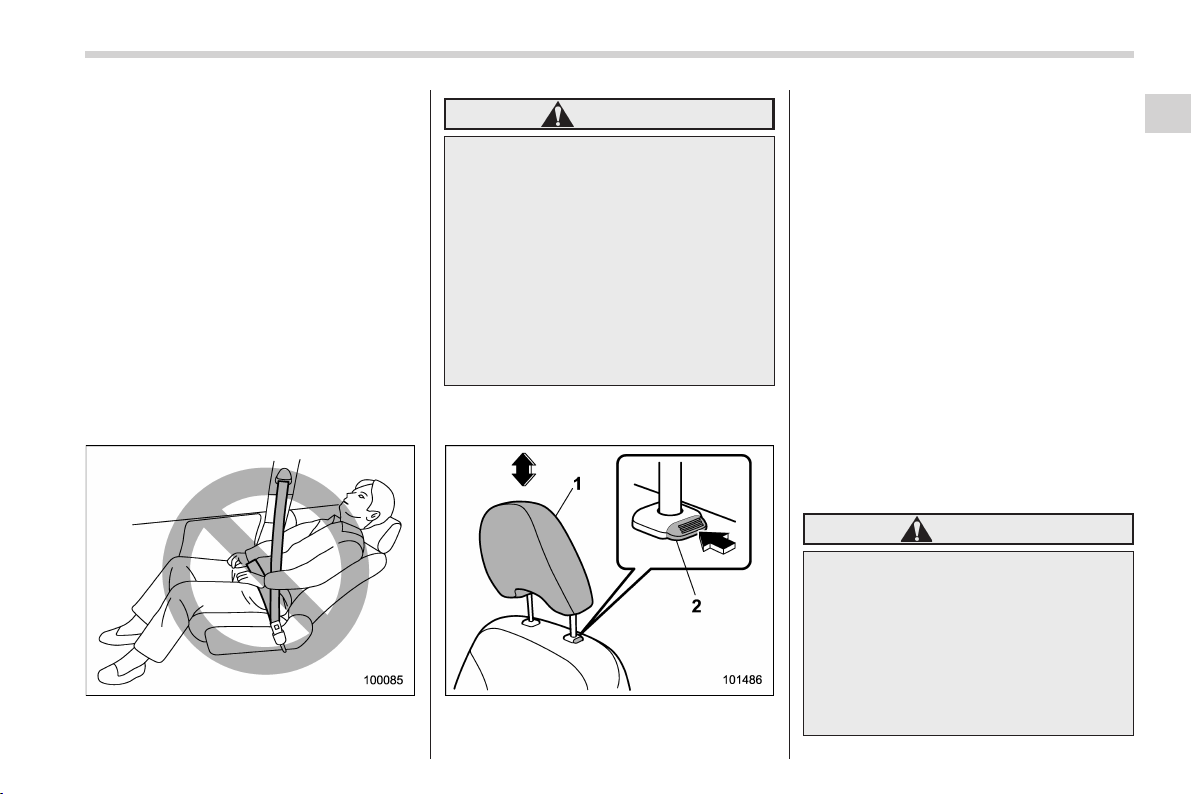
& Head restraint adjustment
1) Head restraint
2) Release button
Both the driver’s seat and the front
passenger’s seat are equipped with head
restraints.
The head restraint should be adjusted so
that the center of the head restraint is
closest to the top of the occupant’s ears.
To raise:
Pull the head restraint up.
To lower:
Push the head restraint down while
pressing the release button on the top of
the seatback.
To remove:
While pressing the release button, pull out
the head restraint.
To install:
Install the head restraint into the holes that
are located on the top of the seatback until
the head restraint locks.
WARNING
. Never drive the vehicle with the
head restraints removed because
they are designed to reduce the
risk of serious neck injury in the
event that the vehicle is struck
from the rear. Therefore, when
you remove the head restraints,
you must reinstall all head restraints to protect vehicle occu-
– CONTINUED –
Loading…
- Артикул: 4930 — назовите при заказе по телефону
- Издательство: Автонавигатор
- ISBN: 978-5-98410-110-3
- Число страниц: 506
- Формат: А4
- Переплет: Мягкий
- Год выпуска: 2010-13
- V бенз дв: 2.0; 2.5
Цена в интернет-магазине: 3 480 руб.

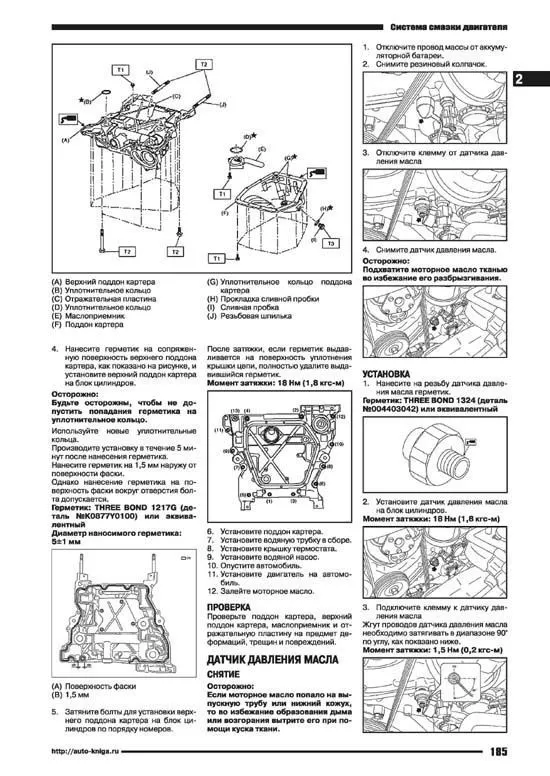
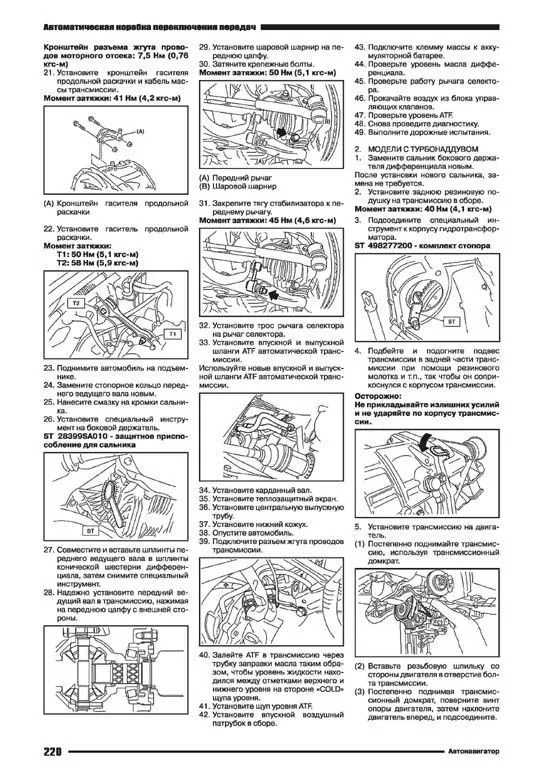
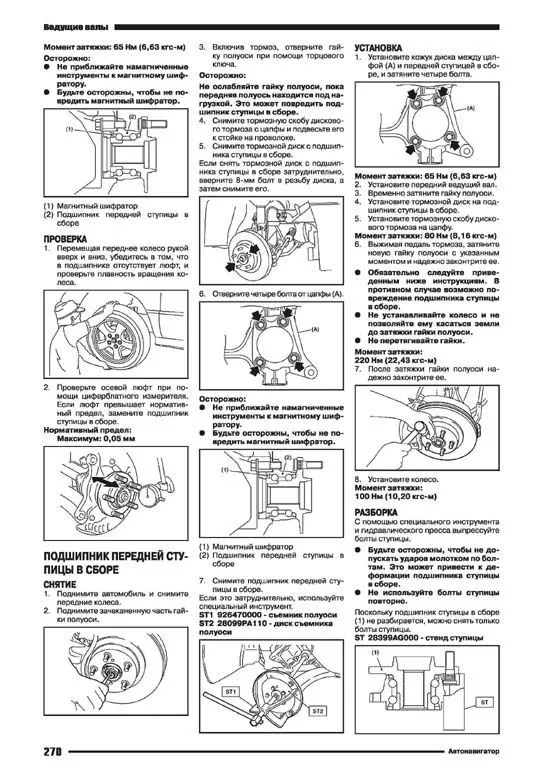
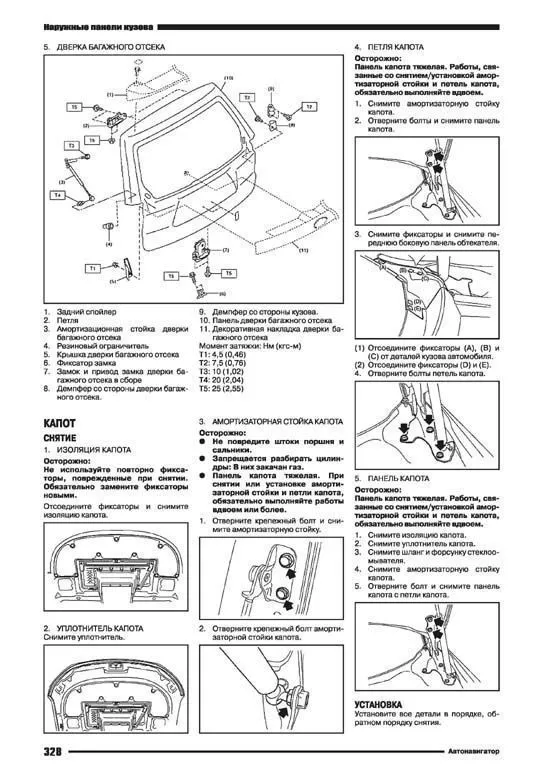
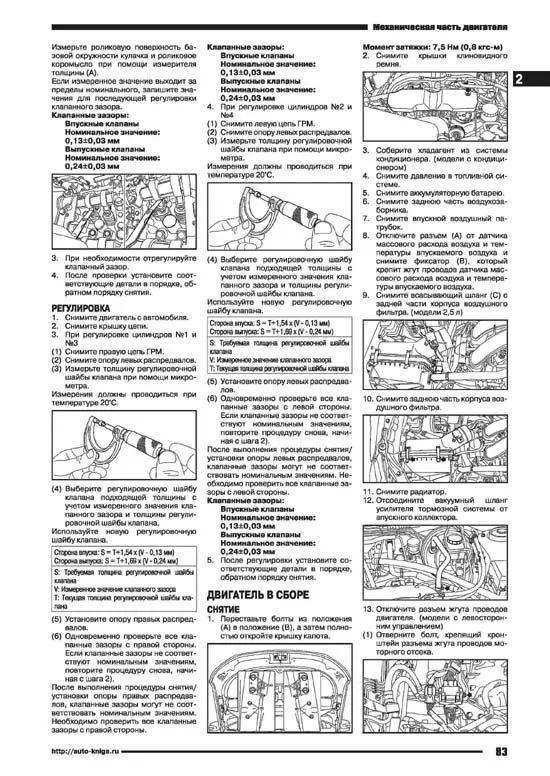
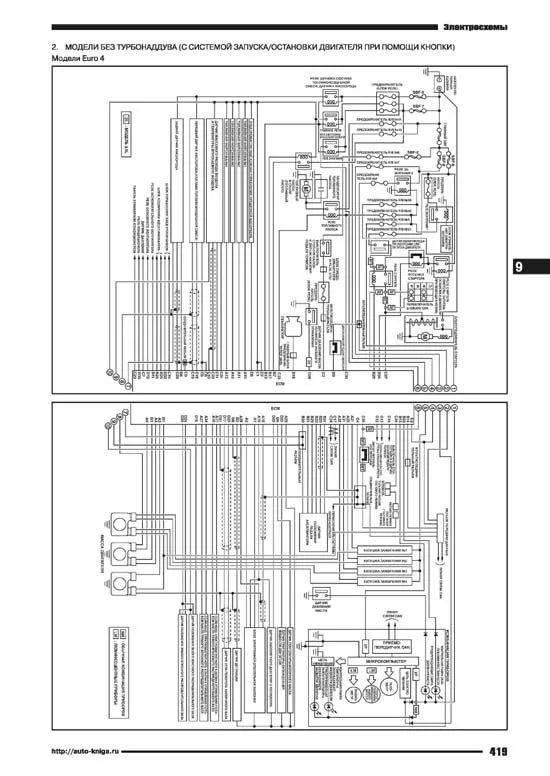
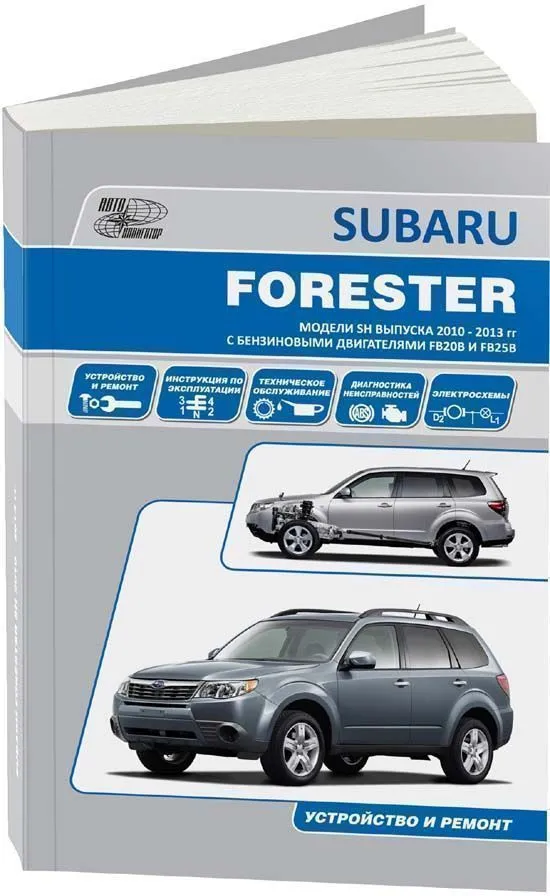
Книга Субару Форестер СШ 2010-2013 с бензиновыми двигателями FB20B 2.0, FB25B 2.5. Электросхемы, диагностика неисправностей. Руководство по ремонту, эксплуатации и техническому обслуживанию автомобиля.
В издании представлено руководство по техническому обслуживанию и ремонту автомобилей Subaru Forester в кузове SH 2010-2013 гг выпуска с бензиновыми двигателями B20B(2,0 л), FB25B(2,5 л).
В руководстве представлено описание работ по снятию/установке, разборке/сборке различных узлов и механизмов автомобиля.
Детально рассмотрены методы по регулировке и ремонту двигателей, систем управления двигателями, автоматической коробки передач (АКПП), механической коробки передач (МКПП),систем подачи воздуха и отвода отработавших газов, тормозной системы (включая антиблокировочную систему тормозов ABS, систему динамической стабилизации VDC), рулевого управления, подвески, системы полного привода, дополнительной системы безопасности и кузова.
Приведены коды неисправностей, описаны процедуры самодиагностики основных систем автомобиля (двигателя, АКП, ABS и т.д.).
Книга предназначена для персонала СТО, ремонтных мастерских и автовладельцев.
Скачать бесплатно PDF страницы книги по ремонту и обслуживанию Subaru Forester 2010-2013 бензин
Купить книгу по ремонту и эксплуатации автомобиля Subaru Forester SH 2010-2013 с бензиновыми двигателями FB20B 2.0, FB25B 2.5, электросхемы Вы можете в нашем интернет-магазине с доставкой Почтой России или курьером по Москве.
Интернет-портал Легион-Автодата создан для удобных покупок: автолитературы, программ для диагностики автомобиля, диагностических приборов, адаптеров elm327, автоаксессуаров и инструментов для авторемонта. Купить книги и приборы для диагностики и ремонта автомобиля Вы можете в нашем интернет магазине.
Удобно оплатить руководства по ремонту и эксплуатации выбранных Вами марок авто любой из платежных систем.
Заказать доставку автокниги почтой без предоплаты, курьером по Москве, регионам и в более 200 пунктов самовывоза по всей России.
This repair manual contains complete technical information on the maintenance and repair of the Subaru Forester SJ 2012–2018. Includes diagrams of units and assemblies,
instructions for diagnostics, repair of the engine, transmission, suspension, brake system and electrical system. Useful for both professionals and car owners who want to solve technical issues
on their own.
Engine: 2.5L Non-turbo, 2.0L Turbo
Transmission: CVT(TR580), CVT(TR690), 6MT
🔧 Engine and transmission
1️⃣ Oil consumption (FB20, FB25)
More common on naturally aspirated FB20 (2.0) and FB25 (2.5) engines.
Cause: design features of the piston group.
Solution: replace piston rings, decarbonize or switch to oil with high heat resistance.
2️⃣ CVT vibrations and noise (Lineartronic TR580, TR690)
Gear shifts are delayed, jerks are felt.
Cause: oil contamination, belt wear, problems with the valve body.
Solution: oil change every 40,000–60,000 km, diagnostics of pulleys and solenoids.
3️⃣ Engine cooling problems
The thermostat may get stuck in the closed position, causing overheating.
Antifreeze leaks are possible due to weak clamps.
Solution: check the coolant level, replace the thermostat with a reinforced one.
⚙ Suspension and steering
4️⃣ Rapid wear of the front wheel bearings
A hum and play appear at speed.
Cars with active driving on bad roads suffer more often.
Solution: change bearings every 80,000–100,000 km.
5️⃣ Squeaking and wear of the silent blocks of the front arms
Knocking appears on small bumps.
Factory silent blocks are soft, wear out quickly.
Solution: install reinforced silent blocks or polyurethane analogs.
6️⃣ Knocking of the steering rack
Especially noticeable on Forester with a mileage of 50,000 km.
The reason is the wear of the plastic bushings.
Solution: adjust the rack or install reinforced bushings.
🔌 Electrics and sensors
7️⃣ Failure of the automatic transmission selector position sensor
The gearbox does not always switch to P or D mode, errors appear.
Solution: clean the contacts or replace the sensor.
8️⃣ Multimedia and rear view camera glitches
Freezing and loss of image on the screen are possible.
Cause: poor moisture protection, poor wiring.
Solution: check the contacts, replace the camera with an analog.
🛑 Body and corrosion
9️⃣ Weak protection of arches and thresholds from corrosion
Critical areas: rear arches, thresholds, lower part of the doors.
The factory anti-corrosion layer is weak.
Solution: anti-corrosion treatment, installation of mudguards with noise insulation.
🔟 Front windshield problems
Often cracks from small stones.
Factory glass is fragile, prone to chipping.
Solution: replace with reinforced triplex glass.
💡 Result
Despite its weak points, the Subaru Forester SJ (2012–2018) remains a reliable car with timely maintenance. Key recommendations:
✅ Monitor the oil and antifreeze levels.
✅ Change the CVT oil every 40,000 km.
✅ Treat the body with anti-corrosion.
✅ Monitor the condition of the suspension and steering rack.
Free download & check preview

Answer & Preview
Subaru Forester 2013 Owner’s Manual PDF one of the great collections by the Manuals Expert Team and you can download it completely free. Just follow the instruction we have below and download completley free Subaru Forester 2013 Owner’s Manual PDF pdf manuals online at manualsexpert.com.
How to Download manuals:
Follow the steps we have described bellow and if you still getting stuck or facing any other issues to download the manual then let us know through our contact page.
Important Note: If you see download is not being started automatically then try to refresh the manual page and try to download it again. This is happened sometimes for internet or server slowness issues also browser relatet issues.
Also if your downloaded file doesn’t have .pdf extention format then rename it to manualsName.pdf because sometime Safari add .txt extension with the downloaded PDF manual file. So rename it out and enjoy!