
Kia Soul (2010)
kkiiaa,, tthhee ccoommppaannyy
Now that you are the owner of a KIA Vehicle, you’ll probably
be asked a lot of questions about your vehicle and the company
like “What is a KIA?,” “Who is KIA?,” “What does ‘KIA’
mean?”
Here are some answers. First, KIA is the oldest car company in
Korea. It’s a company that has thousands of employees focused
on building high-quality vehicles at affordable prices.
The first syllable, KI, in the word “KIA” means “to arise from
to the world” or “to come up out of to the world”. The second
syllable, A, means “Asia”. So, the word KIA, means “to arise
from” or “to come up out of Asia to the world”.
Enjoy your Vehicle!
View the manual for the Kia Soul (2010) here, for free. This manual comes under the category cars and has been rated by 26 people with an average of a 9.1. This manual is available in the following languages: English. Do you have a question about the Kia Soul (2010) or do you need help?
Ask your question here
Product Images (2)


Kia Soul (2010) specifications
Below you will find the product specifications and the manual specifications of the Kia Soul (2010).
The Kia Soul (2010) is a compact car with a distinct square shape. It has a fuel-efficient four-cylinder engine with a horsepower of 142 and a six-speed manual or four-speed automatic transmission. The car can accelerate from 0-60 mph in approximately 9 seconds. Its boxy design allows for ample headroom and legroom for passengers in both front and rear seats. The cargo area offers 19.3 cubic feet of storage space, which can be expanded to 53.4 cubic feet when the rear seats are folded down. The car has a comfortable ride, thanks to its well-tuned suspension, and it handles well on curves and corners.
The Kia Soul (2010) is equipped with safety features such as front-impact airbags, side curtain airbags, and anti-lock brakes. It also has electronic stability control and a tire pressure monitoring system. The car has received high safety ratings from the National Highway Traffic Safety Administration (NHTSA) and the Insurance Institute for Highway Safety (IIHS).
The car’s interior is practical and functional, with easy-to-use controls and a user-friendly infotainment system. It comes with standard features like air conditioning, power windows, and a six-speaker audio system with satellite radio and iPod connectivity. Higher trims offer additional features such as a rearview camera, navigation system, and Bluetooth connectivity.
Overall, the Kia Soul (2010) is a dependable and practical car with a unique design, offering good value for its price.
General
| Brand | Kia |
| Model | Soul (2010) |
| Product | car |
| Language | English |
| Filetype | User manual (PDF) |
Frequently Asked Questions
Can’t find the answer to your question in the manual? You may find the answer to your question in the FAQs about the Kia Soul (2010) below.
How to Quickly Cool Your Kia Soul 2010’s AC
When does my Kia need maintenance?
Regular maintenance is necessary for every car. How often the car needs maintenance and what exactly needs to be done can be found in the maintenance instructions.
For major periodic service, this should generally be done every 2 years or after 30,000 kilometres.
One or more doors won’t open from the inside. Now what?
The lock is most likely set to the child safety lock so it cannot be opened from the inside. How to unset the child safety lock differs per brand and type.
My car radio does not turn on, now what?
If your car radio does not turn on, it will not receive any power. Check that the red wire is connected to the contact power supply and the yellow wire to the constant power supply.
How do I convert miles into kilometres?
1 mile equals 1.609344 kilometers and 1 kilometer equals 0.62137119 miles.
Where can I find the VIN number of my Kia?
The location of the VIN number of the car differs per brand and type of car.
The code may be stamped on the frame of the car or mounted on a plate. It is best to consult the manual of the Kia Soul (2010)for the exact location of the VIN number.
When should I change the brake fluid of my Kia?
It is recommended to change the brake fluid every two years.
What is the difference between E10 and E5 petrol?
E10 petrol consists of up to ten per cent ethanol while E5 petrol will contain less than five per cent ethanol. As a result, the percentage of E10 petrol is lower than that of E5 petrol, making it less bad for the environment.
What is a VIN number?
The VIN number of a car is an identification number unique to each car. The abbreviation VIN therefore stands for Vehicle Identification Number.
Is the manual of the Kia Soul (2010) available in English?
Yes, the manual of the Kia Soul (2010) is available in English .
Is your question not listed? Ask your question here

kia, the company
Congratulations! Your selection of a KIA was a wise investment. It
will give you years of driving pleasure. Now that you are the owner of
a KIA vehicle, you’ll probably be asked a lot of questions about your
vehicle and the company like “What is a KIA?”, “Who is KIA?”,
“What does ‘KIA’ mean?”.
Here are some answers. First, KIA is the oldest car company in Korea.
It is a company that has thousands of employees focused on building
high-quality vehicles at affordable prices.
The first syllable, KI, in the word “KIA” means “to arise from to the
world” or “to come up out of to the world”. The second syllable, a,
means “Asia”. So, the word KIA, means “to arise from” or “to come
up out of Asia to the world”.
Drive safely and enjoy your Kia!

i
Thank you for choosing a KIA vehicle.
When you require service, remember that your KIA Dealer
knows your vehicle best. Your dealer has factory-trained technicians, recommended special tools, genuine KIA replacement
parts and is dedicated to your complete satisfaction.
Because subsequent owners require this important information
as well, this publication should remain with the vehicle if it is
sold.
This manual will familiarize you with operational, maintenance and safety information about your new vehicle. It is supplemented by a Warranty and Consumer Information manual
that provides important information on all warranties regarding
your vehicle.
W e ur ge you to read these publications carefully and follow the
recommendations to help assure enjoyable and safe operation
of your new vehicle.
KIA offers a great variety of options, components and features
for its various models. Therefore, some of the equipment
described in this manual, along with the various illustrations,
may not be applicable to your particular vehicle.
The information and specifications provided in this manual
were accurate at the time of printing. KIA reserves the right to
discontinue or change specifications or design at any time
without notice and without incurring any obligation. If you
have questions, always check with your KIA dealer.
We assure you of our continuing interest in your motoring
pleasure and satisfaction in your KIA vehicle.
© 2009 Kia Canada Inc.
All rights reserved. Reproduction by any means, electronic or
mechanical, including photocopying, recording, or by any
information storage and retrieval system or translation in
whole or part is not permitted without written authorization
from Kia Canada Inc..
Printed in Korea
Foreword
ii
1
2
3
4
5
6
7
8
I
Introduction
Your vehicle at a glance
Safety features of your vehicle
Features of your vehicle
Driving your vehicle
What to do in an emergency
Maintenance
Specifications & Consumer information
Index
table of contents
1
How to use this manual / 1-2
Fuel requirements / 1-3
Vehicle handling instructions / 1-5
Vehicle break-in process / 1-5
Indicator symbols on the instrument cluster / 1-6
Introduction
Introduction
21
A010000AAM
We want to help you get the greatest
possible driving pleasure from your vehicle.Your Owner’s Manual can assist you
in many ways. We strongly recommend
that you read the entire manual. In order
to minimize the chance of death or injury ,
you must read the WARNING and CAUTION sections in the manual.
Illustrations complement the words in this
manual to best explain how to enjoy your
vehicle.By reading your manual, you will
learn about features, important safety
information, and driving tips under various road conditions.
The general layout of the manual is provided in the Table of Contents. Use the
index when looking for a specific area or
subject;it has an alphabetical listing of all
information in your manual.
Sections:This manual has eight sections
plus an index.Each section begins with a
brief list of contents so you can tell at a
glance if that section has the information
you want.
You will find various WARNINGs,
CAUTIONs, and NOTICEs in this manual. These WARNINGs were prepared to
enhance your personal safety.Y ou should
carefully read and follow ALL procedures
and recommendations provided in these
WARNINGS, CAUTIONS and NOTICES.
✽✽
NOTICE
ANOTICE indicates interesting orhelpful information is being provided.
HOW T O USE THIS MANUAL
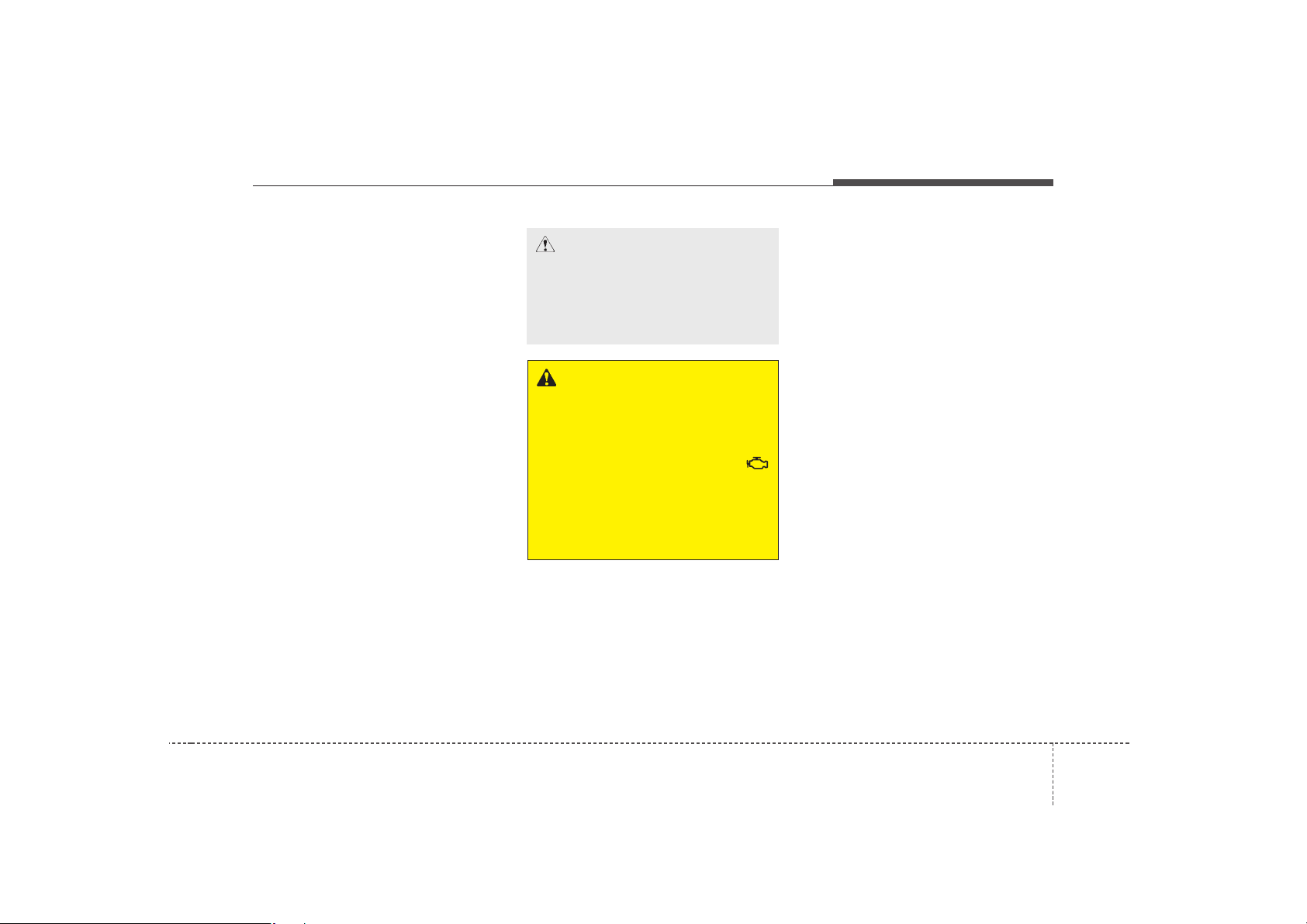
WARNING
A WARNING indicates a situation in
which harm, serious bodily injury or
death could result if the warning is
ignored.
CAUTION
A CAUTION indicates a situation in
which damage to your vehicle could
result if the caution is ignored.
13
Introduction
A020101AHM-EU
Your new vehicle is designed to use only
unleaded fuel having a pump octane
number ((R+M)/2) of 87 (Research
Octane Number 91) or higher.
Your new vehicle is designed to obtain
maximum performance with UNLEADED
FUEL, as well as minimize exhaust emissions and spark plug fouling.
A020103AUN-EU
Gasoline containing alcohol and
methanol
Gasohol, a mixture of gasoline and
ethanol (also known as grain alcohol),
and gasoline or gasohol containing
methanol (also known as wood alcohol)
are being marketed along with or instead
of leaded or unleaded gasoline.
Do not use gasohol containing more than
10% ethanol, and do not use gasoline or
gasohol containing any methanol. Either
of these fuels may cause drivability problems and damage to the fuel system.
Discontinue using gasohol of any kind if
drivability problems occur.
Vehicle damage or drivability problems
may not be covered by the manufacturer’s warranty if they result from the use
of:
1. Gasohol containing more than 10%
ethanol.
2.Gasoline or gasohol containing
methanol.
3. Leaded fuel or leaded gasohol.
FUEL REQUIREMENTS
CAUTION
Never add any fuel system cleaning
agents to the fuel tank other than
what has been specified. (Consult
an authorized KIA dealer for
details.)
WARNING
• Do not «top off» after the nozzle
automatically shuts off when
refueling.
• Tighten the cap until it clicks,otherwise the Check Engine
light will illuminate.
• Always check that the fuel cap is
installed securely to prevent fuel
spillage in the event of an accident.
Introduction
41
«E85» fuel is an alternative fuel comprised of 85 percent ethanol and 15 percent gasoline, and is manufactured
exclusively for use in Flexible Fuel
Vehicles. “E85” is not compatible with
your vehicle. Use of “E85” may result in
poor engine performance and damage to
your vehicle’s engine and fuel system.
KIA recommends that customers do not
use fuel with an ethanol content exceeding 10 percent.
A020104AUN
Use of MTBE
KIA recommends avoiding fuels containing MTBE (Methyl Tertiary Butyl Ether)
over 15.0% vol. (Oxygen Content 2.7%
weight) in your vehicle.
Fuel containing MTBE over 15.0% vol.
(Oxygen Content 2.7% weight) may
reduce vehicle performance and produce
vapor lock or hard starting.
A020105AUN
Do not use methanol
Fuels containing methanol (wood alcohol) should not be used in your vehicle.
This type of fuel can reduce vehicle performance and damage components of
the fuel system.
A020106AUN
Gasolines for cleaner air
To help contribute to cleaner air, KIA recommends that you use gasolines treated
with detergent additives, which help prevent deposit formation in the engine.
These gasolines will help the engine run
cleaner and enhance performance of the
Emission Control System.
A020107AUN
Operation in foreign countries
If you are going to drive your vehicle in
another country, be sure to:
• Observe all regulations regarding registration and insurance.
• Determine that acceptable fuel is available.
CAUTION
Your New Vehicle Limited Warranty
may not cover damage to the fuel
system and any performance problems that are caused by the use of
fuels containing methanol or fuels
containing MTBE (Methyl Tertiary
Butyl Ether) over 15.0% vol.
(Oxygen Content 2.7% weight.)
CAUTION
Never use gasohol which contains
methanol. Discontinue use of any
gasohol product which impairs drivability.
CAUTION
Your New Vehicle Limited Warranty
does not cover damage to the fuel
system or any performance problems caused by the use of “E85”fuel.

15
Introduction
A090000AEN
As with other vehicles of this type, failure
to operate this vehicle correctly may
result in loss of control, an accident or
vehicle rollover.
Specific design characteristics (higher
ground clearance, track, etc.) give this
vehicle a higher center of gravity than
other types of vehicles. In other words
they are not designed for cornering at the
same speeds as conventional 2-wheel
drive vehicles. Avoid sharp turns or
abrupt maneuvers.Again, failure to operate this vehicle correctly may result in
loss of control, an accident or vehicle
rollover. Be sure to read the “Reducing
the risk of a rollover” driving guidelines, in section 5 of this manual.
A030000AUN
No special break-in period is needed. By
following a f e w simple precautions for the
first 1,000 km (600 miles) you may add to
the performance, economy and life of
your vehicle.
• Do not race the engine.
• While driving, keep your engine speed
(rpm, or revolutions per minute)
between 2,000 rpm and 4,000 rpm.
• Do not maintain a single speed for long
periods of time, either fast or slow.
Varying engine speed is needed to
properly break-in the engine.
• Avoid hard stops, except in emergencies, to allow the brakes to seat properly.
• Don’t let the engine idle longer than 3
minutes at one time.
• Don’t tow a trailer during the first 2,000
km (1,200 miles) of operation.
VEHICLE BREAK-IN PROCESSVEHICLE HANDLING
INSTRUCTIONS
Introduction
61
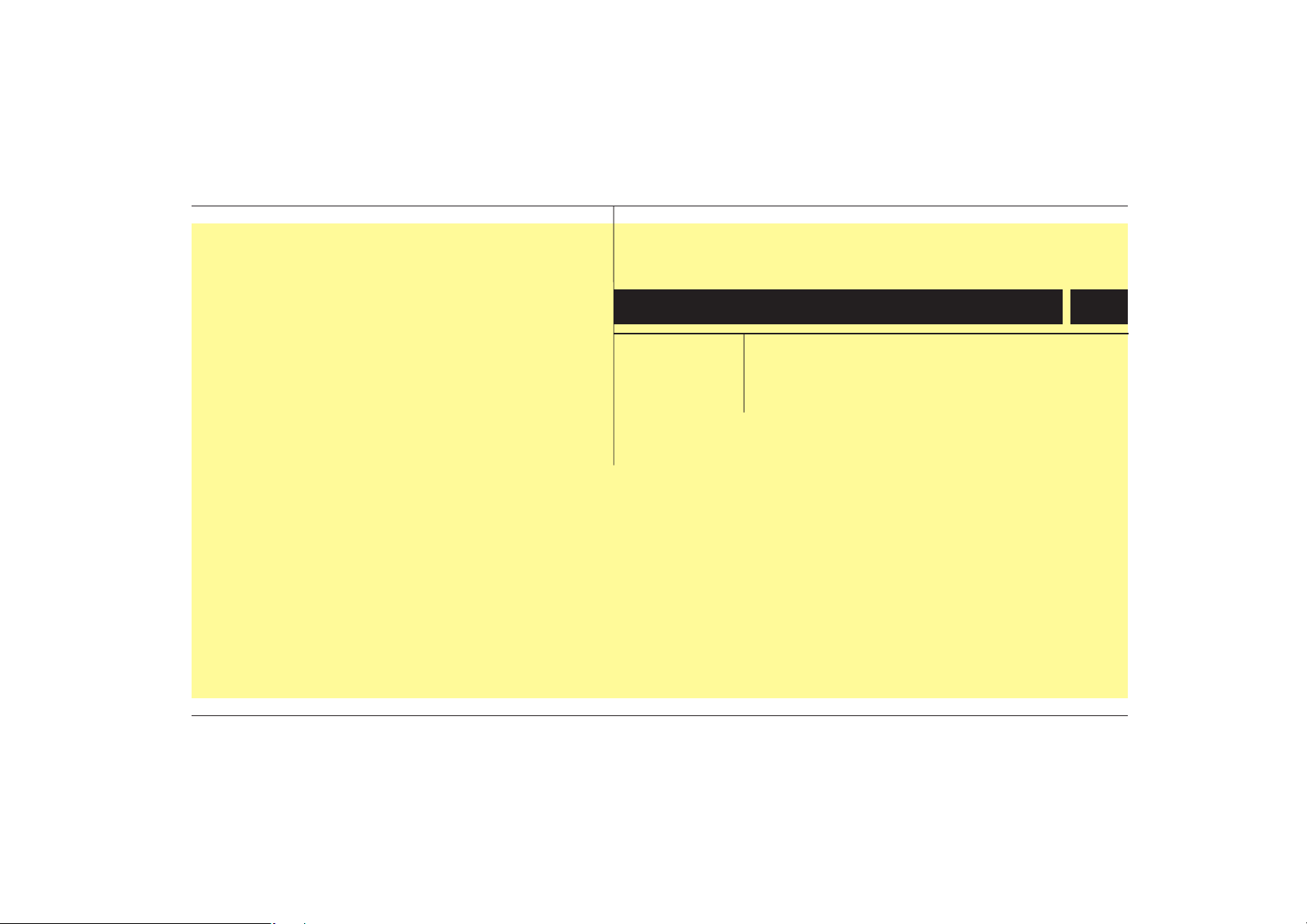
INDICATOR SYMBOLS ON THE INSTRUMENT CLUSTER
Seat Belt Warning Light
High Beam Indicator
Turn Signal Indicator
ABS Warning Light*
Parking Brake & Brake Fluid
Warning Light
Malfunction Indicator*
Immobilizer Indicator
Low Fuel Level Warning Light
* : if equipped
Tailgate Open Warning Light
❈ For more detailed explanations, refer to “Instrument cluster” in section 4.
Charging System Warning Light
Door Ajar Warning Light
A050000AAM-EC
Front Fog Light Indicator*
Engine Oil Pressure Warning Light
O/D OFF Indicator*
O/D
OFF
Air Bag Warning Light*
TPMS (Tire Pressure Monitoring
System) Malfunction Indicator*
Low Tire Pressure T elltale*
Cruise Indicator*
Cruise SET Indicator*
Shift Pattern Indicator
ESC Indicator*
ESC OFF Indicator*
TPMS
Tail Light Indicator*
Low Windshield Washer Fluid
Level Warning Light*
Low Beam Indicator*
2
Interior overview / 2-2
Instrument panel overview / 2-3
Engine compartment / 2-4
Your vehicle at a glance
Your vehicle at a glance
22
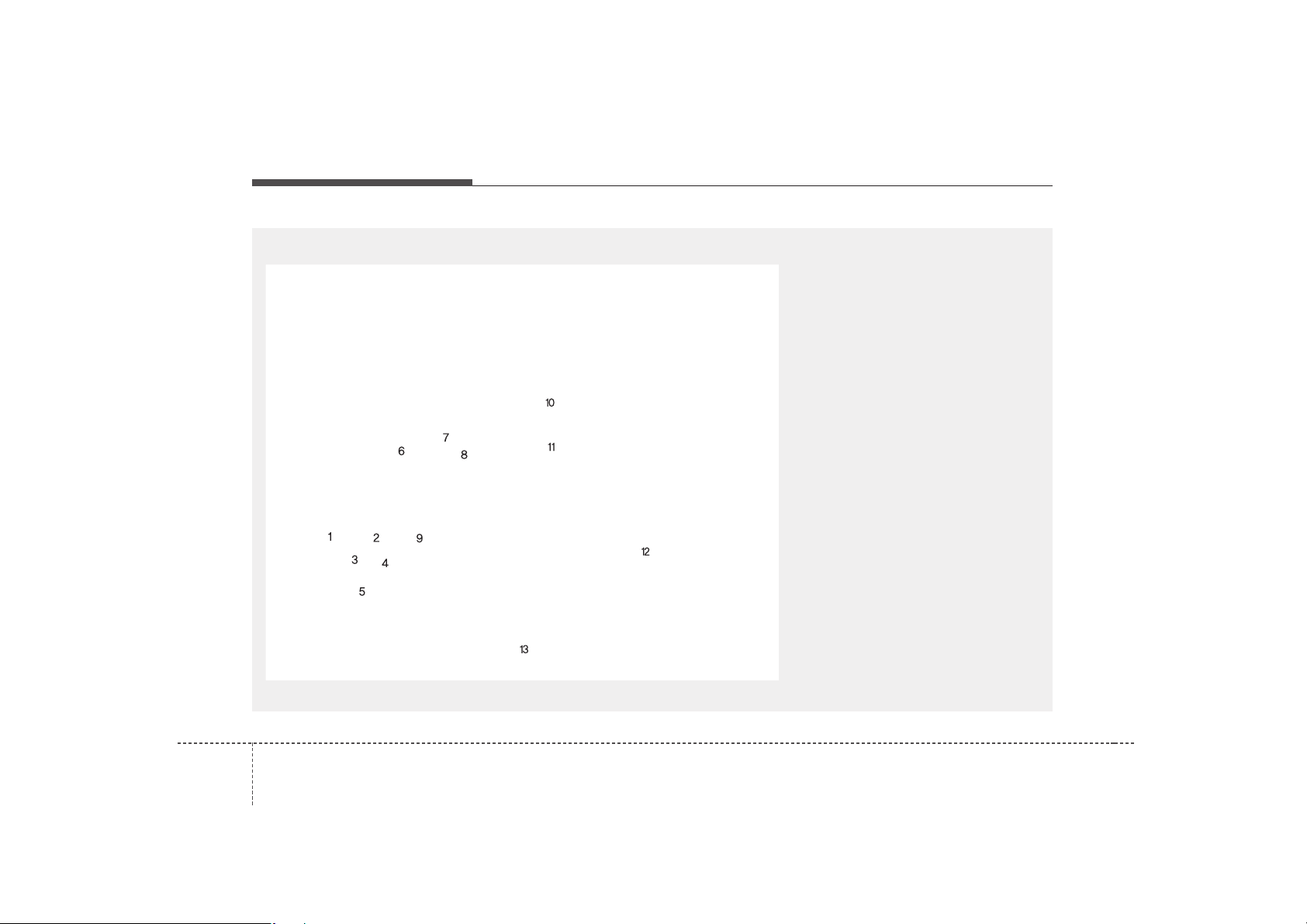
INTERIOR OVERVIEW
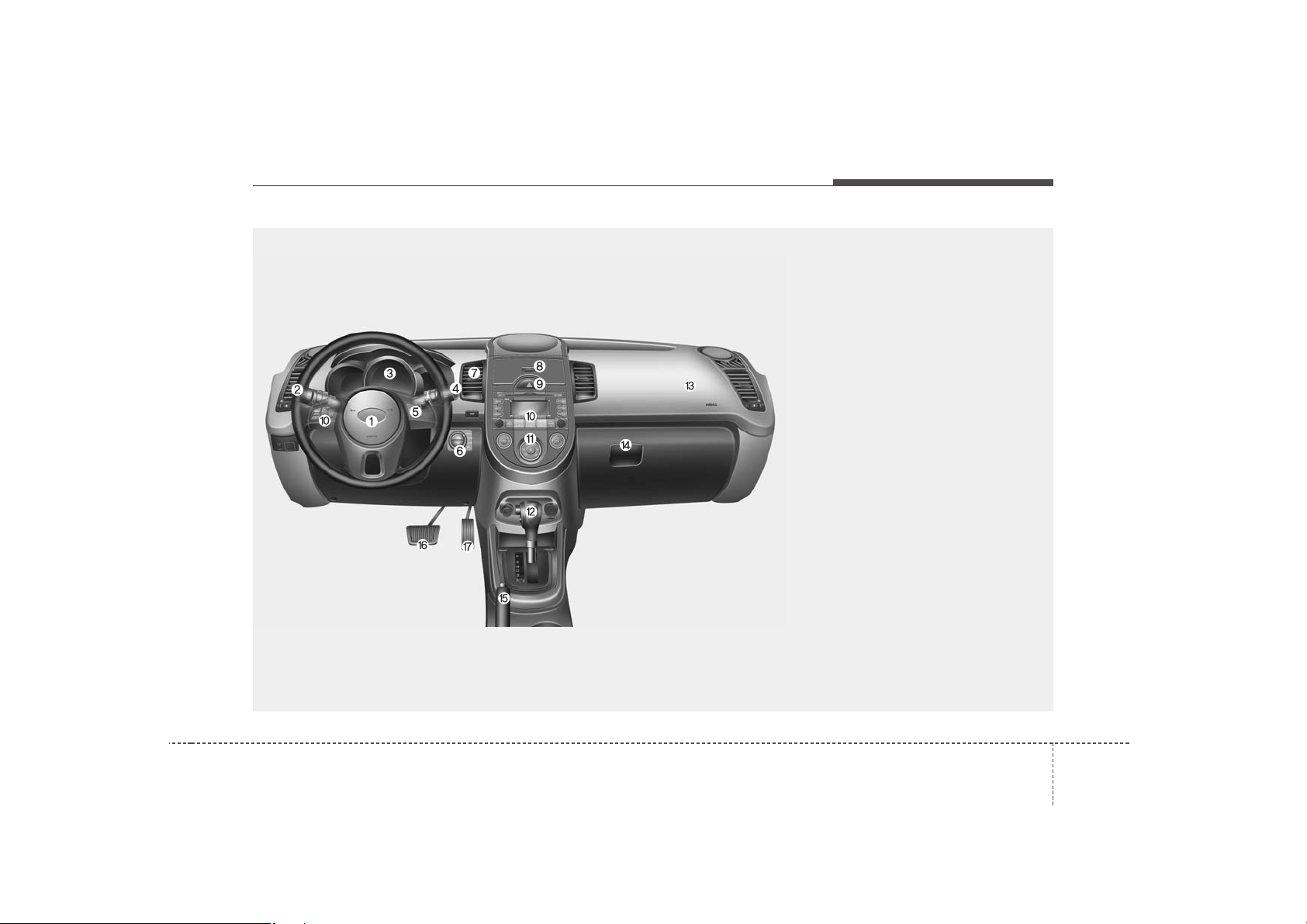
1. Door Lock/Unlock Button………………..4-8
2. Outside Rear view Mirror Control
Switch*……………………………………….4-30
3. Central Door Lock Switch* …………….4-10
4. Power Window Lock Button*………….4-16
5. Power Window Switches* ……………..4-14
6. Fuse Box …………………………………….7-43
7. Instrument Panel Illumination Control
Knob*…………………………………………4-33
8. ESC OFF Button* ………………………..5-21
9. Hood Release Lever…………………….4-17
10. Steering Wheel ………………………….4-26
11. Steering Wheel Tilt Lever*…………..4-27
12. Seat……………………………………………3-2
13. Fuel Filler Lid Release Lever*………4-19
* : if equipped
OAM019001
B010000AUN-EU-C1
23
Your vehicle at a glance
INSTRUMENT PANEL OVERVIEW
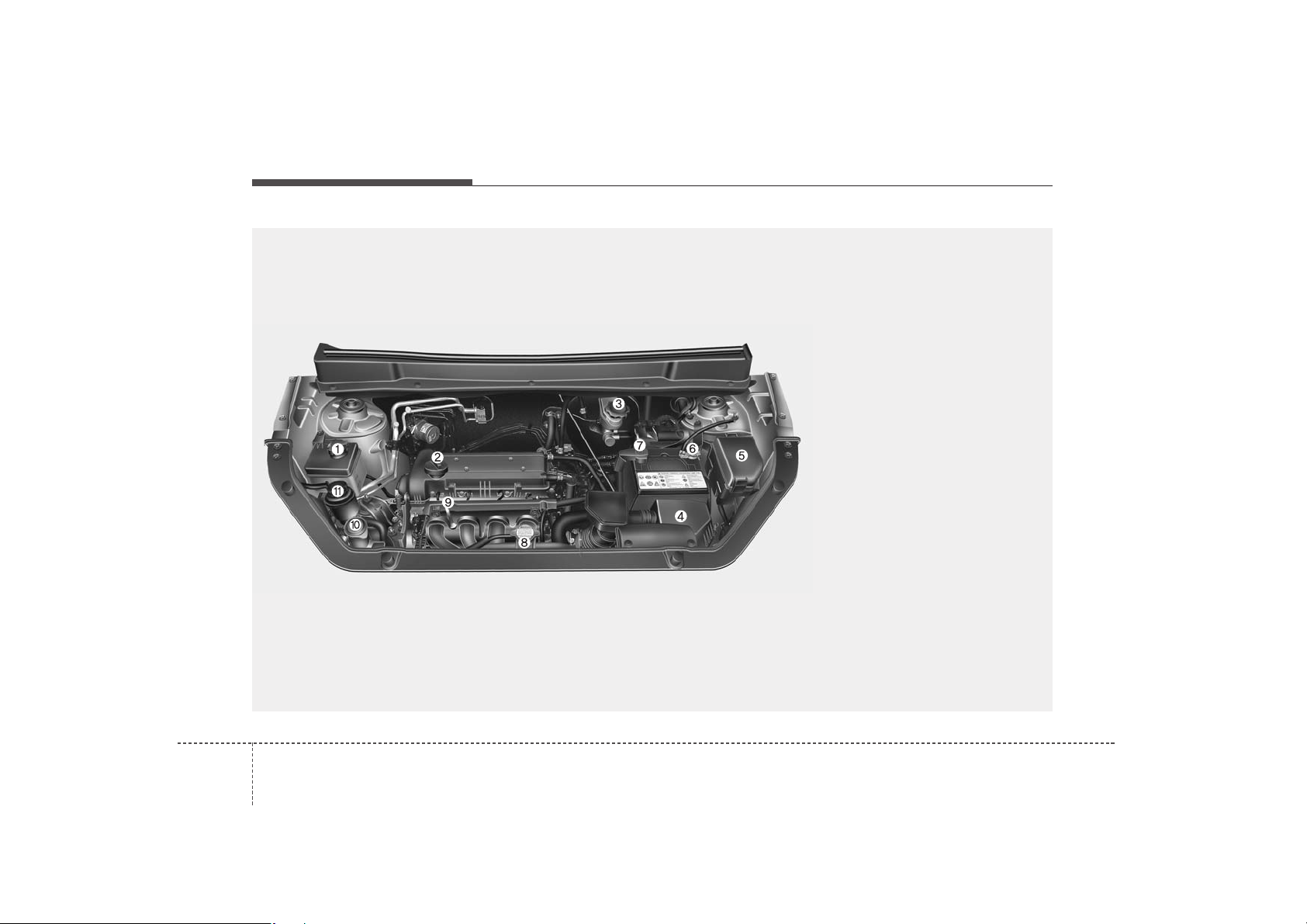
1. Driver’s Front Air Bag…………………..3-33
2. Light Control / Tur n Signals…………..4-47
3. Instrument Cluster……………………….4-32
4.Wiper/Washer……………………………..4-51
5. Auto Cruise Controls*…………………..5-26
6. Advanced Lighting Speaker* …………4-77
7.Vent Controls………………………………4-58
8. Multi Box*…………………………………..4-69
9. Hazard Warning Flasher Switch…4-46/6-2
10. Audio Controls* …………………………4-75
11. Climate Control System*…………….4-57
12. Shift Lever*……………………………….5-10
13. Passenger’s Front Air Bag ………….3-33
14. Glove Box…………………………………4-68
15. Parking Brake……………………………5-17
16. Brake Pedal………………………………5-16
17. Accelerator Pedal………………………..5-6
* : if equipped
OAM019002
B020000AAM
Your vehicle at a glance
42
ENGINE COMPARTMENT
B030000AUN-C1
OAM019003N
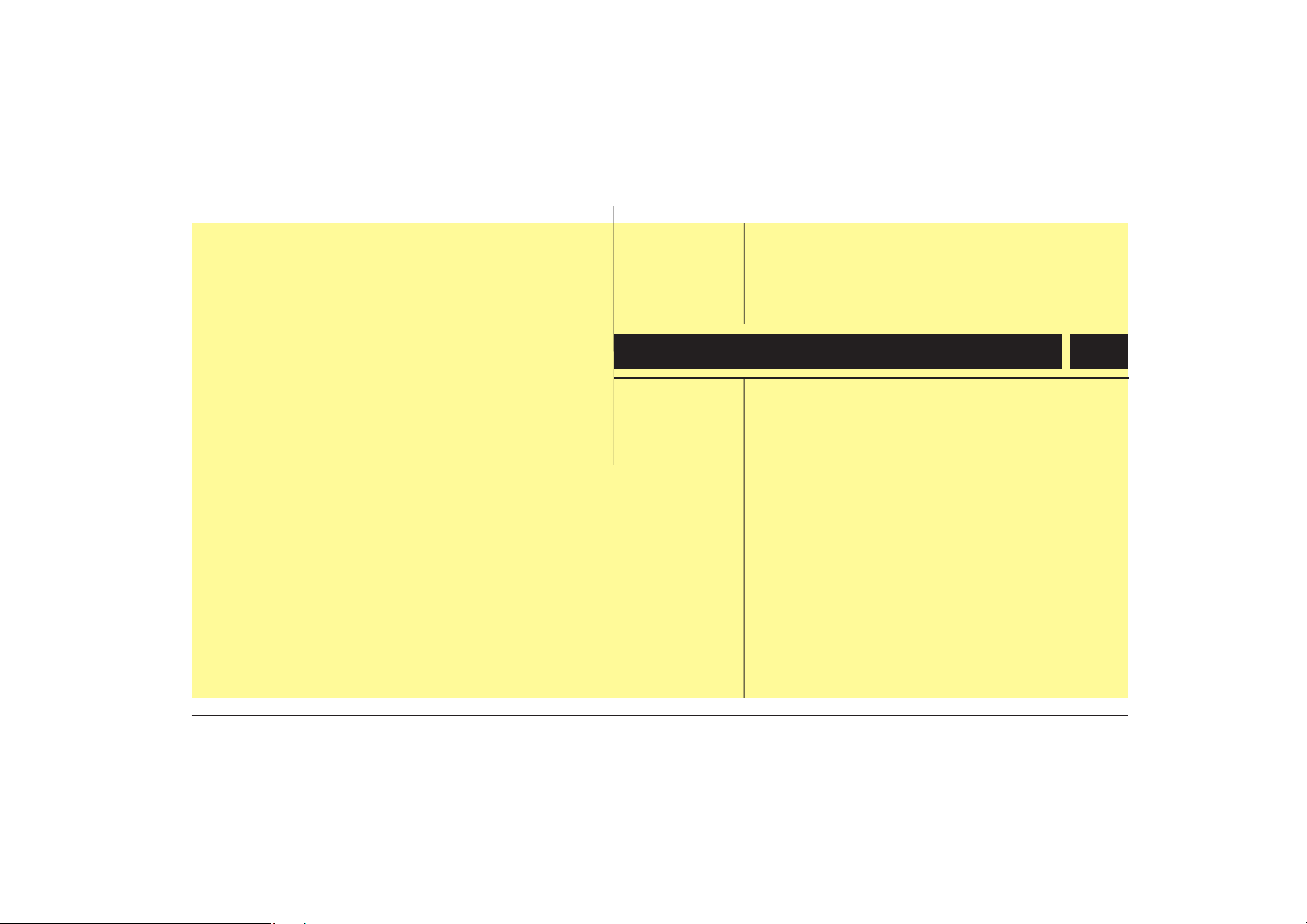
* The actual engine room in the vehicle may differ from the illustration.
1. Engine Coolant Reser voir…………….7-15
2. Engine Oil Filler Cap……………………7-14
3. Brake Fluid Reservoir…………………..7-18
4. Air Cleaner …………………………………7-23
5. Fuse Box……………………………………7-43
6. Negative Battery Ter minal……….6-4/7-27
7. Positive Battery Terminal…………6-4/7-27
8. Radiator Cap…………………………6-6/7-17
9. Engine Oil Dipstick………………………7-14
10.Windshield Washer Fluid Reservoir ..7-22
11. Power Steering Fluid Reservoir*….7-19
* : if equipped
3
Seats / 3-2
Seat belts / 3-13
Child restraint system / 3-25
Air bag — advanced supplemental restraint system / 3-33
Safety features of your vehicle
Safety features of your vehicle
23
C010000AAM-EC
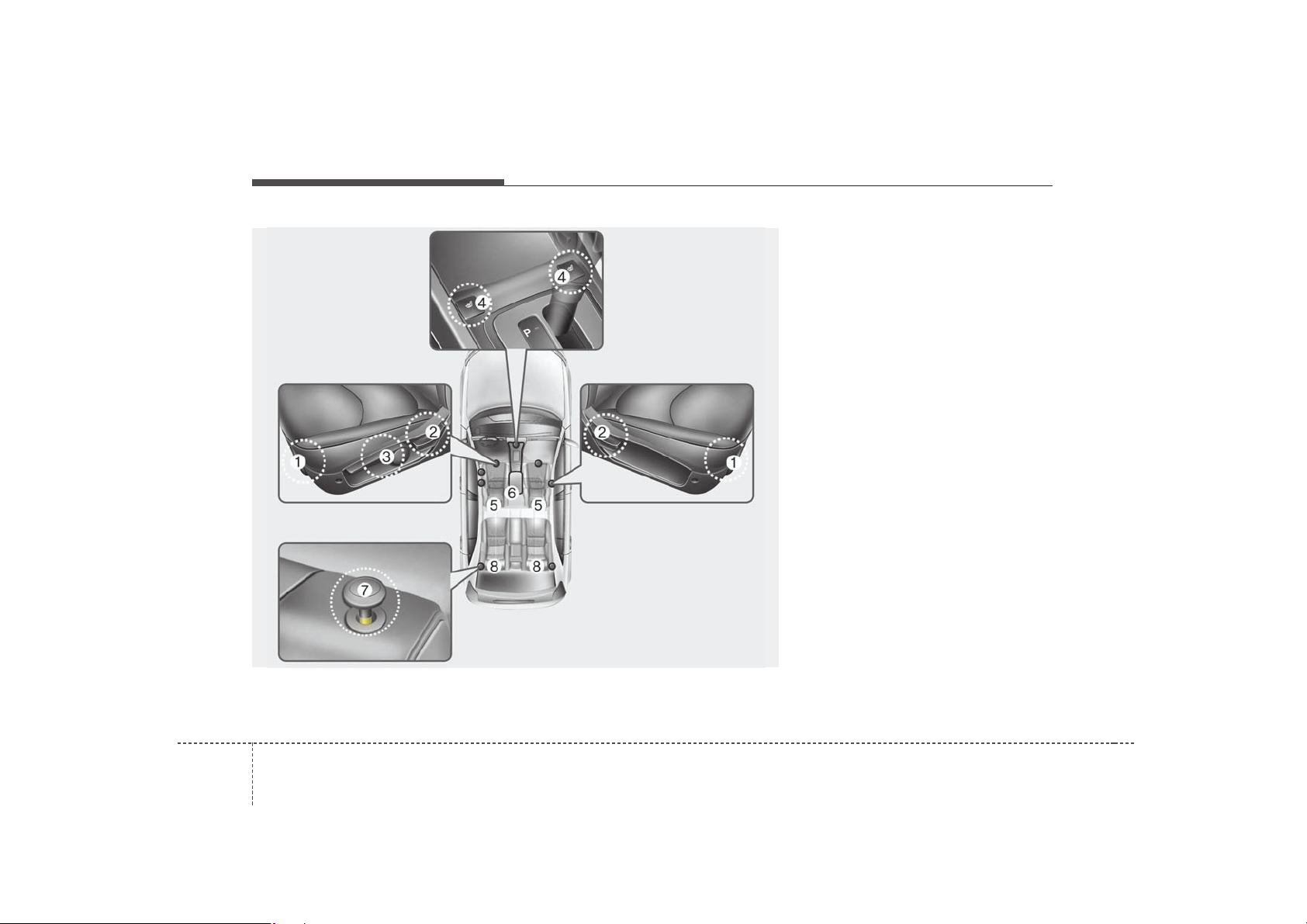
Front seat
(1) Forward and backward
(2) Seatback angle
(3) Seat cushion height (Driver’s seat)*
(4) Seat warmer*
(5) Headrest
(6) Armrest (Driver’s seat)*
Rear seats
(7) Folding the seatback
(8) Headrest
*: if equipped
SEATS
OAM039001
33
Safety features of your vehicle
WARNING — Driver’s seat
• Never attempt to adjust the seat
while the vehicle is moving. This
could result in loss of control,
and an accident causing death,
serious injury, or property damage.
• Do not allow anything to interfere
with the normal position of the
seatback. Storing items against a
seatback or in any other way
interfering with proper locking of
a seatback could result in serious
or fatal injury in a sudden stop or
collision.
• Always drive and ride with your
seatback upright and the lap portion of the seat belt snug and low
across the hips. This is the best
position to protect you in case of
an accident.
• In order to avoid unnecessary
and perhaps severe air bag
injuries, always sit as far back as
possible from the steering wheel
while maintaining comfortable
control of the vehicle.We recommend that your chest be at least
250 mm (10 inches) away from
the steering wheel.
WARNING — Uprighting
seat
When you return the seatback to its
upright position, hold the seatback
and return it slowly and be sure
there are no other occupants
around the seat. If the seatback is
returned without being held and
controlled, the back of the seat
could spring forward resulting in
accidental injury to a person struck
by the seatback.
WARNING — Loose objects
Loose objects in the driver’s foot
area could interfere with the operation of the foot pedals, possibly
causing an accident. Do not place
anything under the front seats.
WARNING — Driver respon-
sibility for passengers
Riding in a vehicle with the seatback reclined could lead to serious
or fatal injury in an accident. If a
seat is reclined during an accident,
the occupant’s hips may slide
under the lap portion of the seat
belt applying great force to the
unprotected abdomen. Serious or
fatal internal injuries could result.
The driver must advise the passenger to keep the seatback in an
upright position whenever the vehicle is in motion.
Safety features of your vehicle
43
Front seat adjustment — manual
C010101AHM
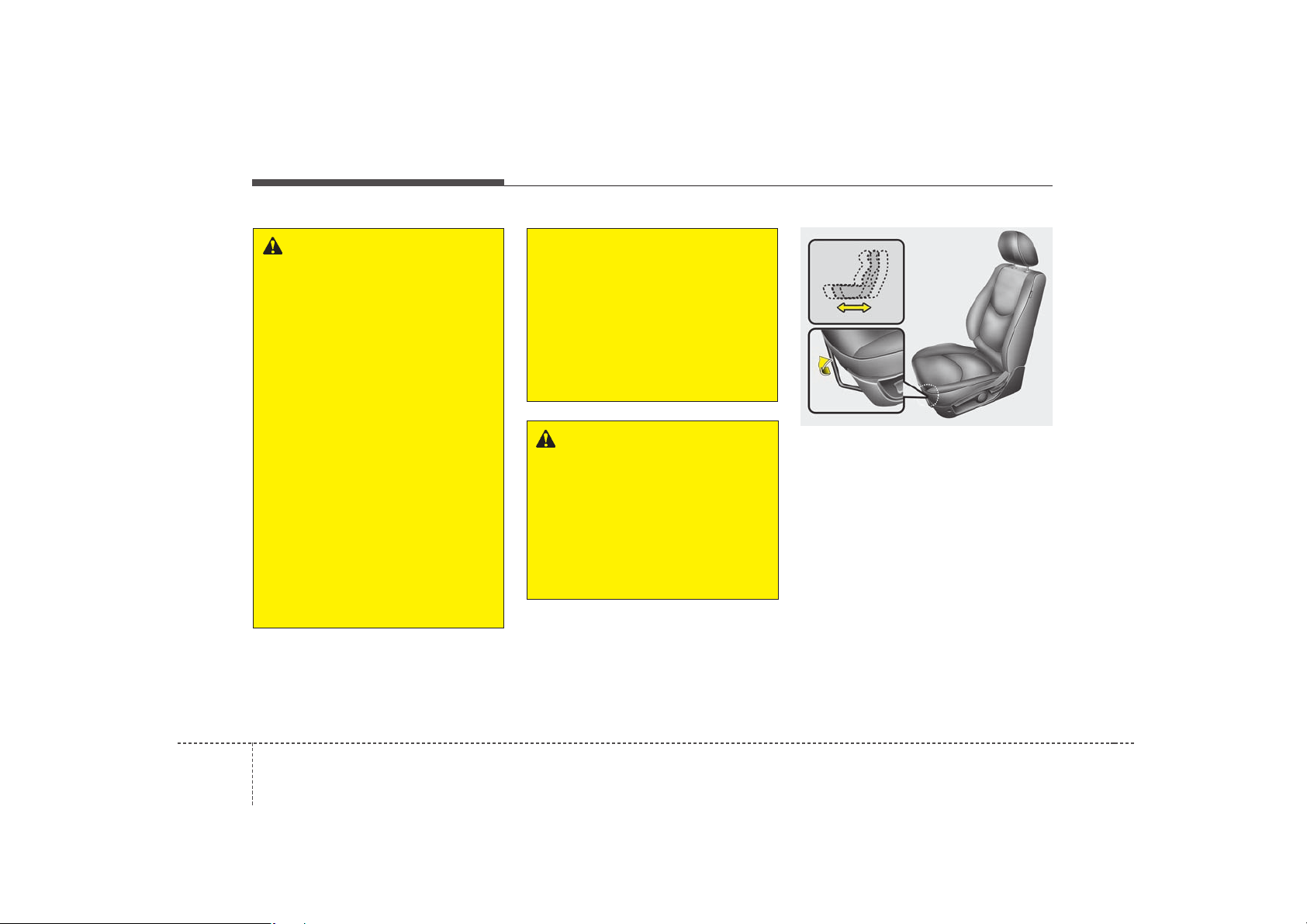
Forward and backward
To move the seat forward or backward:
1. Pull the seat slide adjustment lever up
and hold it.
2. Slide the seat to the position you
desire.
3. Release the lever and make sure the
seat is locked in place.
Adjust the seat before driving, and make
sure the seat is locked securely by trying
to move forward and backward without
using the lever. If the seat moves, it is not
locked properly.
(Continued)
• When resetting the seatback to
the upright position, make sure it
is securely latched by pushing it
forward and backwards.
• To avoid the possibility of burns,
do not remove the carpet in the
cargo area. Emission control
devices beneath this floor generate high temperatures.
WARNING — Rear seatbacks
• The rear seatback must be
securely latched. If not, passengers and objects could be thrown
forward resulting in serious
injury or death in the event of a
sudden stop or collision.
• Luggage and other cargo should
be laid flat in the cargo area. If
objects are large, heavy, or must
be piled, they must be secured.
Under no circumstances should
cargo be piled higher than the
seatbacks. Failure to follow these
warnings could result in serious
injury or death in the event of a
sudden stop, collision or rollover.
• No passenger should ride in the
cargo area or sit or lie on folded
seatbacks while the vehicle is
moving. All passengers must be
properly seated in seats and
restrained properly while riding.
(Continued)
WARNING
After adjusting the seat, always
check that it is securely locked into
place by attempting to move the
seat forward or backward without
using the lock release lever.
Sudden or unexpected movement
of the driver’s seat could cause you
to lose control of the vehicle resulting in an accident.
OAM039002
35
Safety features of your vehicle
C010102AHM
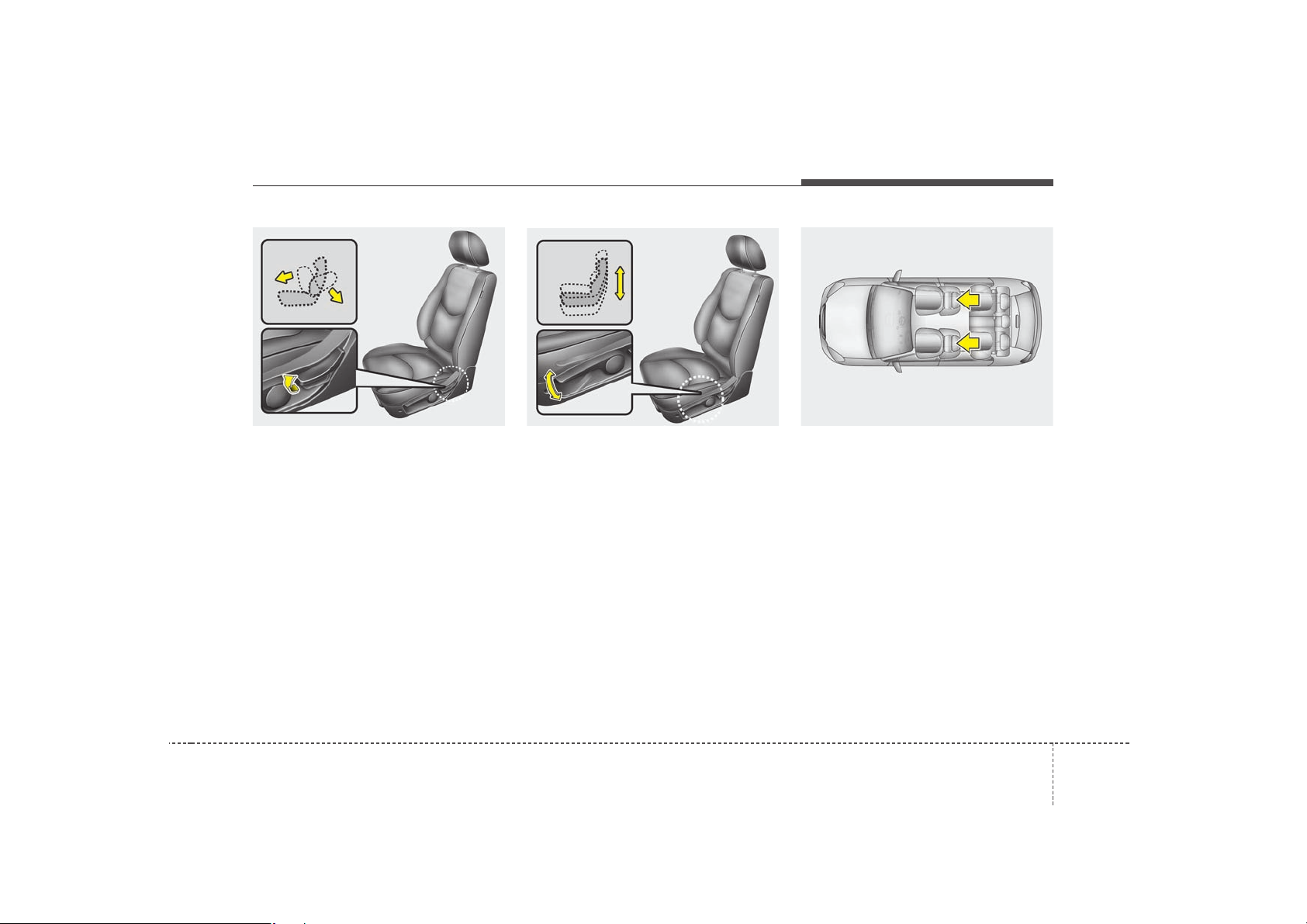
Seatback angle
To recline the seatback:
1. Lean forward slightly and lift up the
seatback recline lever.
2. Carefully lean back on the seat and
adjust the seatback of the seat to the
position you desire.
3. Release the lever and make sure the
seatback is locked in place. (The lever
MUST return to its original position for
the seatback to lock.)
C010103APB
Seat height (for driver’s seat)
To change the height of the seat, push
the lever upwards or downwards.
• To lower the seat cushion, push down
the lever several times.
• To raise the seat cushion, pull up the
lever several times.
C010104AHM
Headrest
The driver’s and front passenger’s seats
are equipped with a headrest for the
occupant’s safety and comfort.
The headrest not only provides comfort
for the driver and front passenger, but
also helps protect the head and neck in
the event of a collision.
OAM039004 OPA039052OAM039003
Safety features of your vehicle
63
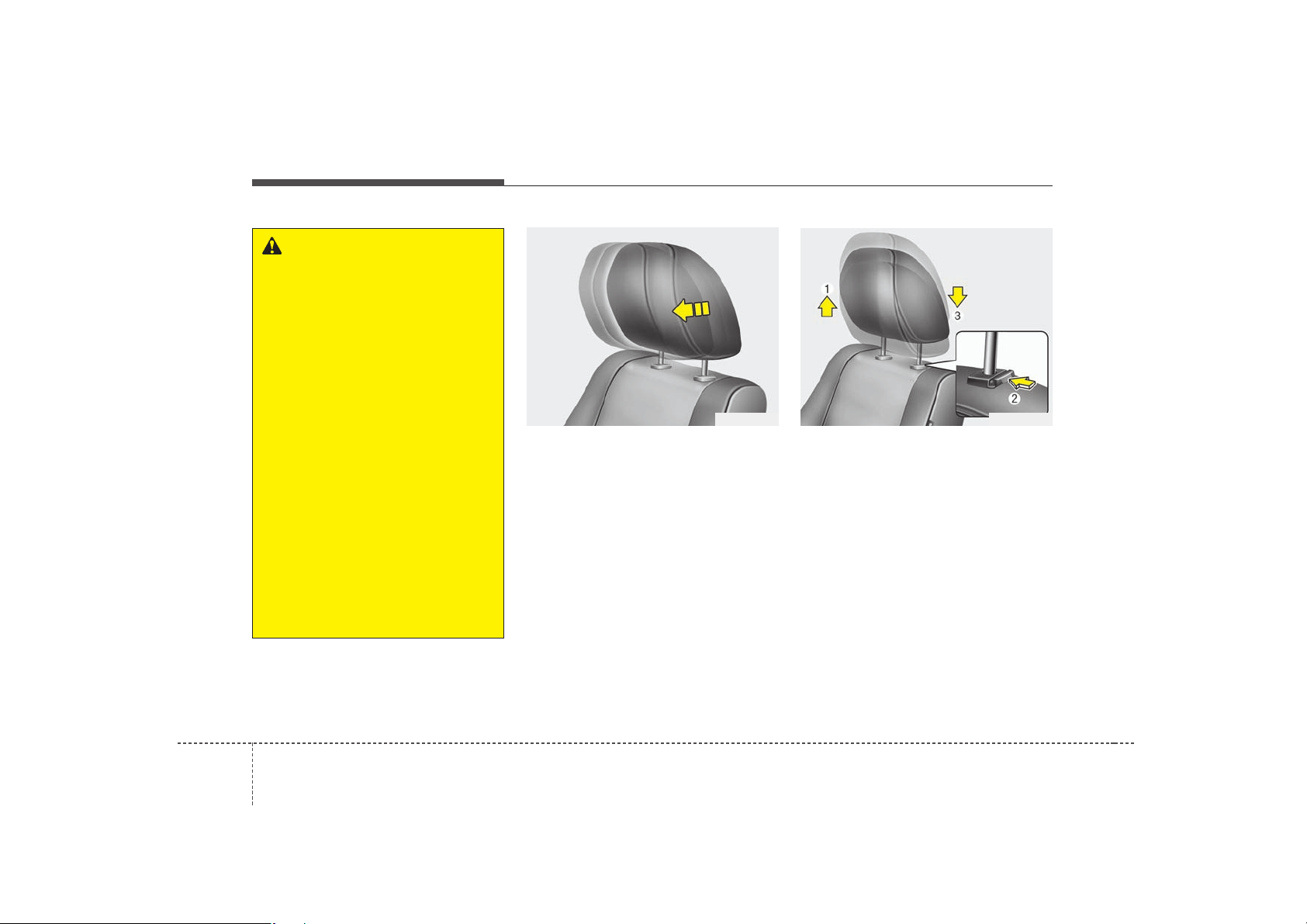
Forward and backward adjustment
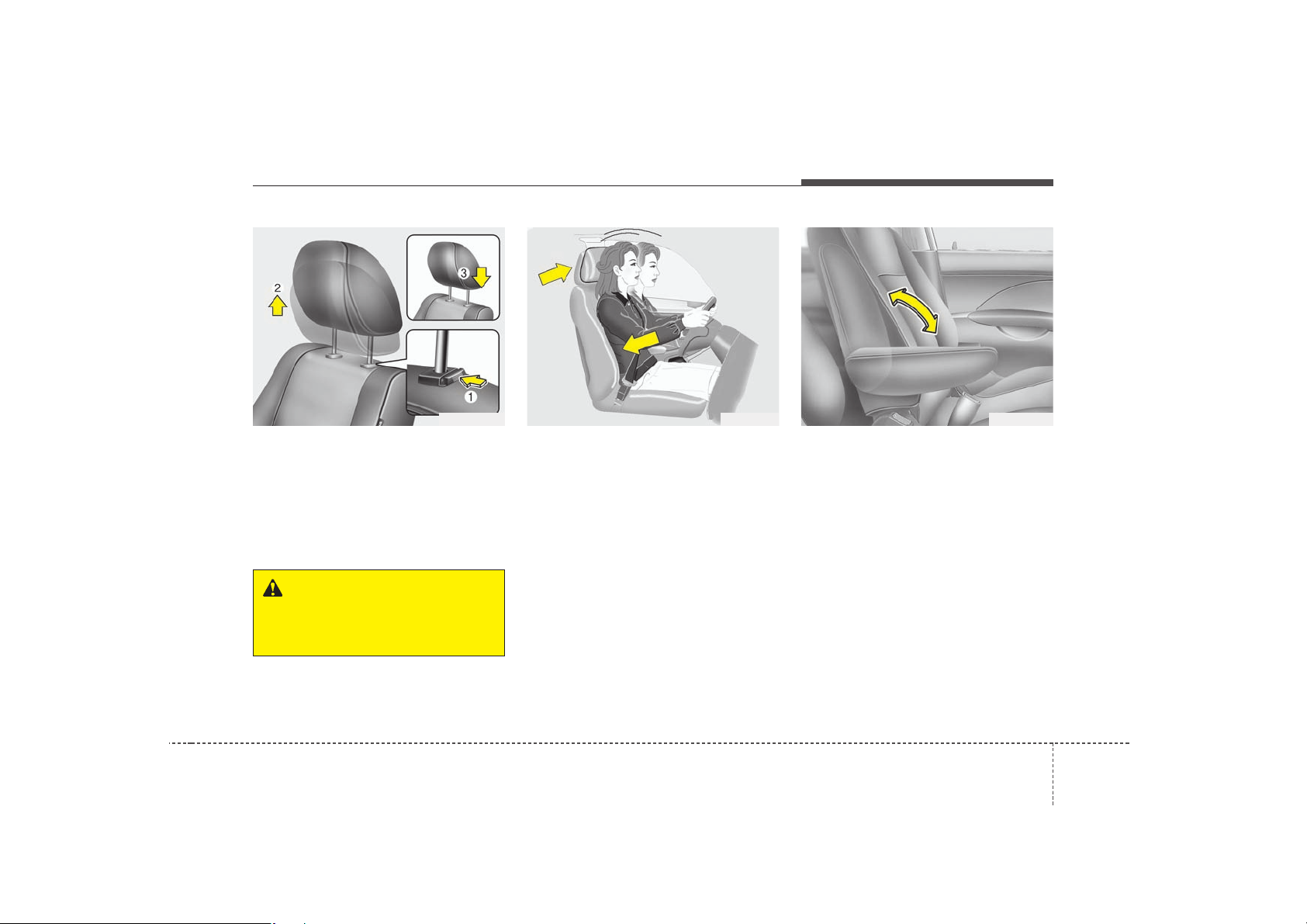
The headrest may be adjusted forw ard to
3 different positions by pulling the headrest forward to the desired detent. To
adjust the headrest to it’s furthest backwards position, pull it fully forward to the
farthest position and release it.Adjust the
headrest so that it properly supports the
head and neck.
Adjusting the height up and down
To raise the headrest, pull it up to the
desired position (1). To lower the headrest, push and hold the release button (2)
on the headrest support and lower the
headrest to the desired position (3).
WARNING
• For maximum effectiveness in
case of an accident, the headrest
should be adjusted so the middle
of the headrest is at the same
height of the center of gravity of
an occupant’s head. Generally,
the center of gravity of most people’s head is similar with the
height of the top of their eyes.
Also, adjust the headrest as close
to your head as possible. For this
reason, the use of a cushion that
holds the body away from the
seatback is not recommended.
• Do not operate the vehicle with
the headrests removed. Severe
injury to the occupants may
occur in the event of an accident.
Headrests may provide protection against neck injuries when
properly adjusted.
• Do not adjust the headrest position of the driver’s seat while the
vehicle is in motion.
OAM039006OAM039005
37
Safety features of your vehicle
Removal
To remove the headrest, raise it as far as
it can go then press the release button
(1) while pulling the headrest up (2).
To reinstall the headrest, put the headrest poles (3) into the holes while pressing the release button (1). Then adjust it
to the appropriate height.
Active headrest (if equipped)
The active headrest is designed to move
forward and upward during a rear impact.
This helps to prevent the driver’s and
front passenger’s heads from moving
backward and thus helps minimize neck
injuries.
C010109AVQ-C1
Armrest (for driver’s seat, if equipped)
To use the armrest, swing down the armrest to the lowest position.
WARNING
Make sure the headrest locks in
position after adjusting it to properly protect the occupants.
HNF2041-1OAM039007 OSA038123
Safety features of your vehicle
83
C010107AAM
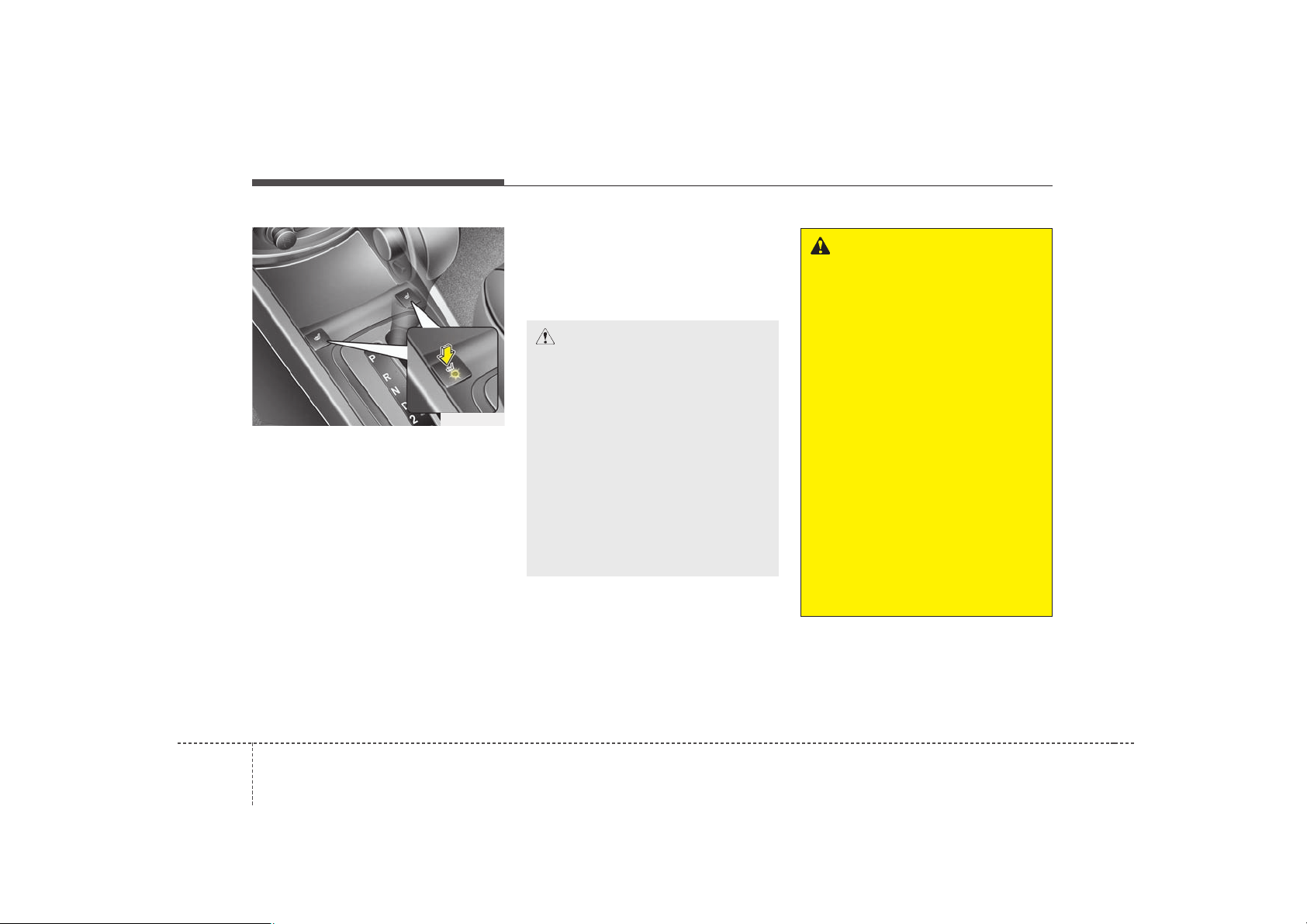
Seat warmer (if equipped)
The seat warmers are provided to warm
the front seats during cold weather.With
the ignition switch in the ON position,
push either of the switches to warm the
driver’s seat or the front passenger’s
seat.
During mild weather or under conditions
where the operation of the seat warmer
is not needed, keep the switches in the
OFF position.
✽✽
NOTICE
With the seat warmer switch in the ON
position, the heating system in the seat
turns off or on automatically depending
on the seat temperature.
WARNING — Seat warmer
burns
Passengers should use extreme
caution when using seat warmers
due to the possibility of excess
heating or burns. The occupants
must be able to feel if the seat is
becoming too warm and turn the
seat warmer off. In particular, the
driver must exercise extreme care
for the following types of passengers:
1. Infants, children, elderly or disabled persons, or hospital outpatients
2. Persons with sensitive skin or
those that burn easily
3. Fatigued individuals
4. Intoxicated individuals
5. Individuals taking medication
that can cause drowsiness or
sleepiness (sleeping pills, cold
tablets, etc.)
CAUTION
• When cleaning the seats, do not
use an organic solvent such as
thinner, benzene, alcohol and
gasoline. Doing so may damage
the surface of the heater or seats.
• To prevent overheating the seat
warmer, do not place blankets,
cushions or seat covers on the
seats while the seat warmer is in
operation.
• Do not place heavy or sharp
objects on seats equipped with
seat warmers. Damage to the seat
warming components could occur.
OAM039010
39
Safety features of your vehicle
C010108AAM
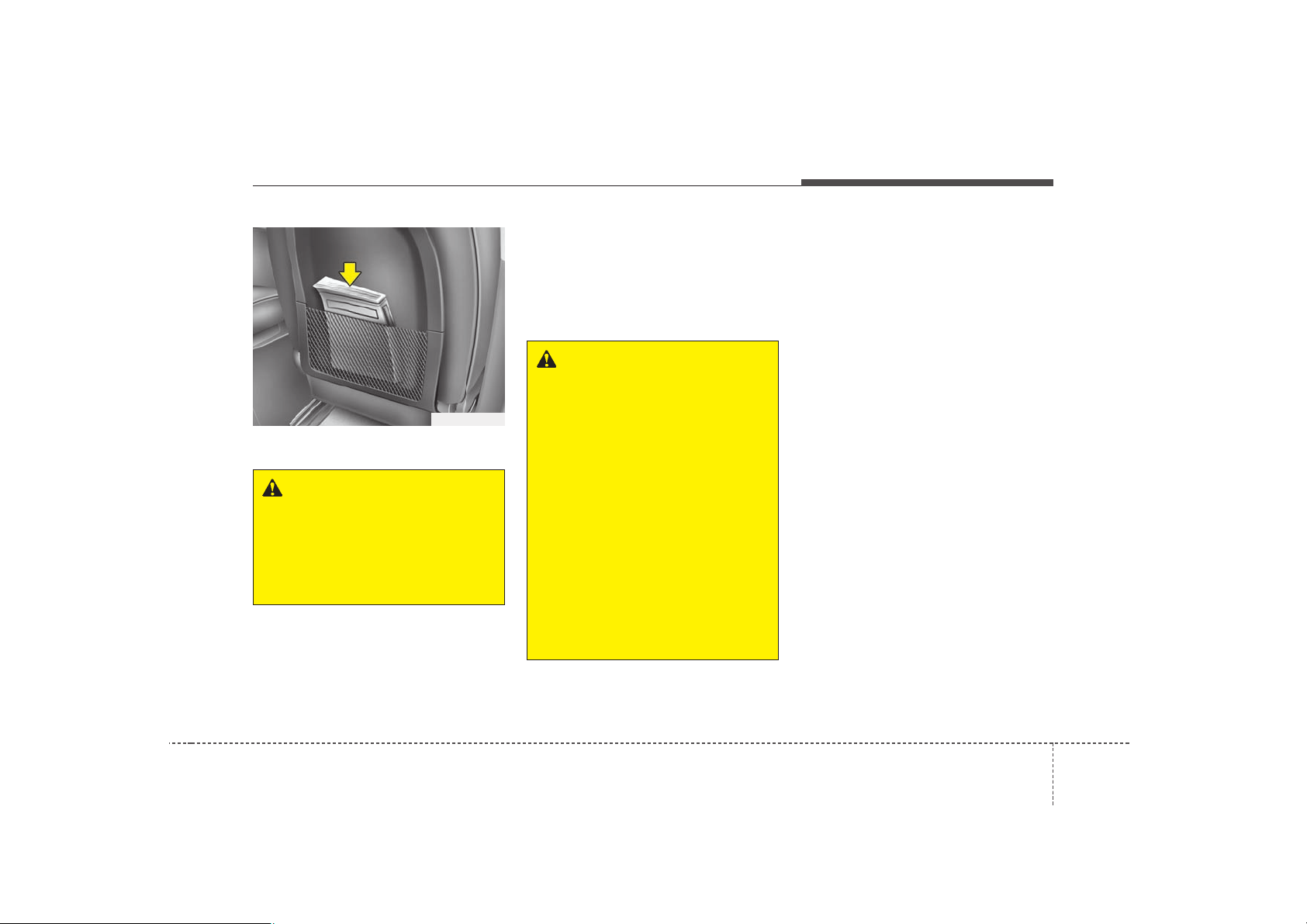
Seatback pocket (if equipped)
Rear seat adjustment
C010307AHM-C1
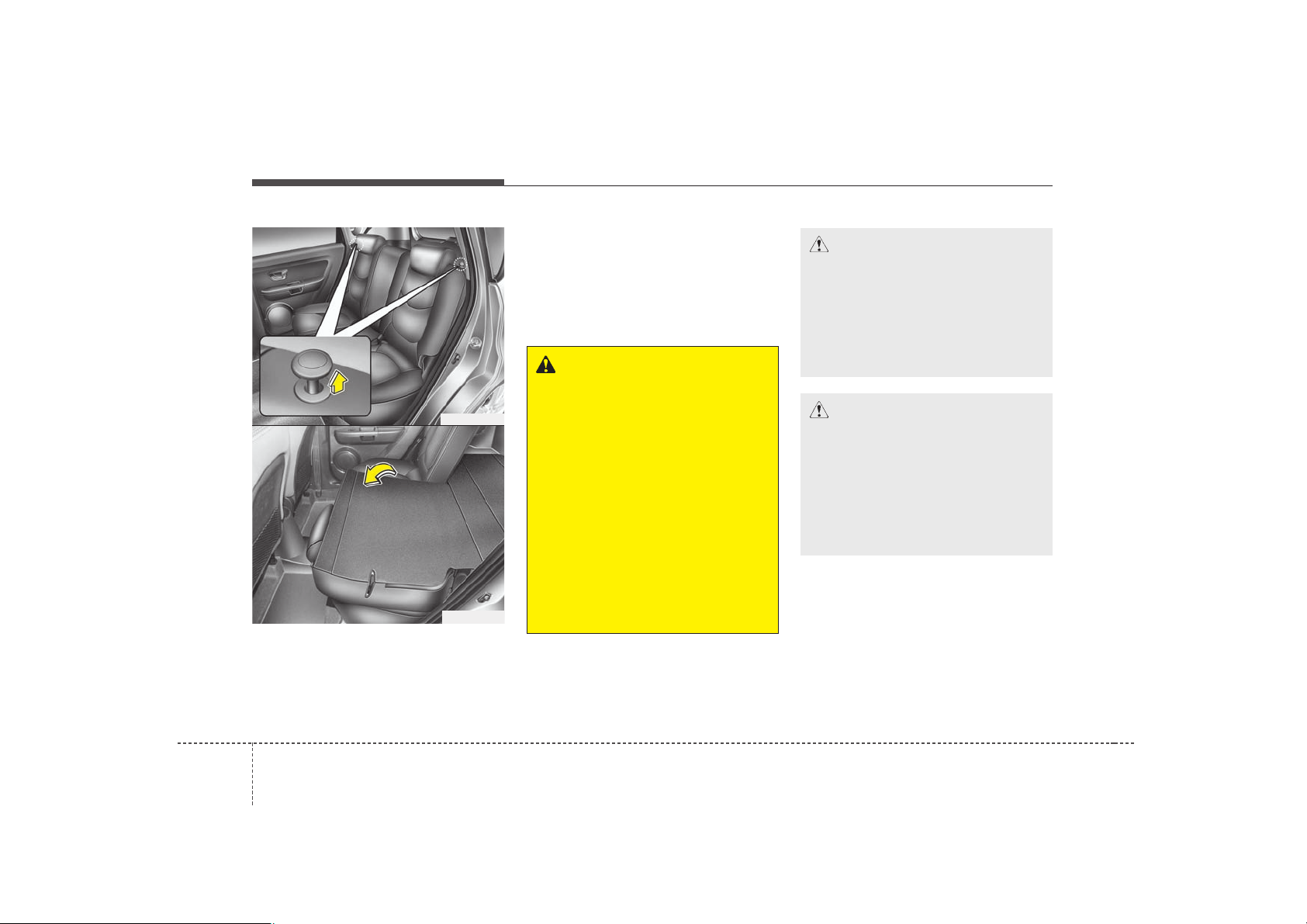
Folding the rear seat
The rear seatbacks can be folded to f acilitate carrying long items or to increase
the luggage capacity of the vehicle.
To fold down the rear seatback:
1. Inser t the rear seat belt buckle in the
pocket (if equipped) between the rear
seatback and cushion, and insert the
rear seat belt webbing in the guide to
prevent the seat belt from being damaged.
2. Set the front seatback to the upright
position and if necessary, slide the
front seat forward.
3.Lower the rear headrests to the lowest
position.
WARNING — Seatback
pockets
Do not put heavy or sharp objects
in the seatback pockets. In an accident they could come loose from
the pocket and injure vehicle occupants.
OUN028040/H
WARNING
The purpose of the fold-down rear
seatbacks is to allow you to carry
longer objects that could not be
accommodated in the cargo area.
Never allow passengers sit on top
of the folded down seatback while
the vehicle is moving.This is not a
proper seating position and no seat
belts are available for use.
This could result in serious injury
or death in case of an accident or
sudden stop.Objects carried on the
folded down seatback should not
extend higher than the top of the
front seatbacks. Doing this could
allow cargo to slide forward and
cause injury or damage during sudden stops.
Safety features of your vehicle
103
4.Pull on the seatback folding lever, then
fold the seat toward the front of the
vehicle.When you return the seatback
to its upright position, always be sure it
has locked into position by pushing on
the top of the seatback.
5. To use the rear seat, lift and pull the
seatback backward by pulling on the
folding lever. Pull the seatback firmly
until it clicks into place. Make sure the
seatback is locked in place.
6. Retur n the rear seat belt to the proper
position.
OAM039020
OAM039021
WARNING
When you return the rear seatback
to its upright position after being
folded down:
Be careful not to damage the seat
belt webbing or buckle. Do not
allow the seat belt webbing or
buckle to get caught or pinched in
the rear seat. Ensure that the seatback is completely locked into its
upright position by pushing on the
top of the seatback. Otherwise, in
an accident or sudden stop, the
seat could fold down and allow
cargo to enter the passenger compartment, which could result in
serious injury or death.
CAUTION — Rear seat belts
When returning the rear seatbacks
to the upright position, remember
to return the rear shoulder belts to
their proper position. Routing the
seat belt webbing through the rear
seat belt guides will help keep the
belts from being trapped behind or
under the seats.
CAUTION — Damaging rear
seat belt buckles
When you fold the rear seatback,
insert the buckle in the pocket
between the rear seatback and
cushion. Doing so can prevent the
buckle from being damaged by the
rear seatback.
311
Safety features of your vehicle
C010303AHM
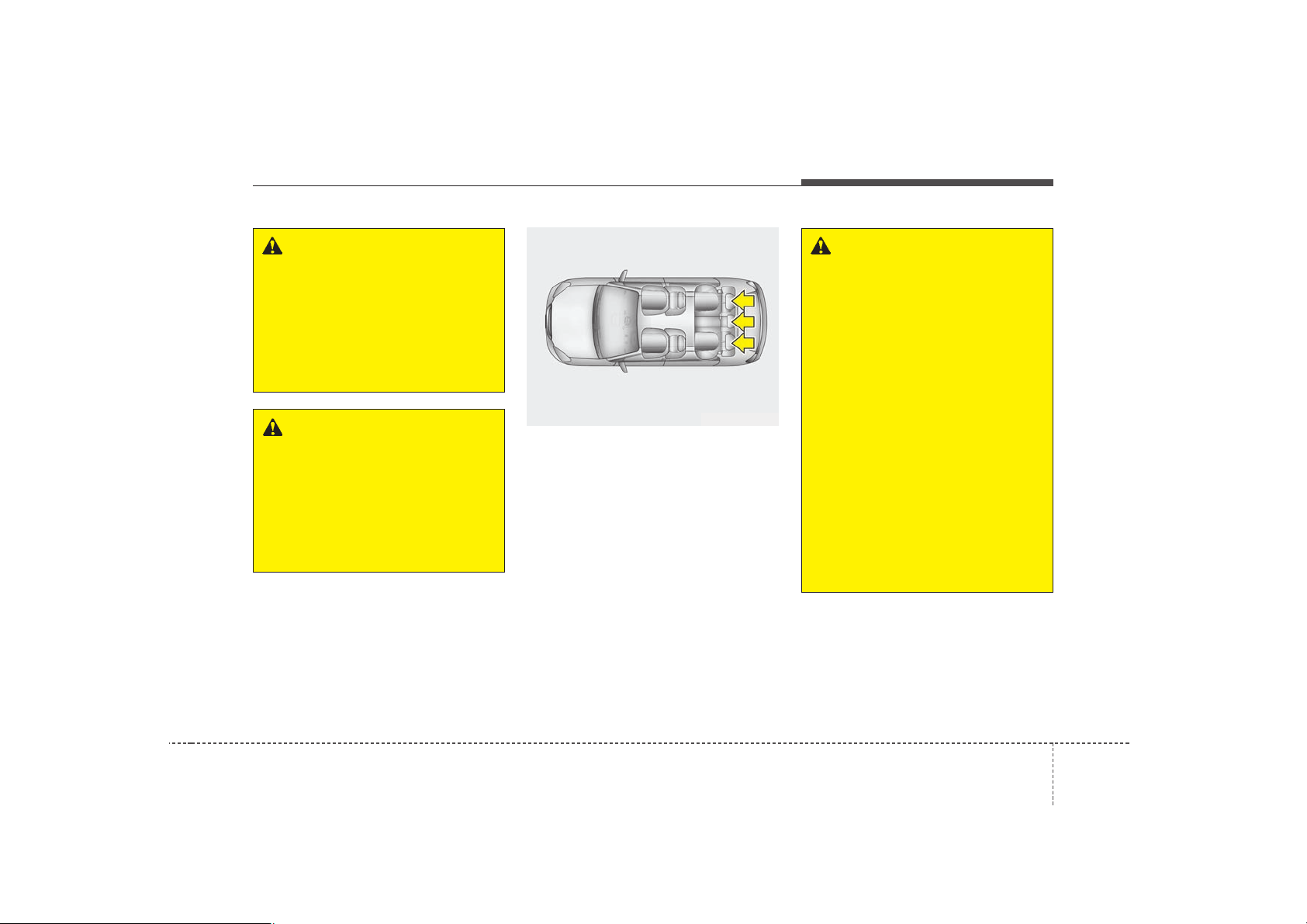
Headrest
The rear seat(s) is equipped with headrests in all the seating positions for the
occupant’s safety and comfort.
The headrest not only provides comfort
for passengers, but also helps protect the
head and neck in the event of a collision.
WARNING — Cargo loading
Make sure the engine is off, the
automatic transaxle is in P (Park)
and the parking brake is securely
applied whenever loading or
unloading cargo. Failure to take
these steps may allow the vehicle
to move if the shift lever is inadvertently moved to another position.
WARNING — Cargo
Cargo should always be secured to
prevent it from being thrown about
the vehicle in a collision and causing injury to the vehicle occupants.
Do not place objects in the rear
seats, since they cannot be properly secured and may hit the front
seat occupants in a collision.
OPA039053
WARNING
• For maximum effectiveness in
case of an accident, the headrest
should be adjusted so the middle
of the headrest is at the same
height of the center of gravity of
an occupant’s head. Generally,
the center of gravity of most people’s head is similar with the
height of the top of their eyes.
Also adjust the headrest as close
to your head as possible. For this
reason, the use of a cushion that
holds the body away from the
seatback is not recommended.
• Do not operate the vehicle with
the headrests removed. Severe
injury to an occupant may occur
in the event of an accident.
Headrests may provide protection against severe neck injuries
when properly adjusted.
Safety features of your vehicle
123
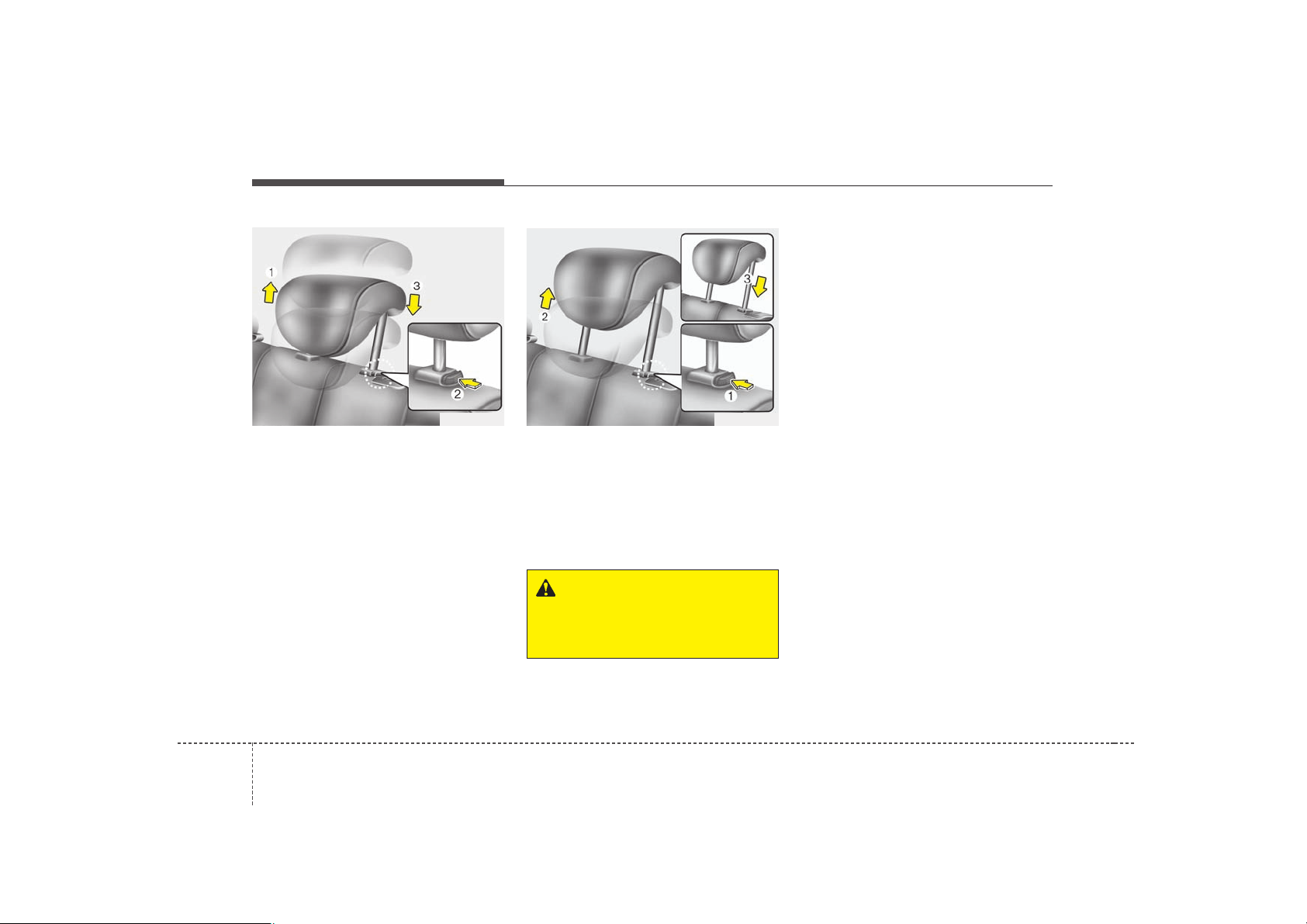
Adjusting the height up and down
To raise the headrest, pull it up to the
desired position (1). To lower the headrest, push and hold the release button (2)
on the headrest support and lower the
headrest to the desired position (3).
Removal
To remove the headrest, raise it as far as
it can go then press the release button
(1) while pulling the headrest up (2).
To reinstall the headrest, put the headrest poles (3) into the holes while pessing
the release button (1). Then adjust it to
the appropriate height.
OUN026043 OUN028044
WARNING
Make sure the headrest locks in
position after adjusting it to properly protect the occupants.
313
Safety features of your vehicle
C020100AHM
Seat belt restraint system
SEAT BELTS
WARNING
• For maximum restraint system
protection, the seat belts must
always be used whenever the
vehicle is moving.
• Seat belts are most effective
when seatbacks are in the
upright position.
• Children age 12 and under must
always be properly restrained in
the rear seat. Never allow children to ride in the front passenger seat. If a child over 12 must
be seated in the front seat,he/she
must be properly belted and the
seat should be moved as far back
as possible.
• Never wear the shoulder belt
under your arm or behind your
back. An improperly positioned
shoulder belt can cause serious
injuries in a crash. The shoulder
belt should be positioned midway
over your shoulder across your
collarbone.
(Continued)
WARNING
Seat belts are designed to bear
upon the bony structure of the
body, and should be worn low
across the front of the pelvis or the
pelvis, chest and shoulders, as
applicable; wearing the lap section
of the belt across the abdominal
area must be avoided.
Seat belts should be adjusted as
firmly as possible, consistent with
comfort, to provide the protection
for which they have been designed.
A slack belt will greatly reduce the
protection afforded to the wearer.
(Continued)
(Continued)
Care should be taken to avoid con-
tamination of the webbing with polishes, oils and chemicals, and particularly battery acid. Cleaning may
safely be carried out using mild
soap and water.The belt should be
replaced if webbing becomes
frayed, contaminated or damaged.
It is essential to replace the entire
assembly after it has been worn in
a severe impact even if damage to
the assembly is not obvious. Belts
should not be worn with straps
twisted. Each belt assembly must
only be used by one occupant; it is
dangerous to put a belt around a
child being carried on the occupant’s lap.
WARNING
No modifications or additions
should be made by the user which
will either prevent the seat belt
adjusting devices from operating to
remove slack, or prevent the seat
belt assembly from being adjusted
to remove slack.
(Continued)
• Avoid wearing twisted seat belts.
A twisted belt can’t do its job
well. In a collision, it could even
cut into you. Be sure the belt
webbing is straight and not twisted.
• Be careful not to damage the belt
webbing or hardware. If the belt
webbing or hardware is damaged, replace it.
Safety features of your vehicle
143
C020101AAM-EU
Seat belt warning
As a reminder to the driver, the seat belt
warning light will blink for approximately
6 seconds each time you turn the ignition
switch ON regardless of belt fastening.
If the driver’s seat belt is not fastened
when the ignition switch is turned on, the
seat belt warning light and the seat belt
warning chime will operate for approximately 6 seconds. But if it is fastened
within the 6 seconds, the warning light
will blink till the 6 seconds and the warning chime will turn off immediately.
If the driver’s seat belt is disconnected
after the ignition switch is turned to the
ON position, the seat belt warning light
and chime will operate for approximately
6 seconds. But if it is fastened within the
6 seconds, the warning light and chime
will turn off immediately. If the driver’s
seat belt is not fastened when the vehicle
speed exceeds 10 km/h (6 mph), the
seat belt warning light and chime will
operate for approximately 11 times with a
pattern of 6 seconds on and 24 seconds
off until the belt is fastened or the vehicle
speed decreases below 5 km/h (3 mph).
C020102AAM-EU
Seat belt — Driver’s 3-point system
with emergency locking retractor
To fasten your seat belt:
To fasten your seat belt, pull it out of the
retractor and insert the metal tab (1) into
the buckle (2). There will be an audible
«click» when the tab locks into the buc kle.
The seat belt automatically adjusts to the
proper length only after the lap belt portion is adjusted manually so that it fits
snugly around your hips. If you lean forward in a slow, easy motion, the belt will
extend and let you move around. If there
is a sudden stop or impact, however, the
belt will lock into position. It will also lock
if you try to lean forward too quickly.
1GQA2083
B180A01NF-1
315
Safety features of your vehicle
✽✽
NOTICE
If you are not able to pull out the seat
belt from the retractor, firmly pull the
belt out and release it. Then you will be
able to pull the belt out smoothly.
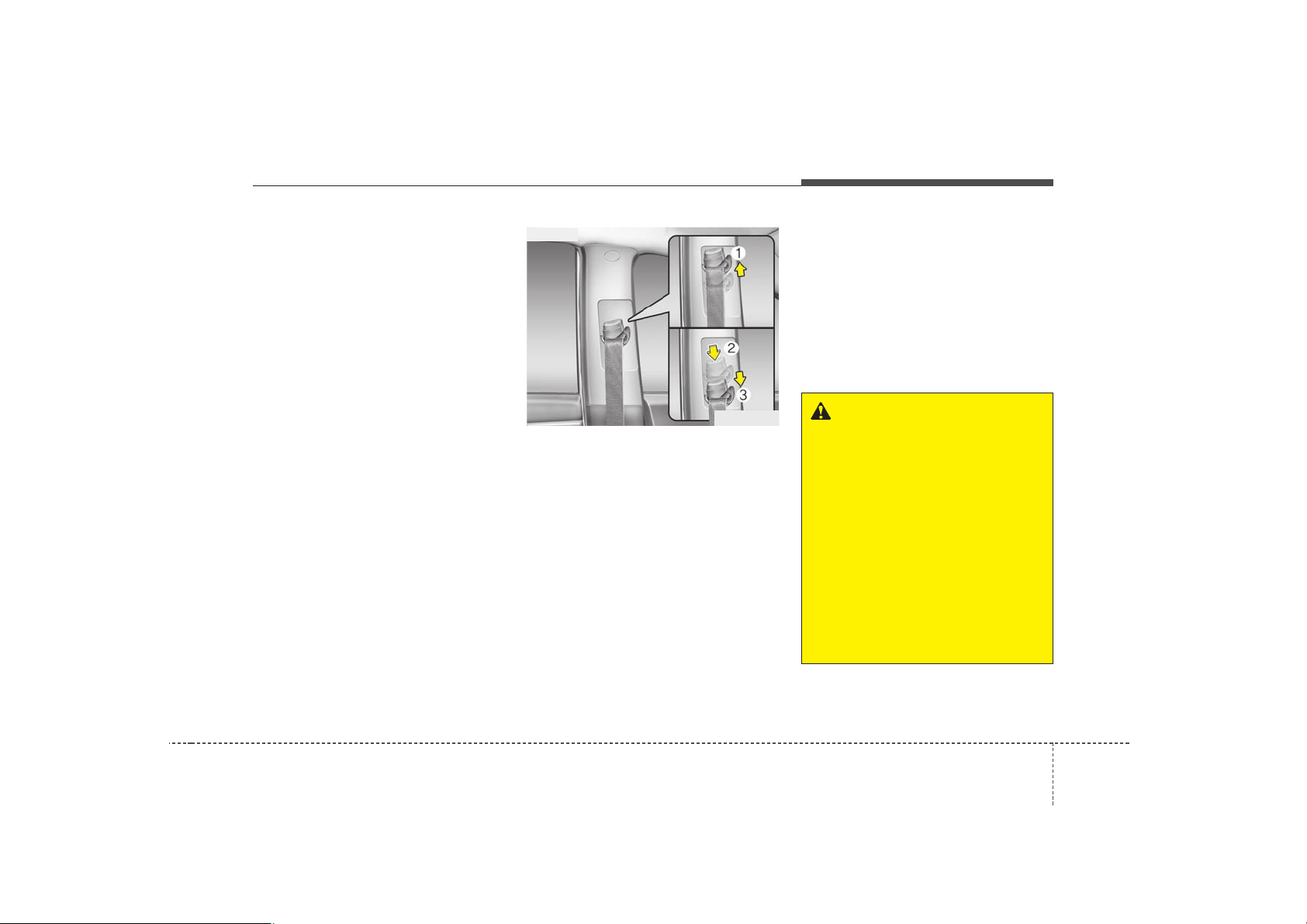
Height adjustment
You can adjust the height of the shoulder
belt anchor to one of the 4 positions for
maximum comfort and safety.
The height of the adjusting seat belt
should not be too close to your neck.The
shoulder portion should be adjusted so
that it lies across your chest and midway
over your shoulder near the door and not
your neck.
To adjust the height of the seat belt
anchor, lower or raise the height adjuster
into an appropriate position.
To raise the height adjuster, pull it up (1).
To lower it, push it down (3) while pressing the height adjuster button (2).
Release the button to lock the anchor
into position. Try sliding the height
adjuster to make sure that it has locked
into position.
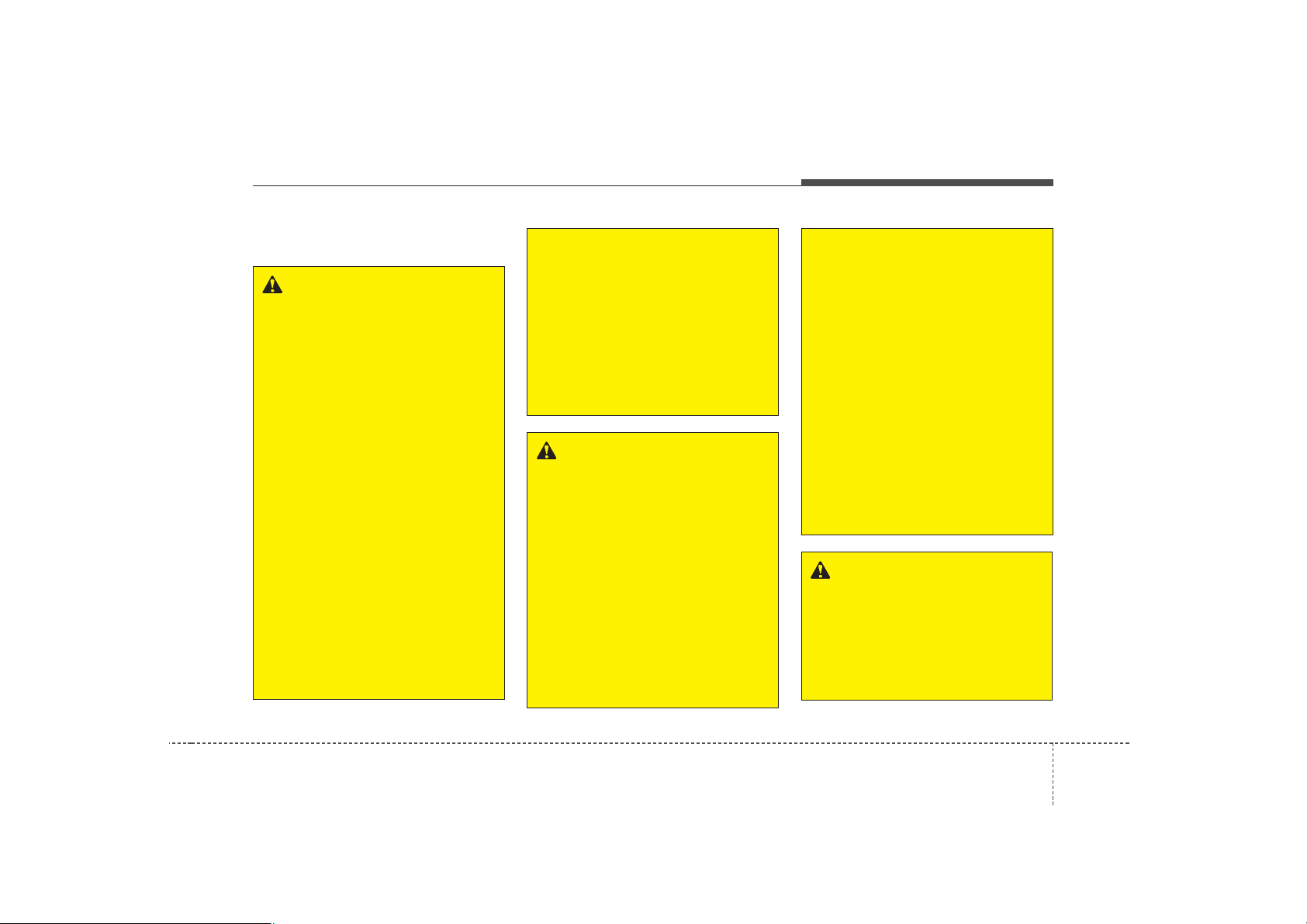
WARNING
• Verify that the shoulder belt
anchor is locked into position at
the appropriate height. Never
position the shoulder belt across
your neck or face. Improperly
positioned seat belts can cause
serious injuries in an accident.
• Failure to replace seat belts after
an accident could leave you with
damaged seat belts that will not
provide protection in the event of
another collision leading to personal injury or death. Replace
your seat belts after being in an
accident as soon as possible.
OUN026100
Front seat
Safety features of your vehicle
163
C020106AUN
Seat belts — Front passenger and rear
seat 3-point system with combination
locking retractor
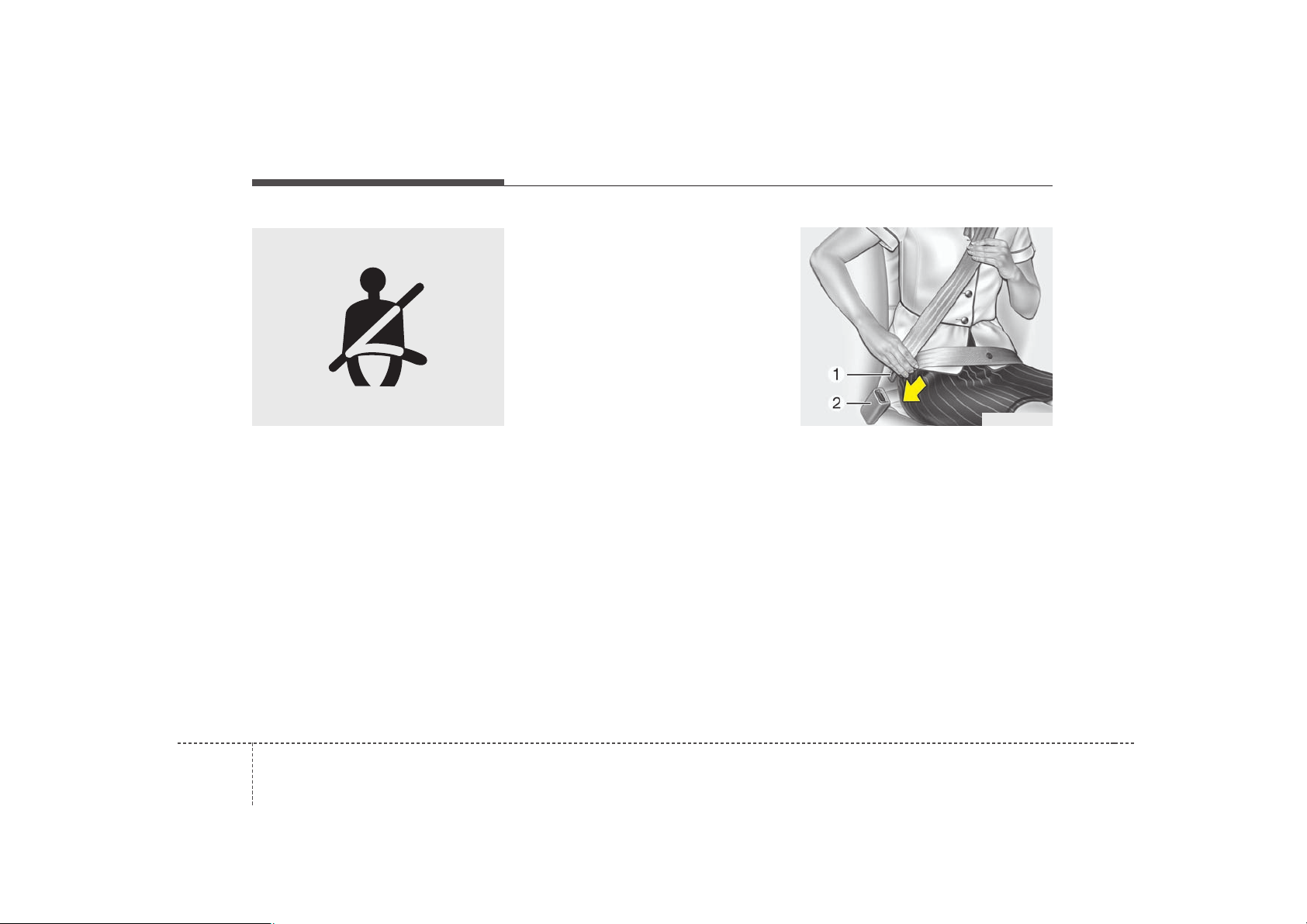
To fasten your seat belt:
Combination retractor type seat belts are
installed in the rear seat positions to help
accommodate the installation of child
restraint systems. Although a combination retractor is also installed in the front
passenger seat position, it is strongly
recommended that children always be
seated in the rear seat. NEVER place
any infant restraint system in the front
seat of the vehicle.
This type of seat belt combines the features of both an emergency locking
retractor seat belt and an automatic locking retractor seat belt.To f asten y our seat
belt, pull it out of the retractor and insert
the metal tab into the buckle. There will
be an audible «click» when the tab locks
into the buckle. When not securing a
child restraint, the seat belt operates in
the same way as the driver’s seat belt
(Emergency Locking Retractor Type). It
automatically adjusts to the proper length
only after the lap belt portion of the seat
belt is adjusted manually so that it fits
snugly around your hips.
When the seat belt is fully extended from
the retractor to allow the installation of a
child restraint system, the seat belt operation changes to allow the belt to retract,
but not to extend (Automatic Locking
Retractor Type). Refer to “Using a child
restraint system” in this section.
✽✽
NOTICE
Although the combination retractor
provides the same level of protection for
seated passengers in either emergency
or automatic locking modes, it is recommended that seated passengers use the
emergency locking feature for improved
convenience. The automatic locking
function is intended to facilitate child
restraint installation. To convert from
the automatic locking feature to the
emergency locking operation mode,
allow the unbuckled seat belt to fully
retract.
B200A02NF
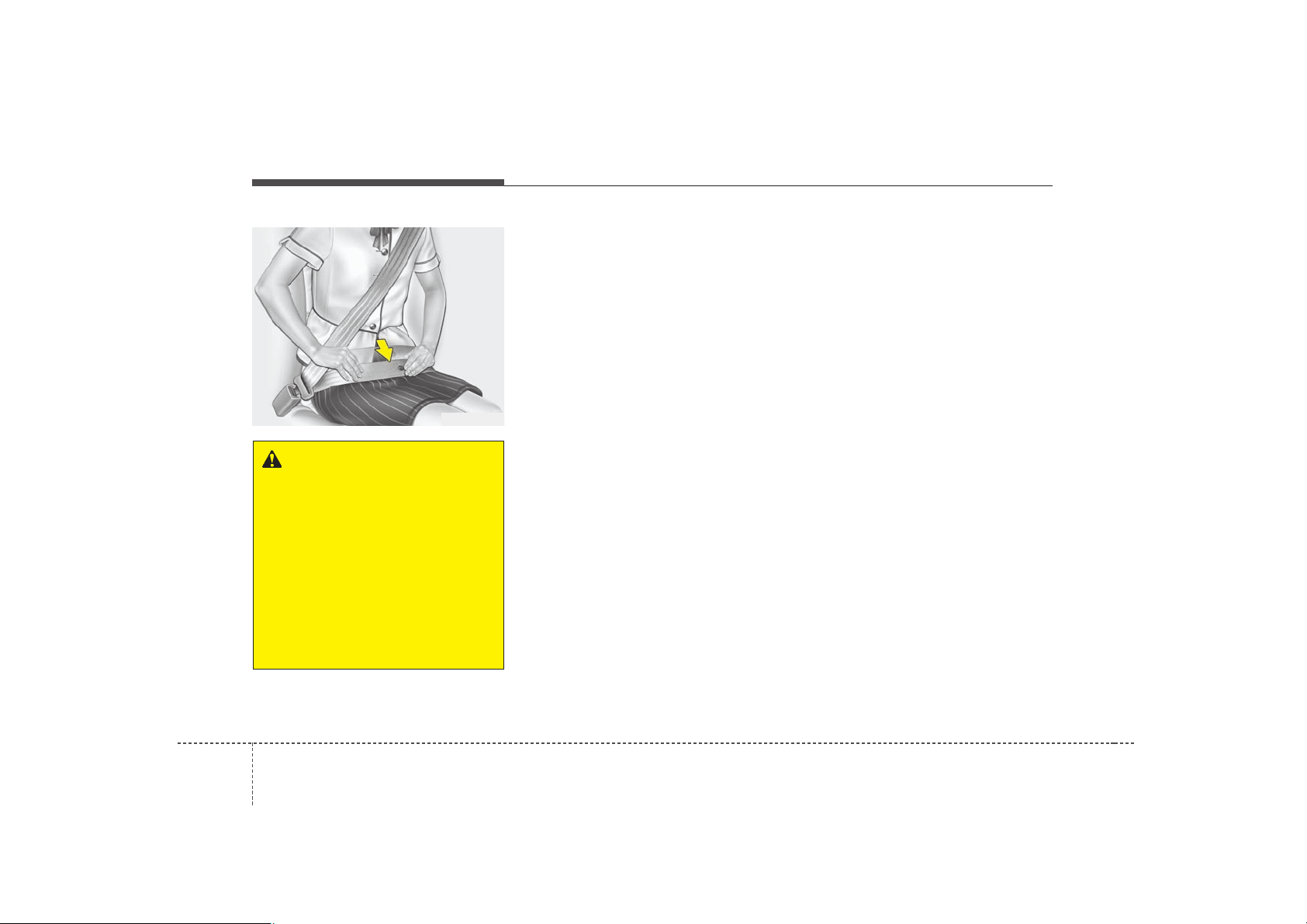
WARNING
You should place the lap belt portion as low as possible and snugly
across your hips,not on your waist.
If the lap belt is located too high on
your waist, it may increase the
chance of injury in the event of a
collision. Both arms should not be
under or over the belt. Rather, one
should be over and the other under ,
as shown in the illustration.
Never wear the seat belt under the
arm that is near the door.
317
Safety features of your vehicle
When using the rear center seat belt, the
buckle with the “CENTER”mark must be
used.
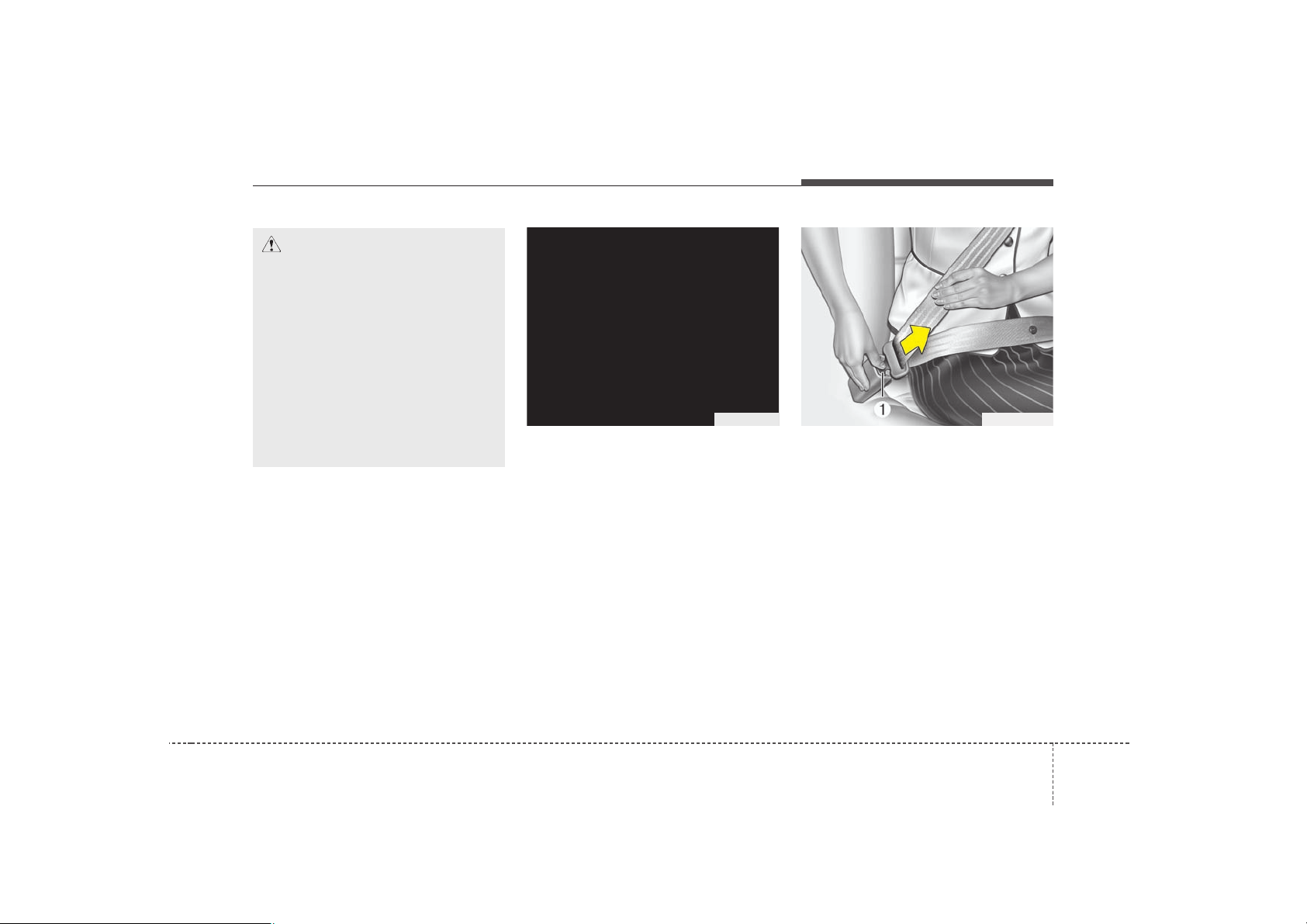
To release the seat belt:
The seat belt is released by pressing the
release button (1) in the locking buckle.
When it is released, the belt should automatically draw back into the retractor.
If this does not happen, check the belt to
be sure it is not twisted, then try again.
CAUTION
Do NOT fold do wn the left portion of
the rear seat back when the rear
center seat belt is buckled.ALWA YS
UNBUCKLE the rear center seat
belt before folding down the left
portion of the rear seat back. If the
rear center seat belt is buckled
when the left portion of the rear
seat back is folded down,distortion
and damage to the top portion of
the seat back and seat belt garnish
may result,causing the seat back to
lock into the folded down position.
OAM039046
B210A01NF-1
Loading…
Инструкция (руководство) по эксплуатации Киа Соул
Инструкция Киа Соул 1 (AM)
года выпуска (2009, 2010, 2011, 2012, 2013)
Инструкция Киа Соул 2 (PS)
года выпуска (2014, 2015, 2016, 2017, 2018, 2019)
Инструкция Киа Соул 3 (SK3)
года выпуска (2019, 2020, 2021, 2022, 2023 +)
FAQ: Types of Manuals and Their Contents
Kia Soul 2010 Manuals come in various types, each serving a specific purpose to help users effectively operate and maintain their devices. Here are the common types of Kia Soul 2010 User Guides and the information they typically include:
- User Manuals: Provide comprehensive instructions on how to use the device, including setup, features, and operation. They often include troubleshooting tips, safety information, and maintenance guidelines.
- Service Instructions: Designed for technicians and repair professionals, these manuals offer detailed information on diagnosing and repairing issues with the device. They include schematics, parts lists, and step-by-step repair procedures.
- Installation Guides: Focus on the installation process of the device, providing detailed instructions and diagrams for proper setup. They are essential for ensuring the device is installed correctly and safely.
- Maintenance Manuals: Provide guidance on routine maintenance tasks to keep the device in optimal condition. They cover cleaning procedures, part replacements, and regular servicing tips.
- Quick Start Guides: Offer a concise overview of the essential steps needed to get the device up and running quickly. They are ideal for users who need immediate assistance with basic setup and operation.
Each type of Kia Soul 2010 instruction is designed to address specific needs, ensuring users have the necessary information to use, maintain, and repair their devices effectively.
Related Instructions for Kia Soul 2010:
1
Magentis
Owner’s manual User Guide: Kia Magentis (M891F4, Upd.Tue 12.2024)
211
71
13
2
Rio 2008
Manual Rio 2008 Manual — 9Z6BR4
256
978
216
3
RIO
Features & functions manual Kia Air Conditioner Features & functions manual (File: kia-rio-features-functions-manual-38, 06th Jan 2025)
38
210
49
4
B2H58-AP000 B2H58-AP010
7
1466
264
7
Soul EV 2018
477
798
160
8
2015 Sorento
Owner’s manual 2015 Sorento (Automobile ePDF User Manual, #V7MFEU)
565
455
110
9
RED301-2WAY
User manual for key Kia RED301-2WAY User Manual (User manual for key), @135912
10
1436
273
10
Forte 2011
Owner’s manual Kia Automobile Owner’s manual (File: kia-forte-2011-owner-s-manual-294, 30/01/2025)
294
1378
207
Automobile Devices by Other Brands:
|
Kia Sorento 2021 Quick Start Manual Automobile #HGSQXM VOICE RECOGNITION1 AND BLUETOOTH®2 12 May 2025 | 4 |
|
|
Kia Optima Owner’s Manual Automobile #49WVQ6 Gasoline 15 Oct 2024 | 356 |
|
|
Mercedes-Benz AMG GT Operator’s Manual Mercedes-Benz Automobile Operator’s manual (File: mercedes-benz-amg-gt-operator-s-manual-422, 02/05/2025) Digital – in the vehicle 02 May 2025 | 422 |
|
|
Toyota CAMRY SV21 Wiring Diagram Toyota Automobile Wiring diagram (File: toyota-camry-sv21-automobile-185, 19.04.2025) FOREWORD 19 Apr 2025 | 185 |
Categories:
Car Navigation system
Stereo Receiver
Automobile
Automobile Electronics
Scooter
CD Player
Где я могу найти номер VIN для моего KIA?
Положение номера VIN различается среди марок автомобилей и моделей. Он может быть отпечатан на кузове автомобиля или указан на табличке. Рекомендуется обратиться к руководству по эксплуатации KIA Soul (2010) для точной информации о месте нахождения номера VIN.
Как проверить давление в шинах моего KIA Soul (2010)?
Вы можете проверить давление в шинах вашего KIA Soul (2010) с помощью манометра для измерения давления в шинах. Рекомендуемое давление в шинах обычно указано на наклейке внутри двери водителя или в руководстве владельца.
Какое масло нужно моему KIA Soul?
Тип масла, необходимого вашему KIA Soul, зависит от типа двигателя. Обратитесь к руководству владельца для рекомендуемой вязкости и спецификации масла.
Что такое номер VIN?
Номер VIN, также известный как идентификационный номер автомобиля, служит уникальным идентификатором для каждого автомобиля. Для точного местоположения номера VIN рекомендуется обратиться к руководству по эксплуатации KIA Soul (2010).
Где я могу найти информацию о гарантийном покрытии моего KIA Soul?
Информацию о гарантийном покрытии вашего KIA Soul (2010) можно найти в гарантийном буклете, поставляемом с автомобилем. Обычно в нем содержится информация о сроке действия и охвате различных компонентов.
Когда мне следует запланировать техобслуживание для моего KIA Soul?
Регулярное техническое обслуживание необходимо для оптимальной производительности автомобиля. Подробности о частоте техобслуживания и конкретных задачах можно найти в инструкциях по техническому обслуживанию. Обычно крупное техобслуживание должно производиться каждые два года или после пробега 30 000 километров.
Как сбросить индикатор технического обслуживания на панели приборов моего KIA Soul?
Чтобы сбросить индикатор технического обслуживания на панели приборов вашего KIA Soul (2010), следуйте инструкциям, описанным в руководстве по эксплуатации. Обычно это требует нажатия определенной комбинации кнопок в определенном режиме работы автомобиля.
С каким интервалом мне следует рассмотреть замену тормозной жидкости для моего KIA Soul?
Рекомендуется заменять тормозную жидкость в вашем KIA Soul (2010) каждые два года.
Что делать, если загорается лампа контроля двигателя моего KIA Soul?
Если загорается лампа контроля двигателя вашего KIA Soul (2010), это указывает на потенциальную проблему с автомобилем. Рекомендуется обратиться к квалифицированному механику для диагностики причины проблемы.
Как часто мне следует переключать шины на моем KIA Soul?
Периодическая перестановка шин помогает обеспечить равномерный износ и продлить срок службы шин. Обычно рекомендуется переключать шины каждые 6 000-8 000 километров или по указаниям в руководстве владельца KIA Soul (2010).
Что делать, если разряжается аккумулятор моего KIA?
Если разряжается аккумулятор вашего KIA Soul, вы можете запустить автомобиль, используя провода для запуска двигателя и другой автомобиль с заряженным аккумулятором. В противном случае вы можете вызвать помощь на дороге.
Что делать, если одна или несколько дверей отказываются открываться изнутри?
Если у вас возникают проблемы с открыванием дверей изнутри, вероятно, включена детская защелка. Способ отключения детской защелки зависит от марки и модели автомобиля.
Как программировать новый ключ для моего KIA Soul?
Для программирования нового ключа для вашего KIA Soul обычно требуется следовать определенным инструкциям, описанным в руководстве пользователя, или обратиться за помощью в дилерский центр или к слесарю.
Какой рекомендуемый интервал для замены воздушного фильтра в моем KIA Soul?
Рекомендуемый интервал для замены воздушного фильтра в вашем KIA Soul (2010) зависит от условий езды. Обычно рекомендуется проверять воздушный фильтр каждые 12 000-15 000 километров и заменять его при необходимости.
Доступно ли руководство для KIA Soul (2010) на русском языке?
Нет, руководство для KIA Soul (2010) доступно на английском языке.