
* In spite of paying attention and showing great sensitivity when providing the information, we can not guarantee 100% accuracy.
* Price and properties of the products must be verified from the sellers/suppliers. Not all sellers or offers might be shown in the price lists.
* Epey.co.uk cannot be held accountable for any damage or loss due to missings or errors occured
* This website may earn commissions when referring visitors to partner sites. As Epey, we comply with the guidelines of regulatory agencies requiring us to disclose such material connections when promoting products and services.
* PassMark puanı zamanla değişiklik gösterebilir. Bunun sebebi, bu yazılımı kullanan kişi sayısındaki artış ve farklı sistemlerden elde edilen sonuçların çeşitlenmesidir. Puan, genel ortalamaya göre belirlenir ve test sayısı arttıkça puanda dalgalanmalar meydana gelebilir.
Copyright © 2025 All Rights Reserved.
From Wikipedia, the free encyclopedia
Advanced Vector Extensions (AVX, also known as Gesher New Instructions and then Sandy Bridge New Instructions) are SIMD extensions to the x86 instruction set architecture for microprocessors from Intel and Advanced Micro Devices (AMD). They were proposed by Intel in March 2008 and first supported by Intel with the Sandy Bridge[1] microarchitecture shipping in Q1 2011 and later by AMD with the Bulldozer[2] microarchitecture shipping in Q4 2011. AVX provides new features, new instructions, and a new coding scheme.
AVX2 (also known as Haswell New Instructions) expands most integer commands to 256 bits and introduces new instructions. They were first supported by Intel with the Haswell microarchitecture, which shipped in 2013.
AVX-512 expands AVX to 512-bit support using a new EVEX prefix encoding proposed by Intel in July 2013 and first supported by Intel with the Knights Landing co-processor, which shipped in 2016.[3][4] In conventional processors, AVX-512 was introduced with Skylake server and HEDT processors in 2017.
Advanced Vector Extensions
[edit]
AVX uses sixteen YMM registers to perform a single instruction on multiple pieces of data (see SIMD). Each YMM register can hold and do simultaneous operations (math) on:
- eight 32-bit single-precision floating-point numbers or
- four 64-bit double-precision floating-point numbers.
The width of the SIMD registers is increased from 128 bits to 256 bits, and renamed from XMM0–XMM7 to YMM0–YMM7 (in x86-64 mode, from XMM0–XMM15 to YMM0–YMM15). The legacy SSE instructions can still be utilized via the VEX prefix to operate on the lower 128 bits of the YMM registers.
AVX-512 register scheme as extension from the AVX (YMM0-YMM15) and SSE (XMM0-XMM15) registers
| 511 256 | 255 128 | 127 0 |
| ZMM0 | YMM0 | XMM0 |
| ZMM1 | YMM1 | XMM1 |
| ZMM2 | YMM2 | XMM2 |
| ZMM3 | YMM3 | XMM3 |
| ZMM4 | YMM4 | XMM4 |
| ZMM5 | YMM5 | XMM5 |
| ZMM6 | YMM6 | XMM6 |
| ZMM7 | YMM7 | XMM7 |
| ZMM8 | YMM8 | XMM8 |
| ZMM9 | YMM9 | XMM9 |
| ZMM10 | YMM10 | XMM10 |
| ZMM11 | YMM11 | XMM11 |
| ZMM12 | YMM12 | XMM12 |
| ZMM13 | YMM13 | XMM13 |
| ZMM14 | YMM14 | XMM14 |
| ZMM15 | YMM15 | XMM15 |
| ZMM16 | YMM16 | XMM16 |
| ZMM17 | YMM17 | XMM17 |
| ZMM18 | YMM18 | XMM18 |
| ZMM19 | YMM19 | XMM19 |
| ZMM20 | YMM20 | XMM20 |
| ZMM21 | YMM21 | XMM21 |
| ZMM22 | YMM22 | XMM22 |
| ZMM23 | YMM23 | XMM23 |
| ZMM24 | YMM24 | XMM24 |
| ZMM25 | YMM25 | XMM25 |
| ZMM26 | YMM26 | XMM26 |
| ZMM27 | YMM27 | XMM27 |
| ZMM28 | YMM28 | XMM28 |
| ZMM29 | YMM29 | XMM29 |
| ZMM30 | YMM30 | XMM30 |
| ZMM31 | YMM31 | XMM31 |
AVX introduces a three-operand SIMD instruction format called VEX coding scheme, where the destination register is distinct from the two source operands. For example, an SSE instruction using the conventional two-operand form a ← a + b can now use a non-destructive three-operand form c ← a + b, preserving both source operands. Originally, AVX’s three-operand format was limited to the instructions with SIMD operands (YMM), and did not include instructions with general purpose registers (e.g. EAX). It was later used for coding new instructions on general purpose registers in later extensions, such as BMI. VEX coding is also used for instructions operating on the k0-k7 mask registers that were introduced with AVX-512.
The alignment requirement of SIMD memory operands is relaxed.[5] Unlike their non-VEX coded counterparts, most VEX coded vector instructions no longer require their memory operands to be aligned to the vector size. Notably, the VMOVDQA instruction still requires its memory operand to be aligned.
The new VEX coding scheme introduces a new set of code prefixes that extends the opcode space, allows instructions to have more than two operands, and allows SIMD vector registers to be longer than 128 bits. The VEX prefix can also be used on the legacy SSE instructions giving them a three-operand form, and making them interact more efficiently with AVX instructions without the need for VZEROUPPER and VZEROALL.
The AVX instructions support both 128-bit and 256-bit SIMD. The 128-bit versions can be useful to improve old code without needing to widen the vectorization, and avoid the penalty of going from SSE to AVX, they are also faster on some early AMD implementations of AVX. This mode is sometimes known as AVX-128.[6]
These AVX instructions are in addition to the ones that are 256-bit extensions of the legacy 128-bit SSE instructions; most are usable on both 128-bit and 256-bit operands.
| Instruction | Description |
|---|---|
VBROADCASTSS, VBROADCASTSD, VBROADCASTF128
|
Copy a 32-bit, 64-bit or 128-bit memory operand to all elements of a XMM or YMM vector register. |
VINSERTF128
|
Replaces either the lower half or the upper half of a 256-bit YMM register with the value of a 128-bit source operand. The other half of the destination is unchanged. |
VEXTRACTF128
|
Extracts either the lower half or the upper half of a 256-bit YMM register and copies the value to a 128-bit destination operand. |
VMASKMOVPS, VMASKMOVPD
|
Conditionally reads any number of elements from a SIMD vector memory operand into a destination register, leaving the remaining vector elements unread and setting the corresponding elements in the destination register to zero. Alternatively, conditionally writes any number of elements from a SIMD vector register operand to a vector memory operand, leaving the remaining elements of the memory operand unchanged. On the AMD Jaguar processor architecture, this instruction with a memory source operand takes more than 300 clock cycles when the mask is zero, in which case the instruction should do nothing. This appears to be a design flaw.[7] |
VPERMILPS, VPERMILPD
|
Permute In-Lane. Shuffle the 32-bit or 64-bit vector elements of one input operand. These are in-lane 256-bit instructions, meaning that they operate on all 256 bits with two separate 128-bit shuffles, so they can not shuffle across the 128-bit lanes.[8] |
VPERM2F128
|
Shuffle the four 128-bit vector elements of two 256-bit source operands into a 256-bit destination operand, with an immediate constant as selector. |
VTESTPS, VTESTPD
|
Packed bit test of the packed single-precision or double-precision floating-point sign bits, setting or clearing the ZF flag based on AND and CF flag based on ANDN. |
VZEROALL
|
Set all YMM registers to zero and tag them as unused. Used when switching between 128-bit use and 256-bit use. |
VZEROUPPER
|
Set the upper half of all YMM registers to zero. Used when switching between 128-bit use and 256-bit use. |
- Intel
- Sandy Bridge processors (Q1 2011) and newer, except models branded as Celeron and Pentium.[9]
- Pentium and Celeron branded processors starting with Tiger Lake (Q3 2020) and newer.[10]
- AMD:
- Bulldozer processors (Q4 2011) and newer.[11]
Issues regarding compatibility between future Intel and AMD processors are discussed under XOP instruction set.
- VIA:
- Nano QuadCore
- Eden X4
- Zhaoxin:
- WuDaoKou-based processors (KX-5000 and KH-20000)
Compiler and assembler support
[edit]
- Absoft supports with -mavx flag.
- The Free Pascal compiler supports AVX and AVX2 with the -CfAVX and -CfAVX2 switches from version 2.7.1.
- RAD studio (v11.0 Alexandria) supports AVX2 and AVX512.[12]
- The GNU Assembler (GAS) inline assembly functions support these instructions (accessible via GCC), as do Intel primitives and the Intel inline assembler (closely compatible to GAS, although more general in its handling of local references within inline code). GAS supports AVX starting with binutils version 2.19.[13]
- GCC starting with version 4.6 (although there was a 4.3 branch with certain support) and the Intel Compiler Suite starting with version 11.1 support AVX.
- The Open64 compiler version 4.5.1 supports AVX with -mavx flag.
- PathScale supports via the -mavx flag.
- The Vector Pascal compiler supports AVX via the -cpuAVX32 flag.
- The Visual Studio 2010/2012 compiler supports AVX via intrinsic and /arch:AVX switch.
- NASM starting with version 2.03 and newer. There were numerous bug fixes and updates related to AVX in version 2.04.[14]
- Other assemblers such as MASM VS2010 version, YASM,[15] FASM and JWASM.
Operating system support
[edit]
AVX adds new register-state through the 256-bit wide YMM register file, so explicit operating system support is required to properly save and restore AVX’s expanded registers between context switches. The following operating system versions support AVX:
- DragonFly BSD: support added in early 2013.
- FreeBSD: support added in a patch submitted on January 21, 2012,[16] which was included in the 9.1 stable release.[17]
- Linux: supported since kernel version 2.6.30,[18] released on June 9, 2009.[19]
- macOS: support added in 10.6.8 (Snow Leopard) update[20][unreliable source?] released on June 23, 2011. In fact, macOS Ventura does not support x86 processors without the AVX2 instruction set.[21]
- OpenBSD: support added on March 21, 2015.[22]
- Solaris: supported in Solaris 10 Update 10 and Solaris 11.
- Windows: supported in Windows 7 SP1, Windows Server 2008 R2 SP1,[23] Windows 8, Windows 10.
- Windows Server 2008 R2 SP1 with Hyper-V requires a hotfix to support AMD AVX (Opteron 6200 and 4200 series) processors, KB2568088
- Windows XP and Windows Server 2003 do not support AVX in both kernel drivers and user applications.
Advanced Vector Extensions 2
[edit]
Advanced Vector Extensions 2 (AVX2), also known as Haswell New Instructions,[24] is an expansion of the AVX instruction set introduced in Intel’s Haswell microarchitecture. AVX2 makes the following additions:
- expansion of most vector integer SSE and AVX instructions to 256 bits
- Gather support, enabling vector elements to be loaded from non-contiguous memory locations
- DWORD- and QWORD-granularity any-to-any permutes
- vector shifts.
Sometimes three-operand fused multiply-accumulate (FMA3) extension is considered part of AVX2, as it was introduced by Intel in the same processor microarchitecture. This is a separate extension using its own CPUID flag and is described on its own page and not below.
| Instruction | Description |
|---|---|
VBROADCASTSS, VBROADCASTSD
|
Copy a 32-bit or 64-bit register operand to all elements of a XMM or YMM vector register. These are register versions of the same instructions in AVX1. There is no 128-bit version, but the same effect can be simply achieved using VINSERTF128. |
VPBROADCASTB, VPBROADCASTW, VPBROADCASTD, VPBROADCASTQ
|
Copy an 8, 16, 32 or 64-bit integer register or memory operand to all elements of a XMM or YMM vector register. |
VBROADCASTI128
|
Copy a 128-bit memory operand to all elements of a YMM vector register. |
VINSERTI128
|
Replaces either the lower half or the upper half of a 256-bit YMM register with the value of a 128-bit source operand. The other half of the destination is unchanged. |
VEXTRACTI128
|
Extracts either the lower half or the upper half of a 256-bit YMM register and copies the value to a 128-bit destination operand. |
VGATHERDPD, VGATHERQPD, VGATHERDPS, VGATHERQPS
|
Gathers single- or double-precision floating-point values using either 32- or 64-bit indices and scale. |
VPGATHERDD, VPGATHERDQ, VPGATHERQD, VPGATHERQQ
|
Gathers 32 or 64-bit integer values using either 32- or 64-bit indices and scale. |
VPMASKMOVD, VPMASKMOVQ
|
Conditionally reads any number of elements from a SIMD vector memory operand into a destination register, leaving the remaining vector elements unread and setting the corresponding elements in the destination register to zero. Alternatively, conditionally writes any number of elements from a SIMD vector register operand to a vector memory operand, leaving the remaining elements of the memory operand unchanged. |
VPERMPS, VPERMD
|
Shuffle the eight 32-bit vector elements of one 256-bit source operand into a 256-bit destination operand, with a register or memory operand as selector. |
VPERMPD, VPERMQ
|
Shuffle the four 64-bit vector elements of one 256-bit source operand into a 256-bit destination operand, with a register or memory operand as selector. |
VPERM2I128
|
Shuffle (two of) the four 128-bit vector elements of two 256-bit source operands into a 256-bit destination operand, with an immediate constant as selector. |
VPBLENDD
|
Doubleword immediate version of the PBLEND instructions from SSE4. |
VPSLLVD, VPSLLVQ
|
Shift left logical. Allows variable shifts where each element is shifted according to the packed input. |
VPSRLVD, VPSRLVQ
|
Shift right logical. Allows variable shifts where each element is shifted according to the packed input. |
VPSRAVD
|
Shift right arithmetically. Allows variable shifts where each element is shifted according to the packed input. |
- Intel
- Haswell processors (Q2 2013) and newer, except models branded as Celeron and Pentium.
- Celeron and Pentium branded processors starting with Tiger Lake (Q3 2020) and newer.[10]
- AMD
- Excavator processors (Q2 2015) and newer.
- VIA:
- Nano QuadCore
- Eden X4
AVX-512 are 512-bit extensions to the 256-bit Advanced Vector Extensions SIMD instructions for x86 instruction set architecture proposed by Intel in July 2013.[3]
AVX-512 instructions are encoded with the new EVEX prefix. It allows 4 operands, 8 new 64-bit opmask registers, scalar memory mode with automatic broadcast, explicit rounding control, and compressed displacement memory addressing mode. The width of the register file is increased to 512 bits and total register count increased to 32 (registers ZMM0-ZMM31) in x86-64 mode.
AVX-512 consists of multiple instruction subsets, not all of which are meant to be supported by all processors implementing them. The instruction set consists of the following:
- AVX-512 Foundation (F) – adds several new instructions and expands most 32- and 64-bit floating-point SSE-SSE4.1 and AVX/AVX2 instructions with EVEX coding scheme to support the 512-bit registers, operation masks, parameter broadcasting, and embedded rounding and exception control
- AVX-512 Conflict Detection Instructions (CD) – efficient conflict detection to allow more loops to be vectorized, supported by Knights Landing[3]
- AVX-512 Exponential and Reciprocal Instructions (ER) – exponential and reciprocal operations designed to help implement transcendental operations, supported by Knights Landing[3]
- AVX-512 Prefetch Instructions (PF) – new prefetch capabilities, supported by Knights Landing[3]
- AVX-512 Vector Length Extensions (VL) – extends most AVX-512 operations to also operate on XMM (128-bit) and YMM (256-bit) registers (including XMM16-XMM31 and YMM16-YMM31 in x86-64 mode)[25]
- AVX-512 Byte and Word Instructions (BW) – extends AVX-512 to cover 8-bit and 16-bit integer operations[25]
- AVX-512 Doubleword and Quadword Instructions (DQ) – enhanced 32-bit and 64-bit integer operations[25]
- AVX-512 Integer Fused Multiply Add (IFMA) – fused multiply add for 512-bit integers.[26]: 746
- AVX-512 Vector Byte Manipulation Instructions (VBMI) adds vector byte permutation instructions which are not present in AVX-512BW.
- AVX-512 Vector Neural Network Instructions Word variable precision (4VNNIW) – vector instructions for deep learning.
- AVX-512 Fused Multiply Accumulation Packed Single precision (4FMAPS) – vector instructions for deep learning.
- VPOPCNTDQ – count of bits set to 1.[27]
- VPCLMULQDQ – carry-less multiplication of quadwords.[27]
- AVX-512 Vector Neural Network Instructions (VNNI) – vector instructions for deep learning.[27]
- AVX-512 Galois Field New Instructions (GFNI) – vector instructions for calculating Galois field.[27]
- AVX-512 Vector AES instructions (VAES) – vector instructions for AES coding.[27]
- AVX-512 Vector Byte Manipulation Instructions 2 (VBMI2) – byte/word load, store and concatenation with shift.[27]
- AVX-512 Bit Algorithms (BITALG) – byte/word bit manipulation instructions expanding VPOPCNTDQ.[27]
- AVX-512 Bfloat16 Floating-Point Instructions (BF16) – vector instructions for AI acceleration.
- AVX-512 Half-Precision Floating-Point Instructions (FP16) – vector instructions for operating on floating-point and complex numbers with reduced precision.
Only the core extension AVX-512F (AVX-512 Foundation) is required by all implementations, though all current implementations also support CD (conflict detection). All central processors with AVX-512 also support VL, DQ and BW. The ER, PF, 4VNNIW and 4FMAPS instruction set extensions are currently only implemented in Intel computing coprocessors.
The updated SSE/AVX instructions in AVX-512F use the same mnemonics as AVX versions; they can operate on 512-bit ZMM registers, and will also support 128/256 bit XMM/YMM registers (with AVX-512VL) and byte, word, doubleword and quadword integer operands (with AVX-512BW/DQ and VBMI).[26]: 23
AVX-512 CPU compatibility table
[edit]
|
Subset |
F |
CD |
ER |
PF |
4FMAPS |
4VNNIW |
VPOPCNTDQ |
VL |
DQ |
BW |
IFMA |
VBMI |
VBMI2 |
BITALG |
VNNI |
BF16 |
VPCLMULQDQ |
GFNI |
VAES |
VP2INTERSECT |
FP16 |
|---|---|---|---|---|---|---|---|---|---|---|---|---|---|---|---|---|---|---|---|---|---|
| Intel Knights Landing (2016) | Yes | Yes | No | ||||||||||||||||||
| Intel Knights Mill (2017) | Yes | No | |||||||||||||||||||
| Intel Skylake-SP, Skylake-X (2017) | No | No | Yes | No | |||||||||||||||||
| Intel Cannon Lake (2018) | Yes | No | |||||||||||||||||||
| Intel Cascade Lake-SP (2019) | No | Yes | No | ||||||||||||||||||
| Intel Cooper Lake (2020) | No | Yes | No | ||||||||||||||||||
| Intel Ice Lake (2019) | Yes | No | Yes | No | |||||||||||||||||
| Intel Tiger Lake (2020) | Yes | No | |||||||||||||||||||
| Intel Rocket Lake (2021) | No | ||||||||||||||||||||
| Intel Alder Lake (2021) | PartialNote 1 | PartialNote 1 | |||||||||||||||||||
| AMD Zen 4 (2022) | Yes | Yes | No | ||||||||||||||||||
| Intel Sapphire Rapids (2023) | No | Yes | |||||||||||||||||||
| AMD Zen 5 (2024) | Yes | No |
[28]
^Note 1 : Intel does not officially support AVX-512 family of instructions on the Alder Lake microprocessors. In early 2022, Intel began disabling in silicon (fusing off) AVX-512 in Alder Lake microprocessors to prevent customers from enabling AVX-512.[29]
In older Alder Lake family CPUs with some legacy combinations of BIOS and microcode revisions, it was possible to execute AVX-512 family instructions when disabling all the efficiency cores which do not contain the silicon for AVX-512.[30][31][32]
Compilers supporting AVX-512
[edit]
- Clang 3.9 and newer[33]
- GCC 4.9 and newer[34]
- ICC 15.0.1 and newer[35]
- Microsoft Visual Studio 2017 C++ Compiler[36]
Assemblers supporting AVX-512
[edit]
- FASM
- NASM 2.11 and newer[14]
AVX-VNNI is a VEX-coded variant of the AVX512-VNNI instruction set extension. Similarly, AVX-IFMA is a VEX-coded variant of AVX512-IFMA. These extensions provide the same sets of operations as their AVX-512 counterparts, but are limited to 256-bit vectors and do not support any additional features of EVEX encoding, such as broadcasting, opmask registers or accessing more than 16 vector registers. These extensions allow support of VNNI and IFMA operations even when full AVX-512 support is not implemented in the processor.
- Intel
- Alder Lake processors (Q4 2021) and newer.
- AMD
- Zen 5 processors (Q3 2024) and newer.[37]
- Intel
- Sierra Forest E-core-only Xeon processors (Q2 2024) and newer.
- Grand Ridge special-purpose processors and newer.
- Meteor Lake mobile processors (Q4 2023) and newer.
- Arrow Lake desktop processors (Q4 2024) and newer.
AVX10, announced in July 2023,[38] is a new, «converged» AVX instruction set. It addresses several issues of AVX-512, in particular that it is split into too many parts[39] (20 feature flags). The initial technical paper also made 512-bit vectors optional to support, but as of revision 3.0 vector length enumeration is removed and 512-bit vectors are mandatory.[40]
AVX10 presents a simplified CPUID interface to test for instruction support, consisting of the AVX10 version number (indicating the set of instructions supported, with later versions always being a superset of an earlier one).[41] For example, AVX10.2 indicates that a CPU is capable of the second version of AVX10.[42] Initial revisions of the AVX10 technical specifications also included maximum supported vector length as part of the ISA extension name, e.g. AVX10.2/256 would mean a second version of AVX10 with vector length up to 256 bits, but later revisions made that unnecessary.
The first version of AVX10, notated AVX10.1, does not introduce any instructions or encoding features beyond what is already in AVX-512 (specifically, in Intel Sapphire Rapids: AVX-512F, CD, VL, DQ, BW, IFMA, VBMI, VBMI2, BITALG, VNNI, GFNI, VPOPCNTDQ, VPCLMULQDQ, VAES, BF16, FP16). For CPUs supporting AVX10 and 512-bit vectors, all legacy AVX-512 feature flags will remain set to facilitate applications supporting AVX-512 to continue using AVX-512 instructions.[42]
AVX10.1 was first released in Intel Granite Rapids[42] (Q3 2024) and AVX10.2 will be available in Diamond Rapids.[43]
APX is a new extension. It is not focused on vector computation, but provides RISC-like extensions to the x86-64 architecture by doubling the number of general-purpose registers to 32 and introducing three-operand instruction formats. AVX is only tangentially affected as APX introduces extended operands.[44][45]
- Suitable for floating-point-intensive calculations in multimedia, scientific and financial applications (AVX2 adds support for integer operations).
- Increases parallelism and throughput in floating-point SIMD calculations.
- Reduces register load due to the non-destructive instructions.
- Improves Linux RAID software performance (requires AVX2, AVX is not sufficient)[46]
- Cryptography
- BSAFE C toolkits uses AVX and AVX2 where appropriate to accelerate various cryptographic algorithms.[47]
- OpenSSL uses AVX- and AVX2-optimized cryptographic functions since version 1.0.2.[48] Support for AVX-512 was added in version 3.0.0.[49] Some of these optimizations are also present in various clones and forks, like LibreSSL.
- Multimedia
- Blender uses AVX, AVX2 and AVX-512 in the Cycles render engine.[50]
- Native Instruments’ Massive X softsynth requires AVX.[51]
- dav1d AV1 decoder can use AVX2 and AVX-512 on supported CPUs.[52][53]
- SVT-AV1 AV1 encoder can use AVX2 and AVX-512 to accelerate video encoding.[54]
- Science, engineering an others
- Esri ArcGIS Data Store uses AVX2 for graph storage.[55]
- Prime95/MPrime, the software used for GIMPS, started using the AVX instructions since version 27.1, AVX2 since 28.6 and AVX-512 since 29.1.[56]
- Einstein@Home uses AVX in some of their distributed applications that search for gravitational waves.[57]
- TensorFlow since version 1.6 and tensorflow above versions requires CPU supporting at least AVX.[58]
- EmEditor 19.0 and above uses AVX2 to speed up processing.[59]
- Microsoft Teams uses AVX2 instructions to create a blurred or custom background behind video chat participants,[60] and for background noise suppression.[61]
- simdjson, a JSON parsing library, uses AVX2 and AVX-512 to achieve improved decoding speed.[62][63]
- x86-simd-sort, a library with sorting algorithms for 16, 32 and 64-bit numeric data types, uses AVX2 and AVX-512. The library is used in NumPy and OpenJDK to accelerate sorting algorithms.[64]
- Tesseract OCR engine uses AVX, AVX2 and AVX-512 to accelerate character recognition.[65]
Since AVX instructions are wider, they consume more power and generate more heat. Executing heavy AVX instructions at high CPU clock frequencies may affect CPU stability due to excessive voltage droop during load transients. Some Intel processors have provisions to reduce the Turbo Boost frequency limit when such instructions are being executed. This reduction happens even if the CPU hasn’t reached its thermal and power consumption limits.
On Skylake and its derivatives, the throttling is divided into three levels:[66][67]
- L0 (100%): The normal turbo boost limit.
- L1 (~85%): The «AVX boost» limit. Soft-triggered by 256-bit «heavy» (floating-point unit: FP math and integer multiplication) instructions. Hard-triggered by «light» (all other) 512-bit instructions.
- L2 (~60%):[dubious – discuss] The «AVX-512 boost» limit. Soft-triggered by 512-bit heavy instructions.
The frequency transition can be soft or hard. Hard transition means the frequency is reduced as soon as such an instruction is spotted; soft transition means that the frequency is reduced only after reaching a threshold number of matching instructions. The limit is per-thread.[66]
In Ice Lake, only two levels persist:[68]
- L0 (100%): The normal turbo boost limit.
- L1 (~97%): Triggered by any 512-bit instructions, but only when single-core boost is active; not triggered when multiple cores are loaded.
Rocket Lake processors do not trigger frequency reduction upon executing any kind of vector instructions regardless of the vector size.[68] However, downclocking can still happen due to other reasons, such as reaching thermal and power limits.
Downclocking means that using AVX in a mixed workload with an Intel processor can incur a frequency penalty. Avoiding the use of wide and heavy instructions help minimize the impact in these cases. AVX-512VL allows for using 256-bit or 128-bit operands in AVX-512 instructions, making it a sensible default for mixed loads.[69]
On supported and unlocked variants of processors that down-clock, the clock ratio reduction offsets (typically called AVX and AVX-512 offsets) are adjustable and may be turned off entirely (set to 0x) via Intel’s Overclocking / Tuning utility or in BIOS if supported there.[70]
- F16C instruction set extension
- Memory Protection Extensions
- Scalable Vector Extension for ARM — a new vector instruction set (supplementing VFP and NEON) similar to AVX-512, with some additional features.
- ^ Kanter, David (September 25, 2010). «Intel’s Sandy Bridge Microarchitecture». www.realworldtech.com. Retrieved February 17, 2018.
- ^ Hruska, Joel (October 24, 2011). «Analyzing Bulldozer: Why AMD’s chip is so disappointing — Page 4 of 5 — ExtremeTech». ExtremeTech. Retrieved February 17, 2018.
- ^ a b c d e James Reinders (July 23, 2013), AVX-512 Instructions, Intel, retrieved August 20, 2013
- ^ «Intel Xeon Phi Processor 7210 (16GB, 1.30 GHz, 64 core) Product Specifications». Intel ARK (Product Specs). Retrieved March 16, 2018.
- ^ «14.9». Intel 64 and IA-32 Architectures Software Developer’s Manual Volume 1: Basic Architecture (PDF) (-051US ed.). Intel Corporation. p. 349. Retrieved August 23, 2014.
Memory arguments for most instructions with VEX prefix operate normally without causing #GP(0) on any byte-granularity alignment (unlike Legacy SSE instructions).
- ^ «i386 and x86-64 Options — Using the GNU Compiler Collection (GCC)». Retrieved February 9, 2014.
- ^ «The microarchitecture of Intel, AMD and VIA CPUs: An optimization guide for assembly programmers and compiler makers» (PDF). Retrieved October 17, 2016.
- ^ «Chess programming AVX2». Archived from the original on July 10, 2017. Retrieved October 17, 2016.
- ^ «Intel Offers Peek at Nehalem and Larrabee». ExtremeTech. March 17, 2008.
- ^ a b «Intel® Celeron® 6305 Processor (4M Cache, 1.80 GHz, with IPU) Product Specifications». ark.intel.com. Retrieved November 10, 2020.
- ^ Butler, Michael; Barnes, Leslie; Das Sarma, Debjit; Gelinas, Bob (March–April 2011). «Bulldozer: An Approach to Multithreaded Compute Performance» (PDF). IEEE Micro. 31 (2): 6–15. doi:10.1109/MM.2011.23. S2CID 28236214. Archived from the original (PDF) on May 19, 2024.
- ^ «What’s New — RAD Studio». docwiki.embarcadero.com. Retrieved September 17, 2021.
- ^ «GAS Changes». sourceware.org. Retrieved May 3, 2024.
- ^ a b «NASM — The Netwide Assembler, Appendix C: NASM Version History». nasm.us. Retrieved May 3, 2024.
- ^ «YASM 0.7.0 Release Notes». yasm.tortall.net.
- ^ Add support for the extended FPU states on amd64, both for native 64bit and 32bit ABIs, svnweb.freebsd.org, January 21, 2012, retrieved January 22, 2012
- ^ «FreeBSD 9.1-RELEASE Announcement». Retrieved May 20, 2013.
- ^ x86: add linux kernel support for YMM state, retrieved July 13, 2009
- ^ Linux 2.6.30 — Linux Kernel Newbies, retrieved July 13, 2009
- ^ Twitter, retrieved June 23, 2010
- ^ «Devs are making progress getting macOS Ventura to run on unsupported, decade-old Macs». August 23, 2022.
- ^ Add support for saving/restoring FPU state using the XSAVE/XRSTOR., retrieved March 25, 2015
- ^ Floating-Point Support for 64-Bit Drivers, retrieved December 6, 2009
- ^ Haswell New Instruction Descriptions Now Available, Software.intel.com, retrieved January 17, 2012
- ^ a b c James Reinders (July 17, 2014). «Additional AVX-512 instructions». Intel. Retrieved August 3, 2014.
- ^ a b «Intel Architecture Instruction Set Extensions Programming Reference» (PDF). Intel. Retrieved January 29, 2014.
- ^ a b c d e f g «Intel® Architecture Instruction Set Extensions and Future Features Programming Reference». Intel. Retrieved October 16, 2017.
- ^ «Intel® Software Development Emulator | Intel® Software». software.intel.com. Retrieved June 11, 2016.
- ^ Alcorn, Paul (March 2, 2022). «Intel Nukes Alder Lake’s AVX-512 Support, Now Fuses It Off in Silicon». Tom’s Hardware. Retrieved March 7, 2022.
- ^ Cutress, Ian; Frumusanu, Andrei (August 19, 2021). «Intel Architecture Day 2021: Alder Lake, Golden Cove, and Gracemont Detailed». AnandTech. Retrieved August 25, 2021.
- ^ Alcorn, Paul (August 19, 2021). «Intel Architecture Day 2021: Alder Lake Chips, Golden Cove and Gracemont Cores». Tom’s Hardware. Retrieved August 21, 2021.
- ^ Cutress, Ian; Frumusanu, Andrei. «The Intel 12th Gen Core i9-12900K Review: Hybrid Performance Brings Hybrid Complexity». www.anandtech.com. Retrieved November 5, 2021.
- ^ «LLVM 3.9 Release Notes — LLVM 3.9 documentation». releases.llvm.org. Retrieved April 3, 2017.
- ^ «GCC 4.9 Release Series — Changes, New Features, and Fixes – GNU Project — Free Software Foundation (FSF)». gcc.gnu.org. Retrieved April 3, 2017.
- ^ «Intel® Parallel Studio XE 2015 Composer Edition C++ Release Notes | Intel® Software». software.intel.com. Retrieved April 3, 2017.
- ^ «Microsoft Visual Studio 2017 Supports Intel® AVX-512». July 11, 2017.
- ^ «AMD Zen 5 Compiler Support Posted For GCC — Confirms New AVX Features & More». www.phoronix.com. Retrieved February 10, 2024.
- ^ Bonshor, Gavin (July 25, 2023). «Intel Unveils AVX10 and APX Instruction Sets: Unifying AVX-512 For Hybrid Architectures». AnandTech. Retrieved August 21, 2024.
- ^ Mann, Tobias (August 15, 2023). «Intel’s AVX10 promises benefits of AVX-512 without baggage». www.theregister.com. Retrieved August 20, 2023.
- ^ Larabel, Michael (March 19, 2025). «Intel AVX10 Drops Optional 512-bit: No AVX10 256-bit Only E-Cores In The Future». Phoronix. Retrieved March 19, 2025.
- ^ «The Converged Vector ISA: Intel® Advanced Vector Extensions 10 Technical Paper». Intel.
- ^ a b c «Intel® Advanced Vector Extensions 10 (Intel® AVX10) Architecture Specification». Intel.
- ^ Larabel, Michael (October 23, 2024). «Intel Preps GCC Compiler For New AMX & ISA Features Ahead Of Diamond Rapids». Phoronix. Retrieved October 23, 2024.
- ^ «Intel® Advanced Performance Extensions (Intel® APX) Architecture Specification». Intel.
- ^ Robinson, Dan (July 26, 2023). «Intel discloses x86 and vector instructions for future chips». www.theregister.com. Retrieved August 20, 2023.
- ^ «Linux RAID». LWN. February 17, 2013. Archived from the original on April 15, 2013.
- ^ «Comparison of BSAFE cryptographic library implementations». July 25, 2023.
- ^ «Improving OpenSSL Performance». May 26, 2015. Retrieved February 28, 2017.
- ^ «OpenSSL 3.0.0 release notes». GitHub. September 7, 2021.
- ^ Jaroš, Milan; Strakoš, Petr; Říha, Lubomír (May 28, 2022). «Rendering in Blender using AVX-512 Vectorization» (PDF). Intel eXtreme Performance Users Group. Technical University of Ostrava. Retrieved October 28, 2022.
- ^ «MASSIVE X Requires AVX Compatible Processor». Native Instruments. Retrieved November 29, 2019.
- ^ «dav1d: performance and completion of the first release». November 21, 2018. Retrieved November 22, 2018.
- ^ «dav1d 0.6.0 release notes». March 6, 2020.
- ^ «SVT-AV1 0.7.0 release notes». September 26, 2019.
- ^ «ArcGIS Data Store 11.2 System Requirements». ArcGIS Enterprise. Retrieved January 24, 2024.
- ^ «Prime95 release notes». Retrieved July 10, 2022.
- ^ «Einstein@Home Applications».
- ^ «Tensorflow 1.6». GitHub.
- ^ New in Version 19.0 – EmEditor (Text Editor)
- ^ «Hardware requirements for Microsoft Teams». Microsoft. Retrieved April 17, 2020.
- ^ «Reduce background noise in Teams meetings». Microsoft Support. Retrieved January 5, 2021.
- ^ Langdale, Geoff; Lemire, Daniel (2019). «Parsing Gigabytes of JSON per Second». The VLDB Journal. 28 (6): 941–960. arXiv:1902.08318. doi:10.1007/s00778-019-00578-5. S2CID 67856679.
- ^ «simdjson 2.1.0 release notes». GitHub. June 30, 2022.
- ^ Larabel, Michael (October 6, 2023). «OpenJDK Merges Intel’s x86-simd-sort For Speeding Up Data Sorting 7~15x». Phoronix.
- ^ Larabel, Michael (July 7, 2022). «Tesseract OCR 5.2 Engine Finds Success With AVX-512F». Phoronix.
- ^ a b Lemire, Daniel (September 7, 2018). «AVX-512: when and how to use these new instructions». Daniel Lemire’s blog.
- ^ BeeOnRope. «SIMD instructions lowering CPU frequency». Stack Overflow.
- ^ a b Downs, Travis (August 19, 2020). «Ice Lake AVX-512 Downclocking». Performance Matters blog.
- ^ «x86 — AVX 512 vs AVX2 performance for simple array processing loops». Stack Overflow.
- ^ «Intel® Extreme Tuning Utility (Intel® XTU) Guide to Overclocking : Advanced Tuning». Intel. Retrieved July 18, 2021.
See image in linked section, where AVX2 ratio has been set to 0.
- Intel Intrinsics Guide
- x86 Assembly Language Reference Manual
- reed
- Oct. 18, 2023
- 2 Comment
In the era of computer processors, technological advancements are a constant. One such advancement that has garnered attention is the implementation of Advanced Vector Extensions 2 (AVX2) in modern CPUs. AVX2 is an instruction set extension that aims to accelerate performance in various applications by enhancing the processor’s ability to perform mathematical and logical operations on multiple data points simultaneously.
To determine if your CPU has AVX2 support, consult your CPU’s specifications or documentation provided by the manufacturer. You can also use third-party utilities like CPU-Z or HWiNFO to check for AVX2 support. Verify the «Instructions» section in these tools to confirm AVX2 compatibility.
In this article, we’ll delve into what AVX2 is, its benefits, and how to determine if your CPU supports it.
Understanding Advanced Vector Extensions 2 (AVX2)
Advanced Vector Extensions 2 (AVX2) is an advanced instruction set designed to enable processors to handle larger data sets with greater efficiency. This technology builds upon the foundation of its predecessor, Advanced Vector Extensions (AVX), and is specifically optimized to improve performance in floating-point calculations, digital signal processing, image and video processing, scientific simulations, and more.
At its core, AVX2 introduces new 256-bit and 128-bit SIMD (Single Instruction, Multiple Data) integer and floating-point instructions. SIMD instructions enable a single instruction to operate on multiple data elements in parallel, making them particularly useful for tasks that involve repetitive operations. By supporting wider registers (256-bit) and providing additional instructions, AVX2 enhances the processor’s ability to process data at a faster rate.
What are AVX instructions?
AVX, or Advanced Vector Extensions, is a set of instructions that extend the x86 instruction set architecture used by many modern CPUs, including those from Intel and AMD. AVX instructions are designed to accelerate performance for applications that involve floating-point arithmetic and other mathematical operations by allowing the processor to perform multiple calculations on data elements in parallel. AVX was introduced as an enhancement to the SSE (Streaming SIMD Extensions) instruction set, with each subsequent version bringing more capabilities and wider registers. AVX2 is the second version of AVX, and it offers even more advanced features than the original AVX.
Here are some key aspects of AVX instructions
SIMD Operations
SIMD stands for «Single Instruction, Multiple Data.» SIMD instructions allow a single instruction to operate on multiple data elements simultaneously. This is particularly useful for tasks that involve repetitive mathematical operations, such as those found in multimedia processing, scientific simulations, and other data-intensive applications.
Wider Registers
One of the significant improvements introduced by AVX is the use of wider registers compared to previous instruction sets like SSE. AVX registers are 256 bits wide, allowing for more data to be processed in a single instruction. This wider data path enables higher throughput and improved performance.
Floating-Point and Integer Operations
AVX instructions cover both floating-point and integer operations. This versatility makes AVX suitable for a wide range of applications, including graphics processing, audio and video encoding/decoding, and scientific calculations.
Enhanced Precision
AVX supports higher precision floating-point calculations, such as double-precision (64-bit) floating-point arithmetic. This is important for applications that demand accurate and precise numerical computations.
Multiple Execution Units
CPUs with AVX support have multiple execution units that can simultaneously process different portions of the same instruction on different data elements. This increases parallelism and allows for faster execution of calculations.
Performance Benefits
AVX instructions offer significant performance benefits for applications that can take advantage of parallel processing. Certain workloads, such as 3D rendering, simulations, and machine learning, can experience substantial speedups when using AVX instructions.
Energy Efficiency
AVX’s ability to perform more work per instruction cycle can lead to improved energy efficiency. This is especially important in environments where power consumption is a concern, such as data centers.
AVX2 Improvements
AVX2, the second version of Advanced Vector Extensions, builds upon the foundation of AVX with additional instructions and features. AVX2 introduces new 256-bit SIMD integer instructions, which further enhance performance in tasks that involve integer arithmetic.
Benefits of AVX2
Enhanced Parallelism
AVX2 enables processors to perform multiple calculations on larger data sets simultaneously. This improved parallelism leads to faster execution of tasks that involve repetitive mathematical operations.
Improved Performance
Applications that require heavy computational tasks, such as video editing, 3D rendering, and scientific simulations, can experience significant performance boosts with AVX2 support. The ability to process larger chunks of data per instruction cycle results in faster overall execution.
Energy Efficiency
AVX2’s ability to complete more work per clock cycle can lead to improved energy efficiency. This is particularly important in scenarios where maximizing performance while minimizing power consumption is crucial.
Multimedia Applications
AVX2 is well-suited for multimedia applications that involve manipulating and processing large amounts of data, such as image and video editing, audio processing, and compression algorithms.
Scientific Computing
Scientific simulations and data analysis tasks can benefit from AVX2’s improved vector processing capabilities. Complex calculations can be executed more efficiently, reducing the time required for computations.
Determining AVX2 Support in Your CPU
Before exploring the benefits of AVX2, it’s essential to confirm whether your CPU supports this technology. Here’s how you can check:
CPU Documentation
The easiest and most reliable method to determine AVX support is by consulting the official specifications and documentation provided by the CPU manufacturer (such as Intel or AMD). You can find this information on their respective websites or user manuals. Look for details related to instruction set extensions or capabilities of your specific CPU model.
Third-Party Software
CPU-Z is a widely used third-party utility that provides detailed information about your CPU, including its instruction set extensions. Download and install CPU-Z, then launch the application. In the «Instructions» section, you will find a list of supported instruction sets. Look for «AVX» or «Advanced Vector Extensions» to confirm if your CPU supports these instructions.
Command-Line Tools
If you’re comfortable with command-line interfaces, you can use tools like CPUID or PowerShell to determine AVX support. CPUID is a utility that provides hardware information, including instruction set extensions. PowerShell, a built-in scripting tool in Windows, can also be used to check CPU features. For example, you can use PowerShell with the following command:
Get-WmiObject Win32_Processor | Select-Object -Property Name, Caption, Family, MaxClockSpeed, Description, NumberOfCores, NumberOfLogicalProcessors, AddressWidth, DataWidth, __ISAExtensions
Look for the «__ISAExtensions» property to identify AVX support.
System Information
On Windows systems, you can use the built-in System Information tool to check CPU features. Press «Win + R» to open the Run dialog, type «msinfo32,» and press Enter. In the System Information window, navigate to «Processor» under «System Summary.» Look for «AVX» or «Advanced Vector Extensions» in the «Instructions» field.
Determining AVX support is crucial, especially if you’re planning to use applications that heavily rely on parallel processing and advanced mathematical operations. AVX instructions can significantly boost the performance of tasks such as multimedia processing, scientific simulations, 3D rendering, and more. By confirming your CPU’s AVX capabilities, you can optimize your computing experience and ensure that you’re taking full advantage of your hardware’s potential. Always remember that hardware features may vary between CPU models, so it’s essential to verify the specific capabilities of your processor.
Can I upgrade my CPU to get AVX2 support?
Upgrading your CPU to obtain AVX2 support is not as straightforward as a simple software update or driver installation. AVX2 support is a hardware-level feature that depends on the microarchitecture of the CPU. It is integrated into the design of the processor and cannot be added or enabled through software or BIOS updates.
To gain AVX2 support, you would need to replace your current CPU with a newer model that includes AVX2 instructions in its microarchitecture. When considering a CPU upgrade for AVX2 support, here are a few important points to keep in mind:
- Research Compatibility: Make sure to research and confirm that the CPU you are considering for the upgrade indeed supports AVX2 instructions. Check the manufacturer’s specifications and documentation to ensure compatibility.
- Socket Compatibility: The new CPU must be compatible with your existing motherboard socket. CPU sockets can vary between different generations and brands, so you may need to upgrade both the CPU and the motherboard if they are not compatible.
- Cooling and Power Requirements: Newer CPUs may have different power requirements and thermal characteristics. Ensure that your cooling solution and power supply are adequate to handle the new CPU’s specifications.
- Budget Considerations: Upgrading a CPU often involves additional costs, such as purchasing a new motherboard and potentially new RAM if the new motherboard requires a different type. Consider your budget and weigh the cost of the upgrade against the benefits of AVX2 support.
- Professional Assistance: Upgrading a CPU can be a complex process that requires technical knowledge. If you are not comfortable performing the upgrade yourself, consider seeking assistance from a professional or experienced individual.
- Performance Gains: While AVX2 can provide performance benefits in certain applications, not all software may fully utilize these instructions. Consider whether the specific applications you use will benefit significantly from AVX2 support before committing to an upgrade.
Conclusion
Determining whether your CPU supports AVX2 instructions is essential for optimizing its performance in applications that require parallel processing and advanced mathematical operations. By referring to your CPU’s specifications, utilizing third-party tools like CPU-Z, or exploring system information utilities, you can confirm AVX2 compatibility. If your CPU lacks AVX2 support, upgrading to a newer model that includes these instructions may provide enhanced capabilities for tasks such as multimedia processing, scientific simulations, and more. Remember to consider factors like compatibility, budget, and potential performance gains before making a decision. Embracing AVX2 support can lead to a more efficient and powerful computing experience, particularly in scenarios demanding intensive computational workloads.
Frequently Asked Questions
Are AVX2 instructions backward compatible?
Yes, AVX2 instructions are generally backward compatible with older AVX and SSE instruction sets. This means that applications using AVX2 instructions can run on CPUs that support AVX2, AVX, and SSE instructions. However, optimal performance is achieved on CPUs with AVX2 support.
Are there any software compatibility considerations for AVX2?
While AVX2 instructions are supported by many modern CPUs, not all software may be optimized to take full advantage of AVX2 capabilities. Some applications and software libraries may be specifically coded to use AVX2 instructions, while others may not. It’s recommended to check with the software developers or documentation to determine AVX2 compatibility.
Can I enable or disable AVX2 instructions in BIOS or settings?
AVX2 instructions are a fundamental hardware feature of the CPU and cannot be enabled or disabled through BIOS settings or software. If your CPU supports AVX2, it will be available for use by compatible software without any user intervention.
Is AVX2 support the same across all CPU models?
No, AVX2 support varies between CPU models and generations. Newer CPU models are more likely to include AVX2 support, but it’s essential to verify the specific capabilities of your CPU by referring to the manufacturer’s documentation or using the methods mentioned earlier.
What should I do if my CPU does not support AVX2?
If your CPU does not support AVX2, you can still use your computer for various tasks. However, you may experience reduced performance in applications that heavily rely on AVX2 instructions. If you require AVX2 capabilities, consider upgrading to a newer CPU that supports this feature.
When it comes to enhancing your computer’s performance, one crucial aspect to consider is whether your CPU supports AVX2. AVX2, or Advanced Vector Extensions 2, is an instruction set extension that can significantly accelerate certain types of calculations, like mathematical and scientific computations. But how do you know if your CPU supports AVX2? Let’s dive into the world of CPU technology and find out.
CPU support for AVX2 has become increasingly important with the rise of demanding applications and software that require high-performance computing. AVX2 was first introduced by Intel in 2013 as an extension to the original AVX instruction set. It provides additional features and improvements, allowing CPUs to process more data per clock cycle. With AVX2, your CPU can deliver faster and more efficient performance, making it ideal for tasks such as video editing, image rendering, and scientific simulations. So, if you want to unleash the full potential of your computer, it’s worth checking if your CPU supports AVX2.
AVX2 (Advanced Vector Extensions 2) is an advanced instruction set extension designed to improve performance for CPU-intensive tasks. To check if your CPU supports AVX2, follow these steps:
- Open Task Manager by right-clicking the taskbar and selecting «Task Manager.»
- Go to the «Performance» tab.
- Under «CPU,» look for the «Instruction Set» field.
- If AVX2 is listed, your CPU supports it. If not, your CPU does not support AVX2.
Introduction: Understanding AVX and AVX2
The Advanced Vector Extensions (AVX) and AVX2 are important instruction set extensions that enhance the performance of CPUs by enabling parallel processing and SIMD (Single Instruction, Multiple Data) operations. These extensions are designed to accelerate multimedia, scientific, and technical computing workloads.
When it comes to determining whether your CPU supports AVX2, it is crucial to understand the compatibility of your processor with these extensions. In this article, we will explore the fundamentals of AVX and AVX2, discuss how to check AVX2 support on your CPU, and provide additional insights into its benefits and implications.
What is AVX and AVX2?
AVX (Advanced Vector Extensions) is an instruction set extension introduced by Intel in 2011 with their Sandy Bridge microarchitecture. It aimed to improve the performance of floating-point-intensive applications by introducing new vector instructions and registers that can handle multiple data elements simultaneously.
AVX supports both single-precision (32-bit) and double-precision (64-bit) floating-point operations, allowing CPU cores to process 256-bit vectors with a single instruction. AVX enhances the performance of various tasks such as image and video processing, scientific simulations, and 3D rendering.
AVX2, the successor to AVX, was introduced in 2013 with Intel’s Haswell microarchitecture. It further expanded the capabilities of AVX by introducing new instructions, wider vector registers, and improved performance. AVX2 allows processing of 256-bit integer vectors, enabling enhanced performance for integer-based workloads.
Checking AVX2 Support on Your CPU
To determine whether your CPU supports AVX2, you can follow these steps:
- Step 1: Identify your CPU model and brand.
- Step 2: Visit the manufacturer’s website, such as Intel or AMD.
- Step 3: Look for the specifications or documentation section.
- Step 4: Search for your CPU model and check the supported instruction sets.
- Step 5: Look for AVX2 or AVX512 in the list of supported instruction sets.
If your CPU supports AVX2, it will be mentioned in the list of supported instruction sets on the manufacturer’s website. Alternatively, you can use third-party software tools like CPU-Z or Speccy to gather information about the supported instruction sets on your CPU.
Benefits of AVX2
AVX2 offers several benefits, including:
- Improved Performance: AVX2 enables faster processing of floating-point and integer-based workloads, leading to improved performance in various applications.
- Enhanced Efficiency: By utilizing wider vector registers and new instructions, AVX2 reduces the number of instructions required to perform complex calculations.
- Parallel Processing: AVX2 allows for parallel processing of multiple data elements, enabling faster execution of tasks that can be divided into smaller units.
- Optimized Multimedia Workloads: AVX2 is particularly beneficial for multimedia applications that involve image and video processing, gaming, audio encoding, and decoding.
Compatibility and Software Optimization
While AVX2 provides significant performance benefits, it is essential to consider compatibility and software optimization when utilizing AVX2 instructions. Some factors to keep in mind include:
Operating System Support: Your operating system should support AVX2 instructions to take full advantage of the CPU’s capabilities. Most modern operating systems, such as Windows 10 and recent versions of Linux, provide AVX2 support.
Software Optimization: Not all software applications are optimized for AVX2. Ensure that the applications you are using are developed to leverage AVX2 instructions to achieve optimal performance.
Hardware Compatibility: AVX2 support is limited to newer generations of processors. Older CPUs may not support AVX2, or they may have limited AVX2 capabilities. Verify the compatibility of your hardware before relying on AVX2 instructions.
Conclusion
Understanding whether your CPU supports AVX2 is important for optimizing performance and leveraging the benefits of this instruction set extension. By checking the specifications or using third-party software tools, you can determine if your CPU supports AVX2 and take advantage of its improved performance, enhanced efficiency, and parallel processing capabilities. However, it is crucial to consider compatibility and software optimization to ensure optimal utilization of AVX2 instructions.

CPU Support for AVX2
In order to determine if your CPU supports AVX2, you can follow these steps:
- Check the CPU model: Look up the specifications of your processor to see if it supports AVX2. This information can usually be found on the manufacturer’s website or in the product documentation.
- Utilize CPU monitoring software: There are various software tools available that can provide detailed information about your CPU, including its supported instruction sets. These programs can help you determine if AVX2 is supported.
- Check the operating system requirements: AVX2 support may also depend on the operating system you are using. Make sure that your OS is compatible with AVX2 before expecting your CPU to support it.
If your CPU does not support AVX2, it may impact the performance of certain applications or tasks that rely on this instruction set. It is important to consider the system requirements of any software you intend to use to ensure compatibility with your CPU’s capabilities.
Key Takeaways: Does My CPU Support AVX2
- AVX2 is an instruction set extension for CPUs that enhances performance in certain applications.
- To check if your CPU supports AVX2, you can use the CPU-Z utility or check the specifications on the manufacturer’s website.
- AVX2 support is mainly found in newer CPUs released in recent years.
- Enabling AVX2 on your CPU can result in faster computation for tasks that utilize AVX2 instructions.
- Not all applications or software may require AVX2, so it’s important to determine if it’s necessary for your specific needs.
Frequently Asked Questions
In this section, we will address some common questions you may have about whether your CPU supports AVX2.
1. What is AVX2?
AVX2 stands for Advanced Vector Extensions 2, which is an instruction set extension developed by Intel Corporation. It is designed to improve performance for certain applications by allowing more efficient processing of data using wider and more capable registers.
AVX2 provides a significant boost in floating-point performance, especially for tasks that involve intensive numerical computations, such as scientific simulations, video encoding, and 3D modeling. It allows for parallel processing of data, leading to faster execution times for compatible software.
2. How can I check if my CPU supports AVX2?
To determine if your CPU supports AVX2, you can use various methods:
— Check the specifications of your CPU model on the manufacturer’s website or product documentation.
— Use system information tools such as CPU-Z or HWiNFO, which provide detailed information about your processor’s features and capabilities.
— Check the BIOS settings of your computer to see if AVX2 is listed as a supported instruction set.
3. What are the benefits of AVX2?
The benefits of AVX2 include:
— Improved performance in applications that utilize AVX2 instructions, such as multimedia editing software, scientific simulations, and image processing.
— Faster execution times for tasks that involve intensive numerical computations.
— Enhanced parallel processing capabilities, enabling more efficient data handling and manipulation.
4. Can I enable AVX2 if my CPU does not support it?
No, you cannot enable AVX2 if your CPU does not support it. AVX2 is a hardware-level instruction set extension that requires specific processor support. If your CPU does not have AVX2 support, you cannot enable it through software or settings.
5. Which processors support AVX2?
AVX2 is supported by various Intel processors, including:
— Intel Haswell (4th generation) processors
— Intel Broadwell (5th generation) processors
— Intel Skylake (6th generation) processors
— Intel Kaby Lake (7th generation) processors
— Intel Coffee Lake (8th and 9th generation) processors
— Intel Cascade Lake (9th and 10th generation) processors
Based on the information provided in this conversation, it is important to determine whether your CPU supports AVX2 instructions. AVX2 is an extension of the Advanced Vector Extensions (AVX) instruction set, which enhances performance by allowing the CPU to process multiple data elements simultaneously. AVX2 specifically focuses on integer arithmetic operations, providing improved speed and efficiency for certain applications.
To check if your CPU supports AVX2, you can refer to the specifications of your processor. You can typically find this information on the manufacturer’s website or by checking the documentation that came with your CPU. Look for details on the specific instruction set extensions supported by your CPU, and verify if AVX2 is listed. If it is, then your CPU does indeed support AVX2.
Аббревиатура AVX расшифровывается как Advanced Vector Extensions. Это наборы инструкций для процессоров Intel и AMD, идея создания которых появилась в марте 2008 года. Впервые такой набор был встроен в процессоры линейки Intel Haswell в 2013 году. Поддержка команд в Pentium и Celeron появилась лишь в 2020 году.
Прочитав эту статью, вы более подробно узнаете, что такое инструкции AVX и AVX2 для процессоров, а также — как узнать поддерживает ли процессор AVX.
Содержание статьи:
AVX и AVX2 – что это такое
AVX/AVX2 — это улучшенные версии старых наборов команд SSE. Advanced Vector Extensions расширяют операционные пакеты со 128 до 512 бит, а также добавляют новые инструкции. Например, за один такт процессора без инструкций AVX будет сложена 1 пара чисел, а с ними — 10. Эти наборы расширяют спектр используемых чисел для оптимизации подсчёта данных.
Наличие у процессоров поддержки AVX весьма желательно. Эти инструкции предназначены, прежде всего, для выполнения сложных профессиональных операций. Без поддержки AVX всё-таки можно запускать большинство игр, редактировать фото, смотреть видео, общаться в интернете и др., хотя и не так комфортно.
Как узнать, поддерживает ли процессор AVX
Далее будут показаны несколько простых способов узнать это. Некоторые из методов потребуют установки специального ПО.
1. Таблица сравнения процессоров на сайте Chaynikam.info.
Для того чтобы узнать, поддерживает ли ваш процессор инструкции AVX, можно воспользоваться предлагаемым способом. Перейдите на этот сайт. В правом верхнем углу страницы расположена зелёная кнопка Добавить процессор. Нажмите её.
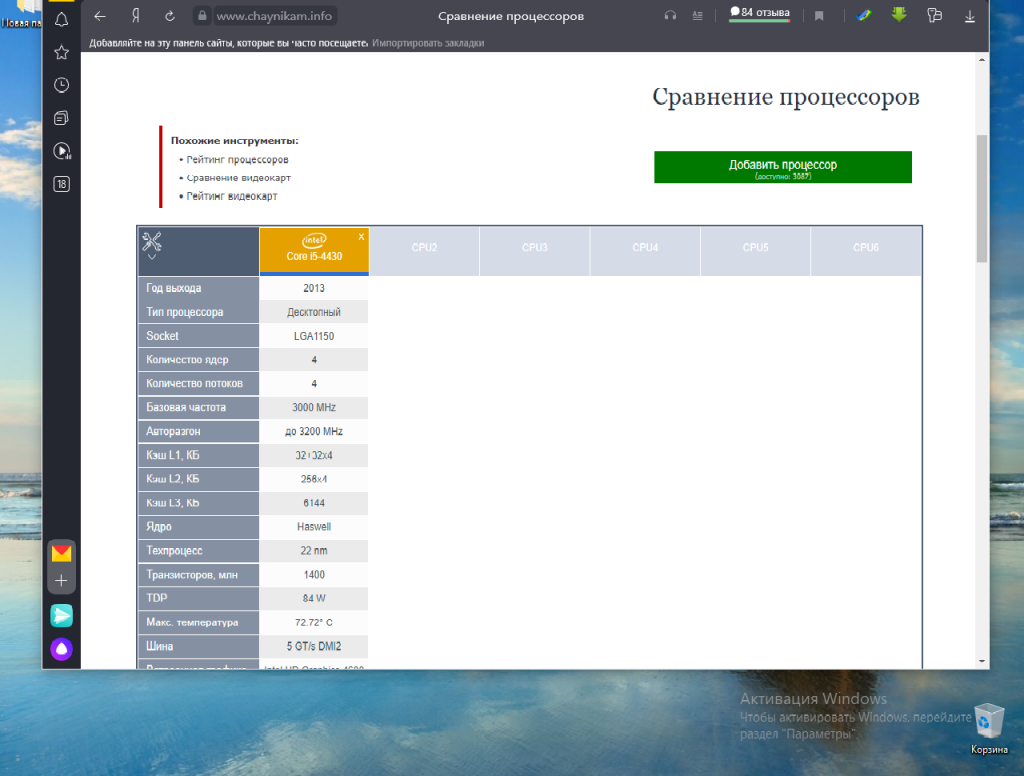
В открывшемся окне вам будет предложено указать параметры выбора нужного процессора. Все указывать не обязательно.
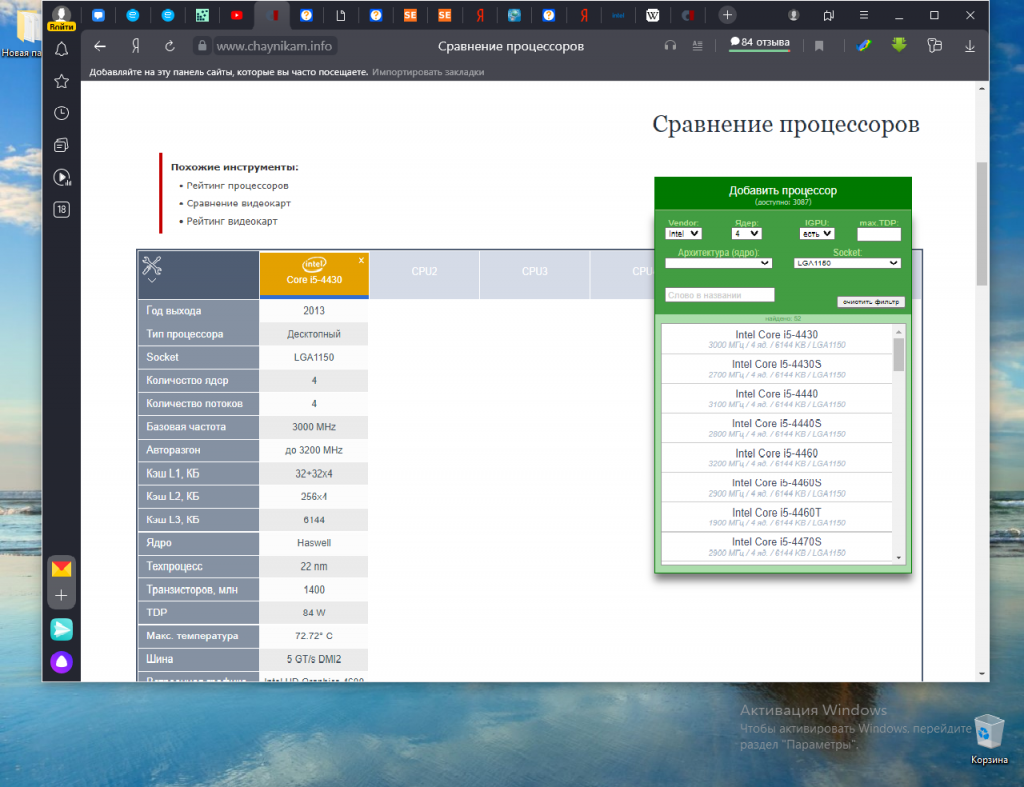
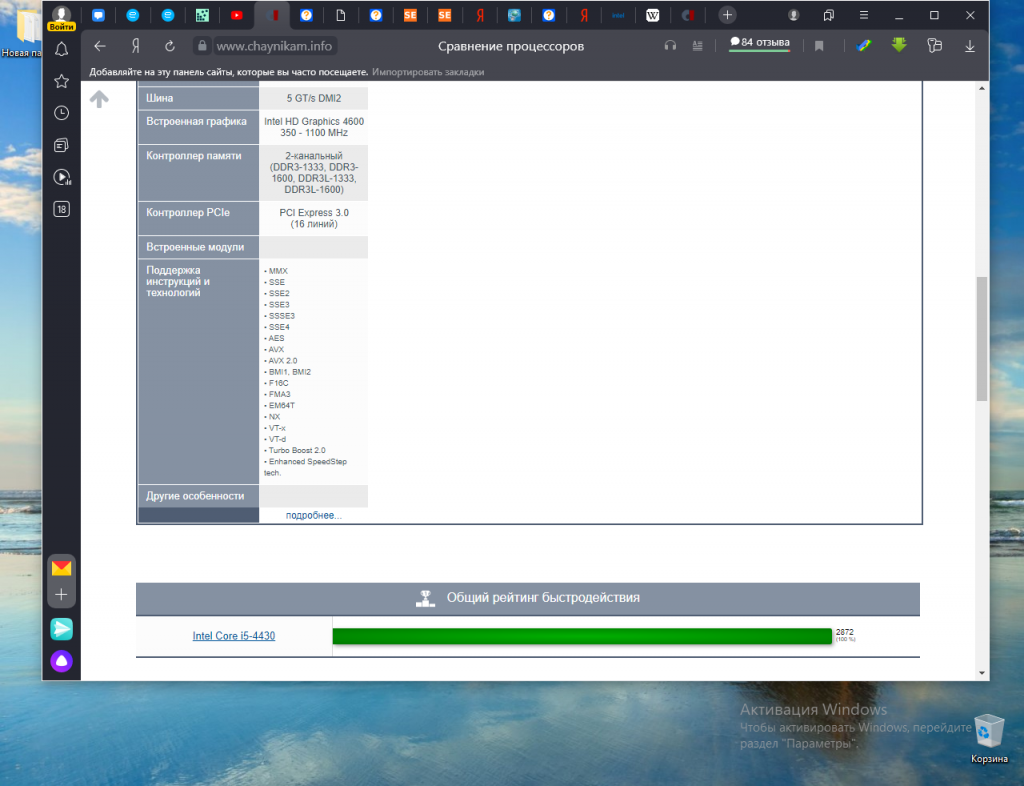
В результате выполнения поиска будет сформирована таблица с параметрами выбранного из списка процессора. Прокрутите таблицу вниз. В строке Поддержка инструкций и технологий будет показана подробная информация.
2. Утилита CPU-Z.
Один из самых простых и надёжных способов узнать поддерживает ли процессор AVX инструкции, использовать утилиту для просмотра информации о процессоре — CPU-Z. Скачать утилиту можно на официальном сайте. После завершения установки ярлык для запуска утилиты появится на рабочем столе. Запустите её.
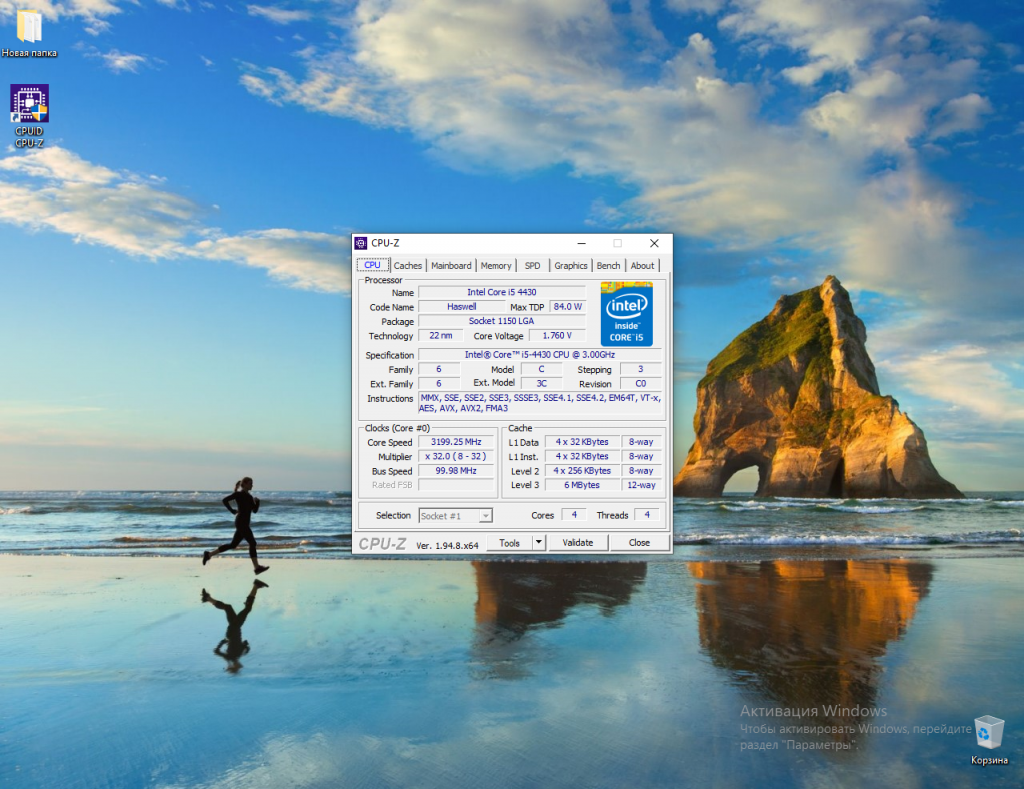
В строке Instructions показаны все инструкции и другие технологии, поддерживаемые вашим процессором.
3. Поиск на сайте производителя.
Ещё один способ узнать, есть ли AVX на процессоре, воспользоваться официальным сайтом производителя процессоров. В строке поиска браузера наберите название процессора и выполните поиск. Если у вас процессор Intel, выберите соответствующую страницу в списке и перейдите на неё. На этой странице вам будет предоставлена подробная информация о процессоре.
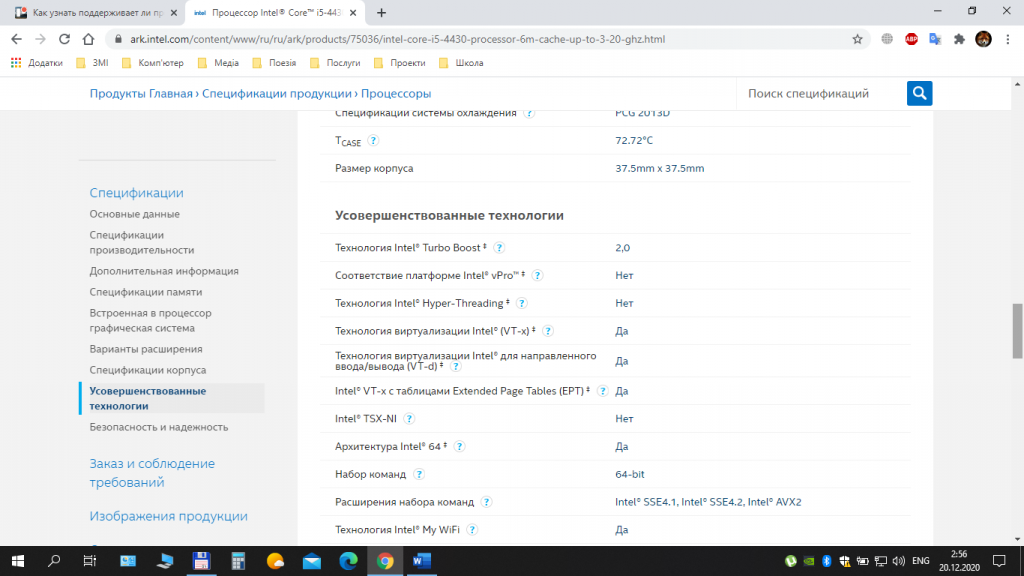
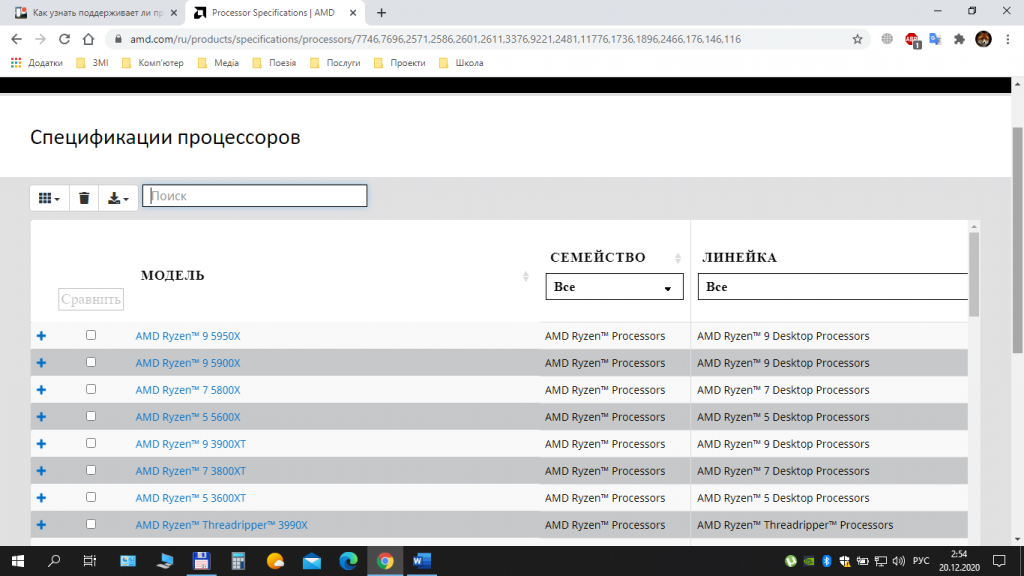
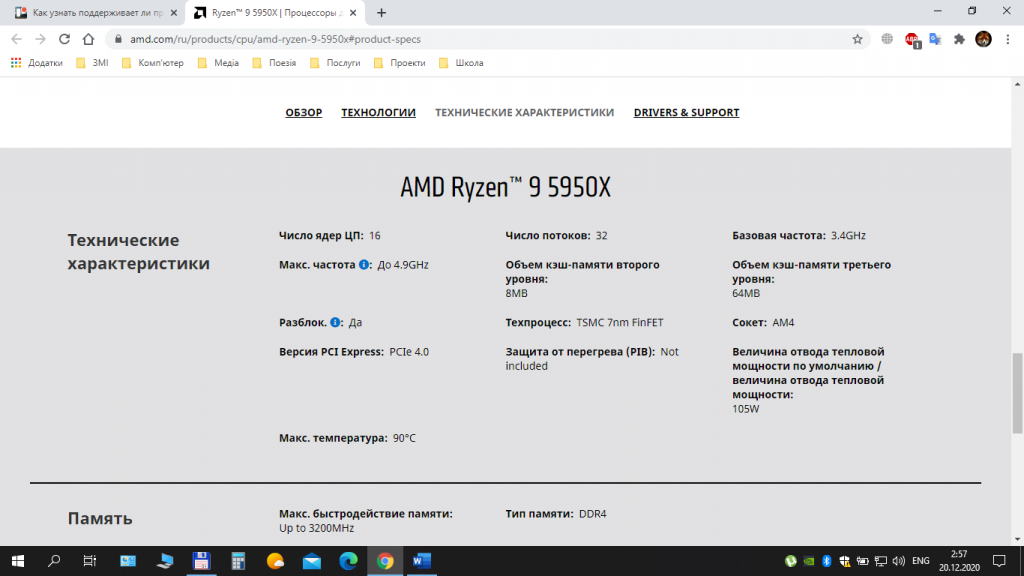
Если у вас процессор от компании AMD, то лучше всего будет воспользоваться сайтом AMD. Выберите пункт меню Процессоры, далее — пункт Характеристики изделия и затем, выбрав тип (например, Потребительские процессоры), выполните переход на страницу Спецификации процессоров. На этой странице выполните поиск вашего процессора по названию и посмотрите подробную информацию о нём.
Выводы
В этой статье мы довольно подробно рассказали о поддержке процессорами инструкций AVX, AVX2, а также показали несколько способов, позволяющих выяснить наличие такой поддержки конкретно вашим процессором. Надеемся, что дополнительная информация об используемом процессоре будет полезна для вас, а также поможет в выборе процессора в будущем.
Была ли эта статья полезной?
ДаНет
Оцените статью:
(12 оценок, среднее: 4,67 из 5)
Загрузка…
Об авторе
Над статьей работал не только её автор, но и другие люди из команды te4h, администратор (admin), редакторы или другие авторы. Ещё к этому автору могут попадать статьи, авторы которых написали мало статей и для них не было смысла создавать отдельные аккаунты.