
Раздел: Бытовая, кухонная техника, электроника и оборудование
Тип: Стиральная Машина
Характеристики, спецификации
Максимальная загрузка белья:
7 кг
Управление:
электронное (интеллектуальное)
Размеры (ШxГxВ):
60x54x82 см
Высота для встраивания:
90 см
Класс электропотребления:
A+
Класс эффективности стирки:
A
Класс эффективности отжима:
B
Скорость вращения при отжиме:
до 1200 об/мин
Выбор скорости отжима:
есть
Защита от протечек:
частичная (корпус)
Контроль за уровнем пены:
есть
Специальные программы:
стирка деликатных тканей, экономичная стирка, предотвращение сминания, супер-полоскание, экспресс-стирка, программа удаления пятен
Таймер отсрочки начала стирки:
есть (до 9 ч)
Инструкция к Стиральной Машине Hotpoint-Ariston AWM 129
Ñîäåðæàíèå
Óñòàíîâêà 2-10
Ðàñïàêîâêà è âûðàâíèâàíèå
Ïîäêëþ÷åíèå ê âîäîïðîâîäíîé è ýëåêòðè÷åñêîé ñåòè
Ïðîáíûé öèêë ñòèðêè
Òåõíè÷åñêèå õàðàêòåðèñòèêè
Èíñòðóêöèè ïî ìîíòàæó îáîðóäîâàíèÿ
Îïèñàíèå ñòèðàëüíîé ìàøèíû è çàïóñê ïðîãðàììû 11-14
Ïàíåëü óïðàâëåíèÿ
Èíäèêàòîðû
Ïîðÿäîê çàïóñêà ïðîãðàììû
Ïðîãðàììû 15-16
Òàáëèöà ïðîãðàìì
Óñòàíîâêè ïîëüçîâàòåëÿ 17-18
Óñòàíîâêà òåìïåðàòóðû
Óñòàíîâêà ñêîðîñòè îòæèìà
Äîïîëíèòåëüíûå ôóíêöèè
Ìîþùèå ñðåäñòâà è áåëüå 19-20
Ðàñïðåäåëèòåëü ìîþùèõ ñðåäñòâ
Öèêë îòáåëèâàíèÿ
Ïîäãîòîâêà áåëüÿ
Îñîáåííîñòè ñòèðêè îòäåëüíûõ èçäåëèé
Ñèñòåìà áàëàíñèðîâêè çàãðóçêè
Ïðåäóïðåæäåíèÿ è ðåêîìåíäàöèè 21-22
Îñíîâíûå ïðàâèëà áåçîïàñíîñòè
Óòèëèçàöèÿ
Êàê âðó÷íóþ îòêðûòü çàáëîêèðîâàííóþ äâåðöó
Îáñëóæèâàíèå è óõîä 23-24
Îòêëþ÷åíèå âîäî- è ýëåêòðîñíàáæåíèÿ
Óõîä çà: • ñòèðàëüíîé ìàøèíîé
• ðàñïðåäåëèòåëåì ìîþùèõ ñðåäñòâ
• äâåðöåé ñòèðàëüíîé ìàøèíû è áàðàáàíîì
×èñòêà íàñîñà
Ïðîâåðêà çàëèâíîãî øëàíãà
Óñòðàíåíèå íåèñïðàâíîñòåé 25-26
Ïîìîùü 27
AWM 129
1
11
11
Óñòàíîâêà
! Âíèìàòåëüíî ïðî÷èòàéòå ðóêîâîäñòâî: â íåì ñîäåðæàòñÿ âàæíûå ñâåäåíèÿ
Ïîäêëþ÷åíèå ê âîäîïðîâîäíîé è ýëåêòðè÷åñêîé ñåòè
Óñòàíîâêà
ïî óñòàíîâêå è áåçîïàñíîé ýêñïëóàòàöèè ñòèðàëüíîé ìàøèíû.
Ñîõðàíèòå ðóêîâîäñòâî. Îíî äîëæíî áûòü â êîìïëåêòå ñî ñòèðàëüíîé ìàøè-
Ïîäñîåäèíåíèå çàëèâíîãî øëàíãà
íîé â ñëó÷àå åå ïðîäàæè, ïåðåäà÷è èëè ïåðååçäà, ÷òîáû íîâûé âëàäåëåö
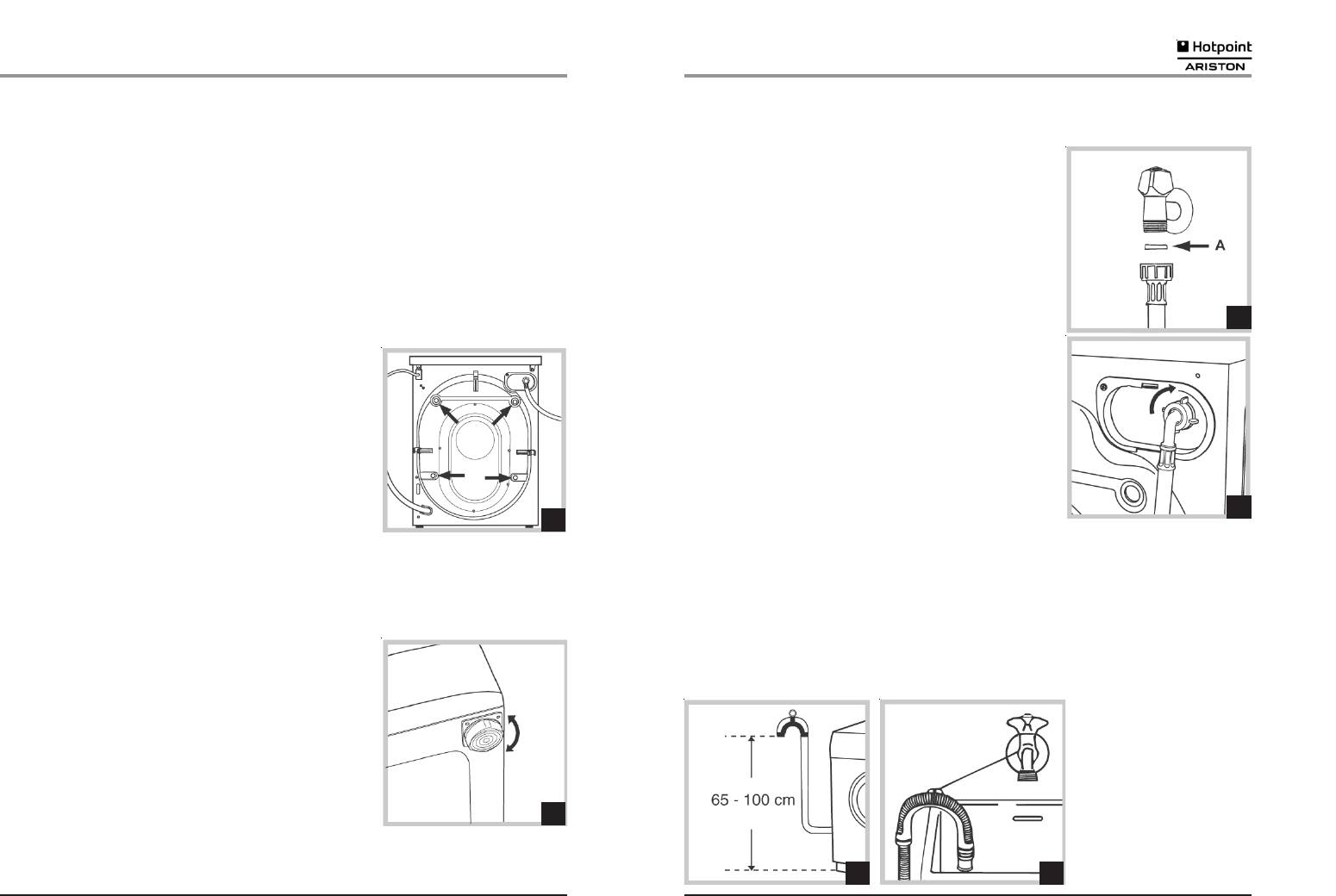
1. Âñòàâüòå ïðîêëàäêó À â êîíåö çàëèâíîãî øëàíãà
îáîðóäîâàíèÿ ìîã îçíàêîìèòüñÿ ñ ïðàâèëàìè åãî ôóíêöèîíèðîâàíèÿ è îáñëó-
è íàâåðíèòå åãî íà âûâîä âîäîïðîâîäà õîëîäíîé
æèâàíèÿ.
âîäû ñ ðåçüáîâûì îòâåðñòèåì 3/4 äþéìà (ðèñ. 3).
Ðàñïàêîâêà è âûðàâíèâàíèå
Ïåðåä ïîäñîåäèíåíèåì îòêðîéòå âîäîïðîâîä—
íûé êðàí è äàéòå ñòå÷ü ãðÿçíîé âîäå.
Ðàñïàêîâêà
2. Ïîäñîåäèíèòå çàëèâíîé øëàíã ê ñòèðàëüíîé
1. Ðàñïàêóéòå ñòèðàëüíóþ ìàøèíó.
ìàøèíå, íàâèíòèâ åãî íà âîäîïðèåìíèê, ðàñïî-
2. Óáåäèòåñü, ÷òî îáîðóäîâàíèå íå áûëî ïîâðåæäåíî âî âðåìÿ òðàíñïîðòè-
ëîæåííûé ââåðõó ñïðàâà íà çàäíåé ÷àñòè îáî-
ðîâêè. Ïðè îáíàðóæåíèè ïîâðåæäåíèé íå ïðèñòóïàéòå ê óñòàíîâêå îáîðóäî-
ðóäîâàíèÿ (ñì. ðèñ. 4).
3
âàíèÿ – ñâÿæèòåñü ñ ïîñòàâùèêîì íåìåäëåííî.
3. Óáåäèòåñü, ÷òî øëàíã íå ïåðåêðó÷åí è íå ïåðå-
æàò.
3. Óäàëèòå 4 òðàíñïîðòèðîâî÷íûõ áîëòà è ðåçèíî-
âûå ïðîáêè ñ ïðîêëàäêàìè, ðàñïîëîæåííûå â çàä-
! Äàâëåíèå âîäû äîëæíî áûòü â ïðåäåëàõ çíà÷å-
íåé ÷àñòè ñòèðàëüíîé ìàøèíû (ðèñ. 1).
íèé, óêàçàííûõ â òàáëè÷êå Òåõíè÷åñêèõ õàðàê-
òåðèñòèê îáîðóäîâàíèÿ (ñì. ñ. 5).
4. Çàêðîéòå îòâåðñòèÿ ïðèëàãàþùèìèñÿ ïëàñòè-
! Åñëè äëèíà âîäîïðîâîäíîãî øëàíãà îêàæåòñÿ íå-
êîâûìè çàãëóøêàìè.
äîñòàòî÷íîé, îáðàòèòåñü â Àâòîðèçîâàííûé ñåð-
5. Ñîõðàíèòå âñå äåòàëè: îíè ìîãóò ïîíàäîáèòüñÿ
âèñíûé öåíòð.
â ñëó÷àå ïîñëåäóþùåé òðàíñïîðòèðîâêè ñòèðàëü-
! Íå ïðèìåíÿéòå øëàíãè, áûâøèå â óïîòðåáëåíèè.
íîé ìàøèíû.
! Èñïîëüçóéòå òîëüêî øëàíã, ïîñòàâëÿåìûé ñ ìà-
4
1
! Íå ðàçðåøàéòå äåòÿì èãðàòü ñ óïàêîâî÷íûìè
øèíîé.
ìàòåðèàëàìè.
Ïîäñîåäèíåíèå ñëèâíîãî øëàíãà
Âûðàâíèâàíèå
Ïîâåñüòå çàãíóòûé êîíåö ñëèâíîãî øëàíãà íà êðàé ðàêîâèíû, âàííû, èëè ïî-
1. Óñòàíîâèòå ñòèðàëüíóþ ìàøèíó íà ðîâíîì è ïðî÷íîì ïîëó òàê, ÷òîáû îíà
ìåñòèòå â ñïåöèàëüíûé âûâîä êàíàëèçàöèè. Øëàíã íå äîëæåí ïåðåãèáàòüñÿ.
íå êàñàëàñü ñòåí, ìåáåëè è ïðî÷èõ ïðåäìåòîâ.
Êîíåö ñëèâíîãî øëàíãà äîëæåí íàõîäèòüñÿ íà âûñîòå 65-100 ñì îò ïîëà
(ðèñ. 5). Ðàñïîëîæåíèå ñëèâíîãî øëàíãà äîëæíî îáåñïå÷èâàòü ðàçðûâ ñòðóè
2. Åñëè ïîë íå ñîâñåì ðîâíûé, âûðîâíÿéòå ìàøè-
ïðè ñëèâå (êîíåö øëàíãà íå äîëæåí áûòü ïîãðóæåí â âîäó).  ñëó÷àå êðåïëå-
íó, âêðó÷èâàÿ èëè âûêðó÷èâàÿ åå ïåðåäíèå ðåãó-
íèÿ íà êðàé âàííû èëè ðàêîâèíû, øëàíã âåøàåòñÿ ñ ïîìîùüþ íàïðàâëÿþùåé
ëèðóåìûå íîæêè (ñì. ðèñ. 2); óãîë îòêëîíåíèÿ
(âõîäèò â êîìïëåêò ïî-
âåðõíåé êðûøêè êîðïóñà ìàøèíû îò ãîðèçîíòàëè
ñòàâêè), êîòîðàÿ êðå-
íå äîëæåí ïðåâûøàòü 2°.
ïèòñÿ ê êðàíó (ðèñ. 6).
Ïðàâèëüíîå âûðàâíèâàíèå îáîðóäîâàíèÿ ïîìî-
! Íå ðåêîìåíäóåòñÿ èñ-
æåò èçáåæàòü øóìà, âèáðàöèé è ñìåùåíèé ìàøè-
ïîëüçîâàòü óäëèíèòåëè
íû âî âðåìÿ åå ðàáîòû.
äëÿ ñëèâíîãî øëàíãà.
Åñëè ñòèðàëüíàÿ ìàøèíà óñòàíàâëèâàåòñÿ íà
Ïðè íåîáõîäèìîñòè äî-
ïîëó ñ êîâðîâûì ïîêðûòèåì, îòðåãóëèðóéòå åå
2
ïóñêàåòñÿ åãî íàðàùè-
íîæêè òàêèì îáðàçîì, ÷òîáû ïîä îñíîâàíèåì ìà-
âàíèå øëàíãîì òàêîãî
øèíû èìåëîñü äîñòàòî÷íîå ïðîñòðàíñòâî äëÿ âåíòèëÿöèè.
æå äèàìåòðà è äëèíîé
5
6
íå áîëåå 150 ñì.
AWM 129
AWM 129
2
22
22
33
3
33
Ïîäñîåäèíåíèå ê ýëåêòðîñåòè
Ïðîáíûé öèêë ñòèðêè
ÂÍÈÌÀÍÈÅ! Îáîðóäîâàíèå îáÿçàòåëüíî äîëæíî áûòü çàçåìëåíî!
Ïî çàâåðøåíèè óñòàíîâêè, ïåðåä íà÷àëîì ýêñïëóàòàöèè íåîáõîäèìî ïðîèç-
âåñòè îäèí öèêë ñòèðêè ñî ñòèðàëüíûì ïîðîøêîì, íî áåç áåëüÿ, âûáðàâ ïðî-
1. Ìàøèíà ïîäêëþ÷àåòñÿ ê ýëåêòðè÷åñêîé ñåòè ïðè ïîìîùè äâóõïîëþñíîé ðî-
ãðàììó 1.
çåòêè ñ çàçåìëÿþùèì êîíòàêòîì (ðîçåòêà íå ïîñòàâëÿåòñÿ ñ ìàøèíîé). Ôàç-
íûé ïðîâîä äîëæåí áûòü ïîäêëþ÷åí ÷åðåç àâòîìàò çàùèòû ñåòè, ðàññ÷èòàí-
íûé íà ìàêñèìàëüíûé òîê (òîê ñðàáàòûâàíèÿ) 16 À, è èìåþùèé âðåìÿ ñðàáà-
Òåõíè÷åñêèå õàðàêòåðèñòèêè
òûâàíèÿ íå áîëåå 0,1 ñ.
2. Ïðè íàëè÷èè âáëèçè îò ïðåäïîëàãàåìîãî ìåñòà óñòàíîâêè ìàøèíû ðîçåòêè
Ìîäåëü AWM 129
ñ çàçåìëÿþùèì êîíòàêòîì, èìåþùåé òðåõïðîâîäíóþ ïîäâîäêó êàáåëÿ ñ ìåä-
Ðàçìåðû øèðèíà — 59,5 ñì;
íûìè æèëàìè ñå÷åíèåì íå ìåíåå 1,5 êâ. ìì (èëè àëþìèíèåâûìè æèëàìè ñå-
âûñîòà — 81,5 ñì;
÷åíèåì íå ìåíåå 2,5 êâ. ìì), äîðàáîòêà ýëåêòðîñåòè íå ïðîèçâîäèòñÿ. Ïðè îò-
ãëóáèíà — 54 ñì
ñóòñòâèè óêàçàííîé ðîçåòêè è ïðîâîäêè ñëåäóåò ïðîâåñòè èõ ìîíòàæ.
Çàãðóçêà 1–7 êã
3. Ïðîêëàäêà çàçåìëåíèÿ îòäåëüíûì ïðîâîäîì íå äîïóñêàåòñÿ.
Ýëåêòðè÷åñêèå ñì. òàáëè÷êó òåõíè÷åñêèõ äàííûõ
4. Äëÿ äîðàáîòêè ýëåêòðè÷åñêîé ñåòè ðåêîìåíäóåòñÿ ïðèìåíÿòü ïðîâîä
ïàðàìåòðû íà ìàøèíå
ÏÏÂ 3õ1,5 380 ÃÎÑÒ 6223-79. Äîïóñêàåòñÿ ïðèìåíåíèå äðóãèõ ìàðîê êàáåëÿ,
îáåñïå÷èâàþùèõ ïîæàðî- è ýëåêòðîáåçîïàñíîñòü ïðè ýêñïëóàòàöèè ìàøèíû.
Ãèäðàâëè÷åñêèå max äàâëåíèå 1 ÌÏà (10 áàð)
ïàðàìåòðû min äàâëåíèå 0,05 ÌÏà (0,5 áàð)
Ïåðåä âêëþ÷åíèåì ìàøèíû â ñåòü óáåäèòåñü, ÷òî:
îáúåì áàðàáàíà 52 ë
• Ðîçåòêà èìååò çàçåìëåíèå â ñîîòâåòñòâèè ñ íîðìàìè ýëåêòðîáåçîïàñíîñ-
Ñêîðîñòü îòæèìà äî 11200 îá./ìèí
òè.
Êîíòðîëüíûå ïðîãðàììà 6,
• Ðîçåòêà ìîæåò âûäåðæàòü ìàêñèìàëüíóþ íàãðóçêó îáîðóäîâàíèÿ, óêàçàí-
ïðîãðàììû ïî òåìïåðàòóðà 60°Ñ
íóþ â òàáëè÷êå òåõíè÷åñêèõ äàííûõ (ñì. ñ. 5).
íîðìàòèâó IEC 456 ïðè çàãðóçêå 7 êã
• Íàïðÿæåíèå ïèòàíèÿ ñîîòâåòñòâóåò çíà÷åíèÿì, óêàçàííûì â òàáëè÷êå òåõ-
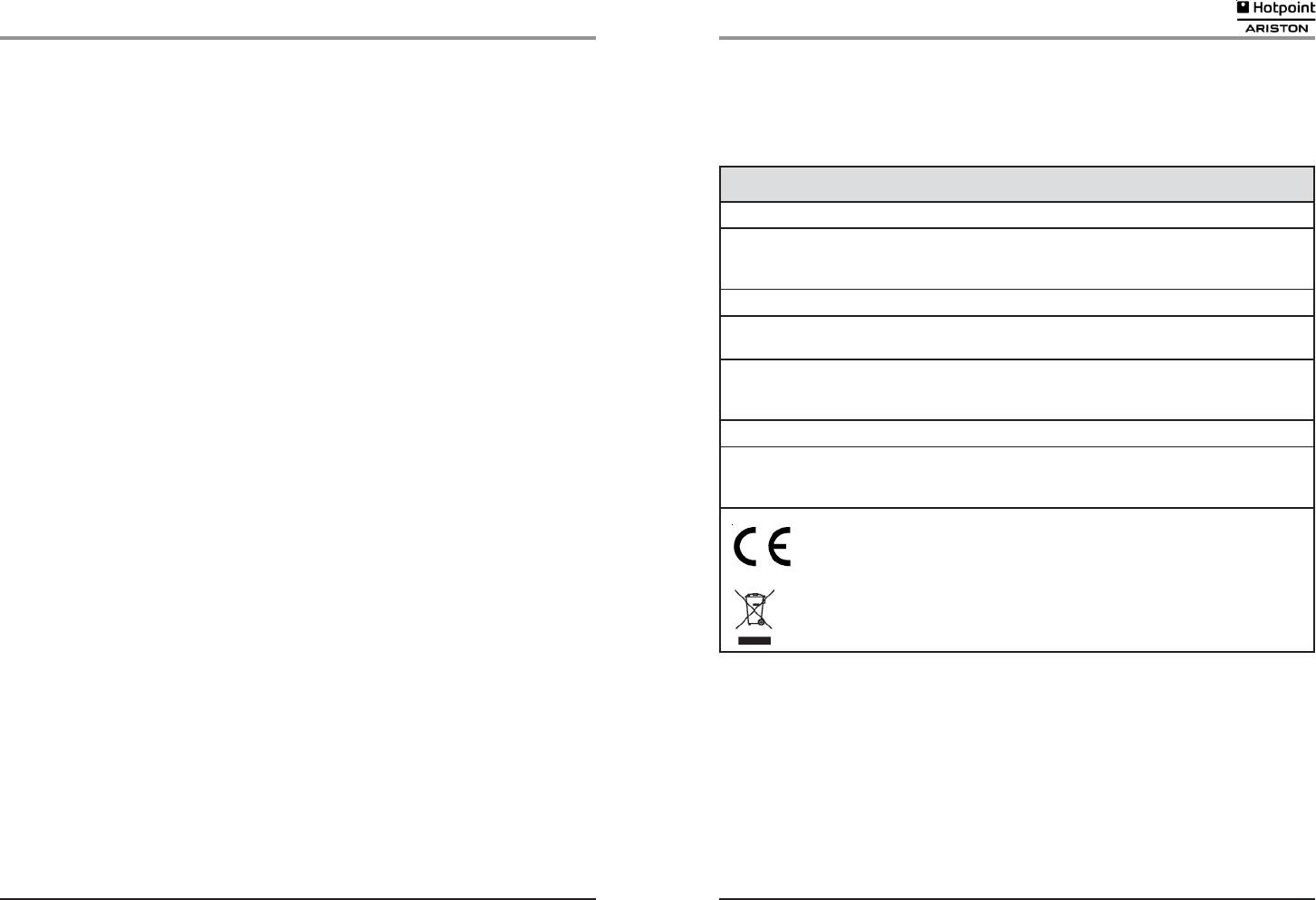
Ñîîòâåòñòâèå Äèðåêòèâàì Åâðîïåéñêîãî Ýêîíîìè÷åñêîãî ñîîáùåñòâà:
íè÷åñêèõ äàííûõ îáîðóäîâàíèÿ.
— 89/336 /ÅÅÑ îò 03.05.89 (Ýëåêòðîìàãíèòíàÿ ñîâìåñòèìîñòü) è
• Ðîçåòêà ïîäõîäèò ê âèëêå ñòèðàëüíîé ìàøèíû.  ïðîòèâíîì ñëó÷àå çàìå-
ïîñëåäóþùèå ìîäèôèêàöèè;
íèòå ðîçåòêó èëè âèëêó.
— 2006/95/EC (Íèçêîå íàïðÿæåíèå)
! Ñòèðàëüíàÿ ìàøèíà íå äîëæíà óñòàíàâëèâàòüñÿ âíå ïîìåùåíèé (äàæå ïîä
íàâåñîì): ÷ðåçâû÷àéíî îïàñíî îñòàâëÿòü îáîðóäîâàíèå ïîä âîçäåéñòâèåì
— 2002/96/EÑ (Óòèëèçàöèÿ ýëåêòðè÷åñêîãî è ýëåêòðîííîãî îáîðóäîâàíèÿ).
äîæäÿ è äðóãèõ àòìîñôåðíûõ îñàäêîâ/ÿâëåíèé.
! Ïîñëå óñòàíîâêè äîëæåí áûòü îáåñïå÷åí ñâîáîäíûé äîñòóï ê ïèòàþùåìó
êàáåëþ è âèëêå îáîðóäîâàíèÿ.
! Íå èñïîëüçóéòå óäëèíèòåëè è ìíîãîãíåçäîâûå ðîçåòêè.
! Ïèòàþùèé êàáåëü íå äîëæåí áûòü ïåðåêðó÷åí èëè ïåðåæàò (íàõîäèòüñÿ ïîä
ìàøèíîé ïîñëå ïîäêëþ÷åíèÿ).
! Çàìåíà ïèòàþùåãî êàáåëÿ äîëæíà ïðîèçâîäèòüñÿ òîëüêî ñïåöèàëèñòàìè
Àâòîðèçîâàííîãî ñåðâèñíîãî öåíòðà (ñì. Ïîìîùü).
Ïðîèçâîäèòåëü ñíèìàåò ñ ñåáÿ âñÿêóþ îòâåòñòâåííîñòü â ñëó÷àå
íåñîáëþäåíèÿ óêàçàííûõ íîðì óñòàíîâêè è ïîäêëþ÷åíèÿ îáîðóäîâà-
íèÿ.
AWM 129
AWM 129
4
44
44
55
5
55
Èíñòðóêöèè ïî ìîíòàæó
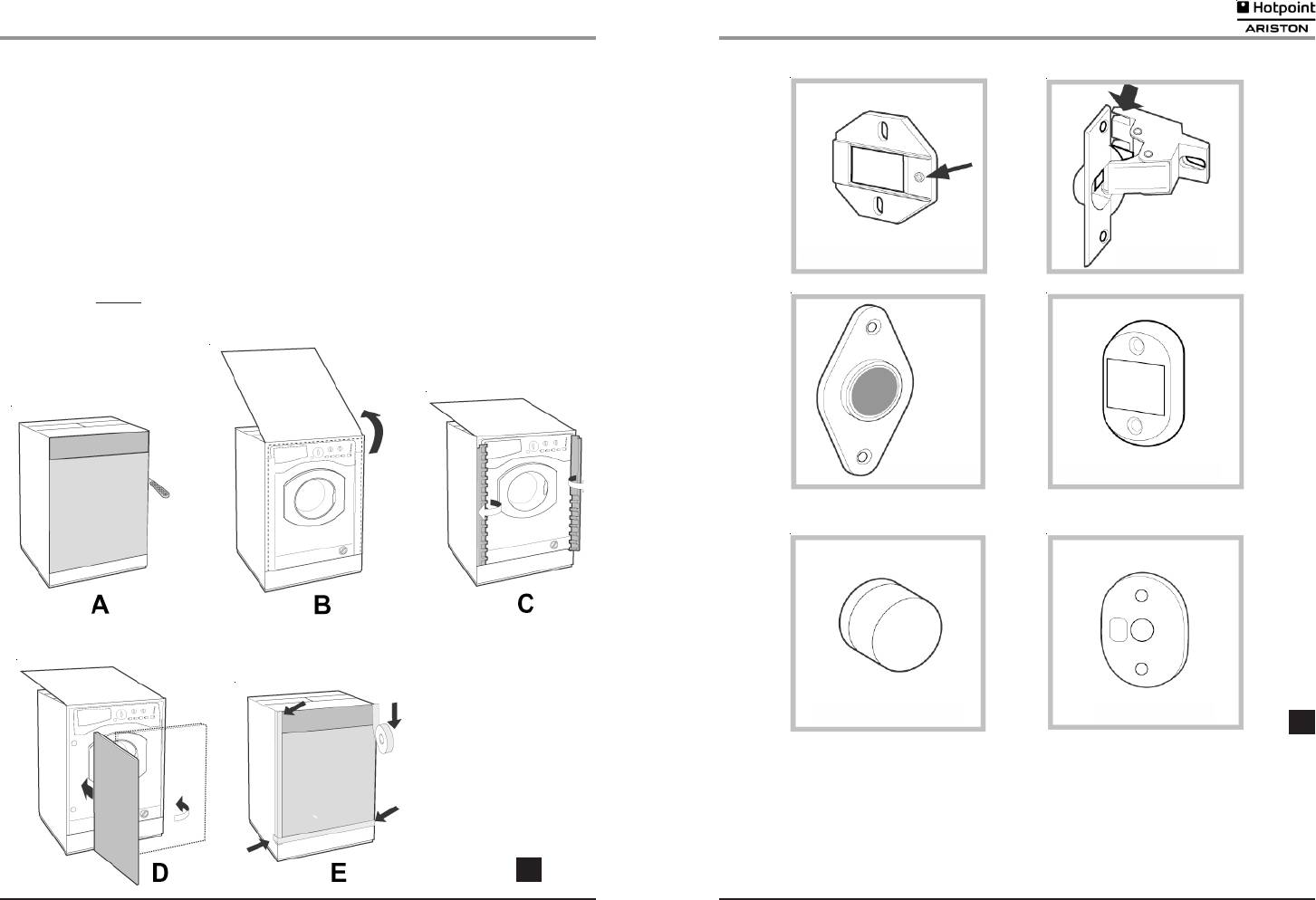
Àêñåññóàðû äëÿ ìîíòàæà äâåðíîé ïàíåëè
Óñòàíîâêà äåðåâÿííîé ïàíåëè íà äâåðöó
12
è âñòðàèâàíèå ìàøèíû â ìîäóëü êóõîííîé ìåáåëè
 ñëó÷àå, êîãäà ñòèðàëüíàÿ ìàøèíà äîëæíà áûòü ïåðåâåçåíà äëÿ îêîí÷à-
òåëüíîé óñòàíîâêè ïîñëå òîãî, êàê äåðåâÿííàÿ ïàíåëü óæå áûëà íàâåøåíà,
ìû ïðåäëàãàåì îñòàâèòü ìàøèíó â åå îðèãèíàëüíîé óïàêîâêå. Êîíñòðóêöèÿ
óïàêîâêè ïîçâîëÿåò íàâåñèòü äåðåâÿííóþ ïàíåëü íà ìàøèíó, íå èçâëåêàÿ
ïîñëåäíþþ ïîëíîñòüþ èç óïàêîâêè (ñì. ðèñ. 7).
Äåðåâÿííàÿ ïàíåëü, êîòîðàÿ çàêðûâàåò ëèöåâóþ ñòîðîíó ìàøèíû, äîëæíà
Ðàìêà ïåòëè (2 øò.) Ïåòëÿ (2 øò.)
áûòü òîëùèíîé íå ìåíåå 18 ìì è ìîæåò íàâåøèâàòüñÿ èëè ñïðàâà, èëè ñëå-
âà.  öåëÿõ ïðàêòè÷íîãî èñïîëüçîâàíèÿ ìàøèíû ìû ðåêîìåíäóåì íàâåøè-
âàòü ïàíåëü
ñëåâà, ÷òîáû îíà îòêðûâàëàñü â òó æå ñàìóþ ñòîðîíó, ÷òî è äâåð-
öà ìàøèíû.
34
Ìàãíèò
Ìàãíèòíàÿ ïëàñòèíêà
(1 øò.)
(1 øò.)
Ìàãíèòíàÿ çàùåëêà
54B
Ðåçèíîâûé
Ïðîêëàäêà çàùåëêè
îãðàíè÷èòåëü (1 øò.)
(1 øò.)
8
••
• ñàìîíàðåçíûå âèíòû òèï À äë. 13 ìì – 6 øò.,
••
••
••
• ìåòðè÷åñêèå âèíòû ñ ïîòàéíîé ãîëîâêîé òèï  äë. 25 ìì
(äëÿ êðåïëåíèÿ ìàãíèòíîé ïëàñòèíêè ê êîðïóñó ìåáåëè) – 2 øò.,
••
••
• ìåòðè÷åñêèå âèíòû òèï Ñ äë. 15 ìì
(äëÿ ïðèêðåïëåíèÿ ðàìîê ïåòåëü ê êîðïóñó ìåáåëè) – 4 øò.,
••
• ìåòðè÷åñêèå âèíòû òèï D äë. 7 ìì
••
7
(äëÿ çàêðåïëåíèÿ ïåòåëü íà ðàìêàõ) – 4 øò.
AWM 129
AWM 129
6
66
66
77
7
77
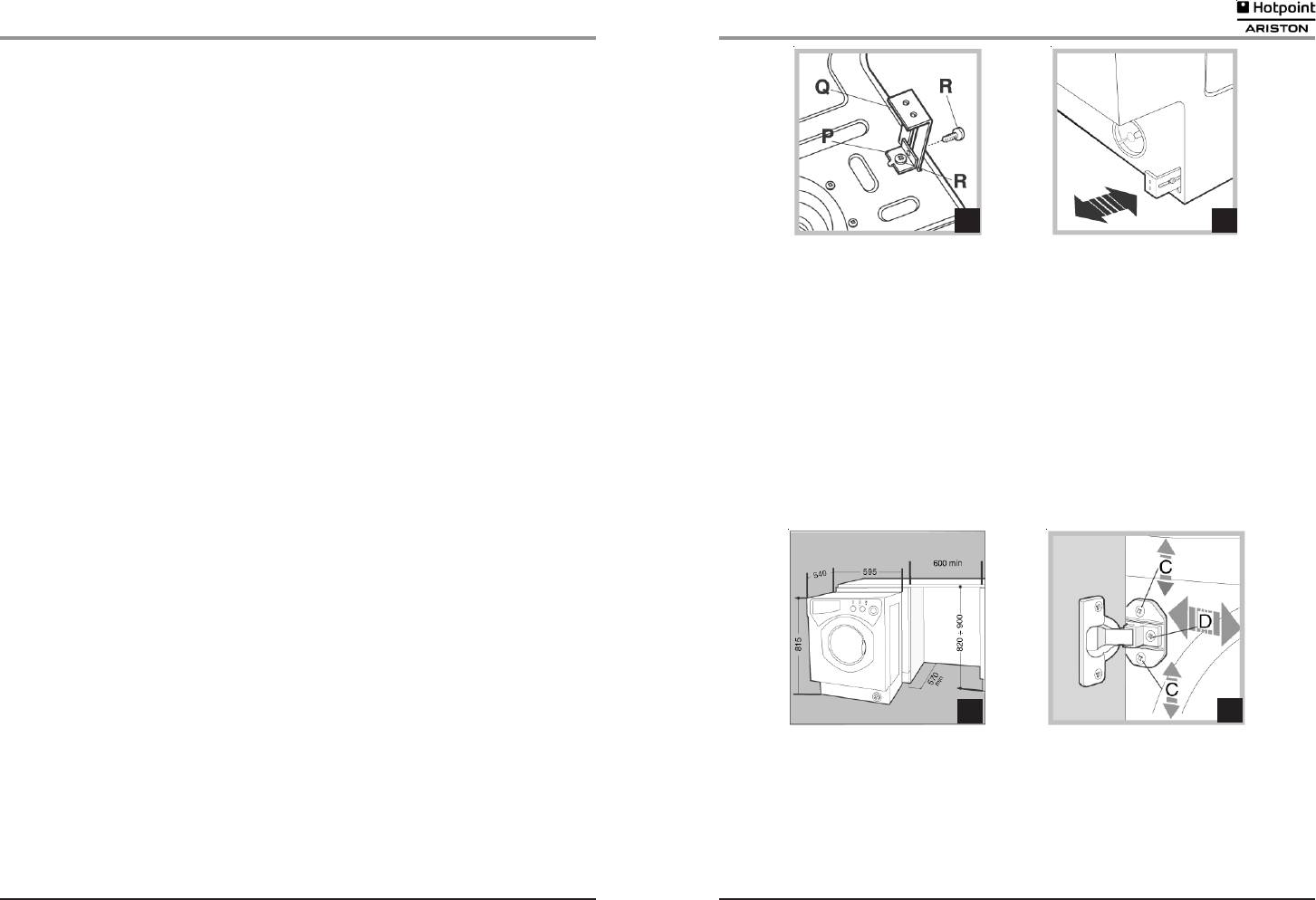
Êðåïëåíèå ýëåìåíòîâ ñ ëèöåâîé ñòîðîíû ìàøèíû
– Âèíòàìè òèïà Ñ çàêðåïèòå ðàìêè ïåòåëü òàêèì îáðàçîì, ÷òîáû îòâåðñòèå,
îáîçíà÷åííîå ñòðåëêîé íà ðèñ. 8-1, áûëî íàïðàâëåíî ê âíóòðåííåé ÷àñòè
ëèöåâîé ñòîðîíû ìàøèíû.
– Óñòàíîâèòå ñ ïðîòèâîïîëîæíîé ñòîðîíû ââåðõó îòâåòíóþ ÷àñòü ìàãíèòíîé
çàùåëêè, èñïîëüçóÿ äâà âèíòà òèïà Â.
– Ïîìåñòèòå ïðîêëàäêó, èçîáðàæåííóþ íà ðèñ. 8-4Â, ìåæäó ëèöåâîé ñòîðî-
íîé îáîðóäîâàíèÿ è îòâåòíîé ÷àñòüþ ìàãíèòíîé çàùåëêè.
9 10
Èñïîëüçîâàíèå øàáëîíà
– ×òîáû ðàçìåòèòü ïîëîæåíèå îòâåðñòèé íà ëåâîé ñòîðîíå ïàíåëè, âûðîâ-
Óñòàíîâêà íàïðàâëÿþùåé (ðèñ. 9):
íÿéòå øàáëîí ñ åå âåðõíèì ëåâûì êðàåì, ñâåðÿÿñü ñ êîíòðîëüíûìè ëèíè-
– çàêðåïèòå óãîëîê Ð âèíòîì R, âñòàâüòå íàïðàâëÿþùóþ Q â ñïåöèàëüíîå îò-
ÿìè øàáëîíà.
âåðñòèå, ðàçìåñòèòå åå â æåëàåìîì ïîëîæåíèè è çàêðåïèòå ñ ïîìîùüþ óãîë-
– ×òîáû ðàçìåòèòü ïîëîæåíèå îòâåðñòèé íà ïðàâîé ñòîðîíå ïàíåëè, âûðîâ-
êà Ð è âèíòà R.
íÿéòå øàáëîí ñ åå âåðõíèì ïðàâûì êðàåì.
– Ïðîñâåðëèòå îòâåðñòèÿ äëÿ äâóõ ïåòåëü, ðåçèíîâîãî îãðàíè÷èòåëÿ è ìàã-
Âñòðàèâàíèå ìàøèíû â êîðïóñ êóõîííîé ìåáåëè
íèòíîãî çàìêà, èñïîëüçóÿ ñâåðëî ïîäõîäÿùåãî ðàçìåðà.
– Âñòàâüòå ìàøèíó â íèøó, âûðîâíÿâ åå ñ ìåáåëüþ (ðèñ. 11).
– Îòðåãóëèðóéòå íîæêè ìàøèíû, ÷òîáû ïîäíÿòü åå íà ïîäõîäÿùóþ âûñîòó.
Êðåïëåíèå ýëåìåíòîâ íà äåðåâÿííóþ ïàíåëü (äâåðöó)
– Îòðåãóëèðóéòå ïîëîæåíèå äåðåâÿííîé ïàíåëè â ãîðèçîíòàëüíîì è âåðòè-
– Âñòàâüòå ïåòëè â îòâåðñòèÿ (ïîäâèæíàÿ ÷àñòü ïåòëè äîëæíà áûòü óñòàíîâ-
êàëüíîì íàïðàâëåíèÿõ, èñïîëüçóÿ âèíòû Ñ è D, êàê ïîêàçàíî íà ðèñ. 12.
ëåíà ëèöåâîé ñòîðîíîé ïî íàïðàâëåíèþ îò ïàíåëè) è çàêðåïèòå èõ 4 âèíòà-
Âàæíî: ïëèíòóñ äîëæåí çàêðûâàòü íèæíþþ ëèöåâóþ ÷àñòü ìàøèíû äî
ìè òèïà À.
ïîëà.
– Âñòàâüòå ìàãíèòíóþ çàùåëêó (ðèñ. 8-3) â âåðõíåå îòâåðñòèå íà ñòîðîíå,
ïðîòèâîïîëîæíîé ïåòëÿì, è çàôèêñèðóéòå åå 2 âèíòàìè òèïà Â.
– Âñòàâüòå ðåçèíîâûé îãðàíè÷èòåëü â íèæíåå îòâåðñòèå.
Òåïåðü ïàíåëü (äâåðöà) ãîòîâà ê óñòàíîâêå íà ìàøèíó.
Óñòàíîâêà äåðåâÿííîé ïàíåëè (äâåðöû) íà ìàøèíó
Âñòàâüòå êîí÷èê ïåòëè (îòìå÷åííûé ñòðåëêîé íà ðèñ. 8-2) â îòâåðñòèå äëÿ
ïåòëè è ïðîäâèíüòå íà ïàíåëü ïî íàïðàâëåíèþ ê ëèöåâîé ñòîðîíå ìàøèíû.
Çàêðåïèòå 2 ïåòëè âèíòàìè òèïà D.
Êðåïëåíèå íàïðàâëÿþùèõ ïëèíòóñà
11
12
(íèæíåé äåêîðàòèâíîé ïàíåëè)
Åñëè ìàøèíà óñòàíàâëèâàåòñÿ â êîíöå ìåáåëüíîãî ìîäóëÿ, äëÿ ïëèíòóñà
(íèæíåé äåêîðàòèâíîé ïàíåëè) ïðîèçâîäèòñÿ ìîíòàæ îäíîé èëè îáåèõ íà-
ïðàâëÿþùèõ, êàê ïîêàçàíî íà ðèñ. 9. Îòðåãóëèðóéòå èõ íà ãëóáèíó ïëèíòóñà
è ïðè íåîáõîäèìîñòè ïðèêðåïèòå ïëèíòóñ ê íàïðàâëÿþùèì (ðèñ. 10)
AWM 129
AWM 129
8
88
88
99
9
99
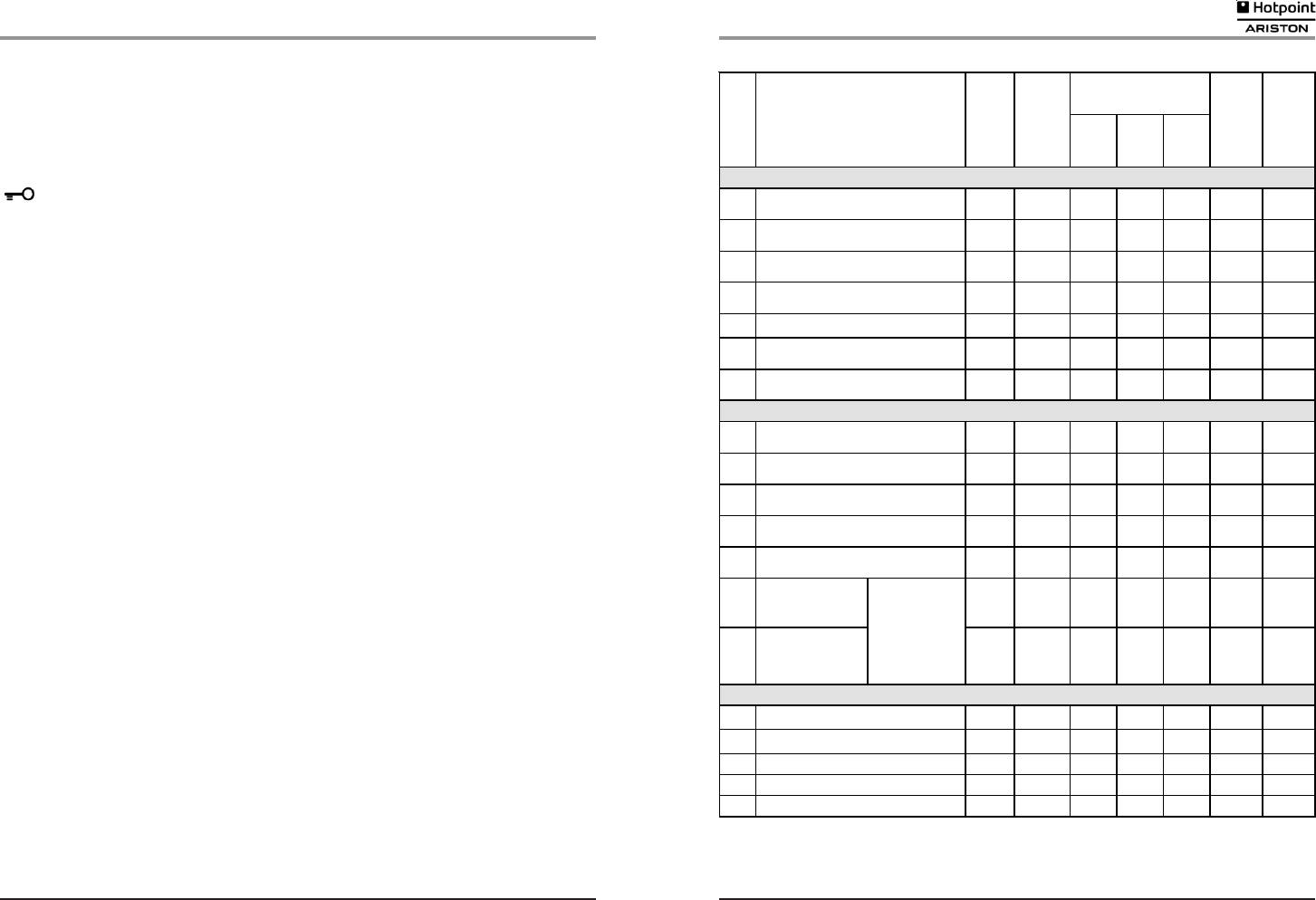
Îïèñàíèå ñòèðàëüíîé ìàøèíû è çàïóñê ïðîãðàììû
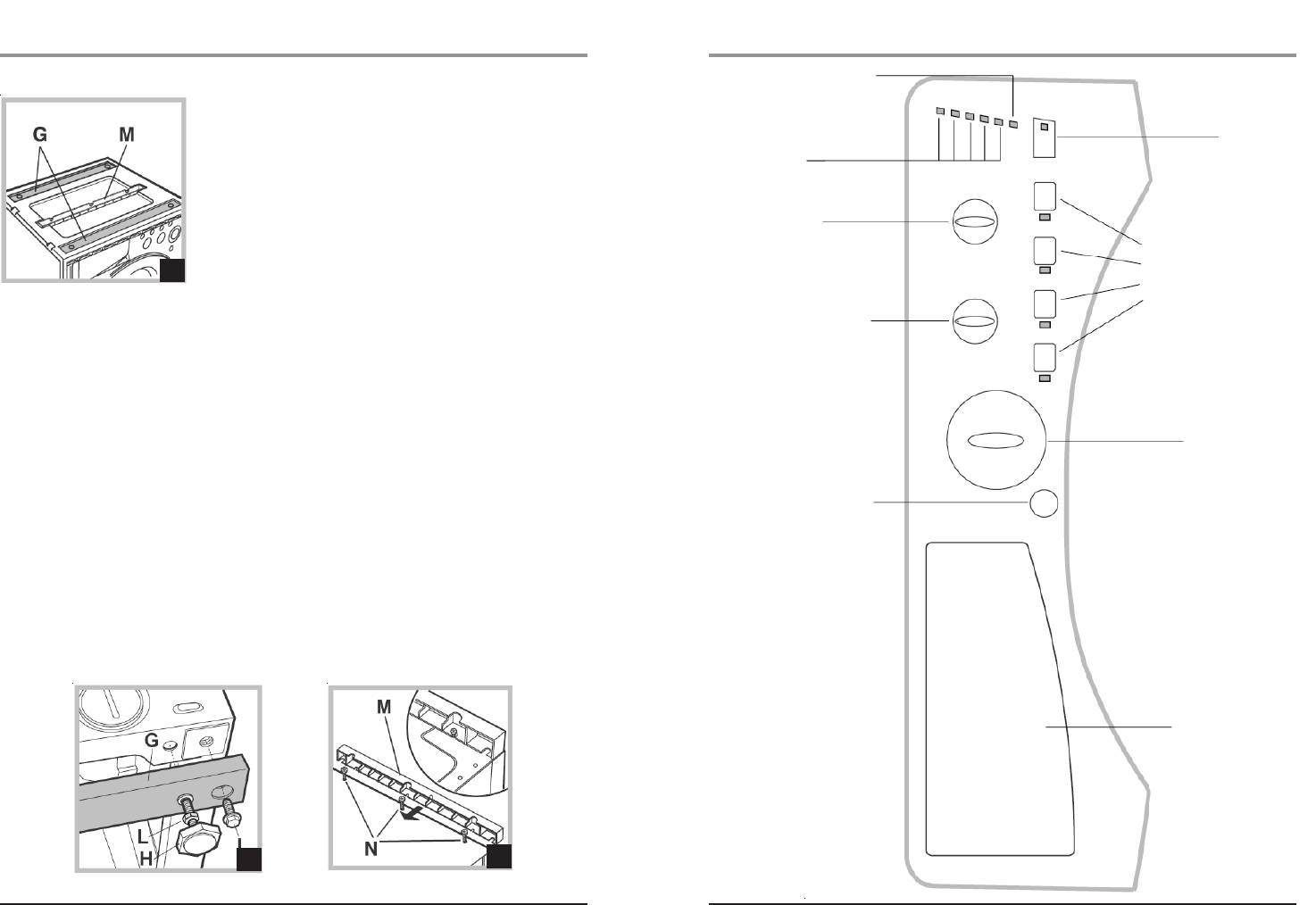
Ïðèñïîñîáëåíèÿ äëÿ ðåãóëèðîâêè âûñîòû ñòèðàëüíîé ìàøèíû
Ïîä êðûøêîé èç ïîëèñòèðîëà (ðèñ. 13) íàõîäÿòñÿ:
2 ïîïåðå÷íûå íàêëàäêè (G); 1 ïëàíêà (Ì).
ÄÂÅÐÖÛ
Èíäèêàòîð
Âíóòðè áàðàáàíà ìàøèíû:
ÁËÎÊÈÐÎÂÊÀ
4 äîïîëíèòåëüíûå íîæêêè (Í);
Êíîïêà
4 âèíòà (I);
4 âèíòà (R);
4 ãàéêè (L);
Èíäèêàòîðû
ñ èíäèêàòîðîì
ÏÓÑÊ / ÏÀÓÇÀ
2 íàïðàâëÿþùèõ äëÿ ïëèíòóñà (íèæíåé äåêîðàòèâ-
13
íîé ïàíåëè) (Q).
Ðóêîÿòêà
ÎÒÆÈÌ
Êíîïêè
Ðåãóëèðîâêà âûñîòû ñòèðàëüíîé ìàøèíû
ÔÓÍÊÖÈß
ÎÒËÎÆÅÍÍÛÉ ÑÒÀÐÒ
ÝÒÀÏÛ ÏÐÎÃÐÀÌÌÛ /
ñ èíäèêàòîðàìè
Âðàùåíèåì 4-õ íîæåê âûñîòà ñòèðàëüíîé ìàøèíû ìîæåò áûòü îòðåãóëèðîâà-
íà îò 815 äî 835 ìì.
Åñëè òðåáóåòñÿ óñòàíîâèòü ìàøèíó íà áî’ëüøóþ âûñîòó (äî 870 ìì), ñëåäóåò
Ðóêîÿòêà
èñïîëüçîâàòü 2 íàêëàäêè (G); 4 äîïîëíèòåëüíûå íîæêè (Í); 4 âèíòà (I); 4 ãàéêè
(L) (ñì. ðèñ. 14).
Âûïîëíèòå ñëåäóþùåå:
ÒÅÌÏÅÐÀÒÓÐÀ
âûâåðíèòå 4 èìåþùèåñÿ íîæêè, ïîìåñòèòå ïîïåðå÷íóþ íàêëàäêó G â ïåðåäíåé
÷àñòè îáîðóäîâàíèÿ è çàêðåïèòå åå âèíòàìè I (âêðóòèâ èõ â îòâåðñòèÿ, ãäå ðà-
Ðóêîÿòêà
íåå áûëè çàêðåïëåíû íîæêè). Çàòåì âêðóòèòå äîïîëíèòåëüíûå íîæêè Í. Ïîâòî-
ÏÐÎÃÐÀÌÌÛ
ðèòå óêàçàííûå øàãè äëÿ çàäíåé ñòîðîíû îáîðóäîâàíèÿ.
Òåïåðü îòðåãóëèðóéòå âûñîòó ìàøèíû îò 835 äî 870 ìì ñ ïîìîùüþ äîïîëíè-
òåëüíûõ íîæåê Í.
Óñòàíîâèâ æåëàåìóþ âûñîòó, çàôèêñèðóéòå ãàéêè L íà ïîïåðå÷íîé íàêëàäêå G.
Äëÿ óñòàíîâêè ìàøèíû íà âûñîòó 870–900 ìì, ñëåäóåò óñòàíîâèòü ïëàíêó Ì,
îòðåãóëèðîâàâ íîæêè Í íà òðåáóåìóþ âûñîòó.
×òîáû âñòàâèòü ïëàíêó Ì, îñëàáüòå 3 âèíòà N, ðàñïîëîæåííûå â ïåðåäíåé ÷à-
ñòè âåðõíåé êðûøêè ìàøèíû, ïîìåñòèòå ïëàíêó Ì, êàê ïîêàçàíî íà ðèñ. 15,
Êíîïêà ÂÊË./ÂÛÊË
è çàâåðíèòå âèíòû N.
Ðàñïðåäåëèòåëü
ìîþùèõ ñðåäñòâ
14
15
Ïàíåëü óïðàâëåíèÿ
AWM 129
AWM 129
10
1010
1010
1111
11
1111

Ðàñïðåäåëèòåëü ìîþùèõ ñðåäñòâ: èñïîëüçóåòñÿ äëÿ çàãðóçêè ñòèðàëüíî-
Èíäèêàòîðû
ãî ïîðîøêà è ñìÿã÷èòåëåé (ñì. Ìîþùèå ñðåäñòâà è áåëüå).
Ñ ïîìîùüþ èíäèêàòîðîâ ïîëüçîâàòåëü ïîëó÷àåò ñëåäóþùóþ âàæíóþ èíôîð-
Íàõîäÿùèéñÿ âíóòðè ðàñïðåäåëèòåëÿ êðàòêèé ïåðå÷åíü èìåþùèõñÿ ïðî-
ìàöèþ:
ãðàìì óäîáåí äëÿ áûñòðîé ñïðàâêè.
Îòñðî÷êà çàïóñêà ïðîãðàììû
Êíîïêà ÂÊË. / ÂÛÊË.: äëÿ âêëþ÷åíèÿ è âûêëþ÷åíèÿ ñòèðàëüíîé ìàøèíû.
Åñëè çàäåéñòâîâàíà ôóíêöèÿ òàéìåðà (ñì. Óñòàíîâêè ïîëüçîâàòåëÿ), êàê
òîëüêî âû çàïóñòèòå ïðîãðàììó, èíäèêàòîð, ñîîòâåòñòâóþùèé âûáðàííîìó
Ðóêîÿòêà ÏÐÎÃÐÀÌÌÛ: äëÿ âûáîðà ïðîãðàìì ñòèðêè. Â ïðîöåññå âûïîëíå-
âðåìåíè îòñðî÷êè íà÷íåò ìèãàòü:
íèÿ ïðîãðàììû ðóêîÿòêà îñòàåòñÿ íåïîäâèæíîé.
Êíîïêè ñ èíäèêàòîðàìè ÔÓÍÊÖÈß: äëÿ âûáîðà èìåþùèõñÿ ôóíêöèé. Èíäè-
êàòîð âûáðàííîé ôóíêöèè îñòàåòñÿ ãîðåòü.
Ðóêîÿòêà ÒÅÌÏÅÐÀÒÓÐÀ: äëÿ âûáîðà òåìïåðàòóðû ñòèðêè èëè óñòàíîâêè
ñòèðêè â õîëîäíîé âîäå (ñì. Óñòàíîâêè ïîëüçîâàòåëÿ).
(÷àñû)(÷àñû)
Ðóêîÿòêà ÎÒÆÈÌ: äëÿ âûáîðà ñêîðîñòè îòæèìà èëè åãî èñêëþ÷åíèÿ (ñì. Óñ—
òàíîâêè ïîëüçîâàòåëÿ).
Ïî õîäó âðåìåíè îòñðî÷êè âðåìÿ, îñòàþùååñÿ äî çàïóñêà ïðîãðàììû, áóäåò
Èíäèêàòîðû ÝÒÀÏÛ ÏÐÎÃÐÀÌÌÛ / ÎÒËÎÆÅÍÍÛÉ ÑÒÀÐÒ: îòîáðàæàþò õîä
îáîçíà÷åíî ìèãàíèåì ñîîòâåòñòâóþùåãî èíäèêàòîðà:
ïðîãðàììû ñòèðêè.
Ãîðÿùèé èíäèêàòîð ïîêàçûâàåò, êàêîé ýòàï ïðîãðàììû âûïîëíÿåòñÿ.
Åñëè çàäàí îòëîæåííûé ñòàðò ïðîãðàììû, çàãîðàþùèåñÿ èíäèêàòîðû ïîêà-
çûâàþò âðåìÿ, îñòàþùååñÿ äî åå çàïóñêà (ñì. ñ. 13).
Èíäèêàòîð ÁËÎÊÈÐÎÂÊÀ ÄÂÅÐÖÛ: ïîêàçûâàåò, ìîæíî ëè îòêðûòü äâåðöó
ìàøèíû èëè íåò (ñì. ñ. 14).
Êíîïêà ñ èíäèêàòîðîì ÏÓÑÊ / ÏÀÓÇÀ: äëÿ çàïóñêà ïðîãðàìì èëè èõ âðåìåí-
Ïî èñòå÷åíèè âðåìåíè îòñðî÷êè ìèãàþùèé èíäèêàòîð áóäåò îòêëþ÷åí è âûá-
íîãî ïðåðûâàíèÿ.
ðàííàÿ ïðîãðàììà íà÷íåò ðàáîòó.
Ïðèìå÷àíèå: ÷òîáû ïðåðâàòü ðàáîòàþùóþ ïðîãðàììó, íàæìèòå ýòó êíîïêó,
ñîîòâåòñòâóþùèé èíäèêàòîð íà÷íåò ìèãàòü îðàíæåâûì öâåòîì, â òî âðåìÿ
Èíäèêàòîðû âûïîëíÿåìîãî ýòàïà ïðîãðàììû:
êàê èíäèêàòîð òåêóùåãî ýòàïà îñòàíåòñÿ ãîðåòü, íå ìèãàÿ.
Ïîñëå òîãî, êàê âûáðàííàÿ ïðîãðàììà íà÷àëà ðàáîòàòü èíäèêàòîðû áóäóò çà-
Åñëè èíäèêàòîð ÁËÎÊÈÐÎÂÊÈ ÄÂÅÐÖÛ
íå ãîðèò, òî äâåðöó ìîæíî îò-
ãîðàòüñÿ îäèí çà äðóãèì, ïîêàçûâàÿ, êàêîé ýòàï ïðîãðàììû âûïîëíÿåòñÿ:
êðûòü.
Ñòèðêà
Äëÿ çàïóñêà ïðîãðàììû ñ òîãî ìåñòà, íà êîòîðîì îíà áûëà ïðåðâàíà, ñíîâà
íàæìèòå êíîïêó ÏÓÑÊ / ÏÀÓÇÀ.
Ïîëîñêàíèå
Îòæèì
Ñëèâ
Îêîí÷àíèå ïðîãðàììû
END
(ÊÎÍÅÖ)
AWM 129
AWM 129
12
1212
1212
1313
13
1313
Ïðîãðàììû
Êíîïêè ôóíêöèé ñ ñîîòâåòñòâóþùèìè èíäèêàòîðàìè
Òàáëèöà ïðîãðàìì
Êîãäà ôóíêöèÿ âûáðàíà, ñîîòâåòñòâóþùèé åé èíäèêàòîð áóäåò ãîðåòü.
Ìîþùåå ñðåäñòâî
Ïðîäîë-
Åñëè âûáðàííàÿ ôóíêöèÿ íåñîâìåñòèìà ñ çàïðîãðàììèðîâàííûì öèêëîì
Ìàêñ.
Ìàêñ.
Ìàêñè-
æèòåëü-
òåìïå—
ñêîðîñòü
ìàëüíàÿ
ñòèðêè, åå èíäèêàòîð íà÷íåò ìèãàòü è ôóíêöèÿ àêòèâèðîâàíà íå áóäåò.
Îïèñàíèå ïðîãðàììû
íîñòü
ðàòóðà,
îòæèìà,
çàãðóçêà,
öèêëà,
 ñëó÷àå âûáîðà ôóíêöèè, êîòîðàÿ íå ñîâìåñòèìà ñ äðóãîé, ðàíåå âûáðàí-
Ñ°
îá./ìèí.
îòáåëè—
ñìÿã—
êã
Ïðîãðàììà
ñòèðêà
âàíèå
÷èòåëü
ìèí.
íîé, áóäåò çàäåéñòâîâàíà òîëüêî ôóíêöèÿ, âûáðàííàÿ ïîñëåäíåé.
Ñïåöèàëüíûå ïðîãðàììû
Èíäèêàòîð áëîêèðîâêè äâåðöû
Ñàíèòàðíûé öèêë: ÷ðåçâû÷àéíî
6
90° 1200
• • •
7 170
ãðÿçíîå áåëîå áåëüå
Ãîðÿùèé èíäèêàòîð ïîêàçûâàåò – äâåðöà çàáëîêèðîâàíà, ÷òîáû èñêëþ÷èòü åå
Ñàíèòàðíûé öèêë (1): î÷åíü ãðÿçíîå
ñëó÷àéíîå îòêðûâàíèå. Âî èçáåæàíèå ïîâðåæäåíèÿ ìàøèíû ïðåæäå, ÷åì îò-
6
60° 1200 –
áåëîå è íåëèíÿþùåå öâåòíîå áåëüå
• •
7 153
êðûòü äâåðöó, ïîäîæäèòå, ïîêà èíäèêàòîð ïîãàñíåò.
Öèêë «Goodnight»: ñëàáî çàãðÿçíåííîå
7
40° 800 –
4 290
Ïðèìå÷àíèå: åñëè àêòèâèðîâàíà ôóíêöèÿ ÎÒËÎÆÅÍÍÛÉ ÑÒÀÐÒ, äâåðöà áó-
öâåòíîå äåëèêàòíîå áåëüå
• •
äåò çàáëîêèðîâàíà. Åñëè Âû õîòèòå îòêðûòü äâåðöó, îñòàíîâèòå ðàáîòó ìà-
Öèêë «Baby»: ñèëüíî çàãðÿçíåííîå
8
40° 800 –
äåëèêàòíîå öâåòíîå (äåòñêîå) áåëüå
• •
2 118
øèíû, íàæàâ êíîïêó ÏÓÑÊ/ÏÀÓÇÀ.
9
Ðóáàøêè
40° 600 –
• •
2 70
! Áûñòðîå ñèíõðîííîå ìèãàíèå èíäèêàòîðà ÏÓÑÊ/ÏÀÓÇÀ (îðàíæåâûì öâåòîì)
Шåëê / çàíàâåñè: äëÿ èçäåëèé èç
10
30° 0
–
• •
2 55
è èíäèêàòîðà ôóíêöèè óêàçûâàåò íà íàëè÷èå íåèñïðàâíîñòè (ñì. Óñòðàíåíèå
øåëêà è âèñêîçû, äàìñêîå áåëüå
íåèñïðàâíîñòåé).
Шåðñòü: äëÿ ñòèðêè øåðñòè, êàøåìèðà
11
40° 600 –
è ò.ï.
• •
1,5 55
Çàïóñê ïðîãðàììû
Ïîâñåäíåâíûå ïðîãðàììû
Хëîïîê: î÷åíü ãðÿçíîå áåëîå è
1. Âêëþ÷èòå ñòèðàëüíóþ ìàøèíó, íàæàâ êíîïêó ÂÊË./ÂÛÊË. Âñå èíäèêàòîðû
1
60° 1200
íåëèíÿþùåå öâåòíîå áåëüå
• • •
7 122
çàãîðÿòñÿ íà íåñêîëüêî ñåêóíä , à çàòåì ïîãàñíóò, áóäåò ìèãàòü òîëüêî èí-
Хëîïîê (2): î÷åíü ãðÿçíîå áåëîå è
1
40° 1200
7 115
äèêàòîð ÏÓÑÊ/ÏÀÓÇÀ.
äåëèêàòíîå öâåòíîå áåëüå
• • •
Хëîïîê (3): ñëàáî çàãðÿçíåííîå áåëîå
2. Çàãðóçèòå áåëüå â ìàøèíó è çàêðîéòå åå äâåðöó.
2
40° 1200
è äåëèêàòíîå öâåòíîå áåëüå
• • •
7 85
3. Âûáåðèòå ðóêîÿòêîé ïðîãðàìì íóæíóþ ïðîãðàììó.
Ñèíòåòèêà: ñèëüíî çàãðÿçíåííîå
3
60° 800 –
íåëèíÿþùåå öâåòíîå áåëüå
• •
3 85
4. Óñòàíîâèòå æåëàåìóþ òåìïåðàòóðó ñòèðêè (ñì. Óñòàíîâêè ïîëüçîâàòåëÿ).
Ñèíòåòèêà: ñëàáî çàãðÿçíåííîå
3
40° 800 –
íåëèíÿþùåå öâåòíîå äåëèêàòíîå áåëüå
• •
3 70
5. Óñòàíîâèòå ñêîðîñòü îòæèìà (ñì. Óñòàíîâêè ïîëüçîâàòåëÿ).
áûñòðîå îñâåæå-
Ñìåøàííàÿ ñòèðêà,
6. Äîáàâüòå â ðàñïðåäåëèòåëü ìîþùåå ñðåäñòâî è îïîëàñêèâàòåëü (ñì. Ìîþ-
4
íèå ñëàáî çàãðÿç-
30° 800 –
30 ìèí. (Mix 30’):
• •
3 30
íåííîãî áåëüÿ
ùèå ñðåäñòâà è áåëüå).
(íå ïîäõîäèò äëÿ
øåðñòè, øåëêà è
7. Âûáåðèòå æåëàåìûå äîïîëíèòåëüíûå ôóíêöèè.
Ñìåøàííàÿ ñòèðêà,
èçäåëèé, òðåáóþ-
5
30° 800 –
• •
1,5 15
15 ìèí. (Mix 15’):
ùèõ ðó÷íîé
8. Çàïóñòèòå ïðîãðàììó, íàæàâ êíîïêó ÏÓÑÊ/ÏÀÓÇÀ, ñîîòâåòñòâóþùèé èíäè-
ñòèðêè)
êàòîð îñòàíåòñÿ ãîðåòü, íå ìèãàÿ (çåëåíûì öâåòîì).
Чàñòíûå ïðîãðàììû
Äëÿ îòìåíû âûáðàííîé ïðîãðàììû íàæìèòå êíîïêó ÏÓÑÊ/ÏÀÓÇÀ, ðàáîòà
A
Èíòåíñèâíîå ïîëîñêàíèå
– 1200 – –
•
7 36
ìàøèíû áóäåò ïðåðâàíà. Âûáåðèòå íîâóþ ïðîãðàììó.
B
Äåëèêàòíîå ïîëîñêàíèå
– 800 – –
•
3 31
9. Ïî îêîí÷àíèè ïðîãðàììû çàãîðèòñÿ èíäèêàòîð END (ÊÎÍÅÖ). Èíäèêàòîð
C
Èíòåíñèâíûé îòæèì
– 1200 – – – 7 16
áëîêèðîâêè äâåðöû ïîãàñíåò, ïîêàçûâàÿ, ÷òî äâåðöó ìîæíî îòêðûòü. Âûíü-
D
Äåëèêàòíûé îòæèì
– 800 – – – 3 12
òå áåëüå è îñòàâüòå äâåðöó ìàøèíû ïðèîòêðûòîé äëÿ ïîëíîãî âûñûõàíèÿ
E
Ñëèâ áåç îòæèìà
– 0 – – – 7 2
áàðàáàíà.
Èíôîðìàöèÿ â òàáëèöå ïðèâîäèòñÿ â êà÷åñòâå ðóêîâîäñòâà.
Âûêëþ÷èòå ìàøèíó íàæàòèåì êíîïêè ÂÊË./ÂÛÊË.
Äëÿ ëàáîðàòîðèé òåñòèðîâàíèÿ:
1) Êîíòðîëüíûé öèêë ñòèðêè ñîãëàñíî ñòàíäàðòó EN 60456: ïðîãðàììà 6 ïðè òåìïåðàòóðå 60°C.
2) Ïðîäîëæèòåëüíûé öèêë ñòèðêè äëÿ õëîïêà: ïðîãðàììà 1 ïðè òåìïåðàòóðå 40°C.
3) Êîðîòêèé öèêë ñòèðêè äëÿ õëîïêà: ïðîãðàììà 2 ïðè òåìïåðàòóðå 40°C.
AWM 129
AWM 129
14
1414
1414
1515
15
1515

Óñòàíîâêè ïîëüçîâàòåëÿ
Ñïåöèàëüíûå ïðîãðàììû
Óñòàíîâêà òåìïåðàòóðû
Ñàíèòàðíûé öèêë (ïðîãðàììà 6). Ïðîãðàììà ñòèðêè ïðè âûñîêîé òåìïåðàòó-
Äëÿ âûáîðà òåìïåðàòóðû ñòèðêè âðàùàéòå ðóêîÿòêó ÒÅÌÏÅÐÀÒÓÐÀ (ñì.Òàá-
ðå (âûøå 60°), äëÿ êîòîðîé ïðåäóñìîòðåíî èñïîëüçîâàíèå îòáåëèâàòåëÿ. Äî-
ëèöó ïðîãðàìì). Òåìïåðàòóðó ìîæíî ñíèçèòü èëè äàæå óñòàíîâèòü ñòèðêó â õî-
áàâüòå îòáåëèâàòåëü, ñðåäñòâî äëÿ ñòèðêè è îïîëàñêèâàòåëü â ñîîòâåòñòâóþ-
ëîäíîé âîäå (
).
ùèå îòäåëåíèÿ ðàñïðåäåëèòåëÿ (ñì. § Ðàñïðåäåëèòåëü ìîþùèõ ñðåäñòâ).
Ìàøèíà àâòîìàòè÷åñêè íå äîïóñòèò âûáîðà òåìïåðàòóðû, êîòîðàÿ âûøå ìàê-
ñèìàëüíîé òåìïåðàòóðû, ïðåäóñìîòðåííîé äëÿ êàæäîé ïðîãðàììû.
Öèêë «Goodnight» (ïðîãðàììà 7). Ýòó «áåñøóìíóþ» ïðîãðàììó ìîæíî çàïóñ-
êàòü íî÷üþ, êîãäà ñíèæåí òàðèô íà ýëåêòðîýíåðãèþ. Ïðîãðàììà ïðåäíàçíà÷å-
Óñòàíîâêà ñêîðîñòè îòæèìà
íà äëÿ ñòèðêè õëîïêà è ñèíòåòèêè. Ïî îêîí÷àíèè öèêëà ìàøèíà îñòàíîâèòñÿ
×òîáû óñòàíîâèòü ñêîðîñòü îòæèìà äëÿ âûáðàííîé ïðîãðàììû, âðàùàéòå
ñ âîäîé â áàðàáàíå. ×òîáû âûïîëíèòü îòæèì è ñëèâ, íàæìèòå êíîïêó ÏÓÑÊ/
ðóêîÿòêó ÎÒÆÈÌ.
ÏÀÓÇÀ; â ïðîòèâíîì ñëó÷àå ìàøèíà àâòîìàòè÷åñêè âûïîëíèò ñëèâ è îòæèì
÷åðåç 8 ÷àñîâ.
Ìàêñèìàëüíàÿ ñêîðîñòü îòæèìà äëÿ êàæäîé ïðîãðàììû, îá./ìèí.:
Õëîïîê 1200
Öèêë «Baby» (ïðîãðàììà 8). Èäåàëüíàÿ ïðîãðàììà äëÿ ñòèðêè äåòñêîãî
Ñèíòåòèêà 800
áåëüÿ. Ìîþùåå ñðåäñòâî ïîëíîñòüþ óäàëÿåòñÿ ñ ïåëåíîê /ïîäãóçíèêîâ, ÷òîáû
Øåðñòü 600
çàùèòèòü íåæíóþ êîæó äåòåé, ñòðàäàþùèõ àëëåðãèåé. Ïðîãðàììà, ñíèæàåò êî-
Øåëê òîëüêî ñëèâ
ëè÷åñòâî áàêòåðèé, èñïîëüçóÿ ìíîãî âîäû è îïòèìèçèðóÿ äåéñòâèå ñïåöèàëü-
Ñêîðîñòü îòæèìà ìîæíî ñíèçèòü èëè ñîâñåì èñêëþ÷èòü öèêë îòæèìà, âûáðàâ
íûõ äåçèíôèöèðóþùèõ äîáàâîê, ââîäèìûõ â ñðåäñòâî äëÿ ñòèðêè.
ñèìâîë . Ñòèðàëüíàÿ ìàøèíà àâòîìàòè÷åñêè ïðåäîòâðàùàåò îòæèì ñî
 êîíöå ïðîãðàììû ìàøèíà áóäåò âðàùàòü áàðàáàí ìåäëåííî – âî èçáåæàíèå
ñêîðîñòüþ, ïðåâûøàþùåé ìàêñèìàëüíóþ ñêîðîñòü, äîïóñòèìóþ äëÿ êàæäîé
îáðàçîâàíèÿ ñêëàäîê íà áåëüå. Ïî îêîí÷àíèè ïðîãðàììû íàæìèòå êíîïêó
ïðîãðàììû.
ÏÓÑÊ/ÏÀÓÇÀ.
Äîïîëíèòåëüíûå ôóíêöèè
Ñìåøàííàÿ ñòèðêà 30 ìèí. (Mix»’30) (ïðîãðàììà 4): ýòîò öèêë ïðåäíàçíà÷åí
Ðàçëè÷íûå ôóíêöèè, ïðåäóñìîòðåííûå â ñòèðàëüíîé ìàøèíå, ïîçâîëÿþò
äëÿ áûñòðîé ñòèðêè ñëàáî çàãðÿçíåííîãî áåëüÿ; öèêë äëèòñÿ âñåãî 30 ìèíóò,
äîñòèãàòü æåëàåìûõ ðåçóëüòàòîâ ñòèðêè.
÷òî ïîçâîëÿåò ñýêîíîìèòü âðåìÿ è ýëåêòðîýíåðãèþ. Óñòàíîâêà ýòîé ïðîãðàììû
×òîáû çàäåéñòâîâàòü ôóíêöèþ:
(4 ïðè òåìïåðàòóðå 30°Ñ) ïîçâîëÿåò ñòèðàòü ðàçëè÷íûå âèäû òêàíåé âìåñòå
1. íàæìèòå êíîïêó, ñîîòâåòñòâóþùóþ òðåáóåìîé ôóíêöèè;
(çà èñêëþ÷åíèåì øåðñòè è øåëêà) ïðè ìàêñèìàëüíîé çàãðóçêå áåëüÿ 3 êã.
2. èíäèêàòîð àêòèâèðîâàííîé ôóíêöèè áóäåò ãîðåòü.
Ïðèìå÷àíèå: ÷àñòîå ìèãàíèå èíäèêàòîðà îçíà÷àåò, ÷òî ñîîòâåòñòâóþùàÿ
Ñìåøàííàÿ ñòèðêà 15 ìèí. (Mix’30) (ïðîãðàììà 5): ýòîò öèêë ïðåäíàçíà÷åí
ôóíêöèÿ íå äîñòóïíà äëÿ âûáðàííîé ïðîãðàììû.
äëÿ áûñòðîé ñòèðêè ñëàáî çàãðÿçíåííîãî áåëüÿ; öèêë äëèòñÿ âñåãî 15 ìèíóò,
÷òî ïîçâîëÿåò ñýêîíîìèòü âðåìÿ è ýëåêòðîýíåðãèþ. Óñòàíîâêà ýòîé ïðîãðàììû
Òàéìåð îòñðî÷êè çàïóñêà ïðîãðàììû
(5 ïðè òåìïåðàòóðå 30°Ñ) ïîçâîëÿåò ñòèðàòü ðàçëè÷íûå âèäû òêàíåé âìåñòå
Ôóíêöèÿ ïîçâîëÿåò îòëîæèòü çàïóñê ïðîãðàììû íà âðåìÿ äî 12 ÷àñîâ.
(çà èñêëþ÷åíèåì øåðñòè è øåëêà) ïðè ìàêñèìàëüíîé çàãðóçêå áåëüÿ 1,5 êã.
Íàæèìàéòå íåîäíîêðàòíî íà êíîïêó, ïîêà íå çàãîðèòñÿ èíäèêàòîð, ñîîòâåò-
ñòâóþùèé æåëàåìîìó âðåìåíè îòñðî÷êè. Ïÿòîå íàæàòèå íà êíîïêó îòêëþ÷èò
ôóíêöèþ.
Ïðèìå÷àíèå: ïîñëå íàæàòèÿ êíîïêè ÏÓÑÊ/ÏÀÓÇÀ âðåìÿ îòñðî÷êè ìîæíî èç-
ìåíèòü òîëüêî â ñòîðîíó óìåíüøåíèÿ.
! Ýòà îïöèÿ äîñòóïíà ñî âñåìè ïðîãðàììàìè.
AWM 129
AWM 129
16
1616
1616
1717
17
1717
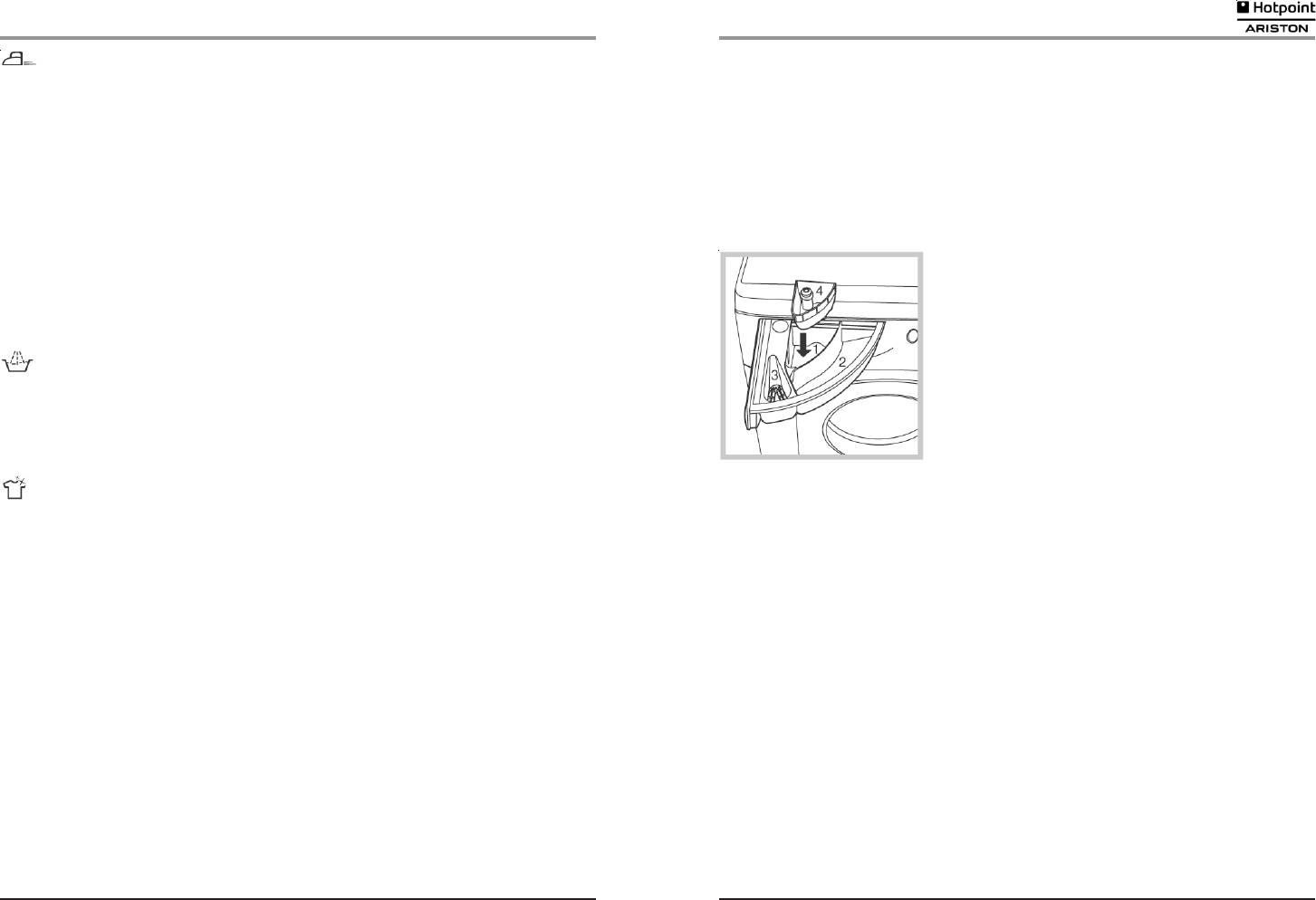
Ìîþùèå ñðåäñòâà è áåëüå
Ëåãêàÿ ãëàæêà
Ðàñïðåäåëèòåëü ìîþùèõ ñðåäñòâ
Ïðè âûáîðå ýòîé ôóíêöèè öèêëû ñòèðêè è îòæèìà áóäóò èçìåíåíû â öåëÿõ
Õîðîøèé ðåçóëüòàò ñòèðêè çàâèñèò òàêæå îò ïðàâèëüíîé äîçèðîâêè ìîþùåãî
ñíèæåíèÿ ñìèíàåìîñòè áåëüÿ. Â êîíöå öèêëà ñòèðàëüíàÿ ìàøèíà áóäåò ìåä-
ñðåäñòâà: åãî èçáûòîê íå ãàðàíòèðóåò áîëåå ýôôåêòèâíóþ ñòèðêó, íàïðîòèâ,
ëåííî âðàùàòü áàðàáàí, èíäèêàòîðû ôóíêöèè ËÅÃÊÀß ÃËÀÆÊÀ è ÏÓÑÊ/ÏÀÓ-
ìîæåò ïðèâåñòè ê îáðàçîâàíèþ íàëåòîâ âíóòðè ìàøèíû è çàãðÿçíåíèþ îêðó-
ÇÀ ñòàíóò ìèãàòü (îðàíæåâûì öâåòîì), èíäèêàòîð ýòàïà «END» («ÊÎÍÅÖ»)
æàþùåé ñðåäû.
îñòàíåòñÿ ãîðåòü, íå ìèãàÿ. Äëÿ çàâåðøåíèÿ ïðîãðàììû ñëåäóåò íàæàòü êíîï-
! Íå èñïîëüçóéòå ìîþùèå ñðåäñòâà, ïðåäíàçíà÷åííûå äëÿ ðó÷íîé ñòèðêè –
êó ÏÓÑÊ/ÏÀÓÇÀ èëè êíîïêó ËÅÃÊÀß ÃËÀÆÊÀ.
îíè èìåþò ñèëüíîå ïåíîîáðàçîâàíèå.
Äëÿ ïðîãðàììû «Øåëê» (10) ìàøèíà çàêîí÷èò öèêë ñ áåëüåì, çàìî÷åííûì
Îòêðîéòå ðàñïðåäåëèòåëü è äîáàâüòå ìîþùåå ñðåäñòâî èëè äîáàâêè ñëåäóþ-
â âîäå; èíäèêàòîðû ËÅÃÊÀß ÃËÀÆÊÀ è ÏÓÑÊ/ÏÀÓÇÀ áóäóò ìèãàòü (îðàíæå-
ùèì îáðàçîì:
âûì öâåòîì), à èíäèêàòîð ýòàïà ïîëîñêàíèÿ îñòàíåòñÿ ãîðåòü, íå ìèãàÿ. ×òî-
áû ñëèòü âîäó è âûíóòü áåëüå, íàæìèòå êíîïêó ÏÓÑÊ/ÏÀÓÇÀ èëè ËÅÃÊÀß
Îòäåëåíèå 1: ìîþùåå ñðåäñòâî äëÿ ïðåäâà-
ÃËÀÆÊÀ.
ðèòåëüíîé ñòèðêè (ïîðîøîê)
! Ýòà ôóíêöèÿ íå ìîæåò èñïîëüçîâàòüñÿ âìåñòå ñ ïðîãðàììàìè 4 , 5 , 6, 7, 8,
Ïåðåä äîáàâëåíèåì ìîþùåãî ñðåäñòâà óáåäè-
11, C, D, E.
òåñü, ÷òî äîïîëíèòåëüíîå îòäåëåíèå 4 íå óñòà-
íîâëåíî.
Îòäåëåíèå 2: ìîþùåå ñðåäñòâî äëÿ ñòèðêè
Äîïîëíèòåëüíîå ïîëîñêàíèå
(ïîðîøîê èëè æèäêîå)
Âûáîð ýòîé ôóíêöèè ïîçâîëÿåò ïîâûñèòü ýôôåêòèâíîñòü ïîëîñêàíèÿ è îáåñ-
Æèäêîå ñðåäñòâî äëÿ ñòèðêè çàëèâàåòñÿ íåïîñ-
ïå÷èòü îïòèìàëüíîå óäàëåíèå ìîþùåãî ñðåäñòâà. Ôóíêöèÿ îñîáåííî ïîëåç-
ðåäñòâåííî ïåðåä çàïóñêîì öèêëà ñòèðêè.
íà â ñëó÷àå ÷óâñòâèòåëüíîé êîæè.
! Ýòà ôóíêöèÿ íå ìîæåò èñïîëüçîâàòüñÿ âìåñòå ñ ïðîãðàììàìè 4, 5, C, D, E.
Îòäåëåíèå 3: Äîáàâêè (ñìÿã÷èòåëè, àðîìàòè-
çàòîðû è ïð.)
Íå çàïîëíÿéòå îòäåëåíèå 3 äëÿ îïîëàñêèâàòåëåé
Èíòåíñèâíàÿ ñòèðêà (Ñóïåðñòèðêà)
âûøå ðåøåòêè.
Ôóíêöèÿ ïîçâîëÿåò ïîëó÷èòü âûñîêîýôôåêòèâíóþ ñòèðêó áëàãîäàðÿ èñïîëü-
Äîïîëíèòåëüíîå îòäåëåíèå 4: îòáåëèâàòåëü.
çîâàíèþ áî’ëüøåãî êîëè÷åñòâà âîäû â íà÷àëüíîì ýòàïå ïðîãðàììû, à òàêæå
óâåëè÷åíèþ ïðîäîëæèòåëüíîñòè öèêëà.
Öèêë îòáåëèâàíèÿ
! Äàííàÿ ôóíêöèÿ íå ìîæåò èñïîëüçîâàòüñÿ âìåñòå ñ ïðîãðàììàìè 4, 5, 6, 10,
Îòáåëèâàíèå âîçìîæíî ïðîèçâîäèòü òîëüêî ñ ïðîãðàììàìè ñòèðêè 1, 2, 6.
11, À, B, C, D, E.
Íàëåéòå îòáåëèâàòåëü â äîïîëíèòåëüíîå îòäåëåíèå 4; äîáàâüòå ìîþùåå
ñðåäñòâî è ñìÿã÷èòåëü â ñîîòâåòñòâóþùèå îòäåëåíèÿ, çàòåì âûáåðèòå îäíó
èç óêàçàííûõ ïðîãðàìì.
Îïöèþ ðåêîìåíäóåòñÿ èñïîëüçîâàòü òîëüêî ïðè ñòèðêå ñèëüíî çàãðÿçíåííîãî
õëîï÷àòîáóìàæíîãî áåëüÿ.
Ïîäãîòîâêà áåëüÿ
• Ðàçáåðèòå áåëüå:
— â ñîîòâåòñòâèè ñ òèïîì òêàíè / îáîçíà÷åíèåì íà ýòèêåòêå;
— ïî öâåòó: îòäåëèòå öâåòíîå áåëüå îò áåëîãî.
• Âûíüòå âñå èç êàðìàíîâ è ïðîâåðüòå, õîðîøî ëè äåðæàòñÿ ïóãîâèöû.
• Íå ïðåâûøàéòå ìàêñèìàëüíûé âåñ çàãðóçêè áàðàáàíà, óêàçàííûé äëÿ ñó-
õîãî áåëüÿ:
AWM 129
AWM 129
18
1818
1818
1919
19
1919

Ïðåäóïðåæäåíèÿ è ðåêîìåíäàöèè
Ïðî÷íûå òêàíè: ìàêñ. 7 êã
! Ñòèðàëüíàÿ ìàøèíà ñïðîåêòèðîâàíà è èçãîòîâëåíà â ñîîòâåòñòâèè ñ ìåæäó-
Ñèíòåòè÷åñêèå òêàíè: ìàêñ. 3 êã
íàðîäíûìè íîðìàìè áåçîïàñíîñòè. Âíèìàòåëüíî ïðî÷èòàéòå íàñòîÿùèå ïðå-
Äåëèêàòíûå òêàíè: ìàêñ. 2 êã
äóïðåæäåíèÿ, ïðèâîäèìûå â öåëÿõ âàøåé áåçîïàñíîñòè.
Øåðñòü: ìàêñ. 1,5 êã
Îáùèå ïðàâèëà áåçîïàñíîñòè
Âåñ áåëüÿ
• Ýòî îáîðóäîâàíèå ïðåäíàçíà÷åíî äëÿ èñïîëüçîâàíèÿ òîëüêî â äîìàøíèõ
1 ïðîñòûíÿ 400 – 500 ã
óñëîâèÿõ.
1 íàâîëî÷êà 150–200 ã
• Ñòèðàëüíàÿ ìàøèíà äîëæíà èñïîëüçîâàòüñÿ òîëüêî âçðîñëûìè ëèöàìè è â
1 ñêàòåðòü 400 – 500 ã
ñîîòâåòñòâèè ñ èíñòðóêöèÿìè äàííîãî ðóêîâîäñòâà.
1 õàëàò 900 –1,200 ã
• Íå êàñàéòåñü ðàáîòàþùåé ìàøèíû, åñëè âàøè ðóêè èëè íîãè ìîêðûå; íå
1 ìàõðîâîå ïîëîòåíöå 150–250 ã
ïîëüçóéòåñü îáîðóäîâàíèåì, êîãäà Âû áîñèêîì.
• Íå òÿíèòå çà ïèòàþùèé êàáåëü, ÷òîáû âûíóòü âèëêó ìàøèíû èç ðîçåòêè:
Îñîáåííîñòè ñòèðêè îòäåëüíûõ èçäåëèé
áåðèòåñü çà âèëêó.
Ðóáàøêè: äëÿ ñòèðêè ðóáàøåê èç ðàçíûõ òêàíåé è ðàçëè÷íûõ öâåòîâ èñïîëü-
• Íå îòêðûâàéòå ðàñïðåäåëèòåëü ìîþùèõ ñðåäñòâ âî âðåìÿ ðàáîòû ìàøè-
çóéòå ñïåöèàëüíóþ ïðîãðàììó 9.
íû.
Ïðîãðàììà ãàðàíòèðóåò ìàêñèìàëüíûé óõîä è ñíèæåíèå ñìèíàåìîñòè äàí-
• Íå êàñàéòåñü ñëèâàåìîé âîäû, åå òåìïåðàòóðà ìîæåò áûòü î÷åíü âûñîêîé.
íûõ èçäåëèé â ïðîöåññå ñòèðêè.
• Íå ïûòàéòåñü ñ ñèëîé îòêðûòü äâåðöó ìàøèíû: ýòî ìîæåò ïîâðåäèòü ìåõà-
Øåëê: äëÿ ñòèðêè øåëêîâûõ èçäåëèé âûáåðèòå ñïåöèàëüíóþ ïðîãðàììó 10.
íèçì áëîêèðîâêè, ðàçðàáîòàííûé äëÿ ïðåäîòâðàùåíèÿ ñëó÷àéíîãî îòêðû-
Ðåêîìåíäóåòñÿ èñïîëüçîâàòü ìîþùåå ñðåäñòâî, ñïåöèàëüíî ïðåäíàçíà÷åí-
âàíèÿ äâåðöû.
íîå äëÿ ñòèðêè äåëèêàòíûõ òêàíåé.
•  ñëó÷àå íåèñïðàâíîñòè ïðè ëþáûõ îáñòîÿòåëüñòâàõ íå êàñàéòåñü âíóò-
Çàíàâåñêè: ñëîæèòå è ïîìåñòèòå â íàâîëî÷êó èëè â ñåò÷àòûé ìåøî÷åê. Èñ-
ðåííèõ ÷àñòåé ìàøèíû, ïûòàÿñü ïî÷èíèòü åå.
ïîëüçóéòå ïðîãðàììó 10.
Øåðñòü: Hotpoint / Ariston – åäèíñòâåííûé ïðîèçâîäèòåëü ñòèðàëüíûõ ìà-
• Ñëåäèòå, ÷òîáû äåòè íå ïðèáëèæàëèñü ê ðàáîòàþùåé ñòèðàëüíîé ìàøèíå.
øèí, ïîëó÷èâøèé îò Êîìïàíèè Woolmark ïðåñòèæíóþ ìàðêó Woolmark
• Äâåðöà ìàøèíû âî âðåìÿ ñòèðêè ìîæåò ñòàòü ãîðÿ÷åé – íå äîòðàãèâàéòåñü
Platinum Care (Ì.0508), ÷òî îçíà÷àåò âîçìîæíîñòü ìàøèííîé ñòèðêè âñåõ
äî íåå.
øåðñòÿíûõ èçäåëèé, â òîì ÷èñëå è ñ ýòèêåòêîé «Òîëüêî ðó÷íàÿ ñòèðêà»
.
• Åñëè íåîáõîäèìî ïåðåìåñòèòü ñòèðàëüíóþ ìàøèíó, âûïîëíÿéòå ýòó îïå-
Èñïîëüçóÿ ïðîãðàììó 11, ñ îïòèìàëüíûì ðåçóëüòàòîì Âû ìîæåòå ñòèðàòü
ðàöèþ âäâîåì èëè âòðîåì ñ ïðåäåëüíîé îñòîðîæíîñòüþ. Íèêîãäà íå ïû-
â ìàøèíå âñå øåðñòÿíûå èçäåëèÿ (ìàêñèìàëüíàÿ çàãðóçêà 1,5 êã).
òàéòåñü ïîäíÿòü ìàøèíó â îäèíî÷êó – îáîðóäîâàíèå ÷ðåçâû÷àéíî òÿæå-
ëîå.
Ñèñòåìà áàëàíñèðîâêè çàãðóçêè
• Ïðåæäå ÷åì çàãðóçèòü áåëüå, óáåäèòåñü, ÷òî áàðàáàí ïóñò.
Ïåðåä êàæäûì öèêëîì îòæèìà, ÷òîáû èçáåæàòü ÷ðåçìåðíîé âèáðàöèè è ðàâ-
Óòèëèçàöèÿ
íîìåðíî ðàñïðåäåëèòü çàãðóçêó, áàðàáàí íåïðåðûâíî âðàùàåòñÿ íà ñêîðîñ-
òè, êîòîðàÿ ñëåãêà âûøå ñêîðîñòè âðàùåíèÿ ïðè ñòèðêå. Åñëè ïîñëå íåñêîëü-
• Óíè÷òîæåíèå óïàêîâî÷íîãî ìàòåðèàëà: ñîáëþäàéòå äåéñòâóþùèå òðåáî-
êèõ ïîïûòîê áåëüå âñå åùå ðàñïðåäåëåíî íåðàâíîìåðíî, âðàùåíèÿ áàðàáà-
âàíèÿ ïî óòèëèçàöèè óïàêîâî÷íûõ ìàòåðèàëîâ.
íà áóäóò ïðîèñõîäèòü íà ñêîðîñòè, íèæå çàäàííîé.
• Óòèëèçàöèÿ ñòàðîé ñòèðàëüíîé ìàøèíû: ïåðåä ñäà÷åé ìàøèíû â óòèëü
Êîãäà çàãðóçêà ÷ðåçìåðíî íåñáàëàíñèðîâàíà, âìåñòî îòæèìà áàðàáàí áóäåò
îáðåæüòå ïèòàþùèé êàáåëü è ñíèìèòå äâåðöó.
âðàùàòüñÿ íà ñêîðîñòè, ïðåäóñìîòðåííîé äëÿ ðàñïðåäåëåíèÿ áåëüÿ.
Äëÿ äîñòèæåíèÿ ëó÷øåãî ðàñïðåäåëåíèÿ è ñáàëàíñèðîâàííîñòè çàãðóçêè ìû
Ñîãëàñíî Åâðîïåéñêîé äèðåêòèâå 2002/96/EC ïî óòèëèçàöèè ýëåêòðè÷åñêîãî
ðåêîìåíäóåì ñìåøèâàòü êðóïíûå è ìåëêèå âåùè.
è ýëåêòðîííîãî îáîðóäîâàíèÿ (WEEE) ñòàðûå ýëåêòðîáûòîâûå ïðèáîðû íå
äîëæíû ïîìåùàòüñÿ â îáùèé ãîðîäñêîé íåîòñîðòèðîâàííûé ïîòîê îòõîäîâ:
îíè äîëæíû ñîáèðàòüñÿ îòäåëüíî, ÷òîáû îïòèìèçèðîâàòü âîññòàíîâëåíèå è
ïåðåðàáîòêó èõ ìàòåðèàëîâ è óìåíüøèòü íåãàòèâíîå âîçäåéñòâèå íà çäîðî-
AWM 129
AWM 129
20
2020
2020
2121
21
2121
Îáñëóæèâàíèå è óõîä
âüå ÷åëîâåêà è ýêîëîãèþ. Óêàçàííûé íà èçäåëèè ñèìâîë ïåðå÷åðêíóòîãî âåä-
Îòêëþ÷åíèå âîäî- è ýëåêòðîñíàáæåíèÿ
ðà íà êîëåñàõ íàïîìèíàåò, ÷òî ïðè óòèëèçàöèè ýòî îáîðóäîâàíèå ñëåäóåò ïî-
• Ïåðåêðûâàéòå êðàí ïîäà÷è âîäû ïîñëå êàæäîé ñòèðêè. Ýòî ñîêðàòèò èçíîñ
ìåñòèòü îòäåëüíî.
ãèäðàâëè÷åñêîé ñèñòåìû ñòèðàëüíîé ìàøèíû è ïîìîæåò èçáåæàòü ïðîòå-
Äëÿ ïîëó÷åíèÿ èíôîðìàöèè ïî ïðàâèëüíîé óòèëèçàöèè ñòàðîãî îáîðóäîâà-
÷åê.
íèÿ ïîòðåáèòåëè äîëæíû îáðàòèòüñÿ â ìåñòíûå îðãàíû óïðàâëåíèÿ èëè â
ôèðìó-ïîñòàâùèê.
• Âñåãäà îòêëþ÷àéòå ìàøèíó îò ýëåêòðîñåòè ïåðåä åå ìîéêîé è îáñëóæèâà-
íèåì.
Êàê âðó÷íóþ îòêðûòü çàáëîêèðîâàííóþ äâåðöó
Åñëè â ðåçóëüòàòå ñáîÿ ýëåêòðîïèòàíèÿ íåâîçìîæíî îòêðûòü äâåðöó, ÷òîáû
Óõîä çà ñòèðàëüíîé ìàøèíîé
âûíóòü áåëüå, âûïîëíèòå ñëåäóþùåå:
Âíåøíèå è ðåçèíîâûå ÷àñòè ìàøèíû î÷èùàéòå ìÿãêîé òêàíüþ ñ òåïëîé
ìûëüíîé âîäîé. Íå èñïîëüçóéòå ðàñòâîðèòåëè èëè àáðàçèâíûå ÷èñòÿùèå
1. Âûíüòå âèëêó ìàøèíû èç ýëåêòðîðîçåòêè.
ñðåäñòâà.
2. Óáåäèòåñü, ÷òî óðîâåíü âîäû âíóòðè ìàøèíû íèæå äâåðíîãî ïðîåìà: åñëè
íåò, ñëåéòå âîäó ÷åðåç ñëèâíîé øëàíã â âåäðî.
Óõîä çà ðàñïðåäåëèòåëåì ìîþùèõ
ñðåäñòâ
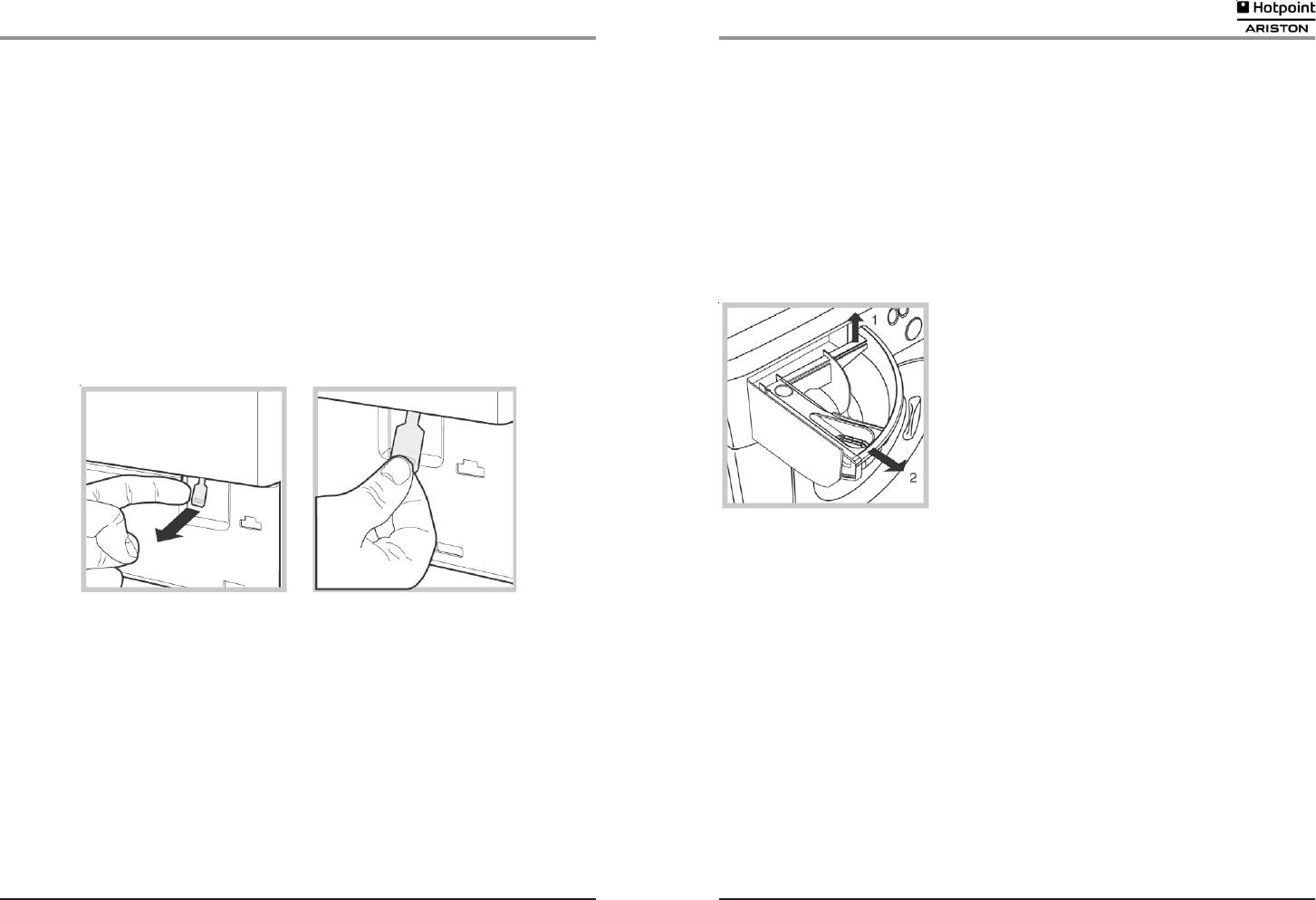
3. Îòòÿíèòå íà ñåáÿ ÿçû÷îê (ñì. ðèñ. íèæå), ÷òîáû ðàçáëîêèðîâàòü ïëàñòèêî-
âóþ ïëàñòèíêó, ïîòÿíèòå åå âíèç è îäíîâðåìåííî îòêðîéòå äâåðöó.
Ïåðèîäè÷åñêè ñëåäóåò ïðîìûâàòü ðàñïðåäåëè-
òåëü ìîþùèõ ñðåäñòâ.
Âûíüòå ðàñïðåäåëèòåëü, ïðèïîäíÿâ è ïîòÿíóâ
åãî íà ñåáÿ (ñì. ðèñ.), è ïðîìîéòå ïîä ñòðóåé
âîäû.
Óõîä çà äâåðöåé ìàøèíû è áàðàáàíîì
• Ïîñëå êàæäîé ñòèðêè îñòàâëÿéòå äâåðöó ìàøèíû ïîëóîòêðûòîé âî èçáåæà-
íèå îáðàçîâàíèÿ â áàðàáàíå íåïðèÿòíûõ çàïàõîâ.
×èñòêà íàñîñà
Ñòèðàëüíàÿ ìàøèíà îñíàùåíà ñàìîî÷èùàþùèìñÿ íàñîñîì, êîòîðûé íå òðå-
áóåò îñîáîãî îáñëóæèâàíèÿ. Îäíàêî ìåëêèå ïðåäìåòû (ìîíåòû èëè ïóãîâèöû)
ìîãóò âñå-òàêè ïîïàäàòü â «óëîâèòåëü» – ôèëüòð, ðàñïîëîæåííûé â íèæíåé
÷àñòè íàñîñà.
! Óáåäèòåñü, ÷òî öèêë ñòèðêè çàêîí÷èëñÿ, è îòêëþ÷èòå îáîðóäîâàíèå îò ñåòè.
AWM 129
AWM 129
22
2222
2222
2323
23
2323
Óñòðàíåíèå íåèñïðàâíîñòåé
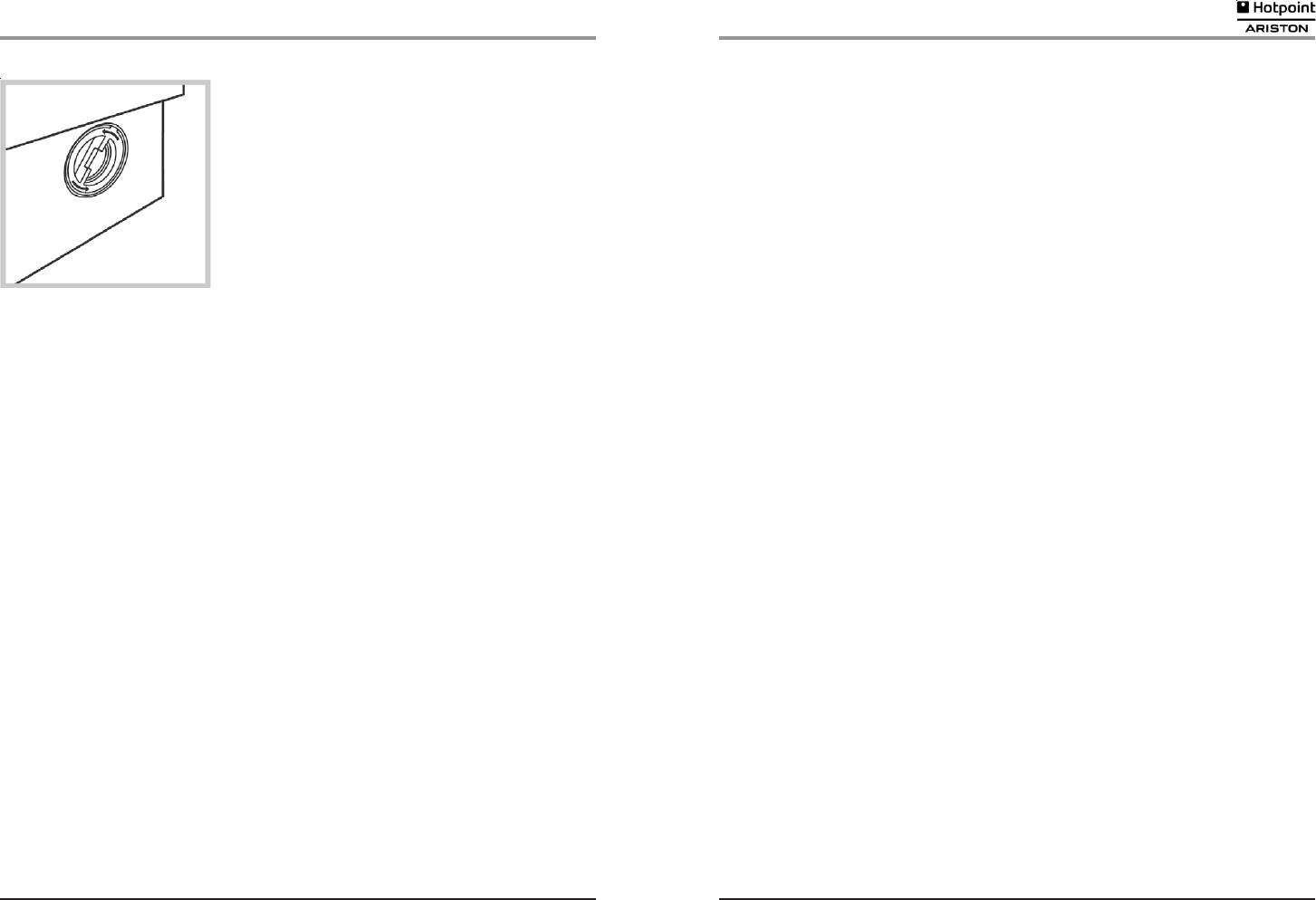
Äëÿ äîñòóïà ê ôèëüòðó:
Åñëè ñòèðàëüíàÿ ìàøèíà ðàáîòàåò íåóäîâëåòâîðèòåëüíî, ïðåæäå ÷åì îáðà-
òèòüñÿ â Àâòîðèçîâàííûé ñåðâèñíûé öåíòð (ñì. Ïîìîùü), ïðî÷èòàéòå ýòîò
1. âûâåðíèòå êðûøêó ôèëüòðà, âðàùàÿ åå ïðî-
ðàçäåë – âîçìîæíî çäåñü Âû íàéäåòå ðåøåíèå ïðîáëåìû.
òèâ ÷àñîâîé ñòðåëêè (ñì. ðèñ.): ìîæåò âûëèòüñÿ
íåìíîãî âîäû – ýòî âïîëíå íîðìàëüíî;
Ïðîáëåìà:
Âîçìîæíûå ïðè÷èíû / Ðåøåíèå:
Ñòèðàëüíàÿ ìàøèíà
• Ìàøèíà íå ïîäêëþ÷åíà ê ýëåêòðîñåòè
íå âêëþ÷àåòñÿ
èëè âèëêà âñòàâëåíà ïëîõî, íå îáåñïå-
÷èâàÿ êîíòàêòà.
• Ñáîé ýëåêòðîïèòàíèÿ
Öèêë ñòèðêè íå çàïóñêàåòñÿ
• Äâåðöà ìàøèíû ïëîõî çàêðûòà.
• Íå áûëà íàæàòà êíîïêà ÂÊË./ÂÛÊË..
2. òùàòåëüíî ïðî÷èñòèòå ôèëüòð èçíóòðè;
• Íå áûëà íàæàòà êíîïêà ÏÓÑÊ/ÏÀÓÇÀ.
3. çàâåðíèòå êðûøêó îáðàòíî.
• Çàêðûò êðàí ïîäà÷è âîäû.
Ïðîâåðêà çàëèâíîãî øëàíãà
• Áûëà óñòàíîâëåíà îòñðî÷êà çàïóñêà
ïðîãðàììû (ñì. Óñòàíîâêè ïîëüçîâà-
Ïðîâåðÿéòå øëàíã íå ðåæå îäíîãî ðàçà â ãîä.  ñëó÷àå ïîÿâëåíèÿ òðåùèí íà
òåëÿ).
øëàíãå åãî ñëåäóåò íåìåäëåííî çàìåíèòü: âî âðåìÿ ðàáîòû ìàøèíû ïîòðåñ-
êàâøèéñÿ øëàíã, íàõîäÿùèéñÿ ïîä ñèëüíûì äàâëåíèåì âîäû, ìîæåò ëåãêî
Ñòèðàëüíàÿ ìàøèíà
• Çàëèâíîé øëàíã íå ïîäñîåäèíåí ê êðà-
ëîïíóòü.
íå çàëèâàåò âîäó
íó.
(èíäèêàòîð ïåðâîãî ýòàïà
• Øëàíã ïåðåêðó÷åí.
! Íèêîãäà íå èñïîëüçóéòå øëàíãè, áûâøèå â óïîòðåáëåíèè.
ñòèðêè áûñòðî ìèãàåò)
• Çàêðûò êðàí ïîäà÷è âîäû.
• Îòêëþ÷åíà ïîäà÷à âîäû â äîìå.
• Íåäîñòàòî÷íîå äàâëåíèå âîäû.
• Íå áûëà íàæàòà êíîïêà ÏÓÑÊ/ÏÀÓÇÀ.
Ñòèðàëüíàÿ ìàøèíà
• Êîíåö ñëèâíîãî øëàíãà ðàñïîëîæåí
íåïðåðûâíî çàëèâàåò è
íèæå 65 èëè âûøå 100 ñì îò ïîëà (ñì.
Óñòàíîâêà).
ñëèâàåò âîäó
• Ñâîáîäíûé êîíåö ñëèâíîãî øëàíãà ïî-
ãðóæåí â âîäó (ñì. Óñòàíîâêà).
• Íàñòåííûé ñëèâ íå èìååò ðåñïèðàòîð-
íîé òðóáêè.
Åñëè ïîñëå ïðîèçâåäåííûõ ïðîâåðîê, ïðîáëåìû îñòàþòñÿ, ïåðåêðîéòå êðàí
ïîäà÷è âîäû, âûêëþ÷èòå îáîðóäîâàíèå è îáðàòèòåñü â ñåðâèñíûé öåíòð.
Åñëè ñëèâíîé øëàíã âñòðîåí â êàíàëèçàöèþ, èìåéòå ââèäó, ÷òî íà âåðõíèõ
ýòàæàõ ìîæåò ñîçäàâàòüñÿ «ñèôîííûé ýôôåêò» – ìàøèíà îäíîâðåìåííî
ñëèâàåò è çàëèâàåò âîäó. Äëÿ ïðåäîòâðàùåíèÿ ïîäîáíîãî ýôôåêòà óñòàíàâ-
ëèâàåòñÿ ñïåöèàëüíûé êëàïàí (àíòèñèôîí).
AWM 129
AWM 129
24
2424
2424
2525
25
2525
Ïîìîùü
Ñòèðàëüíàÿ ìàøèíà
• Âûáðàííàÿ ïðîãðàììà íå ïðåäóñìàòðè-
Ïåðåä òåì, êàê îáðàòèòüñÿ â Àâòîðèçîâàííûé ñåðâèñíûé öåíòð:
íå ïðîèçâîäèò ñëèâ èëè
âàåò ñëèâ âîäû – äëÿ íåêîòîðûõ ïðî-
• Óáåäèòåñü, ÷òî Âû íå ìîæåòå óñòðàíèòü íåèñïðàâíîñòü ñàìîñòîÿòåëüíî
ãðàìì íåîáõîäèìî âêëþ÷èòü ñëèâ âðó÷-
îòæèì
(ñì. Óñòðàíåíèå íåèñïðàâíîñòåé).
íóþ.
• Çàïóñòèòå ïðîãðàììó ïîâòîðíî, ÷òîáû ïðîâåðèòü, óñòðàíåíà ëè ïðîáëåìà.
• Âêëþ÷åíà äîïîëíèòåëüíàÿ ôóíêöèÿ
«Ëåãêàÿ ãëàæêà»: äëÿ çàâåðøåíèÿ ïðî-
•  ïðîòèâíîì ñëó÷àå îáðàòèòåñü â Àâòîðèçîâàííûé ñåðâèñíûé öåíòð ïî òå-
ãðàììû íàæìèòå êíîïêó ÏÓÑÊ/ÏÀÓÇÀ
ëåôîíó, óêàçàííîìó â ãàðàíòèéíîì äîêóìåíòå.
(ñì. Óñòàíîâêè ïîëüçîâàòåëÿ).
! Íå ïîëüçóéòåñü óñëóãàìè ëèö, íå óïîëíîìî÷åííûõ Ïðîèçâîäèòåëåì.
• Ïåðåêðó÷åí ñëèâíîé øëàíã (ñì. Óñòà-
Ïðè ðåìîíòå òðåáóéòå èñïîëüçîâàíèÿ îðèãèíàëüíûõ çàïàñíûõ ÷àñòåé.
íîâêà).
• Çàñîð â êàíàëèçàöèè.
Ïðè îáðàùåíèè â Àâòîðèçîâàííûé ñåðâèñíûé öåíòð ñîîáùèòå:
Ñèëüíàÿ âèáðàöèÿ
• Ïðè óñòàíîâêå ñòèðàëüíîé ìàøèíû áûë
ïðè îòæèìå
íåïðàâèëüíî ðàçáëîêèðîâàí áàðàáàí
• òèï íåèñïðàâíîñòè;
(ñì. Óñòàíîâêà).
• íîìåð ãàðàíòèéíîãî äîêóìåíòà (ñåðâèñíîé êíèæêè, ñåðâèñíîãî ñåðòèôèêà-
• Ñòèðàëüíàÿ ìàøèíà ïëîõî âûðîâíåíà
òà è ò.ï.);
(ñì. Óñòàíîâêà).
• ìîäåëü ìàøèíû (Ìîä.) è ñåðèéíûé íîìåð (S/N), ýòà èíôîðìàöèÿ óêàçàíà
• Íåäîñòàòî÷åí çàçîð ìåæäó ìàøèíîé è
â òàáëè÷êå òåõíè÷åñêèõ äàííûõ, ðàñïîëîæåííîé íà çàäíåé ïàíåëè ñòè-
ñòåíîé/ìåáåëüþ (ñì. Óñòàíîâêà).
ðàëüíîé ìàøèíû, òàêæå èíôîðìàöèþ ìîæíî ïîñìîòðåòü ñ ïåðåäíåé ñòî-
ðîíû ìàøèíû, îòêðûâ äâåðöó.
Ïðîòå÷êè âîäû
• Ïëîõî çàêðåïëåí çàëèâíîé øëàíã
(ñì. Óñòàíîâêà).
èç ñòèðàëüíîé ìàøèíû
• Ðàñïðåäåëèòåëü çàáèò îñòàòêàìè ìîþ-
ùèõ ñðåäñòâ (î ÷èñòêå ðàñïðåäåëèòåëÿ
(ñì. Îáñëóæèâàíèå è óõîä).
• Ïëîõî çàêðåïëåí ñëèâíîé øëàíã
(ñì. Óñòàíîâêà).
Îäíîâðåìåííî áûñòðî
• Âûêëþ÷èòå ìàøèíó è îòêëþ÷èòå åå îò
ìèãàþò èíäèêàòîð ÏÓÑÊ/
ýëåêòðîñåòè; ïîäîæäèòå ïðèìåðíî
ÏÀÓÇÀ (îðàíæåâûì öâåòîì) è
1 ìèíóòó, çàòåì ñíîâà âêëþ÷èòå ìàøè-
èíäèêàòîðû ôóíêöèé
íó. Åñëè ïðîáëåìà îñòàëàñü, îáðàòè-
Ñðîê ñëóæáû 10 ëåò
òåñü â ñåðâèñíûé öåíòð çà ïîìîùüþ.
Èçáûòî÷íîå
• Èñïîëüçóåòñÿ ìîþùåå ñðåäñòâî, íå-
ïåíîîáðàçîâàíèå
ïîäõîäÿùåå äëÿ ìàøèííîé ñòèðêè (íà
óïàêîâêå ñðåäñòâà äîëæíî áûòü óêàçà-
Ïðîèçâîäèòåëü îñòàâëÿåò çà ñîáîé ïðàâî
íî «äëÿ ñòèðàëüíûõ ìàøèí» èëè «ðó÷-
áåç ïðåäóïðåæäåíèÿ âíîñèòü èçìåíåíèÿ â êîíñòðóêöèþ è êîìïëåêòàöèþ,
íàÿ è ìàøèííàÿ ñòèðêà» è ò.ï.).
íå óõóäøàþùèå ýôôåêòèâíîñòü ðàáîòû îáîðóäîâàíèÿ.
• Ïåðåäîçèðîâêà ìîþùåãî ñðåäñòâà.
Íåêîòîðûå ïàðàìåòðû, ïðèâåäåííûå â ýòîé èíñòðóêöèè,
ÿâëÿþòñÿ ïðèáëèçèòåëüíûìè. Ïðîèçâîäèòåëü íå íåñåò îòâåòñòâåííîñòè
çà íåçíà÷èòåëüíûå îòêëîíåíèÿ îò óêàçàííûõ âåëè÷èí.
AWM 129
AWM 129
2626
2626
26
2727
27
2727
Êîìïàíèÿ Indesit Company S.p.A.,
Ñåðèÿ âêëþ÷àåò â ñåáÿ ïîëíûé ñïåêòð ñðåäñòâ ïî óõîäó çà:
ïðîèçâîäèòåëü áûòîâîé òåõíèêè òîðãîâûõ ìàðîê
• Ñðåäñòâî äëÿ î÷èñòêè è äåçèíôåêöèè, 250 ìë 089779
Ïîñóäîìîå÷íîé
• Îïîëàñêèâàòåëü, 250 ìë 082064
Ariston, Hotpoint-Ariston, Indesit, Stinol,
ìàøèíîé
• Ñîëü â òàáëåòêàõ, 2 êã 082057
íàñòîÿòåëüíî ðåêîìåíäóåò èñïîëüçîâàòü
• Äåçîäîðàíò, 2 øò. 082072
äëÿ óõîäà çà Âàøåé áûòîâîé òåõíèêîé
Ñòèðàëüíîé è
ïîñóäîìîå÷íîé
• Ñðåäñòâî äëÿ óäàëåíèÿ íàêèïè, 10 ïàê.* 50 ã 089780
ñðåäñòâà è àêñåññóàðû ïðîôåññèîíàëüíîé ñåðèè
ìàøèíîé
«Çàáîòà î äîìå»
• Ñðåäñòâî ïî óõîäó çà êîíôîðêàìè è ðåøåòêàìè, 250 ìë 082037
Ïëèòîé
• Ñðåäñòâî ïî óõîäó çà ñòåêëîêåðàìè÷. ïîâåðõíîñòüþ, 500 ìë 089782
• Ñðåäñòâî ïî óõîäó çà äóõîâêîé, 500 ìë 089772
• Ñðåäñòâî ïî óõîäó çà õîëîäèëüíèêîì, 500 ìë 089777
Хîëîäèëüíèêîì
• Ïîãëîòèòåëü çàïàõîâ 082073
Ìèêðîâîëíîâîé
• Ñðåäñòâî ïî óõîäó çà ìèêðîâîëíîâîé ïå÷üþ, 500 ìë 089781
ïå÷üþ
ËÜÍÛÕËÜÍÛÕ
ËÜÍÛÕËÜÍÛÕ
ËÜÍÛÕ
• Ñðåäñòâî ïî óõîäó çà êàñòðþëÿìè è ñêîâîðîäàìè, 250 ìë 082042
• Ñðåäñòâî ïî óõîäó çà íåðæàâåþùåé ñòàëüþ, 250 ìë 089778
• Ïîëèðîëü äëÿ íåðæàâåþùåé ñòàëè, 500 ìë 093902
• Ñðåäñòâî ïî óõîäó çà äåðåâÿííûìè ïîâåðõíîñòÿìè 082081
ÄËß ÄÎÌÀ
• Ñðåäñòâî ïî óõîäó çà àëþìèíèåì è ïëàñòèêîì 082083
• Ñðåäñòâî ïî óõîäó çà öâåòíûìè ìåòàëëàìè è ñïëàâàìè 082063
• Ñðåäñòâî ïî óõîäó çà ñòåêëàìè è çåðêàëàìè 082068
• Çàùèòà òêàíè îò ïÿòåí 082069
• Ìèêðîôèáðîâàÿ ñàëôåòêà 094893
ÑÅÐÈßÑÅÐÈß
ÑÅÐÈßÑÅÐÈß
ÑÅÐÈß
ÏÐÎÔÅÑÑÈÎÍÀÏÐÎÔÅÑÑÈÎÍÀ
ÏÐÎÔÅÑÑÈÎÍÀÏÐÎÔÅÑÑÈÎÍÀ
ÏÐÎÔÅÑÑÈÎÍÀ
ÀÊÑÅÑÑÓÀÐÎÂÀÊÑÅÑÑÓÀÐÎÂ
ÀÊÑÅÑÑÓÀÐÎÂÀÊÑÅÑÑÓÀÐÎÂ
ÀÊÑÅÑÑÓÀÐÎÂ
• Ñêðåáîê äëÿ î÷èñòêè ñòåêëîêåðàìè÷åñêîé ïîâåðõíîñòè 136366
• Äîïîëíèòåëüíûå ðåøåòêè è ïðîòèâíè äëÿ äóõîâêè
• Ñòåêëÿííûå êðûøêè äëÿ ðàáî÷èõ ïîâåðõíîñòåé
ÀÊÑÅÑÑÓÀÐÛ
• Ãðèëè è áàðáåêþ äëÿ ðàáî÷èõ ïîâåðõíîñòåé
ÄËß ÒÅХÍÈÊÈ
• Ñàìîî÷èùàþùèåñÿ ïàíåëè äëÿ äóõîâêè
• Óñòðîéñòâî ïðèíóäèòåëüíîé âåíòèëÿöèè äëÿ îõëàæäåíèÿ
âíåøíèõ ïîâåðõíîñòåé äóõîâêè
• Çàùèòíûé ýêðàí äëÿ ðàáî÷åé ïîâåðõíîñòè
Хîëîäèëüíèê:
• Äîïîëíèòåëüíûå êîíòåéíåðû äëÿ õðàíåíèÿ ïðîäóêòîâ
Ñòèðàëüíàÿ è
Ôèðìåííûå ñðåäñòâà ïî óõîäó çà áûòîâîé òåõíèêîé îò ïðîèçâîäèòåëÿ
ïîñóäîìîå÷íàÿ
•
Ìàãíèòíûé ñìÿã÷èòåëü âîäû Calblock
089789
ìàøèíû, âîäî-
Âû ìîæåòå îçíàêîìèòüñÿ ñ ïîëíûì êàòàëîãîì ñåðèè ïðîôåññèîíàëüíûõ àêññå-
íàãðåâàòåëè
ñóàðîâ è ñðåäñòâ «Çàáîòà î äîìå» è ïîëó÷èòü èíôîðìàöèþ â Àâòîðèçîâàííûõ
• Ñëèâíûå è çàëèâíûå øëàíãè
Ñòèðàëüíàÿ è
ñåðâèñíûõ öåíòðàõ (àäðåñà è òåëåôîíû óêàçàíû â ãàðàíòèéíîì äîêóìåíòå);
• Óñòàíîâî÷íûå êîìïëåêòû
ïîñóäîìîå÷íàÿ
ìàøèíû
• Àíòèñèôîíû
íà ñàéòå www.ariston.ru
• Ôèëüòðû
ïî òåëåôîíàì Ñïðàâî÷íîé ñëóæáû êîìïàíèè Indesit Company S.p.A.:
• Óíèâåðñàëüíûå ôèëüòðû èç ïîëèýñòåðà ñ èíäèêàòîðîì
â Ìîñêâå: (495) 974-62-80
Âûòÿæêà:
çàïîëíåíèÿ
â Ñàíêò-Ïåòåðáóðãå: (812) 118-80-55
• Óãîëüíûå ôèëüòðû
â Êèåâå: (044) 494-36-10
ÀÊÑÅÑÑÓÀÐÛ
• Íàïðàâëÿþùèå, êðþ÷êè è ïîëêè èç íåðæàâåþùåé ñòàëè
ÄËß ÊÓХÍÈ
â Åêàòåðèíáóðãå: (343) 376-15-22
• Ñåðâèðîâî÷íûé ñòîëèê
AWM 129
2828
2828
28
Ðóêîâîäñòâî ïî óñòàíîâêå è ýêñïëóàòàöèè
RUS
Ï
ÏÏ
ÏÏ
ÐÎÄÓÊÖÈßÐÎÄÓÊÖÈß
ÐÎÄÓÊÖÈßÐÎÄÓÊÖÈß
ÐÎÄÓÊÖÈß
ÑÅÐÑÅÐ
ÑÅÐÑÅÐ
ÑÅÐ
ÒÈÔÈÖÈÐÎÂÀÍÀÒÈÔÈÖÈÐÎÂÀÍÀ
ÒÈÔÈÖÈÐÎÂÀÍÀÒÈÔÈÖÈÐÎÂÀÍÀ
ÒÈÔÈÖÈÐÎÂÀÍÀ
òèðàëüíàÿ
Ñ
ìàøèíà
AWM 129
Ïðîèçâîäèòåëü:
Àäðåñ è òåëåôîíû
äëÿ êîíòàêòîâ:
Indesit Company S.p.A.
Þðèäè÷åñêèé àäðåñ:
Ðîññèÿ 129223 Ìîñêâà
Âèàëå À.Ìåðëîíè, 47
Ïðîñïåêò Ìèðà, ÂÂÖ (áûâø. ÂÄÍÕ)
60044 Ôàáðèàíî (ÀÍ), Èòàëèÿ
Ïàâèëüîí 46
Òåë. (0732) 6611
Òåë.: (495) 974-6280
Ïðîäàâåö:
Ôàêñ (495) 961-2919
974-6279
Indesit Company International
Business S.A.
http://www.ariston.ru
Þðèäè÷åñêèé àäðåñ:
00168 WI.BI.HA.40
Öåíòð Ãàëëåðåÿ, 2, Âèà Êàíòîíàëå,
6928 Ìàííî, Øâåéöàðèÿ
Аннотации для Стиральной Машиной Hotpoint-Ariston AWM 129 в формате PDF
Топ 10 инструкций
Другие инструкции
Оформить вызов мастера можно двумя способами: по телефонам
+7 (495) 215 – 14 – 41
+7 (903) 722 – 17 – 03
или через специальную заявку на сайте. В обоих случаях сообщите, пожалуйста:
- Какая марка и модель у вашей стиральной машины.
- Признаки поломки. Например, машинка не сливает воду или не отжимает белье.
- Удобное для вас время приезда мастера.
- Ваши контактные данные: имя, адрес, телефон для связи.
Мастер в день ремонта позвонит по указанному вами номеру для подтверждения вызова.
Необходим срочный ремонт стиральной машины Hotpoint-Ariston BS 1400? К вашим услугам сервисный центр «РемБытТех». Наши мастера знают все об устройстве стиралок данной марки и уже в течение суток после вызова отремонтируют вашу неисправную машинку. Вы снова получите полноценно работающий агрегат и гарантию на ремонт до 2-х лет.

AWM 129
Pračka
Návod k inštalácii a použitiu

AWM 129
Pračka
Návod k inštalácii a použitiu
Vážený zákazník,
ďakujeme Vám, že ste si zakúpil výrobok spoločnosti Indesit
Company, SpA.
Pri výbere spotrebiča starostlivo zvážte, aké činnosti a funkcie od
spotrebiča požadujete. To, že výrobok nevyhovuje Vaším neskorším
nárokom, nemôže byť dôvodom k reklamácii. Pred prvým
použitím si pozorne prečítajte priložený slovenský návod, ktorý
dodáva firma Indesit Company, SpA., ku svojím dovážaným
spotrebičom a dôsledne sa ním riaďte. Všetky spotrebiče slúžia pre
domáce použitie. Pre profesionálne použitie sú určené spotrebiče
špecializovaných výrobcov. Všetky doklady o kúpe a eventuálnych
opravách Vášho spotrebiča starostlivo uschovajte pre poskytnutie
maximálne kvalitného záručného i pozáručného servisu.
Dodržovanie týchto zásad, povedie k Vašej spokojnosti. V prípade
ich nerešpektovania však nemôžeme uznať prípadnú reklamáciu.
Odporúčame Vám po dobu záručnej lehoty uchovať pôvodné obaly
ku spotrebiču.
Než budete kontaktovať servisné stredisko, starostlivo preštudujte
návod na obsluhu a záručné podmienky uvedené v záručnom liste.
Pokiaľ bude pri oprave zistené, že porucha nespadá do záruky,
uhradí vzniknuté náklady zákazník.
Vážený zákazník, návod ktorý ste obdŕžal k vášmu spotrebiču,
vychádza z všeobecného návodu pre celú výrobkovú radu. Z tohto
dôvodu môže dôjsť k situácii, že niektoré funkcie, ovládacie
prvky a príslušenstvo nie sú určené pre Váš spotrebič. Ďakujeme za
pochopenie.
Aby bola zaistená riadna účinnosť a bezpečnosť tohto spotrebiča,
odporúčame Vám:
• kontaktovať servisné stredisko, ktoré je autorizované
výrobcom.
• vždy používať originálne náhradné diely.

Návod na použitie
PRAČKA
SK
PWE 81472S
Obsah
Inštalácia, 4 — 5 — 6 — 7
Rozbalenie a vyrovnanie
Pripojenie k zdroju elektriny a vody
Prvý prací cyklus
Technické údaje
Pokyny pre montážnika
Popis pračky a zahájenie prania, 8 — 9
Ovládací panel
Indikátory
Zahájenie programu prania
Programy prania, 10
Tabuľka programov
Užívateľské nastavenie, 11
Nastavenie teploty
Nastavenie rýchlosti odstreďovania
Funkcie
Pracie prostriedky a bielizeň, 12
Zásuvka na pracie prostriedky
Cyklus bielenia
Príprava bielizne
Bielizeň vyžadujúca špeciálnu starostlivosť
Systém vyváženia bielizne
Bezpečnostné opatrenia a rady, 13
Všeobecné bezpečnostné upozornenia
Recyklácia a likvidácia pračky
Manuálne otváranie dvierok
Starostlivosť a údržba, 14
Odpojenie dodávky vody a elektriny
Čistenie práčky
Čistenie zásuvky na pracie prostriedky
Starostlivosť o dvierka a bubon pračky
Čistenie vypúšťacieho čerpadla
Kontrola prívodnej hadice vody
Poruchy a spôsob ich odstraňovania, 15
Servisná služba, 16

Inštalácia
! Uschovajte tento návod na použitie na bezpečné
miesto pre prípad budúcej potreby. V prípade, že
budete pračku predávať, prepravovať alebo
sťahovať, uistite sa, že je návod na požitie spolu so
spotrebičom, aby sa nový majiteľ mohol oboznámiť
s vlastnosťami a funkciami spotrebiča.
! Čítajte nasledujúce inštrukcie pozorne: obsahujú
dôležité informácie spojené s bezpečnou
inštaláciou a funkčnosťou spotrebiča.
Rozbalenie a vyrovnanie do vodorovnej
polohy
Rozbalenie
1. Vyberte pračku z obalu.
2. Presvedčte sa, že pračka nie je poškodená v
dôsledku prepravy. Ak by bola poškodená,
kontaktujte predajcu a nepokračujte v inštalácii.
3. Odstráňte 4 ochranné
skrutky (použité počas
prepravy) a gumové
tesnenia so súhlasnými
vložkami na zadnej strane
spotrebiča (viď obrázok).
4. Uzavrite otvory použitím priložených plastových
krytov.
5. Uložte všetky časti na bezpečné miesto: budete
ich opäť potrebovať v prípade sťahovania pračky
na iné miesto.
! Baliaci materiál a obaly neslúžia ako hračka pre
deti !
Vyváženie
1. Umiestnite pračku na rovnú stabilnú podlahu tak,
aby sa nedotýkala stien, nábytku ani ničoho iného.
2. Ak nie je podlaha úplne
rovná, vyrovnajte
akúkoľvek nerovnosť
zatiahnutím alebo
povolením nastaviteľných
predných nožičiek (viď
obrázok); uhol naklonenia
voči hornej ploche pračky
nesmie presahovať 2°.
Správne vyváženie pračky zaručuje stabilitu,
zabraňuje vibráciám a nadmernému hluku a chráni
pred posúvaním počas prania. Ak je spotrebič
umiestnený na koberci alebo rohožke, nastavte
nožičky tak, aby bol zabezpečený dostatočný
priestor na vetranie pod pračkou.
Pripojenie k zdroju elektriny a vody
Pripojenie prívodovej hadice vody
1. Na koniec prívodnej
hadice nasaďte tesnenie
A druhý koniec prívodnej
hadice priskrutkujte ku
kohútiku so studenou
vodou použitím ¾ hrdla so
závitom (viď obrázok).
Pred pripojením nechajte
odtiecť vodu, kým
nepotečie úplne čistá
voda.
2. Druhý koniec prívodnej
hadice pripojte k pračke
priskrutkovaním do
zodpovedajúceho prívodu
studenej vody na pračke,
ktorý je umiestnený v
pravom hornom rohu na
zadnej strane pračky (viď
obrázok).
3. Uistite sa, že hadica nie je prehnutá alebo
zalomená.
!
Tlak v rozvode vody sa musí pohybovať
v rozmedzí hodnôt uvedených v tabuľke s
technickými údajmi (viď nasledujúca strana).
!
Ak nie je prívodová hadica dostatočne dlhá,
kontaktujte špecializovanú predajňu alebo
autorizovaného technika !
!
Nikdy nepoužívajte už použité hadice.
!
Používajte hadice dodané so spotrebičom.
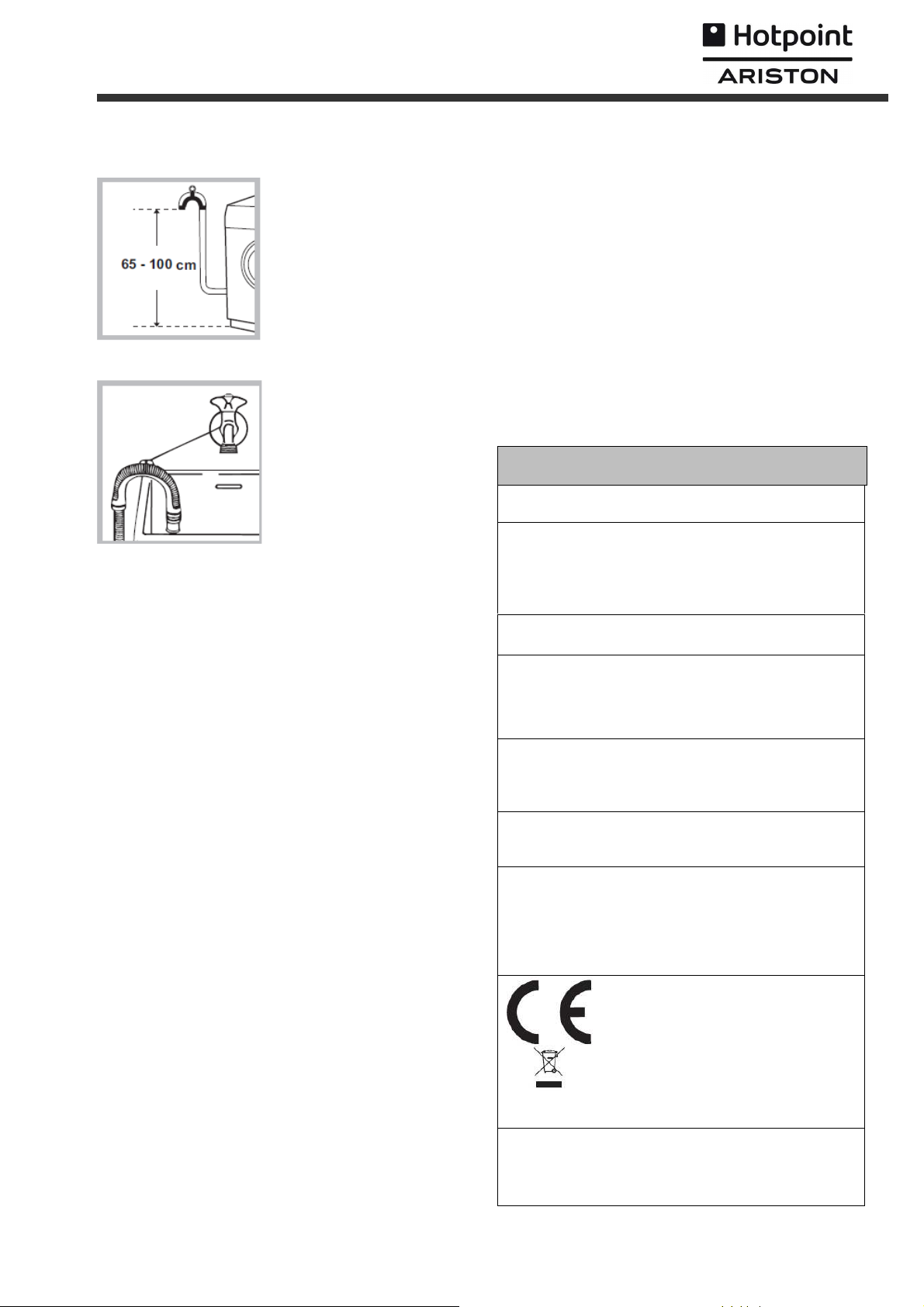
min. tlak 0,05 MPa (0,5 baru);
Pripojenie vypúšťacej hadice
Pripojte odtokovú hadicu
bez toho, aby ste ju zohli,
k odpadovému potrubiu
alebo k odpadu v stene
umiestnenému 65 – 100
cm od podlahy.
Prípade ju umiestnite na
umývadlo, drez alebo
vaňu, pripevnením
hadice ku kohútiku (viď
obrázok). Voľný koniec
hadice by nemal byť pod
vodou.
!
Použitie predlžovacích hadíc sa neodporúča; ak
je však nevyhnutné, predlžovacia hadica musí mať
rovnaký priemer ako originálna hadica a nesmie
presahovať dĺžku 150 cm.
Elektrické pripojenie
Pred pripojením spotrebiča do elektrickej zástrčky
sa uistite, že:
• Zástrčka je uzemnená a spĺňa všetky platné
zákony a normy;
• Zástrčka umožňuje zabezpečenie
maximálneho výkonu spotrebiča podľa
technických údajov uvedených v tabuľke
technických údajov (viď. tabuľka napravo);
• Dodávka prúdu spadá do hodnôt uvedených
v tabuľke s technickými údajmi údajov (viď.
tabuľka napravo);
• Zásuvka je kompatibilná so zástrčkou na
pračke. V prípade, že spolu nesúhlasia,
požiadajte technika autorizovaného servisu o
výmenu zástrčky.
!
Pračka nesmie byť pripojená vonku, aj keby bola
v krytom priestore! Nechávať spotrebič vystavený
dažďu, búrke alebo iným poveternostným
podmienkam je veľmi nebezpečné !
!
Po definitívnom pripojení pračky musí byť
zásuvka ľahko prístupná !
!
Nepoužívajte predlžovacie káble alebo rozvodky.
!
Kábel nesmie byť zohnutý ani stlačený.
!
Prívodový kábel smie vymeniť len autorizovaný
technik !
Upozornenie!
Spoločnosť Indesit nie je
zodpovedná za škodu vzniknutú v prípade
nedodržania uvedených štandardov !
Prvý prací cyklus
Po pripojení pračky a pred prvým praním bielizne,
zapnite prací cyklus s pracím prostriedkom bez
vloženia bielizne, zvolením pracieho cyklu
1.
Technické údaje
Model
Rozmery
Kapacita
Elektrické
pripojenie
Pripojenie vody
Rýchlosť
odstreďovania
Energetická
testovacieho
programu
EN 60456:
Hlučnosť
Pranie
Odstreďovanie
AWM 129
šírka 59,5 cm
výška 81,5 cm
hĺbka 54 cm
1 – 7 kg bielizne
viď. technické údaje na
typovom štítku umiestnenom
na pračke.
max. tlak 1 MPa (10 b
objem bubna 52 litrov
do 1200 otáčok za minútu
Program 6, teplota 60°C,
hmotnosť bielizne 7 kg.
Tento spotrebič odpovedá
nasledujúcim smerniciam ES:
89/336/CEE z 03/06/89
(elektromagnetická
kompatibilita) a následným
zmenám
— 2006/95/EC (nízke napätie)
— 2002/96/EC
66 dB(A)
76 dB(A)
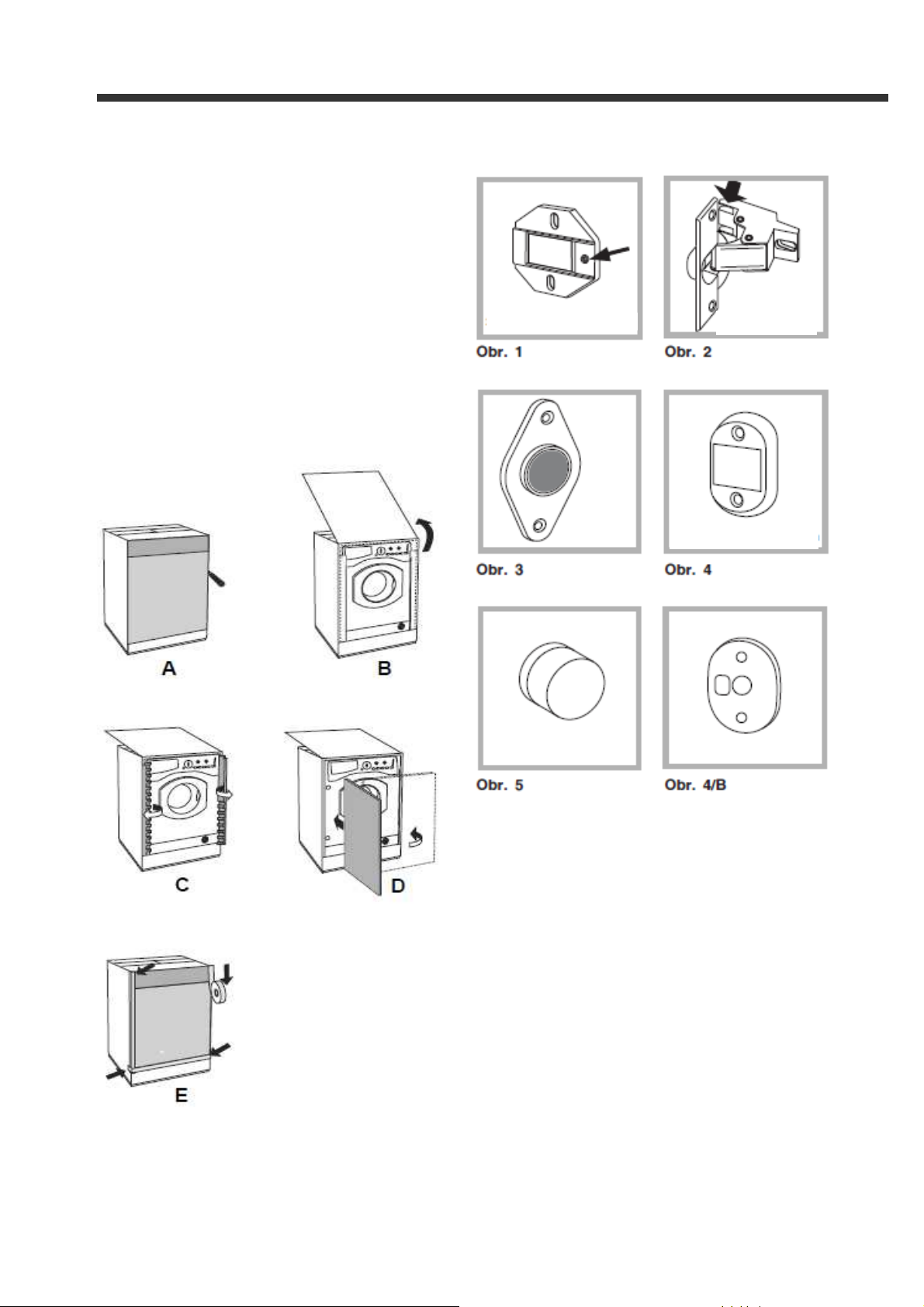
Pokyny pre montéra
Pripevnenie drevenej dosky k dvierkam pračky
a vloženie pračky do vstavanej skrinky.
V prípade, keď je nutné pračku dodať pre konečnú
inštaláciu s už pripevnenou drevenou doskou,
odporúčame ponechať pračku v pôvodnom obale.
Obal pračky bol vytvorený tak, aby bolo možné
k dvierkam pračky pripevniť drevenou dosku, ani by
ste pračku museli úplne vybaliť (viď ilustrácie
nižšie). Drevený panel, ktorý pokrýva prednú časť
pračky, musí byť aspoň 18 mm hrubý a môže byť
zavesený jak vpravo, tak vľavo. V záujmu
praktickosti v priebehu obsluhy pračky odporúčame
drevený panel zavesiť na rovnakú stranu ako
dvierka pračky – vľavo.
Príslušenstvo pre pripevnenie dvierok (Obr. 1-23-4-5).
— 6× závitové skrutky typu A, d = 13 mm
— 2× metrické, zápustné skrutky typu B, d = 25; pre
pripojenie magnetickej podložky ku skrinke.
— 4× typ C metrické skrutky, d = 15 mm; pre
upevnenie podpery závesu dverí ku skrinke.
— 4× typ D metrické skrutky, d = 7 mm, pre
upevnenie závesov k podperám.
Pripevnenie dielov na predný panel pračky
— Pripevníte podpery závesov dverí na predný panel
pračky, pričom otvor umiestnite v polohe
znázornenej šípkou na obr. č. 1, smerom dovnútra
predného panelu pračky.
Podpery upevnite pomocou skrutiek typu C.
— Na opačnú stranu pračky na hornú časť pripevníte
magnetickú doštičku pomocou dvoch skrutiek typu
B.
— Rozperku znázornenú na obr. 4/B umiestnite
medzi predný panel pračky a magnetickú doštičku.
Loading…
1
I
Italiano,1
Sommario
Installazione, 2-3-4-5
Disimballo e livellamento
Collegamenti idraulici ed elettrici
Primo ciclo di lavaggio
Dati tecnici
Istruzioni per l’installatore
Descrizione della lavabiancheria e
avviare un programma, 6-7
Pannello di controllo
Spie
Avviare un programma
Programmi, 8
Tabella dei programmi
Personalizzazioni, 9
Impostare la temperatura
Impostare la centrifuga
Funzioni
Detersivi e biancheria, 10
Cassetto dei detersivi
Ciclo candeggio
Preparare la biancheria
Capi particolari
Sistema bilanciamento del carico
Precauzioni e consigli, 11
Sicurezza generale
Smaltimento
Apertura manuale dell’oblò
Manutenzione e cura, 12
Escludere acqua e corrente elettrica
Pulire la lavabiancheria
Pulire il cassetto dei detersivi
Curare oblò e cestello
Pulire la pompa
Controllare il tubo di alimentazione dell’acqua
Anomalie e rimedi, 13
Assistenza, 14
Assistenza Attiva 7 giorni su 7
I
LAVABIANCHERIA
AWM 129
Istruzioni per l’uso
Deutsch,43
DE
English,15
GB
Français,29
FR
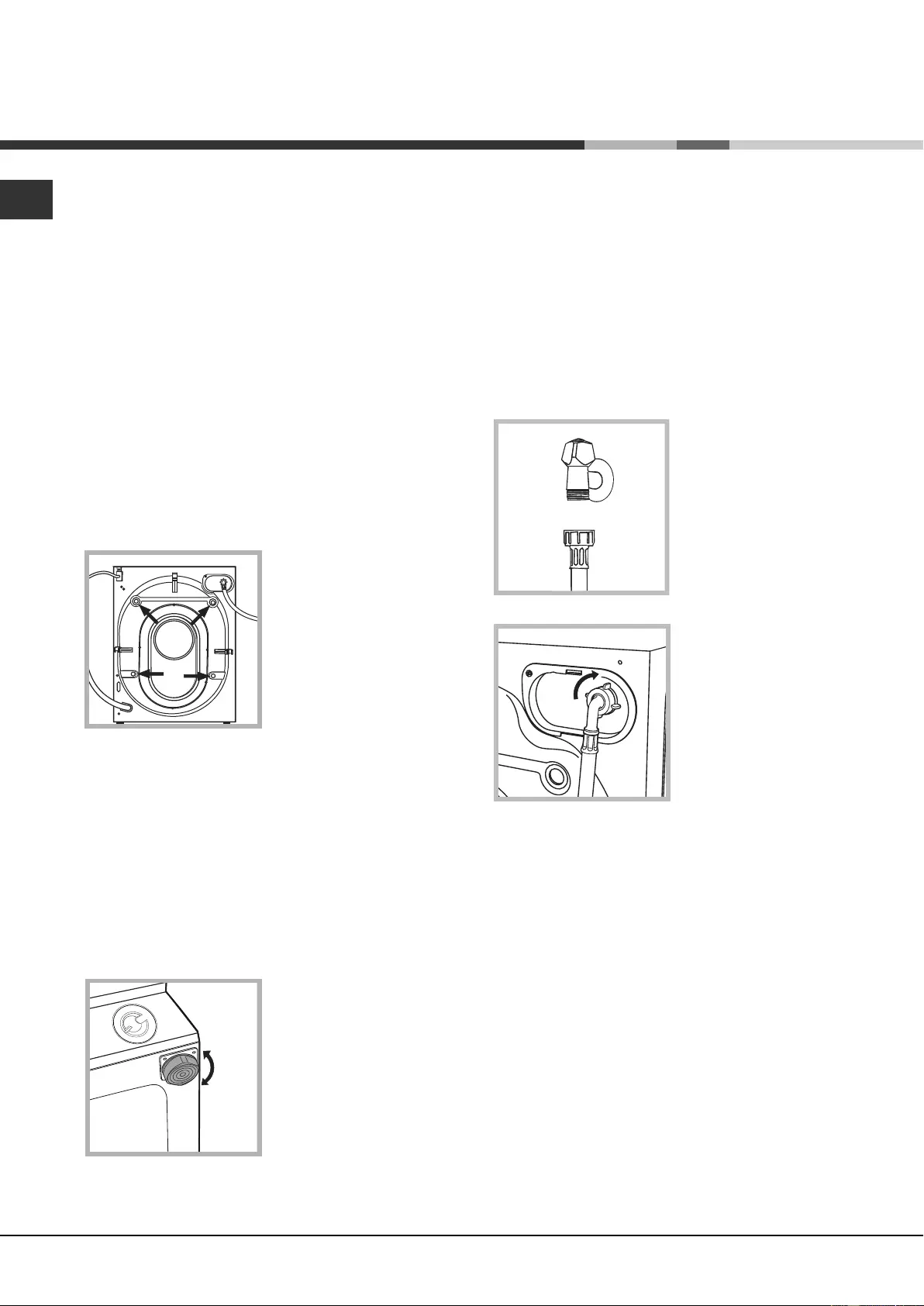
2
I
! È importante conservare questo libretto per poterlo
consultare in ogni momento. In caso di vendita, di
cessione o di trasloco, assicurarsi che resti insieme
alla lavabiancheria per informare il nuovo proprietario
sul funzionamento e sui relativi avvertimenti.
!
Leggere attentamente le istruzioni: ci sono
importanti informazioni sull’installazione, sull’uso
e sulla sicurezza.
Disimballo e livellamento
Disimballo
1. Disimballare la lavabiancheria.
2. Controllare che la lavabiancheria non abbia
subìto danni nel trasporto. Se fosse danneggiata
non collegarla e contattare il rivenditore.
3. Rimuovere le 4 viti di
protezione per il traspor—
to e il gommino con il
relativo distanziale, posti
nella parte posteriore
(vedi figura).
4. Chiudere i fori con i tappi di plastica in dotazione.
5. Conservare tutti i pezzi: qualora la lavabiancheria
debba essere trasportata, dovranno essere
rimontati.
! Gli imballaggi non sono giocattoli per bambini.
Livellamento
1. Installare la lavabiancheria su un pavimento piano
e rigido, senza appoggiarla a muri, mobili o altro.
2. Se il pavimento non
fosse perfettamente
orizzontale, compensare
le irregolarità svitando o
avvitando i piedini
anteriori (vedi figura);
l’angolo di inclinazione,
misurato sul piano di
lavoro, non deve supe-
rare i 2°.
Un accurato livellamento dà stabilità alla macchina
ed evita vibrazioni, rumori e spostamenti durante il
funzionamento. In caso di moquette o di un tappeto,
regolare i piedini in modo da conservare sotto la
lavabiancheria uno spazio sufficiente per la ventila-
zione.
Collegamenti idraulici ed elettrici
Collegamento del tubo di alimentazione
dell’acqua
1. Collegare il tubo di
alimentazione avvitan-
dolo a un rubinetto
d’acqua fredda con
bocca filettata da
3/4 gas (vedi figura).
2. Collegare il tubo di
alimentazione alla
lavabiancheria
avvitandolo all’apposita
presa d’acqua, nella
parte posteriore in alto a
destra (vedi figura).
3. Fare attenzione che nel tubo non ci siano né
pieghe né strozzature.
! La pressione idrica del rubinetto deve essere
compresa nei valori della tabella Dati tecnici
(vedi pagina a fianco).
! Se la lunghezza del tubo di alimentazione non
fosse sufficiente, rivolgersi a un negozio specializzato
o a un tecnico autorizzato.
!!
!!
!
Non utilizzare mai tubi già usati.
!!
!!
!
Utilizzare quelli in dotazione alla macchina.
Installazione
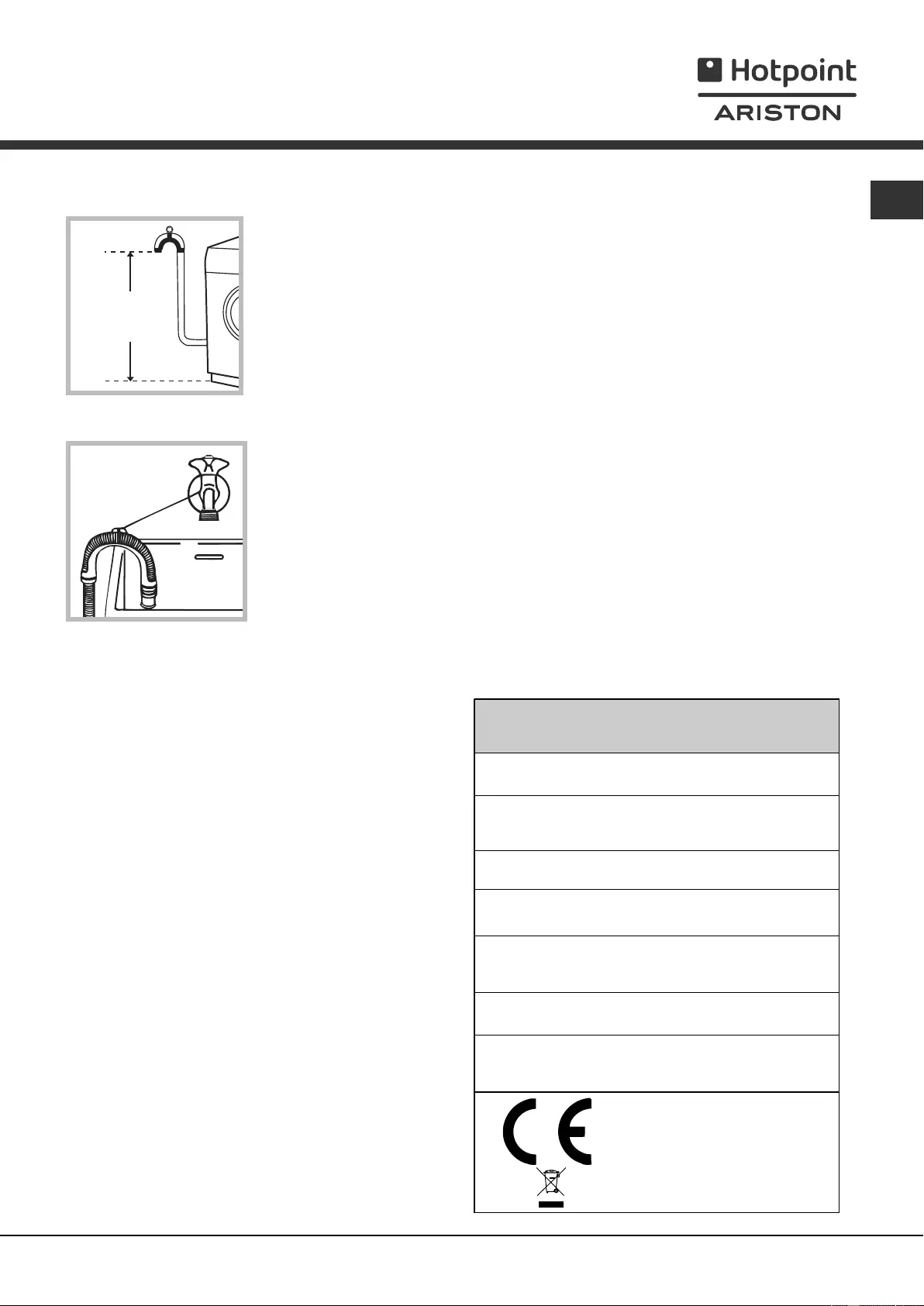
3
I
Collegamento del tubo di scarico
Collegare il tubo di
scarico, senza piegarlo,
a una conduttura di
scarico o a uno scarico
a muro posti tra 65 e
100 cm da terra;
oppure appoggiarlo al
bordo di un lavandino o
di una vasca, legando
la guida in dotazione al
rubinetto (vedi figura).
L’estremità libera del
tubo di scarico non
deve rimanere immersa
nell’acqua.
! È sconsigliato usare tubi di prolunga; se indispen-
sabile, la prolunga deve avere lo stesso diametro del
tubo originale e non superare i 150 cm.
Collegamento elettrico
Prima di inserire la spina nella presa della corrente,
accertarsi che:
• la presa abbia la messa a terra e sia a norma
di legge;
• la presa sia in grado di sopportare il carico
massimo di potenza della macchina, indicato nella
tabella Dati tecnici (vedi a fianco);
• la tensione di alimentazione sia compresa nei
valori indicati nella tabella Dati tecnici (vedi a
fianco);
• la presa sia compatibile con la spina della
lavabiancheria. In caso contrario sostituire la
presa o la spina.
! La lavabiancheria non va installata all’aperto,
nemmeno se lo spazio è riparato, perché è molto
pericoloso lasciarla esposta a pioggia e temporali.
! A lavabiancheria installata, la presa della corrente
deve essere facilmente raggiungibile.
! Non usare prolunghe e multiple.
! Il cavo non deve subire piegature o compressioni.
! Il cavo di alimentazione deve essere sostituito solo
da tecnici autorizzati.
Attenzione! L’azienda declina ogni responsabilità
qualora queste norme non vengano rispettate.
Primo ciclo di lavaggio
Dopo l’installazione, prima dell’uso, effettuare un
ciclo di lavaggio con detersivo e senza biancheria
impostando il programma 1.
65 — 100 cm
Dati tecnici
Modello AWM 129
Dimensioni lar gh ezza cm 59 ,5
alt ezza cm 81 ,5
profondità cm 54,5
Capacità da 1 a 7 kg
Collegamenti
elettrici vedi la targhetta caratteristiche
t ecni ch e appli cata s u ll a macchi na
Collegamenti
idrici
pres s io ne mas s ima 1 MPa (1 0 bar )
pression e minima 0,05 MPa ( 0,5 bar)
capacit à del cest o 5 2 l it ri
Velocità di
centrifuga s ino a 1200 giri al minut o
Programmi di
controllo secondo
la norma EN 60456
programma 6; temperatura 60°C;
effet tu at o con 7 k g di carico .
Qu es t a apparecch iat u ra è co nf orme
all e seg u ent i D iret t ive Comu n it ari e:
— 89/336/CEE del 03/05/89
(Compatibilità Elettromagnetica) e
s ucces s ive mo difi cazion i
— 2002/96/CE
— 2006/95/CE ( Bassa Tension e)
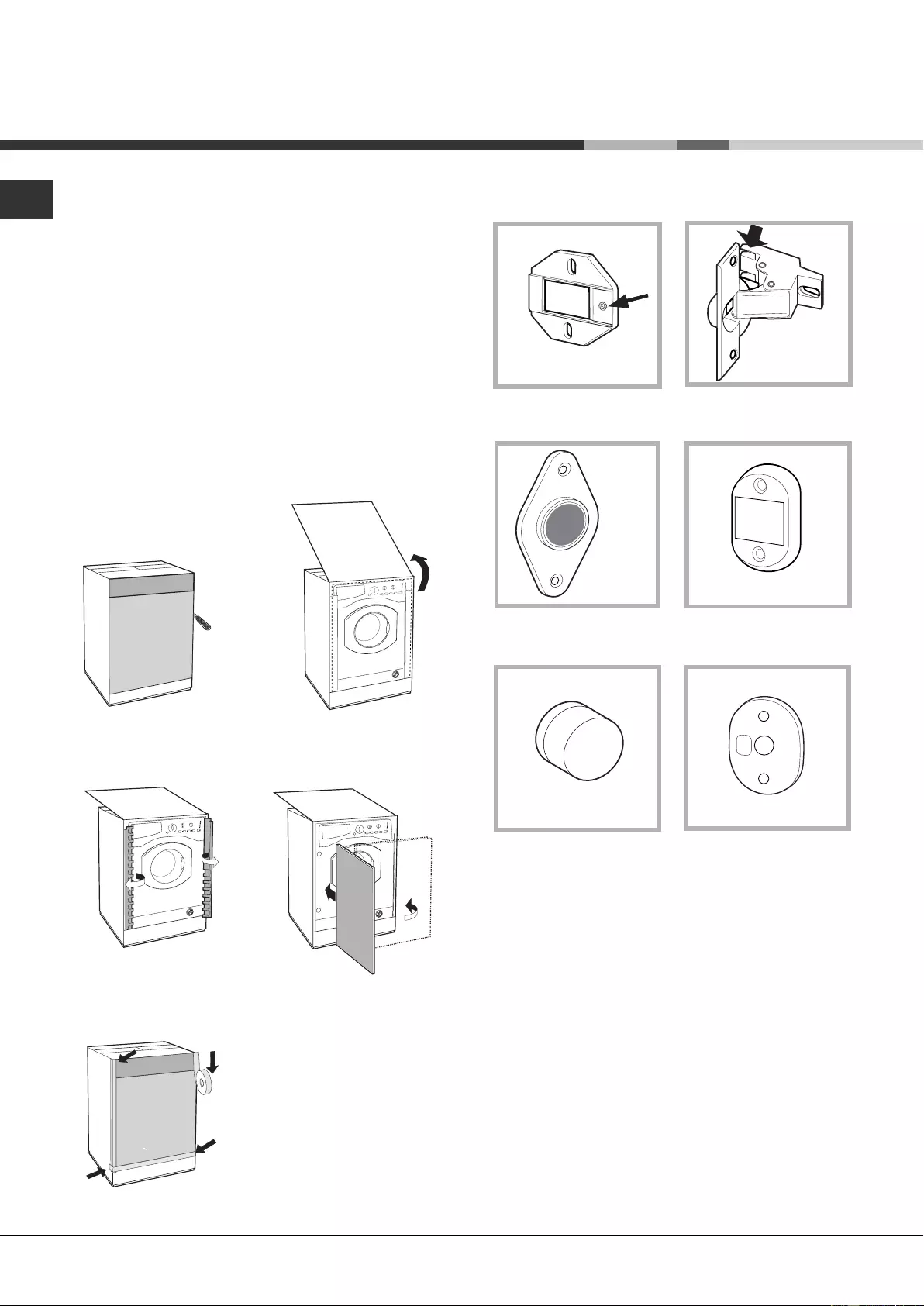
4
I
Istruzioni per l’installatore
Applicazione del pannello in legno alla porta e
inserimento della macchina nei mobili:
Nel caso in cui, dopo il montaggio del pannello in legno,
sia necessario spedire la macchina per l’installazione
finale, consigliamo di lasciarla nel suo imballo originale. A
questo scopo l’imballo è stato realizzato in modo da
permettere il montaggio del pannello di legno sulla
macchina senza disimballare completamente il prodotto
(vedi figure sottostanti).
Il pannello di legno che copre la facciata non deve essere
di spessore inferiore a 18 mm e può essere incernierato
sia sul lato destro che sinistro. Per ragioni di praticità
d’uso della macchina consigliamo lo stesso senso di
apertura dell’oblò con le cerniere applicate sul lato
sinistro.
AB
CD
E
Tur seite
Accessori montaggio portina (Fig. 1-2-3-4-5).
Fig. 1
N° 2 cerniere
N° 1 Magnete N° 1 Riscontro magnete
N° 1 Tassello in gomma
N° 2 Supporti cerniera
N° 4 Distanziali
Fig. 2
Fig. 3 Fig. 4
Fig. 5 Fig. 4/B
— n° 6 viti autofilettanti l = 13 mm «tipo A«.
— n° 2 viti metriche testa svasata l = 25 mm «tipo B«; per
il fissaggio del riscontro magnete al mobile.
— n° 4 viti metriche l = 15 mm «tipo C«; per il montaggio
dei supporti cerniera al mobile.
— n° 4 viti metriche l = 7 mm «tipo D«; per il montaggio
delle cerniere ai supporti.
Montaggio dei particolari sulla facciata della macchina.
— Montare i supporti cerniera alla facciata posizionando il
foro indicato da una freccia nella fig. 1 verso l’interno della
facciata interponendo un distanziale (fig. 4/B), utilizzando
le viti tipo C.
— Montare il riscontro magnete dalla parte opposta in alto
interponendo due distanziali (fig. 4/B) utilizzando le due
viti tipo B.
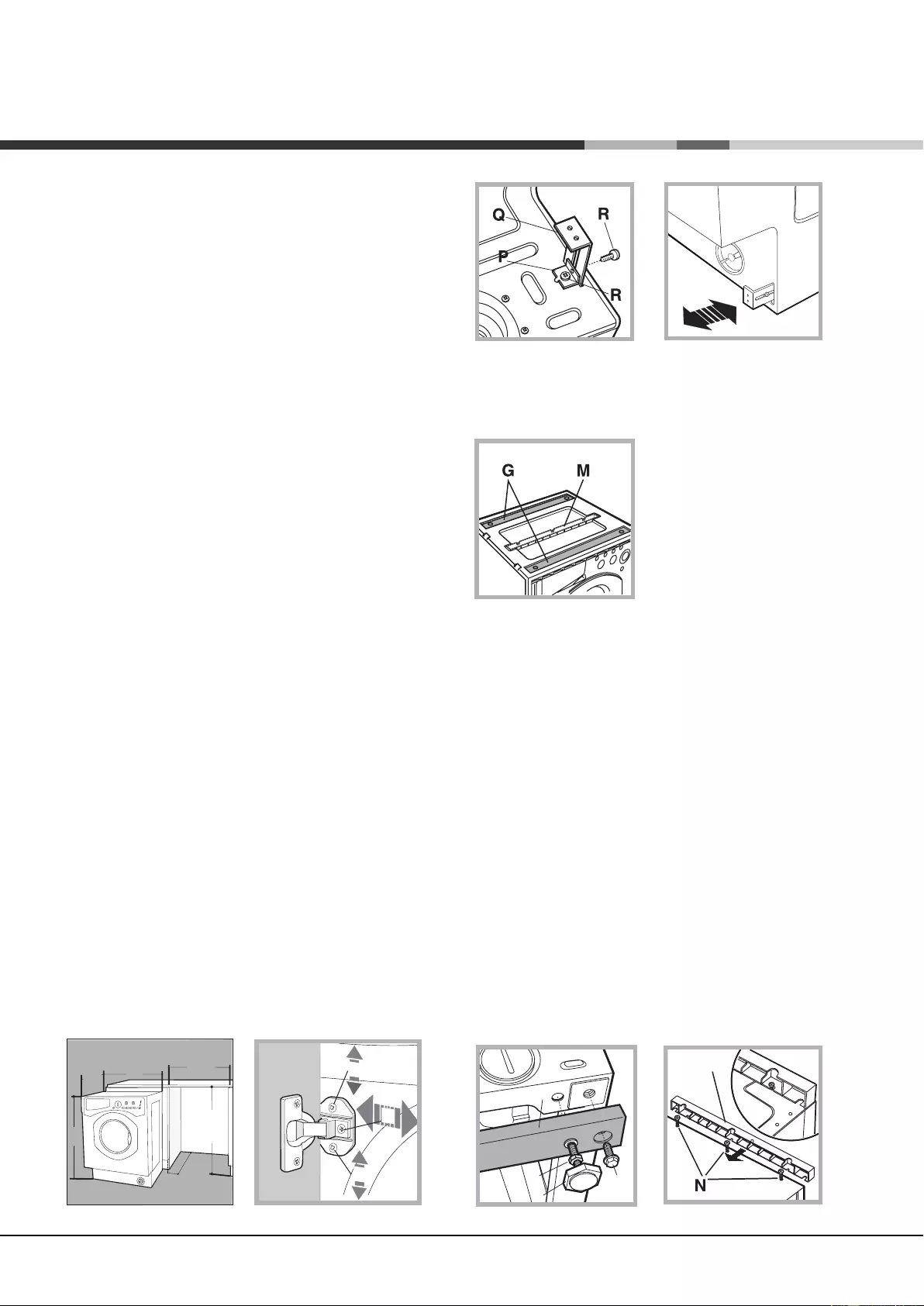
5
Uso della maschera di foratura.
— Per tracciare le posizioni dei fori sul lato sinistro del
pannello, allinerare la maschera di foratura al lato superio-
re e sinistro del pannello facendo riferimento alle linee
tracciate alle estremità.
— Per tracciare le posizioni dei fori sul lato destro del
pannello, allinerare la maschera di foratura al lato superio-
re e destro del pannello.
— Con una fresa di adeguate dimensioni realizzare le
quattro sedi che dovranno alloggiare le due cerniere, il
tassello di gomma e il magnete.
Montaggio dei particolari sul pannello di legno (Antina).
— Inserire le cerniere nelle sedi predisposte (la parte
mobile della cerniera deve trovarsi verso l’esterno del
pannello) e fissarle con 4 viti del tipo A.
— Inserire il magnete nella sede in alto dalla parte opposta
alle cerniere e fissarlo con due viti tipo B.
— Inserire il tassello in gomma nella sede in basso.
Il pannello è ora pronto per essere montato sulla macchina.
Montaggio del pannello alla macchina.
Inserire il nasello della cerniera indicato dalla freccia nella
fig. 2 nella sede del supporto cerniera spingere il pannello
verso la facciata della macchina e fissare le due cerniere
con le due viti tipo D.
Fissaggio della guida zoccolo.
Se la macchina è installata ad una estremità della cucina
componibile montare una o entrambe le guide zoccolo
come indicato in fig. 8, regolandone la profondità in
funzione della posizione dello zoccolo e se necessario
fissarlo alle stesse (fig. 9).
Per montare la guida zoccolo agire cone segue (fig. 8):
Fissare la squadretta P con la vite R, infilare la guida
zoccolo Q nell’apposita asola e una volta posizionata nel
punto desiderato bloccarla alla squadretta P con la vite R.
Inserimento della macchina nei mobili.
— Spingere l’apparecchio nell’apertura allineandola con gli
altri mobili (fig. 6).
— Agire sui piedini di regolazione per portare la macchina
all’altezza desiderata.
— Per regolare la posizione del pannello in legno in senso
verticale ed orizzontale, agire sulle viti C e D come
indicato in fig. 7.
Importante: chiudere la parte inferiore della facciata con
lo zoccolo a battuta sul pavimento.
Fig. 8 Fig. 9
Accessori in dotazione per la regolazione in altezza.
Alloggiate nel coperchio di polistirolo (fig. 10) si trovano:
2 traverse (G); 1 listello (M)all’interno del cestello si trovano:
4 piedini supplementari (H)
4 viti (I)
4 viti (R)
4 dadi (L)
2 guide zoccolo (Q)
Regolazione in altezza della macchina.
La macchina può essere regolata in altezza (da 815 mm a
835 mm) agendo sui 4 piedini.
Se si desidera portarla ad un’altezza superiore a quella
sopraindicata, arrivando fino a 870 mm, occorre utilizzare i
seguenti accessori:
le 2 traverse (G); i 4 piedini (H); le 4 viti (I); i 4 dadi (L), quindi
agire come segue (fig. 11):
togliere i 4 piedini originali, posizionare una traversa G nella
parte anteriore della macchina, fissarla con le viti I (avvitandole
nei fori dove erano montati i piedini originali) quindi inserire i
nuovi pedini H.
Ripetere la stessa operazione nella parte posteriore della macchina.
A questo punto regolando i piedini H la macchina può essere
abbassata o alzata da 835 mm a 870 mm.
Una volta raggiunta l’altezza desiderata bloccare i dadi L alla
traversa G.
Per regolare la macchina ad un’altezza compresa tra 870 mm e
900 mm occorre montare il listello M regolando i piedini H fino
all’altezza desiderata. Per inserire il listello agire come segue:
allentare le tre viti N poste nella parte anteriore della coper—
tura Top, inserire il listello M come indicato nella fig. 12,
quindi bloccare le viti N.
D
C
C
570
min
815
540
595
820 ÷ 900
600 min
Fig. 6 Fig. 7
LI
H
G
M
Fig. 11 Fig. 12
Fig. 10

6
I
Pannello di controllo
Descrizione della lavabiancheria
e avviare un programma
Manopola
TEMPERATURA
Manopola
PROGRAMMI
Cassetto dei detersivi
SPIE A VANZAMENTO CICLO/
P ARTENZA RITARDA TA
T asti con spie
FUNZIONE
Tasto
ACCENSIONE/
SPEGNIMENTO
Manopola
CENTRIFUGA
Spia
OBLÒ
BLOCCATO
Cassetto dei detersivi: per caricare detersivi e
additivi (vedi “Detersivi e biancheria”).
Tasto ACCENSIONE/SPEGNIMENTO: per accen-
dere e spegnere la lavabiancheria.
Manopola PROGRAMMI: per impostare i programmi.
Durante il programma la manopola resterà ferma.
Tasti FUNZIONE: per selezionare le funzioni disponi-
bili. La spia relativa alla funzione selezionata rimarrà
accesa.
Manopola CENTRIFUGA: per impostare la centrifuga
o escluderla (vedi “Personalizzazioni”).
Manopola TEMPERATURA: per impostare la tempe-
ratura o il lavaggio a freddo (vedi “Personalizzazioni”).
SPIE AVANZAMENTO CICLO/PARTENZA RI-
TARDATA: per seguire lo stato di avanzamento del
programma di lavaggio.
La spia accesa indica la fase in corso.
Se è stata impostata la funzione “Partenza Ritarda-
ta”, indicheranno il tempo mancante all’avvio del
programma (vedi pagina a fianco).
Spia OBLÒ BLOCCATO: per capire se l’oblò è
apribile (vedi pagina a fianco).
Tasto AVVIO/PAUSA: per avviare i programmi o
interromperli momentaneamente.
N.B.: per mettere in pausa il lavaggio in corso,
premere questo tasto, la spia relativa lampeggerà
con colore arancione mentre quella della fase in
corso sarà accesa fissa. Se la spia OBLÒ
BLOCCATO sarà spenta, si potrà aprire l’oblò.
Per far ripartire il lavaggio dal punto in cui è stato
interrotto, premere nuovamente questo tasto.
Modalità di stand by
Questa lavatrice, in conformità alle nuove normative
legate al risparmio energetico, è dotata di un
sistema di autospegnimento (stand by) che entra in
funzione dopo circa 30 minuti nel caso di non
utilizzo. Premere brevemente il tasto ACCENSIONE/
SPEGNIMENTO e attendere che la macchina si
riattivi.
Tasto con spia
AVVIO/
PAUSA

7
I
Spie
Le spie forniscono informazioni importanti.
Ecco che cosa dicono:
Partenza ritardata
Se è stata attivata la funzione “Partenza ritardata”
(vedi “Personalizzazioni”), dopo avere avviato il pro-
gramma, inizierà a lampeggiare la spia relativa al ritardo
selezionato:
Col trascorrere del tempo verrà visualizzato il ritardo
residuo con il lampeggio della spia relativa:
Trascorso il ritardo selezionato la spia lampeggiante
si spengnerà e avrà inizio il programma impostato.
Lavaggio
Risciacquo
Centrifuga
Scarico
Fine lavaggio
Spie fase in corso
Una volta selezionato e avviato il ciclo di lavaggio
desiderato, le spie si accenderanno progressivamen-
te per indicarne lo stato di avanzamento:
Tasti funzione e relative spie
Selezionando una funzione la spia relativa si illuminerà.
Se la funzione selezionata non è compatibile con il
programma impostato la spia relativa lampeggerà e
la funzione non verrà attivata.
Nel caso venga impostata una funzione incompatibi-
le con un’altra precedentemente selezionata rimarrà
attiva solo l’ultima scelta.
Spia oblò bloccato
La spia accesa indica che l’oblò è bloccato per
impedire aperture accidentali; per evitare danni è
necessario attendere che la spia si spenga prima di
aprire l’oblò.
N.B.: se è attiva la funzione “Partenza Ritardata”
l’oblo non si può aprire, per aprirlo mettere la mac-
china in pausa premendo il tasto AVVIO/PAUSA.
! Il lampeggio veloce della spia AVVIO/PAUSA
(arancione) contemporaneo a quello delle funzioni
segnala un’anomalia (vedi “Anomalie e rimedi”).
Avviare un programma
1. Accendere la lavabiancheria premendo il tasto ACCENSIONE/SPEGNIMENTO. Tutte le spie si accenderanno
per qualche secondo, poi rimarranno accese le spie ralative alle impostazioni del programma selezionato e pulserà
la spia AVVIO/PAUSA.
2. Caricare la biancheria e chiudere l’oblò.
3. Impostare con la manopola PROGRAMMI il programma desiderato.
4. Impostare la temperatura di lavaggio (vedi “Personalizzazioni”).
5. Impostare la velocità di centrifuga (vedi “Personalizzazioni”).
6. Versare detersivo e additivi (vedi “Detersivi e biancheria”).
7. Selezionare le funzioni desiderate.
8. Avviare il programma premendo il tasto AVVIO/PAUSA e la spia relativa rimarrà accesa fissa di colore verde.
Per annullare il ciclo impostato mettere la macchina in pausa premendo il tasto AVVIO/PAUSA e scegliere un
nuovo ciclo.
9. Al termine del programma si illuminerà la spia . La spia OBLÒ BLOCCATO si spegnerà indicando che l’oblò è
apribile. Estrarre la biancheria e lasciare l’oblò socchiuso per far asciugare il cestello.
Spegnere la lavabiancheria premendo il tasto ACCENSIONE/SPEGNIMENTO.
8
I
Programmi
Tabella dei programmi
Descrizion e del Progr amma Temp.
max.
(°C)
Velocità
max.
(giri al
minuto)
Detersivi Carico
max.
(Kg)
Durata
ciclo
Candeg—
gina Lavaggio Ammorbi-
dente
Programmi Speciali
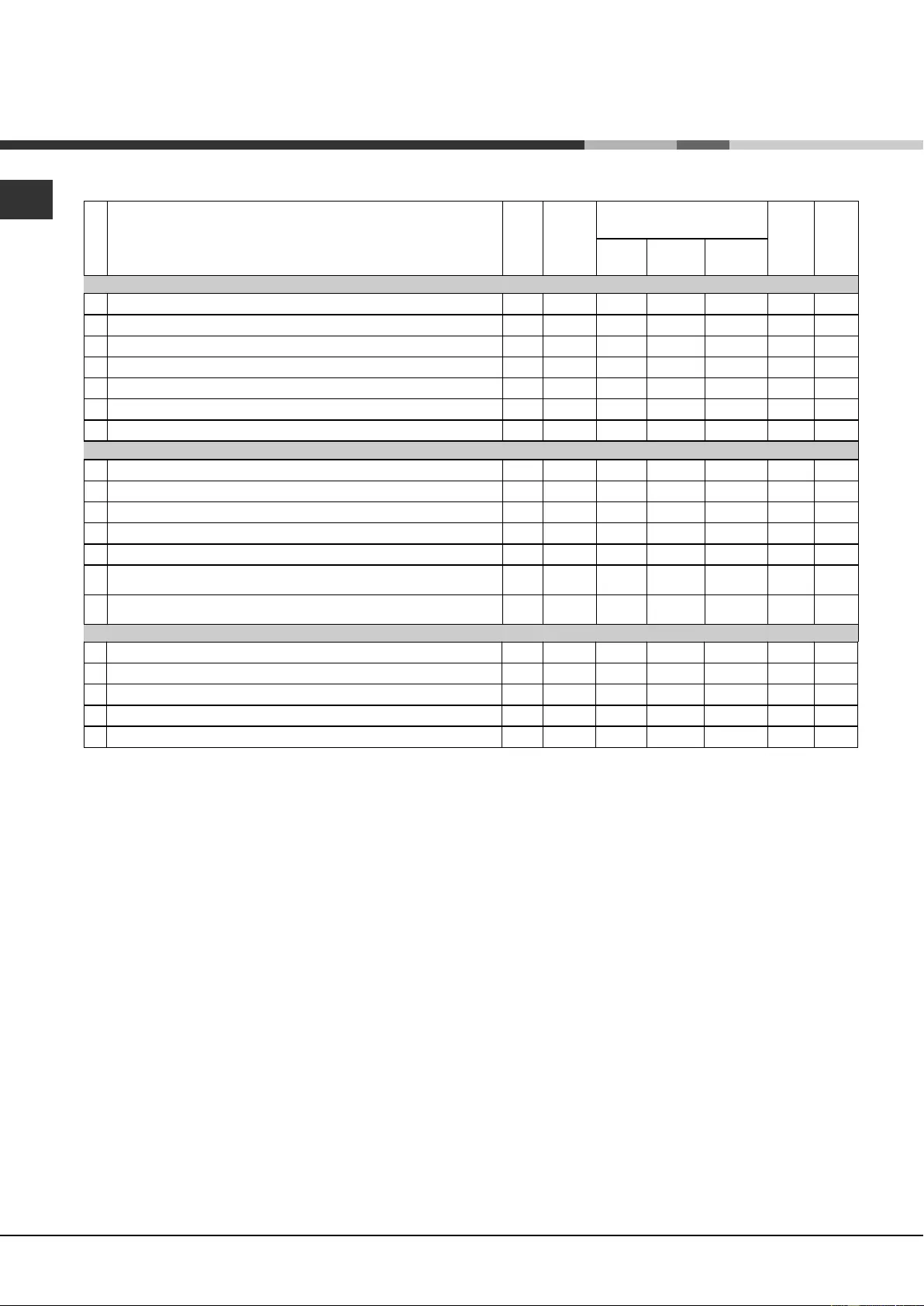
6Sanitary: B i anchi estremamente s p o r chi . 90° 1200 zz z 7170
6San itar y (1 ): B i anch i e col or ati r es i st enti molto s por chi. 60° 1200 —zz
7 153
7Buonanotte: Co l o r i d elicati p o co spo r chi. 40° 800 —zz
4 290
8Ciclo Baby: Colori delicati molto sporchi. 40° 800 —zz
2118
9Camicie 40° 600 —zz
270
10 Seta/Tende: Per cap i i n set a, vi s cosa, li ng erie. 30° 0 —zz
255
11 Lana: Per l ana, cach emi re, ecc. 40° 600 —zz
1,5 55
Progra mmi Giornalieri
1Cotone: B i anchi e col or ati r esisten ti mo l to spo r chi. 60° 1200 zz z 7 122
1Cotone (2): B i anchi e col or ati d elicati molto spo r chi. 40° 1200 zz z 7115
2Cotone Colorati (3): Bianch i p o co spo r chi e co l ori del i cati . 40° 1200 zz z 785
3Sintetici: Colori resistenti molto sporchi. 60° 800 —zz
385
3Sintetici: Colori resistenti poco sporchi. 40° 800 —zz
370
4Mix 3 0 ‘: Per r infr es car e r api d ament e capi p o co spo r chi ( no n
indi cat o p er l ana, seta e capi da l avar e a mano ) . 30° 800 —zz
330
5Mix 1 5 ‘: Per r infr es car e r api d ament e capi p o co spo r chi ( no n
indi cat o p er l ana, seta e capi da l avar e a mano ) . 30° 800 —zz
1,5 15
Programmi Pa rzia li
ARisciacquo —1200 — z736
BR i sciacq u o Del i cato —800 — z331
CCentrifuga —1200 — —716
DCen tr i f uga D el i cata —800 — —312
EScarico —0— —72
Programmi particolari
Sanitary (programma 6). Un programma igienizzante ad alte temperature che prevede l’uso della candeggina con temperature
superiori a 60°C.
Per candeggiare versare la candeggina i detersivi e gli additivi nei relativi scomparti (vedi paragrafo
“Cassetto dei detersivi”).
Buonanotte (programma 7). E’ un ciclo silenzioso che può lavorare di notte quando la tariffa energetica è ridotta. Il
programma è studiato per capi sintetici e di cotone. Alla fine del ciclo la macchina si ferma con l’acqua in vasca; per
effettuar e la centrifiga e lo scarico premer e il tasto A VVIO/P AUSA, altrimenti dopo 8 ore la macchina ef fettuerà automa-
ticamente la centrifuga e lo scarico dell’acqua.
Ciclo Baby (programma 8). Programma in grado di asportare lo sporco tipico dei bambini garantendo la rimozione del
detersivo dai panni onde evitare allergie alla pelle delicata dei bambini. Il ciclo è stato studiato per ridurre la carica
batterica utilizzando una maggior quantità di acqua e ottimizzando l’effetto di additivi specifici igenizzanti aggiunti al
detersivo.
Al temine del lavaggio la macchina effettuerà delle lente rotazioni del cestello per evitare la creazione di pieghe; per
terminare il ciclo premere il tasto A VVIO/PAUSA.
Mix 30′ (programma 4) è studiato per lavare capi leggermente sporchi in poco tempo: dura solo 30 minuti e fa così
risparmiare energia e tempo. Impostando il programma (4 a 30°C) è possibile lavare insieme tessuti di diversa natura
(esclusi lana e seta) con un carico massimo di 3 kg.
Mix 15′ (programma 5) è studiato per lavare capi leggermente sporchi in poco tempo: dura solo 15 minuti e fa così
risparmiare energia e tempo. Impostando il programma (5 a 30°C) è possibile lavare insieme tessuti di diversa natura
(esclusi lana e seta) con un carico massimo di 1,5 kg.
I dati riportati nella tabella hanno valore indicativo.
Per tutti Test Institutes:
1) Programma di controllo secondo la norma EN 60456: impostare il programma 6 con una temperaura di 60°C.
2) Programma cotone lungo: impostare il programma 1 con una temperatura di 40°C.
3) Programma cotone corto: impostare il programma 2 con una temperatura di 40°C.
Programmi
9
I
Personalizzazioni
Impostare la temperatura
Ruotando la manopola TEMPERATURA si imposta la temperatura di lavaggio (vedi Tabella programmi).
La temperatura si può ridurre sino al lavaggio a freddo ( ).
La macchina impedirà automaticamente di impostare una temperatura maggiore a quella massima prevista per
ogni programma.
Impostare la centrifuga
Ruotando la manopola CENTRIFUGA si imposta la velocità di centrifuga del programma selezionato.
Le velocità massime previste per i programmi sono:
Programmi Velocità massima
Cotone 1200 giri al minuto
Sintetici 800 giri al minuto
Lana 600 giri al minuto
Seta solo scarico
La velocità di centrifuga può essere ridotta, oppure esclusa selezionando il simbolo .
La macchina impedirà automaticamente di effettuare una centrifuga maggiore a quella massima prevista per ogni
programma.
Funzioni
Le varie funzioni di lavaggio previste dalla lavabiancheria permettono di ottenere la pulizia e il bianco desiderati.
Per attivare le funzioni:
1. premere il tasto relativo alla funzione desiderata;
2. l’accensione della spia relativa segnala che la funzione è attiva.
Nota: Il lampeggio veloce della spia indica che la funzione relativa non è selezionabile per il programma impostato.
Partenza ritardata
Ritarda l’avvio della macchina sino a 12 ore.
Premere più volte il tasto fino a far accendere la spia relativa al ritardo desiderato. Alla quinta pressione del tasto la
funzione si disattiverà.
N.B.: Una volta premuto il tasto AVVIO/PAUSA, si può modificare il valore del ritardo solo diminuendolo.
! E’ attivo con tutti i programmi.
Stira Facile
Selezionando questa funzione, il lavaggio e la centrifuga saranno opportunamente modificati per ridurre la
formazione di pieghe. Al temine del ciclo la lavabiancheria effettuerà delle lente rotazioni del cestello;
la spia della funzione STIRA FACILE e quella di AVVIO/PAUSA lampeggeranno (arancione) e la spia si illumina.
Per terminare il ciclo si dovrà premere il tasto AVVIO/PAUSA o il tasto STIRA FACILE.
Nel programma Seta la macchina terminerà il ciclo con la biancheria in ammollo, la spia della funzione STIRA
FACILE e quella di AVVIO/PAUSA lampeggeranno (arancione) e la fase RISCIACQUO rimarrà accesa fissa.
Per scaricare l’acqua e poter rimuovere il bucato sarà necessario premere il tasto AVVIO/PAUSA o il tasto STIRA
FACILE.
!
Non è attivabile sui programmi 4, 5, 6, 7, 8, 11, C, D, E.
Extra Risciacquo
Selezionando questa funzione si aumenta l’efficacia del risciacquo, e si assicura la massima rimozione del
detersivo. E’ utile per pelli particolarmente sensibili.
! Non è attivabile sui programmi 4, 5, C, D, E.
Super Lavaggio
Grazie all’utilizzo di una maggior quantità d’ acqua nella fase iniziale del ciclo e all’impiego di maggior tempo, tale
funzione garantisce un lavaggio di alte performance.
! Non è attivabile sui programmi 4, 5, 6, 10, 11, A, B, C, D, E.
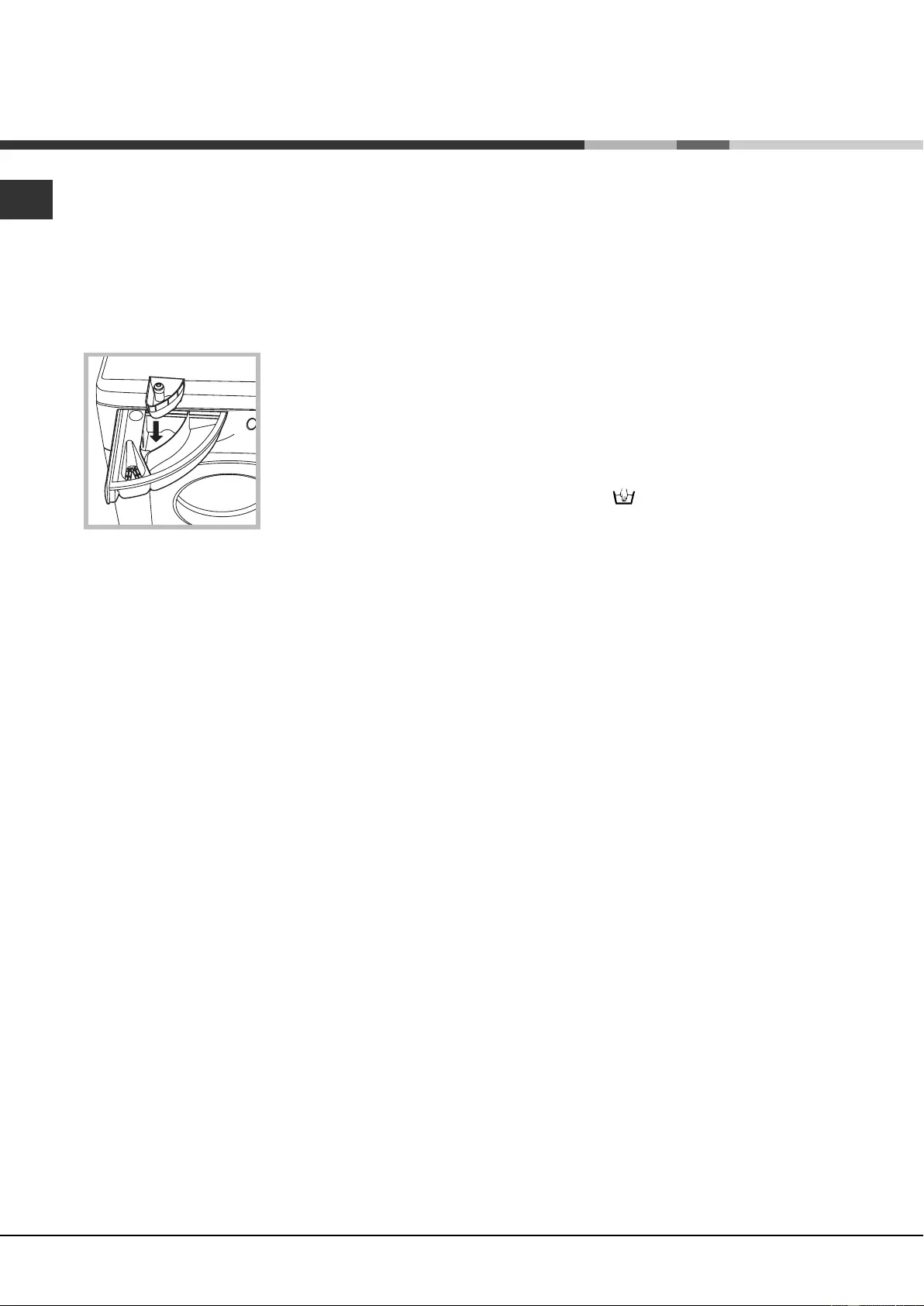
10
I
Cassetto dei detersivi
Il buon risultato del lavaggio dipende anche dal
corretto dosaggio del detersivo: eccedendo non si
lava in modo più efficace e si contribuisce a incro-
stare le parti interne della lavabiancheria e a inquina-
re l’ambiente.
! Non usare detersivi per il lavaggio a mano, perché
formano troppa schiuma. Estrarre il cassetto dei
detersivi e inserire il
detersivo o l’additivo
come segue.
vaschetta 1: Detersivo per lavaggio
(in polvere o liquido)
Il detersivo liquido va versato solo prima dell’avvio.
vaschetta 2: Additivi (ammorbidente, ecc.)
L’ammorbidente non deve fuoriuscire dalla griglia.
vaschetta aggiuntiva 3: Candeggina
Ciclo candeggio
Il candeggio può essere effettuato solo con i pro-
grammi 1, 2, 6.
Versare la candeggina nella vaschetta aggiuntiva 3, il
detersivo e l’ammorbidente nelle rispettive
vaschette, quindi impostare uno dei programmi
soprariportati.
E’ indicato solo per capi in cotone molto sporchi.
Preparare la biancheria
• Suddividere la biancheria secondo:
— il tipo di tessuto / il simbolo sull’etichetta.
— i colori: separare i capi colorati da quelli bianchi.
• Vuotare le tasche e controllare i bottoni.
• Non superare i valori indicati, riferiti al peso della
biancheria asciutta:
Tessuti resistenti: max 7 kg
Tessuti sintetici: max 3 kg
Tessuti delicati: max 2 kg
Lana: max 1,5 kg
Quanto pesa la biancheria?
1 lenzuolo 400-500 gr.
1 federa 150-200 gr.
1 tovaglia 400-500 gr.
1 accappatoio 900-1.200 gr.
1 asciugamano 150-250 gr.
Capi particolari
Camicie: utilizzare l’apposito programma 9 per
lavare camicie di diversi tipo di tessuto e colore.
Ne garantisce la massima cura minimizzando la
formazione delle pieghe.
Seta: utilizzare l’apposito programma 10 per lavare
tutti i capi in seta. Si consiglia l’utilizzo di un
detersivo specifico per capi delicati.
Tende:
si raccomanda di piegarle e sistemarle
dentro una federa o un sacchetto a rete. Utilizzare il
programma 10.
Lana: Hotpoint/Ariston è l’unica lavabiancheria ad
aver ottenuto il prestigioso riconoscimento Woolmark
Platinum Care (M.0508) da parte di The Woolmark
Company, che certifica il lavaggio in lavatrice di tutti i
capi in lana, anche quelli recanti l’etichetta “solo
lavaggio a mano” . Con il programma 11 si ha
quindi l’assoluta tranquillità di lavare in lavatrice tutti i
capi in lana (max. 1,5 kg) con la garanzia delle
migliori performance.
Sistema bilanciamento del carico
Prima di ogni centrifuga, per evitare vibrazioni
eccessive e per distribuire il carico in modo uniforme,
il cestello effettua delle rotazioni ad una velocità
leggermente superiore a quella del lavaggio. Se al
termine di ripetuti tentativi il carico non fosse ancora
correttamente bilanciato la macchina effettua la
centrifuga ad una velocità inferiore a quella prevista.
In presenza di eccessivo sbilanciamento la
lavabiancheria effettua la distribuzione anzichè la
centrifuga. Per favorire una migliore distribuzione del
carico e il suo corretto bilanciamento si consiglia di
mescolare capi grandi e piccoli.
Detersivi e biancheria
MAX
1
3
2
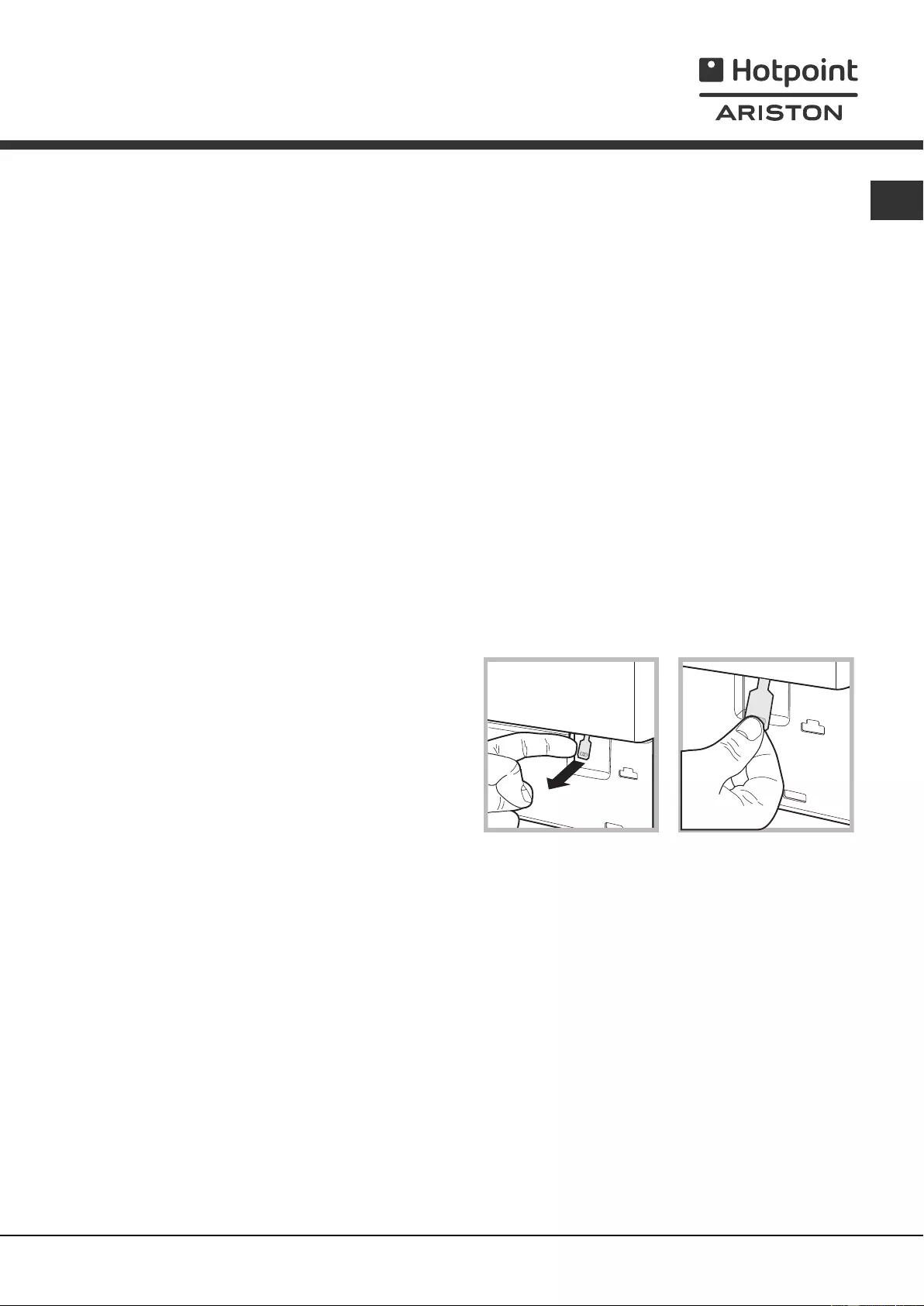
11
I
Precauzioni e consigli
! La lavabiancheria è stata progettata e costruita in
conformità alle norme internazionali di sicurezza.
Queste avvertenze sono fornite per ragioni di
sicurezza e devono essere lette attentamente.
Sicurezza generale
• Questo apparecchio è stato concepito esclusiva-
mente per un uso di tipo domestico.
• L’apparecchio non deve essere utilizzato da
persone (bambini compresi) con capacità fisiche,
sensoriali o mentali ridotte e con esperienze e
conoscenze insufficienti, a meno che tale utilizzo
non avvenga sotto la supervisione o le istruzioni di
una persona responsabile della loro sicurezza. I
bambini devono essere sorvegliati per garantire
che non giochino con l’apparecchio.
• Non toccare la macchina a piedi nudi o con le
mani o i piedi bagnati o umidi.
• Non staccare la spina dalla presa della corrente
tirando il cavo, bensì afferrando la spina.
• Non aprire il cassetto dei detersivi mentre la
macchina è in funzione.
• Non toccare l’acqua di scarico, che può
raggiungere temperature elevate.
• Non forzare in nessun caso l’oblò: potrebbe
danneggiarsi il meccanismo di sicurezza che
protegge da aperture accidentali.
• In caso di guasto, in nessun caso accedere ai
meccanismi interni per tentare una riparazione.
• Controllare sempre che i bambini non si avvicinino
alla macchina in funzione.
• Durante il lavaggio l’oblò tende a scaldarsi.
• Se dev’essere spostata, lavorare in due o tre
persone con la massima attenzione. Mai da soli
perché la macchina è molto pesante.
• Prima di introdurre la biancheria controlla che il
cestello sia vuoto.
Smaltimento
• Smaltimento del materiale di imballaggio:
attenersi alle norme locali, così gli imballaggi
potranno essere riutilizzati.
• La direttiva Europea 2002/96/CE sui rifiuti di
apparecchiature elettriche ed elettroniche, preve-
de che gli elettrodomestici non debbano essere
smaltiti nel normale flusso dei rifiuti solidi urbani.
Gli apparecchi dismessi devono essere raccolti
separatamente per ottimizzare il tasso di recupero
e riciclaggio dei materiali che li compongono ed
impedire potenziali danni per la salute e l’ambien-
te.
Il simbolo del cestino barrato è riportato su
tutti i prodotti per ricordare gli obblighi di raccolta
separata.
Per ulteriori informazioni, sulla corretta dismissione
degli elettrodomestici, i detentori potranno rivol-
gersi al servizio pubblico preposto o ai rivenditori.
Apertura manuale dell’oblò
Nel caso non sia possibile aprire l’oblò a causa della
mancanza di energia elettrica e volete stendere il
bucato, procedere come segue:
1. togliere la spina dalla presa di corrente.
2. verificate che il livello dell’acqua all’interno della
macchina sia inferiore rispetto all’apertura dell’oblò; in
caso contrario togliere l’acqua in eccedenza
attraverso il tubo di scarico raccogliendola in un
secchio.
3. utilizzando la linguetta indicata in figura tirare verso
l’esterno fino a liberare il tirante in plastica dal fermo;
tirarlo successivamente verso il basso e
contemporaneamente aprire l’oblò.
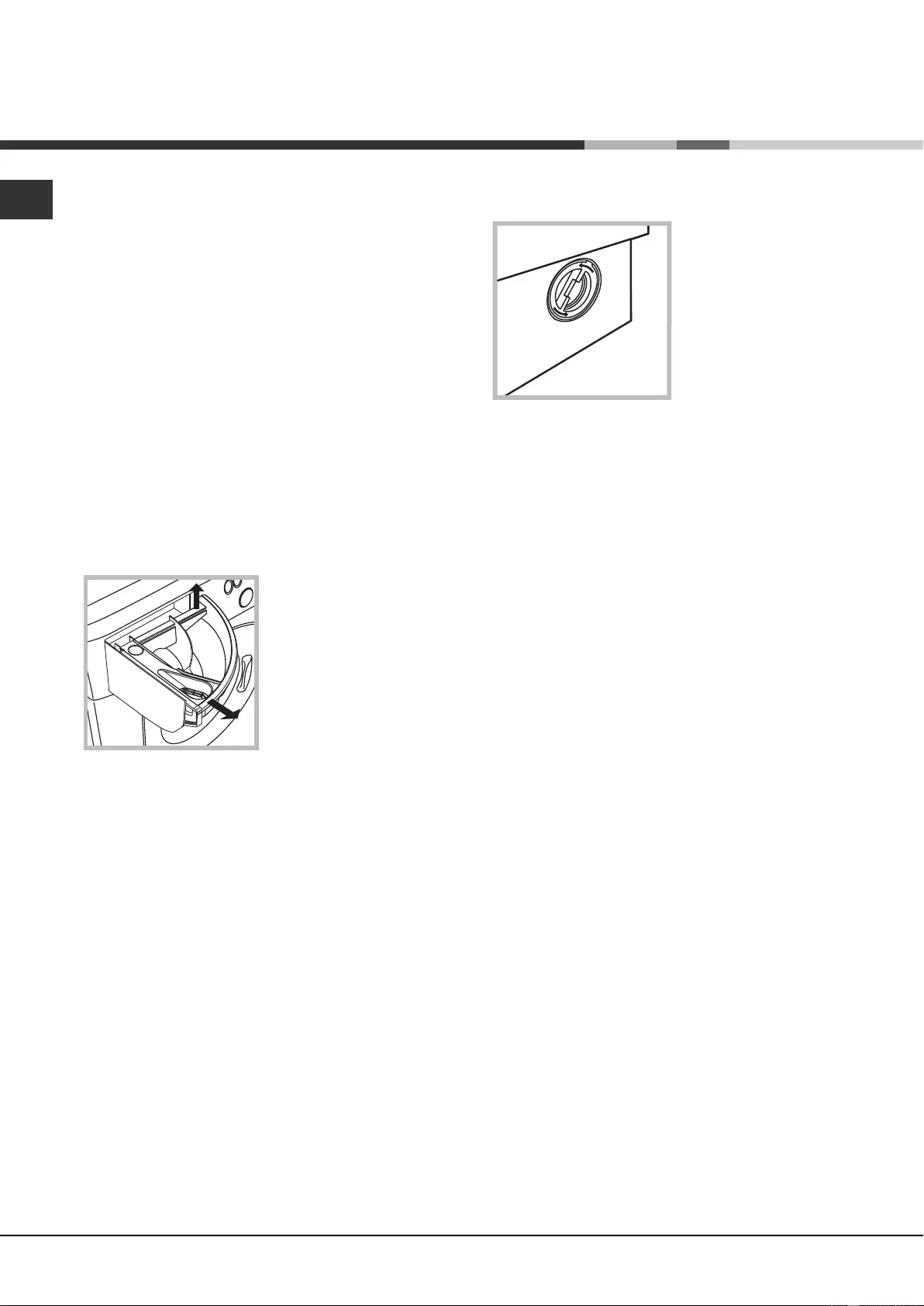
12
I
Manutenzione e cura
Escludere acqua e corrente elettrica
• Chiudere il rubinetto dell’acqua dopo ogni
lavaggio. Si limita così l’usura dell’impianto
idraulico della lavabiancheria e si elimina il pericolo
di perdite.
• Staccare la spina della corrente quando si
pulisce la lavabiancheria e durante i lavori di
manutenzione.
Pulire la lavabiancheria
La parte esterna e le parti in gomma possono
essere puliti con un panno imbevuto di acqua tiepida
e sapone. Non usare solventi o abrasivi.
Pulire il cassetto dei detersivi
Sfilare il cassetto solle-
vandolo e tirandolo
verso l’esterno (vedi
figura).
Lavarlo sotto l’acqua
corrente; questa pulizia
va effettuata
frequentemente.
Curare oblò e cestello
• Lasciare sempre socchiuso l’oblò per evitare che
si formino cattivi odori.
Pulire la pompa
La lavabiancheria è dotata di una pompa
autopulente che non ha bisogno di manutenzione.
Può però succedere che piccoli oggetti (monete,
bottoni) cadano nella precamera che protegge la
pompa, situata nella parte inferiore di essa.
! Assicurarsi che il ciclo di lavaggio sia terminato e
staccare la spina.
Per accedere alla precamera:
1. svitare il coperchio
ruotandolo in senso
antiorario (vedi figura): è
normale che fuoriesca
un po’ d’acqua;
2. pulire accuratamente l’interno;
3. riavvitare il coperchio.
Controllare il tubo di alimentazione
dell’acqua
Controllare il tubo di alimentazione almeno una volta
all’anno. Se presenta screpolature e fessure va
sostituito: durante i lavaggi le forti pressioni potreb-
bero provocare improvvise spaccature.
!!
!!
!
Non utilizzare mai tubi già usati.

13
I
Può accadere che la lavabiancheria non funzioni. Prima di telefonare all’Assistenza (vedi “Assistenza”), controllare
che non si tratti di un problema facilmente risolvibile aiutandosi con il seguente elenco.
Anomalie e rimedi
Anomalie:
La lavabiancheria
non si accende.
Il ciclo di lavaggio
non inizia.
La lavabiancheria non carica
acqua (lampeggia velocemente
la spia della prima fase di
lavaggio).
La lavabiancheria carica e
scarica acqua di continuo.
La lavabiancheria non scarica
o non centrifuga.
La lavabiancheria vibra
molto durante la centrifuga.
La lavabiancheria perde acqua.
La spia AVVIO/PAUSA (arancione)
e le spie delle funzioni
lampeggiano velocemente.
Si forma troppa schiuma.
Possibili cause / Soluzione:
• La spina non è inserita nella presa della corrente, o non abbastanza
da fare contatto.
• In casa non c’è corrente.
• L’oblò non è ben chiuso
• Il tasto ACCENSIONE/SPEGNIMENTO non è stato premuto.
• Il tasto AVVIO/PAUSA non è stato premuto.
• Il rubinetto dell’acqua non è aperto.
• Si è impostato un ritardo sull’ora di avvio (PARTENZA RITARDATA,
vedi “Personalizzazioni”).
• Il tubo di alimentazione dell’acqua non è collegato al rubinetto.
• Il tubo è piegato.
• Il rubinetto dell’acqua non è aperto.
• In casa manca l’acqua.
• Non c’è sufficiente pressione.
• Il tasto AVVIO/PAUSA non è stato premuto.
• Il tubo di scarico non è installato fra 65 e 100 cm da terra (vedi “Installazione”).
• L’estremità del tubo di scarico è immersa nell’acqua (vedi “Installazione”).
• Lo scarico a muro non ha lo sfiato d’aria.
Se dopo queste verifiche il problema non si risolve, chiudere il rubinetto
dell’acqua, spegnere la lavabiancheria e chiamare l’Assistenza. Se
l’abitazione si trova agli ultimi piani di un edificio, è possibile che si verifi-
chino fenomeni di sifonaggio, per cui la lavabiancheria carica e scarica
acqua di continuo. Per eliminare l’inconveniente sono disponibili in com-
mercio apposite valvole anti-sifonaggio.
• Il programma non prevede lo scarico: con alcuni programmi occorre
avviarlo manualmente.
• È attiva la funzione STIRA FACILE: per completare il programma
premere il tasto AVVIO/PAUSA (“Personalizzazioni”).
• Il tubo di scarico è piegato (vedi “Installazione”).
• La conduttura di scarico è ostruita.
• Il cestello, al momento dell’installazione, non è stato sbloccato
correttamente (vedi “Installazione”).
• La lavabiancheria non è in piano (vedi “Installazione”).
• La lavabiancheria è stretta tra mobili e muro (vedi “Installazione”).
• Il tubo di alimentazione dell’acqua non è ben avvitato (vedi “Installazione”).
• Il cassetto dei detersivi è intasato (per pulirlo vedi “Manutenzione e cura”).
• Il tubo di scarico non è fissato bene (vedi “Installazione”).
• Spegnere la macchina e togliere la spina dalla presa, attendere circa 1
minuto quindi riaccenderla.
Se l’anomalia persiste, chiamare l’Assistenza.
• Il detersivo non è specifico per lavabiancheria (deve esserci la
dicitura “per lavatrice”, “a mano e in lavatrice”, o simili).
• Il dosaggio è stato eccessivo.
14
I
Prima di contattare l’Assistenza:
•Verificare se l’anomalia può essere risolta da soli (vedi “Anomalie e rimedi”).
• Riavviare il programma per controllare se l’inconveniente è stato ovviato;
• In caso negativo, contattare il Numero Unico 199.199.199*.
!Non ricorrere mai a tecnici non autorizzati.
Comunicare:
• il tipo di anomalia;
• il modello della macchina (Mod.);
• il numero di serie (S/N).
Queste informazioni si trovano sulla targhetta applicata nella parte posteriore della lavabiancheria e nella
parte anteriore aprendo l’oblò.
Assistenza Attiva 7 giorni su 7 **
**
*
In caso di necessità d’intervento chiamare il Numero Unico Nazionale 199.199.199*.
Un operatore sarà a completa disposizione per fissare un appuntamento con il Centro Assistenza Tecnico
Autorizzato più vicino al luogo da cui si chiama.
È attivo 7 giorni su 7, sabato e domenica compresi, e non lascia mai inascoltata una richiesta.
* Al costo di 14,25 centesimi di Euro al minuto (iva inclusa) dal Lun. al Ven. dalle 08:00 alle 18:30, il Sab. dalle 08:00 alle
13:00 e di 5,58 centesimi di Euro al minuto (iva inclusa) dal Lun. al Ven. dalle 18:30 alle 08:00, il Sab. dalle 13:00 alle 08:00
e i giorni festivi, per chi chiama da telefono fisso.
Per chi chiama da radiomobile le tariffe sono legate al piano tariffario dell’operatore telefonico utilizzato.
Le suddette tariffe potrebbero essere soggette a variazione da parte dell’operatore telefonico; per maggiori informazioni
consultare il sito www.aristonchannel.com.
Assistenza

GB
15
Contents
Installation, 16-17-18-19
Unpacking and levelling
Connecting the electricity and water supplies
The first wash cycle
Technical data
Instructions for the fitter
Description of the washing machine
and starting a wash cycle, 20-21
Control panel
Indicator lights
Starting a wash cycle
W ash cycles, 22
Table of wash cycles
Personalisation, 23
Setting the temperature
Setting the spin speed
Functions
Detergents and laundry, 24
Detergent dispenser drawer
Bleach cycle
Preparing the laundry
Garments requiring special care
Load balancing system
Precautions and tips, 25
General safety
Disposal
Opening the porthole door manually
Care and maintenance, 26
Cutting off the water or electricity supply
Cleaning the washing machine
Cleaning the detergent dispenser drawer
Caring for the door and drum of your appliance
Cleaning the pump
Checking the water inlet hose
Troubleshooting, 27
Service, 28
AWM 129
Instructions for use
WASHING MACHINE
English
GB

16
GB
Installation
! This instruction manual should be kept in a safe
place for future reference. If the washing machine is
sold, transferred or moved, make sure that the
instruction manual remains with the machine so that
the new owner is able to familiarise himself/herself
with its operation and features.
!
Read these instructions carefully: they contain vital
information relating to the safe installation and
operation of the appliance.
Unpacking and levelling
Unpacking
1. Remove the washing machine from its packaging.
2. Make sure that the washing machine has not been
damaged during the transportation process. If it has
been damaged, contact the retailer and do not
proceed any further with the installation process.
3. Remove the 4
protective screws (used
during transportation) and
the rubber washer with
the corresponding
spacer, located on the
rear part of the appliance
(see figure).
4. Close off the holes using the plastic plugs provided.
5. Keep all the parts in a safe place: you will need
them again if the washing machine needs to be
moved to another location.
! Packaging materials should not be used as toys for
children.
Levelling
1. Install the washing machine on a flat sturdy floor,
without resting it up against walls, furniture cabinets
or anything else.
2. If the floor is not
perfectly level, compen-
sate for any unevenness
by tightening or loosening
the adjustable front feet
(see figure); the angle of
inclination, measured in
relation to the worktop,
must not exceed 2°.
Levelling the machine correctly will provide it with
stability, help to avoid vibrations and excessive noise
and prevent it from shifting while it is operating. If it is
placed on carpet or a rug, adjust the feet in such a
way as to allow a sufficient ventilation space
underneath the washing machine.
Connecting the electricity and water
supplies
Connecting the water inlet hose
1. Connect the supply
pipe by screwing it to a
cold water tab using a ¾
gas threaded connection
(see figure).
Before performing the
connection, allow the
water to run freely until it
is perfectly clear.
2. Connect the inlet hose
to the washing machine
by screwing it onto the
corresponding water inlet
of the appliance, which is
situated on the top right-
hand side of the rear part
of the appliance (see
figure).
3. Make sure that the hose is not folded over or bent.
! The water pressure at the tap must fall within the
values indicated in the Technical details table (see
next page).
! If the inlet hose is not long enough, contact a
specialised shop or an authorised technician.
!!
!!
!
Never use second-hand hoses.
!!
!!
!
Use the ones supplied with the machine.
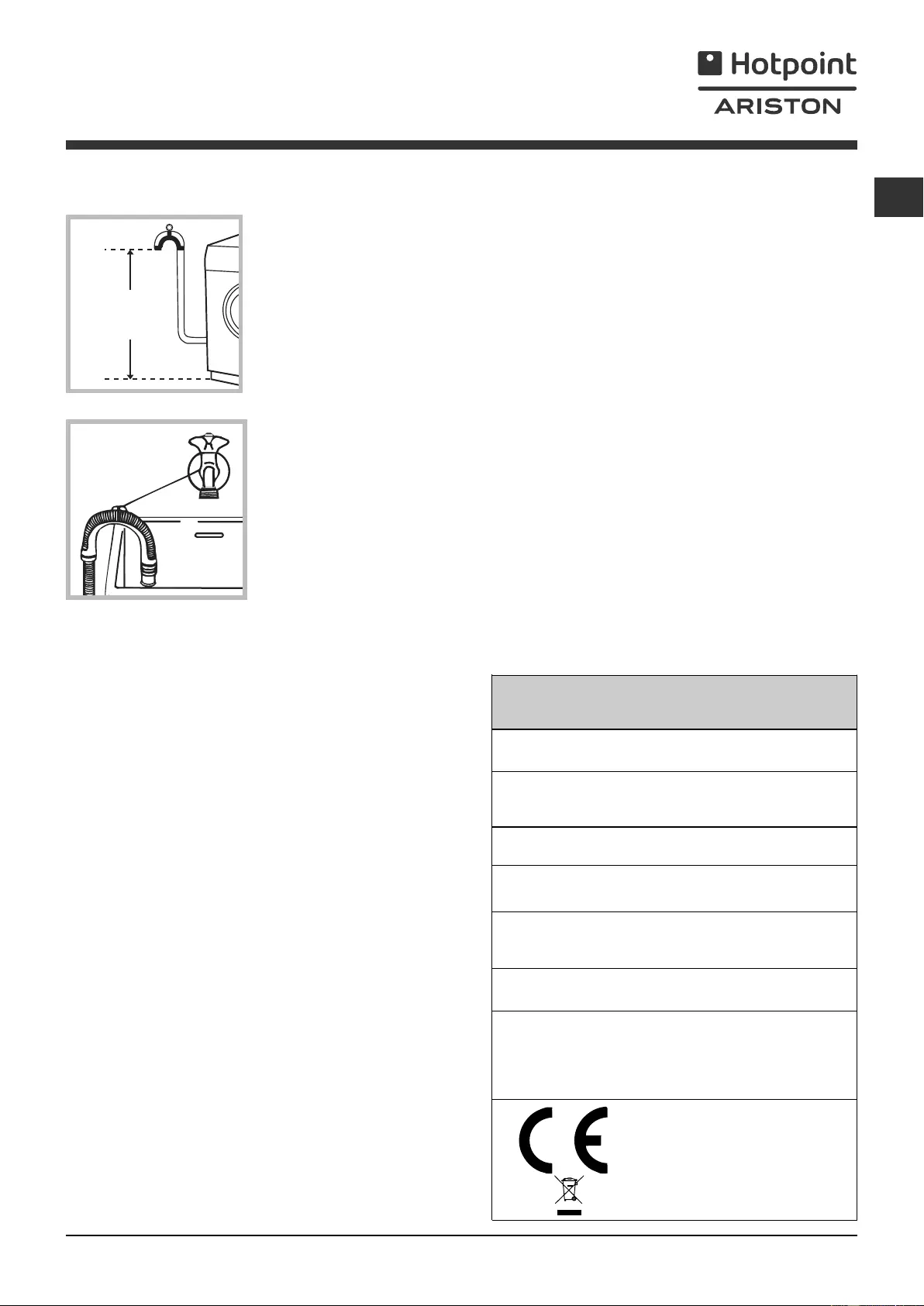
GB
17
Technical da t a
Model AWM 129
Dimensions width 59.5 cm
height 81,5 cm
depth 54 ,5 cm
Capacity from 1 to 7 kg
Electrical
connections pleas e refer t o t h e t echn i cal dat a
plat e fix ed t o t h e mach in e
Water connections maxi mu m pres su re 1 MPa (1 0 bar)
min i mu m p res s u r e 0 .05 MPa ( 0 .5 b ar)
drum capacity 52 litres
Spin speed up to 1200 rot ations per minu te
En er gy rate d
programmes
according to
regulation
EN 60456
programme 6; temperature 60°C;
us ing a load of 7 kg.
Th i s app lian ce co nfo rms t o t he
followin g EC Directives:
— 89/336/EEC dated 03/05/89
(Electromagnetic Compatibility) and
subsequent modifications
— 2002/96/EC
— 2006/95/EC (Low Voltage)
65 — 100 cm
Connecting the drain hose
Connect the drain hose,
without bending it, to a
drainage duct or a wall
drain located at a height
between 65 and 100 cm
from the floor;
alternatively, rest it on
the side of a washbasin
or bathtub, fastening the
duct supplied to the tap
(see figure). The free end
of the hose should not
be underwater.
! We advise against the use of hose extensions; if it is
absolutely necessary, the extension must have the
same diameter as the original hose and must not
exceed 150 cm in length.
Electrical connections
Before plugging the appliance into the electricity
socket, make sure that:
• the socket is earthed and complies with all
applicable laws;
• the socket is able to withstand the maximum power
load of the appliance as indicated in the Technical
data table (see opposite);
• the power supply voltage falls within the values
indicated in the Technical data table (see opposite);
• the socket is compatible with the plug of the
washing machine. If this is not the case, replace
the socket or the plug.
! The washing machine must not be installed
outdoors, even in covered areas. It is extremely
dangerous to leave the appliance exposed to rain,
storms and other weather conditions.
! When the washing machine has been installed, the
electricity socket must be within easy reach.
! Do not use extension cords or multiple sockets.
! The cable should not be bent or compressed.
! The power supply cable must only be replaced by
authorised technicians.
Warning! The company shall not be held responsible
in the event that these regulations are not respected.
The first wash cycle
Once the appliance has been installed, and before
you use it for the first time, run a wash cycle with
detergent and no laundry, using the wash cycle 1.
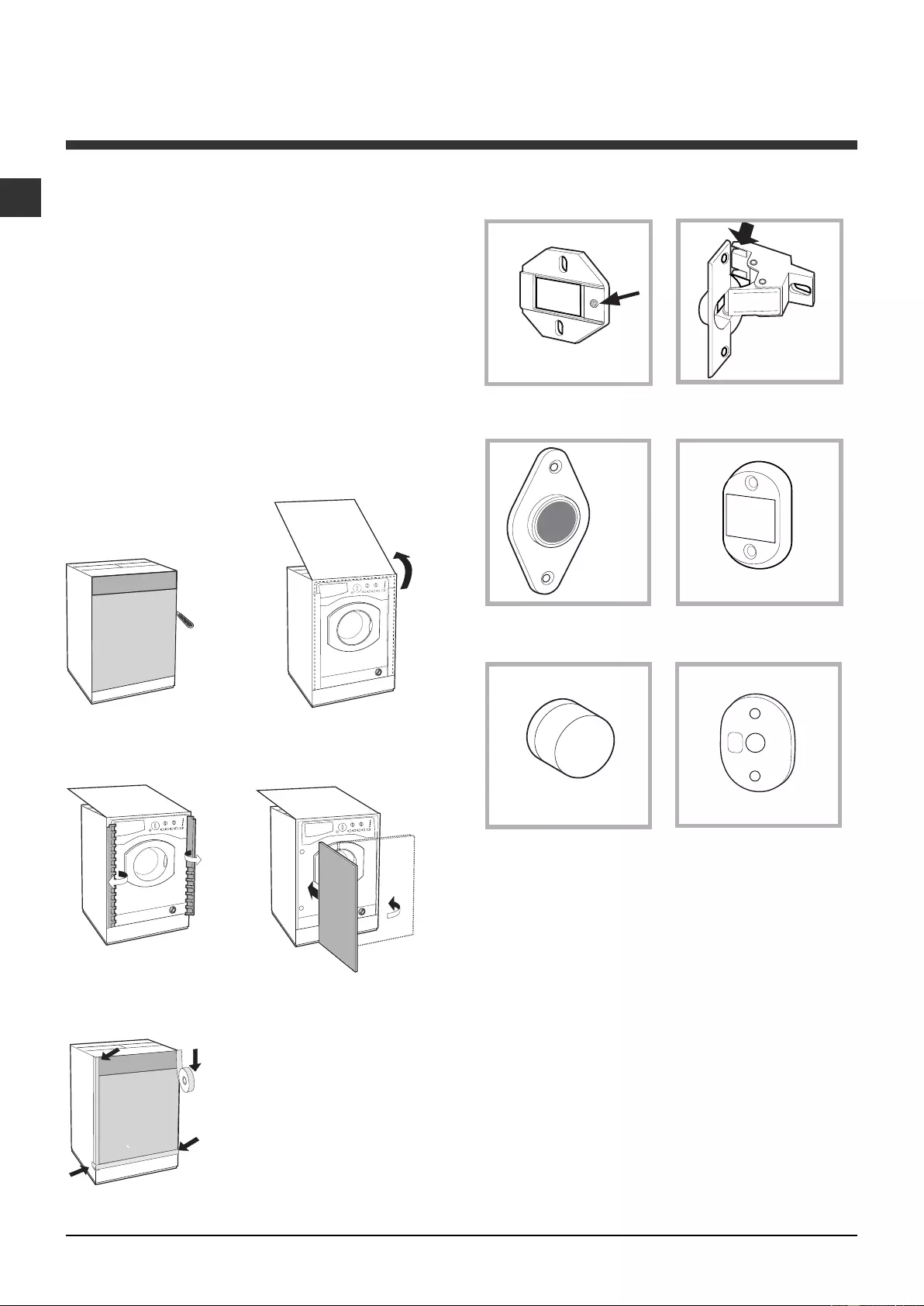
18
GB
Instructions for the fitter
Mounting the wooden panel onto the door and
inserting the machine into cabinets:
In the case where the machine must be shipped for final
installation after the wooden panel has been mounted, we
suggest leaving it in its original packaging. The packaging
was designed to make it possible to mount the wooden
panel onto the machine without removing it completely
(see figures below).
The wooden panel that covers the face of the machine
must not be less than 18 mm in thickness and can be
hinged on either the right or left. For the sake of
practicality when using the machine, we recommend that
the panel be hinged on the same side as the door for the
machine itself — the left.
AB
CD
E
Tur seite
Door Mounting Accessories (Fig. 1-2-3-4-5).
Fig. 1
N° 2 Hinges
N° 1 Magnet N° 1 Magnet plate
N° 1 Rubber plug
N° 2 Hinge Supports
N° 4 Spacers
Fig. 2
Fig. 3 Fig. 4
Fig. 5 Fig. 4/B
— No. 6 type A self-threading screws, l =13 mm.
— No. 2 type B metric, countersunk screws, l =25; for
fastening the magnet plate to the cabinet.
— No. 4 type C metric screws, l =15 mm; for mounting the
hinge supports to the cabinet.
— No. 4 type D metric screws, l =7 mm; for mounting the
hinges on the supports.
Mounting the Parts onto the Face of the Machine.
— Fit the hinge supports to the appliance front panel,
positioning the hole marked with an arrow in fig. 1 so that it
is on the inner side of the front panel. Fit a spacer (fig. 4/B)
between the surfaces using type C screws.
— Fit the magnet plate at the top of the opposite side,
using type B screws to fix two spacers (fig. 4/B) between
the plate and the surface.
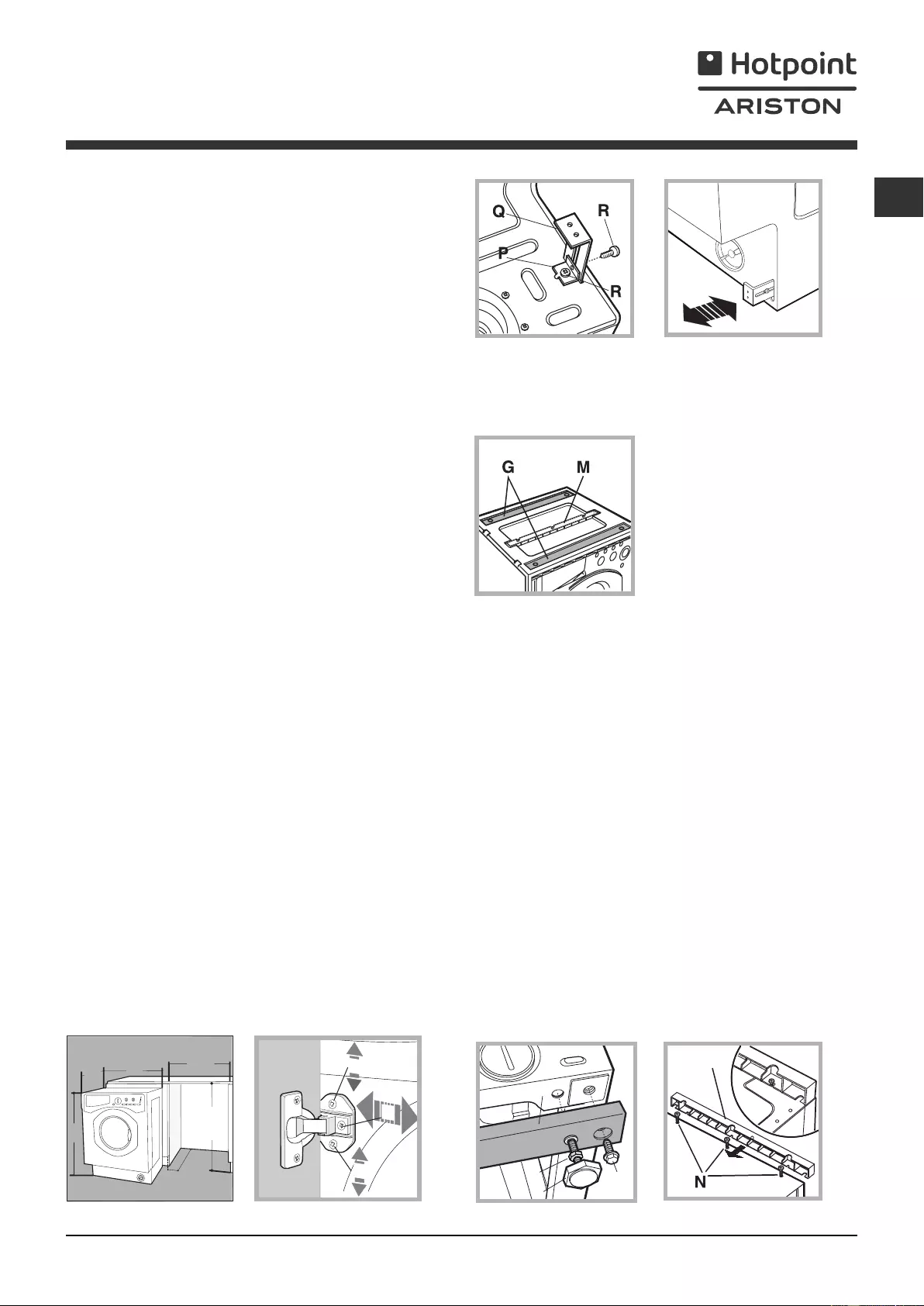
GB
19
Using the Drilling Template.
— To trace the positions of the holes on the left-hand side of
the panel, align the drilling template to the top left side of
the panel using the lines traced on the extremities as a
reference.
— To trace the positions of the holes on the right-hand side
of the panel, align the drilling template to the top right side
of the panel.
— Use an appropriately sized router to mill the holes for the
two hinges, the rubber plug and the magnet.
Mounding the Parts onto the Wooden Panel (Door).
— Insert the hinges into the holes (the movable part of the
hinge must be positioned facing away from the panel) and
fasten them with the 4 type A screws.
— Insert the magnet into the top hole on the opposite side
of the hinges and fasten it with the two type B screws.
— Insert the rubber plug into the bottom hole.
The panel is now ready to be mounted onto the machine.
Mounting the Panel into the machine.
Insert the nib of the hinge (indicated by the arrow in fig. 2)
into the hole for the hinge and push the panel towards the
front of the machine. Fasten the two hinges with the type
D screws.
Fastening the plinth guide.
If the machine is installed at the end of a set of modular
cabinets, mount either one or both of the guides for the
base molding (as shown in fig. 8). Adjust them for depth
based on the position of the base molding, and, if
necessary, fasten the base to the guides (fig. 9).
This is how to assemble the plinth guide (fig.  :
:
Fasten angle P using screw R, insert plinth guide Q into the
special slot and once it is in the desired position, lock it in
place using angle P and screw R.
Inserting the machine into the Cabinet.
— Push the machine into the opening, aligning it with the
cabinets (fig. 6).
— Regulate the adjustable feet to raise the machine to the
appropriate height.
— To adjust the position of the wooden panel in both the
vertical and horizontal directions, use the C and D screws,
as shown in fig. 7.
Important: close the lower part of the appliance front by
ensuring that the plinth rests against the floor.
Fig. 8 Fig. 9
Accessories provided for the height adjustment.
The following can be found inside the polystyrene lid (fig. 10):
2 crossbars (G), 1 strip (M)the following can be found inside
the appliance drum:
4 additional feet (H),
4 screws (I),
4 screws (R),
4 nuts (L),
2 plinth guides (Q)
Adjusting the appliance height.
The height of the appliance can be adjusted (from 815 mm
to 835 mm), by turning the 4 feet.
Should you require the appliance to be placed higher than
the above height, you need to use the following accessories
to raise it to up to 870 mm:
the two crossbars (G); the 4 feet (H); the 4 screws (I); the 4
nuts (L) then perform the following operations (fig. 11):
remove the 4 original feet, place a crossbar G at the front of
the appliance, fastening it in place using screws I (screwing
them in where the original feet were) then insert the new feet H.
Repeat the same operation at the back of the appliance.
Now adjust feet H to raise or lower the appliance from 835
mm to 870 mm.
Once you have reached the desired height, lock nuts L onto
crossbar G.
To adjust the appliance to a height between 870 mm and
900 mm, you need to mount strip M, adjusting feet H to the
required height.
Insert the strip as follows:
loosen the three screws N situated at the front of the Top
cover of the appliance, insert strip M as shown in fig. 12,
then fasten screws N.
D
C
C
570
min
815
540
595
820 ÷ 900
600 min
Fig. 6 Fig. 7
LI
H
G
M
Fig. 11 Fig. 12
Fig. 10
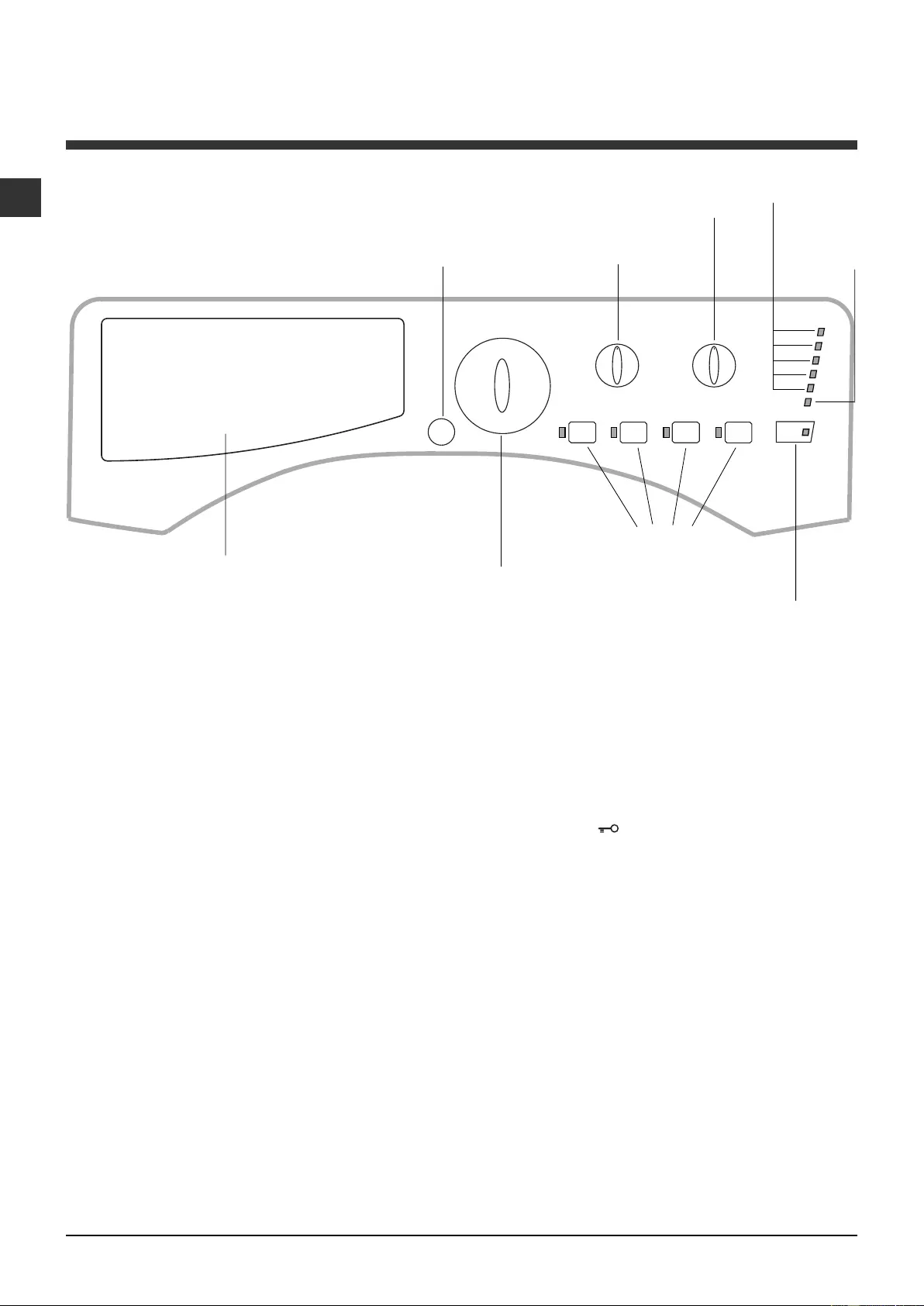
20
GB
Detergent dispenser drawer: used to dispense
detergents and washing additives (see “Detergents
and laundry”).
ON/OFF button: switches the washing machine on
and off.
WASH CYCLE knob: programmes the wash cycles.
During the wash cycle, the knob does not move.
FUNCTION buttons with indicator light: used to
select the available functions. The indicator light
corresponding to the selected function will remain lit.
TEMPERATURE knob: sets the temperature or the
cold wash cycle (see “Personalisation”).
SPIN SPEED knob: sets the spin speed or exclude
the spin cycle completely (see “Personalisation”).
WASH CYCLE PROGRESS/DELAY TIMER
indicator light
s: used to monitor the progress of the
wash cycle.
The illuminated indicator light shows which phase is in
progress.
If the Delay Timer function has been set, the time
remaining until the wash cycle starts will be indicated
(see next page).
DOOR LOCKED indicator light: indicates whether
the door may be opened or not (see next page).
START/PAUSE button with indicator light: starts or
temporarily interrupts the wash cycles.
N.B. To pause the wash cycle in progress, press this
button; the corresponding indicator light will flash
orange, while the indicator light for the current wash
cycle phase will remain lit in a fixed manner. If the
DOOR LOCKED indicator light is switched off, the
door may be opened.
To start the wash cycle from the point at which it was
interrupted, press this button again.
Standby mode
This washing machine, in compliance with new
energy saving regulations, is fitted with an automatic
standby system which is enabled after about 30
minutes if no activity is detected. Press the ON-OFF
button briefly and wait for the machine to start up
again.
Description of the washing machine
and starting a wash cycle
TEMPERATURE
knob
Detergent dispenser drawer
WASH CYCLE PROGRESS/
DELA Y TIMER
indicator lights
FUNCTION
buttons with
indicator lights
ON/OFF
button
SPIN SPEED
knob
DOOR
LOCKED
indicator light
START/
PAUSE
button with
indicator light
Control panel
WASH CYCLE
knob
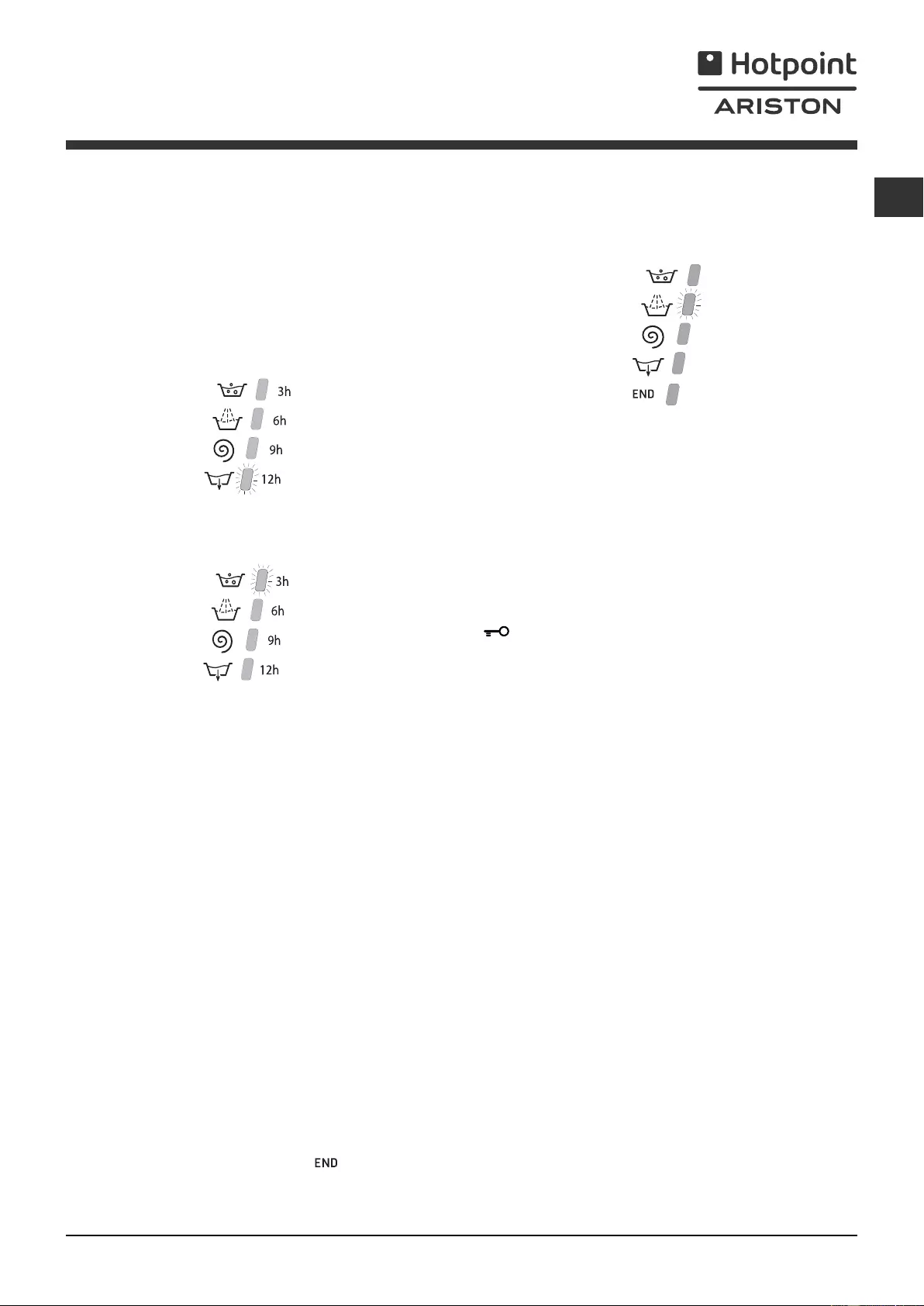
GB
21
Indicator lights
The indicator lights provide important information.
This is what they can tell you:
Delayed start
If the DELAY TIMER function has been activated (see
“Personalisation”), after the wash cycle has been
started the indicator light corresponding to the
selected delay period will begin to flash:
As time passes, the remaining delay will be displayed
and the corresponding indicator light will flash:
Once the set delay has elapsed, the flashing indicator
light will switch off and the selected wash cycle will
begin.
Wash cycle phase indicator lights
Once the desired wash cycle has been selected and has
begun, the indicator lights switch on one by one to
indicate which phase of the cycle is currently in progress.
Function buttons and corresponding indicator
lights
When a function is selected, the corresponding
indicator light will illuminate.
If the selected function is not compatible with the
programmed wash cycle, the corresponding indicator
light will flash and the function will not be activated.
If a function which is incompatible with another
function selected previously, only the most recent
selection will remain active.
Door locked indicator light
If this indicator light is on, the appliance door is locked
to prevent it from being opened accidentally; to avoid
any damage, wait for the indicator light to switch off
before you open the appliance door.
N.B. If the DELAY TIMER function is activated, the door
cannot be opened; pause the machine by pressing the
START/PAUSE button if you wish to open it.
! If the START/PAUSE indicator light (orange) flashes
rapidly at the same time as the function indicator
light, this indicates a problem has occurred (see
“Troubleshooting”).
Starting a wash cycle
1. Turn the washing machine on by pressing the ON/OFF button. All the indicator lights will turn on for a few
seconds, then only the indicator lights relative to the selected programme settings will remain lit and the START/
PAUSE indicator light will flash.
2. Load the laundry and close the door.
3. Set the WASH CYCLE knob to the desired programme.
4. Set the washing temperature (see “Personalisation”).
5. Set the spin speed (see “Personalisation”).
6. Measure out the detergent and washing additives (see “Detergents and laundry”).
7. Select the desired functions.
8. Start the wash cycle by pressing the START/PAUSE button and the corresponding indicator light will remain lit
in a fixed manner, in green.
To cancel the set wash cycle, pause the machine by pressing the START/PAUSE button and select a new cycle.
9. At the end of the wash cycle the indicator light will switch on. The DOOR LOCKED indicator light will switch
off, indicating that the door may be opened. Take out your laundry and leave the appliance door ajar to make
sure the drum dries completely.
Switch the washing machine off by pressing the ON/OFF button.
Wash
Rinse
Spin
Drain
End of wash cycle

22
GB
Specials wash cycles
Sanitizing cycle (wash cycle 6). A high-temperature hygienic wash cycle (over 60°C) which requires the use of bleach.
Pour the bleach, the detergent and the additives into the relevant compartments (see paragraph entitled
“Detergent dispenser drawer”).
Goodnigt cycle (wash cycle 7). This is a silent cycle which can be run at night, when the electricity prices are lower. The
wash cycle is designed for cottons and synthetics. At the end of the cycle the machine stops while there is still water in
the drum; to spin and drain the laundry press the START/PAUSE button; alternatively the machine will perform the spin
cycle and drain the water automatically after 8 hours.
Baby cycle (wash cycle 8). This wash cycle can be used to remove the soiling typically caused by babies, while ensuring
that all detergent is removed from nappies in order to prevent the delicate skin of babies from suffering allergies. The
cycle has been designed to reduce the amount of bacteria by using a greater quantity of water and optimising the effect
of special disinfecting additives added to the detergent.
At the end of the wash cycle, the machine will slowly rotate the drum to prevent the formation of creases; to end the cycle
press the START/PAUSE button.
Mix 30’ (wash cycle 4) this wash cycle was designed to wash lightly soiled garments quickly: it lasts just 30 minutes and
therefore saves both energy and time. By selecting this wash cycle (4 at 30°C), it is possible to wash different fabrics
together (except for wool and silk items), with a maximum load of 3 kg.
Mix 15’(wash cycle 5) this wash cycle was designed to wash lightly soiled garments quickly: it lasts just 15 minutes and
therefore saves both energy and time. By selecting this wash cycle (5 at 30°C), it is possible to wash different fabrics
together (except for wool and silk items), with a maximum load of 1.5 kg.
Wash cycles
The information contained in the table is intended as a guide only.
For all T est Institutes:
1) T est wash cycle in compliance with regulation EN 60456: set wash cycle 6 with a temperature of 60°C.
2) Long wash cycle for cottons: set wash cycle 1 with a temperature of 40°C.
3) Short wash cycle for cottons: set wash cycle 2 with a temperature of 40°C.
Wash cycles
Table of wash cycles
Description of the wash cycle Max
temp.
(°C)
Max.
speed
(rpm)
Detergents Max.
load
(kg)
Cycle
duration
Bleach Wash Fabric
softener
Special cycles
6Sanitizing cycle: Extremely soiled whites. 90° 1200 zz z 7 170
6Sa n i t i z in g cy c le (1 ): Heavily so iled whites and resist ant colou rs. 60° 1200 —zz
7153
7Goodnigt cycle: L igh tly soiled delicate colou rs . 40° 800 —zz
4 290
8Baby cycle: Heavily soiled delicat e colours. 40° 800 —zz
2 118
9Shirts 40° 600 —zz
270
10 Silk/Curtains: F or garment s in s ilk and viscos e, ling erie. 30° 0 —zz
255
11 Wool: Fo r wo ol , cash mere, etc. 40° 600 —zz
1,5 55
Everyday wash cycles (Daily)
1Cotton: Heavily so iled whites and resistant colou rs. 60° 1200 zz z 7122
1Cott on (2): Heavily soi l ed w hites an d del icat e colo urs . 40° 1200 zz z 7 115
2Coloured Cottons (3): L igh t ly soiled wh it es and delicate colou rs . 40° 1200 zz z 785
3Synthetics r e sistents: Heavily soiled resist ant colou rs. 60° 800 —zz
385
3Synthetics delicates: Lightly soiled resistant colours. 40° 800 —zz
370
4Mix 30 ‘: To refresh ligh t ly soiled garments quickly (not s u itable
for wool, silk and clothes which require washing by hand). 30° 800 —zz
330
5Mix 15 ‘: To refresh ligh t ly soiled garments quickly (not s u itable
for wool, silk and clothes which require washing by hand). 30° 800 —zz
1,5 15
Partial wa sh cycles
ARinse —1200 — z736
BLight rinse —800 — z331
CSpin —1200 — —716
DLight spin —800 — —312
EDrain no spin —0— —72
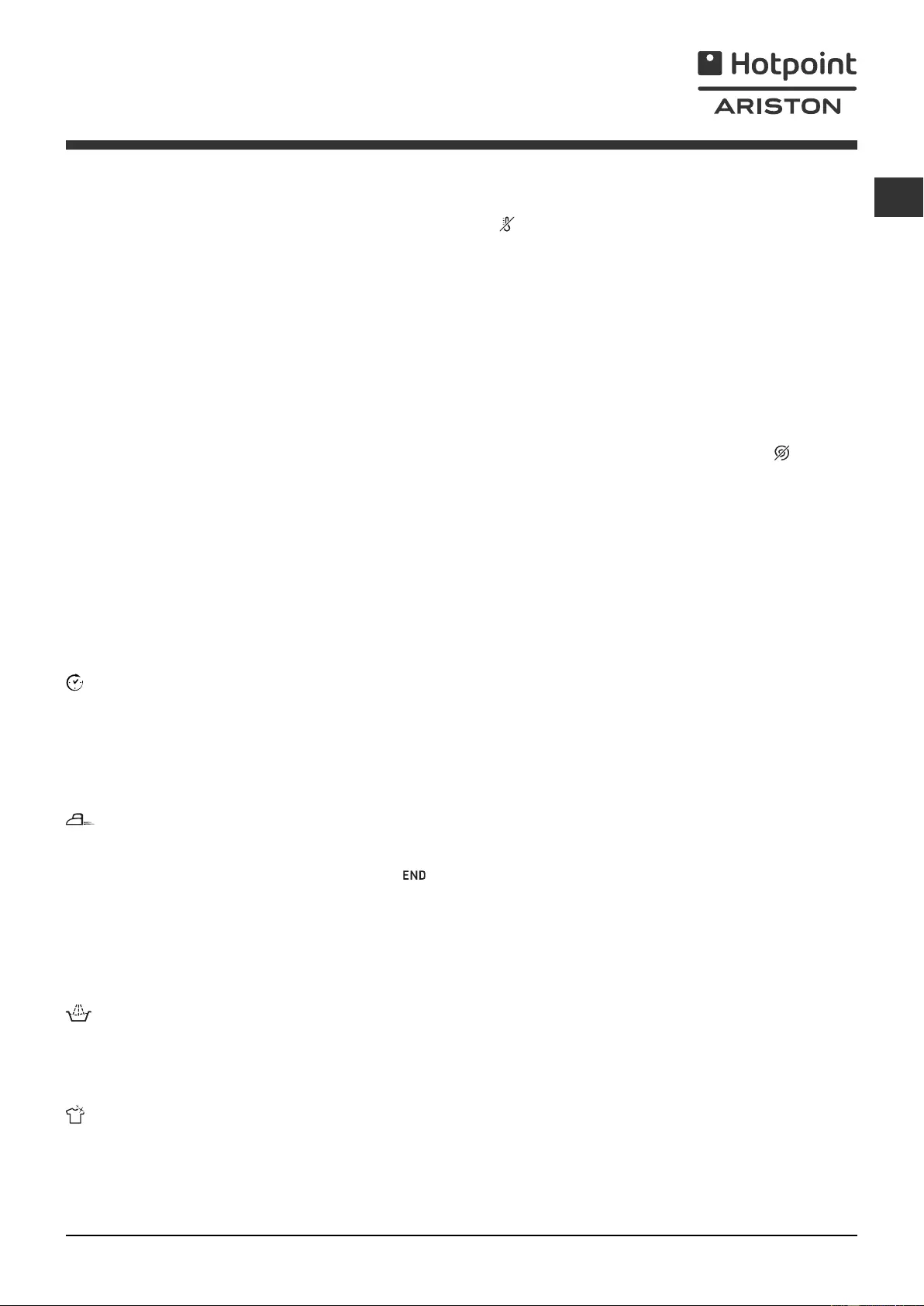
GB
23
Setting the temperature
Turn the TEMPERATURE knob to set the wash temperature (see Table of wash cycles).
The temperature may be lowered, or even set to a cold wash ( ).
The washing machine will automatically prevent you from selecting a temperature which is higher than the
maximum value set for each wash cycle.
Setting the spin speed
Turn the SPIN SPEED knob to set the spin speed for the selected wash cycle.
The maximum spin speeds available for each wash cycle are as follows:
Wash cycles Maximum spin speed
Cottons 1200 rpm
Synthetics 800 rpm
Wool 600 rpm
Silk drain only
The spin speed may be lowered, or the spin cycle can be excluded altogether by selecting the symbol .
The washing machine will automatically prevent you from selecting a spin speed which is higher than the
maximum speed set for each wash cycle.
Functions
The various wash functions available with this washing machine will help to achieve the desired results, every time.
To activate the functions:
1. Press the button corresponding to the desired function;
2. the function is enabled when the corresponding indicator light is illuminated.
Note: If the indicator light flashes rapidly, this signals that this particular function may not be selected in
conjunction with the selected wash cycle.
Delay timer
This timer delays the start time of the wash cycle by up to 12 hours.
Press the button repeatedly until the indicator light corresponding to the desired delay time switches on. The fifth time
the button is pressed, the function will be disabled.
N.B. Once you have pressed the START/PAUSE button, the delay time may only be decreased if you wish to modify it.
!This option is enabled with all programmes.
Easy iron
By selecting this function, the wash and spin cycles will be modified in order to reduce the formation of creases.
At the end of the cycle the washing machine will perform slow rotations of the drum; the EASY IRON and START/
PAUSE indicator lights will flash (orange) and the phase will remain lit in a fixed manner. To end the cycle, press
the START/PAUSE button or the EASY IRON button.
For the Silk (10) wash cycle, the machine will end the cycle while the laundry is soaking, the EASY IRON and
START/PAUSE indicator lights will flash (orange) and the RINSE phase will remain lit in a fixed manner. To drain the
water so that the laundry may be removed, press the START/PAUSE button or the EASY IRON button.
!
This function may not be used in conjunction with wash cycles 4, 5, 6, 7, 8, 11, C, D, E.
Extra rinse
By selecting this function, the efficiency of the rinse is increased and optimal detergent removal is guaranteed. It is
particularly useful for sensitive skin.
! This function may not be used in conjunction with wash cycles 4, 5, C, D, E.
Super Wash
Because a greater quantity of water is used in the initial phase of the cycle, and because of the increased cycle
duration, this function offers a high-performance wash.
! This function may not be used in conjunction with wash cycles 4, 5, 6, 10, 11, A, B, C, D, E.
Personalisation
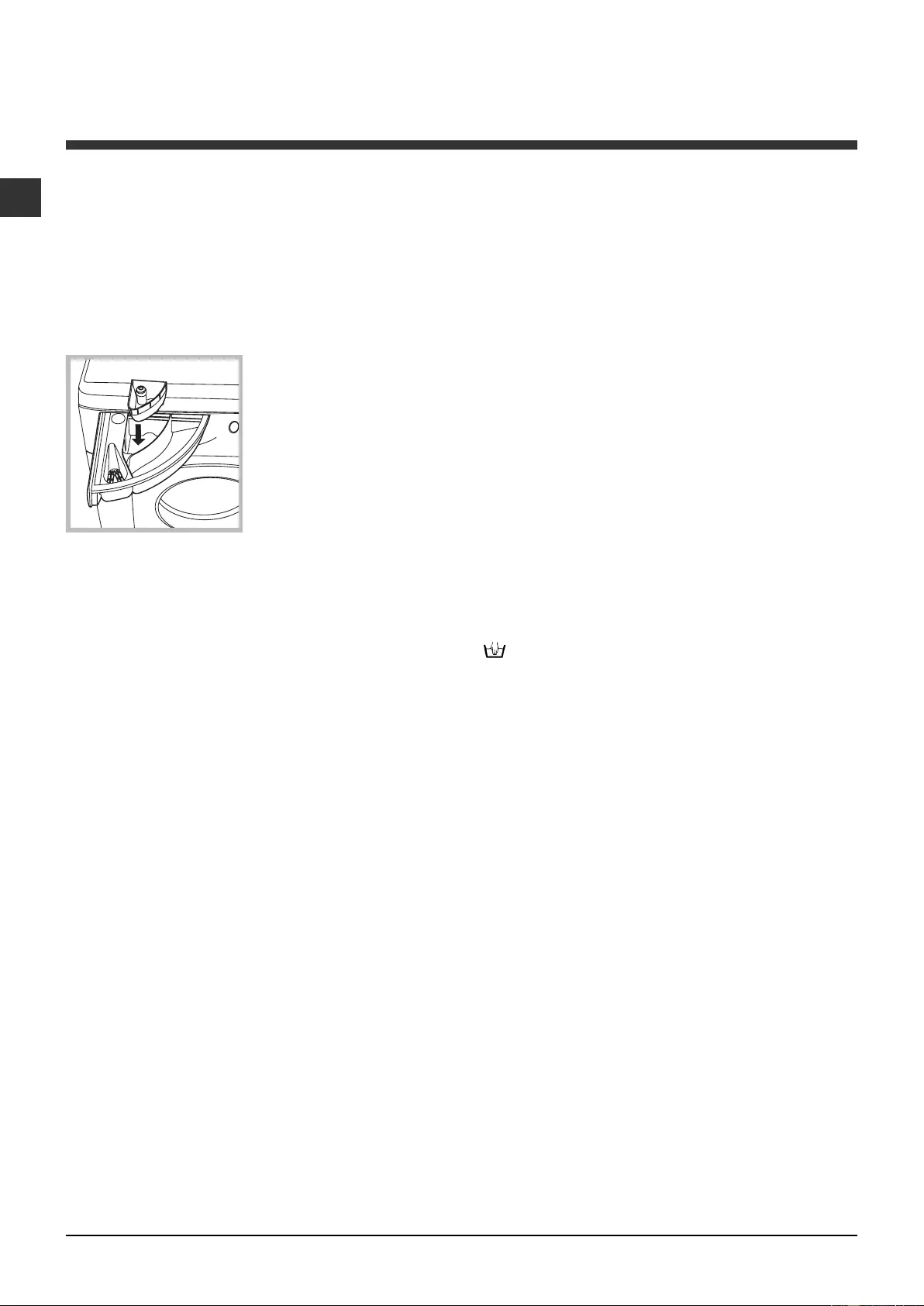
24
GB
Detergents and laundry
Detergent dispenser drawer
Good washing results also depend on the correct
dose of detergent: adding too much detergent will not
necessarily result in a more efficient wash, and may in
fact cause build up on the inside of your appliance
and contribute to environmental pollution.
! Do not use hand washing detergents because these
create too much foam. Open the detergent
dispenser drawer and
pour in the detergent or
washing additive, as
follows.
compartment 1: Detergent for the wash cycle
(powder or liquid)
Liquid detergent should only be poured in immediately
prior to the start of the wash cycle.
compartment 2: Additives (fabric softeners, etc.)
The fabric softener should not overflow the grid.
extra compartment 3: Bleach
Bleach cycle
Bleaching may only be performed in conjunction with
wash cycles 1, 2, 6.
Pour the bleach into extra compartment 3; pour the
detergent and softener into the corresponding
compartments, then select one of the
abovementioned wash cycles.
This option is recommended only for very soiled
cotton garments.
Preparing the laundry
• Divide the laundry according to:
— the type of fabric/the symbol on the label
— the colours: separate coloured garments from
whites.
• Empty all garment pockets and check the buttons.
• Do not exceed the listed values, which refer to the
weight of the laundry when dry:
Durable fabrics: max. 7 kg
Synthetic fabrics: max. 3 kg
Delicate fabrics: max. 2 kg
Wool: max. 1.5 kg
MAX
1
3
2
How much does your laundry weigh?
1 sheet 400-500 g
1 pillow case 150-200 g
1 tablecloth 400-500 g
1 bathrobe 900-1200 g
1 towel 150-250 g
Garments requiring special care
Shirts: use special wash cycle 9 to wash shirts in
various fabrics and colours.
It guarantees maximum care is taken of the garments
and minimises the formation of creases.
Silk: use special wash cycle 10 to wash all silk
garments. We recommend the use of special
detergent which has been designed to wash delicate
clothes.
Curtains:
fold curtains and place them in a pillow
case or mesh bag. Use wash cycle 10.
Wool: Hotpoint/Ariston is the only washing machine
manufacturer to have been awarded the prestigious
Woolmark Platinum Care endorsement (M.0508) by
the Woolmark Company, which means that all
woollen garments may be washed in the washing
machine, even those which state “hand wash only”
on the label. Wash cycle 11 therefore offers
complete peace of mind when washing woollen
garments in the washing machine (max. load 1.5 kg)
and guarantees optimal performance.
Load balancing system
Before every spin cycle, to avoid excessive vibrations
and to distribute the load in a uniform manner, the
drum rotates continuously at a speed which is slightly
greater than the washing rotation speed. If, after
several attempts, the load is not balanced correctly,
the machine spins at a reduced spin speed. If the
load is excessively unbalanced, the washing machine
performs the distribution process instead of spinning.
To encourage improved load distribution and balance,
we recommend small and large garments are mixed
in the load.
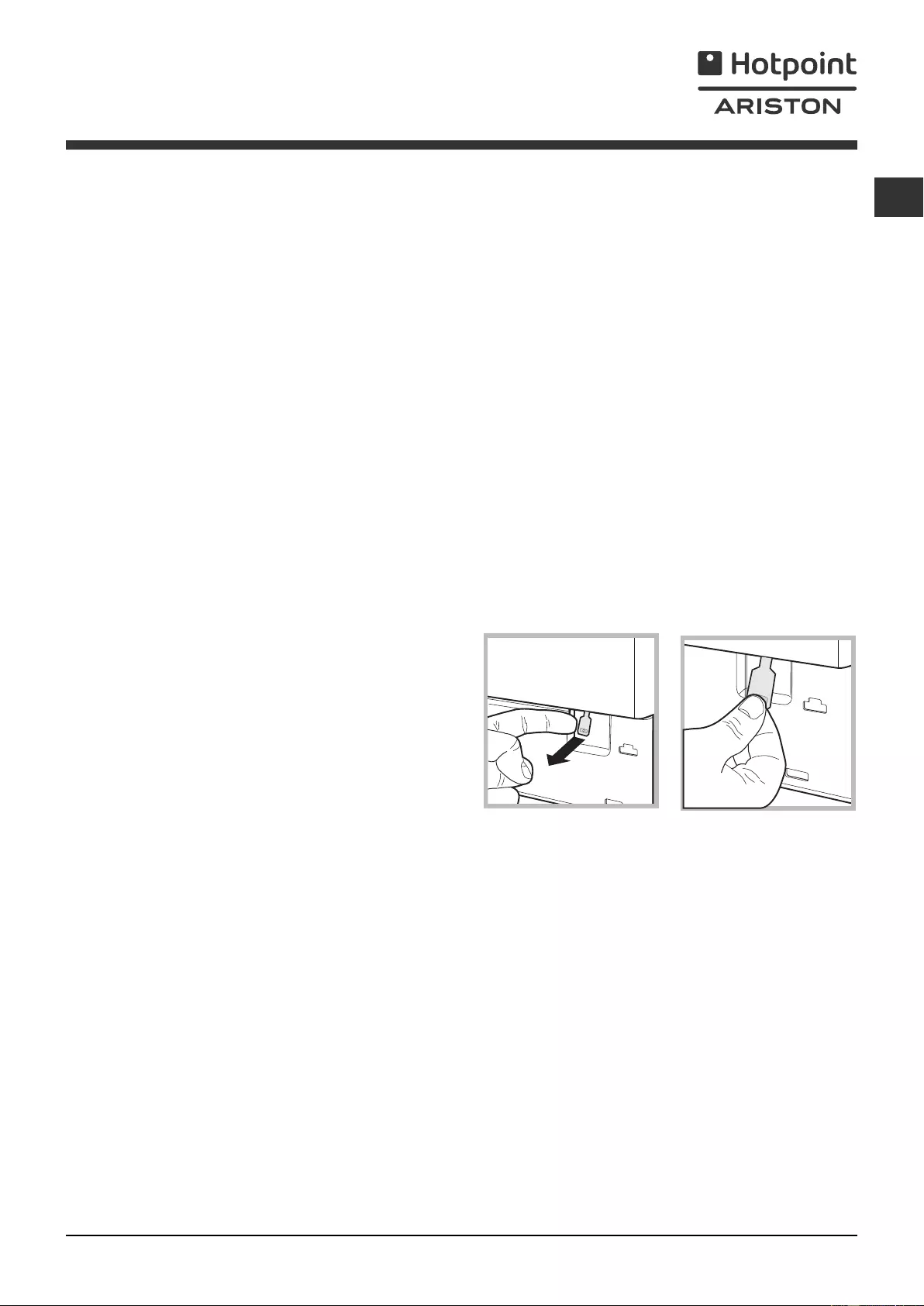
GB
25
Precautions and tips
! This washing machine was designed and
constructed in accordance with international safety
regulations. The following information is provided for
safety reasons and must therefore be read carefully.
General safety
• This appliance was designed for domestic use only.
• This appliance is not intended for use by persons
(including children) with reduced physical, sensory
or mental capabilities, or lack of experience and
knowledge, unless they have been given
supervision or instruction concerning use of the
appliance by a person responsible for their safety.
Children should be supervised to ensure that they
do not play with the appliance.
• Do not touch the machine when barefoot or with
wet or damp hands or feet.
• Do not pull on the power supply cable when
unplugging the appliance from the electricity
socket. Hold the plug and pull.
• Do not open the detergent dispenser drawer while
the machine is in operation.
• Do not touch the drained water as it may reach
extremely high temperatures.
• Never force the porthole door. This could damage
the safety lock mechanism designed to prevent
accidental opening.
• If the appliance breaks down, do not under any
circumstances access the internal mechanisms in
an attempt to repair it yourself.
• Always keep children well away from the appliance
while it is operating.
• The door can become quite hot during the wash cycle.
• If the appliance has to be moved, work in a group
of two or three people and handle it with the utmost
care. Never try to do this alone, because the
appliance is very heavy.
• Before loading laundry into the washing machine,
make sure the drum is empty.
Disposal
• Disposing of the packaging materials: observe local
regulations so that the packaging may be re-used.
• The European Directive 2002/96/EC on Waste
Electrical and Electronic Equipment,requires that
old household electrical appliances must not be
disposed of in the normal unsorted municipal waste
stream. Old appliances must be collected
separately in order to optimise the recovery and
recycling of the materials they contain and reduce
the impact on human health and the environment.
The crossed out «wheeled bin» symbol on the
product reminds you of your obligation, that when
you dispose of the appliance it must be separately
collected.
Consumers should contact their local authority or
retailer for information concerning the correct
disposal of their old appliance.
Opening the porthole door manually
In the event that it is not possible to open the
porthole door due to a powercut, and if you wish to
remove the laundry, proceed as follows:
1. remove the plug from the electrical socket.
2. make sure the water level inside the machine is
lower than the door opening; if it is not, remove
excess water using the drain hose, collecting it in a
bucket.
3. pull outwards using the tab as indicated in the
figure, until the plastic tie-rod is freed from its stop
position; pull downwards and open the door at the
same time.
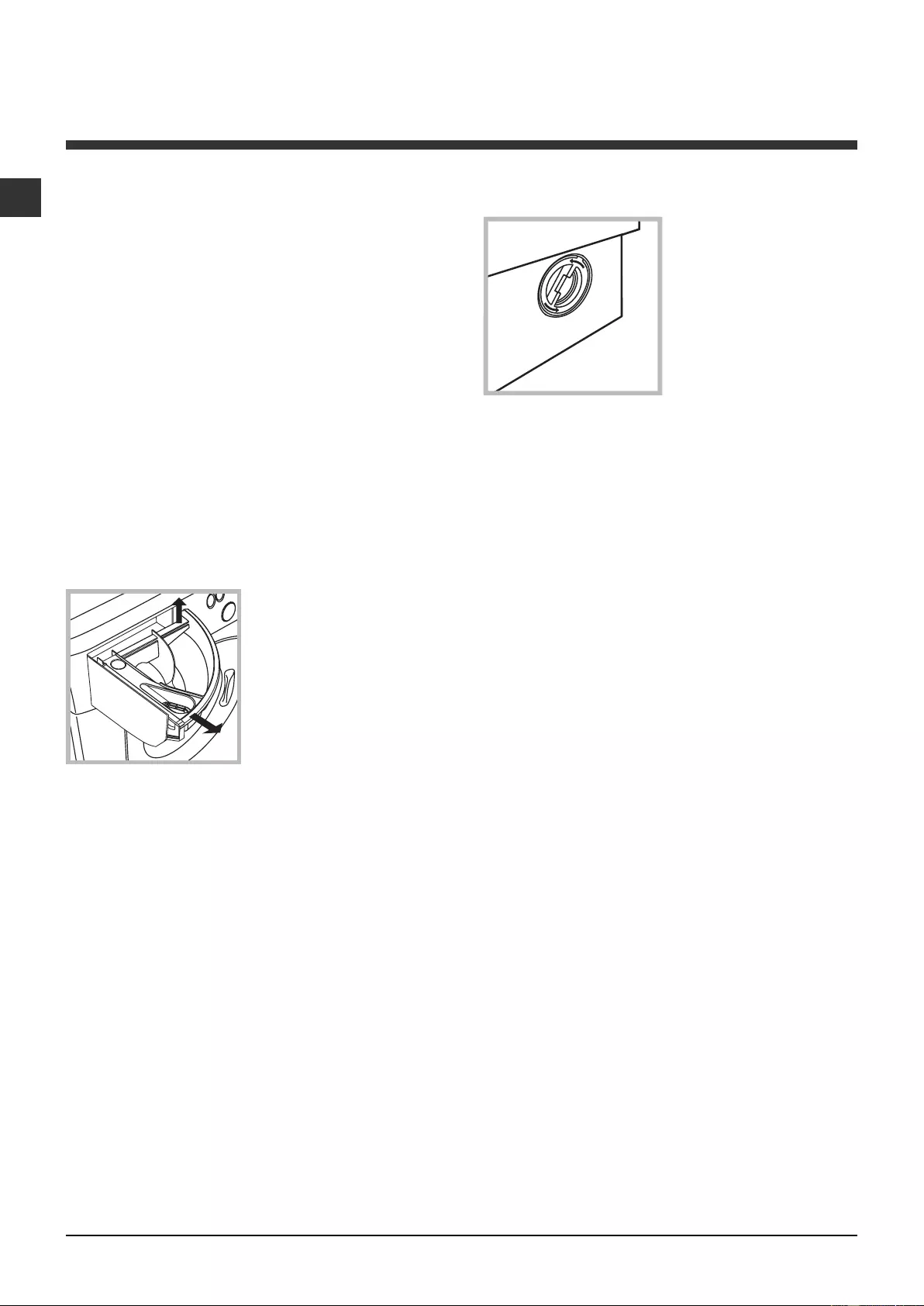
26
GB
Care and maintenance
Cutting off the water and electricity
supplies
• Turn off the water tap after every wash cycle. This
will limit wear on the hydraulic system inside the
washing machine and help to prevent leaks.
• Unplug the washing machine when cleaning it and
during all maintenance work.
Cleaning the washing machine
The outer parts and rubber components of the
appliance can be cleaned using a soft cloth soaked
in lukewarm soapy water. Do not use solvents or
abrasives.
Cleaning the detergent dispenser
drawer
Remove the dispenser
by raising it and pulling it
out (see figure).
Wash it under running
water; this operation
should be repeated
frequently.
Caring for the door and drum of your
appliance
• Always leave the porthole door ajar in order to
prevent unpleasant odours from forming.
Cleaning the pump
The washing machine is fitted with a self-cleaning
pump which does not require any maintenance.
Sometimes, small items (such as coins or buttons)
may fall into the pre-chamber which protects the
pump, situated in its bottom part.
! Make sure the wash cycle has finished and
unplug the appliance.
To access the pre-chamber:
1. unscrew the lid by
rotating it anti-clockwise
(see figure): a little water
may trickle out. This is
perfectly normal;
2. clean the inside thoroughly;
3. screw the lid back on.
Checking the water inlet hose
Check the inlet hose at least once a year. If there are
any cracks, it should be replaced immediately: during
the wash cycles, water pressure is very strong and a
cracked hose could easily split open.
!!
!!
!
Never use second-hand hoses.

GB
27
Troubleshooting
Your washing machine could fail to work. Before contacting the Technical Assistance Centre (see “Assistance”),
make sure that the problem cannot be not solved easily using the following list.
Problem:
The washing machine does not
switch on.
The wash cycle does not start.
The washing machine does not
take in water (the indicator light
for the first wash cycle stage
flashes rapidly).
The washing machine
continuously takes in and drains
water.
The washing machine does not
drain or spin.
The washing machine vibrates a
lot during the spin cycle.
The washing machine leaks.
The START/PAUSE indicator light
(orange) and the function
indicator lights flash rapidly.
There is too much foam.
Possible causes / Solutions:
• The appliance is not plugged into the socket fully, or is not making contact.
• There is no power in the house.
• The washing machine door is not closed properly.
• The ON/OFF button has not been pressed.
• The START/PAUSE button has not been pressed.
• The water tap has not been opened.
• A delayed start has been set (see “Personalisation”).
• The water inlet hose is not connected to the tap.
• The hose is bent.
• The water tap has not been opened.
• There is no water supply in the house.
• The pressure is too low.
• The START/PAUSE button has not been pressed.
• The drain hose is not fitted at a height between 65 and 100 cm from
the floor (see “Installation”).
• The free end of the hose is under water (see “Installation”).
• The wall drainage system is not fitted with a breather pipe.
If the problem persists even after these checks, turn off the water tap,
switch the appliance off and contact the Assistance Service. If the
dwelling is on one of the upper floors of a building, there may be problems
relating to water drainage, causing the washing machine to fill with water
and drain continuously. Special anti-draining valves are available in shops
and help to avoid this inconvenience.
• The wash cycle does not include draining: some wash cycles require
the drain phase to be started manually.
• The EASY IRON function has been activated: To complete the wash
cycle, press the START/PAUSE button (“Personalisation”).
• The drain hose is bent (see “Installation”).
• The drainage duct is clogged.
• The drum was not unlocked correctly during installation (see “Installation”).
• The washing machine is not level (see “Installation”).
• The washing machine is trapped between cabinets and walls (see “Installation”).
• The water inlet hose is not screwed on properly (see “Installation”).
• The detergent dispenser drawer is blocked (for cleaning instructions, see
“Care and maintenance”).
• The drain hose is not fixed properly (see “Installation”).
• Switch off the machine and unplug it, wait for approximately 1 minute
and then switch it back on again.
If the problem persists, contact the Technical Assistance Service.
• The detergent is not suitable for machine washing (it should display the
text “for washing machines” or “hand and machine wash”, or the like).
• Too much detergent was used.

28
GB
Service
Before calling for Assistance:
•Check whether you can solve the problem alone (see “Troubleshooting”);
• Restart the programme to check whether the problem has been solved;
• If this is not the case, contact an authorised Technical Assistance Centre using the telephone number
provided on the guarantee certificate.
!Always request the assistance of authorised technicians.
Have the following information to hand:
• the type of problem;
• the appliance model (Mod.);
• the serial number (S/N).
This information can be found on the data plate applied to the rear of the washing machine, and can also
be found on the front of the appliance by opening the door.

FR
29
Français
Sommaire
Installation, 30-31-32-33
Déballage et mise à niveau
Raccordements eau et électricité
Premier cycle de lavage
Caractéristiques techniques
Instructions pour l’installateur
Description du lave-linge et
démarrage d’un programme, 34-35
Bandeau de commandes
Voyants
Démarrage d’un programme
Programmes,36
Tableau des programmes
Personnalisations, 37
Sélection de la température
Sélection de l’essorage
Fonctions
Produits lessiviels et linge, 38
Tiroir à produits lessiviels
Cycle blanchissage
Triage du linge
Linge ou vêtements particuliers
Système d’équilibrage de la charge
Précautions et conseils, 39
Sécurité générale
Mise au rebut
Ouverture manuelle du hublot
Entretien et soin, 40
Coupure de l’arrivée d’eau et du courant
Nettoyage du lave-linge
Nettoyage du tiroir à produits lessiviels.
Entretien du hublot et du tambour
Nettoyage de la pompe
Contrôle du tuyau d’arrivée de l’eau
Anomalies et remèdes, 41
Assistance, 42
FR
AWM 129
Mode d’emploi
LAVE-LINGE
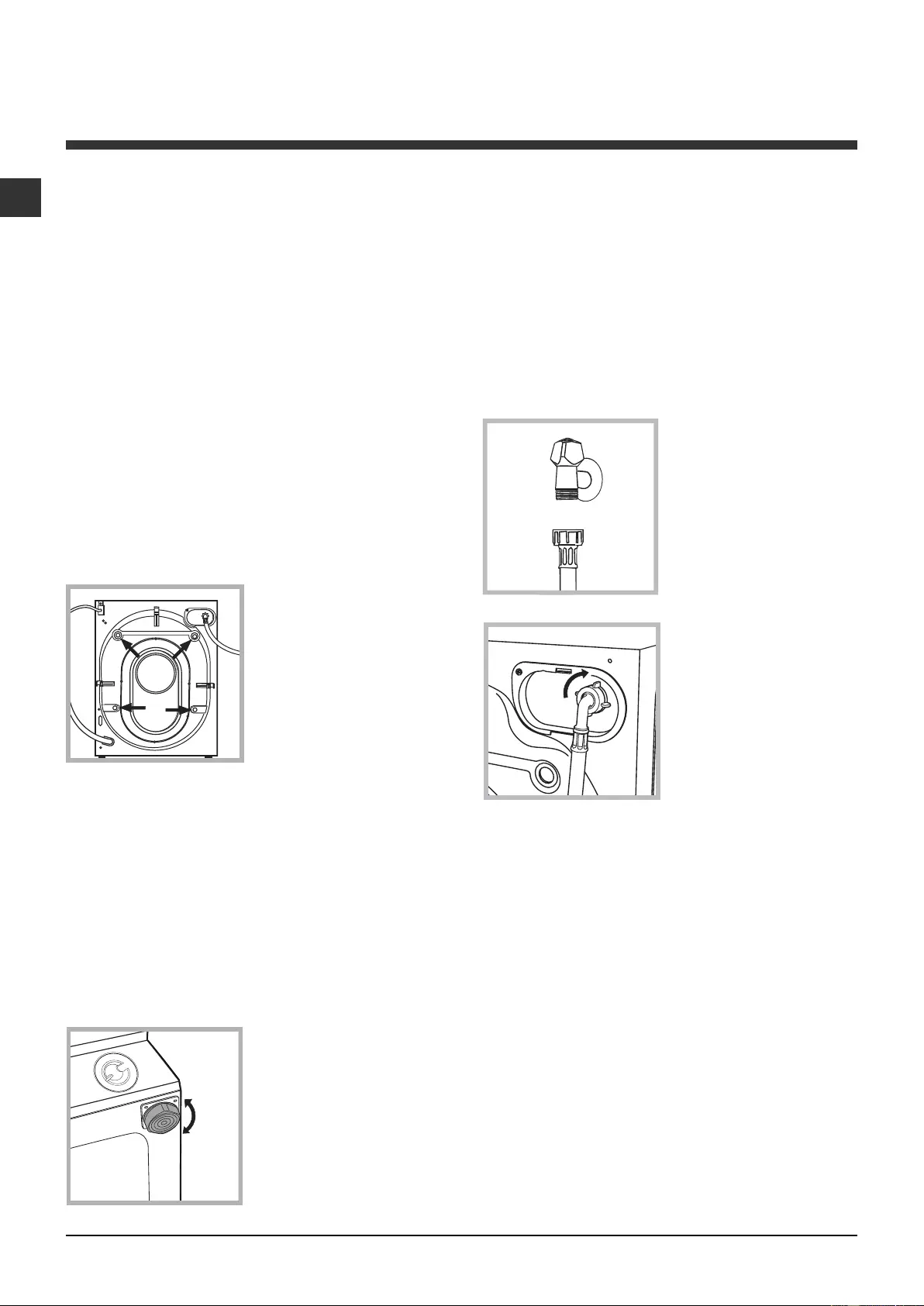
30
FR
Installation
! Conserver ce mode d’emploi pour pouvoir le
consulter à tout moment. En cas de vente, de
cession ou de déménagement, veiller à ce qu’il suive
toujours le lave-linge pour que son nouveau
propriétaire soit informé sur son mode de
fonctionnement et puisse profiter des conseils
correspondants.
!
Lire attentivement les instructions: elles fournissent
des conseils importants sur l’installation, l’utilisation et
la sécurité de l’appareil.
Déballage et mise à niveau
Déballage
1. Déballer le lave-linge.
2. Contrôler que le lave-linge n’a pas été endommagé
pendant le transport. S’il est abîmé, ne pas le
raccorder et contacter le vendeur.
3. Enlever les 4 vis de
protection servant au
transport, le caoutchouc
et la cale, placés dans la
partie arrière (voir figure).
4. Boucher les trous à l’aide des bouchons plastique
fournis.
5. Conserver toutes ces pièces: il faudra les remonter
en cas de transport du lave-linge.
! Les pièces d’emballage ne sont pas des jouets pour
enfants.
Mise à niveau
1. Installer le lave-linge sur un sol plat et rigide, sans
l’appuyer contre des murs, des meubles ou autre.
2. Si le sol n’est pas
parfaitement horizontal,
visser ou dévisser les
pieds de réglage avant
(voir figure) pour niveler
l’appareil; son angle
d’inclinaison, mesuré sur
le plan de travail, ne doit
pas dépasser 2°.
Une bonne mise à niveau garantit la stabilité de
l’appareil et évite qu’il y ait des vibrations, du bruit et
des déplacements en cours de fonctionnement. Si la
machine est posée sur de la moquette ou un tapis,
régler les pieds de manière à ce qu’il y ait
suffisamment d’espace pour assurer une bonne
ventilation.
Raccordements eau et électricité
Raccordement du tuyau d’arrivée de l’eau
1. Reliez le tuyau
d’alimentation en le
vissant à un robinet d’eau
froide à embout fileté 3/4
gaz (voir figure).
Faire couler l’eau jusqu’à
ce qu’elle soit limpide et
sans impuretés avant de
raccorder.
2. Raccorder le tuyau
d’arrivée de l’eau au
lave-linge en le vissant à
la prise d’eau prévue,
dans la partie arrière en
haut à droite (voir figure).
3. Attention à ce que le tuyau ne soit pas plié ou
écrasé.
! La pression de l’eau doit être comprise entre les
valeurs indiquées dans le tableau des Caractéristiques
techniques (voir page ci-contre).
! Si la longueur du tuyau d’alimentation ne suffit pas,
s’adresser à un magasin spécialisé ou à un technicien
agréé.
!!
!!
!
N’utiliser que des tuyaux neufs.
!!
!!
!
Utiliser ceux qui sont fournis avec l’appareil.
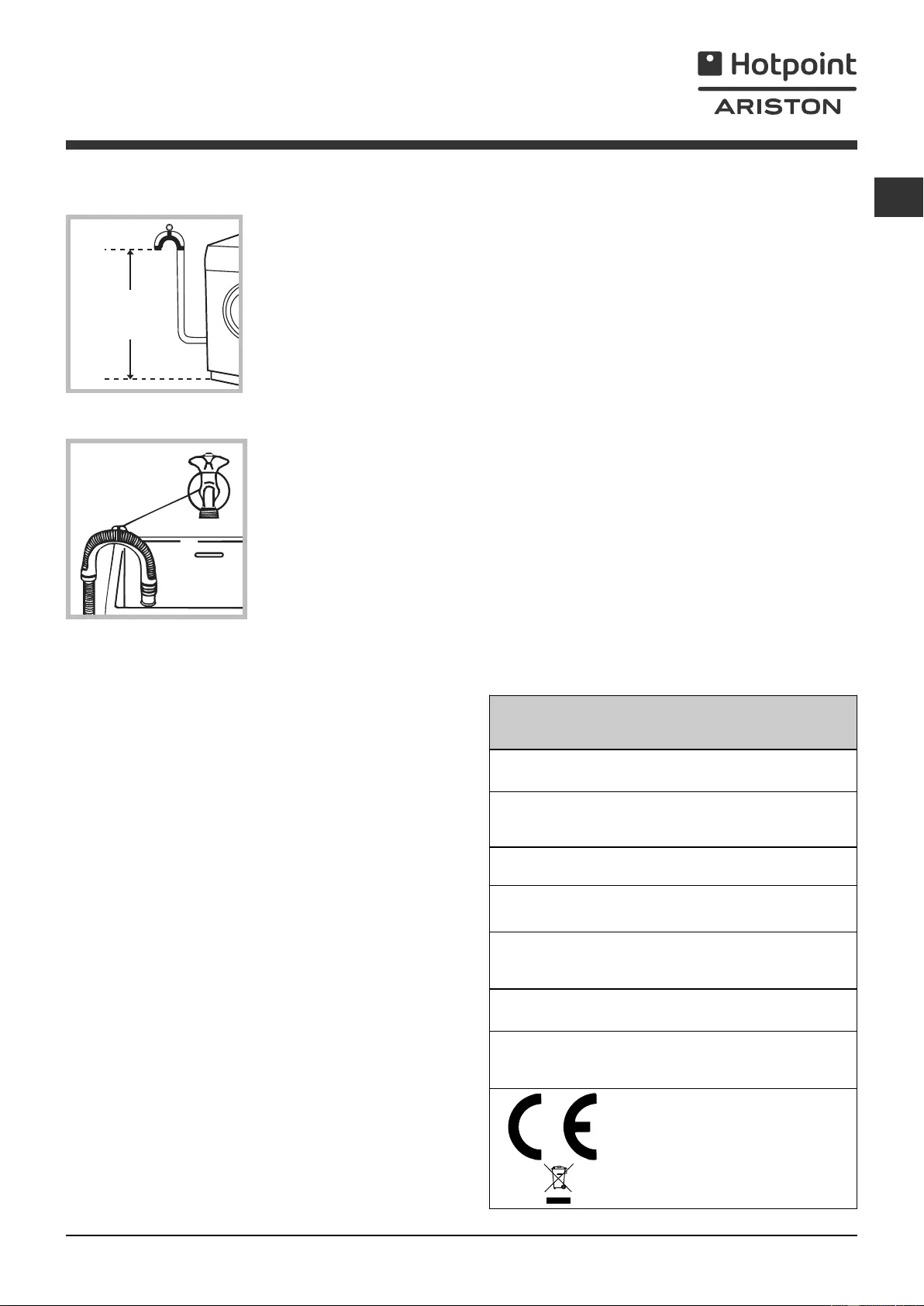
FR
31
65 — 100 cm
Raccordement du tuyau de vidange
Raccorder le tuyau
d’évacuation, sans le
plier, à un conduit
d’évacuation ou à une
évacuation murale placés
à une distance du sol
comprise entre 65 et 100
cm;
ou bien l’accrocher à un
évier ou à une baignoire,
dans ce cas, fixer le
support en plastique
fourni avec l’appareil au
robinet (voir figure).
L’extrémité libre du tuyau
d’évacuation ne doit pas
être plongée dans l’eau.
! L’utilisation d’un tuyau de rallonge est absolument
déconseillée mais si on ne peut faire autrement, il faut
absolument qu’il ait le même diamètre que le tuyau
original et sa longueur ne doit pas dépasser 150 cm.
Branchement électrique
Avant de brancher la fiche dans la prise de courant,
s’assurer que:
• la prise est bien reliée à la terre et est conforme aux
réglementations en vigueur;
• la prise est bien apte à supporter la puissance
maximale de l’appareil indiquée dans le tableau des
Caractéristiques techniques (voir ci-contre);
• la tension d’alimentation est bien comprise entre les
valeurs figurant dans le tableau des Caractéristiques
techniques (voir ci-contre);
• la prise est bien compatible avec la fiche du lave-
linge. Autrement, remplacer la prise ou la fiche.
! Le lave-linge ne doit pas être installé dehors, même
à l’abri, car il est très dangereux de le laisser exposé
à la pluie et aux orages.
! Après installation du lave-linge, la prise de courant
doit être facilement accessible.
! N’utiliser ni rallonges ni prises multiples.
! Le câble ne doit être ni plié ni trop écrasé.
! Le câble d’alimentation ne doit être remplacé que
par des techniciens agréés.
Attention! Nous déclinons toute responsabilité en cas
de non-respect des normes énumérées ci-dessus.
Premier cycle de lavage
Avant la première mise en service de l’appareil,
effectuer un cycle de lavage avec un produit lessiviel
mais sans linge et sélectionner le programme 1.
Ca ractéristiques techniques
Modèle AWM 129
Dimensions largeur 59,5 cm
hauteur 81,5 cm
profondeur 54,5 cm
Capacité de 1 à 7 kg
Raccordements
électriques Voir la plaque sign alétique appliquée
sur la machine
Raccordements
hydrauliques
pression maximale 1 MPa (10 bar)
pression minimale 0,05 MPa (0,5 bar)
capacit é du tamb ou r 5 2 li tr es
Vitesse
d’essorage jusqu’à 1200 tours minute
Programmes de
con trôle selon l a
norme EN 60456
pro gr amme 6; tempér atu re 6 0°C;
effect u é avec un e ch arg e de 7 k g.
Cet apparei l es t confo rme au x
Di rect i ves Co mmu n au t ai res s uivan t es :
— 89/336/CEE du 03/05/89
(C omp ati bi l it é él ect ro mag n ét i qu e) et
mod ifi cat io n s su i van tes
— 2002/96/CE
— 2006/95/CE (Basse Tension)
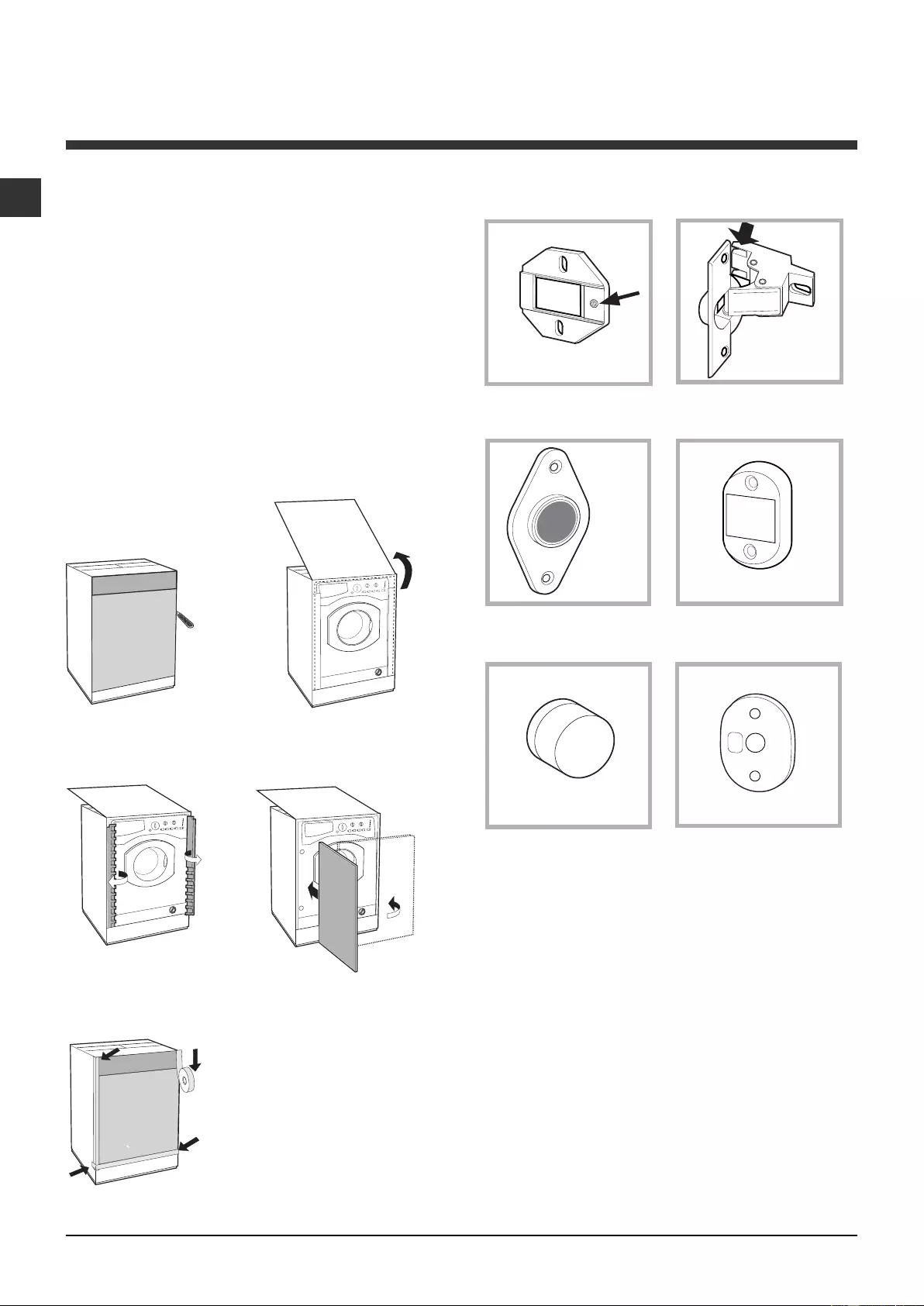
32
FR
Instructions pour l’installateur
Application du panneau d’habillage en bois sur
la porte et montage du machine à laver à
l’intérieur des éléments:
Au cas où, après le montage du panneau en bois, il faudrait
expédier la machine pour son installation finale, nous vous
conseillons de la laisser dans son emballage d’origine.
L’emballage a été justement réalisé de manière à permettre
le montage du panneau en bois sur la machine sans
déballer complètement le produit (voir figures ci-dessous).
Le panneau en bois couvrant la façade ne doit pas avoir
plus de 18 mm d’épaisseur, il peut être articulé tant à
droite qu’à gauche. Pour plus de facilité d’emploi, nous
conseillons d’adopter le même sens d’ouverture que pour
le hublot dont les charnières sont montées sur le côté
gauche.
AB
CD
E
Tur seite
Accessoires montage porte (Fig.1-2-3-4-5).
Fig. 1
N°2 Charnière
N°1 Aimant N°1 Butoir aimant
N°1 Cheville en
caoutchouc
N°2 Supports charnière
N°4 Cales
Fig. 2
Fig. 3 Fig. 4
Fig. 5 Fig. 4/B
— 6 vis autotaraudeuses l = 13 mm «type A«.
— 2 vis métriques à tête évasée l = 25 mm «type B«; pour
fixation du butoir aimant au meuble.
— 4 vis métriques l = 15 mm «type C«; pour montage des
supports charnière au meuble.
— 4 vis métriques l = 7 mm «type D«; pour montage des
charnières aux supports.
Montage des pièces sur la façade de la machine.
— Montez les supports de la charnière sur la façade, en
positionnant le trou indiqué par une flèche dans la fig. 1
vers l’intérieur de la façade et interposez une cale (fig. 4/B).
Utilisez les vis type C.
— Montez le butoir aimant du côté opposé en haut et
interposez deux cales (fig. 4/B). Utilisez les deux vis type B.
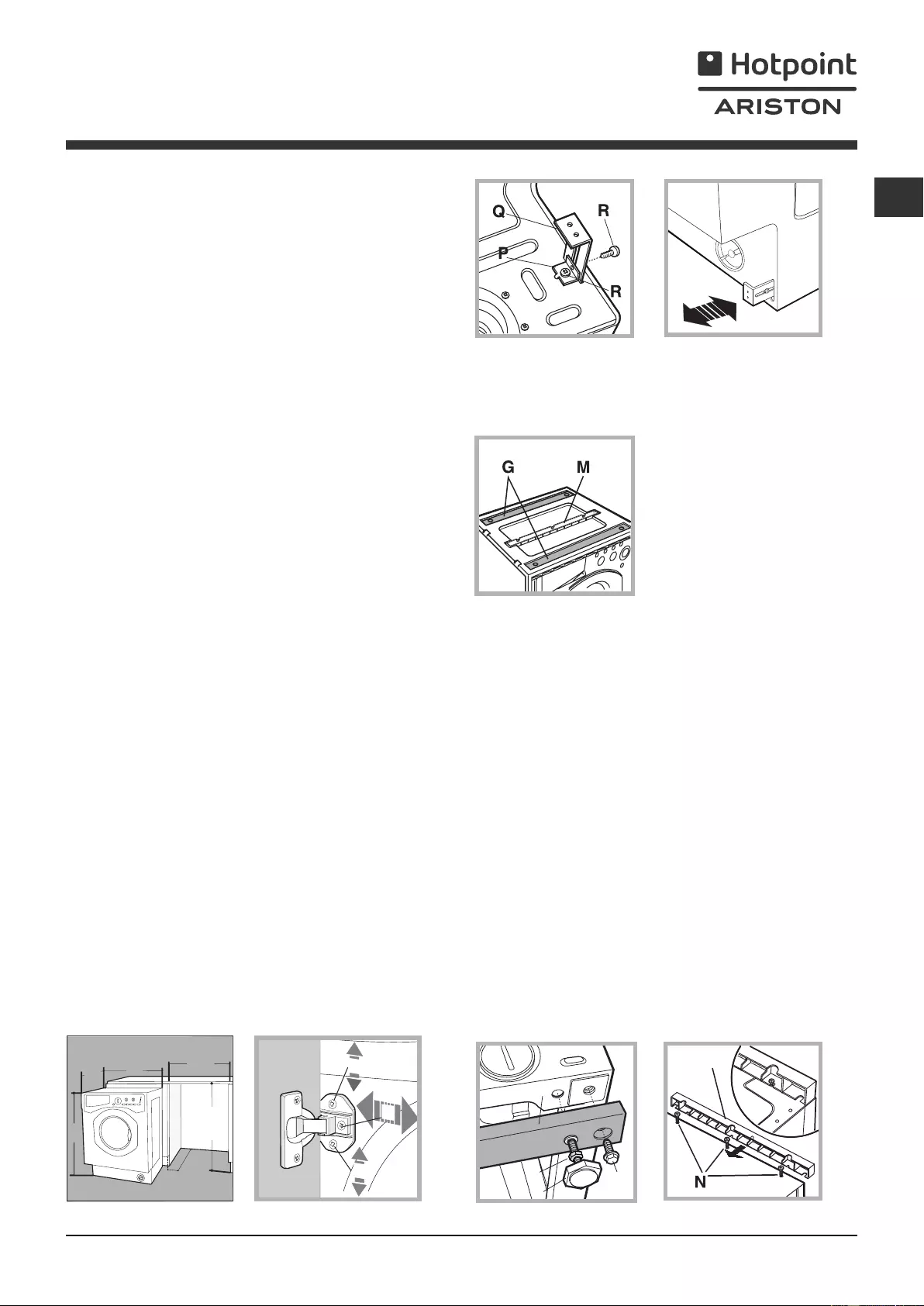
FR
33
Utilisation du gabarit de forage.
— Pour marquer l’emplacement des trous sur le côté du
panneau, alignez le gabarit de perçage avec le côté
supérieur gauche du panneau en vous servant des lignes
tracées aux extrémités.
— Pour marquer l’emplacement des trous sur le côté droit
du panneau, alignez le gabarit de perçage avec le côté
supérieur droit du panneau.
— Réalisez à l’aide d’une fraise appropriée les quatre
emplace-ments où devront trouver place les deux
charnières, la cheville en caoutchouc et l’aimant.
Montage des pièces sur le panneau en bois (Porte).
— Montez les charnières aux emplacements prévus (la partie
mobile de la charnière doit se trouver vers l’extérieur du
panneau) et fixez-les à l’aide de 4 vis type A.
— Montez l’aimant à son emplacement en haut, à l’opposé
des charnières et fixez-le au moyen de deux vis type B.
— Montez la cheville en caoutchouc à sa place en bas.
Le panneau est à présent prêt, vous pouvez le monter sur
la machine.
Montage du panneau sur la machine.
Introduisez l’ergot de la charnière indiqué par la flèche fig. 2
dans le logement du support charnière, poussez le panneau
vers la façade de la machine et fixez les deux charnières à
l’aide des deux vis type D.
Fixation du support de la base.
Si la machine est installée à une extrémité de la cuisine
intégrée, montez une ou les deux glissières du socle
comme illustré fig. 8 en réglant leur profondeur en fonction
de la position du socle et, au besoin, fixez-le à ces
dernières fig. 9. Pour monter le support de la base,
procédez comme suit (fig. : Fixez l’équerre P à l’aide de
la vis R, insérez le support de la base Q dans la fente
prévue et après l’avoir dûment positionné bloquez-le à
l’aide de l’équerre d’assemblage P et de la vis R.
Montage de la machine à l’intérieur des éléments.
— Poussez la machine à travers l’ouverture en l’alignant aux
autres meubles (fig. 6).
— Servez-vous des pieds de réglage pour amener la
machine à la hauteur désirée.
— Pour régler la position du panneau en bois à la verticale et à
l’horizontale, servez-vous des vis C et D comme illustré fig. 7.
Important: fermez la partie inférieure de la façade, la base
touchant au sol.
Fig. 8 Fig. 9
Accessoires fournis pour le réglage de la hauteur.
V ous tr ouverez à l’intérieur du couvercle en polystyrène (fig. 10):
2 traverses (G); 1 listel (M);et à l’intérieur du tambour :
4 pieds supplémentaires (H),
4 vis (I),
4 vis (R),
4 écrous (L),
2 supports pour la base (Q)
Réglage de la machine en hauteur.
La machine peut être réglée en hauteur (de 815 mm à 835
mm) à l’aide de ses 4 pieds.
Si vous souhaitez l’amener à une hauteur supérieure à celle
qui est indiquée plus haut, c’est à dire jusqu’à 870 mm,
utilisez les accessoires suivants :
les 2 traverses (G); les 4 pieds (H); les 4 vis (I); les 4 écrous
(L) puis procédez comme suit (fig. 11):
démontez les 4 pieds originaux, positionnez une traverse G
dans la partie avant de la machine, fixez-la à l’aide des vis I
(en les vissant dans les trous où étaient fixés les pieds
originaux) puis montez les nouveaux pieds H.
Procédez de même dans la partie arrière de la machine.
Vous pouvez alors régler les pieds H pour élever ou abaisser
la machine de 835 mm à 870 mm.
Après avoir atteint la hauteur désirée, bloquez les écrous L à
la traverse G.
Pour régler la machine à une hauteur comprise entre 870
mm et 900 mm, montez le listel M et réglez les pieds H
jusqu’à la hauteur souhaitée.
Pour monter le listel, procédez comme suit:
desserrez les trois vis N situées dans la partie avant du couvercle,
montez le listel M comme illustré fig. 12 et serrez les vis N.
D
C
C
570
min
815
540
595
820 ÷ 900
600 min
Fig. 6 Fig. 7
LI
H
G
M
Fig. 11 Fig. 12
Fig. 10
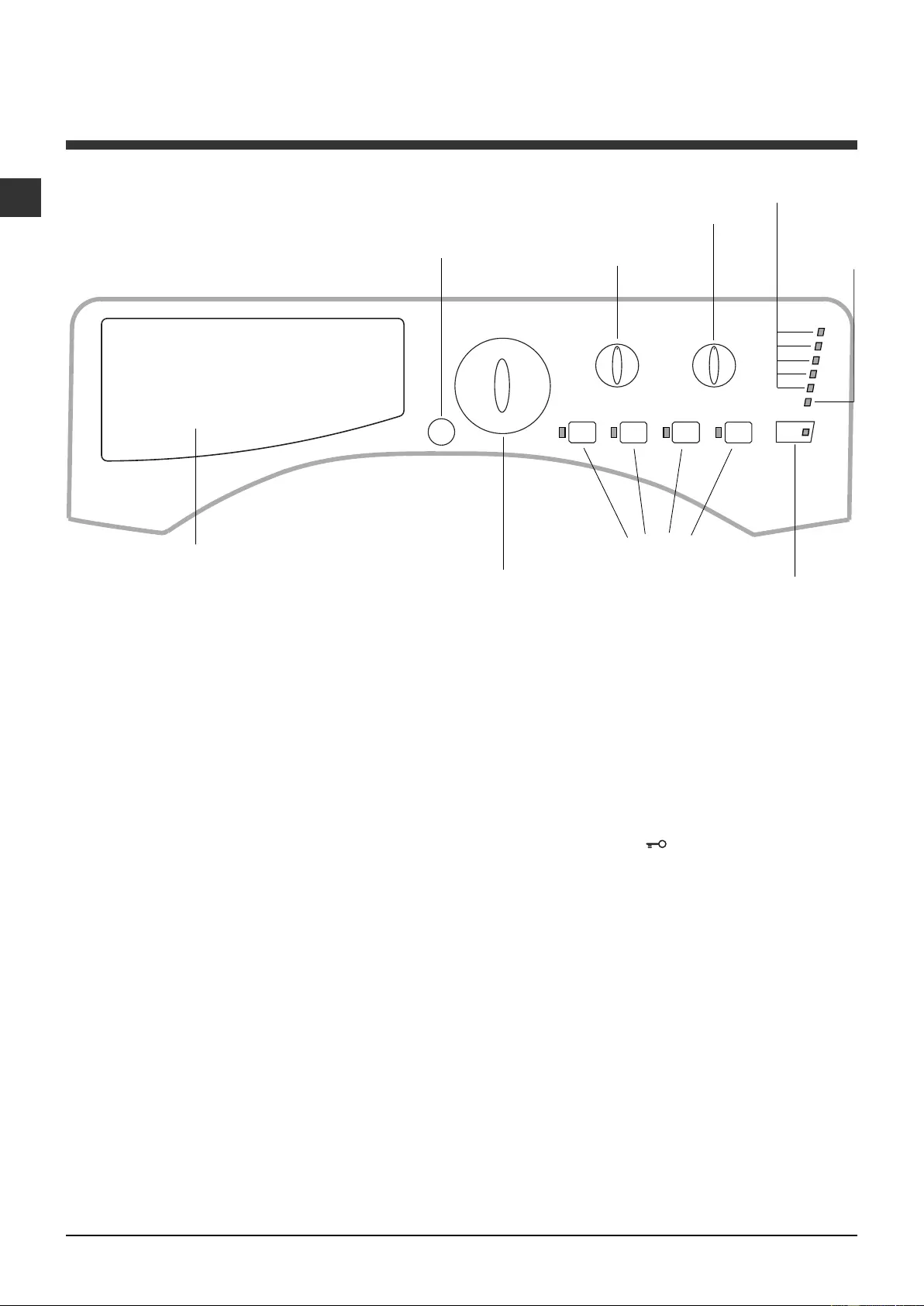
34
FR
Tiroir à produits lessiviels: pour charger les
produits lessiviels et les additifs (voir “Produits lessiviels
et linge”).
Touche MARCHE/ARRÊT: pour allumer ou éteindre
le lave-linge.
Bouton PROGRAMMES: pour sélectionner les
programmes. Pendant le programme, le bouton ne
tournera pas.
Touches avec voyants FONCTION: pour sélectionner
les fonctions disponibles. Le voyant correspondant à
la fonction sélectionnée restera allumé.
Bouton TEMPÉRATURE: pour sélectionner la
température ou un lavage à froid (voir
“Personnalisations”).
Bouton ESSORAGE: pour sélectionner l’essorage ou
le supprimer (voir “Personnalisations”).
Voyants DÉROULEMENT CYCLE/DÉPART
DIFFÉRÉ: pour suivre le stade d’avancement du
programme de lavage.
Le voyant allumé indique la phase de lavage en
cours.
Si la fonction “Départ différé” (départ différé) a été
sélectionnée, ils indiquent le temps restant jusqu’au
démarrage du programme (voir page ci-contre).
Voyant HUBLOT VERROUILLÉ: indique si la porte
est verrouillée (voir page ci-contre).
Touche avec voyant MARCHE/PAUSE: pour
démarrer les programmes ou les interrompre
momentanément.
N.B.: pour effectuer une pause du lavage en cours,
appuyer sur cette touche, le voyant correspondant se
mettra à clignoter en orange tandis que celui de la
phase en cours restera allumé fixe. Si le voyant
HUBLOT VERROUILLÉ est éteint, on peut ouvrir
la porte.
Pour faire redémarrer le lavage exactement de
l’endroit où il a été interrompu, appuyer une nouvelle
fois sur la touche.
Stand-by
Ce lave-linge, conformément aux nouvelles normes
en vigueur dans le domaine de l’économie d’énergie,
est équipée d’un système d’extinction automatique
(veille) activé après environ 30 minutes d’inutilisation.
Appuyez brièvement sur la touche MARCHE/ARRÊT
et attendre que la machine soit réactivée.
Description du lave-linge et
démarrage d’un programme
Bouton
TEMPÉRATURE
Tiroir à produits lessiviels
Voyants
DÉROULEMENT
CYCLE/DÉPART DIFFÉRÉ
Touches avec voyants
FONCTION
Touche
MARCHE/
ARRÊT
Bouton
ESSORAGE
Voyant
HUBLOT
VERROUILLÉ
Touche avec voyant
MARCHE/
PAUSE
Bandeau de commandes
Bouton
PROGRAMMES
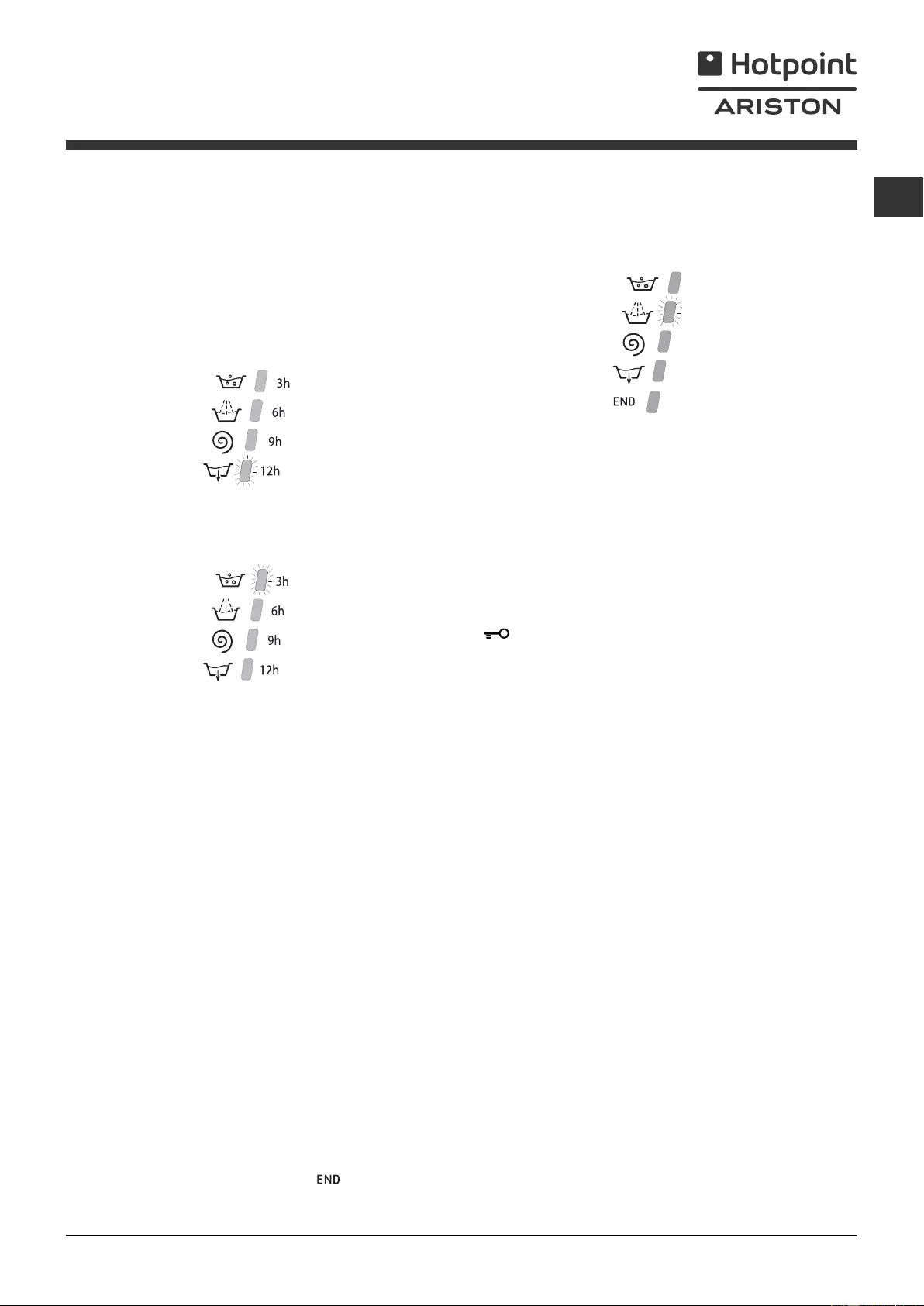
FR
35
Voyants
Les voyants fournissent des informations importantes.
Voilà ce qu’ils signalent:
Départ différé
Si la fonction “Départ différé” a été activée (voir
“Personnalisations”), le voyant correspondant au temps
sélectionné se mettra à clignoter, après avoir lancé le
programme :
Au fur et à mesure que le temps passe, le temps
restant est affiché avec clignotement du voyant
correspondant.
Quand le temps sélectionné touche à sa fin, le voyant
clignotant s’éteint et le programme sélectionné
démarre.
Voyants phase en cours
Une fois que le cycle de lavage sélectionné a
démarré, les voyants s’allument progressivement pour
indiquer son stade d’avancement:
Touches fonction et voyants correspondants
La sélection d’une fonction entraîne l’allumage du
voyant correspondant.
Si la fonction sélectionnée est incompatible avec le
programme sélectionné, le voyant correspondant se
met à clignoter et la fonction n’est pas activée.
En cas de sélection d’une fonction incompatible avec
une autre précédemment sélectionnée, la seule à
être activée sera celle choisie en dernier.
Voyant hublot verrouillé:
Le voyant allumé indique que le hublot est verrouillé
pour empêcher toute ouverture accidentelle. Pour
éviter d’endommager l’appareil, attendre que le
voyant cesse de clignoter avant d’ouvrir la porte.
N.B: si la fonction DÉPART DIFFÉRÉ est activée, le
hublot ne s’ouvre pas. Pour l’ouvrir il faut appuyer sur
la touche MARCHE/PAUSE qui met l’appareil en
pause.
! Un clignotement rapide du voyant MARCHE/PAUSE
(orange) simultané à celui des fonctions signale une
anomalie (voir “Anomalies et remèdes”).
Démarrage d’un programme
1. Allumer le lave-linge en appuyant sur la touche MARCHE/ARRÊT. Tous les voyants s’allumeront pendant
quelques secondes, ne resteront ensuite allumés que les voyants correspondant aux sélections du programme en
cours et le voyant MARCHE/PAUSE se mettra à clignoter.
2. Charger le linge et fermer le hublot.
3. Sélectionner à l’aide du bouton PROGRAMMES le programme désiré.
4. Sélectionner la température de lavage (voir “Personnalisations”).
5. Sélectionner la vitesse d’essorage (voir “Personnalisations”).
6. Verser les produits lessiviels et les additifs (voir “Produits lessiviels et linge”).
7. Sélectionner les fonctions désirées.
8. Appuyer sur la touche MARCHE/PAUSE pour démarrer le programme, le voyant correspondant vert restera
allumé en fixe.
Pour annuler le cycle sélectionné, appuyer sur la touche MARCHE/PAUSE pour placer l’appareil en pause et
choisir un nouveau cycle.
9. A la fin du programme, le voyant s’allume. Le voyant HUBLOT VERROUILLÉ s’éteint pour signaler que le
hublot peut être ouvert. Sortir le linge et laisser le hublot entrouvert pour faire sécher le tambour.
Eteindre le lave-linge en appuyant sur la touche MARCHE/ARRÊT.
Lavage
Rinçage
Essorage
Vidange
Fin de Lavage
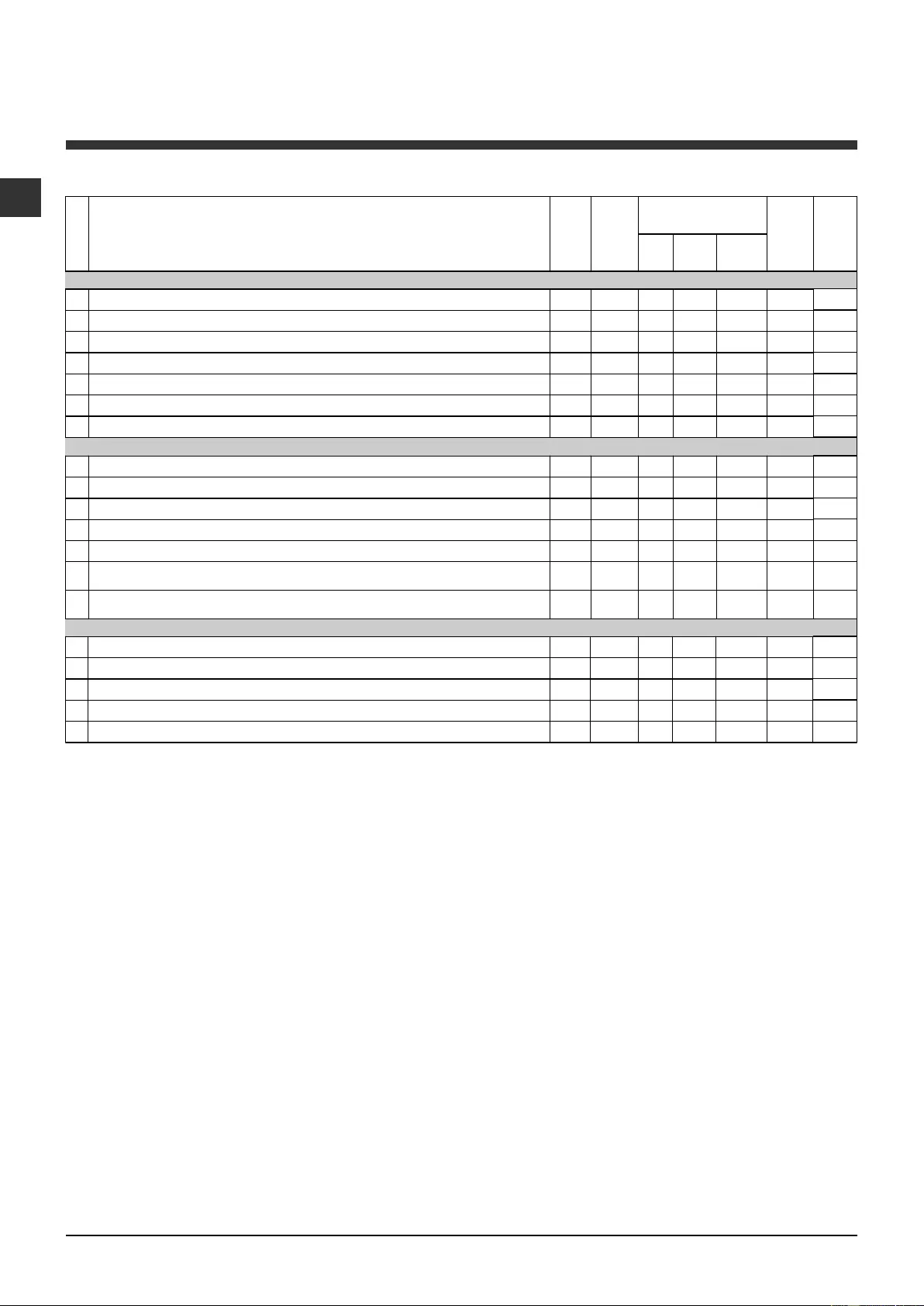
36
FR
Programmes
Les données dans le tableau sont reprises à titre indicatif.
Pour tous les instituts qui effectuent ces tests :
1) Programme de contrôle selon la norme EN 60456: sélectionner le programme 6 et une température de 60°C.
2) Programme coton long: sélectionner le programme 1 et une température de 40°C.
3) Programme coton court: sélectionner le programme 2 et une température de 40°C.
Programmes
Tableau des programmes
Description du Programme Temp.
maxi.
(°C)
Vitesse
maxi
(tours
minute)
Produits lessiviels Charge
maxi
(Kg)
Durée
cycle
Javel Lavage Assou—
plissant
Programmes Spécial
6Anti-bactérien: b l ancs ex trêmement s al es. 90° 1200 zz z 7 170
6Anti-bactérien (1): blancs et cou l eurs r ésist antes t r ès s al es. 60° 1200 —zz 7153
7Bonne Nuit: coul eur s dél i cates peu sal es . 40° 800 —zz 4290
8Bébé: couleurs dél i cates t r ès s al es. 40° 800 —zz 2 118
9Chemises 40° 600 —zz 270
10 Soie/Voilages: pour linge en so ie, vis cose, lingerie. 30° 0 —zz 255
11 Laine: po ur l aine, cach emi r e, etc. 40° 600 —zz
1,5 55
Progr ammes Quot id ie n
1Coton: blancs et couleurs résistan tes t r ès s al esi. 60° 1200 zz z 7122
1Coton (2): bl ancs et coul eurs d él i cates t rès s al es. 40° 1200 zz z 7 115
2Coton (3): b l ancs p eu sales et co ul eur s d él i cates . 40° 1200 zz z 785
3Synt hétique: couleurs résistantes très sales. 60° 800 —zz 385
3Synt hétique: couleurs résistantes peu sales. 40° 800 —zz 370
4MIX 30′: pour r afraîchi r rapidement du l i n g e peu s ale ( n e con vien t pas po u r
la laine, la s o ie et le ling e à laver à la main). 30° 800 —zz 330
5MIX 15′: pour r afraîchi r rapidement du l i n g e peu s ale ( n e con vien t pas po u r
la laine, la s o ie et le ling e à laver à la main). 30° 800 —zz
1,5 15
Cycle
ARinçage —1200 — z736
BR i nçag e dél i cat —800 — z331
CEssorage —1200 — — 716
DEssorage délicat —800 — — 312
EVidange —0— — 72
Programmes spéciaux
Anti-bactérien (programme 6). Un programme hautes températures qui prévoit l’utilisation de produits javelisés à des
températures supérieures à 60°C. Pour blanchir, verser le produit javelisé, les lessives et les additifs dans les
compartiments correspondants (voir paragraphe “Tiroir à produits lessiviels”).
Bonne nuit (programme 7). C’est un cycle silencieux qui permet de faire fonctionner le lave-linge la nuit quand le tarif
d’électricité est plus bas. Ce programme est spécialement conçu pour les synthétiques et le coton. A la fin du cycle
l’appareil s’arrête, cuve pleine. Pour procéder à l’essorage et à la vidange, appuyer sur la touche MARCHE/PAUSE, à
défaut, l’appareil procédera automatiquement au bout de 8 heures à l’essorage et à la vidange de l’eau.
Bébé (programme 8). Programme spécial, idéal pour le lavage des vêtements d’enfants souvent très sales, il élimine
toute trace de lessive du linge pour protéger leur peau délicate et éviter tout risque d’allergie. Spécialement conçu pour
diminuer la charge bactérienne, ce cycle utilise une plus grande quantité d’eau et optimise l’effet des additifs
désinfectants spécifiques ajoutés à la lessive.
En fin de lavage, l’appareil fait tourner le tambour lentement pour éviter de froisser le linge. Pour compléter le cycle
appuyer sur la touche MARCHE/PAUSE.
Mix 30’ (programme 4) spécialement conçu pour laver du linge peu sale en un rien de temps: il ne dure que 30 minutes
et permet ainsi de faire des économies d’énergie et de temps. La sélection de ce programme (4 à 30°C) permet de
laver ensemble des textiles différents (sauf laine et soie) en ne dépassant pas 3 kg de charge.
Mix 15’ (programme 5) spécialement conçu pour laver du linge peu sale en un rien de temps: il ne dure que 15 minutes
et permet ainsi de faire des économies d’énergie et de temps. La sélection de ce programme (5 à 30°C) permet de
laver ensemble des textiles différents (sauf laine et soie) en ne dépassant pas 1,5 kg de charge.
FR
37
Sélection de la température
Tourner le bouton TEMPÉRATURE pour sélectionner la température de lavage (voir Tableau des programmes).
La température peut être abaissée jusqu’au lavage à froid ( ).
La machine interdira automatiquement toute sélection d’une température supérieure à la température maximale
prévue pour chaque programme.
Sélection de l’essorage
Tourner le bouton ESSORAGE pour sélectionner la vitesse d’essorage du programme sélectionné.
Les vitesses maximales prévues pour les programmes sont:
Programmes Vitesse maximale
Coton 1200 tours/minute
Synthétiques 800 tours/minute
Laine 600 tours/minute
Soie vidange seule
La vitesse d’essorage peut être réduite ou l’essorage supprimé en sélectionnant le symbole .
La machine interdira automatiquement tout essorage à une vitesse supérieure à la vitesse maximale prévue pour
chaque programme.
Fonctions
Les différentes fonctions de lavage prévues par le lave-linge permettent d’obtenir la propreté et le blanc souhaités.
Pour activer les fonctions:
1. appuyer sur la touche correspondant à la fonction désirée;
2. l’allumage du voyant correspondant signale que la fonction est activée.
Remarque: Le clignotement rapide du voyant signale que la fonction correspondante n’est pas disponible pour le
programme sélectionné.
Départ différé
Pour différer la mise en marche de la machine jusqu’à 12 heures.
Appuyer plusieurs fois de suite sur la touche jusqu’à ce que le voyant correspondant au retard souhaité s’allume. A
la cinquième pression sur la touche, la fonction se désactive.
N.B: Après avoir appuyé sur la touche MARCHE/PAUSE, le retard programmé ne peut être modifié que pour le
diminuer.
! Il est activé avec tous les programmes.
Repassage facile
En cas de sélection de cette fonction, le lavage et l’essorage seront dûment modifiés pour réduire le froissage. En
fin de cycle, le lave-linge fait tourner le tambour lentement, le voyant de la fonction REPASSAGE FACILE et celui
de MARCHE/PAUSE se mettent à clignoter (orange), la phase reste allumée en fixe. Pour compléter le cycle, il
faut appuyer sur la touche MARCHE/PAUSE ou sur la touche REPASSAGE FACILE.
Pour le programme Soie (10) l’appareil arrive au bout du cycle en laissant le linge tremper, le voyant de la fonction
REPASSAGE FACILE et celui de MARCHE/PAUSE se mettent à clignoter (orange), la phase RINCAGE reste
allumée en fixe. Pour vidanger l’eau et pouvoir sortir le linge, il faut appuyer sur la touche MARCHE/PAUSE ou sur
la touche REPASSAGE FACILE.
!
Cette option n’est pas activable avec les programmes 4, 5, 6, 7, 8, 11, C, D, E.
Super rinçage
La sélection de cette fonction permet d’augmenter l’efficacité du rinçage et d’éliminer toute trace de lessive. Elle
est très utile en cas de peaux particulièrement sensibles.
! Cette option n’est pas activable avec les programmes 4, 5, C, D, E.
Super lavage
Grâce à l’utilisation d’une plus grande quantité d’eau au cours de la phase initiale du cycle et à l’emploi de
davantage de temps, cette fonction permet d’obtenir un lavage très performant.
!
Cette option n’est pas activable avec les programmes 4, 5, 6, 10, 11, A, B, C, D, E.
Personnalisations
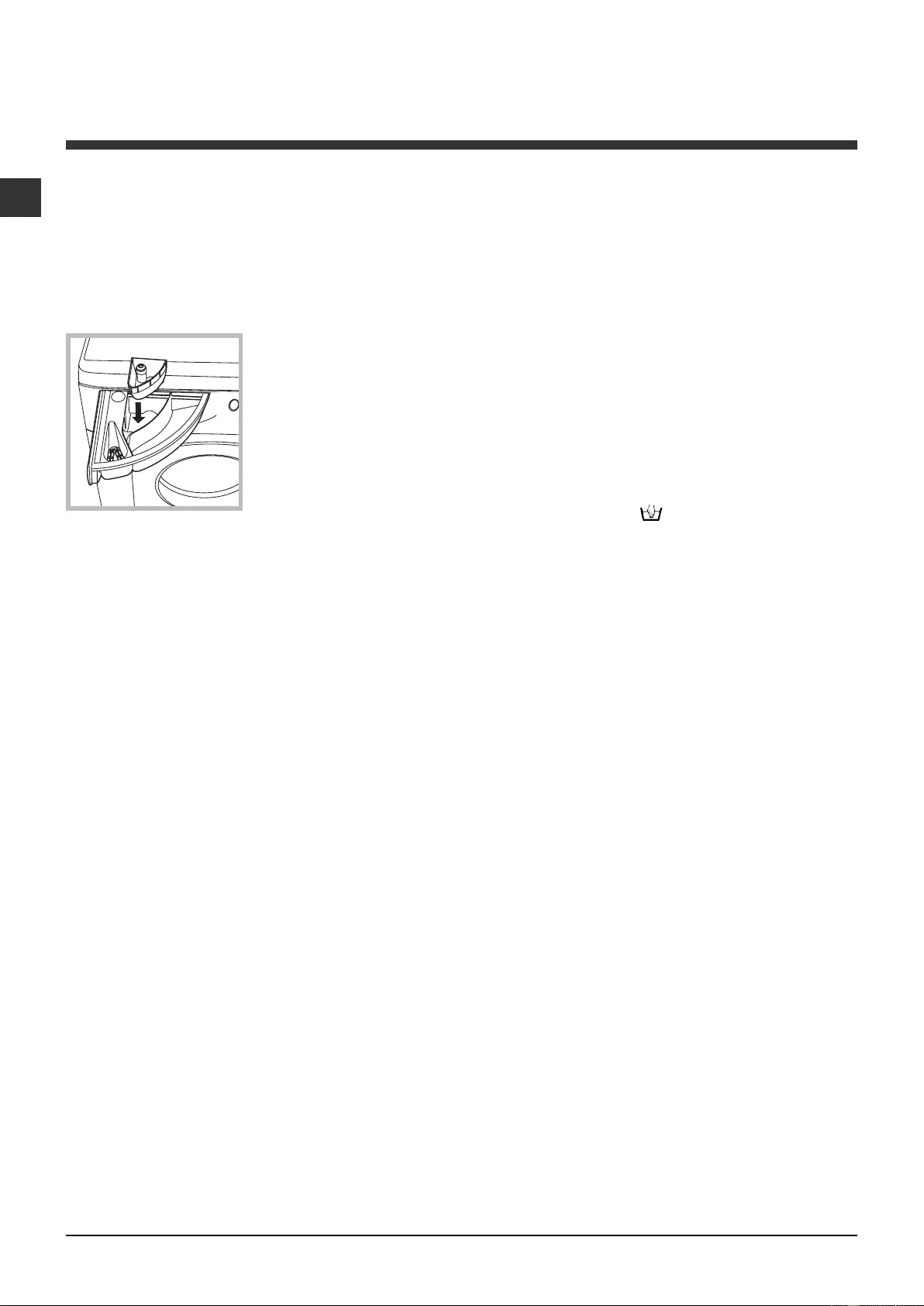
38
FR
Produits lessiviels et linge
Tiroir à produits lessiviels
Un bon résultat de lavage dépend aussi d’un bon
dosage de produit lessiviel: un excès de lessive ne
lave pas mieux, il incruste l’intérieur du lave-linge et
pollue l’environnement.
! Ne pas utiliser de lessives pour lavage à la main,
elles moussent trop. Sortir le tiroir à produits
lessiviels et verser la
lessive ou l’additif comme
suit.
bac 1: Lessive lavage (en poudre ou liquide)
Verser la lessive liquide juste avant la mise en marche.
bac 2: Additifs (assouplissant, etc.)
L’assouplissant ne doit pas déborder de la grille.
bac supplémentaire 3: Produit javelisé
Cycle blanchissage
Le blanchissage n’est possible qu’avec les
programmes 1, 2, 6.
Verser le produit javelisé dans le bac supplémentaire 3,
la lessive et l’assouplissant dans les bacs
correspondants, puis sélectionner un des
programmes sus-indiqués.
Conseillé en cas de linge en coton très sale.
Triage du linge
• Trier correctement le linge d’après:
— le type de textile / le symbole sur l’étiquette.
— les couleurs: séparer le linge coloré du blanc.
• Vider les poches et contrôler les boutons.
• Ne pas dépasser les valeurs indiquées
correspondant au poids de linge sec :
Textiles résistants: 7 kg max.
Textiles synthétiques: 3 kg max.
Textiles délicats: 2 kg max.
Laine: 1,5 kg max.
Combien pèse le linge ?
1 drap 400-500 g
1 taie d’oreiller 150-200 g
1 nappe 400-500 g
1 peignoir 900-1200 g
1 serviette éponge 150-250 g
MAX
1
3
2
Linge ou vêtements particuliers
Chemises: sélectionner le programme 9 approprié
au lavage de chemises de couleurs et textiles
différents.
Il en prend le plus grand soin en réduisant le
froissage.
Soie: sélectionner le programme de lavage spécial 10
pour vêtements en soie. Il est conseillé d’utiliser une
lessive spéciale pour linge délicat.
Rideaux:
pliez-les bien et glissez-les dans une taie
d’oreiller ou dans un sac genre filet. Sélectionner le
programme 10.
Laine: Hotpoint/Ariston est le seul lave-linge à avoir
obtenu le prestigieux label Woolmark Platinum Care
(M.0508) délivré par The Woolmark Company qui
garantit le lavage à la machine de tous les vêtements
en laine, y compris ceux qui portent l’étiquette “lavage
à la main uniquement” . Grâce au programme 11
on peut donc laver à la machine, en toute tranquillité,
tous les vêtements en laine (max. 1,5 kg) avec des
performances de lavage optimales.
Système d’équilibrage de la charge
Avant tout essorage, pour éviter toute vibration
excessive et répartir le linge de façon uniforme, le
lave-linge fait tourner le tambour à une vitesse
légèrement supérieure à la vitesse de lavage. Si au
bout de plusieurs tentatives, la charge n’est toujours
pas correctement équilibrée, l’appareil procède à un
essorage à une vitesse inférieure à la vitesse
normalement prévue. En cas de déséquilibre excessif,
le lave-linge préfère procéder à la répartition du linge
plutôt qu’à son essorage. Pour une meilleure
répartition de la charge et un bon équilibrage, nous
conseillons de mélanger de grandes et petites pièces
de linge.
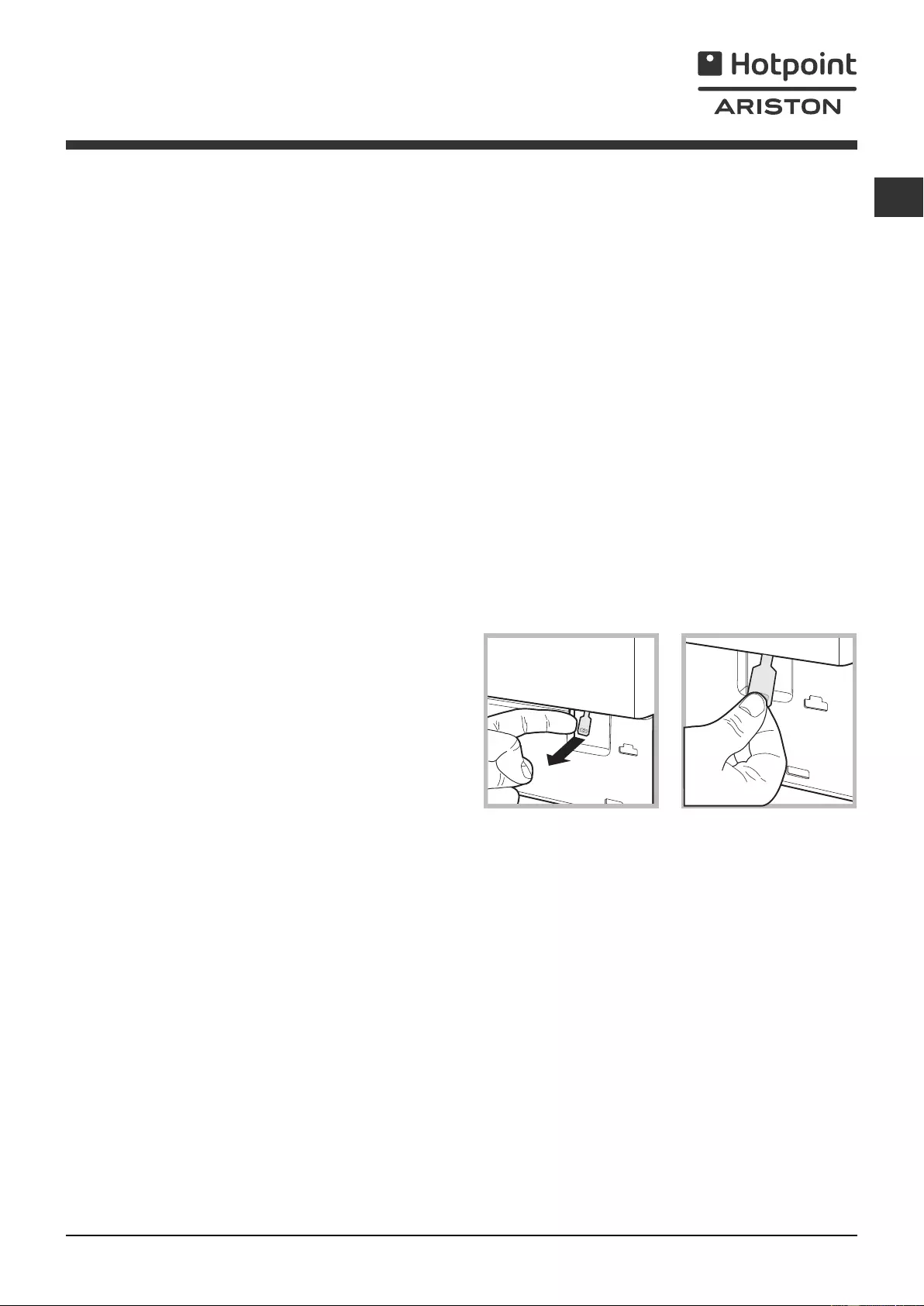
FR
39
Précautions et conseils
! Ce lave-linge a été conçu et fabriqué conformément
aux normes internationales de sécurité. Ces
consignes sont fournies pour des raisons de sécurité,
il faut les lire attentivement.
Sécurité générale
• Cet appareil est conçu pour un usage domestique.
• Cet appareil n’est pas destiné à être utilisé par des
personnes (enfants compris) dont les capacités
physiques, sensorielles ou mentales sont réduites
ou qui ne disposent pas des connaissances ou de
l’expérience nécessaires, à moins qu’elles n’aient
été formées et encadrées pour l’utilisation de cet
appareil par une personne responsable de leur
sécurité. Surveiller les enfants pour s’assurer qu’ils
ne jouent pas avec l’appareil.
• Ne jamais toucher l’appareil si l’on est pieds nus et
si les mains sont mouillées ou humides.
• Ne jamais tirer sur le câble pour débrancher la fiche
de la prise de courant.
• Ne pas ouvrir le tiroir à produits lessiviels si la
machine est branchée.
• Ne pas toucher à l’eau de vidange, elle peut
atteindre des températures très élevées.
• Ne pas forcer pour ouvrir le hublot: le verrouillage de
sécurité qui protège contre les ouvertures
accidentelles pourrait s’endommager.
• En cas de panne, éviter à tout prix d’accéder aux
mécanismes internes pour tenter une réparation.
• Veiller à ce que les enfants ne s’approchent pas de
l’appareil pendant son fonctionnement.
• Pendant le lavage, le hublot a tendance à se
réchauffer.
• Deux ou trois personnes sont nécessaires pour
déplacer l’appareil avec toutes les précautions
nécessaires. Ne jamais le déplacer tout seul car il
est très lourd.
• Avant d’introduire le linge, s’assurer que le tambour
est bien vide.
Mise au rebut
• Mise au rebut du matériel d’emballage: se
conformer aux réglementations locales de manière
à ce que les emballages puissent être recyclés.
• La Directive Européenne 2002/96/EC sur les
Déchets des Equipements Electriques et Electroni-
ques, exige que les appareils ménagers usagés ne
soient pas jetés dans le flux normal des déchets
municipaux. Les appareils usagés doivent être
collectés séparément afin d’optimiser le taux de
récupération et le recyclage des matériaux qui les
composent et réduire l’impact sur la santé humaine
Ouverture manuelle du hublot
A défaut de pouvoir ouvrir la porte hublot à cause
d’une panne de courant pour étendre le linge,
procéder comme suit:
1. débrancher la fiche de la prise de courant.
2. s’assurer que le niveau de l’eau à l’intérieur de
l’appareil se trouve bien au-dessous de l’ouverture du
hublot, si ce n’est pas le cas vider l’eau en excès à
travers le tuyau de vidange dans un seau.
3. se servir de la languette indiquée, tirer vers soi
jusqu’à ce que le tirant en plastique se dégage de
son cran d’arrêt; tirer ensuite vers le bas et ouvrir
l’hublot en même temps.
et l’environnement. Le symbole de la »poubelle
barrée» est apposée sur tous les produits pour
rappeler les obligations de collecte séparée. Les
consommateurs devront contacter les autorités
locales ou leur revendeur concernant la démarche à
suivre pour l’enlèvement de leur vieil appareil.

40
FR
Entretien et soin
Coupure de l’arrivée d’eau et du
courant
• Fermer le robinet de l’eau après chaque lavage.
Cela réduit l’usure de l’installation hydraulique du
lave-linge et évite tout danger de fuites.
• Débrancher la fiche de la prise de courant lors de
tout nettoyage du lave-linge et pendant tous les
travaux d’entretien.
Nettoyage du lave-linge
Pour nettoyer l’extérieur et les parties en
caoutchouc, utiliser un chiffon imbibé d’eau tiède et
de savon. N’utiliser ni solvants ni abrasifs.
Nettoyage du tiroir à produits
lessiviels.
Soulever le tiroir et le
tirer vers soi pour le
sortir de son logement
(voir figure).
Le laver à l’eau
courante; effectuer
cette opération assez
souvent.
Entretien du hublot et du tambour
• Il faut toujours laisser le hublot entrouvert pour
éviter la formation de mauvaise odeurs.
Nettoyage de la pompe
Le lave-linge est équipé d’une pompe
autonettoyante qui n’exige aucune opération
d’entretien. Il peut toutefois arriver que de menus
objets (pièces de monnaie, boutons) tombent dans
la préchambre qui protège la pompe, placée en bas
de cette dernière.
! S’assurer que le cycle de lavage est bien terminé
et débrancher la fiche.
Pour accéder à cette préchambre:
1. dévisser le couvercle
en le tournant dans le
sens inverse des aiguilles
d’une montre (voir figure):
il est normal qu’un peu
d’eau s’écoule;
2. nettoyer soigneusement l’intérieur;
3. revisser le couvercle.
Contrôle du tuyau d’arrivée de l’eau
Contrôler le tuyau d’alimentation au moins une fois
par an. Procéder à son remplacement en cas de
craquèlements et de fissures: car les fortes pressions
subies pendant le lavage pourraient provoquer des
cassures.
!!
!!
!
N’utiliser que des tuyaux neufs.

FR
41
Anomalies et remèdes
Il peut arriver que le lave-linge ne fonctionne pas bien. Avant d’appeler le Service de dépannage (voir
“Assistance”), contrôler s’il ne s’agit pas par hasard d’un problème facile à résoudre à l’aide de la liste suivante.
Anomalies:
Le lave-linge ne s’allume pas.
Le cycle de lavage ne démarre
pas.
Il n’y a pas d’arrivée d’eau (le
voyant de la première phase de
lavage clignote rapidement).
Le lave-linge prend l’eau et
vidange continuellement.
Le lave-linge ne vidange pas et
n’essore pas.
Le lave-linge vibre beaucoup
pendant l’essorage.
Le lave-linge a des fuites.
Le voyant MARCHE/PAUSE
(orange) ainsi que les voyants des
fonctions clignotent rapidement.
Il y a un excès de mousse.
Causes / Solutions possibles:
• La fiche n’est pas branchée dans la prise de courant ou mal branchée.
• Il y a une panne de courant.
• Le hublot n’est pas bien fermé.
• La touche MARCHE/ARRÊT n’a pas été enfoncée.
• La touche MARCHE/PAUSE n’a pas été enfoncée.
• Le robinet de l’eau n’est pas ouvert.
• Un départ différé a été sélectionné (voir “Personnalisations”).
• Le tuyau d’arrivée de l’eau n’est pas raccordé au robinet.
• Le tuyau est plié.
• Le robinet de l’eau n’est pas ouvert.
• Il y a une coupure d’eau.
• La pression n’est pas suffisante.
• La touche MARCHE/PAUSE n’a pas été enfoncée.
• Le tuyau de vidange n’est pas installé à une distance du sol comprise
entre 65 et 100 cm (voir “Installation”).
• L’extrémité du tuyau de vidange est plongée dans l’eau (voir “Installation”).
• L’évacuation murale n’a pas d’évent.
Si après ces vérifications, le problème persiste, fermer le robinet de l’eau,
éteindre la machine et appeler le service Assistance. Si l’appartement est
situé en étage dans un immeuble, il peut y avoir des phénomènes de
siphonnage qui font que le lave-linge prend et évacue l’eau
continuellement. Pour supprimer cet inconvénient, on trouve dans le
commerce des soupapes spéciales anti-siphonnage.
• Le programme ne prévoit pas de vidange: pour certains programmes, il
faut la faire partir manuellement.
• La fonction REPASSAGE FACILE est activée: pour compléter le programme,
appuyer sur la touche MARCHE/PAUSE (“Personnalisations”).
• Le tuyau de vidange est plié (voir “Installation ”).
• La conduite d’évacuation est bouchée.
• Le tambour n’a pas été débloqué comme il faut lors de l’installation du
lave-linge (voir “Installation”).
• Le lave-linge n’est pas posé à plat (voir “Installation”).
• Le lave-linge est coincé entre des meubles et le mur (voir “Installation”).
• Le tuyau d’arrivée de l’eau n’est pas bien vissé (voir “Installation”).
• Le tiroir à produits lessiviels est bouché (pour le nettoyer voir “Entretien et soin”).
• Le tuyau de vidange n’est pas bien fixé (voir “Installation”).
• Eteindre l’appareil et débrancher la fiche de la prise de courant,
attendre 1 minute environ avant de rallumer.
Si l’anomalie persiste, appeler le service d’assistance.
• Le produit de lavage utilisé n’est pas une lessive spéciale machine (il faut qu’il y
ait l’inscription “pour lave-linge”, “main et machine”, ou autre semblable).
• La quantité utilisée est excessive.

42
FR
Assistance
Avant d’appeler le service après-vente:
• Vérifier si on ne peut pas résoudre l’anomalie par ses propres moyens (voir “Anomalies et Remèdes”);
• Remettre le programme en marche pour contrôler si l’inconvénient a disparu;
• Autrement, contacter le Centre d’Assistance technique agréé au numéro de téléphone indiqué sur le
certificat de garantie.
!Ne jamais s’adresser à des techniciens non agréés.
Communiquer:
• le type de panne;
• le modèle de l’appareil (Mod.);
• son numéro de série (S/N).
Ces informations se trouvent sur la plaque signalétique apposée à l’arrière du lave-linge et à l’avant quand on
ouvre la porte hublot.

DE
43
Deutsch
INHALTSVERZEICHNIS
Installation 44-45-46-47
Auspacken und Aufstellen
Wasser— und Elektroanschlüsse
Erster Waschgang
Technische Daten
Anleitungen für den Installateur
Beschreibung des Waschvollautomaten
und Starten eines W aschpr ogramms 48-49
Bedienblende
Kontrollleuchten
Starten eines Waschprogramms
W aschpr ogramme, 50
Programmtabelle
Personalisierungen 51
Temperatureinstellung
Schleudereinstellung
Funktionen
Waschmittel und Wäsche 52
Waschmittelschublade
Bleichen
Vorsortieren der Wäsche
Besondere Wäscheteile
Unwuchtkontrollsystem
Vorsichtsmaßregeln und Hinweise 53
Allgemeine Sicherheit
Entsorgung
Manuelles Öffnen der Gerätetür
Reinigung und Pflege 54
Abstellen der Wasser— und Stromversorgung
Reinigung des Gerätes
Reinigung der Waschmittelschublade
Pflege der Gerätetür und Trommel
Reinigung der Pumpe
Kontrolle des Wasserzulaufschlauchs
Störungen und Abhilfe 55
Kundendienst 56
DE
AWM 129
Bedienungsanleitungen
WASCHVOLLAUTOMAT
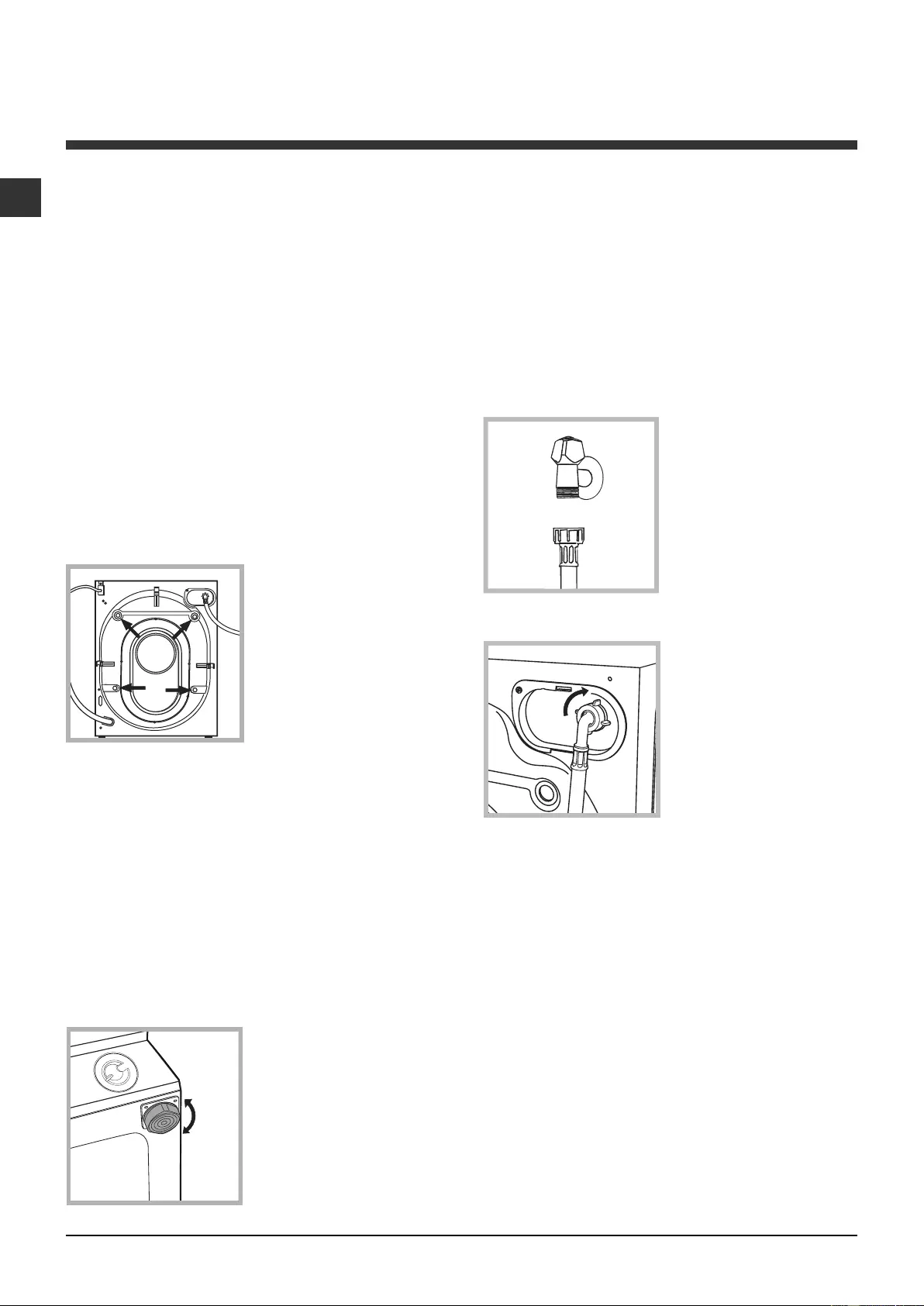
44
DE
Installation
! Es ist äußerst wichtig, diese Bedienungsanleitung
sorgfältig aufzubewahren, um sie jederzeit zu Rate ziehen
zu können. Sorgen Sie dafür, dass sie im Falle eines
Umzugs oder einer Übergabe an einen anderen Benutzer
das Gerät stets begleitet, damit auch der neue Inhaber
die Möglichkeit hat, diese zu Rate zu ziehen.
!
Lesen Sie die Hinweise bitte aufmerksam durch, sie
liefern wichtige Informationen hinsichtlich der Installation,
des Gebrauchs und der Sicherheit.
Auspacken und Aufstellen
Auspacken
1. Gerät auspacken.
2. Sicherstellen, dass der Waschvollautomat keine
Transportschäden erlitten hat. Im Falle einer
Beschädigung Gerät bitte nicht anschließen, sondern
den Kundendienst anfordern.
3. Die 4 Transportschutz-
schrauben
herausschrauben und die
an der Geräterückwand
befindlichen Distanzstücke
aus Gummi entfernen
(siehe Abbildung).
4. Die Öffnungen mittels der mitgelieferten Abdeckungen
verschliessen.
5. Sämtliche Teile aufbewahren: Sollte der
Waschautomat erneut transportiert werden, müssen
diese Teile wieder eingesetzt werden.
! Verpackungsmaterial ist kein Spielzeug für Kinder.
Nivellierung
1. Der Waschvollautomat muss auf einem ebenen,
festen, schwingungsfreien Untergrund aufgestellt werden
ohne diesen an Wände, Möbel etc. direkt anzulehnen.
2. Sollte der Boden nicht
perfekt eben sein, müssen
die Unebenheiten durch
An- bzw. Ausdrehen der
vorderen Stellfüße
ausgeglichen werden
(siehe Abbildung), der auf
der Arbeitsfläche zu
ermittelnde Neigungsgrad
darf 2° nicht überschreiten.
Eine präzise Nivellierung verleiht dem Gerät die
erforderliche Stabilität, durch die Vibrationen,
Betriebsgeräusche und ein Verrücken des Gerätes
vermieden werden. Bei Teppichböden müssen die
Stellfüße so reguliert werden, dass ein ausreichender
Freiraum zur Belüftung unter dem Waschvollautomaten
gewährleistet ist.
Wasser— und Elektroanschlüsse
Anschluss des Zulaufschlauches
1. Schrauben Sie den
Wasserschlauch an einen
Kaltwasserhahn mit ¾-
Zoll-Gewindeanschluss an
(siehe Abbildung).
Lassen Sie das Wasser vor
dem Anschluss so lange
auslaufen, bis klares
Wasser austritt.
2. Das andere Ende des
Schlauches an den oben
rechts am Rückteil des
Waschvollautomaten
befindlichen
Wasseranschluss
anschließen (siehe
Abbildung).
3. Der Schlauch darf hierbei nicht eingeklemmt oder
abgeknickt werden.
! Der Wasserdruck muss innerhalb der Werte liegen,
die in der Tabelle der technischen Daten angegeben
sind (siehe nebenstehende Seite).
! Sollte der Zulaufschlauch nicht lang genug sein,
dann wenden Sie sich bitte an einen Fachhändler
oder an einen autorisierten Fachmann.
!!
!!
!
Verwenden Sie niemals bereits gebrauchte
Schläuche.
!!
!!
!
Verwenden Sie die Schläuche, die mit dem Gerät
geliefert wurden.

DE
45
Tec hnische Da ten
Modell AWM 129
Abmessungen B rei te 5 9,5 cm
Höhe 81,5 cm
Tiefe 54,5 cm
Fassungsvermögen 1 bis 7 kg
Elektroanschlüsse s ieh e das am Gerät befi n dli che
Typenschild
Wasseranschlüsse Höchs tdruck 1 MPa (10 bar)
Min des td ru ck 0 ,0 5 MPa ( 0,5 bar)
Trommelvolumen 52 L iter
Schleudertouren bis zu 1200 U/min.
Prüfprogramme
gemäß EN 60456 Programm 6; Temperatur 60°C;
bei einer Lademenge von 7 kg.
Di eses G erät en t s prich t den
folgenden EG-Richtlinien:
— 89/336/EWG vom 03.05 .89
(el ekt romag n eti sch e Ver tr ägli ch keit )
und nachfolgenden Änderungen
— 2002/96/CE
— 2006/95/CE (Niederspannung)
65 — 100 cm
Anschluss des Ablaufschlauches
Schließen Sie den
Ablaufschlauch ohne ihn
dabei abzuknicken an
einen geeigneten Abfluss
an. Die Mindestablaufhöhe
beträgt 65 — 100 cm
(gemessen vom Boden),
oder hängen Sie diesen
mittels des Schlauchhalters
gesichert in ein Becken
oder Wanne ein;
Befestigen Sie diesen
mittels des mitgelieferten
Schlauchhalters z.B. an
einen Wasserhahn (siehe
Abbildung). Das freie
Ablaufschlauchende darf
nicht unter Wasser
positioniert werden.
! Verlängerungsschläuche sollten nicht eingesetzt
werden. Sollte dies unvermeidlich sein, muss die
Verlängerung denselben Durchmesser des
Originalschlauchs aufweisen und darf eine Länge von
150 cm nicht überschreiten.
Stromanschluss
Vor Einfügen des Netzsteckers in die Steckdose ist
sicherzustellen, dass:
• die Steckdose über eine normgerechte Erdung verfügt;
• die Steckdose die in den Technischen Daten
angegebenen Höchstlast des Gerätes trägt (siehe
nebenstehende Tabelle);
• die Stromspannung den in den Technischen Daten
angegebenen Werten entspricht (siehe
nebenstehende Tabelle);
• die Steckdose mit dem Netzstecker des
Waschvollautomaten kompatibel ist. Andernfalls
muss der Netzstecker (oder die Steckdose) ersetzt
werden.
! Der Waschvollautomat darf nicht im Freien installiert
werden, auch nicht, wenn es sich um einen
geschützten Platz handelt. Es ist gefährlich, das
Gerät Gewittern und Unwettern auszusetzen.
! Die Steckdose sollte nach installiertem Gerät leicht
zugänglich sein.
! Verwenden Sie bitte keine Verlängerungen oder
Mehrfachstecker.
! Das Netzkabel darf nicht gebogen bzw.
eingeklemmt werden.
! Das Versorgungskabel darf nur durch autorisierte
Fachkräfte ausgetauscht werden.
Achtung! Der Hersteller übernimmt keinerlei Haftung,
sollten diese Vorschriften nicht genau beachtet
werden.
Erster Waschgang
Lassen Sie nach der Installation bzw. vor erstmaligem
Gebrauch erst einen Waschgang (mit Waschmittel)
ohne Wäsche durchlaufen. Stellen Sie hierzu das
Waschprogramm 1 ein.
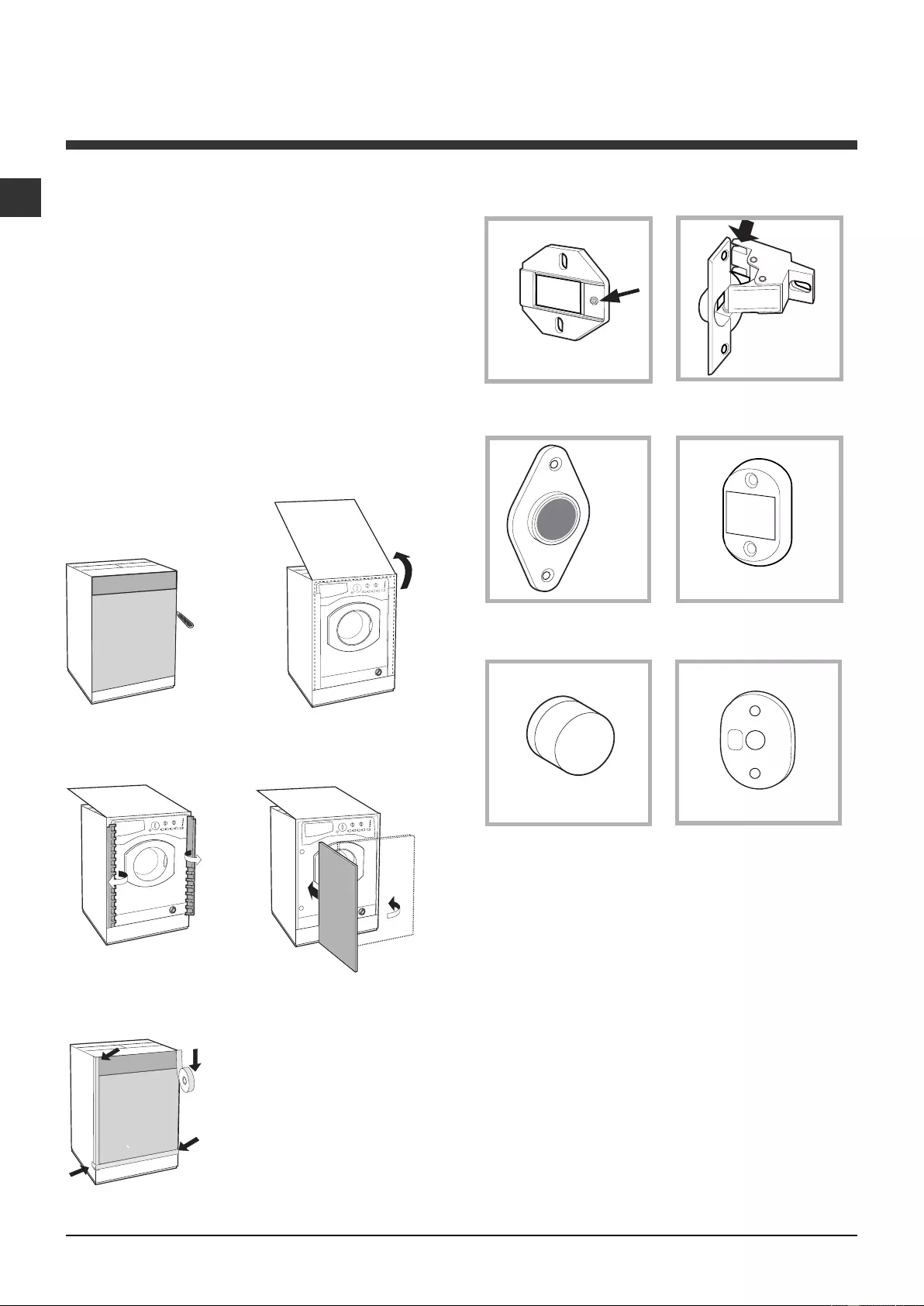
46
DE
Anleitungen für den Installateur
Montage des Holzpaneels auf die Tür und Einfü-
gen der maschine in die Möbel:
Falls nach der Montage des Holzpaneels eine V ersendung
zur End-Installation der Maschine notwendig ist,
empfehlen wir, die Maschine in ihrer ursprünglichen
V erpackung zu belassen. Die V erpackung ist deshalb so
beschaffen, daß eine Anbringung des Holzpaneels auf die
Maschine möglich ist, ohne dabei die V erpackung ganz
entfernen zu müssen (siehe untere Abbildung).
Die Stärke des die Frontseite bedeckenden Holzpaneels
darf 18 mm nicht unterschreiten und das Paneel kann
sowohl auf der rechten als auch auf der linken Seite
montiert werden. Aus praktischen Gründen empfehlen wir
eine Montage in derselben Öffnungsrichtung wie die des
Einfüllfensters, d.h. mit auf der linken Seite montierten
Scharnieren.
AB
CD
E
Tur seite
Montagezubehör für die Tür (Abb. 1-2-3-4-5).
Abb. 1
N° 2 Scharnier
N° 1 Magnet N° 1 Magnetanschlag
N° 1 Gummidübel
N° 2 Scharnierhalterung
N° 4 Distanzstücke
Abb. 2
Abb. 3 Abb. 4
Abb. 5 Abb. 4/B
— 6 selbsteinschneidende Schrauben l = 13 mm “Typ A”.
— 2 metrische Senkkopfschrauben l = 25 mm “Typ B”; zur
Befestigung des Magnetan-schlags am Gehäuse.
— 4 metrische Schrauben l = 15 mm “Typ C”; zur
Anbringung der Scharnierhalterungen am Gehäuse.
— 4 metrische Schrauben l = 7 mm “Typ D”; zur Anbringung
der Scharniere an den Halterungen.
Montage der Einzelteile auf die Maschine-
nvorderseite.
— Montieren Sie die Scharnierhalterungen an der Front,
dabei wird die Bohrung (siehe Pfeil auf Abb. 1) nach innen
zur Front positioniert und ein Distanzstück eingelegt
(Abb. 4/B), verwenden Sie Schrauben vom Typ C.
— Montieren Sie das Magnetgegenstück auf der gegenüber
liegenden Seite oben und legen Sie zwei Distanzstücke ein
(Abb. 4/B) verwenden Sie die beiden Schrauben vom Typ B.
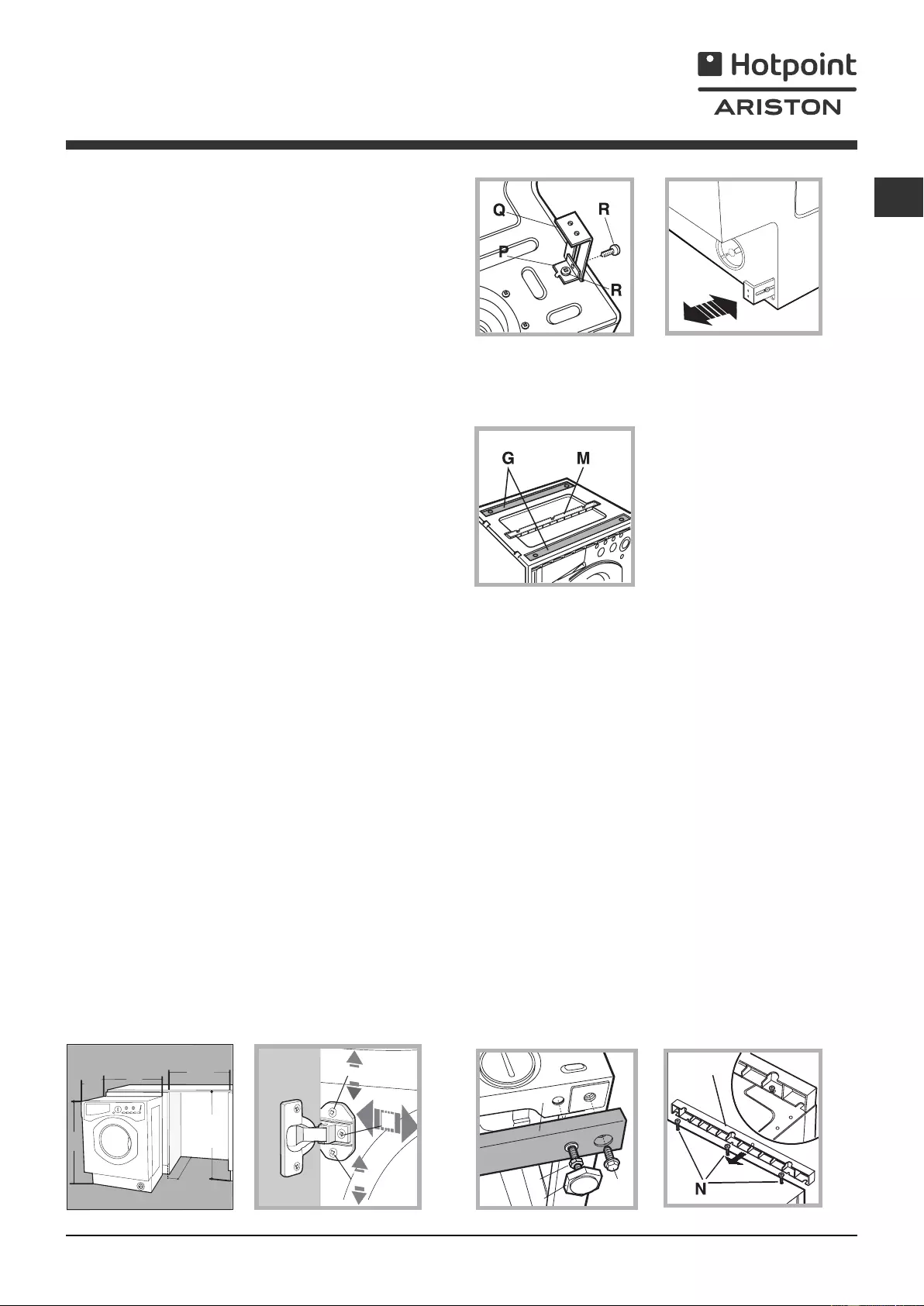
DE
47
Gebrauch der Bohrschablone.
a) Zur Positionsmarkierung der Bohrungen auf der linken
Seite des Paneels, legen Sie die Bohrmaske oben links am
Paneel an und halten Sie sich an die an den Enden markierten
Linien. b) Zur Positionsmarkierung der Bohrungen auf der
rechten Seite des Paneels, legen Sie die Bohrmaske oben
rechts am Paneel an. c) Mit einem Fräser von entsprechender
Größe die vier Sitze fräsen, die die zwei Scharniere, den
Gummidübel und den Magnet aufnehmen sollen.
Montage der Einzelteile auf das Holzpaneel (Tür).
— Setzen Sie die Scharniere in die vorgesehenen Sitze ein (das
bewegliche Scharnierteil muß auf die Außenseite des
Scharniers weisen) und befestigen Sie sie mit den 4 Schrau-
ben des Typs A.
— Setzen Sie den Magnet in den Sitz ein, und zwar oben von
der den Scharnieren entgegensetzten Seite und befestigen
Sie ihn mit zwei Schrauben den Typs B.
— Setzen Sie den Gummidübel in den Sitz unten ein.
Das Paneel kann nun auf die maschine montiert werden.
Montage des Paneels auf die maschine.
Setzen Sie die von dem Pfeil in abb. 2 angegebene Scharnier —
nase in den Sitz der Scharnierhalterung ein, drücken Sie das
Paneel gegen die Frontseite der maschine und befestigen Sie
die beiden Scharniere mit den Schrauben des Typs D.
Befestigung der Sockelführung
Wenn die maschine am Ende einer Küchenzeile installiert
werden soll, montieren Sie eine oder beide Sockelführungen
wie in abb. 8 angegeben, passen Sie deren Tiefe der Sockel-
position an und wenn nötig, befestigen Sie den Sockel an
denselben (abb. 9). Zur Montage der Sockelführung verfahren
Sie wie folgt (Abb. : Befestigen Sie das Winkelstück P
mittels der Schraube R, setzen Sie die Sockelführung Q in
den entsprechenden Schlitz ein, bringen Sie diese in die
gewünschte Lage und befestigen Sie sie daraufhin mittels der
Schraube R an dem Winkelstück P.
Einfügen der maschine in das Möbel.
— Schieben Sie die maschine in die Öffnung und passen Sie sie
der Möbelfront an (abb. 6).
— Regulieren Sie die verstellbaren Füße auf die gewünschte Höhe
der maschine.
— Drehen Sie die Schrauben C und D wie in abb. 7 angegeben,
um die Position des Holzpaneels in vertikaler und horizontaler
Richtung einzustellen.
Wichtig: Schließen Sie den unteren T eil der Frontseite durch den
Sockel, und zwar so, dass letzterer mit dem Boden abschließt.
Abb. 8 Abb. 9
Beiliegendes Zubehör zur Höhenregulierung.
Im Polystyroldeckel (Abb. 10) befinden sich folgende Teile:
2 Querstreben (G); 1 Leiste (M)
In der Wäschetrommel befinden sich:
4 zusätzliche Stellfüße (H),
4 Schrauben (I),
4 Schrauben (R),
4 Schraubenmuttern (L),
2 Sockelführungen (Q)
Höhenregulierung des Waschvollautomaten.
Mit Hilfe der 4 Stellfüße kann die Höhe des Gerätes reguliert
werden (von 815 mm bis 835 mm). Sollte diese Höhe jedoch nicht
ausreichen, kann das Gerät durch Einsatz nachfolgenden
Zubehörs bis auf eine Höhe von 870 mm gebracht werden:
2 Querstreben (G); 4 Stellfüße (H); 4 Schrauben (I); 4 Schrauben-
muttern (L), V erfahren Sie hierzu wie folgt (Abb. 11):
Nehmen Sie die 4 ursprünglich montierten Stellfüße ab, legen Sie
eine Querstrebe G am V orderteil des Gerätes an und befestigen Sie
dieses mittels der Schrauben I (schrauben Sie diese in die Löcher
ein, in denen sich die ursprünglich montierten Stellfüße befanden),
setzen Sie daraufhin die neuen Stellfüße H ein.
Verfahren Sie auf gleiche Weise am hinteren Teil des Gerätes.
Durch Einstellen der Füße H kann das Gerät nun auf eine Höhe von
835 mm bis 870 mm gebracht werden.
Nach Erreichen der gewünschten Höhe befestigen Sie die
Schraubenmuttern L an der Querstrebe G.
Zur Einstellung des Gerätes auf eine Höhe von 870 mm bis 900
mm ist die Leiste M anzubringen, regulieren Sie daraufhin die
Stellfüße H bis auf die gewünschte Höhe.
Die Leiste wird wie folgt eingesetzt:
Lösen Sie die drei an der vorderen Deckelblende befindlichen
Schrauben N, setzen Sie die Leiste M so wie auf Abb. 12
veranschaulicht ein und ziehen Sie die Schrauben N wieder an.
D
C
C
570
min
815
540
595
820 ÷ 900
600 min
Abb. 6 Abb. 7
LI
H
G
M
Abb. 11 Abb. 12
Abb. 10
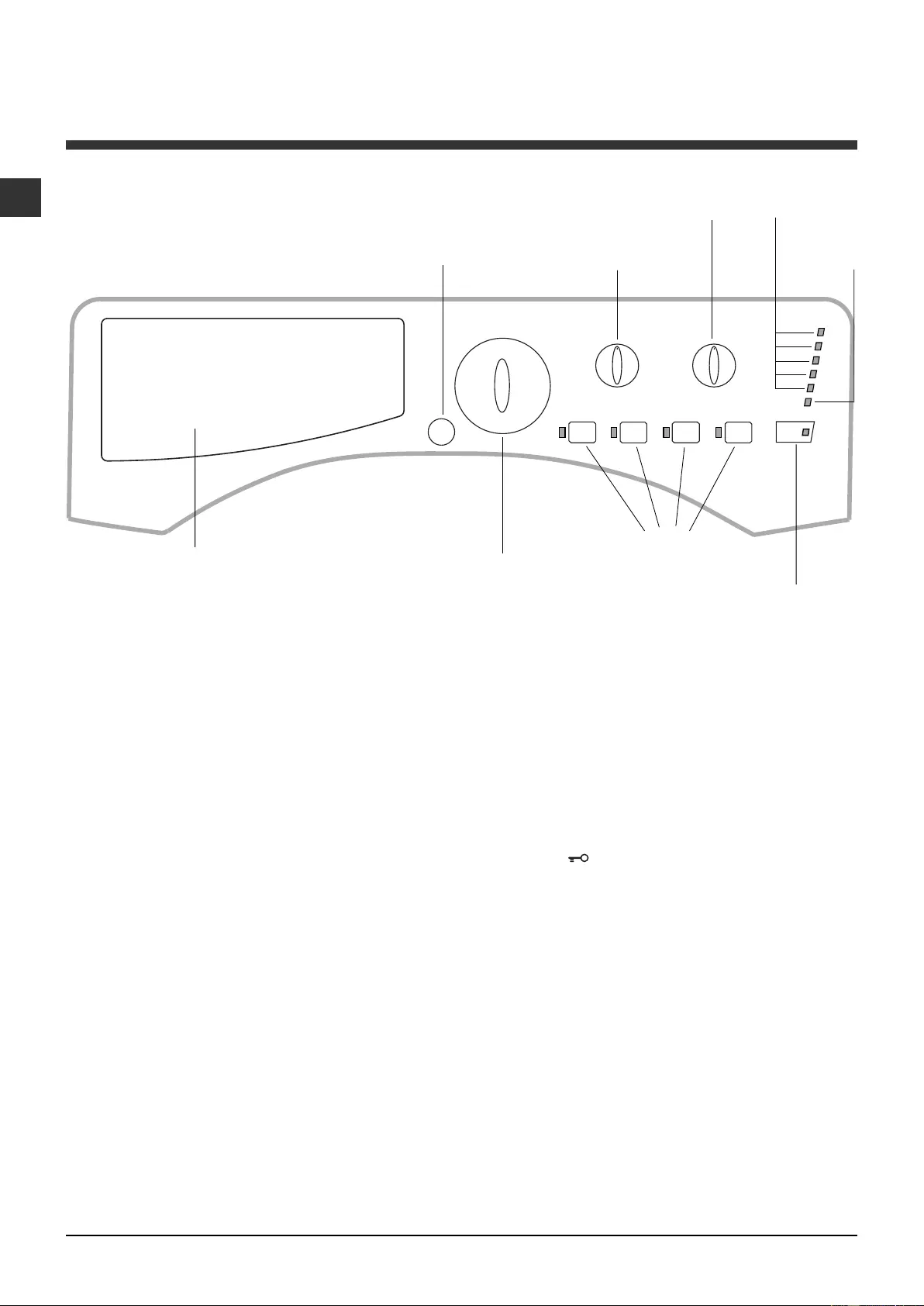
48
DE
Waschmittelschublade: für Waschmittel und
Zusätze (siehe „Waschmittel und Wäsche“).
Taste EIN/AUS: Zum Ein- und Ausschalten Ihres
Waschvollautomaten.
Wählschalter PROGRAMME: Zur Wahl der
Waschprogramme. Während des Programmablaufs
bleibt der Schalter feststehend.
Tasten mit Kontrollleuchten FUNKTIONEN: Zur
Einstellung der verfügbaren Funktionen. Die der
gewählten Einstellung entsprechende Kontrollleuchte
bleibt eingeschaltet.
Wählschalter SCHLEUDERN: oder um das
Schleudern auszuschliessen (siehe
„Personalisierungen“).
Wählschalter TEMPERATUREN: Zur Einstellung der
Waschtemperatur oder einer Kaltwäsche (siehe
„Personalisierungen“).
Kontrollleuchten PROGRAMMABLAUF/
STARTZEITVORWAHL: Zur Kontrolle des
Waschprogrammablaufs.
Die eingeschaltete Kontrollleuchte zeigt die laufende
Programmphase an.
Wurde die Funktion “Startzeitvorwahl” eingestellt,
zeigen sie die bis zum Start noch verbleibende Zeit an
(siehe Nebenseite).
Kontrollleuchte GERÄTETÜR GESPERRT: Diese
Taste zeigt an, ob die Gerätetür geöffnet werden
kann oder nicht (siehe Nebenseite).
Taste mit Kontrollleuchte START/PAUSE: Mittels
dieser Taste werden die Waschprogramme gestartet
oder kurz unterbrochen.
NB: Durch Drücken dieser Taste, kann das
Waschprogramm zeitweilig unterbrochen werden
(Pause). Die entsprechende Kontrollleuchte schaltet
auf orangefarbenes Blinklicht, die Kontrollleuchte der
bestehenden Programmphase dagegen schaltet auf
Dauerlicht. Sobald die Kontrollleuchte GERÄTETÜR
GESPERRT erlischt, kann die Gerätetür geöffnet
werden.
Um das Programm an der Stelle, an der es
unterbrochen wurde, wieder in Gang zu setzen,
drücken Sie diese Taste erneut.
Funktion Standby
Zur Erfüllung der neuen Richtlinien zum
Energieverbrauch ist diese Waschmaschine mit einem
automatischen Ausschaltsystem (Standby)
ausgestattet, das nach 30 Minuten des
Nichtgebrauchs in Funktion tritt. Drücken Sie kurz die
Taste EIN/AUS und warten Sie, bis sich die Maschine
wieder einschaltet.
Beschreibung des Waschvollautomaten
und Starten eines Waschprogramms
Wählschalter
TEMPERATUREN
Waschmittelschublade
Kontrollleuchten
PROGRAMMABLAUF/
STARTZEITVORWAHL
Tasten m i t
Kontrollleuchten
FUNKTIONEN
Taste
EIN/AUS
Wählschalter
SCHLEUDERN
Kontrollleuchte
GERÄTETÜR
GESPERRT
Taste mi t
Kontrollleuchte
START/
PAUSE
Bedienblende
Wählschalter
PROGRAMME

DE
49
Kontrollleuchten
Die Kontrollleuchten liefern wichtige Hinweise.
Sie signalisieren:
Startzeitvorwahl
Wurde die Funktion „Startzeitvorwahl” (siehe
„Personalisierungen“) aktiviert, und das Programm in
Gang gesetzt, schaltet die Kontrollleuchte, die der
eingestellten Zeitverschiebung entspricht, auf Blinklicht:
Nach und nach wird die bis zum effektiven Start noch
verbleibende Zeit eingeblendet, die entsprechende
Kontrollleuchte blinkt:
Nach Ablauf der vorgewählten Zeit erlischt die
Kontrollleuchte und das gewählte Waschprogramm
startet.
Laufende Programmphase
Wurde das Waschprogramm gewählt und gestartet,
leuchten die Kontrollleuchten nach und nach auf, und
zeigen so den jeweiligen Programmstand an.
Funktionstasten und entsprechende
Kontrollleuchten
Nach der Wahl einer Funktion leuchtet die
entsprechendeTaste auf.
Ist die gewählte Funktion nicht vereinbar mit dem
eingestellten Programm, schaltet die entsprechende
Kontrollleuchte auf Blinklicht und die Funktion wird nicht
aktiviert.
Wird eine Funktion eingestellt, die zu der bereits
eingestellten nicht zugeschaltet werden kann, bleibt nur
die zuletzt gewählte aktiv.
Kontrollleuchte Gerätetür gesperrt:
Ist diese Kontrollleuchte eingeschaltet, bedeutet dies,
dass die Gerätetür gesperrt ist, um ungewolltes Öffnen
zu vermeiden; warten Sie, bis die Leuchte erlischt,
bevor Sie die Gerätetür öffnen, um Schäden zu
vermeiden.
NB: Die Gerätetür kann nicht geöffnet werden, wenn
die Funktion “Startzeitvorwahl” aktiviert wurde. Um sie
zu öffnen, drücken Sie die Taste START/PAUSE.
! Das rasche Blinken der Kontrollleuchte START/
PAUSE (orangefarben) bei gleichzeitigem Blinken der
Funktionsleuchten signalisiert eine Gerätestörung
(siehe „Störungen und Abhilfe“).
Starten eines Waschprogramms
1. Schalten Sie das Gerät über die EIN/AUS-Taste ein. Sämtliche Kontrollleuchten leuchten für einige Sekunden auf,
dann bleiben die Kontrollleuchten der Einstellungen des ausgewählten Programms eingeschaltet und die Kontrollleuchte
START/PAUSE schaltet auf Blinklicht.
2. Füllen Sie die Wäsche ein, und schließen Sie die Gerätetür.
3. Stellen Sie mittels des Wählschalters PROGRAMME das gewünschte Programm ein.
4. Stellen Sie die Waschtemperatur ein (siehe „Personalisierungen“).
5. Stellen Sie die Schleuderstufe ein (siehe „Personalisierungen“).
6. Füllen Sie Waschmittel und Zusätze ein (siehe „Waschmittel und Wäsche“).
7. Wählen Sie die gewünschten Funktionen.
8. Setzen Sie das Programm in Gang. Drücken Sie hierzu die Taste START/PAUSE. Die entsprechende Kontrollleuchte
bleibt eingeschaltet (grünes Dauerlicht).
Um die Waschprogramm-Einstellung rückgängig zu machen, muss das Gerät auf Pause geschaltet werden. Drücken
Sie hierzu die Taste START/PAUSE. Wählen Sie daraufhin das neue Programm.
9. Nach Ablauf des Waschprogramms leuchtet die Kontrollleuchte auf. Die Kontrollleuchte TÜR GESPERRT
erlischt, was bedeutet, dass die Gerätetür geöffnet werden kann. Nehmen Sie die Wäsche aus der Maschine und
lassen Sie die Gerätetür leicht offen stehen, damit die Trommel trocknen kann.
Schalten Sie den Waschvollautomaten durch Drücken der EIN/AUS-Taste aus.
Hauptwäsche
Spülen
Schleudern
Abpumpen
Ende des Waschgangs
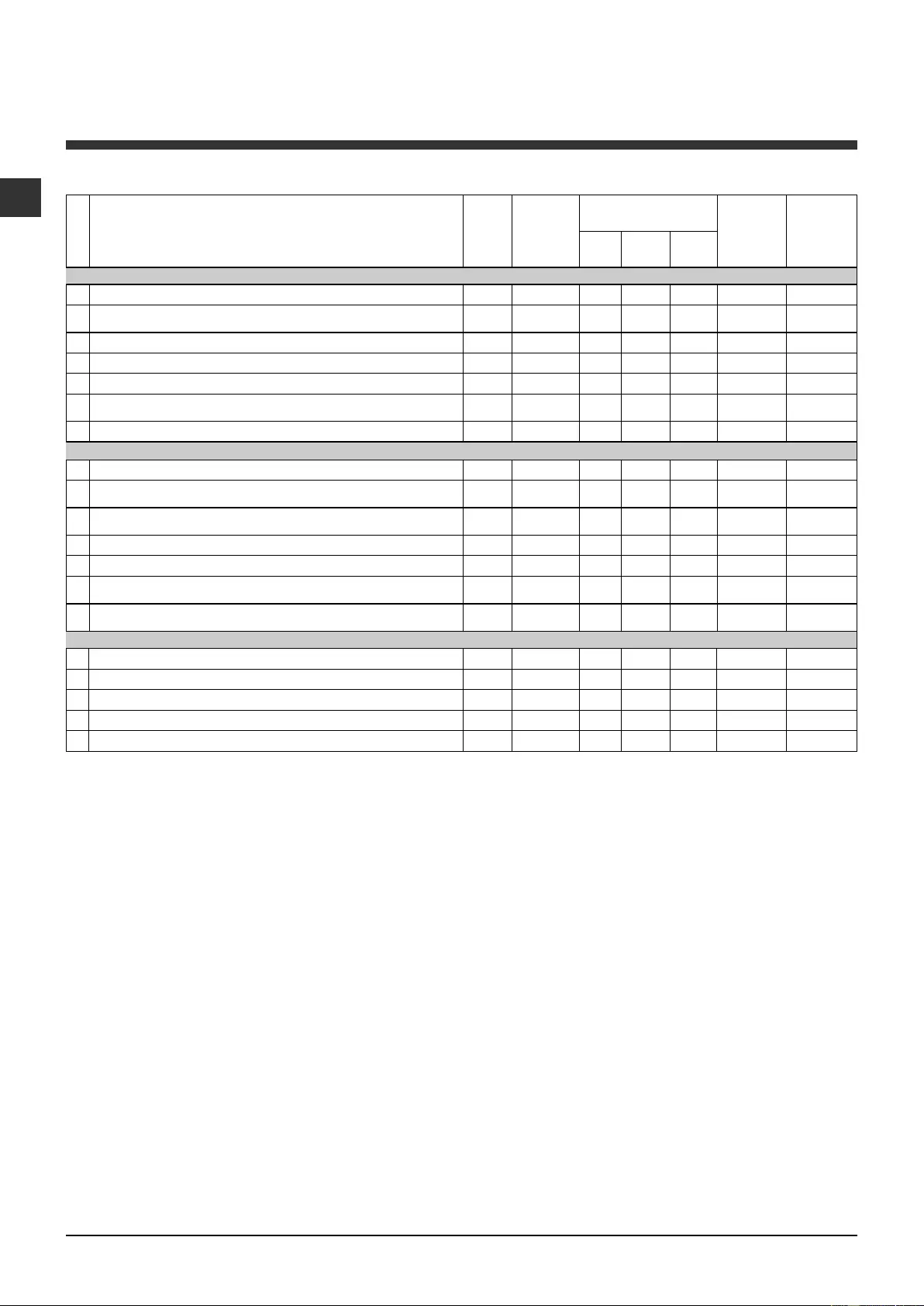
50
DE
Beschre ib ung de s Pr ogram m s
Max.
Tempe—
ratur
(°C)
Max.
Schleuder—
Geschwin-
digkeit
(U/min)
Waschmittel Max.
Beladungs-
menge (kg)
Programm—
dauer
Bleich-
mittel Haupt—
wäsche Weich-
spüler
Spezialprogramme
6Hygiene zyk lus: s t ark vers ch m u t zte Wei ß w äsch e. 90° 1200 zz z 7 170
6Hygiene zyk lus (1): s t ark vers ch m u t zt e Weiß — un d far bechte
Buntwäsche. 60° 1200 —zz 7153
7Gute nacht: leicht verschmutzte empfindliche Buntwäsche. 40° 800 —zz 4 290
8Baby: s t ark versch mu t zt e emp findli ch e Bu n t w äsch e .40° 800 —zz 2 118
9Oberhemden 40° 600 —zz 270
10 Seide/Gardinen: klei dun g s s t ücke aus S eide, Vis k o s e u nd
Feinwäsche. 30° 0 —zz 255
11 Wolle: wolle, Kaschmir usw. 40° 600 —zz 1,5 55
Programme für die tägliche Wäsche
1Baumwolle: stark verschmutzte Weiß— und farbechte Buntwäsche. 60° 1200 zz z 7122
1Baum wolle (2): s t ark vers chmutzt e Weiß— un d empfi n d liche
Buntwäsche. 40° 1200 zz z 7 115
2Baum wolle-Buntwäsche (3): leicht verschmu t zte W eiß w äs che
und empfindliche Buntwäsche. 40° 1200 zz z 785
3Synthetik: st ark vers ch mut zte, farb ech t e B un t w äs ch e. 60° 800 —zz 385
3Synthetik: leicht verschmutzte farbechte Buntwäsche. 40° 800 —zz 370
4Mix 30′: zum kurzen Auffrischen leicht verschmutzter Wäsche
(n i ch t g eeig net fü r Wo l le, Seid e u nd Handw äs che). 30° 800 —zz 330
5Mix 15′: zum kurzen Auffrischen leicht verschmutzter
Wäsche (nicht geeignet für Wolle, Seide und Handwäsche). 30° 800 —zz 1,5 15
Teilprogramme
ASpülen —1200 —z736
BSanftes Spülen —800 —z331
CSchleudern —1200 —— 716
DSanftes Schleu dern —800 —— 312
EAbpumpen —0—— 72
Sonderprogramme
Hygiene zyklus (Programm 6). Ein Programm zur Hygienisierung bei hohen Temperaturen, welches Bleichmittel und
eine Waschtemperatur von mehr als 60°C vorsieht.Geben Sie das Bleichmittel, das Waschmittel und die Zusätze in die
entsprechenden Kammern (siehe Absatz „Waschmittelschublade“).
Gute Nacht (Programm 7). Ein Flüsterprogramm, das nachts und demnach bei verbilligtem Nachttarif arbeiten kann.
Das Programm wurde für Wäsche aus Kunstfasern und Baumwolle konzipiert. Nach Ablauf des Waschgangs stoppt die
Maschine, ohne das Wasser abzupumpen. Um die Schleuder und den Wasserablauf in Gang zu setzen drücken Sie die
Taste START/PAUSE, andernfalls setzt die Maschine nach Ablauf von 8 Stunden die Schleuder automatisch in Gang
und pumpt das Wasser ab.
Baby (Programm 8). Dieses Programm ist in der Lage, die durch Kinder verursachten, typischen Flecken zu beseitigen,
und die Waschmittel optimal auszuspülen, um Allergien an der empfindlichen Kinderhaut zu vermeiden. Dieser Zyklus
wurde konzipiert, um Bakterienvorkommen zu reduzieren, dank des Einsatzes einer erheblich größeren Wassermenge
und Optimierung spezifischer, hygienisierender Waschmittelzusätze.
Am Ende des Waschgangs erfolgen einige langsame und sanfte Trommelumdrehungen, um Knitterbildung zu
vermeiden. Drücken Sie abschließend die Taste START/PAUSE.
Mix 30‘ (Programm 4) Kurzprogramm für die tägliche Wäsche leicht verschmutzter Teile: in nur 30 Minuten, zur
Einsparung von Zeit und Energie. Stellen Sie dieses Waschprogramm (4 bei 30°C) ein, dann können, bei einer
maximalen Lademenge von 3 kg, Gewebe unterschiedlicher Art (mit Ausnahme von Wolle und Seide) zusammen
gewaschen werden.
Mix 15‘ (Programm 5) Kurzprogramm für die Wäsche leicht verschmutzter Teile: in nur 15 Minuten, zur Einsparung von
Zeit und Energie. Stellen Sie dieses Waschprogramm (5 bei 30°C) ein, dann können, bei einer maximalen Lademenge
von 1,5 kg, Gewebe unterschiedlicher Art (mit Ausnahme von Wolle und Seide) zusammen gewaschen werden.
Waschprogramme
Bei den in der Tabelle angegebenen Daten handelt es sich um Richtwerte.
Für alle Testinstitute:
1) Prüfprogramm gemäß EN 60456: Programm 6 und eine Temperatur von 60°C einstellen.
2) Langes Baumwollprogramm: Pr ogramm 1 und eine Temperatur von 40°C einstellen.
3) Kurzes Baumwollprogramm: Pr ogramm 2 und eine Temperatur von 40°C einstellen.
Wasch-
programme
Programmtabelle
DE
51
Temperatureinstellung
Drehen Sie den Wählschalter „TEMPERATUREN“, um die Waschtemperatur einzustellen (siehe Programmtabelle).
Die Temperatur kann bis auf Kaltwäsche ( ) herabgesetzt werden.
Der Waschvollautomat verhindert automatisch die Einstellung einer höheren Schleuderstufe, sollte diese die für das
jeweilige Programm vorgeschriebene Höchstgeschwindigkeit übersteigen.
Schleudereinstellung
Durch Drehen des Wählschalters SCHLEUDER wird die Schleudergeschwindigkeit des gewählten Waschprogramms
eingestellt.
Folgende Höchstgeschwindigkeiten sind für die einzelnen Programme vorgesehen:
Waschprogramme Höchstgeschwindigkeit
Baumwolle 1200 U/min
Kunstfasern 800 U/min
Wolle 600 U/min
Seide nur Wasserablauf
Die Schleudergeschwindigkeit kann herabgesetzt werden. Durch Wahl des Symbols kann die Schleuder gänzlich
ausgeschlossen werden.
Der Waschvollautomat verhindert automatisch ein stärkeres Schleudern, sollte dieses die für das jeweilige Programm
vorgeschriebene Höchstgeschwindigkeit übersteigen.
Funktionen
Die verschiedenen Waschfunktionen, die Ihnen Ihr Waschvollautomat bietet, ermöglichen es Ihnen, hygienisch
saubere und weiße Wäsche zu erhalten, die Ihren Wünschen entspricht.
Aktivierung der Funktionen:
1. Drücken Sie die Taste, die der gewünschten Funktion entspricht.
2. Das Aufleuchten der entsprechenden Kontrollleuchte zeigt an, dass die Funktion aktiviert wurde.
Anmerkung: Sollte die Kontrollleuchte jedoch auf rasches Blinklicht schalten, dann bedeutet dies, dass die Funktion zu
dem eingestellten Programm nicht zugeschaltet werden kann.
Startzeitvorwahl
Der Start des Waschprogramms kann bis zu 12 Stunden verschoben werden.
Drücken Sie die Taste mehrmals, bis die der gewünschten Zeitverschiebung entsprechende Kontrollleuchte aufleuchtet.
Ein fünfter Tastendruck deaktiviert die Funktion.
NB: Ist die Taste START/RESET einmal gedrückt, kann der gewählte Zeitverschiebungswert nur noch herabgesetzt werden.
! Obiges gilt für alle Programme.
Bügelleicht
Wird diese Funktion eingestellt, werden Waschgang und Schleuder entsprechend geändert, um Knitterbildung zu
vermeiden. Am Ende des Waschgangs erfolgen langsame Umdrehungen der Trommel; die Kontrollleuchte der Funktion
BÜGELLEICHT und die der Funktion START/PAUSE blinken (orangefarben), die der Phase bleibt auf Dauerlicht
eingeschaltet. Um den Waschgang abzuschließen, drücken Sie die Taste START/PAUSE oder die Taste BÜGELLEICHT.
Wird das Programm Seide eingestellt, unterbricht Ihr Gerät das Programm, ohne das Wasser abzupumpen. Ihre
Wäsche bleibt so im letzen Aufwaschwasser liegen, die Kontrollleuchte der Funktion BÜGELLEICHT und die der
Funktion START/PAUSE blinken (orangefarben), die der Phase SPÜLEN bleibt auf Dauerlicht eingeschaltet. Zum
Abpumpen des Wassers und um die Wäsche herausnehmen zu können, muss die Taste START/PAUSE, oder die
Taste „BÜGELLEICHT“ gedrückt werden.
!
Diese Funktion kann zu den Programmen 4, 5, 6, 7, 8, 11, C, D, E nicht zugeschaltet werden.
Extra Spülgang
Wählen Sie diese Funktion, wird die Spülwirkung erhöht, und somit ein optimales Ausspülen des Waschmittels
garantiert. Dies ist besonders angezeigt bei sehr empfindlicher Haut bzw. Waschmittelallergien.
! Diese Funktion kann zu den Programmen 4, 5, C, D, E nicht zugeschaltet werden.
Super wash
Dank der Erhöhung der Wassermenge sowie der Waschdauer in der Anfangsphase des Waschvorgangs, garantiert
diese Funktion beste Waschergebnisse.
! Diese Funktion kann zu den Programmen 4, 5, 6, 10, 11, A, B, C, D, E nicht zugeschaltet werden.
Personalisierungen
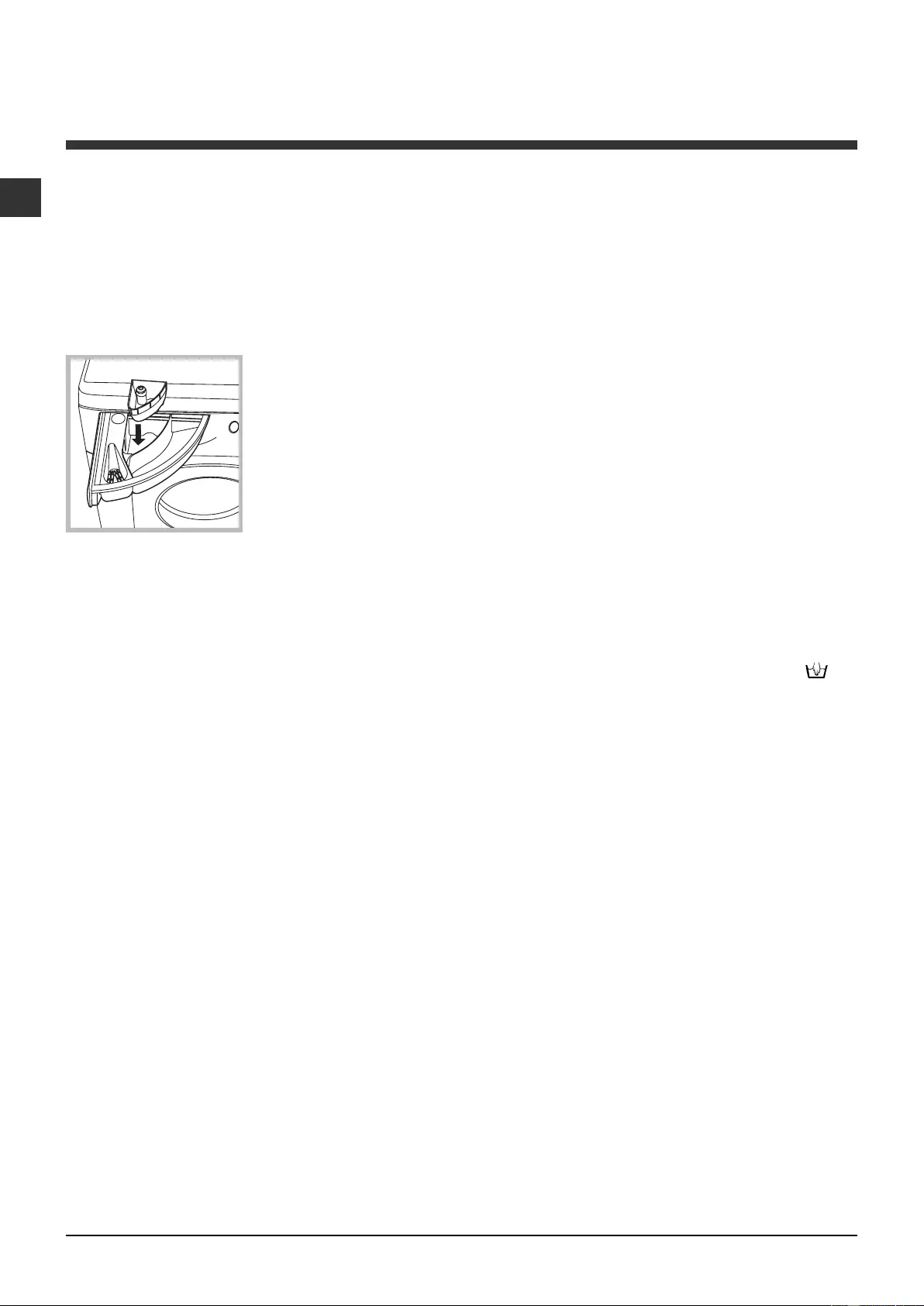
52
DE
Waschmittel und Wäsche
W aschmittel und Wäsche
Ein gutes Waschergebnis hängt auch von einer
korrekten Waschmitteldosierung ab: Eine zu hohe
Dosierung bedeutet nicht unbedingt reinere Wäsche,
sie trägt nur dazu bei, die Maschineninnenteile zu
verkrusten und die Umwelt zu belasten.
! Verwenden Sie keine Handwaschmittel, sie
verursachen eine zu hohe Schaumbildung.
Schublade herausziehen
und Waschmittel oder
Zusätze wie folgt
einfüllen:
In Kammer 1: Waschmittel für die
Hauptwäsche (Waschpulver oder
Flüssigwaschmittel)
Flüssigwaschmittel nur kurz vor dem Start einfüllen.
In Kammer 2: Zusätze (Weichspüler usw.)
Der Weichspüler darf das Gitter nicht übersteigen.
Zusätzliche Kammer 3: Bleichmittel
Bleichen
Bleichen ist nur bei den Programmen 1, 2, 6 möglich.
Füllen Sie das Bleichmittel in die Dosierkammer 3 ein,
und das Waschmittel und den Weichspüler in die
entsprechenden Dosierkammern. Stellen Sie dann
eines der obigen Programme ein.
Diese Funktion eignet sich nur für stark verschmutzte
Baumwollwäsche.
Vorsortieren der Wäsche
• Sortieren Sie die Wäsche nach:
— Gewebeart / Waschetikettensymbol.
— und Farben: Buntwäsche von Weißwäsche
trennen.
• Entleeren Sie alle Taschen.
• Das angegebene Gewicht, das sich auf die
maximale Ladung an Trockenwäsche bezieht, sollte
nicht überschritten werden:
Widerstandsfähige Gewebe: max 7 kg
Kunstfasergewebe: max 3 kg
Feinwäsche: max 2 kg
Wolle: max 1,5 kg
MAX
1
3
2
Wie schwer ist Wäsche?
1 Betttuch 400-500 gr
1 Kissenbezug 150-200 gr
1 Tischdecke 400-500 gr
1 Bademantel 900-1.200 gr
1 Handtuch 150-250 gr
Besondere Wäscheteile
Oberhemden: wählen Sie das Spezialprogramm 9
zum Waschen von Oberhemden jeglicher Gewebeart
und Farbe.
Es gewährleistet höchste Pflege und weitgehende
Vermeidung von Faltenbildung.
Seide: wählen Sie das Spezialprogramm 10 zum
Waschen aller Kleidungs- bzw. Wäschestücke aus
Seide. Es empfiehlt sich der Einsatz von
Feinwaschmittel.
Gardinen:
gardinen zusammengefaltet in einem
Kissenbezug oder in einem netzartigen Beutel waschen.
Stellen Sie das Programma 10 ein.
Wolle: der Waschvollautomat von Hotpoint/Ariston ist
der einzige, der mit dem „Woolmark Platinum Care“-
Siegel (M.0508) von The Woolmark Company
ausgezeichnet wurde. Dieses bestätigt die schonende
Maschinenwäsche aller Kleidungsstücke aus Wolle,
auch solcher, die das Etikett „nur Handwäsche“
tragen. Mit dem Programm 11 lässt sich also sämtliche
Wollwäsche (max. 1,5 kg) bedenkenlos waschen,
wobei beste Resultate gewährleistet sind.
Unwuchtkontrollsystem
Um starke Vibrationen oder eine Unwucht beim
Schleudern zu vermeiden, verfügt das Gerät über ein
Schleuderunwuchtsystem. Die Waschladung wird durch
eine erhöhte Rotation der Trommel als die des
WAschgangs ausbalanciert. Sollte die Wäscheladung
nach Ablauf mehrerer Versuche immer noch nicht
korrekt verteilt sein, schleudert das Gerät die Wäsche
bei einer niedrigeren Geschwindigkeit als die der
vorgesehenen Schleudergeschwindigkeit. Sollte die
Wäsche extrem ungleichmäßig verteilt sein, führt das
Gerät anstelle des Schleudergangs einen
Wäscheverteilungs-Zyklus durch. Um eine optimale
Verteilung der Wäscheladung und somit eine korrekte
Auswuchtung zu fördern, sollten große und kleine
Wäscheteile gemischt eingefüllt werden.

DE
53
Vorsichtsmaßregeln
und Hinweise
! Der Waschvollautomat wurde nach den strengsten
internationalen Sicherheitsvorschriften entworfen und gebaut.
Nachstehende Hinweise werden aus Sicherheitsgründen
geliefert und sollten aufmerksam gelesen werden.
Allgemeine Sicherheit
• Dieses Gerät wurde ausschließlich für den Einsatz
im privaten Haushalt konzipiert.
• Dieses Gerät ist nicht zur Verwendung durch
Personen (einschließlich Kinder) mit eingeschränkten
körperlichen, geistigen oder sensorialen Fähigkeiten
oder ohne ausreichende Erfarhung und Kenntnis
geeignet, es sei denn, sie werden durch eine für
ihre Sicherheit verantwortliche Person beaufsichtigt
und eingewiesen. Kinder müssen beaufsichtigt
werden, um sicherzustellen, dass sie nicht mit dem
Gerät spielen.
• Berühren Sie das Gerät nicht, wenn Sie barfuß
sind, und auch nicht mit nassen oder feuchten
Händen oder Füßen.
• Ziehen Sie den Gerätestecker nicht am Kabel aus
der Steckdose, sondern nur am Netzstecker selbst.
• Öffnen Sie die Waschmittelschublade nicht, wenn
das Gerät in Betrieb ist.
• Berühren Sie nicht das Ablaufwasser, es könnte
sehr heiß sein.
• Öffnen Sie die Gerätetür nicht mit Gewalt: Der
Sicherheits-Schließmechanismus könnte hierdurch
beschädigt werden.
• Bei etwaigen Störungen versuchen Sie bitte nicht,
Innenteile selbst zu reparieren.
• Halten Sie Kinder stets von dem in Betrieb
befindlichen Gerät fern.
• Während des Waschgangs kann die Gerätetür sehr
heiß werden.
• Muss das Gerät versetzt werden, sollten hierfür
zwei oder drei Personen verfügbar sein. Versetzen
Sie es niemals allein, das Gerät ist äußerst schwer.
• Bevor Sie die Wäsche einfüllen, stellen Sie bitte
sicher, dass die Wäschetrommel leer ist.
Entsorgung
• Entsorgung des Verpackungsmaterials: Befolgen Sie
die lokalen Vorschriften, Verpackungsmaterial kann
wiederverwertet werden.
• Gemäß der Europäischen Richtlinie 2002/96/EC über
Elektro- und Elektronik-Altgeräte dürfen Elektro-
haushalts-Altgeräte nicht über den herkömmlichen
Haushaltsmüllkreislauf entsorgt werden. Altgeräte
müssen separat gesammelt werden, um die Wiederver—
wertung und das Recycling der beinhalteten Materialien
zu optimieren und die Einflüsse auf die Umwelt und die
Gesundheit zu reduzieren. Das Symbol „durchgestri-
Manuelles Öffnen der Gerätetür
Sollte die Gerätetür aufgrund eines Stromausfalls nicht
geöffnet werden können, gehen Sie wie folgt vor, um
die Wäsche entnehmen und somit aufhängen zu
können:
1. Ziehen Sie den Netzstecker aus der Steckdose.
2. Stellen Sie sicher, dass der Wasserstand im Innern
des Gerätes die Gerätetür nicht übersteigt,
andernfalls lassen Sie das überschüssige Wasser, so
wie auf der Abbildung veranschaulicht, durch den
Ablaufschlauch in einen Eimer ablaufen.
3. Befreien Sie mithilfe der auf der Abbildung
veranschaulichten Zunge (nach vorne ziehen) die
Kunststoff-Spannvorrichtung aus der Arretierung;
ziehen Sie letztere dann nach unten und öffnen Sie
gleichzeitig die Gerätetür.
chene Mülltonne“ auf jedem Produkt erinnert Sie an
Ihre Verpflichtung, dass Elektrohaushaltsgeräte
gesondert entsorgt werden müssen. Endverbraucher
können sich an Abfallämter der Gemeinden wenden,
um mehr Informationen über die korrekte Entsorgung
ihrer Elektrohaushaltsgeräte zu erhalten.
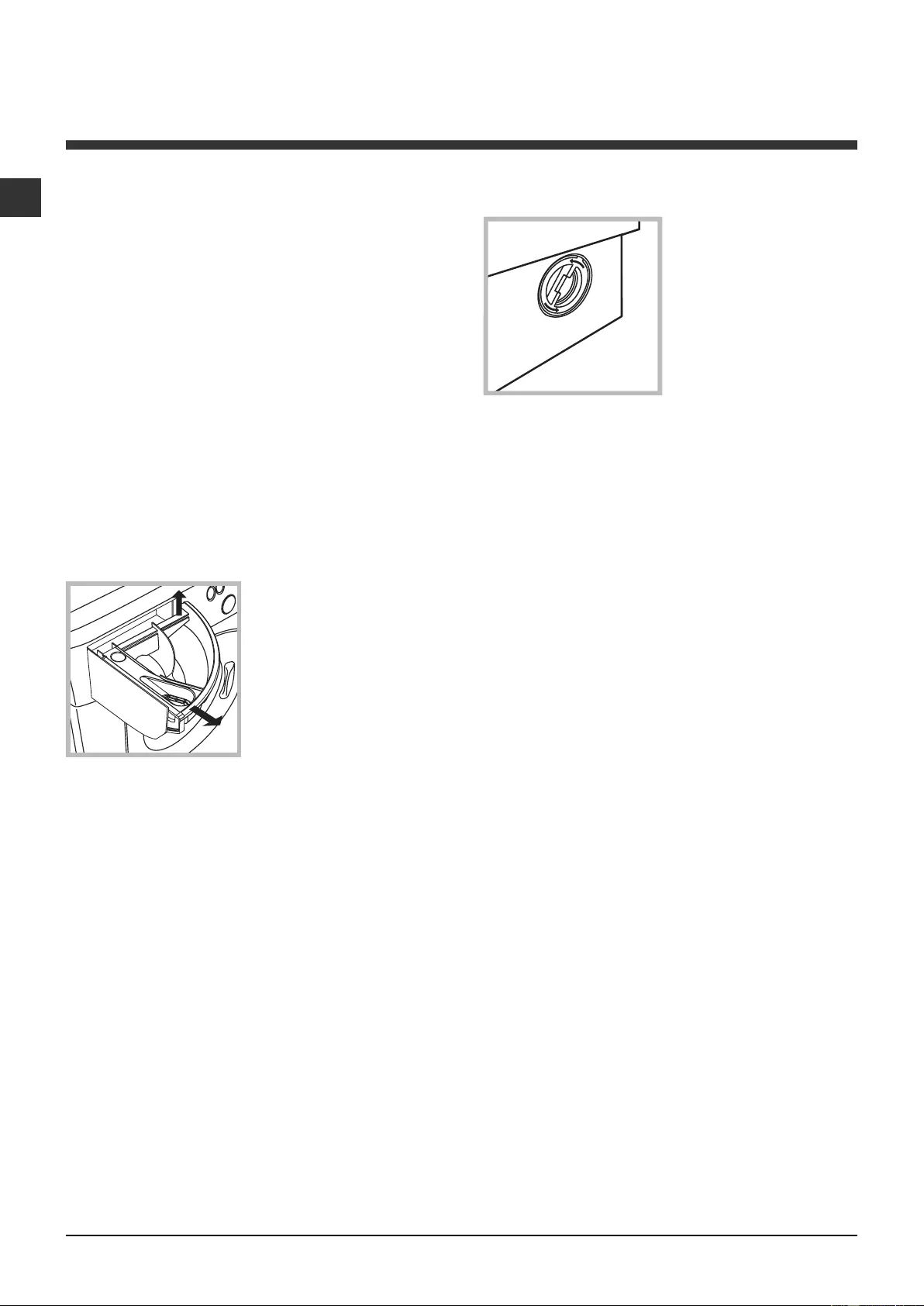
54
DE
Reinigung und Pflege
Abstellen der Wasser— und
Stromversorgung
• Drehen Sie den Wasserhahn nach jedem
Waschvorgang zu. Hierdurch wird der Verschleiß
der Wasseranlage verringert und Wasserlecks
vorgebeugt.
• Ziehen Sie den Netzstecker aus der Steckdose,
bevor Sie Ihren Waschvollautomaten reinigen.
Reinigung des Gerätes
Die Gehäuseteile und die Teile aus Gummi können
mit einem mit warmer Spülmittellauge
angefeuchteten Tuch gereinigt werden. Vermeiden
Sie Löse- und Scheuermittel
Reinigung der Waschmittelschublade
Heben Sie die
Schublade leicht an und
ziehen Sie sie nach
vorne hin heraus (siehe
Abbildung).
Spülen Sie sie
regelmäßig unter
fließendem Wasser
gründlich aus.
Pflege der Gerätetür und Trommel
• Lassen Sie die Gerätetür stets leicht offen stehen,
um die Bildung unangenehmer Gerüche zu
vermeiden.
Reinigung der Pumpe
Ihr Gerät ist mit einer selbstreinigenden Pumpe
ausgerüstet, eine Wartung ist demnach nicht
erforderlich. Es könnte jedoch vorkommen, dass
kleine Gegenstände (Münzen, Knöpfe) in die zum
Schutz der Pumpe dienende Vorkammer (befindlich
unter der Pumpe) fallen.
! Vergewissern Sie sich, dass der Waschgang
abgeschlossen ist und ziehen Sie den Netzstecker
heraus.
Zugang zur Vorkammer:
1. Drehen Sie den
Deckel gegen den
Uhrzeigersinn ab (siehe
Abbildung): es ist ganz
normal, wenn etwas
Wasser austritt;
2. Reinigen Sie das Innere gründlich;
3. Schrauben Sie den Deckel wieder auf.
Kontrolle des Wasserzulaufschlauchs
Kontrollieren Sie den Zulaufschlauch mindestens
einmal im Jahr. Weist er Risse bzw. Brüche auf, muss
er ausgetauscht werden. Der starke Druck während
des Waschprogramms könnte zu plötzlichem Platzen
führen.
!!
!!
!
Verwenden Sie niemals bereits gebrauchte
Schläuche.

DE
55
Störungen und Abhilfe
Bei Funktionsstörung: Bevor Sie sich an den Technischen Kundendienst wenden (siehe „Kundendienst“),
vergewissern Sie sich zuerst, ob es sich nicht um eine Kleinigkeit handelt, die Sie selbst beheben können. Ziehen
Sie hierzu nachstehendes Verzeichnis zu Rate.
Störungen:
Der Waschvollautomat schaltet sich
nicht ein.
Der Waschgang startet nicht.
Der Waschvollautomat lädt kein
Wasser. Die Kontrollleuchte der
ersten Waschphase blinkt (rasches
Blinklicht).
Der Waschvollautomat lädt laufend
Wasser und pumpt es laufend ab.
Der Waschvollautomat pumpt nicht
ab und schleudert nicht.
Der Waschvollautomat vibriert zu
stark während des Schleuderns.
Der Waschvollautomat ist undicht.
Die Kontrollleuchte START/PAUSE
(orangefarben) und die
Funktionsleuchten blinken (rasches
Blinklicht).
Es bildet sich zu viel Schaum.
Mögliche Ursachen / Lösungen:
• Der Stecker steckt nicht in der Steckdose, oder nicht so, dass der Kontakt
hergestellt wird.
• Der Strom ist ausgefallen.
• Die Gerätetür wurde nicht vorschriftsmäßig geschlossen.
• Die EIN/AUS-Taste wurde nicht gedrückt.
• Die Taste START/PAUSE wurde nicht gedrückt.
• Der Wasserhahn ist nicht aufgedreht.
• Es wurde ein verzögerter Start gewählt (siehe „Personalisierungen“).
• Der Zufuhrschlauch ist nicht am Wasserhahn angeschlossen.
• Der Schlauch ist geknickt.
• Der Wasserhahn ist nicht aufgedreht.
• Es ist kein Wasser da.
• Der Druck ist unzureichend.
• Die Taste START/PAUSE wurde nicht gedrückt.
• Der Ablaufschlauch befindet sich nicht auf der vorgeschriebenen Höhe, d.h. 65 – 100 cm
vom Boden (siehe „Installation“).
• Das Schlauchende liegt unter Wasser (siehe „Installation”).
• Der Abfluss der Hausinstallation wurde nicht mit einer Entlüftungsöffnung versehen.
Konnte die Störung durch diese Kontrollen nicht behoben werden, dann drehen Sie den
Wasserhahn zu, schalten das Gerät aus und fordern den Kundendienst an. Falls Sie in
einer der obersten Etagen eines Gebäudes wohnen, kann es vorkommen, dass sich im
Syphon ein V akuum bildet, und der Waschvollautomat ständig W asser ansaugt und
wieder abpumpt. Zur Lösung dieser Probleme bietet der Handel spezielle Syphonventile.
• Das Programm siehe kein Abpumpen vor: Bei einigen Programmen muss es
von Hand eingestellt werden.
• Die Funktion BÜGELLEICHT wurde aktiviert: zur Beendung des Programms
Taste START/P AUSE drücken (siehe „Personalisierungen“).
• Der Ablaufschlauch ist geknickt ( siehe „Installation“).
• Die Ablaufleitung ist verstopft.
• Die Trommel wurde bei der Installation nicht korr ekt befreit ( siehe „Installation“).
• Der Waschvollautomat steht nicht eben ( siehe „Installation“).
• Der Waschvollautomat steht zu eng zwischen der Wand und einem Möbel
(siehe „Installation“).
• Der Zulaufschlauch wurde nicht ordnungsgemäß aufgeschraubt (siehe „Installation“).
• Die Waschmittelschublade ist verstopft (zur Reinigung siehe „Wartung und Pflege“).
• Der Ablaufschlauch ist nicht korrekt befestigt ( siehe „Installation“).
• Schalten Sie das Gerät aus und ziehen Sie den Netzstecker; warten Sie
daraufhin ca. 1 Minute und schalten Sie es wieder ein.
Bleibt die Störung bestehen, kontaktieren Sie bitte den Kundendienst.
• Das Waschmittel ist für Waschmaschinen nicht geeignet (es muss mit der Aufschrift
„Für Waschmaschinen“, „Für Handwäsche und Waschmaschinen“ usw. versehen sein.
• Es wurde zu hoch dosiert.

56
DE
Kundendienst
Bevor Sie sich an den Kundendienst wenden:
•Sollten einige Kontrollen vorab selbst durchgeführt werden (siehe „Störungen und Abhilfe“);
• Starten Sie daraufhin das Programm erneut, um sicherzustellen, dass die Störung auch wirklich behoben
wurde;
• Ist dies nicht der Fall, dann kontaktieren Sie den autorisierten Kundendienst unter der auf dem
Garantieschein befindlichen Telefonnummer.
!Wenden Sie sich auf keinen Fall an nicht autorisierte Techniker.
Geben Sie bitte Folgendes an:
• die Art der Störung;
• das Maschinenmodell (Mod.);
• die Seriennummer (S/N).
Diese Daten entnehmen Sie bitte dem auf der Rückseite des Waschvollautomaten und auf der Vorderseite
(Gerätetür öffnen) befindlichen Typenschild.
195081700.00
09/2009 — Xerox Fabriano
Manuals.eu
- Manuals.eu
- Hotpoint-Ariston
- Home & Kitchen
- Washing machines
- AWM 129 (EU)
- Instruction
×
1
2
3
4
5
6
7
8
9
10
11
12
13
14
15
16
17
18
19
20
21
22
23
24
25
26
27
28
29
30
31
32
33
34
35
36
37
38
39
40
41
42
43
44
45
46
47
48
49
50
51
52
53
54
55
56
57
58
59
60
61
62
63
64
65
66
67
68
69
70
71
72
73
74
75
76
77
78
79
80
81
82
83
84
⟨
⟩
Copyright © Manuals.eu
Agreement
Privacy Policy
Contact us