
Коротко
- Британская «ДжиДаблЮ фармасьютикалс» (GW Pharmaceuticals) через свое американское подразделение в лице «Гринвич байосайенсиз» (Greenwich Biosciences) получила разрешение Управления по санитарному надзору за качеством пищевых продуктов и медикаментов США (FDA) на «Эпидиолекс» (Epidiolex, каннабидиол), предназначенный для терапии эпилептических (судорожных) припадков при синдроме Леннокса — Гасто или синдроме Драве у пациентов в возрасте от двух лет.
- «Эпидиолекс» стал первым одобренным в Соединенных Штатах рецептурным препаратом на базе каннабидиола (CBD) — одного из компонентов конопли. Поскольку каннабидиол не является психоактивным и не вызывает эйфорических эффектов, свойственных другим составляющим конопли вроде дельта-9-тетрагидроканнабинола (THC), никаких серьезных ограничительных мер на предмет потенциального злоупотребления этим лекарственным средством не предусмотрено: он отнесен к перечню V контролируемых веществ. «Эпидиолекс» реализован в жидкой рецептуре фармацевтически чистого каннабидиола натурального происхождения.
- Синдром Леннокса — Гасто и синдром Драве — весьма серьезные, но редкие формы эпилепсии, почти не поддающиеся лечению: противоэпилептические препараты справляются плохо. Пациенты, страдающие от множественных инвалидизирующих и рецидивирующих судорожных припадков, находятся в высокой группе риска внезапной смерти.
Подробности
Синдром Леннокса — Гасто (эпилептическая энцефалопатия детства, синдром Леннокса, petit mal variant) — тяжелая эпилептическая энцефалопатия с различной симптоматикой и высокой частотой повреждений при судорожных приступах. Клиническая триада включает разнообразные и одновременные типы приступов (тонические судороги, атипичные абсансы, тонические и атонические дроп-атаки, неконвульсивный эпилептический статус), когнитивные нарушения, медленные комплексы острая – медленная волна на ЭЭГ. Дебют заболевания обычно случается в возрасте 3–5 лет. Среди причин: повреждения головного мозга (пренатальный или перинатальный инсульт, вызывающая энцефалит или менингит внутриутробная инфекция, опухоль, порок развития) и генетические нарушения (комплекс туберозного склероза, синдром Веста).
Синдром Драве (тяжелая миоклоническая эпилепсия младенчества, полиморфная эпилепсия младенчества, эпилепсия с полиморфными чертами) — трудноизлечимая эпилепсия раннего детства (дебютирует обычно в возрасте 1–24 месяцев), при манифестации характеризующаяся длительными и рецидивирующими гемиконвульсивными приступами с лихорадкой и прогрессированием до полиморфных генерализованных приступов, приводящих к задержке развития, когнитивным нарушениям и повышенной смертности. В большинстве случаев вызывается мутациями de novo гена SCN1A, кодирующего альфа-субъединицу потенциалозависимого натриевого канала типа I (Nav1.1,). Приступы могут быть вызваны гипертермией (лихорадка, теплые ванны или интенсивные физические упражнения), светом, шумом, определенными паттернами, сильными эмоциями или аутостимуляцией.
Как и в случае многих других противоэпилептических лекарственных средств, точный механизм действия, посредством которого каннабидиол проявляет противосудорожные эффекты у людей, не известен. Считается, что благотворный эффект этого вещества не соотносится со связыванием или активацией каннабиноидных рецепторов CB1 и CB2 или влиянием на потенциалозависимые натриевые каналы. Есть мнение, что каннабидиол оказывает кумулятивное воздействие, модулируя множество эндогенных систем, включая нейрональное ингибирование (синаптических и экстрасинаптических ГАМК-каналов), модуляцию внутриклеточного кальция (TRPV, VDAC, GPR-55), противовоспалительный эффект (аденозин).
Эффективность и безопасность «Эпидиолекса» в терапии синдрома Леннокса — Гасто были проверены в двух клинических испытаниях GWPCARE4 (NCT02224690) и GWPCARE3 (NCT02224560) фазы III (рандомизированных, двойных слепых, плацебоконтролируемых), в которых пациентам (n=171 и n=225) ежедневно назначали каннабидиол в дозе 10 или 20 мг/кг либо плацебо. Заболевание участников (в возрасте от 2 до 55 лет) должно было ненадлежащим образом контролироваться как минимум одним противоэпилептическим препаратом (включая клобазам, вальпроат, ламотриджин, леветирацетам, руфинамид); стимуляция блуждающего нерва и/или кетогенная диета были разрешены.
Назначение «Эпидиолекса» обеспечило статистически значимое снижение частоты эпилептических приступов (атонических, тонических, тоникоклонических), начиная с 4 недель и в целом сохраняясь в течение 14-недельного курса терапии. Так, медиана процентного уменьшения в первом исследовании составила 41% (доза 20 мг/кг) против 14% в контрольной группе (p<0,01), во втором — 36% (10 мг/кг) и 38% (20 мг/кг) против 18% (p<0,01).
Эффективность и безопасность «Эпидиолекса» в терапии синдрома Драве были изучены в клинических испытаниях GWPCARE1 (NCT02091375) фазы III (рандомизированных, двойных слепых, плацебоконтролируемых), в которых пациенты (n=120, возраст от 2 до 18 лет) ежедневно получали 20 мг/кг каннабидиола или плацебо. Заболевание участников характеризовалась рефрактерностью и адекватно не отвечало на минимум один противоэпилептический препарат (в том числе клобазам, вальпроат, стирипентол, леветирацетам, топирамат); стимуляция блуждающего нерва и/или кетогенная диета были разрешены.
Применение «Эпидиолекса» обеспечило статистически значимое уменьшение частоты конвульсивных приступов (атонических, тонических, клонических, тоникоклонических), начиная с 4 недель и в целом сохраняясь в течение 14-недельного курса терапии: медианное снижение составило 39% против 13% в группе плацебо (p=0,01).

Согласно прогнозам EvaluatePharma, ожидания от пиковых продаж «Эпидиолекса» прилично высоки: реализация может достигнуть 2,3 млрд долларов к 2024 году. Очевидно, росту спроса помогут назначения «Эпидиолекса» вне инструкции в случае различных эпилептических заболеваний.
Стоимость годового лечения «Эпидиолексом» выставлена в 32,5 тыс. долларов по прейскуранту.
По словам Скотта Готлиба (Scott Gottlieb), главы FDA, включение зеленого света «Эпидиолексу» не означает регуляторного одобрения марихуаны: нет, речь идет лишь о разрешении определенного лекарственного средства для специфического применения.
Помимо «Эпидиолекса» в руках «ДжиДаблЮ» находится пероральный спрей «Сативекс» (Sativex, набиксимолс), доступный в ряде европейских стран, а также Австралии, Бразилии, Израиле, Канаде, Колумбии, Кувейте, Малайзии, Новой Зеландии, ОАЭ, Чили. Этот первый в мире фармацевтический препарат на основе марихуаны (тетрагидроканнабинол плюс каннабидиол), появившийся в 2010 году, предназначен для облегчения симптомов рассеянного склероза, таких как нейропатическая боль, мышечная спастичность, гиперактивность мочевого пузыря. «Сативекс» также применяется для снятия болевого синдрома у раковых больных.
Важная информация
Mosmedpreparaty.ru — энциклопедический веб-ресурс о мире лекарств, специализированная научно-исследовательская и справочно-информационная аналитическая служба группы компаний «Валиет», таргетированная на ключевые события глобальной отрасли фармации, биотехнологий, медицины и здравоохранения.
- Ничто на Mosmedpreparaty.ru не является рекламой или продвижением лекарственных препаратов, методов лечения, медицинских услуг.
- Сведения и публикации Mosmedpreparaty.ru носят исключительно научно-просветительский и ознакомительный характер.
- Медицинская информация, транслируемая Mosmedpreparaty.ru, предназначена только для специалистов в области здравоохранения и сфере обращения лекарственных средств.
- Медицинская информация, содержащаяся на Mosmedpreparaty.ru, не предназначена для использования в качестве замены консультации со специалистом в области здравоохранения.
- Ничто на Mosmedpreparaty.ru не должно истолковываться как предоставление медицинского совета или рекомендации и не может служить основанием для принятия каких-либо решений или осуществления каких-либо действий без участия специалиста в области здравоохранения.
Присутствие на веб-ресурсе Mosmedpreparaty.ru и ознакомление с его содержимым означает, что вы прочитали «Пользовательское соглашение» и приняли его условия.
Препарат Эпидиолекс на основе каннабидиола продемонстрировал эффективность при судорожном синдроме у пациентов с туберозным склерозом
|
Препарат Эпидиолекс (Epidiolex) компании GW Pharmaceuticals продемонстрировал эффективность при судорожном синдроме у пациентов с туберозным склерозом. В основе лекарственного средства лежит очищенный каннабидиол, не содержащий тетрагидроканнабинол — основной психоактивный компонент марихуаны. У пациентов с туберозным склерозом при развитии новообразований в центральной нервной системе часто развиваются судорожные припадки. Согласно результатам клинического исследования III фазы, прием препарата Эпидиолекс позволяет снизить частоту приступов в среднем на 47,6-48,6%. В группе плацебо этот показатель составил 26,5%. В прошлом году препарат Эпидиолекс был одобрен в США для лечения двух редких и тяжелых форм эпилепсии у детей — синдрома Леннокса–Гасто и синдрома Драве у детей в возрасте двух лет и старше. Это первый препарат на основе марихуаны, одобренный в США. Источник: clinical-pharmacy.ru |
EPIDIOLEX® (cannabidiol) offers flexible dosing for tolerability and response optimization
- Standard dosing
- Moderate hepatic impairment
- Severe hepatic impairment
Recommended dosing and titration
Increase in weekly increments of 5 mg/kg/day (2.5 mg/kg twice daily).*
Week 1
5 mg/kg/day
(2.5 mg/kg twice daily)
Week 2
10 mg/kg/day
(5 mg/kg twice daily)
Week 3
15 mg/kg/day†
(7.5 mg/kg twice daily)
Week 4
20 mg/kg/day†
(10 mg/kg twice daily)
Week 5
25 mg/kg/day‡
(12.5 mg/kg twice daily)

Dose adjustment and a slower dose titration are recommended in patients with moderate or severe hepatic impairment. Select an option above to view dosing recommendations for patients with hepatic impairment.
*For patients in whom a more rapid titration is warranted, the dosage may be increased no more frequently than every other day.
†For patients with LGS or Dravet syndrome, administration of the 20-mg/kg/day dosage resulted in somewhat greater reductions in seizure rates than the recommended maintenance dosage of 10 mg/kg/day, but with an increase in adverse reactions. Increase dose from 10 mg/kg/day if tolerated and required.
‡The effectiveness of doses lower than 25 mg/kg/day has not been studied in patients with TSC.
Because of an increase in exposure to EPIDIOLEX, dose adjustment and slower titration are recommended in patients with moderate or severe hepatic impairment. Consider not initiating EPIDIOLEX in patients with evidence of significant liver injury. Dose adjustments are not required in patients with mild hepatic impairment.
Review additional monitoring considerations
Recommended dosing and titration — 1/2 standard dosing*
Week 1
2.5 mg/kg/day
(1.25 mg/kg twice daily)
Week 2
5 mg/kg/day
(2.5 mg/kg twice daily)
Week 3
7.5 mg/kg/day
(3.75 mg/kg twice daily)
Week 4
10 mg/kg/day
(5 mg/kg twice daily)
Week 5
12.5 mg/kg/day
(6.25 mg/kg twice daily)
*Note: Total dosage should be split and administered twice daily. See additional dosing considerations for more information.
Because of an increase in exposure to EPIDIOLEX, dose adjustment and slower titration are recommended in patients with moderate or severe hepatic impairment. Consider not initiating EPIDIOLEX in patients with evidence of significant liver injury. Dose adjustments are not required in patients with mild hepatic impairment.
Review additional monitoring considerations
Recommended dosing and titration — 1/5 standard dosing*
Week 1
1 mg/kg/day
(0.5 mg/kg twice daily)
Week 2
2 mg/kg/day
(1 mg/kg twice daily)
Week 3
3 mg/kg/day
(1.5 mg/kg twice daily)
Week 4
4 mg/kg/day
(2 mg/kg twice daily)
Week 5
5 mg/kg/day
(2.5 mg/kg twice daily)
*Note: Total dosage should be split and administered twice daily. See additional dosing considerations for more information.
Dosing considerations
Food may affect EPIDIOLEX levels
EPIDIOLEX is an oral solution that is compatible with a ketogenic diet. EPIDIOLEX should be administered consistently with respect to meals. If necessary, EPIDIOLEX can be administered with certain nasogastric tubes (NG-tube) or gastrostomy tubes (G-tube). For specific instructions, please see the EPIDIOLEX Prescribing Information.
EPIDIOLEX can cause dose-related elevations of liver transaminases
Because of the risk of hepatocellular injury, obtain serum transaminases (ALT and AST) and total bilirubin levels in all patients prior to starting treatment with EPIDIOLEX and periodically thereafter.
- Because of an increase in exposure to EPIDIOLEX, dose adjustment and slower dose titration are recommended in patients with moderate or severe hepatic impairment. Consider not initiating EPIDIOLEX in patients with evidence of significant liver injury. Dose adjustments are not required in patients with mild hepatic impairment
Taking EPIDIOLEX with other drugs
Strong inducers of CYP3A4 and CYP2C19 may affect EPIDIOLEX exposure. EPIDIOLEX may affect exposure to CYP2C19 substrates (eg, clobazam, diazepam, stiripentol), orally administered P-gp substrates, or other substrates (see full Prescribing Information). Consider dose reduction of orally administered everolimus, with appropriate therapeutic drug monitoring, when everolimus is combined with EPIDIOLEX. A lower starting dose of everolimus is recommended when added to EPIDIOLEX therapy. Concomitant use of EPIDIOLEX and valproate increases the incidence of liver enzyme elevations. Pneumonia was observed more frequently with concomitant use of EPIDIOLEX and clobazam. Dosage adjustment of EPIDIOLEX or other concomitant medications may be necessary.
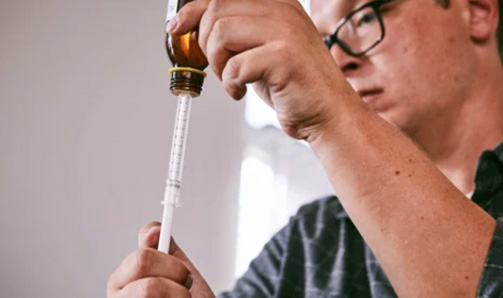
Administering EPIDIOLEX
Step-by-step instructions for administration.
HELP YOUR PATIENTS GET STARTED
Writing a prescription
TITRATION
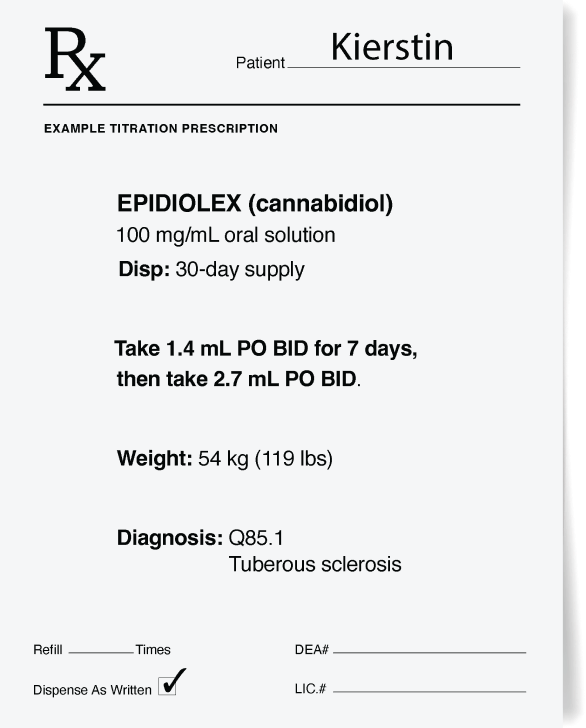
Dosing/ titration schedule
Patient weight
ICD-10 diagnosis code
MAINTENANCE
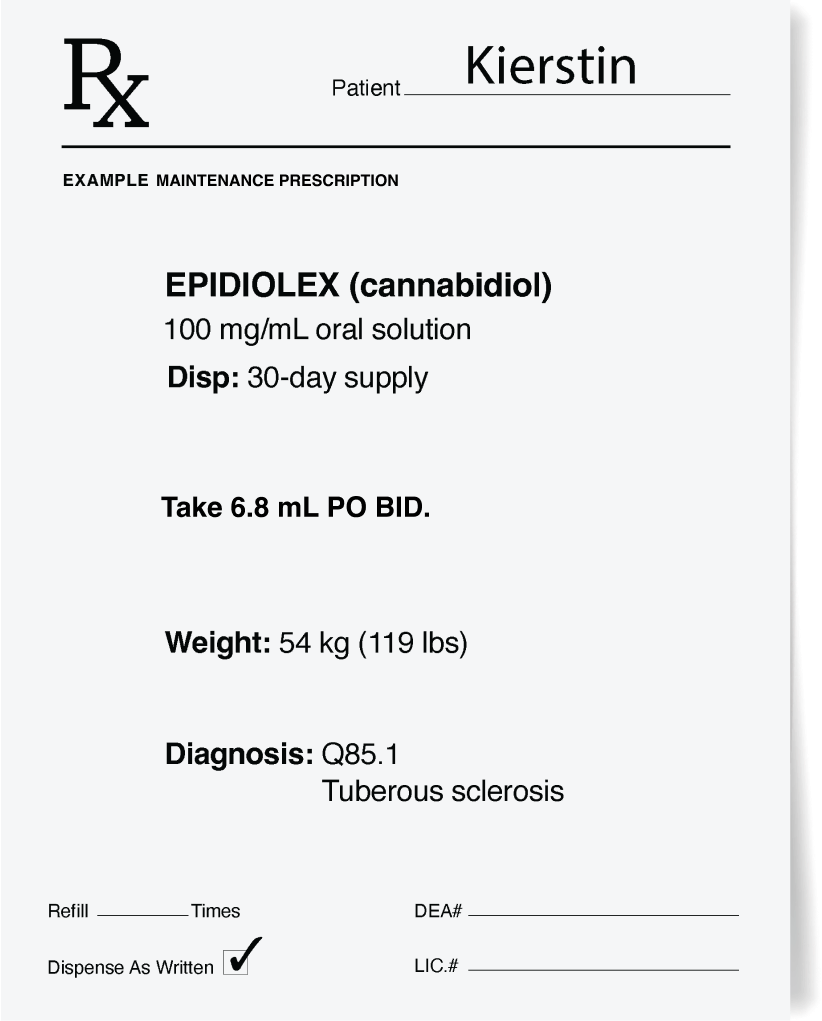
Dosing/ titration schedule
Patient weight
ICD-10 diagnosis code
As certain health plans and institutions may have policies regarding cannabinoid products/use, prescriptions should include EPIDIOLEX by name to avoid rejection.
If dose adjustment is required mid-prescription cycle, a new prescription will be needed.
This is provided for example purposes only. Not intended to supersede independent clinical judgment or institutional protocols. Please see full Prescribing Information for recommendations on liver monitoring.
12.1 Mechanism of Action
The precise mechanisms by which EPIDIOLEX exerts its anticonvulsant effect in humans are unknown. Cannabidiol does not appear to exert its anticonvulsant effects through interaction with cannabinoid receptors.
12.2 Pharmacodynamics
Cardiac Electrophysiology
Concentration-dependent QTc prolongation was observed for EPIDIOLEX. At exposures obtained when administered as monotherapy at recommended doses with a high fat meal, EPIDIOLEX did not prolong the QTc interval greater than 10 msec.
Other factors such as food intake, certain concomitant medications (e.g., clobazam), and alcohol consumption may increase the exposure of EPIDIOLEX and the potential effect on QTc prolongation in this scenario is not known.
12.3 Pharmacokinetics
Cannabidiol demonstrated an increase in exposure that was less than dose-proportional over the range of 5 to 25 mg/kg/day in patients.
Absorption
Cannabidiol has a time to maximum plasma concentration (Tmax) of 2.5 to 5 hours at steady state (Css).
Effect of Food
Coadministration of EPIDIOLEX (750 or 1500 mg) with a high-fat/high-calorie meal increased Cmax by 5‑fold, AUC by 4‑fold, and reduced the total variability, compared with the fasted state in healthy volunteers [see Dosage and Administration (2.4)]. Coadministration of EPIDIOLEX with a low-fat/low-calorie meal increased Cmax and AUC by 4-fold and 3-fold, respectively. Furthermore, coadministration of EPIDIOLEX with bovine milk increased exposure by approximately 3-fold for Cmax and 2.5‑fold for AUC. Coadministration of EPIDIOLEX with alcohol also caused increased exposure to cannabidiol, with 93% increased Cmax and 63% greater AUC.
Distribution
The apparent volume of distribution in healthy volunteers was 20963 L to 42849 L. Protein binding of the cannabidiol and its metabolites was > 94% in vitro.
Elimination
The half-life of cannabidiol in plasma was 56 to 61 hours after twice-daily dosing for 7 days in healthy volunteers. The plasma clearance of cannabidiol following a single EPIDIOLEX 1500 mg dose (approximately equal to the 20 mg/kg/day dosage) is 1111 L/h.
Metabolism
Cannabidiol is metabolized in the liver and the gut (primarily in the liver) by CYP2C19 and CYP3A4 enzymes, and UGT1A7, UGT1A9, and UGT2B7 isoforms.
After repeat dosing, the active metabolite of cannabidiol, 7-OH-CBD, has a 38% lower AUC than the parent drug. The 7-OH-CBD metabolite is converted to 7‑COOH-CBD, which has an approximately 40‑fold higher AUC than the parent drug. Based on preclinical models of seizure, the 7-OH-CBD metabolite is active; however, the activity of the 7‑COOH-CBD metabolite is inconclusive.
Excretion
EPIDIOLEX is excreted in feces, with minor renal clearance.
Specific Populations
Patients with Hepatic Impairment
No effects on the exposures of cannabidiol or metabolite exposures were observed following administration of a single dose of EPIDIOLEX 200 mg in patients with mild (Child-Pugh A) hepatic impairment. Patients with moderate (Child-Pugh B) or severe (Child-Pugh C) hepatic impairment had an approximately 2.5 to 5.2-fold higher AUC, compared with healthy volunteers with normal hepatic function [see Dosage and Administration (2.6), Warnings and Precautions (5.1), and Use in Specific Populations (8.6)].
Drug Interaction Studies
In Vitro Assessment of Drug Interactions
Drug Metabolizing Enzymes [see Drug Interactions (7.1, 7.2)]
Cannabidiol is a substrate for CYP3A4 and CYP2C19. Cannabidiol has the potential to inhibit CYP1A2, CYP2B6, CYP2C8, CYP2C9, and CYP2C19 at clinically relevant concentrations.
Cannabidiol may induce or inhibit CYP2B6 at clinically relevant concentrations.
Cannabidiol inhibits uridine 5′-diphospho-glucuronosyltransferase (UGT) enzymes UGT1A9 and UGT2B7, but does not inhibit the UGT1A1, UGT1A3, UGT1A4, UGT1A6, or UGT2B17 isoforms.
Transporters
Cannabidiol and the cannabidiol metabolite, 7-OH-CBD, are not anticipated to interact with BCRP, BSEP, MDR1/P-gp, OAT1, OAT3, OCT1, OCT2, MATE1, MATE2-K, OATP1B1, or OATP1B3. However, due to limitations of the in vitro testing procedure, inhibition of P-gp mediated efflux by cannabidiol in the intestine could not be excluded. In vivo data show that CBD can affect P-gp efflux activity in the intestine [see In Vivo Assessment of Drug Interactions].
The cannabidiol metabolite, 7-COOH-CBD, is not a substrate of BCRP, OATP1B1, OATP1B3, or OCT1. However, 7-COOH-CBD is a substrate for P-gp. 7-COOH-CBD is an inhibitor of transport mediated via BCRP and BSEP at clinically relevant concentrations.
In Vivo Assessment of Drug Interactions
Drug Interaction Studies with AEDs
Clobazam and Valproate
The interaction potential with other AEDs (clobazam and valproate) was evaluated in dedicated clinical studies following coadministration of EPIDIOLEX (750 mg twice daily in healthy volunteers and 20 mg/kg/day in patients).
Coadministration with clobazam in healthy volunteers increased the cannabidiol active metabolite 7-OH-CBD mean Cmax by 73% and AUC by 47%; and increased the clobazam active metabolite, N-desmethylclobazam, Cmax and AUC by approximately 3-fold, with no effect on clobazam levels [see Drug Interactions (7.2)].
When EPIDIOLEX was coadministered with valproate in a healthy-volunteer trial, there was no effect on the systemic exposure to valproate. In a separate study in epilepsy patients investigating the effect of EPIDIOLEX on valproate exposure, there were decreases in both the plasma Cmax and AUC of valproate, which were not clinically relevant (approximately 17% and 21%, respectively), and a decrease in exposure of the putative hepatotoxic metabolite of valproate, 2-propyl-4-pentanoic acid (approximately 28% and 33%, respectively).
In the healthy-volunteer trial, coadministration with valproate resulted in no clinically relevant changes in exposure to cannabidiol or its major metabolites (cannabidiol Cmax decreased by 26%; 6-OH-CBD AUC increased by 27%; 7-OH-CBD AUC increased by 22%; 7-COOH-CBD Cmax and AUC increased by 25% and 32%, respectively).
Effect of EPIDIOLEX on Midazolam
Coadministration of EPIDIOLEX with midazolam (a sensitive CYP3A4 substrate) did not result in changes in plasma concentrations of midazolam compared to midazolam administered alone.
Effect of EPIDIOLEX on Stiripentol
When EPIDIOLEX was coadministered with stiripentol in a healthy volunteer trial, Cmax and AUC of stiripentol increased 28% and 55%, respectively. In patients with epilepsy, Cmax and AUC of stiripentol increased 17% and 30%, respectively [see Drug Interactions (7.2)].
Effect of EPIDIOLEX on Caffeine
In vivo data from steady-state dosing with cannabidiol (750 mg twice daily) when coadministered with a single dose of caffeine (200 mg), a sensitive CYP1A2 substrate, showed increased caffeine exposure by 15% for Cmax and 95% for AUC compared to when caffeine was administered alone [see Drug Interactions (7.2)].
Effect of CYP3A4 and CYP2C19 Inducers and Inhibitors Coadministered with EPIDIOLEX on Exposure to Cannabidiol
Coadministration of EPIDIOLEX with potent inhibitors of CYP3A4 and CYP2C19 had the following effects on exposure to cannabidiol and its metabolites. The potent CYP3A4 inhibitor, itraconazole, increased exposure by < 10% for cannabidiol and < 20% for 7-OH-CBD and 7-COOH-CBD for both AUC and Cmax. Although the effects of the potent CYP2C19 inhibitor fluconazole were slightly more marked, they are still considered not to be clinically meaningful (cannabidiol increased by 22% and 24% for AUC and Cmax, respectively; 7-OH-CBD decreased by 28% and 41% for AUC and Cmax; 7-COOH-CBD decreased by 33% and 48% for AUC and Cmax).
Coadministration with the potent CYP3A4 and CYP2C19 inducing agent rifampin caused a decrease in cannabidiol exposure of 32% and 34% for AUC and Cmax [see Drug Interactions (7.1)]. There were moderate changes in exposure to the active metabolite (7-OH-CBD decreased by 63% and 67% for AUC and Cmax, 7‑COOH‑CBD decreased by 48% for AUC, whereas there was no change in Cmax).
Effect of EPIDIOLEX on Everolimus
Coadministration of EPIDIOLEX (12.5 mg/kg twice daily) with the P-gp and CYP3A4 substrate everolimus (5 mg) in healthy volunteers led to an approximately 2.5-fold increase in everolimus mean Cmax and AUC [see Drug Interactions (7.2)].