
Служба поддержки онлайн (Английский)
Пн-Пт с: 9:00 до 17:00 (UTC+1)
Обслуживание по почте
Нужна помощь? Мы всегда готовы помочь!
Характеристики
Периферийные устройства
Разъемы для аксессуаровПорты RSA/NATO
Крепежное отверстие 1/4″-20
Крепление «холодный башмак»
Порт видеопередачи / мотора фоллоу-фокуса (USB-C)
Порт управления камерой RSS (USB-C)
Порт мотора фоллоу-фокуса (USB-C)
АккумуляторМодель: BG30-1950 мАч-15,4 В
Тип: литий-полимерный 4S
Емкость: 1950 мАч
Питание: 30,03 Вт·ч
Макс. время работы от аккумулятора: 12 ч.
Время зарядки: 1,5 ч (адаптер USB 24 Вт с протоколом QC 2.0 или PD)
Диапазон температур зарядки: от 5 до 40 °C
ПодключениеBluetooth 5.0; USB-C
Системные требования к мобильным устройствам для приложения AssistantiOS 11 или более поздняя версия;
Android 7.0 или более поздняя версия
Языки, поддерживаемые сенсорным экраноманглийский, китайский (упрощенное письмо), китайский (традиционное письмо), немецкий, французский, корейский, японский, испанский, португальский (Бразилия), русский, тайский
Рабочие характеристики
Оптимальная полезная нагрузка4,5 кг
Макс. управляемая скорость вращенияПоворот: 360°/с
Наклон: 360°/с
Крен: 360°/с
Механический диапазон углов вращенияОсь поворота: непрерывное вращение на 360°
Ось крена: −95°…+240°
Ось наклона: −112°…+214°
Механические и электрические параметры
Диапазон рабочих частот2,4000–2,4835 ГГц
Мощность передатчика< 8 дБм
Диапазон рабочих температурот −20 до +45 °C
МассаСтабилизатор: Около 1072 г (без быстросъемных крепежных площадок)
Рукоятка BG30: Около 265 г
Удлинитель рукоятки / штатив: Около 226 г
Верхняя и нижняя быстросъемная площадка: Около 105 г
Размеры стабилизатораВ сложенном состоянии: 260 × 265 × 70 мм (без рукоятки BG30)
В разложенном состоянии: 410 × 260 × 195 мм (с рукояткой BG30, без удлинителя рукоятки / штатива)
Примечания
Терміни HDMI, HDMI High-Definition Multimedia Interface, фірмовий стиль HDMI та логотипи HDMI є торговельними марками або зареєстрованими торговельними марками компанії HDMI Licensing Administrator, Inc.
FAQ
Shooting Functions
Shooting Functions
Basics
How do I activate DJI RS 2?
Please follow these steps and activate DJI RS 2:
1. Press the power button and hold to power on the gimbal;
2. Enable Bluetooth on your mobile device;
3. Launch the Ronin app, register/log in with your DJI account, select DJI RS 2 on the equipment list, enter default password 12345678, and follow the app’s instructions to activate. A network connection is required throughout the activation;
4. DJI RS 2 will enter sleep mode after successful activation. Press the power button twice to exit sleep mode before use.
How do I update firmware with DJI RS 2?
Please follow these steps to update the firmware of DJI RS 2:
1. Press the power button and hold to power on the gimbal;
2. Launch the Ronin app, connect to the gimbal, and select DJI RS 2 on the equipment list;
3. Whenever there is a new firmware version available for update, you will see a prompt on the top of the main interface of the Ronin app, tap «Update Now» and do not turn of the gimbal or exit the app until firmware update is complete. After the firmware is updated, you will be prompted by the app. Tap to exit and you will be able to use the gimbal with the latest firmware version.
4. If the firmware update fails, please restart the gimbal and try again.
No. The power/data port on DJI RS 2 is not waterproof or dustproof. Please keep away from water and dust during use.
What material is DJI RS 2 made of?
Aluminum alloy, stainless steel, and carbon fiber.
How do I power on/off DJI RS 2?
Press and hold the power button to power on/off the gimbal.
What cameras and lenses does DJI RS 2 support?
Refer to the DJI Ronin Series Camera Compatibility Search for more information on camera compatibility: https://www.dji.com/support/compatibility
Does DJI RS 2 have any key shortcuts?
1. Power Button
Press and hold to power on and off
Press once to lock the touch function of the touchscreen, press again to unlock
Press twice to enter or exit the sleep mode
2. Battery Level Button
Press once to check current battery level
3. Trigger
Tap one (when the Ronin RavenEye Image Transmission System is mounted and turned on): Start ActiveTrack
Press and hold: Enter Lock mode
Press twice: Recenter the gimbal
Press three times: Enter Portrait mode
4. Built-in Front Dial
Electronic focusing (default setting, available to change on the touchscreen)
5. Camera Control Button
Press halfway: Control auto focus
Press once: Start or stop recording
Press and hold: Take photos
6. Joystick
Push up or pull down: Control the tilt direction (by default)
Push left or right: Control the pan direction (by default)
7. M Button
Press once: Switch user profiles
Press and hold: Enter Sport mode
Press and hold while pressing the Trigger twice: Lock Sport mode (eliminates the need to hold the button), repeat to exit
Press twice: Enter Portrait mode, repeat to exit
Press three times: Enter Roll 360. Repeat to exit. In Roll 360, push the joystick to the left or right side twice,
and the camera will rotate automatically. Press the Trigger twice to stop
Press and hold the M Button and Trigger: Auto Calibration
Can I power on the gimbal without a payload?
No, it’s recommended to always have a camera/payload installed before powering on the gimbal.
Performance
What is the max tested payload supported by DJI RS 2?
We do not list maximum payload as camera setups can vary. We’ve tested DJI RS 2 with a dynamic payload of 4.5 kg during handheld use.
How do I enable SuperSmooth?
Tap the «Gimbal Calibration» icon on the touchscreen of the gimbal and enable the SuperSmooth mode on the menu. After enabling SuperSmooth, tap to perform gimbal calibration for better stabilization.
Note: Before using the SuperSmooth, ensure the lens is properly fixed to the gimbal with the lens-fastening strap.
What are the differences between SuperSmooth and normal stabilization on DJI RS 2?
SuperSmooth requires a lens support and lens-fastening strap to stabilize lenses of up to 100mm equivalent focal length and capture even more stabilized footage than normal stabilization. Motor torque settings as well as various other settings are changed behind the scenes to enable this mode to function properly.
What is the battery life of DJI RS 2?
The DJI RS 2 can be used up to 12 hours when the battery is fully charged and the gimbal is balanced well.
How long does it take to fully charge the battery of DJI RS 2?
When using a 24W charger, DJI RS 2 can be fully charged in 1.5 hours. A 15-minute charge can enable two hours of use.
Can I use DJI RS 2 while charging?
What chargers does DJI RS 2 support?
It is recommended to use chargers that comply with PD or QC 2.0 fast charging protocol with a charging power of 24W to charge the battery of DJI RS 2.
Function
What Ronin products does the Ronin app support?
The Ronin app supports Ronin 2, Ronin-S, Ronin-SC, DJI RS 2, and DJI RSC 2.
How many waypoints can I set for Timelapse and Track in the Ronin app?
When using DJI RS 2, you can set up to five waypoints for Timelapse and up to 10 waypoints for Track. You can find guidance for Timelapse and Track in the tutorial «DJI RS 2 — Intelligent Features»
Can I adjust camera parameters with DJI RS 2?
Yes. You can adjust parameters like ISO and exposure of certain cameras in the Ronin app. You can set parameters in «Create» — «Camera Settings.» Or slide up the LCD screen to enter front dial settings page, and select a parameter to be controlled by the front dial, such as ISO and aperture. For compatible camera models, please refer to the Ronin Series Compatibility Search at dji.com.
Can I change the brightness of the screen on DJI RS 2?
Does DJI RS 2 support screen lock?
Yes. You can press the Power button once to lock the screen, and repeat to unlock. When locked, a lock icon will appear on the main screen.
How do I enable different modes on DJI RS 2?
Underslung mode:
Enter sleep mode, put DJI RS 2 upside down, turn the roll axis 180°, and then exit sleep mode.
Flashlight mode: Hold DJI RS 2 horizontally.
Re-center: Press the Trigger twice;
Selfie mode: Press the Trigger three times;
Sleep mode: Press the Power button twice to enter sleep mode, and then repeat to exit sleep mode.
3D Roll 360: Select 3D Roll 360 in Follow Mode in the main screen of DJI RS 2.
Sport mode: Press and hold the M button to enter Sport mode, and then release the button to exit the mode.
Remain in Sport mode: Press and hold the M button and press the trigger twice to remain in Sport mode. Repeat to exit Sport mode
Time Tunnel: Slide right on the screen and select «Time Tunnel.»
Portrait mode: Press the M button twice, or tap Portrait in the Follow Mode.
Shooting Functions
When using ActiveTrack of DJI RS 2, what is the difference between tracking a person and an object in terms of operation?
When tracking a person, we suggest pressing the trigger once to select the subject in the center of the frame. When tracking an object, we suggest framing the subject for more accurate recognition.
How many people/objects can DJI RS 2 follow using ActiveTrack?
DJI RS 2 can follow one subject at a time during ActiveTrack.
When using ActiveTrack on DJI RS 2, how do I compose a shot?
There are two ways to compose a shot during ActiveTrack:
1. Use the virtual joystick in the Ronin app or joystick on the handle to control the gimbal and compose;
2. Enable Force Mobile in the Ronin app to adjust the composition.
When using RavenEye, where is the footage saved?
When DJI RS 2 is connected to Ronin RavenEye Image Transmission System, photos and videos are saved in two ways:
1. On the SD card in the camera;
2. On the SD card and the mobile device. If you want to cache in the mobile device, please follow these instructions: In the image transmission interface of the Ronin app, tap the Settings icon on the upper left corner, select Shutter, and select Cache or Shoot + Cache. If you choose «Cache,» the mobile device will start caching after tapping the shutter, whereas the SD card will not save the photos and videos. If you choose «Shoot + Cache,» the mobile device will start caching after tapping the shutter, and the SD card will save the photos and videos as well.
Note: Videos cached in the mobile devices are 1080p/30fps. The Android system saves footage in the album; the iOS system saves footage in the Ronin app, and the user can download to the album during playback.
How do I use ActiveTrack on DJI RS 2?
The ActiveTrack function of DJI RS 2 requires Ronin RavenEye Image Transmission System. Before using ActiveTrack, please ensure all connections needed are in place.
1. Enter the Ronin app’s image transmission interface. When the center frame aims at the subject, press the trigger once to start ActiveTrack;
2. Enter the Ronin app’s image transmission interface, enable ActiveTrack, and frame the subject to follow. The frame will turn green once it aims at the subject;
Note: If the tracking frame turns red, it means the subject is lost. Please exit ActiveTrack and frame the subject again.
How do I use Time Tunnel on DJI RS 2?
To enter the Time Tunnel mode, select «Time Tunnel» in the menu on the right side of the LCD screen of DJI RS 2. The gimbal will tilt 90°, and the camera will face straight upward. Select parameters like interval, duration, and fps, tap «Next,» and set the starting point, rotational direction, and the number of rotations. After the setting, tap the shutter button to start recording. The gimbal will start with the point you have set.
When using Force Mobile of DJI RS 2 on the Ronin app, what is the maximum control distance?
Approximately 25 m in environments free of interference and obstruction.
Note: This distance was measured on iPhone XS in an open area.
Accessories
What quick-release plate is DJI RS 2 compatible with?
DJI RS 2 has dual-layer quick-release plates. The Ronin Quick-Release Plate (Lower) is compatible with the Manfrotto standard. The Ronin Quick-Release Plate (Upper) is compatible with Arca-Swiss and Manfrotto equipment, such as tripods and stabilizers. However, not all Arca and Manfrotto quick-release plates can be used on DJI RS 2.
What phone width does the Ronin phone holder support?
We suggest using phones of 65-90mm in width. If the phone is narrower than the minimum width, attach a phone case and try again.
Is the Ronin phone holder compatible with Ronin-S, Ronin-SC, or DJI RS 2?
The Ronin phone holder is compatible with DJI RS 2. Only the clamp is compatible with Ronin-S & Ronin-SC, whereas the base mount is not compatible with these two models.
Is the Ronin-S/SC phone holder compatible with DJI RS 2?
Only the clamp is compatible with DJI RS 2, whereas the base mount is not compatible.
What accessories can be used with DJI RS 2, Ronin-S, and Ronin SC?
Please check the appendix «Ronin S, Ronin SC, and DJI RS 2 Universal Accessory List.»
How do I install and use the Ronin Vertical Camera Mount?
Please watch the tutorial «DJI RS 2-Ronin Vertical Camera Mount.»
How do I set up a dual-focus system?
Attach the Ronin Focus Wheel, and connect two Ronin Focus Motors to the Focus Motor Port (USB-C) and Image Transmission/Focus Motor Port (USB-C), respectively, to set up a two-channel, dual-focus system
How do I use DJI RS 2 on a car, jib, or third-party slider?
Use the Ronin Expansion Base Kit to connect DJI RS 2 with joints of a car mount, slider, jib, or other supported mounting platforms.
How do I use the RavenEye Image Transmission System with dual focus?
When using dual focus, a focus motor takes up the Image Transmission/Focus Motor Port (USB-C), so the Image Transmission System cannot connect to the gimbal via cable for charging. However, the RavenEye Image Transmission System has a built-in battery and can work with the gimbal without a cable connection. Therefore, it can be used with dual focus at the same time.
How do I control the gimbal without a cable connection?
There are two ways to control without cable connection:
1. Use RavenEye Image Transmission System;
2. Use the Ronin the app to control remotely via Bluetooth;
How do I use a third-party focus motor?
The third-party motor should be compatible with the 12mm Focus Motor Rod to work with the Ronin Focus Motor.
How do I use the RavenEye Image Transmission System separately from the gimbal?
Connect the RavenEye Image Transmission system to the camera via HDMI cable to use it remotely from the gimbal.
How long can the internal battery last on RavenEye?
RavenEye internal battery lasts approximately 3.5 hours.
How long does it take to fully charge the battery on RavenEye?
It takes approximately 2.5 hours to charge the RavenEye internal battery fully.
What video output formats does the RavenEye image transmission module support?
1080P:59.94/50/29.97/25/23.98fps;
720P:59.94/50/29.97/25/23.98fps;
Search for More Information
Связаться с нами
View the manual for the DJI Ronin RS 2 here, for free. This user manual comes under the category tripods and has been rated by 1 people with an average of a 7.5. This manual is available in the following languages: English. Do you have a question about the DJI Ronin RS 2?
Ask your question here
Frequently asked questions
Can’t find the answer to your question in the manual? You may find the answer to your question in the FAQs about the DJI Ronin RS 2 below.
Is the manual of the DJI Ronin RS 2 available in English?
Yes, the manual of the DJI Ronin RS 2 is available in English .
Is your question not listed? Ask your question here
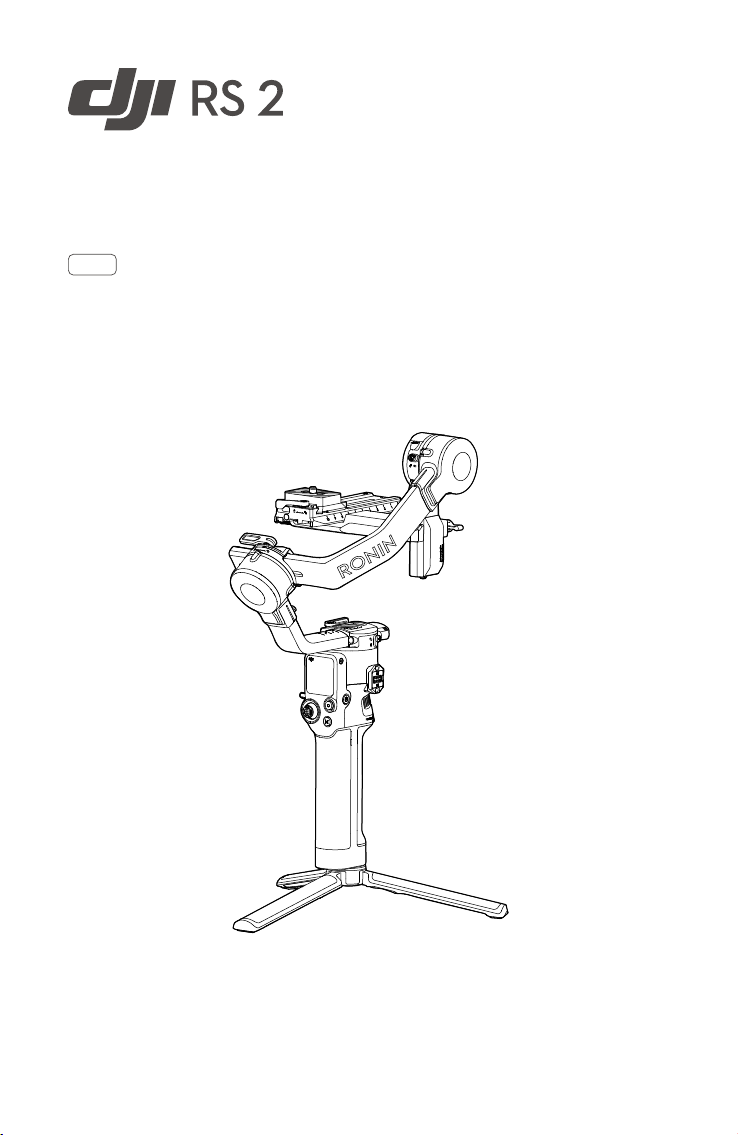
User Manual
2020.10v1.0
Searching for Keywords
Search for keywords such as “battery” and “install” to find a topic. If you are
using Adobe Acrobat Reader to read this document, press Ctrl+F on Windows or
Command+F on Mac to begin a search.
Navigating to a Topic
View a complete list of topics in the table of contents. Click on a topic to navigate
to that section.
Printing this Document
This document supports high resolution printing.
Using this Manual
Legend
Warning Important Hints and tips Reference
Before You Begin
The following documents have been produced to help you safely operate and make full
use of your DJI RS 2.
DJI RS 2 Quick Start Guide
DJI RS 2 User Manual
DJI RS 2 Disclaimer and Safety Guidelines
Read the entire quick start guide and user manual and watch the informational and
tutorial videos on the product page of the DJI official website (http:www.dji.com/
rs-2). Read the disclaimer and safety guidelines to understand your legal rights
and responsibilities. If you have any questions or problems during the installation,
maintenance, or use of this product, contact DJI or a DJI authorized dealer.
Download the Ronin App
Search “Ronin” in the App Store or Google Play and follow the instructions for
installation.
Android 7.0 or aboveiOS 11.0 or above
© 2020 DJI OSMO All Rights Reserved.
2
Ronin App

Contents
Using this Manual
Legend 2
Before You Begin 2
Download the Ronin App 2
Contents
Introduction
DJI RS 2 Diagram 5
Getting Started
Attaching the Extended Grip/Tripod 6
Mounting the Grip 6
Unlocking and Locking the Gimbal 7
Mounting the Camera 7
Balancing 9
BG30 Grip and Built-In Battery
Charging 12
Safety Guidelines 12
Operations
Activating DJI RS 2 16
Touchscreen 16
Ronin App Settings 20
Image Transmission 29
2
3
4
6
12
16
Operation Modes
Updating Firmware
Maintenance
Specications
30
31
31
32
© 2020 DJI OSMO All Rights Reserved.
3

Introduction
DJI RS 2 is a professional single-handed 3-axis gimbal specically designed for DSLR
and mirrorless cameras. It is compatible with a wide range of camera setups and
supports a tested payload of up to 4.5 kg.
DJI RS 2 boasts enhanced gimbal performance thanks to its updated Titan Stabilization
Algorithm. With a full-color touchscreen, users can calibrate the gimbal, set parameters,
and choose from intelligent shooting modes such as ActiveTrack 3.0, Timelapse, Track,
Panorama, and Time Tunnel.
Locks on each axis arm enables faster and more convenient balancing as well as more
secure storage. The onboard buttons allow users to control the gimbal and switch
profiles and working modes. When used with the provided camera control cables,
DJI RS 2 can also control camera focus, shutter, and recording. With the RSA/NATO
ports, accessories such as the Focus Wheel and Twist Grip Dual Handle can be used.
The detachable grip has a built-in battery with a capacity of 1950 mAh, providing a
maximum runtime of up to 12 hours*.
After connecting to the Ronin app, it’s easy to control gimbal movement and parameter
settings with intelligent functions such as Panorama, Timelapse, and Track. With the
DJI Ronin RavenEye Image Transmission System mounted, users can shoot smooth
footage while automatically tracking a subject with ActiveTrack 3.0.
* The runtime was tested with DJI RS 2 well-balanced and without any accessories or camera control
cables attached. The maximum runtime is for reference only.
© 2020 DJI OSMO All Rights Reserved.
4
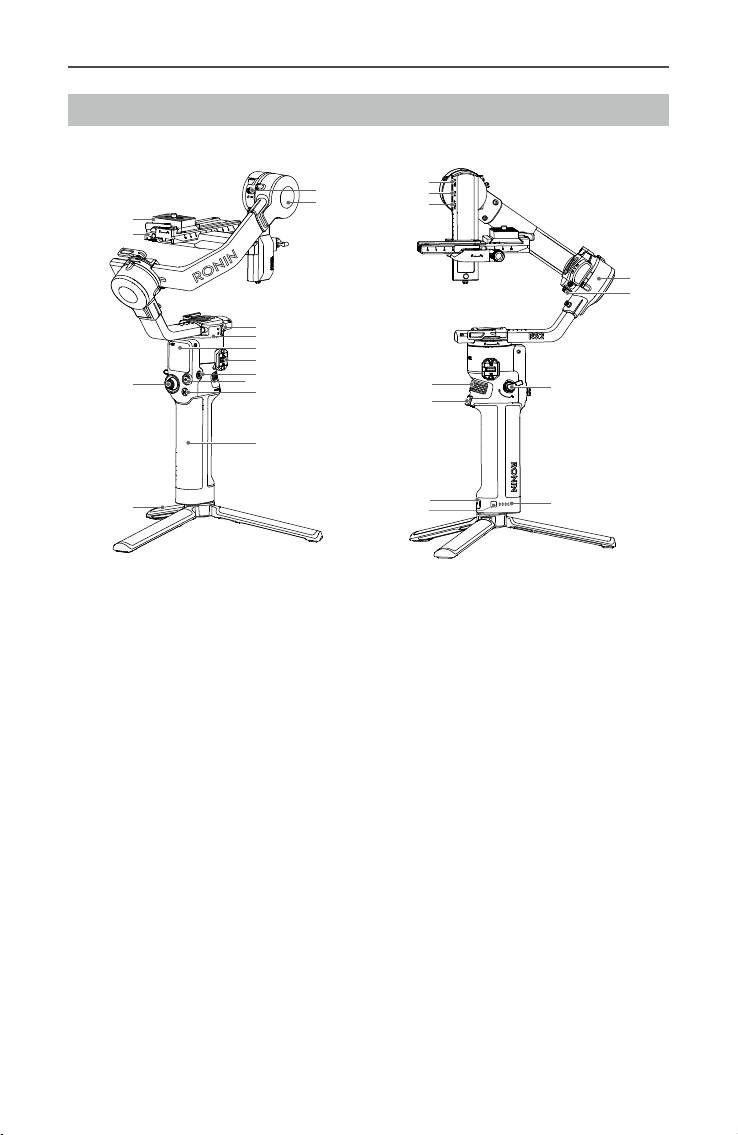
DJI RS 2 Diagram
DJI RS 2 User Manual
1
14
13
3
4
5
6
7
12
11
8
9
10
2
1. Tilt Lock
2. Tilt Motor
3. Pan Lock
4. Pan Motor
5. Touchscreen
6. Ronin Series Accessories (RSA)/
NATO Ports
7. Power Button
8. Camera Control Button
9. M Button
10. BG30 Grip (Built-in battery with
¼»-20 screw hole)
11. Extended Grip/Tripod
12. Joystick
25
24
23
15
16
22
21
20
19
17
18
13. Lower Quick-Release Plate
14. Upper Quick-Release Plate
15. Roll Motor
16. Roll Lock
17. Grip Lever/Safety Button
18. Battery Level Indicators
19. Battery Level Button
20. Power Port (USB-C)
21. Trigger
22. Front Dial
23. Image Transmission/Focus Motor
Port (USB-C)
24. Focus Motor Port (USB-C)
25. RSS Camera Control Port (USB-C)
© 2020 DJI OSMO All Rights Reserved.
5
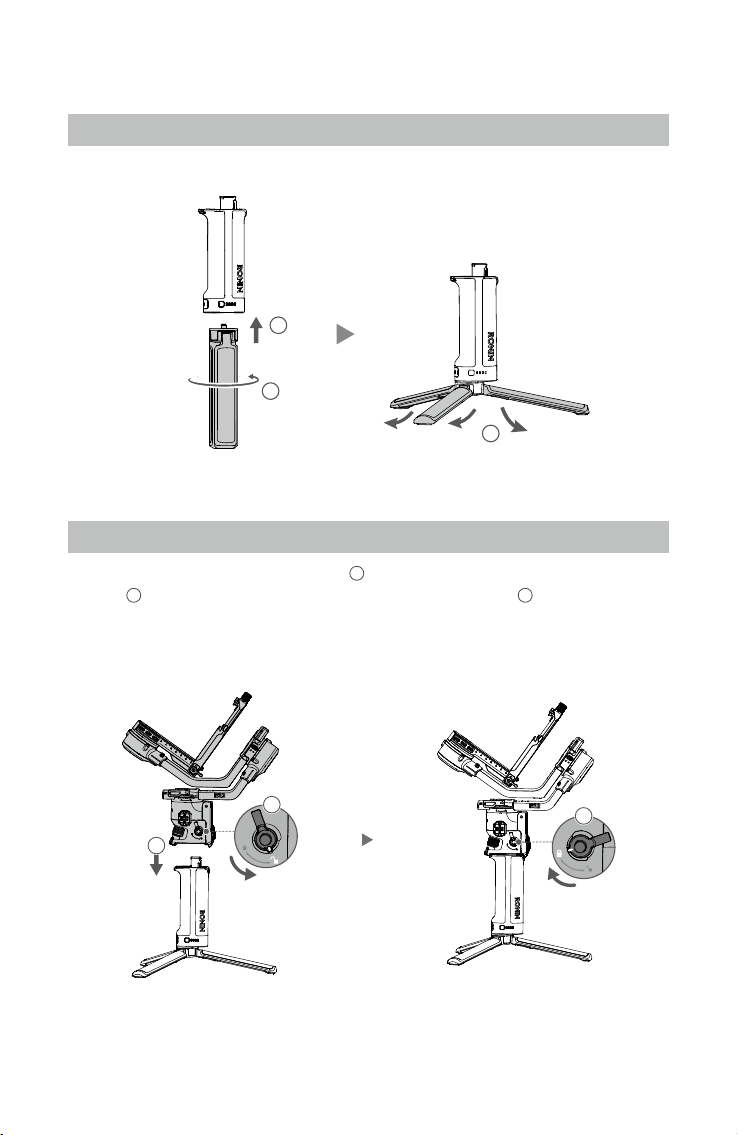
Getting Started
Attaching the Extended Grip/Tripod
1
2
3
Mounting the Grip
Insert the grip into the gimbal as shown 1. Make sure the grip lever is in the unlocked
position 2, and then toggle to the locked position after attaching 3.
To remove the grip, toggle the lever to the unlocked position, hold down the safety
button, and pull the grip away from the gimbal.
2
1
3
© 2020 DJI OSMO All Rights Reserved.
6
DJI RS 2 User Manual
Unlocking and Locking the Gimbal
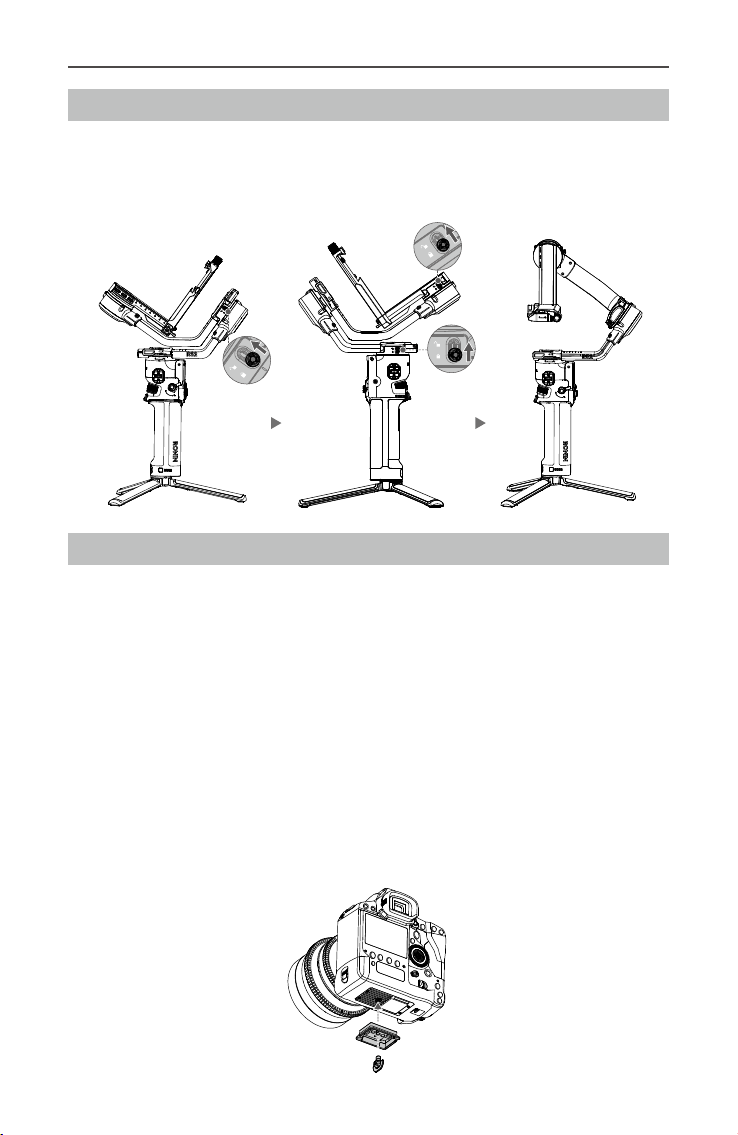
The gimbal is folded by default. To unfold the gimbal, toggle the tilt lock, roll lock, and
pan lock levers to the unlocked position and adjust the gimbal position as shown, and
then toggle the three locks to the locked position.
Tilt Lock
Roll Lock
Pan Lock
Mounting the Camera
Supported Cameras and Lenses
DJI RS 2 has been rigorously tested to support a payload of 4.5 kg. Make sure the
combined weight of the camera, lens, and other accessories are within 4.5 kg. Refer
to the official DJI website (https://www.dji.com/support/compatibility) for the most
updated DJI RS 2 Camera Compatibility List.
Mounting a Camera
Make sure to prepare the camera before mounting it to DJI RS 2. Remove the lens cap
and check that the battery and memory card are inserted in the camera. Make sure DJI
RS 2 is powered o or in sleep mode before mounting the camera.
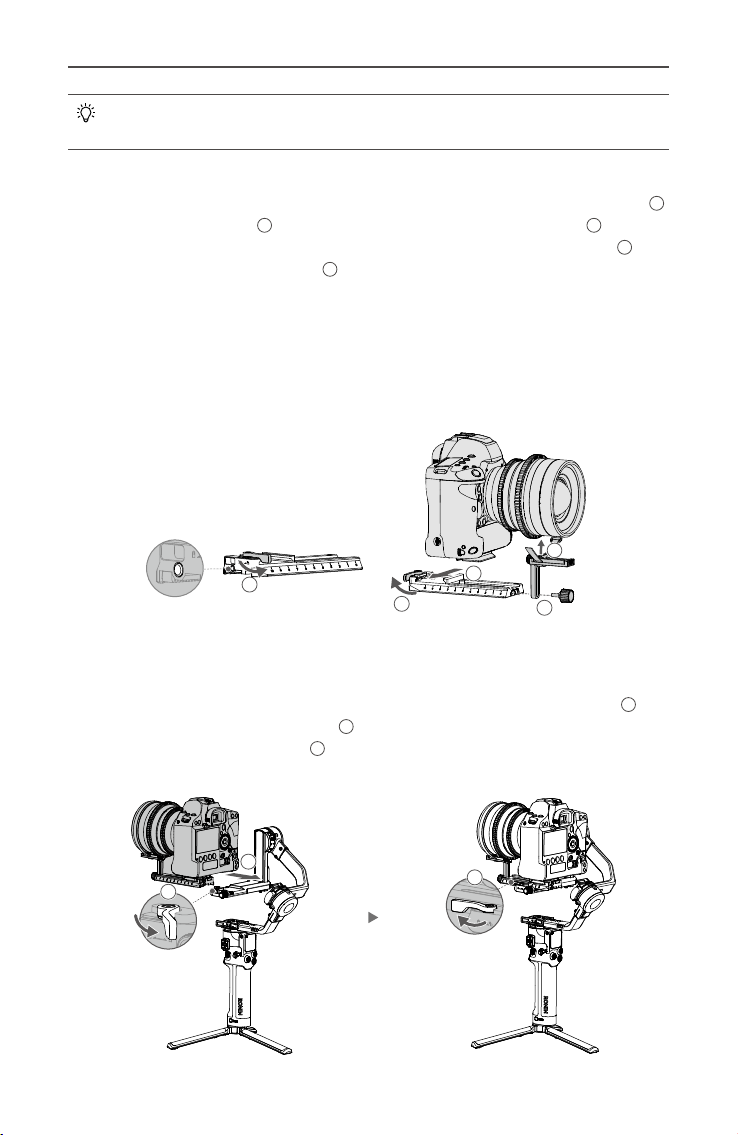
1. Attach the Upper Quick-Release Plate
The camera lens and the arrow on the bottom of the upper quick-release plate must
face the same direction. Attach the upper quick-release plate to the camera by
tightening the screw.
© 2020 DJI OSMO All Rights Reserved.
7
DJI RS 2 User Manual
A camera riser is required when using a focus motor or a small camera with a
large lens, such as a Sony A6400 with the Sony FE 24-70 f2.8 GM lens.
2. Attach the Lower Quick-Release Plate and Lens-Fastening Strap
Toggle the lever on the lower quick-release plate to the unlocked position 1,
then insert the camera 2 and toggle the lever to the locked position 3 after it is
engaged. Attach the lens-fastening strap to the lower quick-release plate 4, and
bind the strap to the camera lens 5. Note that the rubber of the lens-fastening strap
must be directly under the lens.
It is recommended to use the lens-fastening strap when using a long or heavy lens,
and always use the lens-fastening strap before enabling SuperSmooth mode.
To remove the camera from the lower quick-release plate, toggle the lever to the
unlocked position and remove the camera while pressing the safety lock beside the
lever.
5
2
4
Safety Lock
1
3
3. Attach the Camera to the Gimbal
Toggle the lever on the camera mounting plate to the unlocked position 1 and
insert the lower quick-release plate 2. Toggle the lever to the locked position once
the camera is roughly balanced 3.
1
© 2020 DJI OSMO All Rights Reserved.
8
2
3

DJI RS 2 User Manual
To remove the lower quick-release plate, toggle the lever on the camera mounting plate
to the unlocked position and remove the lower quick-release plate while pressing the
safety lock on the mounting plate.
RSS Camera Control Port
Safety Lock
4. Connect the Camera Control Cable
Choose the proper camera control cable according to the camera type. Plug one
end of the cable into the camera and plug the other end into the RSS camera
control port of the gimbal as shown above.
Balancing
To obtain the best performance from DJI RS 2, proper balancing is essential. Proper
balance is critical for shots with DJI RS 2 where fast motion or acceleration is required
and also oers longer battery runtimes. There are three axes that need to be properly
balanced before powering on DJI RS 2 and setting up the software.
Before Balancing
1. The camera needs to be fully congured, with all accessories and cables connected,
before installing and balancing the camera on the gimbal. If the camera has a lens
cap, make sure to remove it before balancing.
2. Before balancing, make sure to power on the camera if using an optical zoom
lens and to select the focal length if using a varifocal lens. Make sure DJI RS 2 is
powered o or in sleep mode before balancing.
Balancing Steps
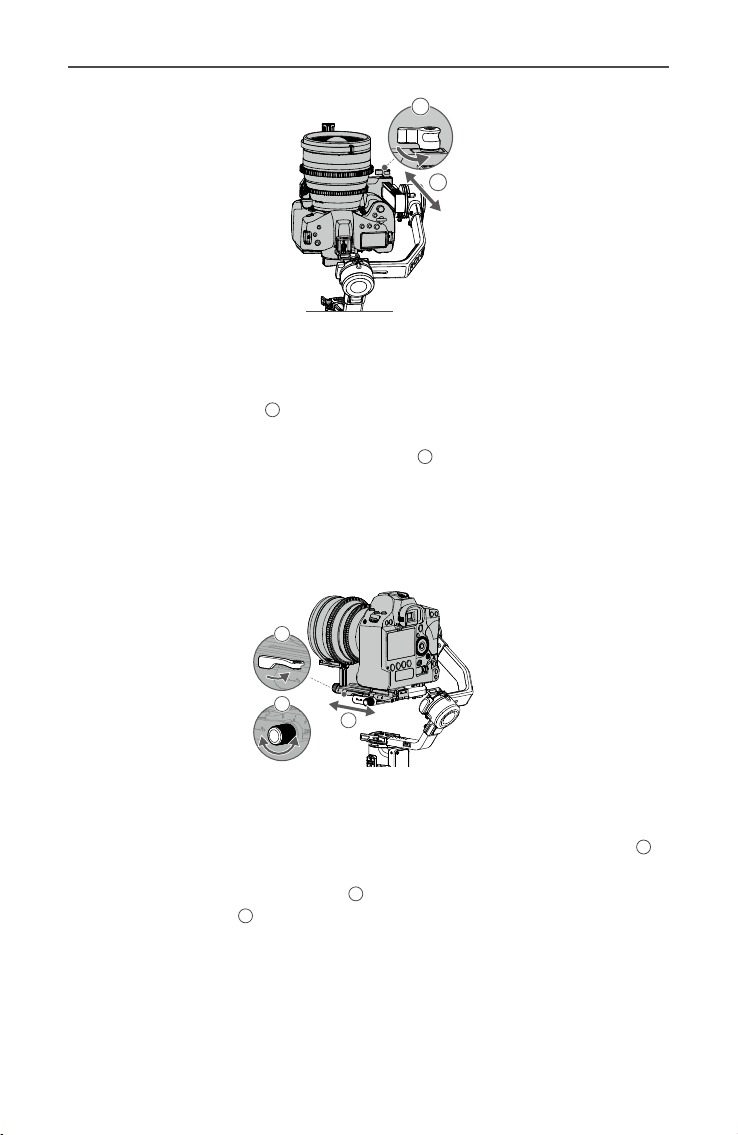
1. Balancing the Vertical Tilt
a. Unlock the tilt axis and loosen the mounting plate knob 1.
b. Rotate the tilt axis so that the camera lens is pointing upward. Check to make
sure the camera is not top or bottom-heavy. If top-heavy, move the camera
backward
2
. If bottom-heavy, move the camera forward 2.
c. Tighten the mounting plate knob while holding the camera upward. The vertical
tilt is balanced when the camera is steady while pointing upward.
© 2020 DJI OSMO All Rights Reserved.
9
DJI RS 2 User Manual
1
2
2. Balancing Depth for the Tilt Axis
a. Rotate the tilt axis so that the camera lens is pointing forward. Toggle the lever to
the unlocked position 1.
b. Check to make sure the camera is not front or back-heavy. If front-heavy, move
the camera backward by turning the knob
2
. If back-heavy, move the camera
forward.
c. Toggle the lever to the locked position. The tilt axis is balanced when the camera
is steady while tilted up or down by 45°.
d. Lock the tilt axis.
1
2
3
3. Balancing the Roll Axis
a. Unlock the roll axis. Toggle the lever on the roll arm to the unlocked position 1.
b. Check the direction in which the roll motor swings. If the camera rotates to the
left, move the camera to the right
2
. If the camera rotates to the right, move the
camera to the left 2.
c. Toggle the lever on the roll arm to the locked position. The roll axis is balanced
when the camera is steady.
d. Lock the roll axis.
© 2020 DJI OSMO All Rights Reserved.
10
Loading…
2 2020 DJI OSMO All Rights Reserved.
Using this Manual Legend
Warning Important Hints and tips Reference
Before You Begin
The following documents have been produced to help you safely operate and make full use of your DJI RS 2. DJI RS 2 Quick Start Guide DJI RS 2 User Manual DJI RS 2 Disclaimer and Safety Guidelines Read the entire quick start guide and user manual and watch the informational and tutorial videos on the product page of the DJI official website (http:www.dji.com/ rs-2). Read the disclaimer and safety guidelines to understand your legal rights and responsibilities. If you have any questions or problems during the installation, maintenance, or use of this product, contact DJI or a DJI authorized dealer.
Download the Ronin App
Searching for Keywords Search for keywords such as battery and install to find a topic. If you are using Adobe Acrobat Reader to read this document, press Ctrl+F on Windows or Command+F on Mac to begin a search.
Navigating to a Topic View a complete list of topics in the table of contents. Click on a topic to navigate to that section.
Printing this Document This document supports high resolution printing.
Android 7.0 or aboveiOS 11.0 or above Ronin App
2020 DJI OSMO All Rights Reserved.3
Contents
Using this Manual 2 Legend 2 Before You Begin 2 Download the Ronin App 2
Contents 3
Introduction 4 DJI RS 2 Diagram 5
Getting Started 6 Attaching the Extended Grip/Tripod 6 Mounting the Grip 6 Unlocking and Locking the Gimbal 7 Mounting the Camera 7 Balancing 9
BG30 Grip and Built-In Battery 12 Charging 12 Safety Guidelines 12
Operations 16 Activating DJI RS 2 16 Touchscreen 16 Ronin App Settings 20 Image Transmission 29
Operation Modes 30
Updating Firmware 31
Maintenance 31
Specifications 32
4 2020 DJI OSMO All Rights Reserved.
Introduction DJI RS 2 is a professional single-handed 3-axis gimbal specifically designed for DSLR and mirrorless cameras. It is compatible with a wide range of camera setups and supports a tested payload of up to 4.5 kg. DJI RS 2 boasts enhanced gimbal performance thanks to its updated Titan Stabilization Algorithm. With a full-color touchscreen, users can calibrate the gimbal, set parameters, and choose from intelligent shooting modes such as ActiveTrack 3.0, Timelapse, Track, Panorama, and Time Tunnel. Locks on each axis arm enables faster and more convenient balancing as well as more secure storage. The onboard buttons allow users to control the gimbal and switch profiles and working modes. When used with the provided camera control cables, DJI RS 2 can also control camera focus, shutter, and recording. With the RSA/NATO ports, accessories such as the Focus Wheel and Twist Grip Dual Handle can be used. The detachable grip has a built-in battery with a capacity of 1950 mAh, providing a maximum runtime of up to 12 hours*. After connecting to the Ronin app, it’s easy to control gimbal movement and parameter settings with intelligent functions such as Panorama, Timelapse, and Track. With the DJI Ronin RavenEye Image Transmission System mounted, users can shoot smooth footage while automatically tracking a subject with ActiveTrack 3.0.
* The runtime was tested with DJI RS 2 well-balanced and without any accessories or camera control cables attached. The maximum runtime is for reference only.
DJI RS 2 User Manual
2020 DJI OSMO All Rights Reserved.5
DJI RS 2 Diagram
1. Tilt Lock 2. Tilt Motor 3. Pan Lock 4. Pan Motor 5. Touchscreen 6. Ronin Series Accessories (RSA)/
NATO Ports 7. Power Button 8. Camera Control Button 9. M Button 10. BG30 Grip (Built-in battery with
«-20 screw hole) 11. Extended Grip/Tripod 12. Joystick
13. Lower Quick-Release Plate 14. Upper Quick-Release Plate 15. Roll Motor 16. Roll Lock 17. Grip Lever/Safety Button 18. Battery Level Indicators 19. Battery Level Button 20. Power Port (USB-C) 21. Trigger 22. Front Dial 23. Image Transmission/Focus Motor
Port (USB-C) 24. Focus Motor Port (USB-C) 25. RSS Camera Control Port (USB-C)
19
1
3
8
25 24 23
15 16
17
18
7 9
6
11
12
2
5
10
4
13 14
21 22
20
6 2020 DJI OSMO All Rights Reserved.
Getting Started
Attaching the Extended Grip/Tripod
Mounting the Grip
Insert the grip into the gimbal as shown 1 . Make sure the grip lever is in the unlocked position 2 , and then toggle to the locked position after attaching 3 . To remove the grip, toggle the lever to the unlocked position, hold down the safety button, and pull the grip away from the gimbal.
1
2
3
1
2 3
DJI RS 2 User Manual
2020 DJI OSMO All Rights Reserved.7
Unlocking and Locking the Gimbal
The gimbal is folded by default. To unfold the gimbal, toggle the tilt lock, roll lock, and pan lock levers to the unlocked position and adjust the gimbal position as shown, and then toggle the three locks to the locked position.
Mounting the Camera
Supported Cameras and Lenses DJI RS 2 has been rigorously tested to support a payload of 4.5 kg. Make sure the combined weight of the camera, lens, and other accessories are within 4.5 kg. Refer to the official DJI website (https://www.dji.com/support/compatibility) for the most updated DJI RS 2 Camera Compatibility List.
Mounting a Camera Make sure to prepare the camera before mounting it to DJI RS 2. Remove the lens cap and check that the battery and memory card are inserted in the camera. Make sure DJI RS 2 is powered off or in sleep mode before mounting the camera.
1. Attach the Upper Quick-Release Plate The camera lens and the arrow on the bottom of the upper quick-release plate must face the same direction. Attach the upper quick-release plate to the camera by tightening the screw.
Roll Lock Pan Lock
Tilt Lock
DJI RS 2 User Manual
8 2020 DJI OSMO All Rights Reserved.
A camera riser is required when using a focus motor or a small camera with a large lens, such as a Sony A6400 with the Sony FE 24-70 f2.8 GM lens.
2. Attach the Lower Quick-Release Plate and Lens-Fastening Strap Toggle the lever on the lower quick-release plate to the unlocked position 1 , then insert the camera 2 and toggle the lever to the locked position 3 after it is engaged. Attach the lens-fastening strap to the lower quick-release plate 4 , and bind the strap to the camera lens 5 . Note that the rubber of the lens-fastening strap must be directly under the lens. It is recommended to use the lens-fastening strap when using a long or heavy lens, and always use the lens-fastening strap before enabling SuperSmooth mode. To remove the camera from the lower quick-release plate, toggle the lever to the unlocked position and remove the camera while pressing the safety lock beside the lever.
Safety Lock 43
1
5
2
3. Attach the Camera to the Gimbal Toggle the lever on the camera mounting plate to the unlocked position 1 and insert the lower quick-release plate 2 . Toggle the lever to the locked position once the camera is roughly balanced 3 .
2
1 3
DJI RS 2 User Manual
2020 DJI OSMO All Rights Reserved.9
To remove the lower quick-release plate, toggle the lever on the camera mounting plate to the unlocked position and remove the lower quick-release plate while pressing the safety lock on the mounting plate.
Safety Lock
RSS Camera Control Port
4. Connect the Camera Control Cable Choose the proper camera control cable according to the camera type. Plug one end of the cable into the camera and plug the other end into the RSS camera control port of the gimbal as shown above.
Balancing
To obtain the best performance from DJI RS 2, proper balancing is essential. Proper balance is critical for shots with DJI RS 2 where fast motion or acceleration is required and also offers longer battery runtimes. There are three axes that need to be properly balanced before powering on DJI RS 2 and setting up the software.
Before Balancing 1. The camera needs to be fully configured, with all accessories and cables connected,
before installing and balancing the camera on the gimbal. If the camera has a lens cap, make sure to remove it before balancing.
2. Before balancing, make sure to power on the camera if using an optical zoom lens and to select the focal length if using a varifocal lens. Make sure DJI RS 2 is powered off or in sleep mode before balancing.
Balancing Steps
1. Balancing the Vertical Tilt a. Unlock the tilt axis and loosen the mounting plate knob 1 . b. Rotate the tilt axis so that the camera lens is pointing upward. Check to make
sure the camera is not top or bottom-heavy. If top-heavy, move the camera backward 2 . If bottom-heavy, move the camera forward 2 .
c. Tighten the mounting plate knob while holding the camera upward. The vertical tilt is balanced when the camera is steady while pointing upward.
DJI RS 2 User Manual
10 2020 DJI OSMO All Rights Reserved.
1
2
2. Balancing Depth for the Tilt Axis a. Rotate the tilt axis so that the camera lens is pointing forward. Toggle the lever to
the unlocked position 1 . b. Check to make sure the camera is not front or back-heavy. If front-heavy, move
the camera backward by turning the knob 2 . If back-heavy, move the camera forward.
c. Toggle the lever to the locked position. The tilt axis is balanced when the camera is steady while tilted up or down by 45.
d. Lock the tilt axis.
1
2 3
3. Balancing the Roll Axis a. Unlock the roll axis. Toggle the lever on the roll arm to the unlocked position 1 . b. Check the direction in which the roll motor swings. If the camera rotates to the
left, move the camera to the right 2 . If the camera rotates to the right, move the camera to the left 2 .
c. Toggle the lever on the roll arm to the locked position. The roll axis is balanced when the camera is steady.
d. Lock the roll axis.
DJI RS 2 User Manual
2020 DJI OSMO All Rights Reserved.11
1
2
4. Balancing the Pan Axis a. Unlock the pan axis. Toggle the lever on the pan arm to the unlocked position 1 . b. While holding the grip, tilt DJI RS 2 forward, and rotate the pan arm until parallel
with you. c. Check the movement of the pan axis. If the camera lens rotates to the left, push
the pan axis to the right 2 . If the camera lens rotates to the right, push the pan axis to the left 2 .
d. Toggle the lever on the pan arm to the locked position. The pan axis is balanced when the camera is steady when rotating the pan while tilting the grip.
1
2
If mounting a longer camera system, it is necessary to use counterweights. Visit the official DJI store to purchase the counterweights.
12 2020 DJI OSMO All Rights Reserved.
BG30 Grip and Built-In Battery The BG30 grip is for handheld use. The built-in battery within the grip has a capacity of 1950 mAh and the maximum runtime is 12 hours (when the DJI RS 2 is properly balanced).
Charging
Before using for the first time, charge the battery grip through the power port using a charging cable (included) and a USB adapter (not included). It is recommended to use a USB adapter with QC 2.0 and PD protocol (max. 24 W). During charging and usage, the battery level indicators indicate the battery level. When not in use, press the battery level button to check the battery level.
Safety Guidelines
The following terms are used throughout the product literature to indicate various levels of potential harm when operating this product:
Procedures, which if not properly followed, create a possibility of physical property damage AND a little or no possibility of injury.
Procedures, which if not properly followed, create the probability of property damage, collateral damage, and serious injury OR create a high probability of superficial injury.
USB Power Adapter
Power Outlet 100 — 240 V
Power Port High Low
Read the user manual to become familiar with the features of this product before operating. Failure to operate the
product correctly can result in damage to the product, personal property, and cause serious injury. This is a sophisticated product. It must be operated with caution and common sense and requires some basic mechanical ability. Failure to operate this product in a safe and responsible manner could result in injury or damage to the product or other property. This product is not intended for use by children without direct adult supervision. Do not use with incompatible components or alter this product in any way outside of the documents provided by SZ DJI OSMO TECHNOLOGY CO., LTD. These Safety Guidelines contain instructions for safety, operation and maintenance. It is essential to read and follow all of the instructions and warnings in the user manual, prior to assembly, setup or use, in order to operate the product correctly and avoid damage or serious injury.
DJI RS 2 User Manual
2020 DJI OSMO All Rights Reserved.13
To avoid fire, serious injury, and property damage, observe the following safety guidelines when using, charging, or storing the grip.
Grip Use 1. DO NOT allow the grip to come into contact with any kind of liquid. DO NOT
leave the grip out in the rain or near a source of moisture. DO NOT drop the grip into water. If the inside of the battery comes into contact with water, chemical decomposition may occur, potentially resulting in the battery catching on fire, and may even lead to an explosion.
2. If the grip falls into water by accident, put it in a safe and open area immediately. Maintain a safe distance from the grip until it is completely dry. DO NOT use the grip again, and dispose of the grip properly as described in the Grip Disposal section.
3. Put out any fire using water, sand, fire blanket, or a dry powder fire extinguisher. 4. DO NOT use non-DJI batteries. Go to www.dji.com to purchase new batteries. DJI
takes no responsibility for any damage caused by non-DJI batteries. 5. DO NOT use or charge a swollen, leaky, or damaged grip. If the grip is abnormal,
contact DJI or a DJI authorized dealer for further assistance. 6. The grip should be used in temperatures from -20 to 45 C (-4 to 113 F). Use of
the grip in environments above 50 C (122 F) can lead to a fire or explosion. Use of grip below -10 C (14 F) can lead to permanent damage.
7. DO NOT use the grip in strong electrostatic or electromagnetic environments. Otherwise, the battery control board may malfunction.
8. DO NOT disassemble or pierce the grip in any way or the battery may leak, ignite, or explode.
9. DO NOT drop or strike batteries. DO NOT place heavy objects on the grip or charger.
10. Electrolytes in the battery are highly corrosive. If any electrolytes make contact with your skin or eyes, immediately wash the affected area with fresh running water for at least 15 minutes, and then see a doctor immediately.
11. DO NOT use the grip if dropped. 12. DO NOT heat batteries. DO NOT put the grip in a microwave oven or in a pressurized
container. 13. DO NOT manually short-circuit the grip. 14. Clean grip terminals with a clean, dry cloth.
Grip Charging 1. DO NOT leave the grip unattended during charging. DO NOT charge the grip near
flammable materials or on flammable surfaces such as carpet or wood. 2. Charging the grip outside of the temperature range of 5 to 40 C (41 to 104 F) may
lead to leakage, overheating, or battery damage. The ideal charging temperature is 22 to 28 C (72 to 82 F).
DJI RS 2 User Manual
14 2020 DJI OSMO All Rights Reserved.
Grip Storage 1. Keep the grip out of the reach of children and animals. 2. If the grip will be stored for an extended period, charge the grip until the battery
level reaches between 30% and 50%. 3. DO NOT leave the grip near heat sources such as a furnace or heater. DO NOT
leave the grip inside of a vehicle on hot days. The ideal storage temperature is 22 to 28 C (72 to 82 F).
4. Keep the grip dry.
Grip Maintenance 1. DO NOT use the grip when the temperature is too high or too low. 2. DO NOT store the battery in environments with a temperature higher than 45 C
(113 F) or lower than 0 C (32 F).
Travel Notice 1. Before carrying the grip on an airline flight, it must first be discharged until the
battery level is lower than 30%. Only discharge the grip in a fireproof location and store the grip in a ventilated location.
2. Keep the grip away from metal objects such as glasses, watches, jewelry, and hairpins.
3. DO NOT transport a damaged grip or a grip with battery level higher than 30%.
Grip Disposal Dispose of the grip in specific recycling boxes only after a complete discharge. DO NOT place the grip in regular trash containers. Strictly follow your local regulations regarding the disposal and recycling of batteries.
Grip Use 1. Make sure the grip is fully charged before use. 2. If a low-battery warning appears, charge the grip as soon as possible.
Grip Charging 1. The grip is designed to stop charging when it is full. It is good practice, however, to
monitor the charging progress and disconnect the gimbal when fully charged.
Grip Storage 1. Discharge the grip to 40%-65% if it will not be used for 10 days or more. This can
greatly extend the battery life.
DJI RS 2 User Manual
2020 DJI OSMO All Rights Reserved.15
2. If the grip is stored for an extended period and the battery is depleted, the grip will enter sleep mode. Recharge the grip to exit sleep mode.
3. Remove the grip from the gimbal when stored for an extended period.
Grip Maintenance 1. Battery life may be reduced if not used for an extended period. 2. Discharge and charge the grip completely once every three months to keep it in
good condition.
Grip Disposal 1. If the grip is disabled and the battery cannot be fully discharged, contact a
professional battery disposal or recycling agent for further assistance. 2. Dispose of the grip immediately if it cannot be powered on after over-discharging.
16 2020 DJI OSMO All Rights Reserved.
Operations
Activating DJI RS 2
DJI RS 2 needs to be activated through the Ronin app before using for the first time. 1. Press and hold the power button to power on the gimbal. 2. Enable Bluetooth on your mobile device and launch the Ronin app. Once detected
in the list of Bluetooth devices, select DJI RS 2 and input the default Bluetooth password: 12345678. Make sure you are connected to the internet and follow the on-screen instructions to activate DJI RS 2. Note that a DJI account is required during activation.
Touchscreen
Home
100
PTF Fast
M1 User Profile: indicates the current user profile. Users can set and save three user profiles: M1, M2, and M3.
Camera Status: indicates a camera control cable is connected.
100 Battery Level: displays the current battery level of the gimbal. indicates the battery is charged with a normal charger. indicates the battery is charged
with a quick charger. Auto Tune: tap to enter the auto tune screen after balancing the gimbal. If the lens-
fastening strap is installed, users can enable SuperSmooth prior to auto tune for optimal performance. SuperSmooth will take effect after auto tune completed. The stiffness can be adjusted on the auto tune screen.
Balance Status: tap to check the balance status.
DJI RS 2 User Manual
2020 DJI OSMO All Rights Reserved.17
Follow Mode: tap to select follow mode. The tilt motor controls the tilt axis to follow, pan motor controls the pan axis to follow, and roll motor controls the roll axis to follow.
PF: pan follow, where only the pan axis follows the movement of the grip. PTF: pan and tilt follow, where both the pan and tilt axes follow the movement of the grip. FPV: pan, tilt and roll follow, where all three axes follow the movement of the grip.
3D Roll 360: enable to shoot footage while rotating the camera 360. Portrait: enable to shoot in portrait mode. Custom: enable or disable any axis follow as required.
Follow Speed: tap to select follow speed. Users can choose fast, medium, slow, and custom.
Joystick Speed: allows users to control the speed of the joystick for the gimbal. Users can choose fast, medium, slow, and custom. Joystick Smoothness: allows users to control the sensitivity of the gimbal. The lower the smoothing value, the more sensitive the movement of the gimbal. Dial Functions: allows users to set the function of the front dial. Users can choose to control the focus motor, focus, ISO, aperture, and roll axis. Dial Speed: allows users to set the response speed of the function set for the front dial.
30
High Joystick Speed Joystick Smoothness
Dial Functions Dial Speed
Slide Up: Joystick and Front Dial Settings Screen Slide up from the bottom of the screen to enter the joystick and front dial settings screen.
100
Slide Down: Image Transmission Screen Slide down from the top of the screen to enter the image transmission screen after mounting the DJI Ronin RavenEye Image Transmission System.
After the subject is selected, ActiveTrack can be enabled by pressing the trigger once. ActiveTrack allows users to track the subject automatically and maintain the subject in the middle of the frame. The appropriate speed should be set by adjusting the speed bar on the bottom of the screen when using ActiveTrack. Subjects may be lost if the speed is set too high and the stabilization may be affected if the speed is set too low.
DJI RS 2 User Manual
18 2020 DJI OSMO All Rights Reserved.
Silent Mode: enable to turn off sounds including the warning tone. Push Mode: enable to manually control the tilt and pan axis. Disable Selfie: prevents accidentally entering selfie mode and interrupting recording. If disabled, Selfie mode will not be entered if the trigger is pressed three times.
More Settings Horiz Calibration: use if the gimbal is unlevel when the gimbal is steady. If the issue persists, use Tune Manually. Gimbal Auto Check: tap to analyze and output the status information of the gimbal. Restore Parameters: tap to restore the gimbal parameters and Bluetooth password to default settings. Language: choose the onscreen language from English, Chinese (Simplified), Chinese (Traditional), German, French, Korean, Japanese, Spanish, Brazilian Portuguese, Russian, and Thai. Device Info: displays the IMU, GCU, and more Bluetooth information.
Silent Mode
Push Mode
Disable Sele
Slide Left: System Settings Screen Slide left from the right edge of the screen to enter the system settings screen.
Slide Right: Create Screen Slide right from the left edge of the screen to enter the Create screen.
Timelapse Track
Panorama Time Tunnel
Timelapse In Timelapse, DJI RS 2 triggers the camera to capture still images at the set interval time and will automatically stop when completed. The duration for the Timelapse and the interval time can be set so that DJI RS 2 can calculate the exact number of images required, and the duration of the video can be calculated after the frame rate is set. Motionlapse allows users to set up to five waypoints so that the camera moves and shoots during the Timelapse.
Track Track is designed to capture video with up to 10 waypoints. The waypoint needs to be selected by manually moving the gimbal or using the joystick. Tap + to add a waypoint.
DJI RS 2 User Manual
2020 DJI OSMO All Rights Reserved.19
* The functions of the camera control button and front dial vary according to the camera and require the camera control cable to be connected. Refer to the DJI RS 2 Camera Compatibility List on https://www.dji.com/support/ compatibility for more information.
The duration and stay time can be set on the waypoint settings screen after a waypoint is added and the position of the waypoint also can be reset. The duration indicates how much time it will take for the gimbal to travel from one waypoint to the next. The stay time indicates how long the gimbal will remain steady at the waypoint before moving to the next waypoint.
Panorama Panorama allows users to capture a series of interconnecting still images with precise control based on the settings. Users can then generate a panorama using image processing software. The camera captures interconnecting still images based on the setting range when selecting 3×3 or 180 panorama. When creating a custom panorama, users need to set the shooting range, sensor type, lens focal length, overlap, and interval.
Time Tunnel Allows users to capture a Timelapse while the gimbal is in 3D Roll 360 mode. The number of photos and the duration of the video can be calculated after setting the interval, duration, and the frame rate. The starting angle and the number of rotations will determine the way that the gimbal will move. Tap Start to begin shooting and check progress by tapping Preview.
Make sure the camera and gimbal are connected using the corresponding camera control cable before using Timelapse, Panorama, or Time Tunnel. The interval time between shooting photos should be set to one second more than the shutter time to avoid blurred footage when using a long exposure.
Button Functions Power Button Press and hold to power on or off. Tap to lock or unlock the touchscreen. Press twice to enter or exit sleep mode.
Battery Level Button Press once to check battery level.
Trigger Tap once to start ActiveTrack (requires the Image Transmission System to be enabled). Press and hold to enter Lock mode. Tap twice to re-center the gimbal. Tap three times to turn the gimbal 180 so that the camera faces you (selfie mode).
Front Dial* Turn to control focus (default setting).
Camera Control Button* Press halfway for autofocus. Press once to start or stop recording. Press and hold to take a photo.
Joystick Push up or down to control the movement of the tilt axis (default setting). Push left or right to control the movement of the pan axis (default setting).
DJI RS 2 User Manual
20 2020 DJI OSMO All Rights Reserved.
M Button Tap to select a user profile. Press and hold to enter Sport mode. Press and hold and press the trigger twice to remain in Sport mode. Repeat to exit Sport mode. Quickly tap twice to enter portrait mode. Press three times to enter or exit 3D Roll 360. When in 3D Roll 360, move the joystick left or right twice to automatically rotate the camera. Tap the trigger twice to stop continuous auto rotation. Press and hold the M button together with the trigger to begin auto tune.
Ronin App Settings
The Ronin App contains all the features of the touchscreen as well as more features of the gimbal and the DJI Ronin RavenEye Image Transmission System. The screenshots below are based on the iOS version of the app.
Top Bar Sleep/Wake: tap to enter or exit sleep mode. When DJI RS 2 is in sleep mode, the motor will be powered off, but the gimbal remains powered on. M1: displays the current user profile . Battery Level: displays the battery level of the gimbal.
About Settings: view your account and the quick start guide. Device List: displays the device name and password. Firmware: displays the firmware version.
Academy Watch the tutorials and read the manual documents.
DJI RS 2 XXX
DJI RS 2 User Manual
2020 DJI OSMO All Rights Reserved.21
Create Virtual Joystick
Use the virtual joystick in the app to control the movement of the gimbal and to shoot. 1. Control Bar: control the speed and smoothness of the gimbal by adjusting the
control bar. Speed allows users to adjust the remote-controlled rotational speed. Smoothness allows users to adjust the sensitivity of the gimbal. The lower the smoothing value, the more sensitive the movement of the gimbal.
2. Roll Stick: control the roll axis movement of the gimbal using the virtual joystick. 3. Pan/Tilt Stick: control the pan and tilt axis movement of the gimbal using the virtual
joystick. 4. Recenter: tap to recenter the gimbal. 5. Shoot/Record Button: tap to take photos or record videos. 6. Photo/Video Toggle: tap to switch between photo and video modes. Make sure the
mode is the same as the settings on the camera.
6
3
2
4
5
1
DJI RS 2 User Manual
22 2020 DJI OSMO All Rights Reserved.
Force Mobile
Force Mobile requires the phone holder and a mobile phone mounted on a tripod or handlebar vertically. After enabling this feature in the Ronin app, the gimbal movement can be controlled by tilting and rotating your mobile phone. Speed determines the relationship between the rotational speed and angle. When the speed is set to 50, the angle of rotation for the gimbal and mobile phone is 1-to-1. The gimbal will move at an identical angle to the mobile phone. When the speed is set to less than 50, the gimbal will rotate slower than the movement of the phone. When the max speed is set higher to a higher value than 50, the rotation of the gimbal is faster than the mobile phone. Smoothing allows users to control the sensitivity of the gimbal. The lower the smoothing value, the more sensitive the movement of the gimbal. Recenter: tap to recenter the gimbal. Shutter/Record Button: tap to take photos or record videos.
DJI RS 2 User Manual
2020 DJI OSMO All Rights Reserved.23
Panorama
Panorama allows users to capture a series of interconnecting still images with precise control based on the sensor type, lens focal length, overlap, and interval. Make sure you have connected the camera and gimbal using the corresponding camera control cable before using Panorama. Overlap: determines the overlap ratio of every photo when generating a panorama. The interval time between shooting photos should be set to one second more than the shutter time to avoid blurred footage when using a long exposure. After confirming the camera settings, the panorama range can be set by dragging the white dots on the grid map, pushing the gimbal manually, or using the virtual joystick. The total range covered by the endpoints and the shots required to compose the panorama is displayed above the grid map. The tilt axis range in Panorama is -45 to +90 in order to avoid capturing the gimbal in the shot, while the pan axis allows you to capture a full 360 rotation. Tap the shutter/record button to begin.
DJI RS 2 User Manual
24 2020 DJI OSMO All Rights Reserved.
Timelapse
In Timelapse, DJI RS 2 triggers the camera to capture still images with the set interval time and will automatically stop when completed. The duration for the Timelapse and the frame rate can be set so that DJI RS 2 can calculate the exact number of images required. By enabling Push mode, users can manually adjust the pan and tilt axes before starting the Timelapse. Users can push DJI RS 2 to alter the camera orientation and adjust the framing. Tap the virtual joystick icon to use the virtual joystick to adjust the camera orientation. Motionlapse allows users to set up to five waypoints so that the camera moves during the Timelapse. To adjust the position of a waypoint, adjust the camera to the desired position, and tap the + icon to confirm the waypoint. You can also use the virtual joystick to control the pan, tilt, and roll axis as well. To add another waypoint, move the gimbal to the next waypoint, and tap the + icon above the grid map. Afterwards, to delete a waypoint, select the waypoint and tap the trash icon. After setting up the waypoints, you can either tap Preview to make sure the Motionlapse includes everything or tap the shutter/record button to start shooting. Make sure the camera and gimbal have been connected using the corresponding camera control cable.
DJI RS 2 User Manual
2020 DJI OSMO All Rights Reserved.25
Track
Track is designed to capture video with up to 10 waypoints. Users need to select the waypoint manually by moving the gimbal or using the virtual joystick. The duration parameter below the grid map indicates how much time it will take for the gimbal to travel from one waypoint to the next. The stay time indicates how long the gimbal will remain steady at the waypoint before moving to the next waypoint.
DO NOT press the shutter button of the camera while using Track.
DJI RS 2 User Manual
26 2020 DJI OSMO All Rights Reserved.
Gaming Controller
PS4 DualShock and Xbox controllers can be used to control the gimbal and camera. After connecting the controller to the mobile device and gimbal, users can control gimbal movements, focus, and zoom, and can record videos, recenter gimbal, capture photos, and switch profiles. The speed and smoothness of the control sticks can be adjusted. Set the focus value within 10 on the camera settings for optimal performance. iOS 13 or higher, Android 9.0 or higher, and Ronin app v1.4.0 or higher are required. Tap How to Use to learn more about the gaming controller.
Balance Adjustment
Tap Begin Test and DJI RS 2 will check the balance status and provide a score for each axis. Make sure the gimbal is not obstructed in any way before performing the balance test and follow the onscreen instructions.
DJI RS 2 User Manual
2020 DJI OSMO All Rights Reserved.27
Motor Parameters
Auto Tune: the stiffness value is determined by the payload of the gimbal. Use Auto Tune to obtain the stiffness value automatically after balancing. Tap Auto Tune and DJI RS 2 automatically calculates the result based on the weight of the gimbal setup. Alternatively, press and hold the M button and trigger simultaneously for four seconds to start auto tune without using the app. The auto tune process takes approximately 15 to 30 seconds. After auto tune, you can see detailed motor diagnostics at the bottom of the screen. If the gimbal is properly balanced, the power value of the motors should be in the range of 5. If power consumption on a particular axis constantly goes beyond that range, check the mechanical balance of DJI RS 2. Stiffness: the motor stiffness adjustment allows you to fine-tune the power that is applied by the motors as they react and balance the weight on each axis. Make sure you leave an extra margin to ensure stability at all times. If the stiffness value is too high the gimbal may shake and if the value is too low the gimbal performance will be affected.
When using auto tune, make sure the three axes are unlocked and that DJI RS 2 is placed on a steady surface in Upright or Underslung mode.
Make sure the gimbal is balanced and the stiffness values are tuned properly every time you change the camera or lens.
DJI RS 2 User Manual
28 2020 DJI OSMO All Rights Reserved.
User Profile
Three user profiles can be set and save. Follow Mode: choose from Pan and Tilt Follow, FPV, Customized, and 3D Roll 360. Speed: determines how fast the camera travels while translating a pan, tilt, or roll movement. Deadband: determines how much movement the gimbal tolerates prior to translating the pan, tilt, and roll movement of the camera. Push: After enabling Push, the gimbal axis can be manually pushed to the desired position.
Control Settings Channels The channel indicator provides feedback when configuring remote operation. Pan, tilt, and roll channels can be reassigned and each axis can also be inverted. Normal means the direction of movement is the same as the joystick. Inverted means the direction of movement is the opposite of the joystick. When using the joystick, you can only control CH1 and CH3, which is mapped to tilt and pan axes by default. You can customize channel mapping by tapping on the name of the axis on the right of the screen.
Motion You can set the joystick control by adjusting deadband, max speed, smoothing, and endpoints for each axis. There are three default profiles for each settings. Deadband: when the deadband value increases, more stick movement will be required to translate into the actual movement of the gimbal. Max Speed: allows the remote-controlled rotational speed to be adjusted. Smoothing: allows you to control the sensitivity of the gimbal. The lower the smoothing value, the more sensitive the movement of the gimbal.
DJI RS 2 User Manual
2020 DJI OSMO All Rights Reserved.29
Status
Settings Use more features such as Motor Pause, Disable Gimbal Portrait Mode, Silent Mode, System Calibration, Advanced Calibration, and Restore Gimbal Setup.
Checklist When the gimbal status is abnormal, the status information is displayed here.
Endpoint: limits the rotational range of the gimbal by setting the endpoints. The pan axis has a slip-ring, enabling DJI RS 2 to rotate continuously when the endpoints are set to 180. On the tilt axis, you can set up the endpoints according to your requirements. Some longer lenses may hit the gimbal frame. Set the endpoint angle to prevent such cases.
Image Transmission
With the DJI Ronin RavenEye Image Transmission System mounted, tap Connect to RavenEye on the home screen of the Ronin app to use the image transmission feature.
02:30
8001/800F 2.8
100
ActiveTrack Speed: 15
DJI RS 2 User Manual
30 2020 DJI OSMO All Rights Reserved.
3D Roll 360 is available when using DJI RS 2 in Flashlight mode. The slip-ring on the pan axis enables DJI RS 2 to perform a continuous roll rotation. 3D Roll 360 can be used with the grip at any orientation. Press the M button three times to enter or exit 3D Roll 360 or go to User Profile in the
Using ActiveTrack 3.0 When tracking a person, it is recommended to select and confirm the person in the center of the camera view by pressing the trigger once. When tracking an object, it is recommended to select and confirm the object by dragging a box around it in order to recognize the object better. The gimbal begins to track after recognizing the object successfully. The appropriate speed should be set when using ActiveTrack. Subjects may be lost if the speed is set too high and the stabilization may be affected if the speed is set too low. For optimal performance, it is recommended to set the ActiveTrack speed to 20 when using a lens with a 24 mm equivalent focal length (tested with Sony 7 III). Increase the ActiveTrack speed when using a lens with an equivalent focal length less than 24 mm. Decrease the ActiveTrack speed when using a lens with an equivalent focal length more than 24 mm. Tap to use Virtual Joystick and Force Mobile.
Refer to the DJI Ronin RavenEye Image Transmission System User Guide for more information.
Operation Modes There are four operation modes for the DJI RS 2: Upright, Underslung, Flashlight, and Briefcase.
Flashlight ModeUnderslung ModeUpright Mode
DJI RS 2 User Manual
2020 DJI OSMO All Rights Reserved.31
2
1
3
4
When attaching the briefcase handle to the other side, the extended grip/tripod angle must be adjusted by loosening the screw on the briefcase handle.
Updating Firmware Update the firmware using the Ronin app. An on-screen alert will be received when new firmware is available. Follow the on-screen instructions to update the firmware.
Maintenance DJI RS 2 is not waterproof. Make sure to protect it from dust and water during use. After use, it is recommended to wipe DJI RS 2 with a soft dry cloth. DO NOT spray any cleaning liquids onto DJI RS 2.
Ronin app to enable or disable 3D Roll 360. Push the joystick to the left or right to begin 3D Roll 360. Push the joystick to the left or right twice in quick succession to trigger auto rotation. During auto rotation: when the grip is horizontal, press the trigger twice and the camera will stop in an upright position. Press the trigger three times and the camera will stop in an upside-down position. When the grip is vertical, press the trigger twice and the camera will stop at a pan axis angle of 0 with the lens pointing upward. Press the trigger three times and the camera will stop at a pan axis angle of 180 degree with lens pointing upward. Set the Max Speed and Smoothing for the 3D Roll 360 in the Control settings under the User Profile of the Ronin app. Note that Speed and Deadband are unavailable when using 3D Roll 360. You can use DJI RS 2 in Briefcase mode with the briefcase handle and extended grip/ tripod mounted. The briefcase handle can be mounted to either RSA/NATO port. Attach the briefcase handle as shown. Make sure the knob is tightened.
32 2020 DJI OSMO All Rights Reserved.
External Device
Accessory Port
RSA/NATO Ports 1/4″-20 UNC Screw Holes Cold Shoe Image Transmission/Focus Motor Port (USB-C) Focus Motor Port (USB-C) RSS Camera Control Port (USB-C)
Input Power
Model: BG30-1950mAh-15.4V Type: LiPo 4S Capacity: 1950 mAh Energy: 30.03 Wh Voltage: 12-17.6 V Max. Runtime: Approx. 12 h Charging Time: Approx. 1.5 h (when using 24 W USB Charger) Charging Temperature Range: 5 to 40 C (41 to 104 F) USB Input: 5V/2A, 9V/2A, 12V/2A, 15V/1.6A
Connections Bluetooth 5.0, Power Port (USB-C)
Ronin App Requirements
iOS 11.0 or above Android 7.0 or above
On Screen Supported languages
Chinese (Simplified), English, Chinese (Traditional), German, French, Korean, Japanese, Spanish, Brazilian Portuguese, Russian, Thai.
Working Performance
Load Weight (Reference Value) 4.5 kg (Handheld)
Maximum Controlled Rotation
Pan axis: 360/s
Tilt axis: 360/s
Roll axis: 360/s
Pan axis: 360 continuous rotation
Roll axis: -95 to +240
Tilt axis: -112 to +214
Mechanical and Electrical Characteristics
Bluetooth Operating Frequency 2.40 — 2.4835 GHz
Bluetooth Transmitter Power <8 dBm
Operating Temperature -20 to 45 (-4 to 113 F)
Weight
Gimbal: Approx. 960 g (2.12 lbs) (excl. the Quick- Release Plates and Camera Mounting Plate) Camera Mounting Plate: Approx. 150 g (0.33 lbs) BG30 Grip: Approx. 265 g (0.58 lbs) Extended Grip/Tripod: Approx. 226 g (0.50 lbs) Upper and Lower Quick-Release Plates: Approx. 105 g (0.23 lbs)
Dimensions Gimbal (folded): 26026570 mm (excl. grip) Gimbal (unfolded): 410260195 mm (incl. grip, excl. Extended Grip/Tripod)
Specifications
- June 6, 2024
- DJi
Table of Contents
- DJI RS 2
- Overview
- Getting Started
- Mounting the Camera
- Balancing
- Operation
- Button Functions
- Specifications
- Read User Manual Online (PDF format)
- Download This Manual (PDF format)
DJI RS 2

Overview

- Tilt Lock
- Tilt Motor
- Pan Lock
- Pan Motor
- Touchscreen
- Ronin Series Accessories (RSA)/ NATO Ports
- Power Button
- Camera Control Button
- M Button
- BG30 Grip (Built-in battery with ¼”-20 screw hole)
- Extended Grip/Tripod
- Joystick
- Lower Quick-Release Plate
- Upper Quick-Release Plate
- Roll Motor
- Roll Lock
- Grip Lever/Release Button
- Battery Level Indicators
- Battery Level Button
- Power Port (USB-C)
- Trigger
- Front Dial
- Image Transmission/Focus Motor Port (USB-C)
- Focus Motor Port (USB-C)
- RSS Camera Control Port (USB-C)
Getting Started
A. Downloading the DJI RONINTM App and Watching the Tutorials.
B. Charging the Battery and Checking the Battery Level
Before using for the first time, charge the battery grip through the power
port using a charging cable (included) and a USB adapter (not included). It is
recommended to use a USB adapter with QC 2.0 and PD protocol (max. 24 W).
During charging and usage, the battery level indicators indicate the battery
level. When not in use, press the battery level button to check the battery
level.

C. Attaching the Extended Grip/Tripod

D. Mounting the Grip
Insert the grip into the gimbal as shown 1 . Make sure the grip lever is in
the unlocked position 2 , and then toggle to the locked position after
attaching 3 . To remove the grip, toggle the lever to the unlocked position,
hold down the release button, and pull the grip away from the
gimbal.

The gimbal is folded by default. To unfold the gimbal, toggle the tilt lock,
roll lock, and pan lock levers to the unlocked position and adjust the gimbal
position as shown, and then toggle the three locks to the locked
position.

E. Powering On/Off and Entering/Exiting Sleep Mode
Press and hold the power button to turn DJI RS 2 on or off. Press twice to
enter or exit sleep mode.
F. Activating DJI RS 2
DJI RS 2 needs to be activated through the Ronin app before using for the
first time.
- Press and hold the power button to power on the gimbal.
- Enable Bluetooth on your mobile device and launch the Ronin app. Note that a DJI account is required to launch the Ronin app. Once detected in the list of Bluetooth devices, select DJI RS 2 and input the default Bluetooth password: 12345678. Make sure you are connected to the internet and follow the on-screen instructions to activate DJI RS 2.
Mounting the Camera
Make sure to prepare the camera before mounting it to DJI RS 2. Remove the
lens cap and check that the battery and memory card are inserted in the
camera. Make sure DJI RS 2 is powered off or in sleep mode before mounting the
camera.
-
Attach the Upper Quick-Release Plate
The camera lens and the arrow on the bottom of the upper quick-release plate
must face the same direction. Attach the upper quick-release plate to the
camera by tightening the screw.
Tips : A camera riser is
required when using a focus motor or a small camera with a large lens, such as
a Sony A6400 with the Sony FE 24-70 f2.8 GM lens. -
Attach the Lower Quick-Release Plate and Lens-Fastening Strap
Toggle the lever on the lower quick-release plate to the unlocked position 1 ,
then insert the camera 2 and toggle the lever to the locked position 3 after
it is engaged. Attach the lens-fastening strap to the lower quick-release
plate 4 , and bind the strap to the camera lens 5 . Note that the rubber of
the lens-fastening strap must be directly under the lens. It is recommended to
use the lens-fastening strap when using a long or heavy lens, and always use
the lens-fastening strap before enabling SuperSmooth mode. To remove the
camera from the lower quick-release plate, toggle the lever to the unlocked
position and remove the camera while pressing the safety lock beside the
lever.
-
Attach the Camera to the Gimbal
Toggle the lever on the camera mounting plate to the unlocked position 1 and
insert the lower quick-release plate 2 . Toggle the lever to the locked
position once the camera is roughly balanced 3.
To
remove the lower quick-release plate, toggle the lever on the camera mounting
plate to the unlocked position and remove the lower quick-release plate while
pressing the safety lock on the mounting plate.
-
Connect the Camera Control Cable
Choose the proper camera control cable according to the camera type. Plug one
end of the cable into the RSS camera control port of the gimbal (shown above)
and plug the other end into the camera.


Balancing
Balancing is required before shooting. Before balancing, make sure to power on
the camera if using an optical zoom lens and to select the focal length if
using a varifocal lens. Make sure DJI RS 2 is powered off or in sleep mode
before balancing.
- Balancing the Vertical Tilt
- Unlock the tilt axis and loosen the mounting plate knob 1 .
- Rotate the tilt axis so that the camera lens is pointing upward. Check to make sure the camera is not top or bottom-heavy. If top-heavy, move the camera backward 2 . If bottom-heavy, move the camera forward 2 .
- Tighten the mounting plate knob while holding the camera upward. The vertical tilt is balanced when the camera is steady while pointing upward.
- Balancing Depth for the Tilt Axis
- Rotate the tilt axis so that the camera lens is pointing forward. Toggle the lever to the unlocked position 1 .
- Check to make sure the camera is not front or back-heavy. If front-heavy, move the camera backward by turning the knob 2 . If back-heavy, move the camera forward.
- Toggle the lever to the locked position. The tilt axis is balanced when the camera is steady while tilted up or down by 45°.
- Lock the tilt axis.
- Balancing the Roll Axis
- Unlock the roll axis. Toggle the lever on the roll arm to the unlocked position 1 .
- Check the direction in which the roll motor swings. If the camera rotates to the left, move the camera to the right 2 . If the camera rotates to the right, move the camera to the left 2 .
- Toggle the lever on the roll arm to the locked position. The roll axis is balanced when the camera is steady.
- Lock the roll axis.
- Balancing the Pan Axis
- Unlock the pan axis. Toggle the lever on the pan arm to the unlocked position 1 .
- While holding the grip, tilt DJI RS 2 forward, and rotate the pan arm until parallel with you.
- Check the movement of the pan axis. If the camera lens rotates to the left, push the pan axis to the right 2 . If the camera lens rotates to the right, push the pan axis to the left 2.
- Toggle the lever on the pan arm to the locked position. The pan axis is balanced when the camera is steady when rotating the pan while tilting the grip.


Briefcase Mode
You can use DJI RS 2 in Briefcase mode with the briefcase handle and extended
grip/ tripod mounted. The briefcase handle can be mounted to either RSA/NATO
port. Attach the briefcase handle as shown. Make sure the knob is
tightened.

Tip: When attaching the briefcase handle to the other side, the Extended
Grip/Tripod angle must be adjusted by loosening the screw on the briefcase
handle.
Operation
After balancing, make sure the three axes are unlocked before powering on DJI
RS 2.
Touchscreen
- Auto-Tune: after balancing, DJI RS 2 must be auto-tuned before it can be used. Tap the icon to enter auto-tune page. If the lens-fastening strap is installed, you can enable SuperSmooth prior to auto-tune for the best performance.
- Balance Status : tap to check the balance status.
- Follow Mode: tap to select follow mode. The tilt motor controls the tilt axis to follow, pan motor controls the pan axis to follow, and roll motor controls the roll axis to follow.
- PF: pan follow, where only the pan axis follows the grip’s movements.
- PTF: pan and tilt follow, where both the pan and tilt axes follow the grip’s movements.
- FPV : pan, tilt and roll follow, where all three axes follow the grip’s movements. 3D Roll 360: enable to shoot footage while rotating the camera 360°.
- Portrait: enable to shoot in portrait mode.
- Custom: enable or disable any axis follow as required.
- Follow Speed: tap to select follow speed.
Navigating the Screen

- Slide up on the screen to enter the joystick and front dial settings page.
- Slide down on the screen to view the image transmission (with the Image Transmission System mounted).
- Slide left on the screen to set system settings
- Slide right on the screen to select shooting modes.
Button Functions
Power Button
Press and hold to power on or off. Tap to lock or unlock the touchscreen.
Press twice to enter or exit sleep mode.
Trigger
Tap once to start ActiveTrack (requires the Image Transmission System to be
enabled). Press and hold to enter Lock mode. Tap twice to re-center the
gimbal. Tap three times to turn the gimbal 180° so that the camera faces you
(selfie mode).
**Camera Control Button***
Press halfway for autofocus. Press once to start or stop recording. Press and
hold to take a photo.
M Button
Tap to select a user profile. Press and hold to enter Sport mode. Press and
hold and press the trigger twice to remain in Sport mode. Repeat to exit Sport
mode. Quickly tap twice to enter portrait mode. Press three times to enter or
exit 3D Roll 360. When in 3D Roll 360, move the joystick left or right twice
to automatically rotate the camera. Tap the trigger twice to stop continuous
auto rotation. Press and hold the M button together with the trigger to begin
auto tune.
Battery Level Button
Press once to check battery level.
**Front Dial***
Turn to control focus (default setting).
Joystick
Push up or down to control the movement of the tilt axis (default setting).
Push left or right to control the movement of the pan axis (default setting).
The functions of the camera control button and front dial vary according to
the camera and require the camera control cable to be connected. Refer to the
DJI RS 2 Camera Compatibility List on
www.dji.com/rs-2 for more information.
Ronin App
Use the Ronin app to access more functions such as Force Mobile, virtual
joystick, and gimbal and camera settings.
Specifications
-
Weight Gimbal: Approx. 960 g (2.12 lbs) (excluding the Quick- Release Plates and Camera Mounting Plate)
-
Camera Mounting Plate: Approx. 150 g (0.33 lbs)
-
BG30 Grip: Approx. 265 g (0.58 lbs)
-
Extended Grip/Tripod: Approx. 226 g (0.50 lbs)
-
Upper and Lower Quick-Release Plates: Approx. 105 g (0.23 lbs)
-
Dimensions Gimbal (folded): 260×265×70 mm (excl. grip)
-
Gimbal (unfolded): 410×260×195 mm (incl. grip, excl. Extended Grip/Tripod)
-
Input Power Model: BG30-1950mAh-15.4V
-
Type: LiPo 4S
-
Capacity: 1950 mAh
-
Energy: 30.03 Wh
-
Voltage: 12 – 17.6 V
USB Input 5V/2A, 9V/2A, 12V/2A, 15V/1.6A Bluetooth Operating Frequency 2.40 –
2.4835 GHz Bluetooth Transmitter Power <8 dBm -
Operating Temperature -20° to 45° C (-4° to 113° F)
-
Max Standby Time 12 hours
-
Charging Time 1.5 hours (when using a 24 W charger )
For more information, read the User Manual:
www.dji.com/rs-2/downloads
This content is subject to change without prior notice.
Read User Manual Online (PDF format)
Read User Manual Online (PDF format) >>
Download This Manual (PDF format)
Download this manual >>