
288255
Сегодня мы будем настраивать роутер TP-LINK Archer C20. Это двухдиапазонный Wi-Fi роутер, который по техническим характеристикам и цене очень похож на модель Archer C20i. Это практически одинаковые устройства, только в разных корпусах. Что касается процесса настройки, то здесь все просто. Мы рассмотрим настройку маршрутизатора через панель управления. Можно так же настроить роутер со смартфона, или планшета. Через браузер, как и с компьютера, или через приложение TP-LINK Tether.
Я хотел выполнить настройку этого маршрутизатора через мастер быстрой настройки, где можно пошагово задать необходимые параметры (подключение к провайдеру, настройка Wi-Fi сети), но у меня не получилось. Как только я заканчивал настройку, появлялась ошибка, что я не задал параметры для подключения к интернету через 3G/4G модем. Но в процессе настройки, я отключал этот пункт, так как модема у меня нет.
В моем случае, настройки роутера сразу были на английском языке. На официальном сайте есть прошивка на русском. После обновления прошивки, панель управления стала более понятна. Настраивать так намного проще. Если хотите, можете сразу обновить прошивку роутера. Сам процесс обновления ничем не отличался от других моделей TP-LINK. Поэтому, можете смотреть эту инструкцию. А если нет желания этим заниматься, то можете настраивать и на английской версии. Правда, в последнем обновлении добавлено много новых возможностей и улучшений. Например, поддержка 3G/4G модемов.
Подключение роутера TP-LINK Archer C20
Здесь все по стандартной схеме. Сначала подключаем маршрутизатор к электросети и включаем его, чтобы загорелись индикаторы на передней панели. Дальше, в Internet порт (он синий) подключаем кабель от нашего интернет-провайдера, или от ADSL модема.
Если вы хотите настраивать роутер по сетевому кабелю, подключив его к ПК, или ноутбуку, то возьмите сетевой кабель, который идет в комплекте, и соедините компьютер с маршрутизатором. Если есть возможность, то советую настраивать именно по кабелю. Так надежнее, и сможете избежать многих непонятных моментов.

Если хотите, можете подключится к роутеру по Wi-Fi. После включения, ваши устройства должны обнаружить Wi-Fi сеть с заводским названием. Для подключения к этой сети нужно использовать пароль (PIN-код), который указан на наклейке, снизу роутера Archer C20. Там же указаны и стандартные названия Wi-Fi сетей.
Вход в панель управления
Чтобы зайти в настройки роутера TP-LINK Archer C20, достаточно на устройстве, которое подключено к роутеру открыть любой браузер, и перейти по адресу tplinklogin.net. Появится страница авторизации, где нужно указать имя пользователя и пароль. По умолчанию – admin и admin. Адрес для входа в настройки, и другие заводские параметры, так же указаны на наклейке снизу маршрутизатора.

После этого должна открыться страница с настройками роутера. Где мы зададим все необходимые параметры.
TP-LINK Archer C20: настройка подключения к интернету
В настройке любого роутера, главное выбрать правильный тип подключения к интернету, и задать необходимые параметры. Что бы роутер смог установить соединение с интернет-провайдером. Именно здесь, большинство сталкивается с проблемой, когда к роутеру устройства подключаются, но интернет не работает. Без доступа к интернету. Все это именно из-за неправильных настроек интернета.
Прежде чем продолжить, вы должны знать тип подключения к интернету, который использует ваш интернет-провайдер. И если это не «Динамический IP», то у вас должен быть еще как минимум логин и пароль. Их выдает интернет провайдер.
В настройках перейдите на вкладку «Сеть» – «WAN». Здесь, первым делом нужно выбрать тип подключения. У меня, например, Динамический IP. Если у вас такой же способ подключения, то выбирать ничего не нужно, он установлен по умолчанию. И интернет через роутер уже должен работать, а индикатор на роутере должен гореть синим, а не оранжевым. Единственный момент, если у вас «Динамический IP», то провайдер может делать привязку по MAC-адресу. Если роутер не подключаться к интернету, то уточните этот вопрос у провайдера.

А если у вас PPPoE, или L2TP, то выбираем соответствующий тип подключения в меню, и задаем необходимые параметры, которые вам выдал провайдер. Если что, можете позвонить в поддержку провайдера, и уточнить у них всю информацию по настройке.
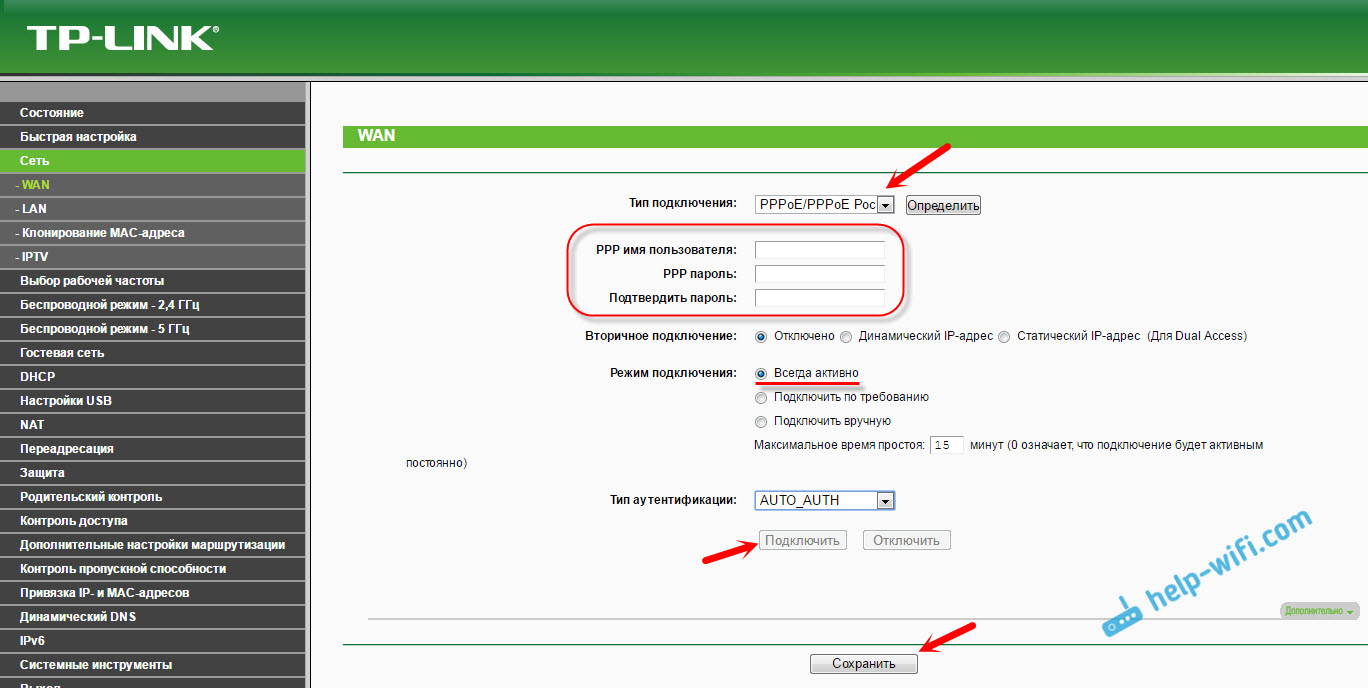
Там есть еще кнопка «Определить», нажав на которую, роутер попробует сам определить тип вашего подключения к интернету.
Необходимо, чтобы интернет заработал через наш TP-LINK Archer C20. Индикатор «Internet» должен гореть синим цветом.
Если никак не получается настроить, то почитайте еще статью: при настройке роутера пишет «Без доступа к интернету», или «Ограничено» и нет соединения с интернетом. Ну а если интернет уже работает, то можно переходить к настройке Wi-Fi сети.
Настройка Wi-Fi и установка пароля на TP-LINK Archer C20
Так как это двухдиапазонный роутер, то он транслирует две Wi-Fi сети. Одну на частоте 2.4 ГГц, а вторую на 5 ГГц. Если вам не нужна какая-то сеть, то предлагаю перейти на вкладку «Выбор рабочей частоты», и отключить сеть на той частоте, которая вам не нужна. Достаточно просто убрать галочку, и сохранить настройки. А можете оставить обе сети. Например, старые устройства подключать к 2.4 ГГц, а новые, которые поддерживают, к Wi-Fi 5 ГГц.

Дальше переходим на вкладку Wi-Fi сети, которую нам нужно настроить. Задаем название сети, и выбираем свой регион.
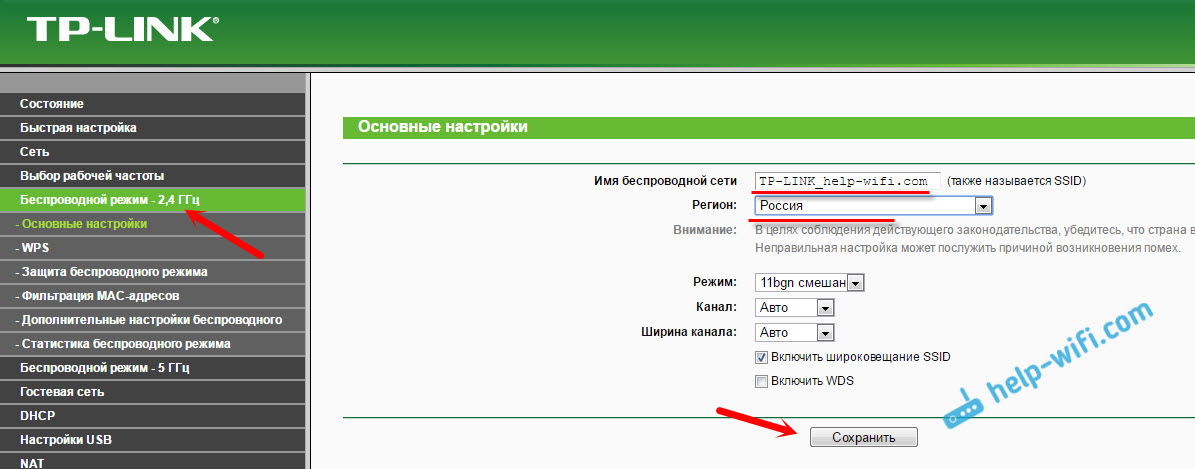
Не забудьте сохранить настройки. Следующий шаг – установка пароля на Wi-Fi сеть. Перейдите на вкладку «Защита беспроводного режима». Выставьте параметры как на скриншоте ниже, и в поле «Пароль беспроводной сети» задайте пароль, который будет использоваться для подключения к вашей сети. Сохраните настройки, и перезагрузите роутер.

Важно! Если вы оставили трансляцию сетей на частоте 2.4 ГГц и 5 ГГц, то задайте настройки для обоих сетей, и установите пароль.
Если вы до настройки Wi-Fi подключали к беспроводной сети какие-то устройства, то после смены пароля и перезагрузки роутера, нужно будет подключить их заново, уже указав новый пароль.
На этом настройка беспроводной сети закончена.
Смена пароля admin
Настоятельно рекомендую сменить заводской пароль admin, который используется для защиты настроек маршрутизатора. Сделать это можно на вкладке «Системные инструменты» – «Пароль». Просто укажите старый пароль и имя пользователя, и новые данные. Сохраните настройки.

Только постарайтесь не забыть установленный пароль, а то не сможете зайти в панель управления, придется делать сброс настроек, и настраивать свой TP-LINK Archer C20 заново.
Все, можете пользоваться своим роутером.
Послесловие
Если у вас панель управления на русском языке, то думаю, что будет несложно разобраться в настройках, которых там не мало. Тех настроек, которые мы задали, достаточно для того, чтобы пользоваться маршрутизатором. Возможно, вы захотите настроить какие-то другие функции. Много инструкций есть у нас на сайте, если не найдете нужной, то спрашивайте в комментария, обязательно подскажу.
Ну и если в процессе настройки роутера TP-LINK Archer C20 возникли какие-то проблемы, то можете оставлять вопросы в комментариях. Хотя, думаю, у вас все получилось. У меня роутер заработал без проблем, и сразу начал раздавать интернет. Всего хорошего!
Как подключить и настроить TP-Link Archer C20
Wi-Fi маршрутизаторы для интернета за городом бренда TP-Link очень популярны. Это надежное сетевое оборудование, которое подходит для домашней и офисной работы. Сегодня мы подробно рассмотрим роутер ТП-Линк АС 750. Приведенная ниже инструкция поможет новичкам разобраться в нюансах настройки. Многие моменты будут полезны и для продвинутых пользователей.
Особенности маршрутизатора AC750
Модель TP-Link C20 – это достаточно распространенное сетевое оборудование, которое можно встретить в частных домах, квартирах и офисах. С его помощью можно создавать локальные и беспроводные сети.
Маршрутизатор рассматриваемой модели рассчитан на поддержку множества вспомогательных опций:
- интерактивное телевидение;
- медиасервер;
- поддержка протокола IP шестой версии;
- межсетевой экран.
Устройство может работать в двух частотных диапазонах. Скорость в диапазоне 5 ГГц составляет 433 Мбит/с.
Роутер использует для подключения к провайдеру протоколы:
- L2TP;
- PPTP;
- IPSec.
Роутер не предназначен для использования в качестве торрент-клиента. Опция изменения кнопок здесь отсутствует.
Внешний вид роутера AC750
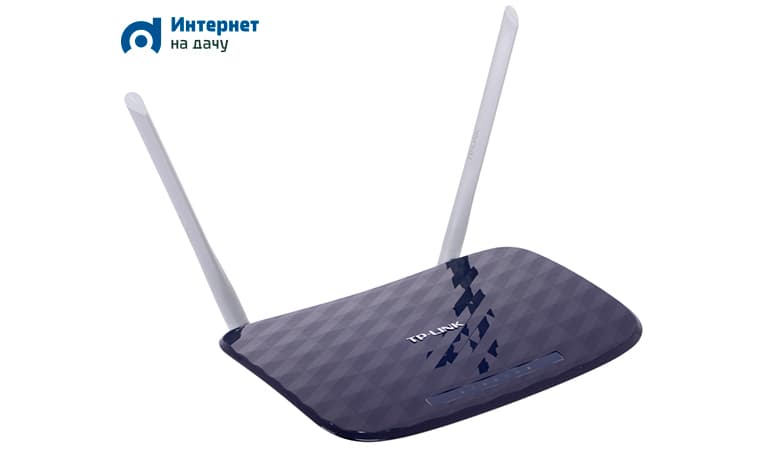
Внешний вид маршрутизатора рассматриваемой модели очень стильный и оригинальный. Сверху корпус покрыт темно-синим глянцем. Снизу роутер Archer имеет матовую поверхность бежевого цвета. Такое оформление нравится многим пользователям. На общем фоне других сетевых устройств TP-Link Archer C20 заметно выделяется.
На корпусе производитель разместил три несъемные антенны для беспроводной сети. По отзывам пользователей, Wi-Fi сигнал достаточно стабильный и не пропадает. Сзади на устройстве можно увидеть 4 разъема LAN, каждый из которых рассчитан на скорость работы 100 Мбит/с. Здесь же вы найдете порт WAN, к которому подключают кабель от поставщика услуг. На тыльной стороне еще имеется порт USB, специальная кнопка для сброса настроек и питания.
Используя USB-разъем, вы можете подключать 3G/4G-модемы для создания резервного канала связи. Также сюда можно подсоединить внешний жесткий диск или принтер. Модель оснащена специальной кнопкой на тыльной стороне. С ее помощью пользователи могут быстро деактивировать режим беспроводного вещания.
Как подключить и подготовить роутер к работе
Перед тем, как настроить роутер TP-Link Archer C20, его нужно подключить и подготовить к дальнейшим действиям. В наборе вместе с устройством поставляется сетевой и кабель питания, диск и краткое руководство. Для начала необходимо выбрать правильное место для расположения оборудования. Желательно установить его в такой зоне, откуда сигнал будет равномерно распространяться по всему дому или офису. Когда место для установки маршрутизатора будет подобрано, переходим к следующим этапам.
Теперь нам нужно подсоединить к роутеру кабель питания и подключить его к электросети. Сетевой кабель, который проведен в квартиру провайдером, подключаем в соответствующий разъем. Устанавливать сетевое оборудование очень просто. Манипуляции по подключению не отнимут много времени.
Настройка роутера TP-Link Archer C20
Настройки роутера Archer C20 можно выполнить самостоятельно. Сначала нам нужно попасть в веб-конфигуратор маршрутизатора. Берем в руки наше устройство и находим снизу наклейку. На ней должны быть прописаны сведения для входа в панель управления. Нас будет интересовать адрес роутера и данные для входа в веб-интерфейс.
На компьютере или ноутбуке открываем любой удобный браузер и прописываем адрес устройства в адресной строке. Если адрес был введен корректно, должна отобразиться страница с предложением пройти процедуру авторизации. Для полей логин и пароль значение по умолчанию будет «admin» (вписываем без кавычек). Теперь вы попали в конфигуратор и можете самостоятельно настраивать прибор.
Простые настройки
Обычно новички предпочитают автоматические настройки. В таком случае всю работу берет на себя мастер настройки. Чтобы активировать этот режим, в панели управления находим вкладку «Быстрая настройка». Теперь нужно только следовать подсказкам мастера инсталляции.
Далее нужно выбрать государство и город проживания. После этого указываем своего поставщика услуг и способ подключения к интернету. Тип подключения вы можете уточнить из письменного соглашения на предоставление услуг. Затем потребуется прописать логин и пароль, которые также должны быть указаны в договоре. Настройки будут отличаться в зависимости от того, какой тип подключения использует ваш провайдер.
Поскольку роутер рассматриваемой модели является двухдиапазонным устройством, потребуется указать активные режимы работы. Эксперты советуют оставлять обе частоты активными. В таком случае, если одна из частот будет загружена, маршрутизатор сможет автоматически без запроса переключиться на более свободный канал связи. Переходим к настройкам беспроводной сети. В соответствующем подразделе прописываем необходимые значения.
Когда все параметры будут указаны, отобразятся сводные данные. Пользователю нужно проверить правильность внесенной информации и сохранить новые настройки. Маршрутизатор автоматически выполнит перезапуск, после чего будет работать с новыми настройками. На этом автонастройка успешно завершена.
Как подключаться к интернету провайдеров
Пользователи могут конфигурировать параметры в индивидуальном порядке. Для этого в главном меню панели управления находим раздел под названием «Сеть», выбираем подраздел WAN.
Теперь параметры нужно задавать в зависимости от поставщика услуг:
- «Ростелеком» и «Дом.ру». Оба провайдера работают с протоколом PPPoE. Следовательно, нам нужно выбрать такой же тип подключения в настройках. Открываем нужную категорию и указываем необходимый способ подключения к интернету. Затем прописываем логин и ключ доступа, которые указаны в договоре. «Динамический IP» должен быть выбран как альтернативное подключение. Обратите внимание: нужно всегда оставлять соединение активным. После внесения всех параметров сохраняемся и выполняем перезагрузку роутера. После перезапуска маршрутизатор будет работать с новыми настройками.
- «NetByNet». Компания позволяет подключаться к интернету с использованием динамического IP. Это значит, что параметры IP-адреса, маски подсети и шлюза будут предоставлены поставщиком услуг. Идентификация осуществляется посредством физического адреса роутера. Теперь нам нужно попасть в раздел, который называется «Клонирование». Запишите физический адрес своего оборудования, а затем сообщите его провайдеру. Компания зарегистрирует этот адрес, затем будет предоставлен доступ к интернету. В случае когда у пользователя до покупки нового роутера уже был доступ к сети, нужно выбрать опцию «Клонировать MAC-адрес». Процедуру выполняют, чтобы поставщик услуг мог увидеть разрешенный адрес и не блокировал доступ. Нажмите на «Сохранить» и выполните перезагрузку маршрутизатора.
Как создать резервный канал связи 3G/4G
Маршрутизатор модели Archer AC750 оснащен разъемом USB, к которому при необходимости подсоединяют мобильные модемы. Таким образом, можно организовать резервный канал связи. Чтобы настроить модемное устройство, находим в панели управления специальную категорию. Перед вами отобразится рабочая зона, где нужно будет ввести необходимые параметры. Для начала следует прописать государство и провайдера.
По умолчанию в настройки подключения через модем уже вшиты рабочие параметры маршрутизатора. Все другие значения оставляем без изменений, новые настройки сохраняем и перезапускаем маршрутизатор.
Настройки Wi-Fi
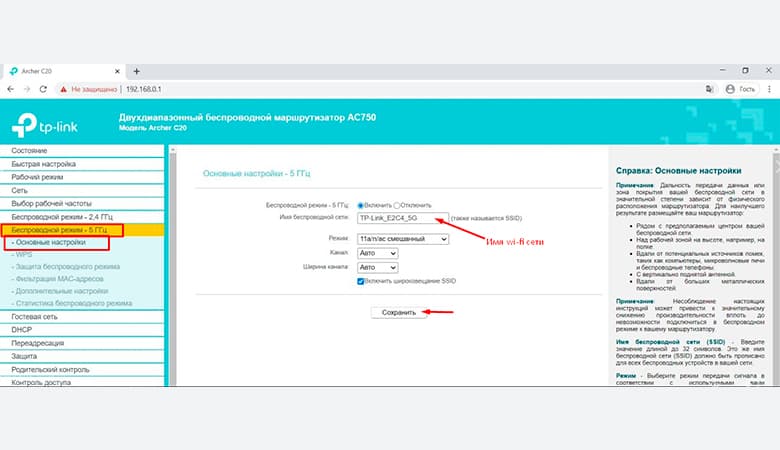
TP-Link Archer C20 рассчитан на поддержку двух режимов работы. Он может функционировать в двух частотных диапазонах: 2,4 и 5 ГГц. Оба диапазона должны быть включены. Для обоих режимов предусмотрены отдельные вкладки с настройками. В разделе с основными настройками пользователю нужно указать имя своей беспроводной сети.
Напротив пунктов номер канала и ширина выбираем значение «Авто». Следующий шаг – настройка защиты. Здесь необходимо выбрать пункт WPA/WPA2. Ключ доступа должен состоять как минимум из 8 символов. Желательно использовать буквы, цифры и специальные символы.
Archer C20 поддерживает функцию создания гостевой сети. Если ее активировать, можно ограничить доступ других пользователей от домашней сети владельца роутера. Настройки выполняются в одноименном разделе. Не забудьте создать надежный пароль для гостевой сети.
После внесения изменений новые параметры сохраняем и перезагружаем маршрутизатор.
Как настроить Archer C20 на работу в режиме репитера
Разработчики предусмотрели возможность настройки роутера на работу в режиме репитера. Нужно, чтобы в доме было установлено два маршрутизатора. Первый будет раздавать сигналы, а второй их усиливать. Оба прибора предварительно настраивают на один и тот же канал связи. Затем потребуется включить функцию WDS.
Другие настройки
- Интерактивное телевидение. Роутер рассматриваемой модели предполагает поддержку опции IPTV. Настроить ее можно через веб-конфигуратор в разделе «Сеть». Если ваш поставщик услуг предлагает определенные параметры для настройки цифрового телевидения, их нужно внести в соответствующие поля. Роутер в автоматическом режиме подсоединится через телевизионную приставку и выполнит настройки.
- Маршрутизаторы серии Archer оснащены встроенной поддержкой IPv6. Настройки этого сетевого протокола можно произвести в одноименной категории в панели управления. Обратите внимание: функция будет работать только тогда, если ваш провайдер предоставляет такую возможность. Многие поставщики услуг в РФ подобную опцию не поддерживают.
- Динамический DNS. С помощью этой опции пользователь сможет выполнять подключение к роутеру через интернет для дачи по удаленному доменному имени. Чтобы ее активировать, потребуется пройти регистрацию доменного имени.
- Безопасность. В маршрутизаторах линейки Archer по умолчанию межсетевой экран активирован. В разделе «Расширенные настройки» есть специальная опция защиты от DDoS-атак. По умолчанию она отключена. Эксперты советуют активировать эту функцию только в том случае, если у пользователей есть понимание принципов ее работы.
- Родительский контроль. Это опция идеально подходит тем родителям, которые желают ограничить доступ к интернету своим детям. Настроить параметры можно в панели управления в одноименном разделе. Здесь потребуется просто включить функцию, а затем прописать сетевой адрес рабочей станции, которая будет контролировать доступ. Для доступа к сети можно выставить график или расписание. После внесения изменений сохраняем настройки.
- Подключение принтера. Принтеры подключают к роутеру посредством USB-разъема. В веб-конфигураторе нужно найти раздел «Настройка USB», далее подраздел «Принт-сервер». Активируем опцию и пользуемся принтером.
Вероятные проблемы в работе оборудования
Все неполадки, с которыми могут столкнуться владельцы маршрутизатора TP-Link Archer C20, можно разделить на аппаратные и программные. При возникновении физической неисправности роутер желательно сразу отнести в ремонт. Мастера заменят или отремонтируют вышедшие из строя комплектующие. Часто проблемы возникают с сетевым кабелем. В таком случае можно вызвать на дом мастера от провайдера.
Программные сбои в большинстве случаев удается устранить путем перезагрузки или обнуления параметров. В особо сложных ситуациях, когда не помогает сброс, мастера выполняют перепрошивку устройства.
Как обновить прошивку: основные способы
Самый простой способ – найти на сайте производителя актуальную версию прошивки, скачать файл на ПК и установить на роутер.
Алгоритм выполнения процедуры обновления через панель управления:
- В главном меню веб-конфигуратора находим раздел, который называется «Системные инструменты».
- Здесь ищем пункт «Обновление».
- Указываем путь к скачанному файлу.
- Кликаем на кнопку «Обновить».
Весь процесс отнимет не более пяти минут. По окончании обновления маршрутизатор сам выполнит перезагрузку.
Есть еще один способ обновления – с помощью USB-устройства. Пользователю нужно всего лишь записать распакованный файл на флешку, затем подключить ее к маршрутизатору. Дальнейшая последовательность действий такая же, как в предыдущем способе. Через мобильное приложение на телефоне роутерами серии Archer можно только управлять. Опция удаленного обновления микропрограммного обеспечения недоступна.
Как обнулять настройки
Выполнить сброс настроек до заводских можно двумя способами: аппаратным и программным. Для аппаратного сброса нужно подготовить любой острый тонкий предмет. Им зажимают кнопку RESET, расположенную на задней стороне устройства. Кнопку нужно удерживать примерно пятнадцать секунд. Когда индикаторы на панели замигают, это будет сигнализировать об успешном сбросе настроек.
Второй вариант выполнения сброса параметров – программный. Для этого нам нужно зайти в панель управления, выбрать категорию «Системные инструменты» и выбрать опцию «Заводские настройки». Когда откроется новое окошко, выбираем позицию «Восстановить». Роутер автоматически обнулит все настройки.
По своим техническим характеристикам маршрутизатор TP-Link Archer C20 является превосходным вариантом для домашней или офисной работы. Он умеет работать в двух частотных диапазонах, поддерживает массу полезных функций.

REV2.0.0 1910011813
Archer C20
User Guide
AC900 Wireless Dual Band Router

Contents
About This Guide …………………………………………………………………………………..1
Chapter 1. Get to Know About You Router . . . . . . . . . . . . . . . . . . . . . . . . . . 2
1. 1. Product Overview . . . . . . . . . . . . . . . . . . . . . . . . . . . . . . . . . . . . . . . . . . . . . . . . . . . . . . . . . . 3
1. 2. Panel Layout . . . . . . . . . . . . . . . . . . . . . . . . . . . . . . . . . . . . . . . . . . . . . . . . . . . . . . . . . . . . . . . 3
1. 2. 1. Top View. . . . . . . . . . . . . . . . . . . . . . . . . . . . . . . . . . . . . . . . . . . . . . . . . . . . . . . . . . . . . 3
1. 2. 2. The Back Panel . . . . . . . . . . . . . . . . . . . . . . . . . . . . . . . . . . . . . . . . . . . . . . . . . . . . . . . 4
Chapter 2. Connect the Hardware. . . . . . . . . . . . . . . . . . . . . . . . . . . . . . . . . . 6
2. 1. Position Your Router. . . . . . . . . . . . . . . . . . . . . . . . . . . . . . . . . . . . . . . . . . . . . . . . . . . . . . . . 7
2. 2. Connect Your Router . . . . . . . . . . . . . . . . . . . . . . . . . . . . . . . . . . . . . . . . . . . . . . . . . . . . . . . 7
Chapter 3. Log into Your Router. . . . . . . . . . . . . . . . . . . . . . . . . . . . . . . . . . . 10
Chapter 4. Set Up Internet Connection . . . . . . . . . . . . . . . . . . . . . . . . . . . . 12
4. 1. Quick Setup. . . . . . . . . . . . . . . . . . . . . . . . . . . . . . . . . . . . . . . . . . . . . . . . . . . . . . . . . . . . . . . 13
4. 2. Manually Configure Your Internet Connection Settings . . . . . . . . . . . . . . . . . . . . . 15
4. 3. Setting Up an IPv6 Internet Connection . . . . . . . . . . . . . . . . . . . . . . . . . . . . . . . . . . . . 19
Chapter 5. Guest Network . . . . . . . . . . . . . . . . . . . . . . . . . . . . . . . . . . . . . . . . 24
5. 1. Create a Network for Guests . . . . . . . . . . . . . . . . . . . . . . . . . . . . . . . . . . . . . . . . . . . . . . . 25
5. 2. Customize Guest Network Options. . . . . . . . . . . . . . . . . . . . . . . . . . . . . . . . . . . . . . . . . 26
Chapter 6. Parental Controls. . . . . . . . . . . . . . . . . . . . . . . . . . . . . . . . . . . . . . 27
Chapter 7. QoS. . . . . . . . . . . . . . . . . . . . . . . . . . . . . . . . . . . . . . . . . . . . . . . . . . . 31
7. 1. Prioritize Internet Traffic with QoS. . . . . . . . . . . . . . . . . . . . . . . . . . . . . . . . . . . . . . . . . . 32
7. 2. Update the Database. . . . . . . . . . . . . . . . . . . . . . . . . . . . . . . . . . . . . . . . . . . . . . . . . . . . . . 35
Chapter 8. Network Security. . . . . . . . . . . . . . . . . . . . . . . . . . . . . . . . . . . . . . 36
8. 1. Protect the Network from Cyber Attacks . . . . . . . . . . . . . . . . . . . . . . . . . . . . . . . . . . . 37
8. 2. Access Control . . . . . . . . . . . . . . . . . . . . . . . . . . . . . . . . . . . . . . . . . . . . . . . . . . . . . . . . . . . . 38
8. 3. IP & MAC Binding. . . . . . . . . . . . . . . . . . . . . . . . . . . . . . . . . . . . . . . . . . . . . . . . . . . . . . . . . . 40

Chapter 9. NAT Forwarding . . . . . . . . . . . . . . . . . . . . . . . . . . . . . . . . . . . . . . . 41
9. 1. Share Local Resources on the Internet by Virtual Servers . . . . . . . . . . . . . . . . . . . . 42
9. 2. Open Ports Dynamically by Port Triggering. . . . . . . . . . . . . . . . . . . . . . . . . . . . . . . . . 43
9. 3. Make Applications Free from Port Restriction by DMZ . . . . . . . . . . . . . . . . . . . . . . 44
9. 4. Make Xbox Online Games Run Smoothly by UPnP . . . . . . . . . . . . . . . . . . . . . . . . . . 45
Chapter 10. Customize Your Network Settings . . . . . . . . . . . . . . . . . . . . . . 47
10. 1. Change the LAN Settings . . . . . . . . . . . . . . . . . . . . . . . . . . . . . . . . . . . . . . . . . . . . . . . . . . 48
10. 2. Configure to Support IPTV Service . . . . . . . . . . . . . . . . . . . . . . . . . . . . . . . . . . . . . . . . . 48
10. 3. Specify DHCP Server Settings . . . . . . . . . . . . . . . . . . . . . . . . . . . . . . . . . . . . . . . . . . . . . . 50
10. 4. Set Up a Dynamic DNS Service Account . . . . . . . . . . . . . . . . . . . . . . . . . . . . . . . . . . . . 51
10. 5. Create Static Routes . . . . . . . . . . . . . . . . . . . . . . . . . . . . . . . . . . . . . . . . . . . . . . . . . . . . . . . 52
10. 6. Specify Wireless Settings . . . . . . . . . . . . . . . . . . . . . . . . . . . . . . . . . . . . . . . . . . . . . . . . . . 54
10. 7. Use WPS for Wireless Connection . . . . . . . . . . . . . . . . . . . . . . . . . . . . . . . . . . . . . . . . . . 56
10. 7. 1. Set the Router’s PIN . . . . . . . . . . . . . . . . . . . . . . . . . . . . . . . . . . . . . . . . . . . . . . . . 56
10. 7. 2. Use the WPS Wizard for Wi-Fi Connections . . . . . . . . . . . . . . . . . . . . . . . . . . 56
10. 8. Schedule Your Wireless Function . . . . . . . . . . . . . . . . . . . . . . . . . . . . . . . . . . . . . . . . . . . 57
Chapter 11. Manage the Router . . . . . . . . . . . . . . . . . . . . . . . . . . . . . . . . . . . 59
11. 1. Set Up System Time . . . . . . . . . . . . . . . . . . . . . . . . . . . . . . . . . . . . . . . . . . . . . . . . . . . . . . . 60
11. 2. Test the Network Connectivity . . . . . . . . . . . . . . . . . . . . . . . . . . . . . . . . . . . . . . . . . . . . . 61
11. 3. Upgrade the Firmware. . . . . . . . . . . . . . . . . . . . . . . . . . . . . . . . . . . . . . . . . . . . . . . . . . . . . 62
11. 3. 1. Online Upgrade. . . . . . . . . . . . . . . . . . . . . . . . . . . . . . . . . . . . . . . . . . . . . . . . . . . . 63
11. 3. 2. Local Upgrade . . . . . . . . . . . . . . . . . . . . . . . . . . . . . . . . . . . . . . . . . . . . . . . . . . . . . 63
11. 3. 3. Restore Interrupted Upgrade after Power Failure . . . . . . . . . . . . . . . . . . . . 64
11. 4. Backup and Restore Configuration Settings . . . . . . . . . . . . . . . . . . . . . . . . . . . . . . . . 64
11. 5. Change the Administrator Account . . . . . . . . . . . . . . . . . . . . . . . . . . . . . . . . . . . . . . . . 66
11. 6. Password Recovery . . . . . . . . . . . . . . . . . . . . . . . . . . . . . . . . . . . . . . . . . . . . . . . . . . . . . . . . 66
11. 7. Local Management. . . . . . . . . . . . . . . . . . . . . . . . . . . . . . . . . . . . . . . . . . . . . . . . . . . . . . . . 67
11. 8. Remote Management . . . . . . . . . . . . . . . . . . . . . . . . . . . . . . . . . . . . . . . . . . . . . . . . . . . . . 68
11. 9. System Log . . . . . . . . . . . . . . . . . . . . . . . . . . . . . . . . . . . . . . . . . . . . . . . . . . . . . . . . . . . . . . . 69
11. 10. Monitor the Internet Traffic Statistics . . . . . . . . . . . . . . . . . . . . . . . . . . . . . . . . . . . . . . . 71
11. 11. Control LEDs . . . . . . . . . . . . . . . . . . . . . . . . . . . . . . . . . . . . . . . . . . . . . . . . . . . . . . . . . . . . . . 72
FAQ ………………………………………………………………………………………………………79

1
About This Guide
This guide is a complementation of Quick Installation Guide. The Quick Installation
Guide instructs you on quick Internet setup, and this guide provides details of each
function and shows you the way to configure these functions appropriate to your
needs.
When using this guide, please notice that features of the router may vary slightly
depending on the model and software version you have, and on your location, language,
and Internet service provider. All screenshots, images, parameters and descriptions
documented in this guide are used for demonstration only.
Conventions
In this guide the following conventions are used:
Convention Description
Blue Italic Hyperlinks are in blue italic. You can click to redirect to a website or a specific section.
Blue Contents to be emphasized and texts on the web page are in blue, including the
menus, items, buttons, etc.
>
The menu structures to show the path to load the corresponding page. For example,
Advanced > Wireless > MAC Filtering means the MAC Filtering function page is under
the Wireless menu that is located in the Advanced tab.
Note: Ignoring this type of note might result in a malfunction or damage to the device.
Tips: Indicates important information that helps you make better use of your device.
symbols on the web
page
• click to edit the corresponding entry.
• click to delete the corresponding entry.
• click to enable or disable the corresponding entry.
• click to view more information about items on the page.
More Info
The latest software, management app and utility can be found at Download Center at
www.tp-link.com/support.
The Quick Installation Guide can be found where you find this guide or inside the
package of the router.
Specifications can be found on the product page at http://www.tp-link.com.
A Technical Support Forum is provided for you to discuss our products at
http://forum.tp-link.com.
Our Technical Support contact information can be found at the Contact Technical
Support page at www.tp-link.com/support.

Chapter 1
Get to Know About You
Router
This chapter introduces what the router can do and shows its main features and
appearance.
This chapter contains the following sections:
• Product Overview
• Panel Layout

3
Chapter 1 Get to Know About You Router
1. 1. Product Overview
The TP-LINK router is designed to fully meet the need of Small Office/Home Office
(SOHO) networks and the users demanding higher networking performance. The
powerful antennas ensure continuous Wi-Fi signal to all your devices while boosting
widespread coverage throughout your home, and the built-in Ethernet ports supply
high-speed connection to your wired devices.
Moreover, it is simple and convenient to set up and use the TP-LINK router due to its
intuitive web interface and the powerful Tether app.
1. 2. Panel Layout
1. 2. 1. Top View
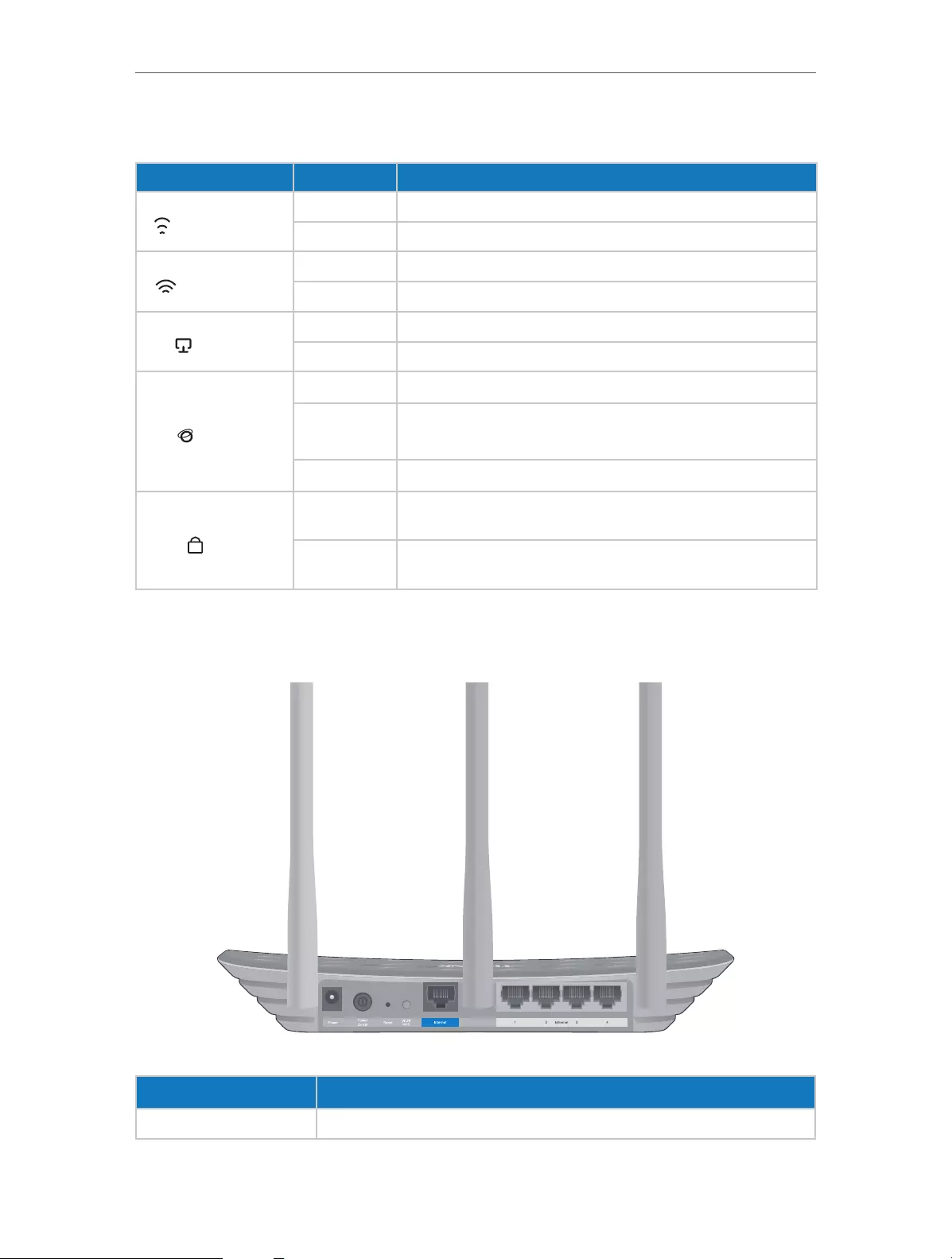
The router’s LEDs (view from left to right) are located on the front. You can check the
router’s working status by following the LED Explanation table.
LED Explanation
Name Status Indication
(Power)
On System initialization completes.
Flashing System initialization or firmware upgrade is in process. Do not
disconnect or power off the router.
Off Power is off.
4
Chapter 1 Get to Know About You Router
LED Explanation
Name Status Indication
(2.4GHz Wireless)
On The 2.4GHz wireless band is working properly.
Off The 2.4GHz wireless band is disabled.
( 5GHz Wireless)
On The 5GHz wireless band is working properly.
Off The 5GHz wireless band is disabled.
(Ethernet)
On The Ethernet port is connected.
Off No connection.
(Internet)
Blue On Internet is available.
Orange On The router’s Internet port is connected, but the Internet
is not available.
Off The router’s Internet port is not connected.
(WPS)
On/Off Turns On when a WPS synchronization is established and
automatically turns Off about 5 minutes later.
Flashing A wireless device is trying to connect to the network via WPS. This
process may take up to 2 minutes.
1. 2. 2. The Back Panel
The following parts (view from left to right) are located on the rear panel.
Item Description
Power Port For connecting the router to power socket via the provided power adapter.

5
Chapter 1 Get to Know About You Router
Item Description
Power On/Off Button Press this button to power on or off the router.
Reset Hole Use a pin to press and hold this button until the Power LED starts blinking
to reset the router to its factory default settings.
Wi-Fi/WPS
To turn on/off the Wi-Fi function by pressing until the 2.4Ghz LED and
5Ghz LED on/off.
To enable the WPS function, press this button about 2 seconds. If you have
a WPS-supported device, you can press this button to quickly establish a
connection between the router and the client device and automatically
configure wireless security for your wireless network.
Internet Port For connecting to a DSL/Cable modem, or an Ethernet port.
Ethernet Ports (1/2/3/4) For connecting your PCs or other wired network devices to the router.
Antennas Used for wireless operation and data transmit. Upright them for the best
Wi-Fi performance.

Chapter 2
Connect the Hardware
This chapter contains the following sections:
• Position Your Router
• Connect Your Router
7
Chapter 2 Connect the Hardware
2. 1. Position Your Router
• The Product should not be located where it will be exposed to moisture or excessive
heat.
• Place the router in a location where it can be connected to the various devices as well
as to a power source.
• Make sure cables and power cords are safely placed out of the way so they do not
create a tripping hazard.
• The router can be placed on a shelf or desktop.
• Keep away from the strong electromagnetic radiation and the device of
electromagnetic sensitive.
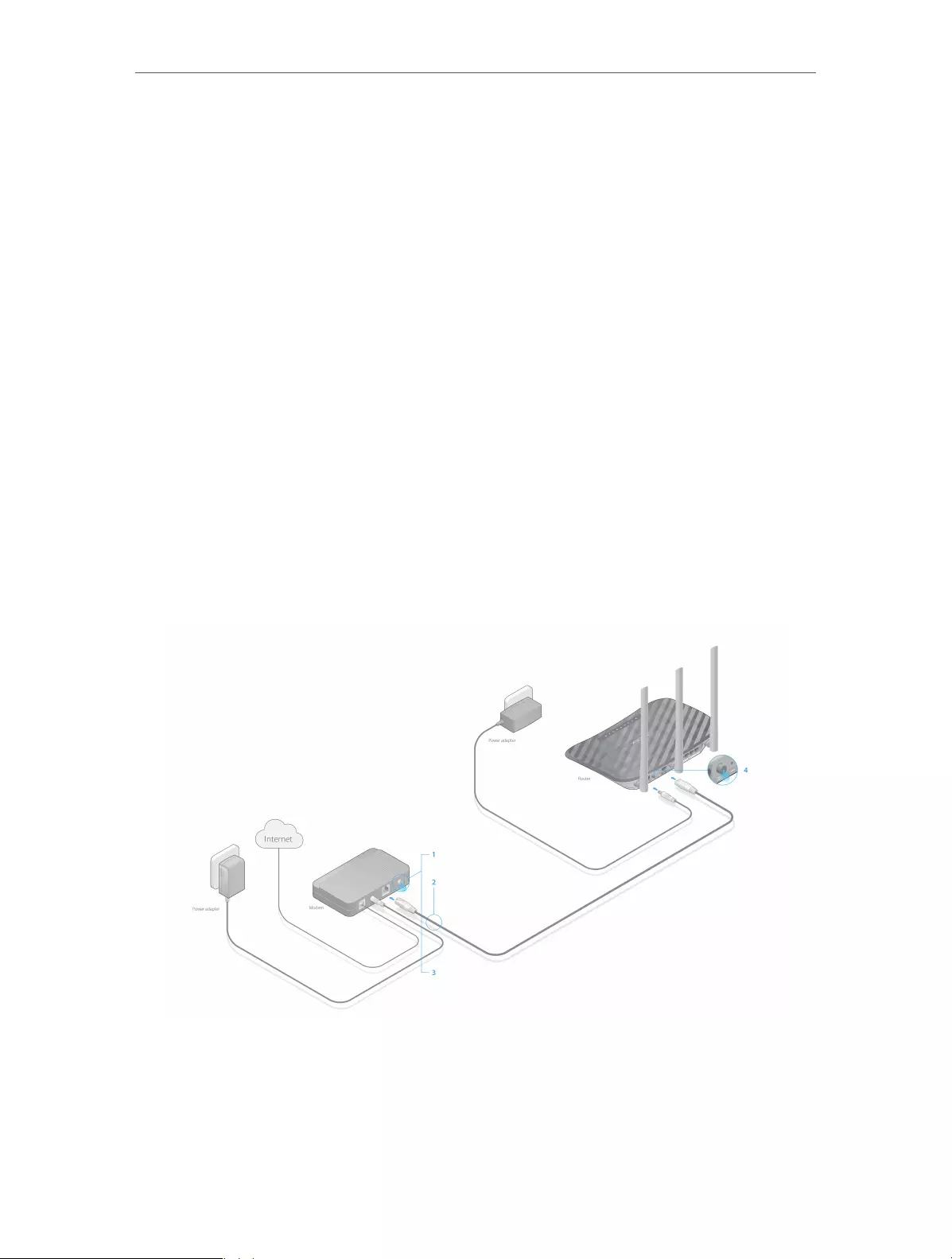
2. 2. Connect Your Router
1. Follow the steps below to connect your router.
If your Internet connection is through an Ethernet cable from the wall instead of
through a DSL / Cable / Satellite modem, connect the Ethernet cable directly to the
router’s Internet port, then follow step 4 and 5 to complete the hardware connection.
1 ) Turn off the modem, and remove the backup battery if it has one.
2 ) Connect the modem to the Internet port on your router with an Ethernet cable.
3 ) Turn on the modem, and then wait about 2 minutes for it to restart.
4 ) Turn on the router.

8
Chapter 2 Connect the Hardware
5 ) Verify that the following LEDs are on and stable before continuing with the
configuration.
wer
On
2.4G
On
5G
On On
Internet
Tips:
If the 2.4GHz and 5GHz LEDs are off, press the Wi-Fi/WPS button until they are on.
2. Connect your computer to the router.
• Method 1: Wired
Turn off the Wi-Fi on your computer and connect the devices as shown below.
Ethernet cable
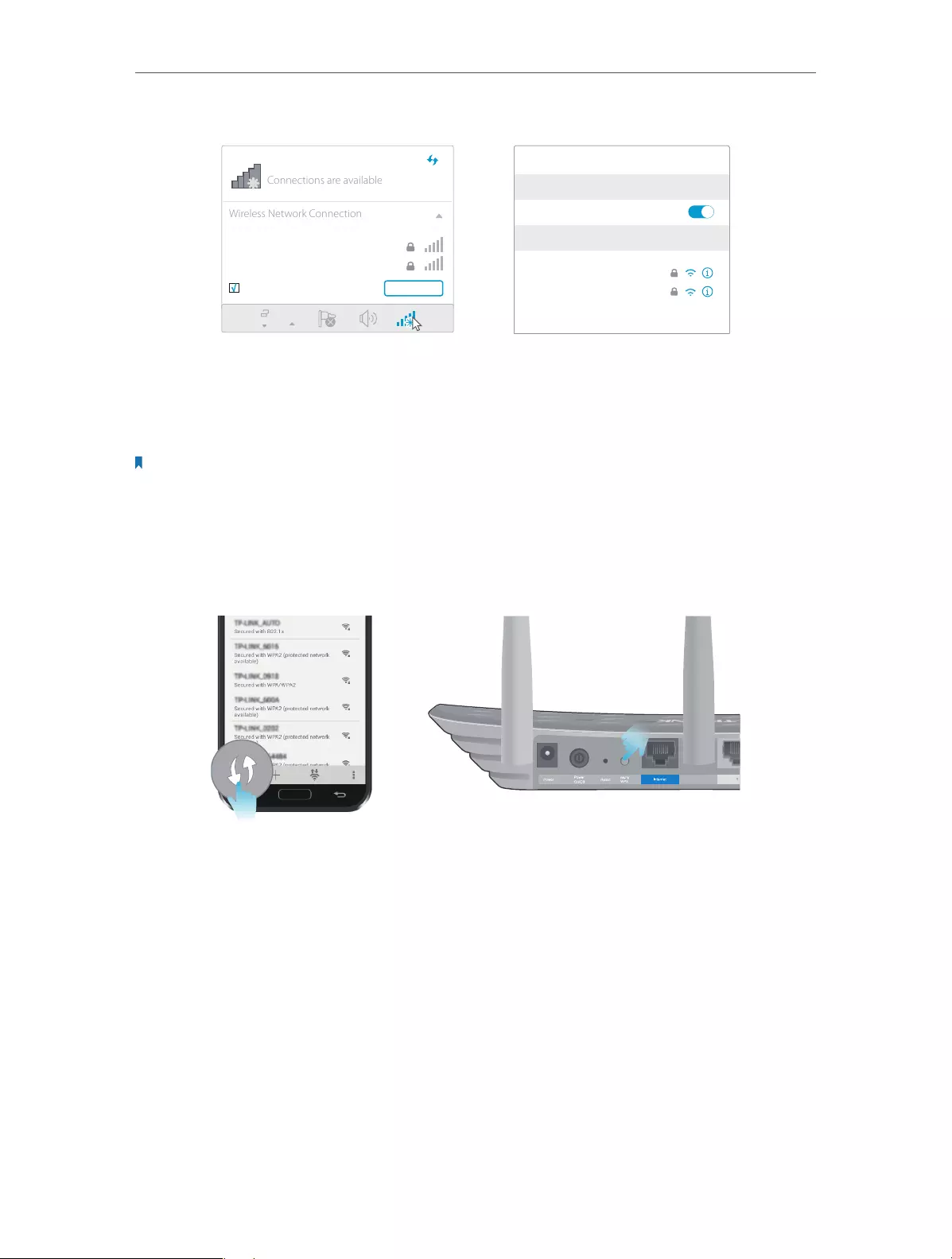
• Method 2: Wireless
1 ) Find the SSID (Network Name) and Wireless Password printed on the label at
the bottom of the router.
2 ) Click the network icon of your computer or go to Wi-Fi Setting of your smart
device, and the select the SSID to join the network.
9
Chapter 2 Connect the Hardware
Computer Smart Device
Connections are available
Wireless Network Connection
Connect automatically Connect
√
TP-LINK_XXXX
TP-LINK_XXXX_5G
Wi-Fi
Wi-Fi
TP-LINK_XXXX
TP-LINK_XXXX_5G
CHOOSE A NETWORK…
Other…
< Settings
• Method 3: Use the WPS button
Wireless devices that support WPS, including Android phones, tablets, most USB
network cards, can be connected to your router through this method. (WPS is not
supported by iOS devices.)
Note:
The WPS function cannot be configured if the wireless function of the router is disabled. Also, the WPS function will
be disabled if your wireless encryption is WEP. Please make sure the wireless function is enabled and is configured
with the appropriate encryption before configuring the WPS.
1. Tab the WPS icon on the device’s screen.
2. Immediately press the WPS button on your router.
Close to

Chapter 3
Log into Your Router
11
Chapter 3 Log into Your Router
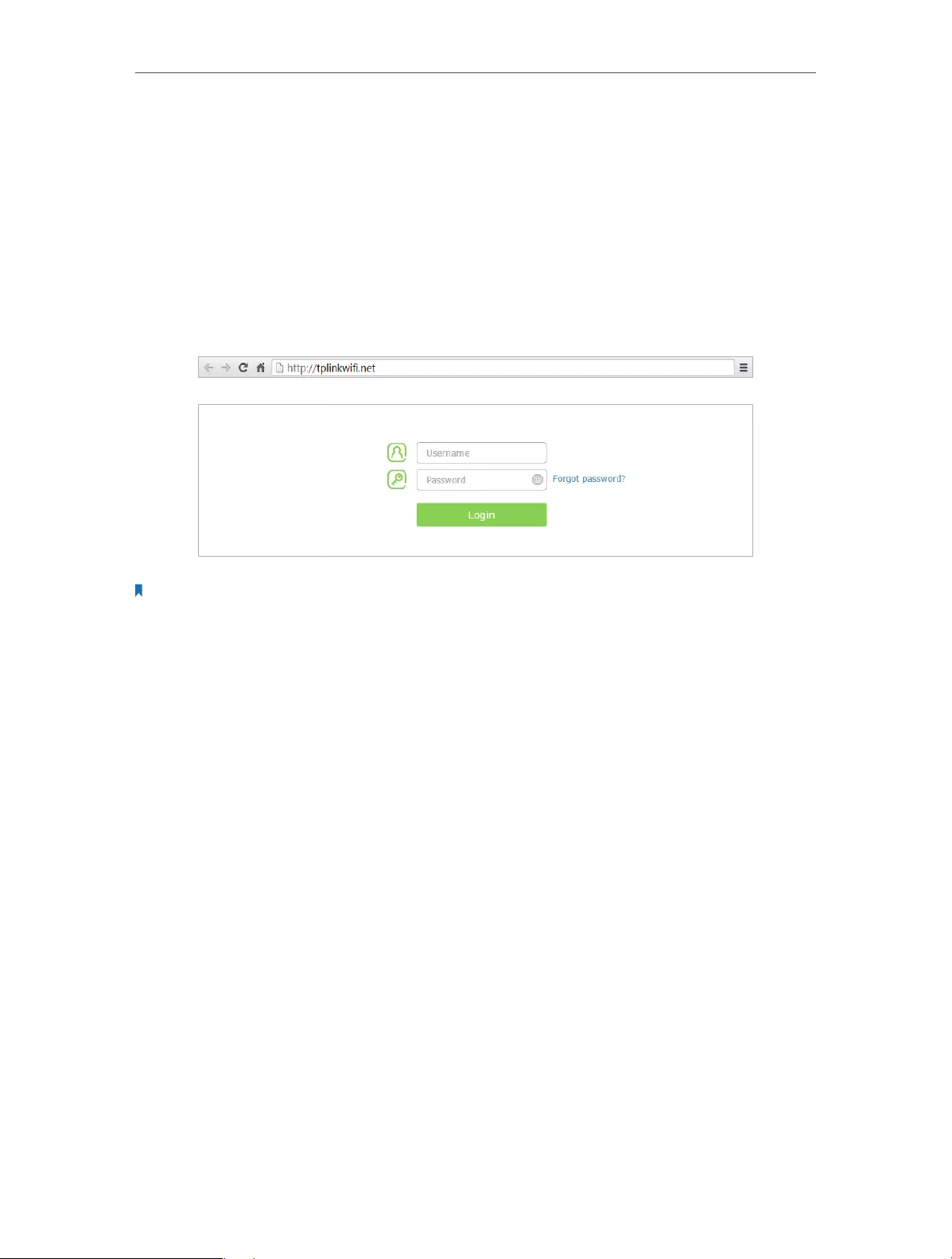
With a Web-based utility, it is easy to configure and manage the router. The Web-based
utility can be used on any Windows, Macintosh or UNIX OS with a Web browser, such as
Microsoft Internet Explorer, Mozilla Firefox or Apple Safari.
Follow the steps below to log into your router.
1. Set up the TCP/IP Protocol in Obtain an IP address automatically mode on your
computer.
2. Visit http://tplinkwifi.net, and log in with the username and password you set for the
router. The default one is admin for both username and password.
Note:
If the login window does not appear, please refer to FAQ.

Chapter 4
Set Up Internet Connection
This chapter introduces how to connect your router to the Internet. The router is
equipped with a web-based Quick Setup wizard. It has many ISP information built
in, automates many of the steps and verifies that those steps have been successfully
completed. Furthermore, you can also set up an IPv6 connection if your ISP provides
IPv6 service.
This chapter contains the following sections:
• Quick Setup
• Manually Configure Your Internet Connection Settings
• Setting Up an IPv6 Internet Connection
13
Chapter 4 Set Up Internet Connection
4. 1. Quick Setup
The Quick Setup Wizard will guide you through the process to set up your router to
access the Internet.
Tips:
If you need the IPv6 Internet connection, please refer to the section of 4. 3. Setting Up an IPv6 Internet Connection.
Follow the steps below to set up your router to access the Internet.
1. Visit http://tplinkwifi.net, and log in with the username and password you set for the
router.
2. Click Quick Setup on the top of the page.
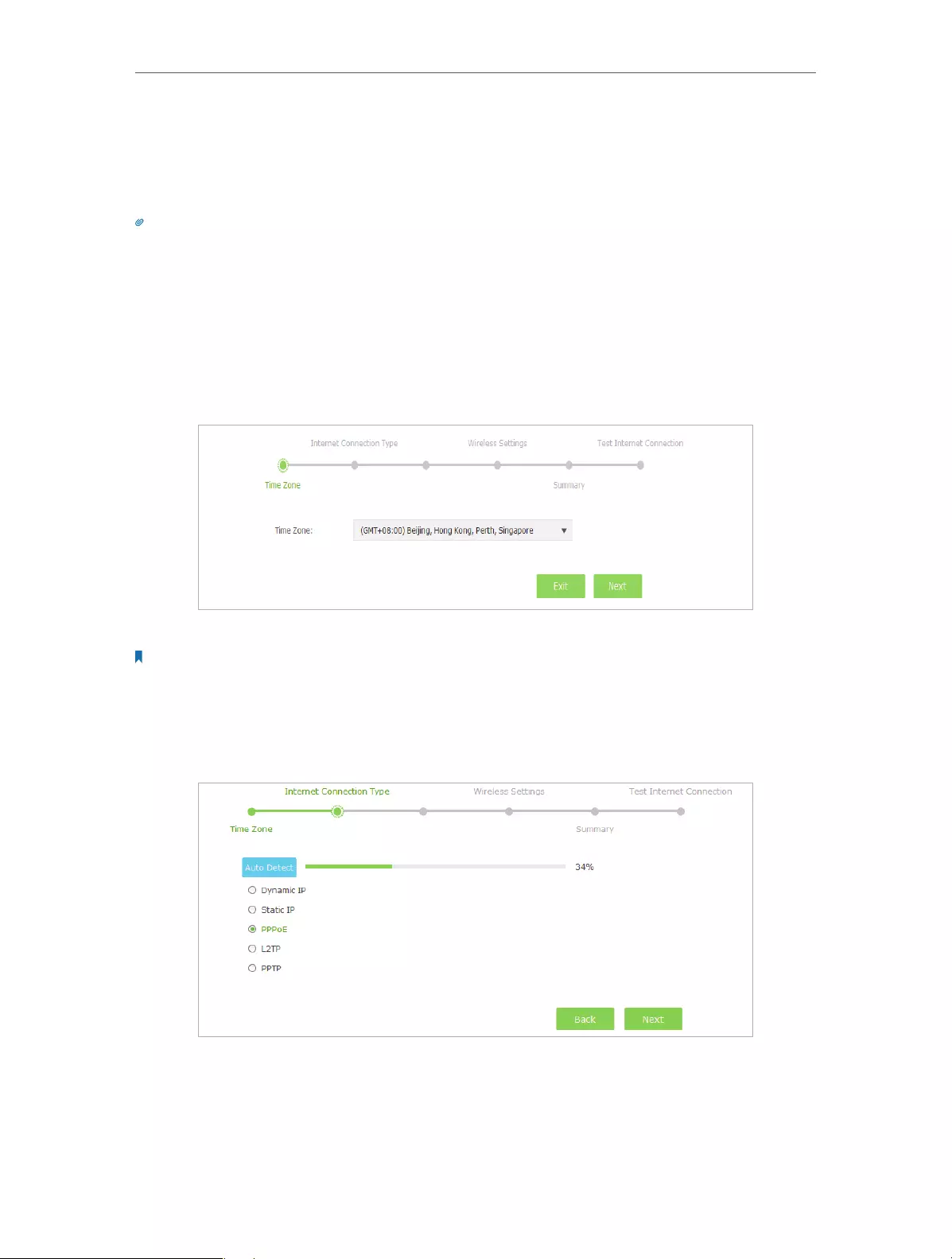
3. Select your Time Zone from the drop-down list and click Next.
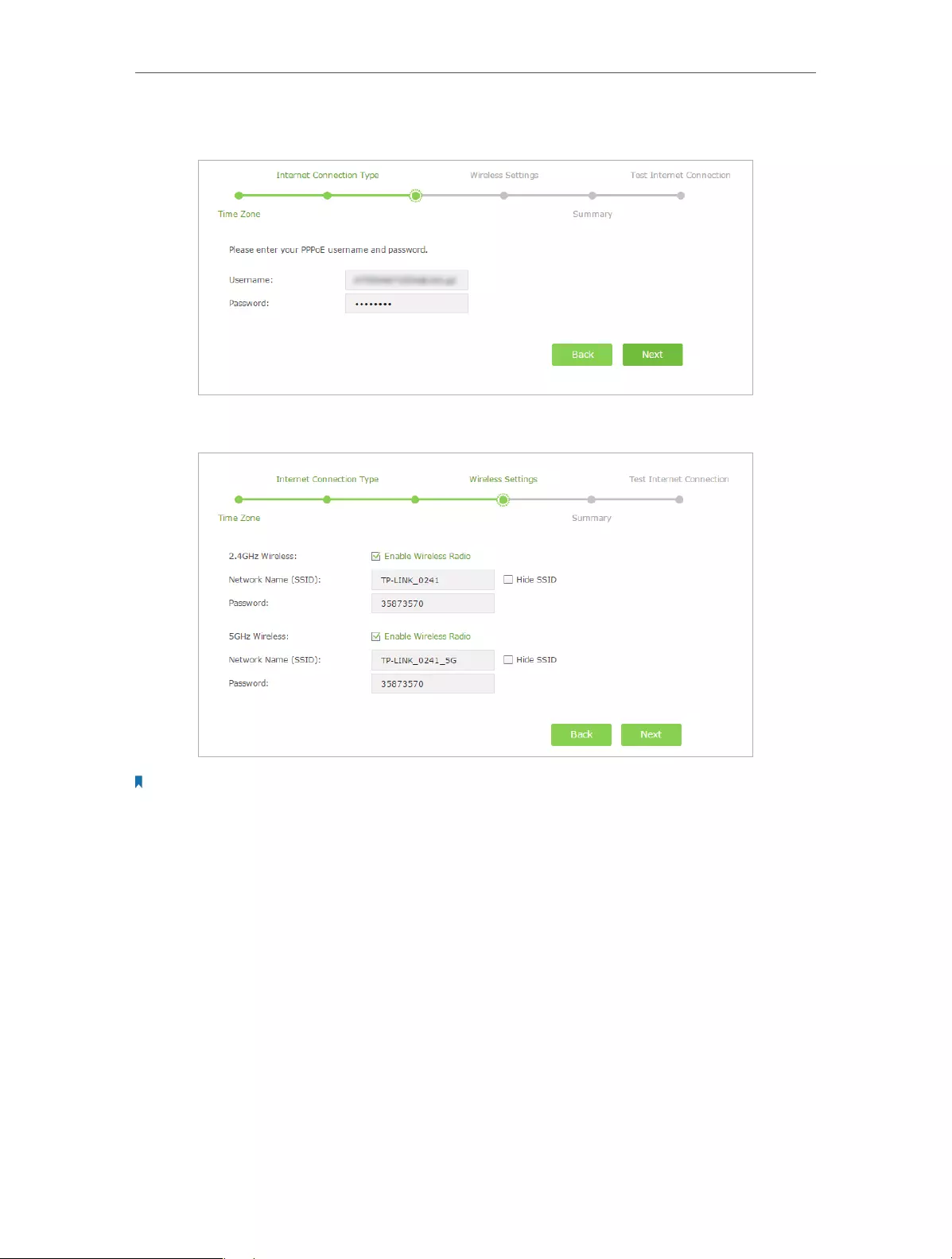
4. Click Auto Detect and the router will detect your connection type automatically.
Note:
You can also choose the connection type manually. Contact your ISP if you are not sure about the Internet connection
information.
• If you use DSL line and you are only provided with an account name and a password by your ISP, choose PPPoE.
• If you use cable TV or fiber cable, choose Dynamic IP.
• If you are provided with more information such as IP address, Subnet Mask and Default Gateway, choose Static IP.
5. In this case, the router automatically detects PPPoE as the connection type. Click
Next.
14
Chapter 4 Set Up Internet Connection
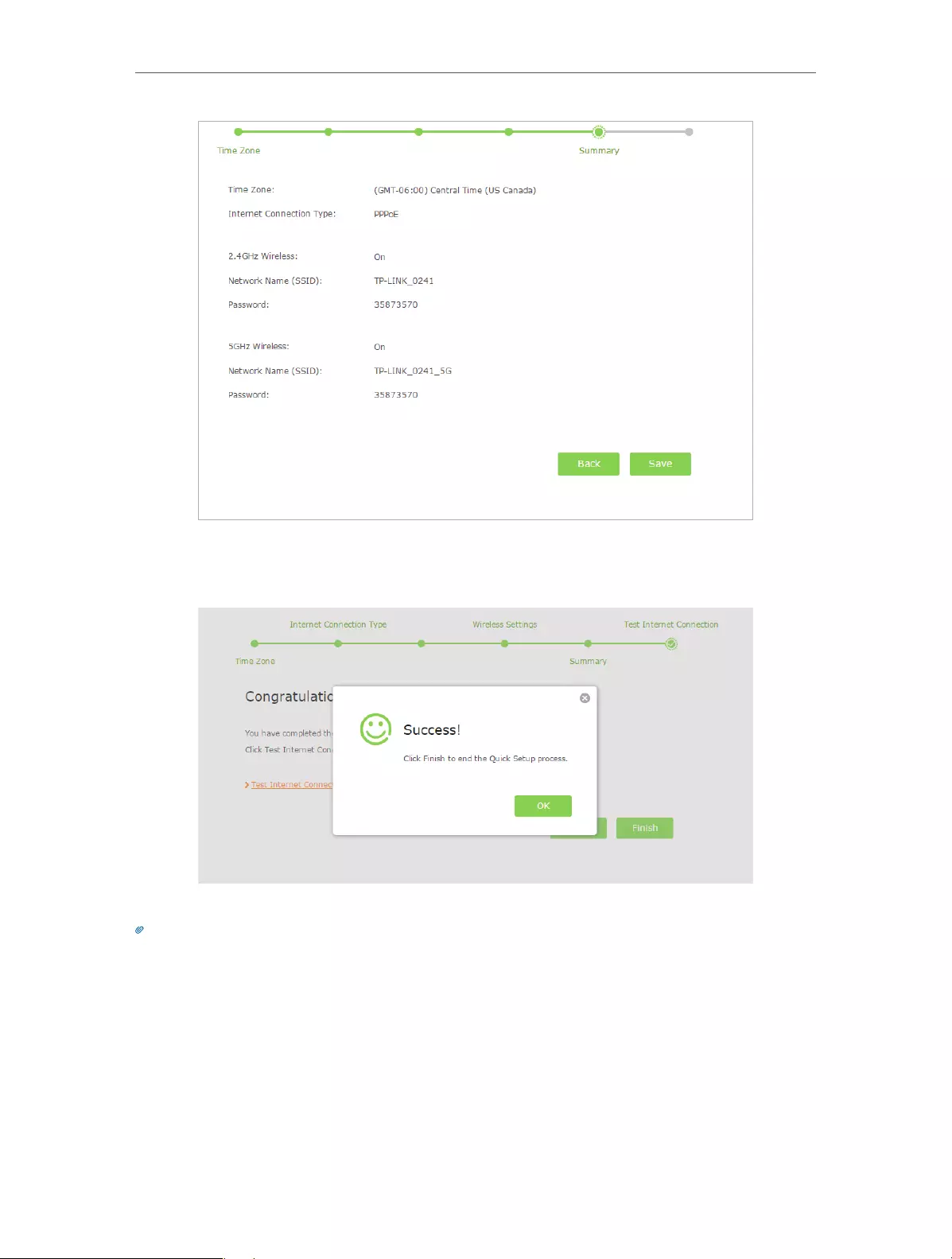
6. Fill the Username and Password provided by your ISP in the field. Click Next.
7. Configure your wireless settings and click Next.
Note:
1. You may customize your 2.4GHz/5GHz SSID and password. Once done, the wireless connection will disconnect
automatically, and you must then use the new SSID and password to regain access to the Internet.
2. Tick Hide SSID if you want to hide this wireless network name.
8. Confirm the information and click Save.
15
Chapter 4 Set Up Internet Connection
9. Click Test Internet Connection. If you successfully connect to the Internet, the screen
will display as follows.
10. Now your computer and Wi-Fi devices can connect to the Internet!
Tips:
You can connect your computer to the router’s Ethernet port using an Ethernet cable to join the local area network.
You can also find and select the wireless network name on your Wi-Fi device to join the Wi-Fi network.
4. 2. Manually Configure Your Internet Connection
Settings
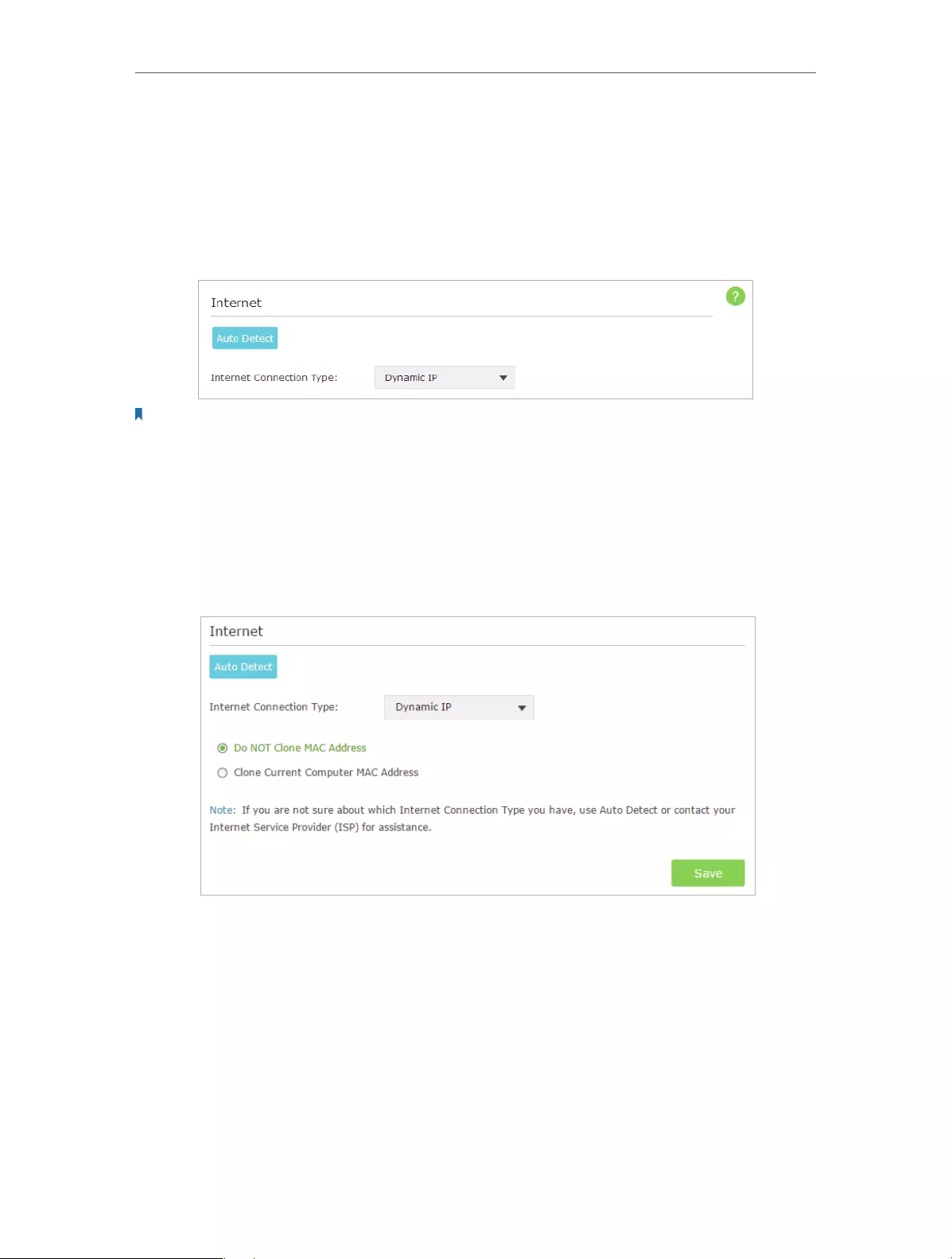
In this part, you can check your current Internet connection settings. You can also
modify the settings according to the service information provided by your ISP.
16
Chapter 4 Set Up Internet Connection
Follow the steps below to check or modify your Internet connection settings.
1. Visit http://tplinkwifi.net, and log in with the username and password you set for the
router.
2. Go to Basic > Internet.
3. Select your Internet connection type from the drop-down list.
Note:
If you are unsure of what your connection type is, click Auto Detect. Since different connection types need different
cables and connection information, you can also refer to the demonstrations in Step 4 to judge your connection
type.
4. Follow the instructions on the page to continue the configuration. Parameters on
the figures are just used for demonstration.
1 ) If you choose Dynamic IP, you need to select whether to clone the MAC address
or not. Dynamic IP users are usually equipped with cable TV or fiber cable.
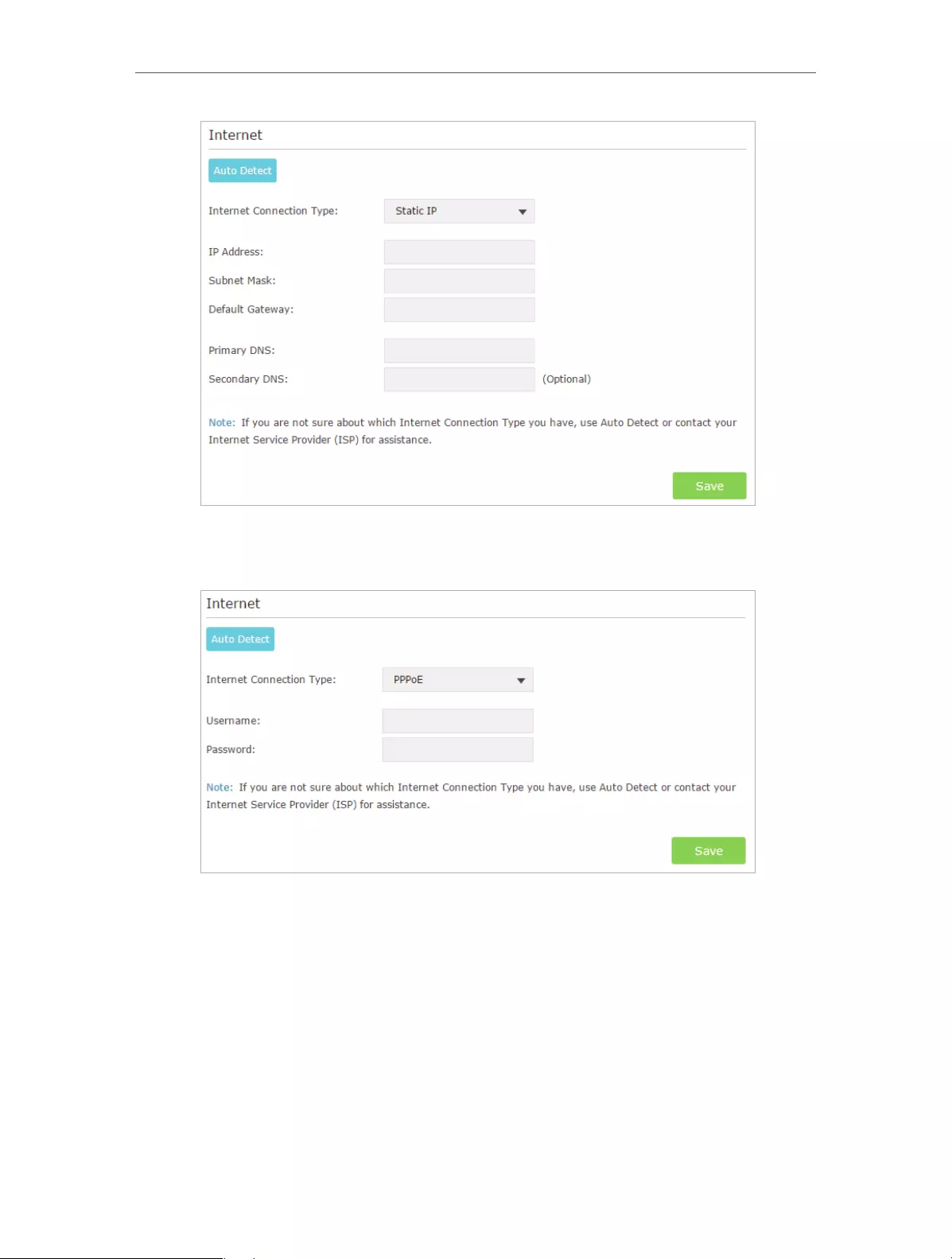
2 ) If you choose Static IP, enter the information provided by your ISP in the
corresponding fields.
17
Chapter 4 Set Up Internet Connection
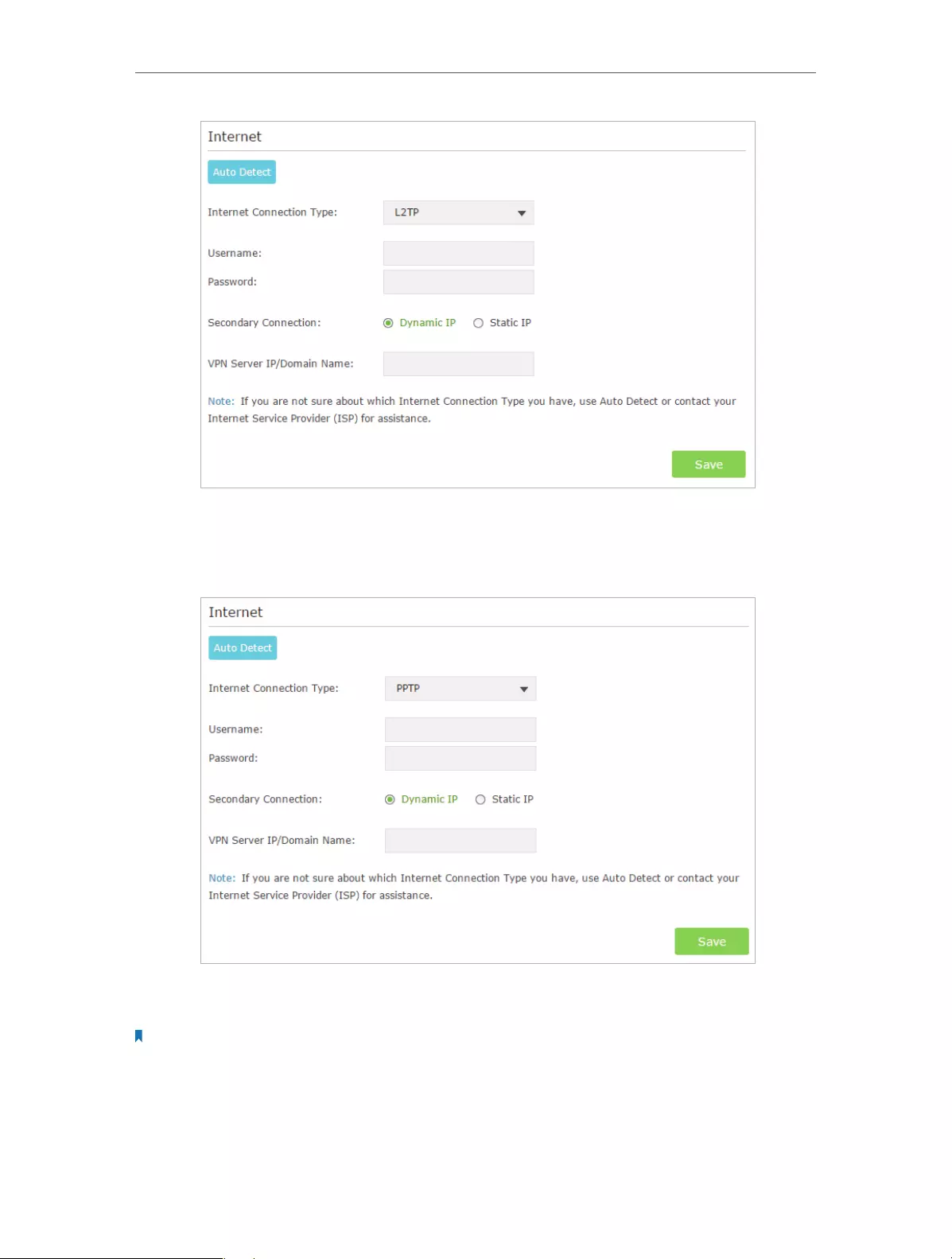
3 ) If you choose PPPoE, enter the username and password provided by your ISP.
PPPoE users usually have a DSL cable.
4 ) If you choose L2TP, enter the username and password and choose the Secondary
Connection provided by your ISP. Different parameters are needed according
to the Secondary Connection.
18
Chapter 4 Set Up Internet Connection
5 ) If you choose PPTP, enter the username and password, and choose the
Secondary Connection provided by your ISP. Different parameters are needed
according to the Secondary Connection.
5. Click Save to make the settings take effect. To check your Internet connection, click
Network Map on the left of the page.
Note:
It may take 1-2 minutes to make the settings valid.
6. After the connection succeeds, the screen will display as follows. Here we take
PPPoE as an example.

19
Chapter 4 Set Up Internet Connection
Tips:
1. If your Internet connection type is BigPond Cable, please go to Advanced > Network > Internet.
2. If you use Dynamic IP and PPPoE and you are provided with any other parameters that are not required on the
page, please go to Advanced > Network > Internet to complete the configuration.
3. If you still cannot connect to the Internet, refer to FAQ for further instructions.
4. 3. Setting Up an IPv6 Internet Connection
Your ISP provides information about one of the following Internet connection types:
PPPoE, Dynamic IP(SLAAC/DHCPv6), Static IP, 6to4 tunnel, Pass-Through (Bridge).
1. Visit http://tplinkwifi.net, then log in with the username and password you set for
the router.
2. Go to Advanced > IPv6.

20
Chapter 4 Set Up Internet Connection
3. Select the Internet connection type provided by your ISP.
Tips:
If you do not know what your Internet connection type is, contact your ISP or judge according to the already known
information provided by your ISP.
4. Fill in information as required by different connection types. (Red blanks must be
filled in.)
1 ) Static IP: Fill in blanks and click Save.

21
Chapter 4 Set Up Internet Connection
2 ) Dynamic IP(SLAAC/DHCPv6): Click Advanced to have more configuration if
your ISP requires. Click Save to save the settings and then click Renew to finish
the configuration.
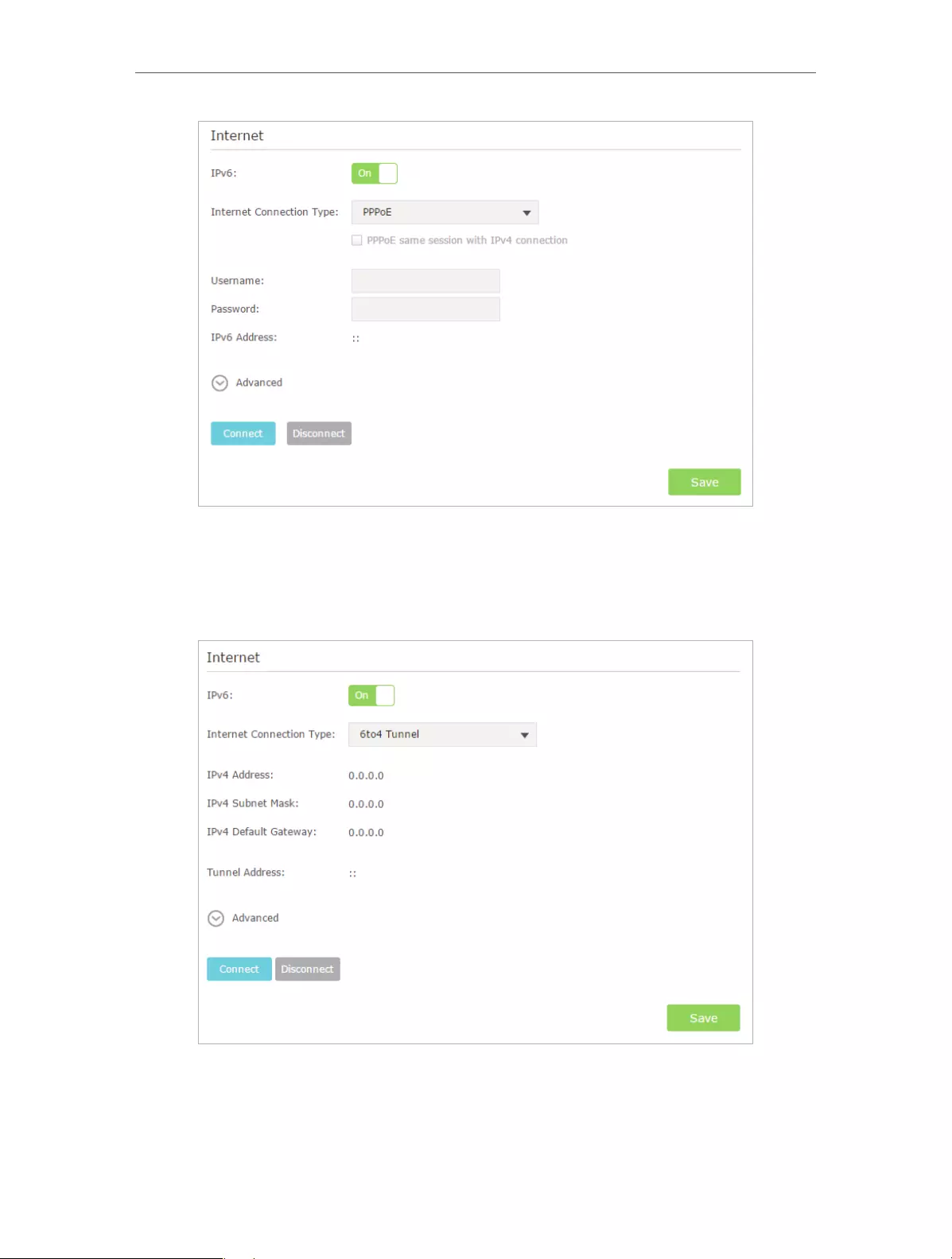
3 ) PPPoE: Fill in the Username and Password. Click Advanced to have more
configuration if your ISP requires. Click Save to save the settings and then click
Connect to finish the configuration.
22
Chapter 4 Set Up Internet Connection
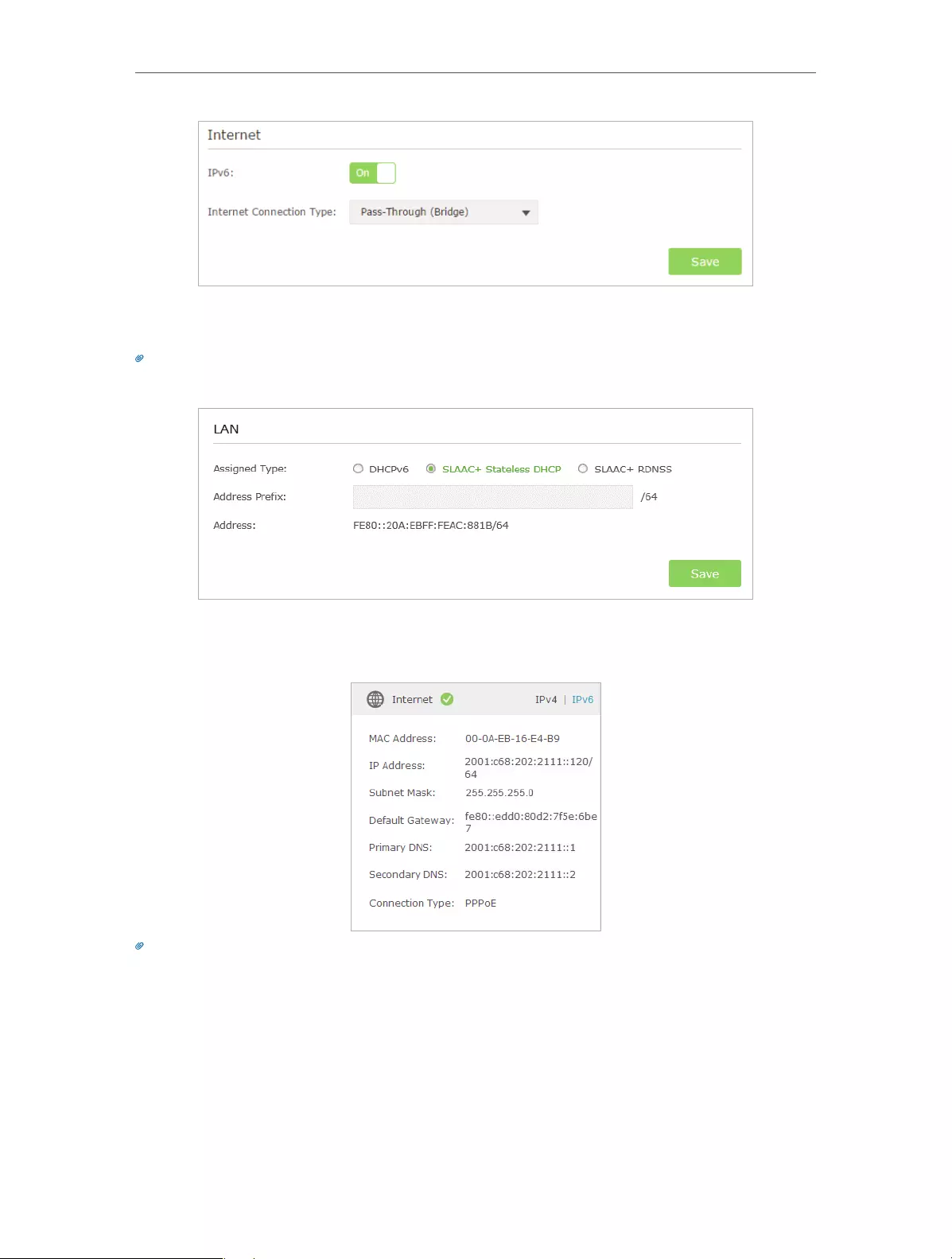
4 ) 6to4 Tunnel: An IPv4 Internet connection type is a prerequisite for this
connection type (Manually Configure Your Internet Connection Settings). Click
Advanced to have more configuration if your ISP requires. Click Save to save
the settings and then click Connect to finish the configuration.
5 ) Pass-Through (Bridge): Click Save and skip to step 6.
23
Chapter 4 Set Up Internet Connection
5. Configure LAN ports. Windows users are recommended to choose from the first two
types. Fill in Address Prefix provided by your ISP, and click Save to save the settings.
Tips:
Find Help on the management interface to know more about items.
6. Click Status to check whether you succeed or not. The following figure is an example
of a successful PPPoE configuration.
Tips:
Visit FAQ if there is no Internet connection.

Chapter 5
Guest Network
This function allows you to provide Wi-Fi access for guests without disclosing your
main network. When you have guests in your house, apartment, or workplace, you can
create a guest network for them. In addition, you can customize guest network options
to ensure network security and privacy.
This chapter contains the following sections:
• Create a Network for Guests
• Customize Guest Network Options
25
Chapter 5 Guest Network
5. 1. Create a Network for Guests
1. Visit http://tplinkwifi.net, and log in with the username and password you set for the
router.
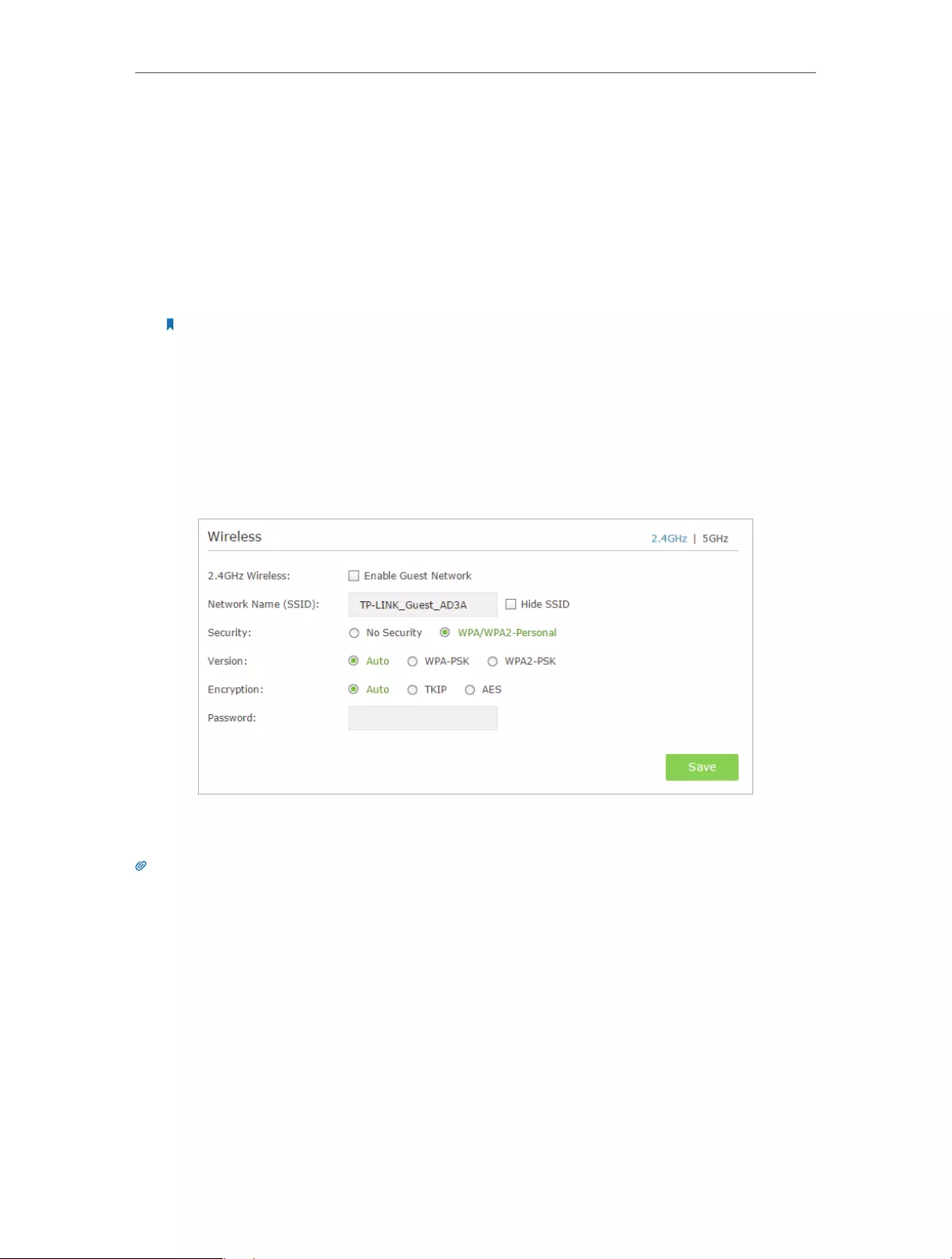
2. Go to Advanced > Guest Network. Locate the Wireless section.
3. Create a guest network according to your needs.
1 ) Enable 2.4GHz Wireless network or 5GHz Wireless network.
Note:
Guest network and WDS cannot be enabled at the same time. If WDS was enabled, disable it at Advanced >
System Tools > System Parameters.
2 ) Customize the SSID. Don‘t select Hide SSID unless you want your guests to
manually input the SSID for guest network access.
3 ) Set Security to WPA/WPA2 Personal, keep the default Version and Encryption
values, and customize your own password.
4. Click Save. Now your guests can access your guest network using the SSID and
password you set!
Tips:
To view guest network information, go to Advanced > Status and locate the Guest Network section.
26
Chapter 5 Guest Network
5. 2. Customize Guest Network Options
1. Visit http://tplinkwifi.net, and log in with the username and password you set for the
router.
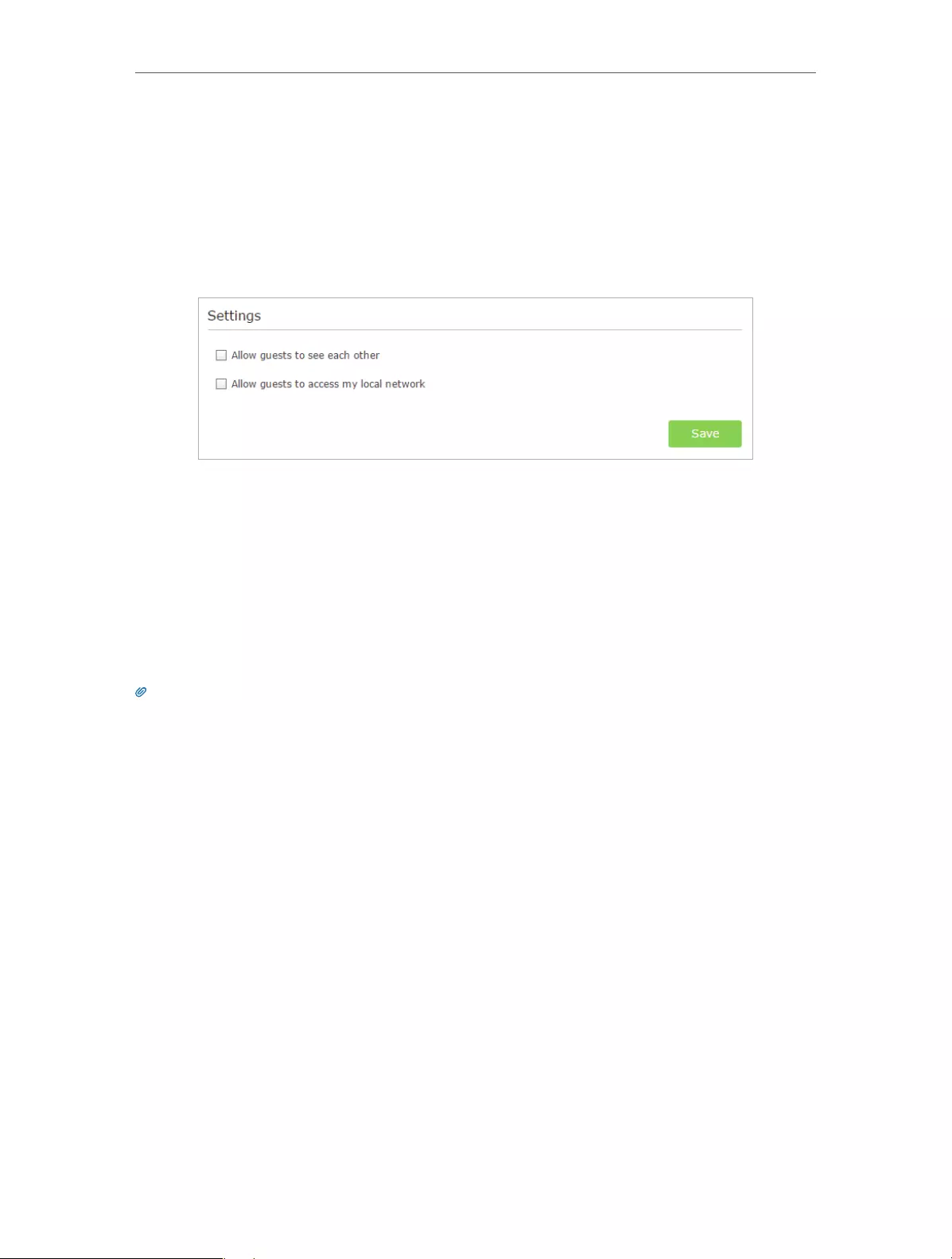
2. Go to Advanced > Guest Network. Locate the Settings section.
3. Customize guest network options according to your needs.
• Allow guests to see each other
Select this checkbox if you want to allow the wireless clients on your guest network
to communicate with each other via methods such as network neighbors and Ping.
• Allow guests to access my local network
Select this checkbox if you want to allow the wireless clients on your guest network
to communicate with the devices connected to your router’s LAN ports or main
network via methods such as network neighbors and Ping.
4. Click Save. Now you can ensure network security and privacy!
Tips:
To view guest network information, go to Advanced > Status and locate the Guest Network section.

Chapter 6
Parental Controls
This function allows you to block inappropriate, explicit and malicious websites, and
controls access to specified websites at specified time.
28
Chapter 6 Parental Controls
Control the times of day my children or other home network
users are allowed to access the Internet and even types of
websites they can visit.
For example, I want to allow my children’s devices (e.g. a
computer or a tablet) to access only www.tp-link.com and
Wikipedia.org from 18:00 (6PM) to 22:00 (10PM) at the weekend
and not other times.
1. Visit http://tplinkwifi.net, and log in with the username and
password you set for the router.
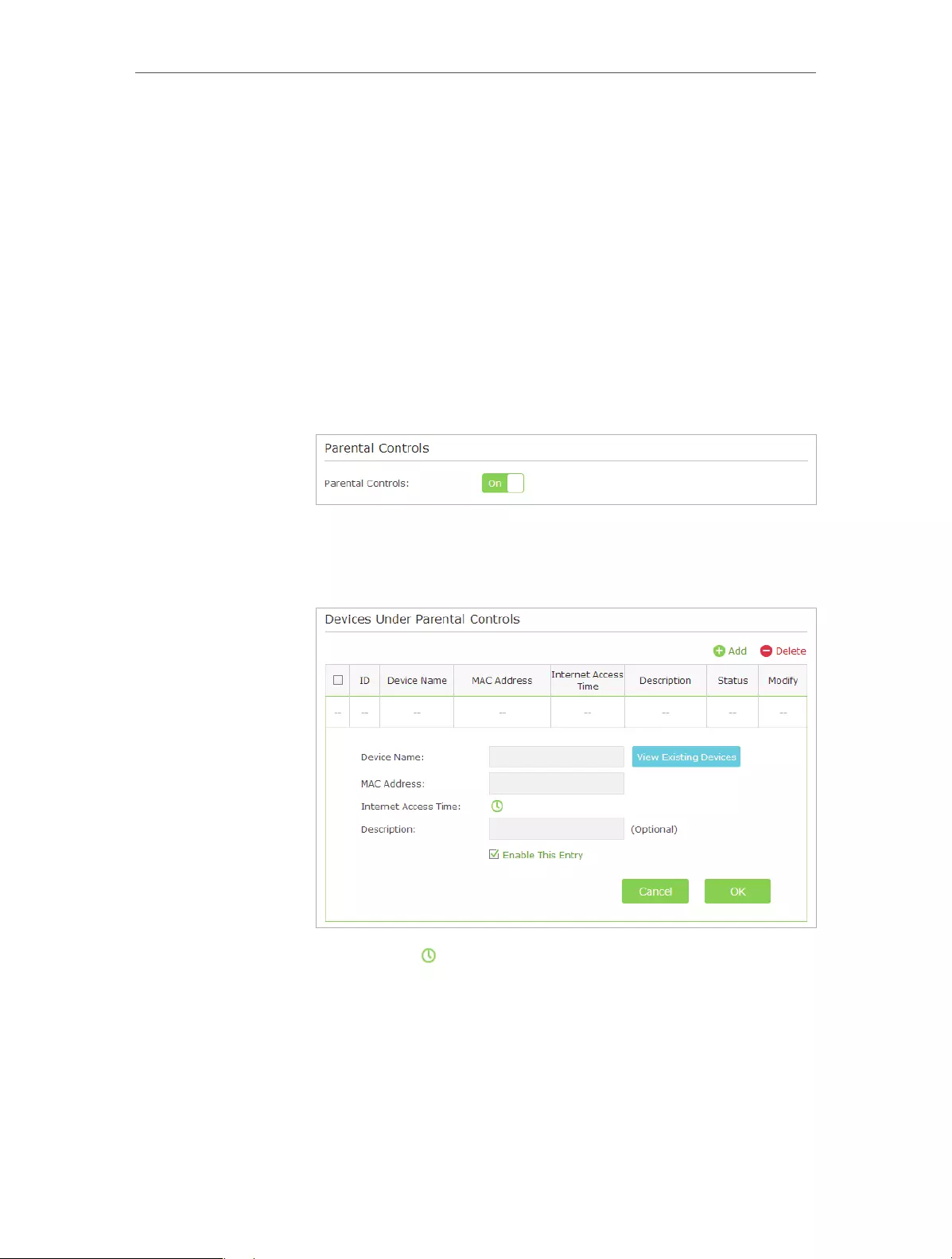
2. Go to Advanced > Parental Controls and enable Parental
Controls.
3. Click Add. And then Click View Existing Devices, and select
the access device. Or, input the Device Name and MAC
Address manually.
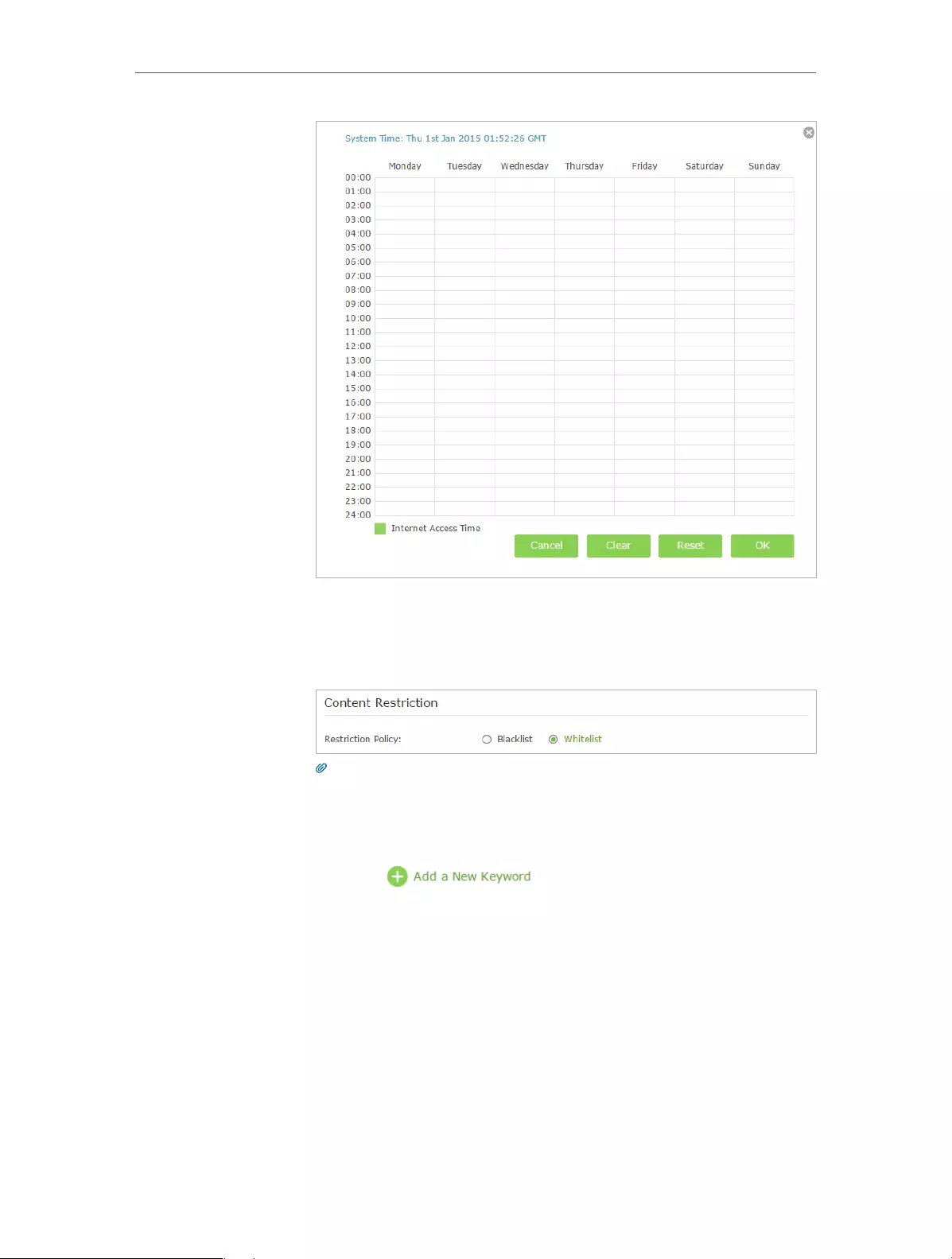
4. Click the icon to set the Internet Access Time. Drag the
cursor over the appropriate cell(s) and click OK.
I want to:I want
How can I
do that?
29
Chapter 6 Parental Controls
5. Enter a Description for the entry. Keep the Enable This Entry
checkbox selected. Click OK.
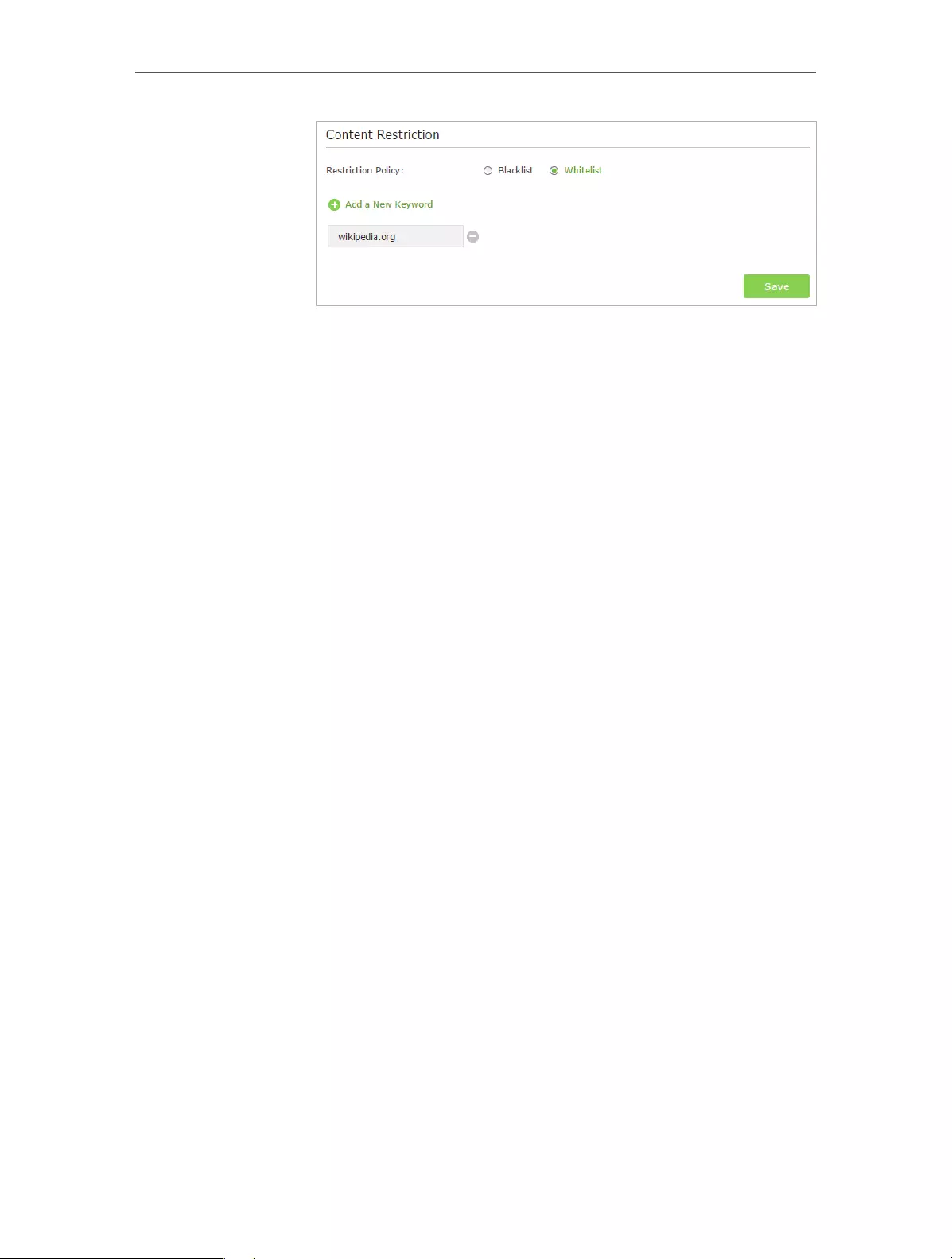
6. Select Whitelist as the restriction policy.
Tips:
1. With Blacklist selected, the controlled devices cannot access any websites
containing the specified keywords during the Internet Access Time period.
2. With Whitelist selected, the controlled devices can only access websites containing
the specified keywords during the Internet Access Time period.
7. Click . Enter a keyword or a website and
click Save.
You can add up to 32 keywords for either Blacklist or Whitelist.
Below are some sample entries to allow access.
• Enter a web address (e.g. wikipedia.org) or a web address
keyword (e.g. wikipedia) to only allow or block access to
the websites containing that keyword.
• Specify the domain suffix (eg. .edu or .org) to allow access
only to the websites with that suffix.
• If you wish to block all Internet browsing access, do not
add any keyword to the Whitelist.
30
Chapter 6 Parental Controls
Now you can control your children’s Internet access according
to your needs.
Done!

Chapter 7
QoS
This chapter introduces how to create a QoS (Quality of Service) rule to specify
prioritization of traffic and minimize the impact caused when the connection is under
heavy load.
This chapter contains the following sections:
• Prioritize Internet Traffic with QoS
• Update the Database
32
Chapter 7 QoS
7. 1. Prioritize Internet Traffic with QoS
QoS (Quality of Service) is designed to ensure the efficient operation of the network
when come across network overload or congestion.
Specify priority levels for some devices or applications.
For example, I have several devices that are connected to my
wireless network. I would like to set an intermediate speed on
the Internet for my phone.
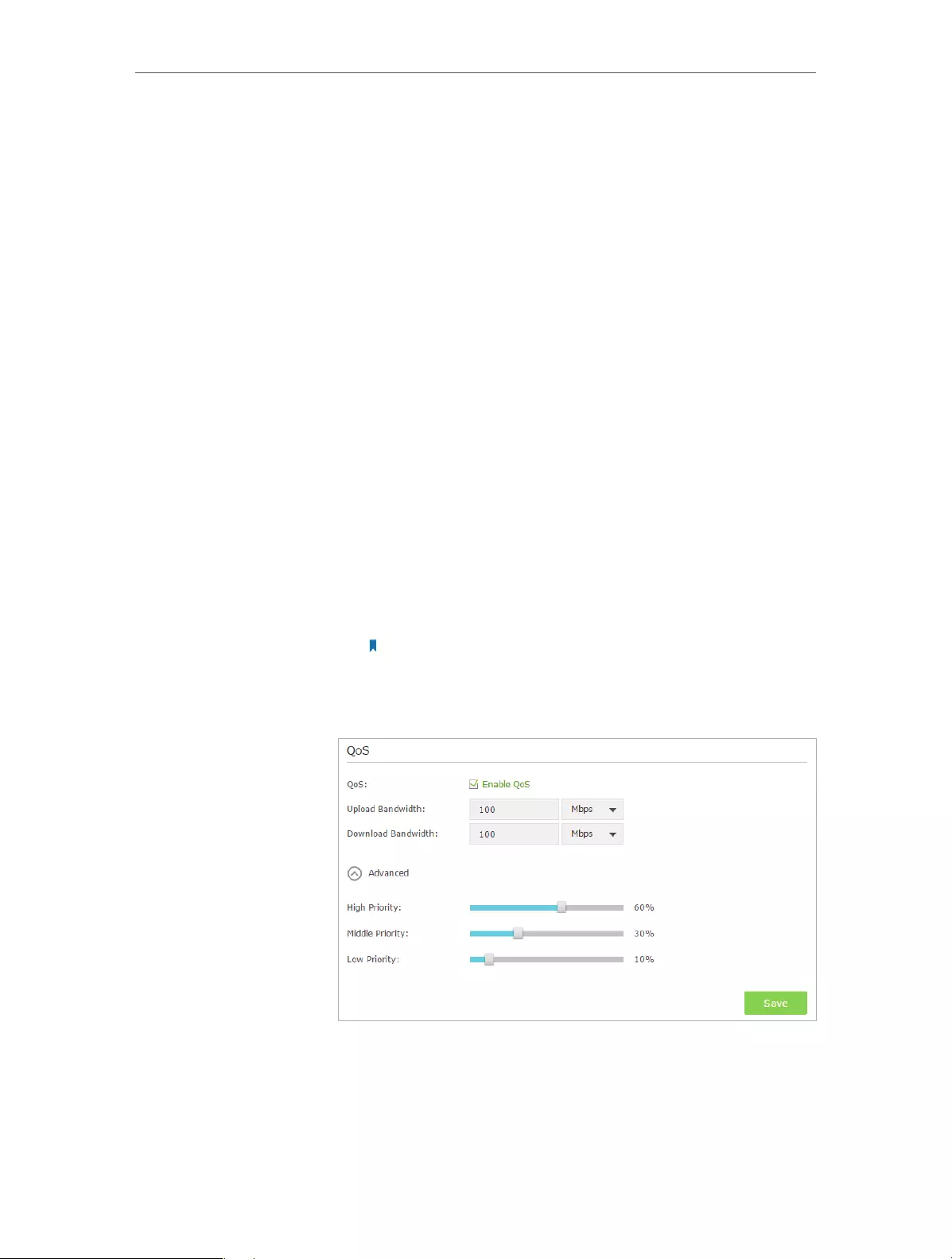
1. Enable QoS and set bandwidth allocation.
1 ) Visit http://tplinkwifi.net, and log in with the username
and password you set for the router.
2 ) Go to Advanced > QoS > Settings.
3 ) Select Enable QoS.
4 ) Input the maximum upload and download bandwidth
provided by your service provider. 1Mbps is equal to
1000Kbps.
5 ) Click Advanced and drag the scroll bar to set the
bandwidth priority percentage.
Note:
Add each priority up no more than 100%. High Priority is greater than
Middle Priority, and Middle Priority is greater than Low Priority.
6 ) Click Save.
2. Add QoS Rules.
I want to:
How can I
do that?
33
Chapter 7 QoS
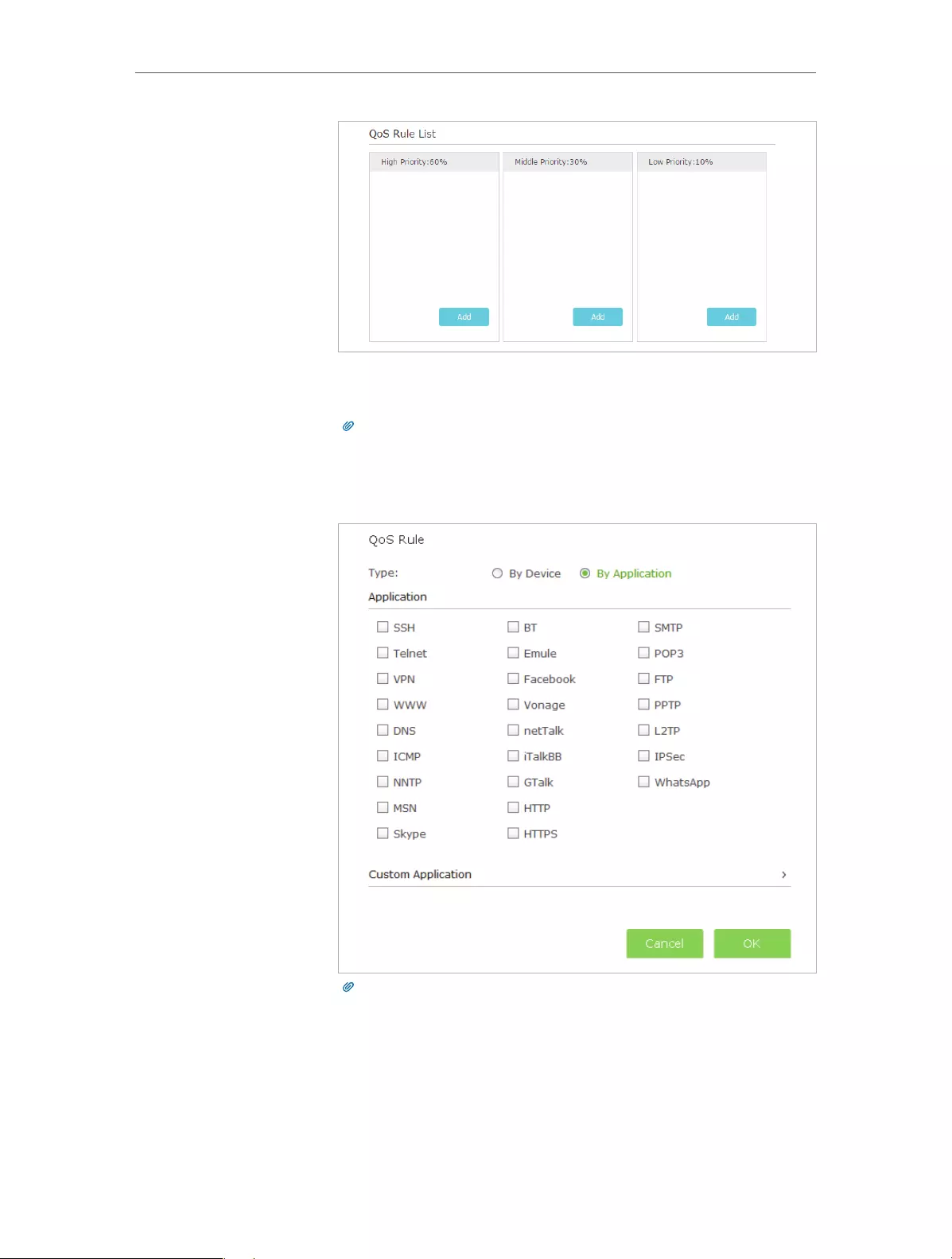
1 ) Set a High Priority rule for the FTP server.
a . Click Add in the High Priority section.
Tips:
In the QoS rule field, displays three rule type include By Device and By Application.
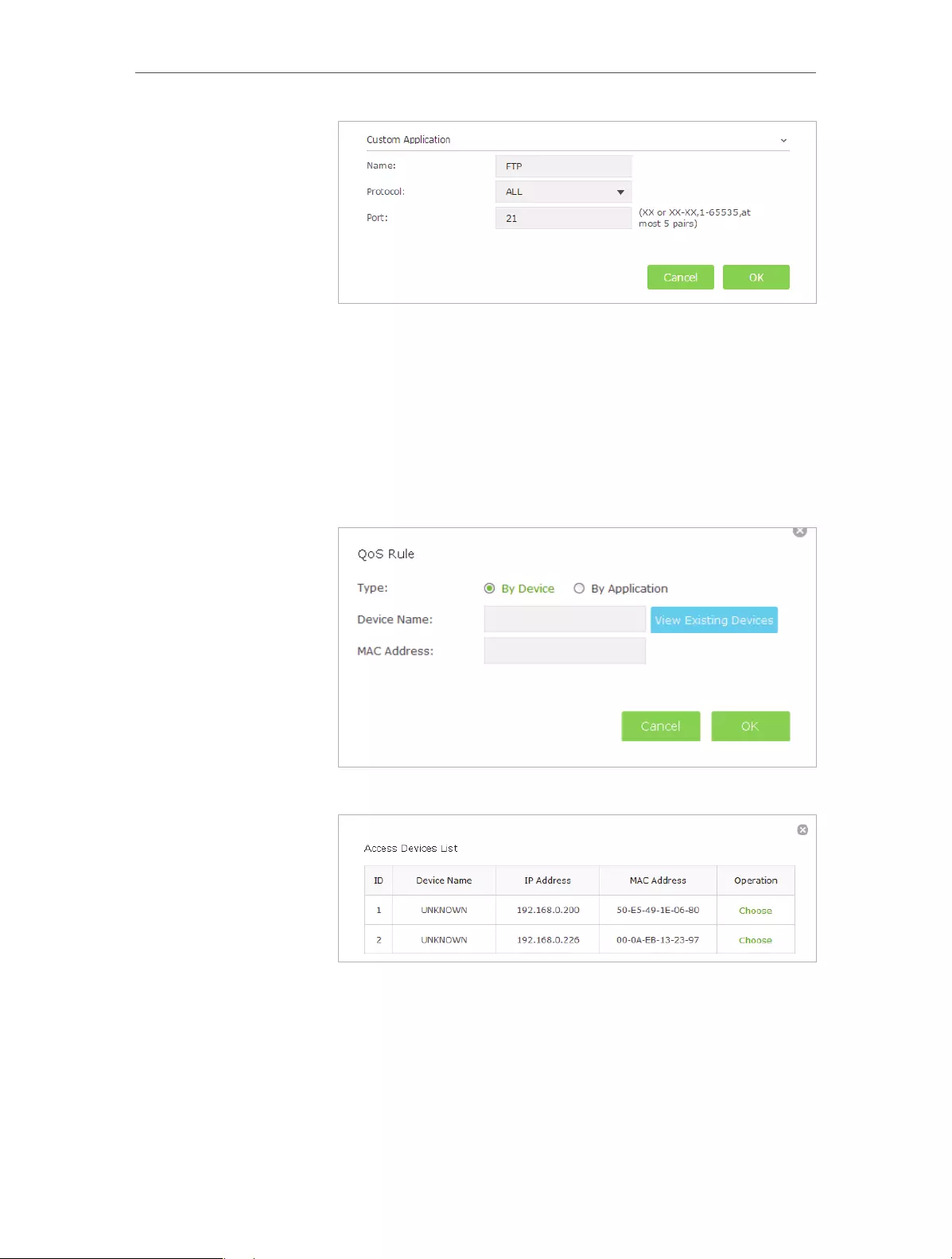
b . Select By Application and then select FTP in the list. Scroll
down and click OK.
Tips:
If your application isn’t listed on the screen, click Custom Application to add
application manually.
34
Chapter 7 QoS
• Name: Enter a name for your application.
• Protocol: Select the protocol for your application, if your are not sure, select
ALL.
• Port: Enter the destination port for your application, usually each application
has a fixed port, please ensure you enter the correct the port. In this case, the
destination port for FTP is 21.
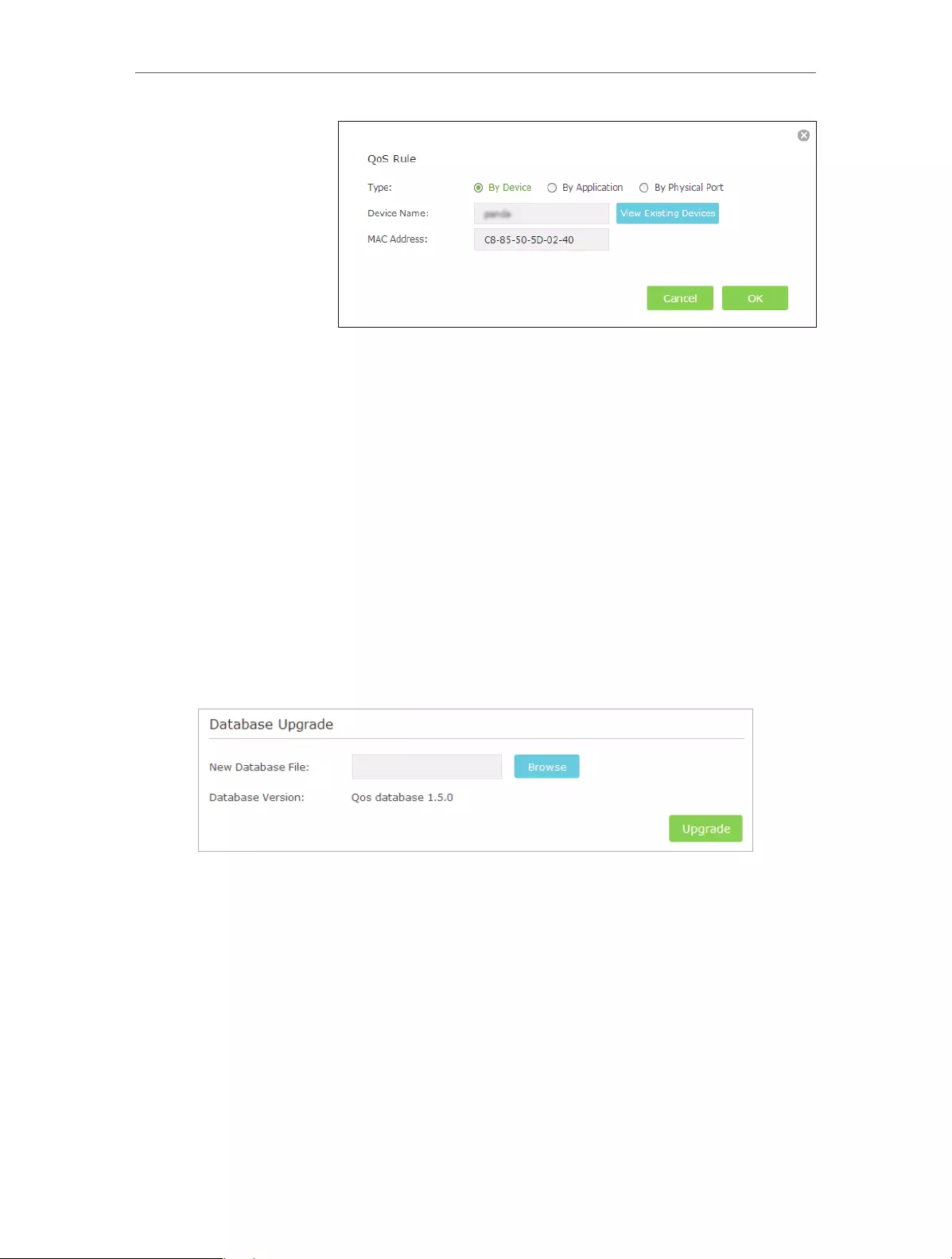
2 ) Set a Middle Priority rule for the phone.
a . Click Add in the Middle Priority section.
b . Select By Device and then click View Existing Devices.
c . Choose the respective device from the list.
d . Click OK.
35
Chapter 7 QoS
7. 2. Update the Database
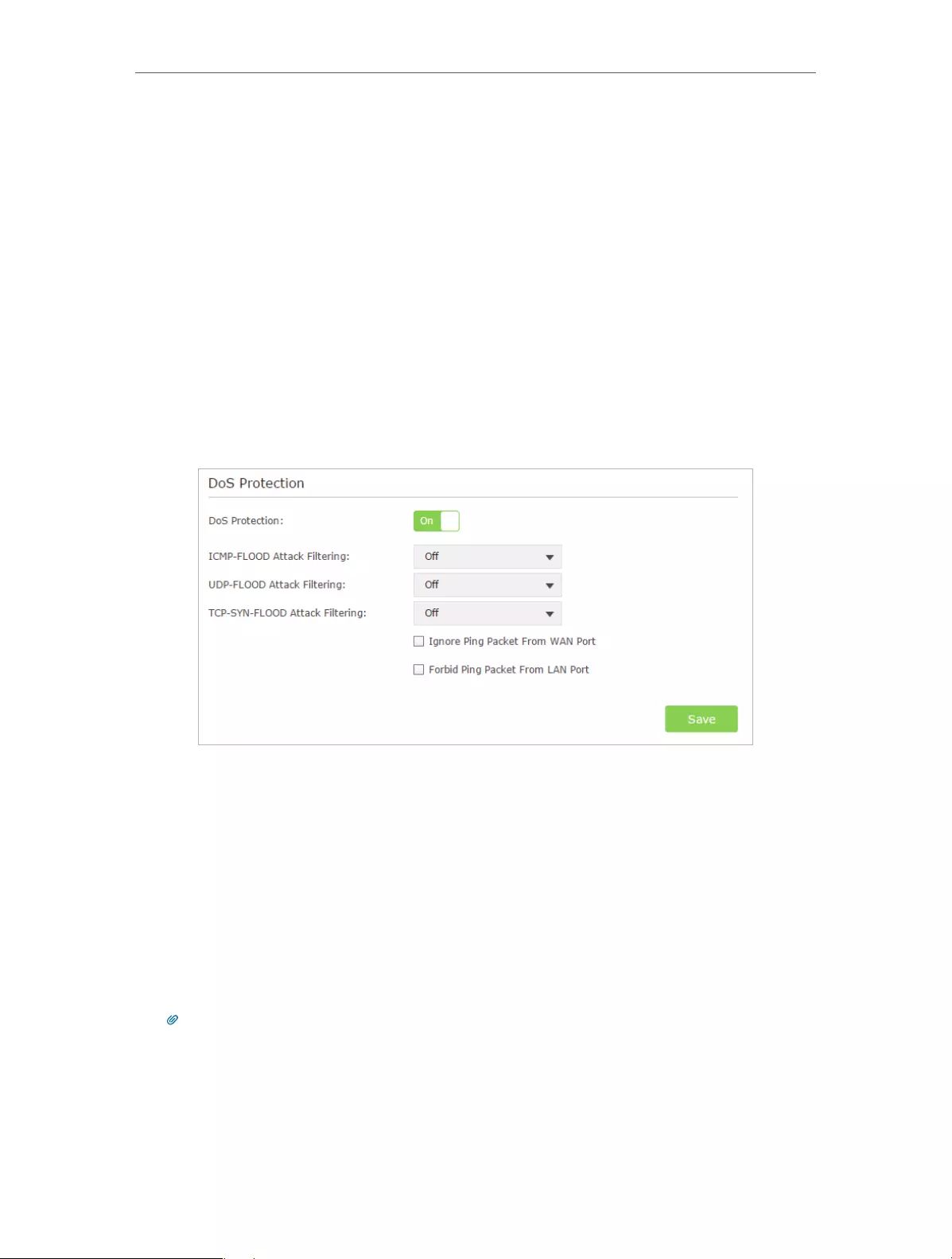
This function can help to add or update the applications of the router supports. If the
applications you need are not listed in the Application list, you can try to download the
new version and upgrade. New database versions are posted at www.tp-link.com and
can be downloaded for free.
1. Download the latest QoS database from our website (www.tp-link.com).
2. Visit http://tplinkwifi.net, and log in with the username and password you set for the
router.
3. Go to Advanced > QoS > Database. Click Browse to select the database upgrade file,
then click Upgrade. Wait until the upgrade is completed and do not operate during
the process.

Chapter 8
Network Security
This chapter guides you on how to protect your home network from cyber attacks
and unauthorized users by implementing these three network security functions. You
can protect your home network against DoS (Denial of Service) attacks from flooding
your network with server requests using DoS Protection, block or allow specific client
devices to access your network using Access Control, or you can prevent ARP spoofing
and ARP attacks using IP & MAC Binding.
This chapter contains the following sections:
• Protect the Network from Cyber Attacks
• Access Control
• IP & MAC Binding
37
Chapter 8 Network Security
8. 1. Protect the Network from Cyber Attacks
The SPI (Stateful Packet Inspection) Firewall and DoS (Denial of Service) Protection
protect the router from cyber attacks.
The SPI Firewall can prevent cyber attacks and validate the traffic that is passing
through the router based on the protocol. This function is enabled by default, and it’s
recommended to keep the default settings.
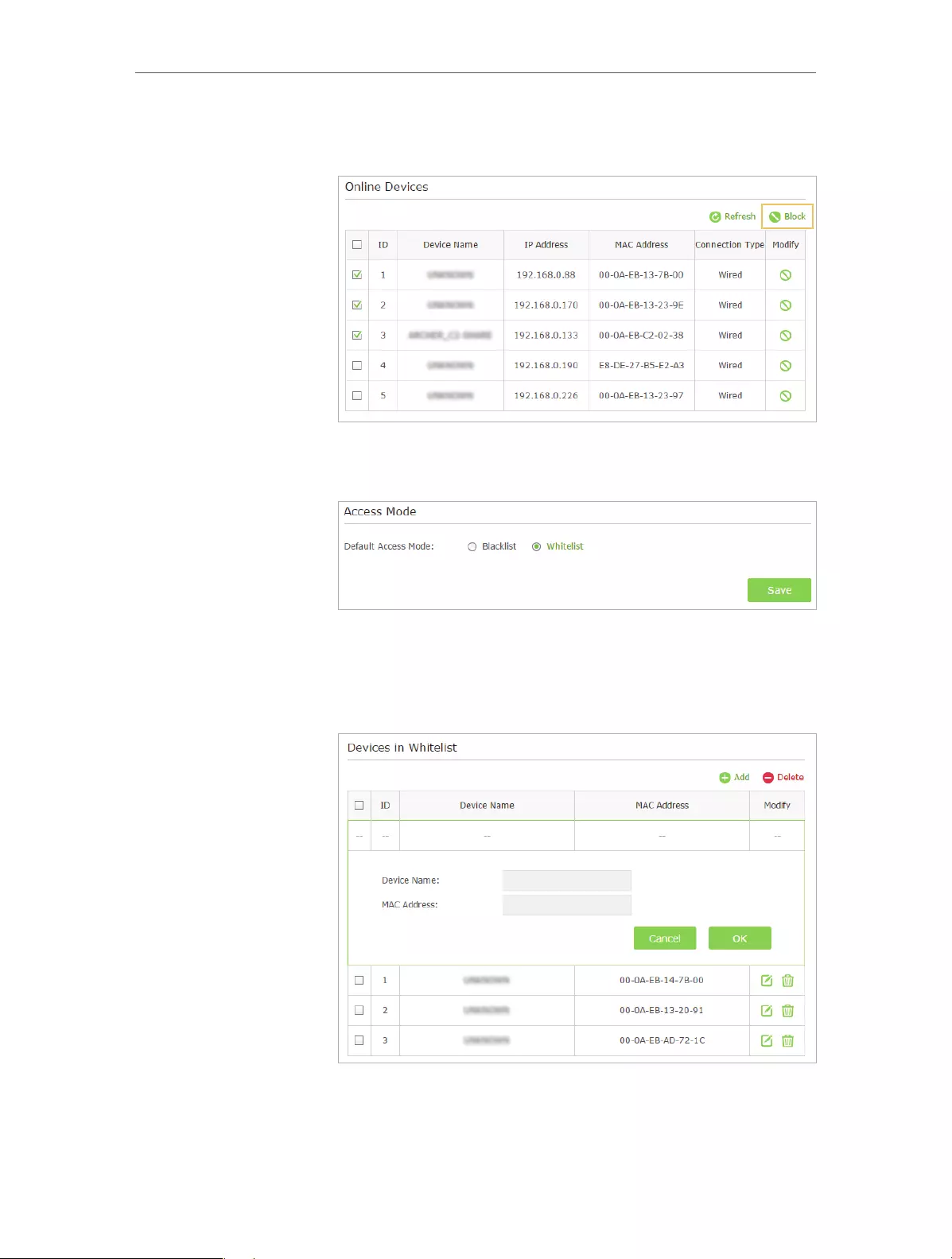
DoS Protection can protect your home network against DoS attacks from flooding your
network with server requests. Follow the steps below to configure DoS Protection.
1. Visit http://tplinkwifi.net, and log in with the username and password you set for
the router.
2. Go to Advanced > Security > Settings.
3. Enable DoS Protection.
4. Set the level (Off, Low, Middle or High) of protection for ICMP-FLOOD Attack
Filtering, UDP-FlOOD Attack Filtering and TCP-SYN-FLOOD Attack Filtering.
• ICMP-FLOOD Attack Filtering — Enable to prevent the ICMP (Internet Control
Message Protocol) flood attack.
• UDP-FlOOD Attack Filtering — Enable to prevent the UDP (User Datagram
Protocol) flood attack.
• TCP-SYN-FLOOD Attack Filtering — Enable to prevent the TCP-SYN (Transmission
Control Protocol-Synchronize) flood attack.
Tips:
The level of protection is based on the number of traffic packets. The protection will be triggered immediately
when the number of packets exceeds the preset threshold value (the value can be set on Advanced > System
Tools > System Parameters > DoS Protection Level Settings), and the vicious host will be displayed in the
Blocked DoS Host List.

38
Chapter 8 Network Security
5. If you want to ignore the ping packets from the WAN port, select Ignore Ping Packet
From WAN Port; if you want to ignore the ping packets form the LAN port, select
Ignore Ping Packet From LAN Port.
6. Click Save.
8. 2. Access Control
Access Control is used to block or allow specific client devices to access your network
(via wired or wireless) based on a list of blocked devices (Blacklist) or a list of allowed
devices (Whitelist).
Block or allow specific client devices to access my network (via
wired or wireless).
1. Visit http://tplinkwifi.net, and log in with the username and
password you set for the router.
2. Go to Advanced > Security > Access Control.
3. Enable Access Control.
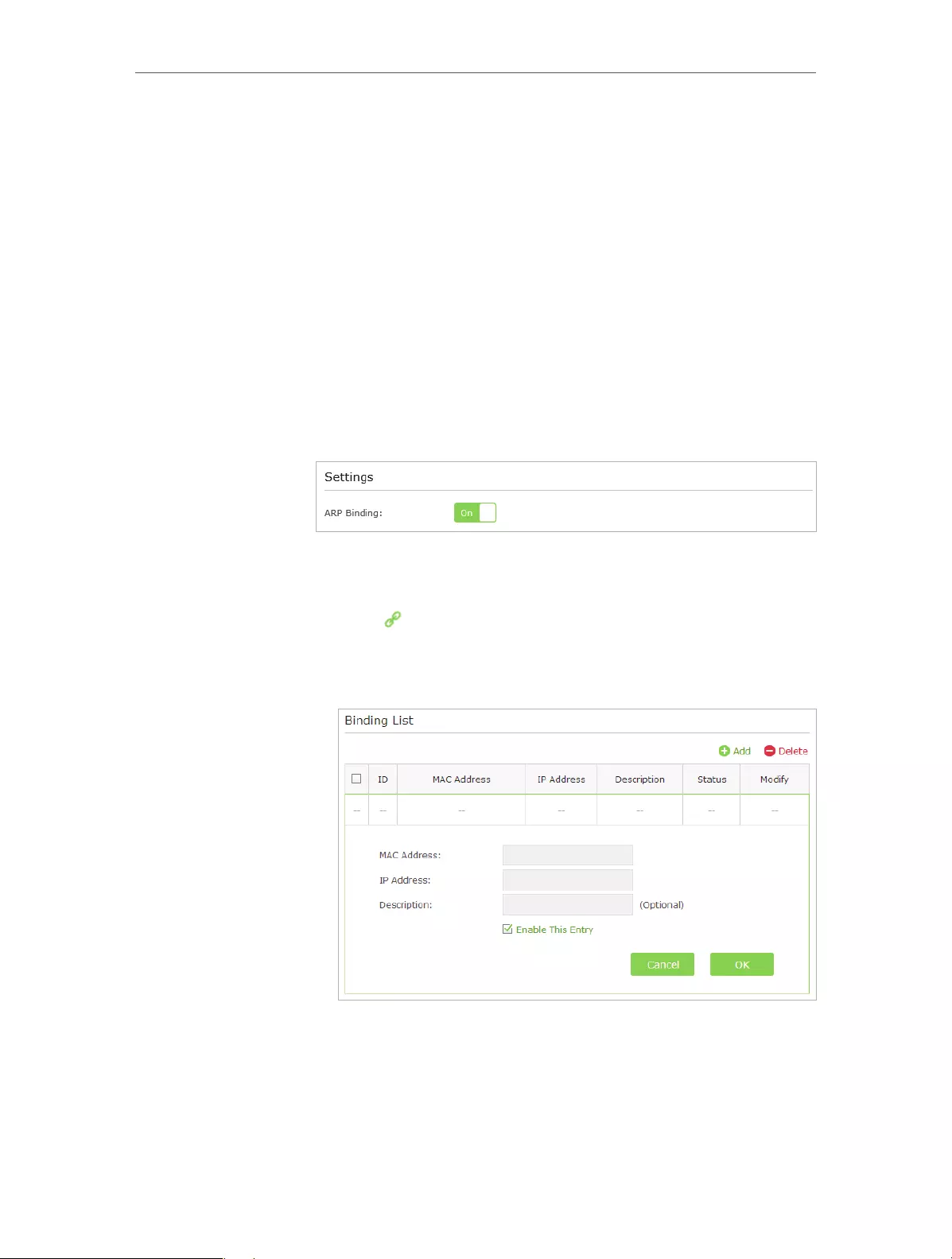
4. Select the access mode to either block (recommended) or
allow the device(s) in the list.
To block specific device(s)
1 ) Select Blacklist and click Save.
2 ) Select the device(s) to be blocked in the Devices Online
table by ticking the box.
I want to:
How can I
do that?
39
Chapter 8 Network Security
3 ) Click Block above the Online Devices table. The selected
devices will be added to Devices in Blacklist automatically.
To allow specific device(s)
1 ) Select Whitelist and click Save.
2 ) Click Add in the Devices in Whitelist section. Enter the
Device Name and MAC Address (You can copy and paste
the information from the Online Devices list if the device
is connected to your network).
3 ) Click OK.
Now you can block or allow specific client devices to access your
network (via wired or wireless) using the Blacklist or Whitelist.
Done!
40
Chapter 8 Network Security
8. 3. IP & MAC Binding
IP & MAC Binding, namely, ARP (Address Resolution Protocol) Binding, is used to bind
network device’s IP address to its MAC address. This will prevent ARP Spoofing and
other ARP attacks by denying network access to an device with matching IP address in
the Binding list, but unrecognized MAC address.
Prevent ARP spoofing and ARP attacks.
1. Visit http://tplinkwifi.net, and log in with the username and
password you set for the router.
2. Go to Advanced > Security > IP & MAC Binding.
3. Enable ARP Binding.
4. Bind your device(s) according to your need.
To bind the connected device(s):
Click to add the corresponding device to the Binding List.
To bind the unconnected device
1 ) Click Add in Binding List section.
2 ) Enter the MAC address and IP address that you want to
bind. Enter a Description for this binding entry.
3 ) Tick the Enable This Entry check box and click OK.
Now you don’t need to worry about ARP spoofing and ARP
attacks!
I want to:
How can I
do that?
Done!

Chapter 9
NAT Forwarding
Router’s NAT (Network Address Translation) feature makes the devices in the LAN
use the same public IP address to communicate on the Internet, which protects the
local network by hiding IP addresses of the devices. However, it also brings about the
problem that external host cannot initiatively communicate with the specified device
in the local network.
With forwarding feature the router can penetrate the isolation of NAT and allows the
external hosts on the Internet to initiatively communicate with the devices in the local
network, thus to realize some special functions.
TP-LINK router includes four forwarding rules. If two or more rules are set, the priority
of implementation from high to low is Virtual Servers, Port Triggering, UPNP and DMZ.
This chapter contains the following sections:
• Share Local Resources on the Internet by Virtual Servers
• Open Ports Dynamically by Port Triggering
• Make Applications Free from Port Restriction by DMZ
• Make Xbox Online Games Run Smoothly by UPnP

42
Chapter 9 NAT Forwarding
9. 1. Share Local Resources on the Internet by Virtual
Servers
When you build up a server in the local network and want to share it on the Internet,
Virtual Servers can realize the service and provide it to the Internet users. At the same
time Virtual Servers can keep the local network safe as other services are still invisible
from the Internet.
Virtual Servers can be used for setting up public services in your local network, such
as HTTP, FTP, DNS, POP3/SMTP and Telnet. Different service uses different service port.
Port 80 is used in HTTP service, port 21 in FTP service, port 25 in SMTP service and port
110 in POP3 service. Please verify the service port number before the configuration.
Share my personal website I’ve built in local network with my
friends through the Internet.
For example, the personal website has been built on my home
PC (192.168.0.100). I hope that my friends on the Internet can
visit my website in some way. The PC is connected to the router
with the WAN IP address 218.18.232.154.
Personal Website
Home
Router
WAN: 218.18.232.154LAN
1. Assign a static IP address to your PC, for example
192.168.0.100.
2. Visit http://tplinkwifi.net, and log in with the username and
password you set for the router.
3. Go to Advanced > NAT Forwarding > Virtual Servers.
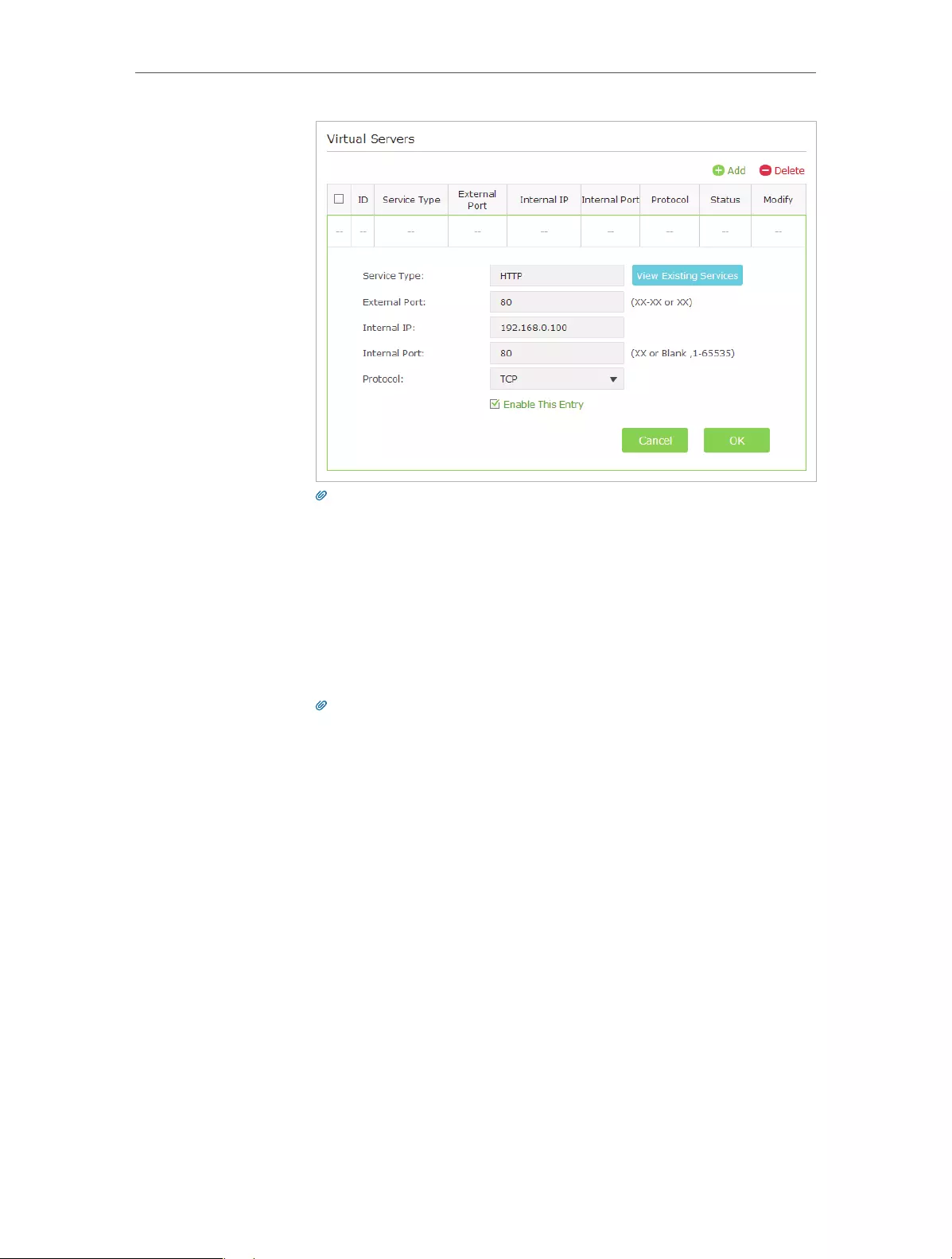
4. Click Add. Click View Existing Services and select HTTP. The
External Port, Internal Port and Protocol will be automatically
filled with contents. Enter the PC’s IP address 192.168.0.100
into the Internal IP field.
5. Click OK.
I want to:
How can I
do that?
INTERNET
43
Chapter 9 NAT Forwarding
Tips:
1. It is recommended to keep the default settings of Internal Port and Protocol if you
are not clear about which port and protocol to use.
2. If the service you want to use is not in the Service Type, you can enter the
corresponding parameters manually. You should verify the port number that the
service needs.
3. You can add multiple virtual server rules if you want to provide several services in
a router. Please note that the External Port should not be overlapped.
Users on the Internet can enter http:// WAN IP (in this example:
http:// 218.18.232.154) to visit your personal website.
Tips:
1. WAN IP should be a public IP address. For the WAN IP is assigned dynamically by
ISP, it is recommended to apply and register a domain name for the WAN referring
to Set Up a Dynamic DNS Service Account. Then users on the Internet can use
http:// domain name to visit the website.
2. If you have changed the default External Port, you should use
http:// WAN IP: External Port or http:// domain name: External Port to visit the
website.
9. 2. Open Ports Dynamically by Port Triggering
Port Triggering can specify a triggering port and its corresponding external ports.
When a host in the local network initiates a connection to the triggering port, all the
external ports will be opened for subsequent connections. The router can record the IP
address of the host, when the data from the Internet return to the external ports, the
router can forward them to the corresponding host. Port Triggering is mainly applied to
online games, VoIPs, video players and common applications including MSN Gaming
Zone, Dialpad and Quick Time 4 players, etc.
Follow the steps below to configure the Port Triggering rules:
Done!
44
Chapter 9 NAT Forwarding
1. Visit http://tplinkwifi.net, and log in with the username and password you set for the
router.
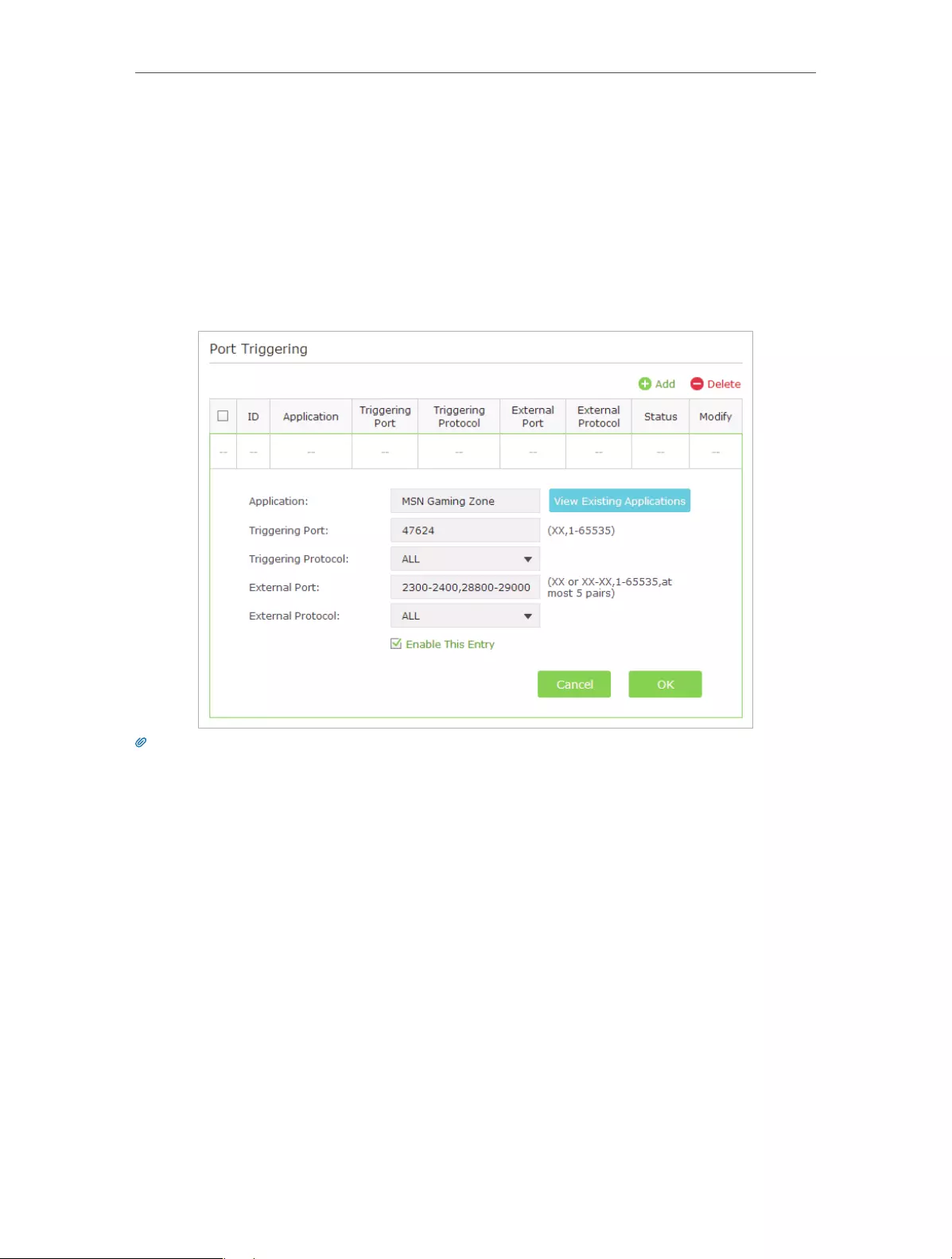
2. Go to Advanced > NAT Forwarding > Port Triggering and click Add.
3. Click View Existing Applications, and select the desired application. The External Port,
Internal Port and Protocol will be automatically filled with contents. The following
picture takes application MSN Gaming Zone as an example.
4. Click OK.
Tips:
1. You can add multiple port triggering rules according to your network need.
2. The triggering ports can not be overlapped.
3. If the application you need is not listed in the Existing Applications list, please enter the parameters manually.
You should verify the external ports the application uses first and enter them into External Port field according
to the format the page displays.
9. 3. Make Applications Free from Port Restriction by
DMZ
When a PC is set to be a DMZ (Demilitarized Zone) host in the local network, it is totally
exposed to the Internet, which can realize the unlimited bidirectional communication
between internal hosts and external hosts. The DMZ host becomes a virtual server with
all ports opened. When you are not clear about which ports to open in some special
applications, such as IP camera and database software, you can set the PC to be a DMZ
host.
45
Chapter 9 NAT Forwarding
Note:
When DMZ is enabled, the DMZ host is totally exposed to the Internet, which may bring some potential safety
hazards. If DMZ is not in use, please disable it in time.
Make the home PC join the Internet online game without port
restriction.
For example, due to some port restriction, when playing the
online games, you can login normally but cannot join a team
with other players. To solve this problem, set your PC as a DMZ
with all ports opened.
1. Assign a static IP address to your PC, for example
192.168.0.100.
2. Visit http://tplinkwifi.net, and log in with the username and
password you set for the router.
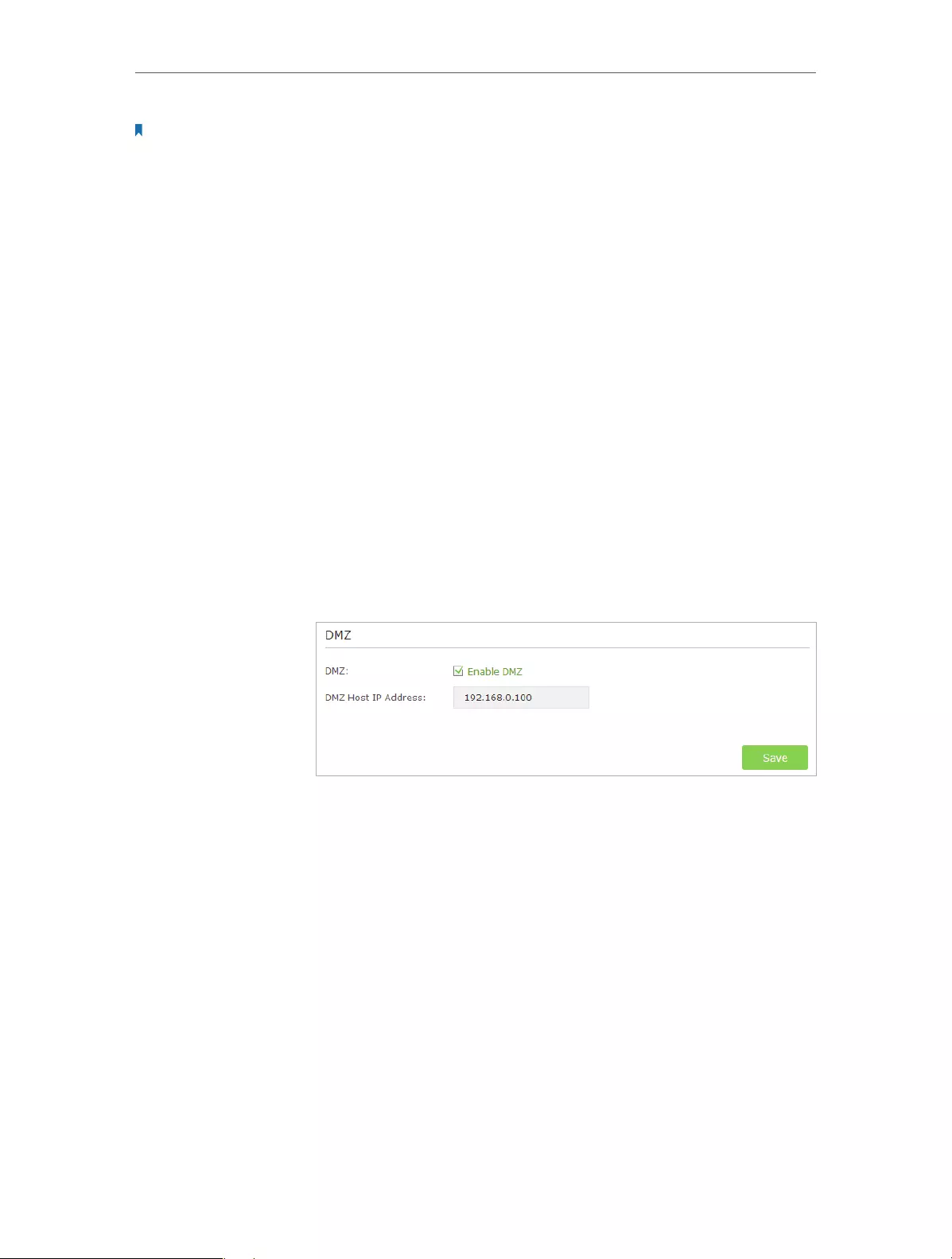
3. Go to Advanced > NAT Forwarding > DMZ and select Enable
DMZ.
4. Enter the IP address 192.168.0.100 in the DMZ Host IP
Address filed.
5. Click Save.
The configuration is completed. You’ve set your PC to a DMZ
host and now you can make a team to game with other players.
9. 4. Make Xbox Online Games Run Smoothly by UPnP
UPnP (Universal Plug and Play) protocol allows the applications or host devices
to automatically find the front-end NAT device and send request to it to open the
corresponding ports. With UPnP enabled, the applications or host devices on the
local network or the Internet can freely communicate with each other realizing the
seamless connection of the network. You may need to enable the UPnP if you want
to use applications for multiplayer gaming, peer-to-peer connections, real-time
communication (such as VoIP or telephone conference) or remote assistance, etc.
I want to:
How can I
do that?
Done!
46
Chapter 9 NAT Forwarding
Tips:
1. UPnP is enabled by default in this router.
2. Only the application supporting UPnP protocol can use this feature.
3. UPnP feature needs the support of operating system (e.g. Windows Vista/ Windows 7/ Windows 8, etc. Some of
operating system need to install the UPnP components).
For example, when you connect your Xbox to the router which has connected to
the Internet to play online games, UPnP will send request to the router to open the
corresponding ports allowing the following data penetrating the NAT to transmit.
Therefore, you can play Xbox online games without a hitch.
XBOX Router
INTERNET
LAN WAN
If necessary, you can follow the steps to change the status of UPnP.
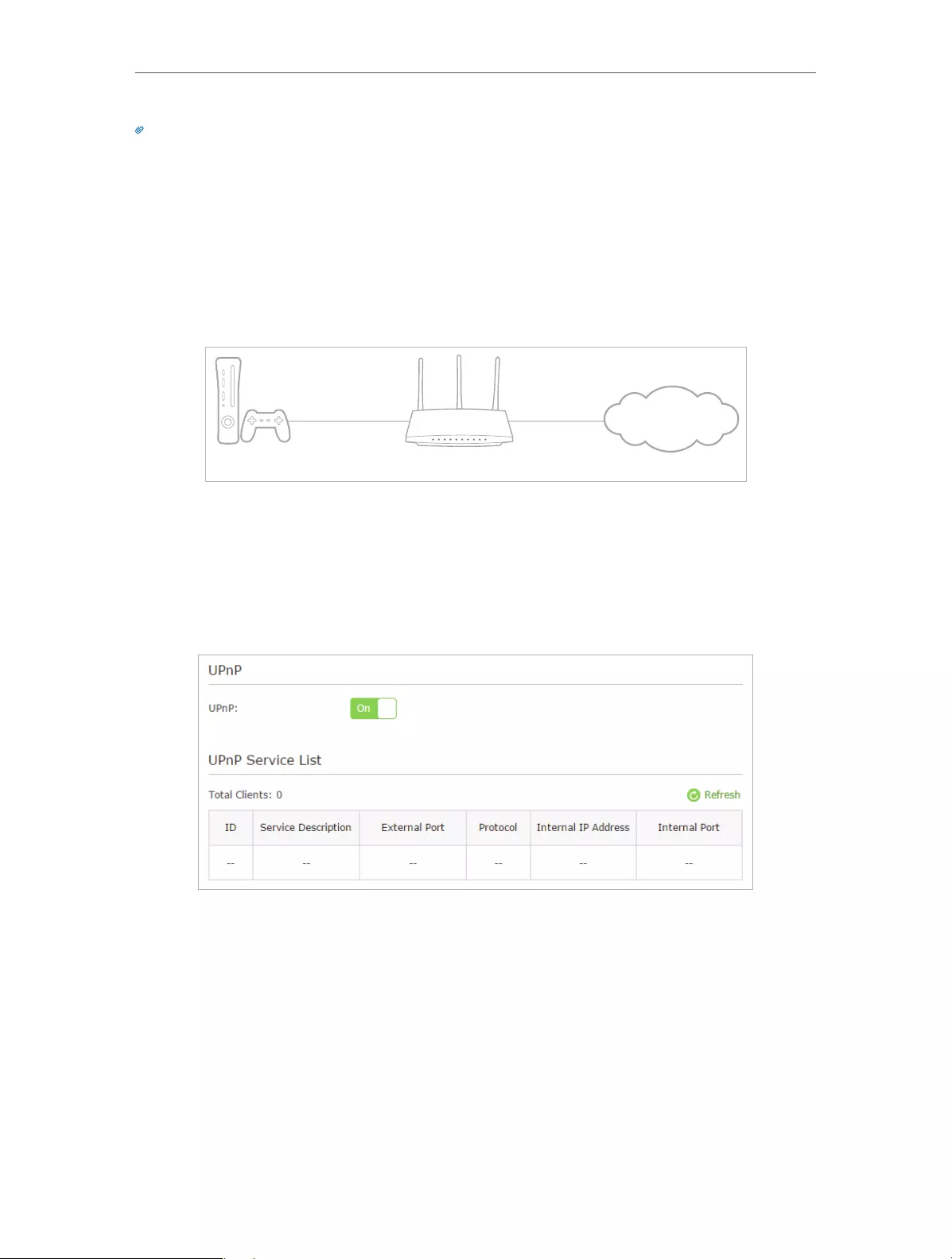
1. Visit http://tplinkwifi.net, and log in with the username and password you set for the
router.
2. Go to Advanced > NAT Forwarding > UPnP and toggle on or off according to your
needs.

Chapter 10
Customize Your Network
Settings
This chapter guides you on how to configure advanced network features.
This chapter contains the following sections:
• Change the LAN Settings
• Configure to Support IPTV Service
• Specify DHCP Server Settings
• Set Up a Dynamic DNS Service Account
• Create Static Routes
• Specify Wireless Settings
• Use WPS for Wireless Connection
• Schedule Your Wireless Function
48
Chapter 10 Customize Your Network Settings
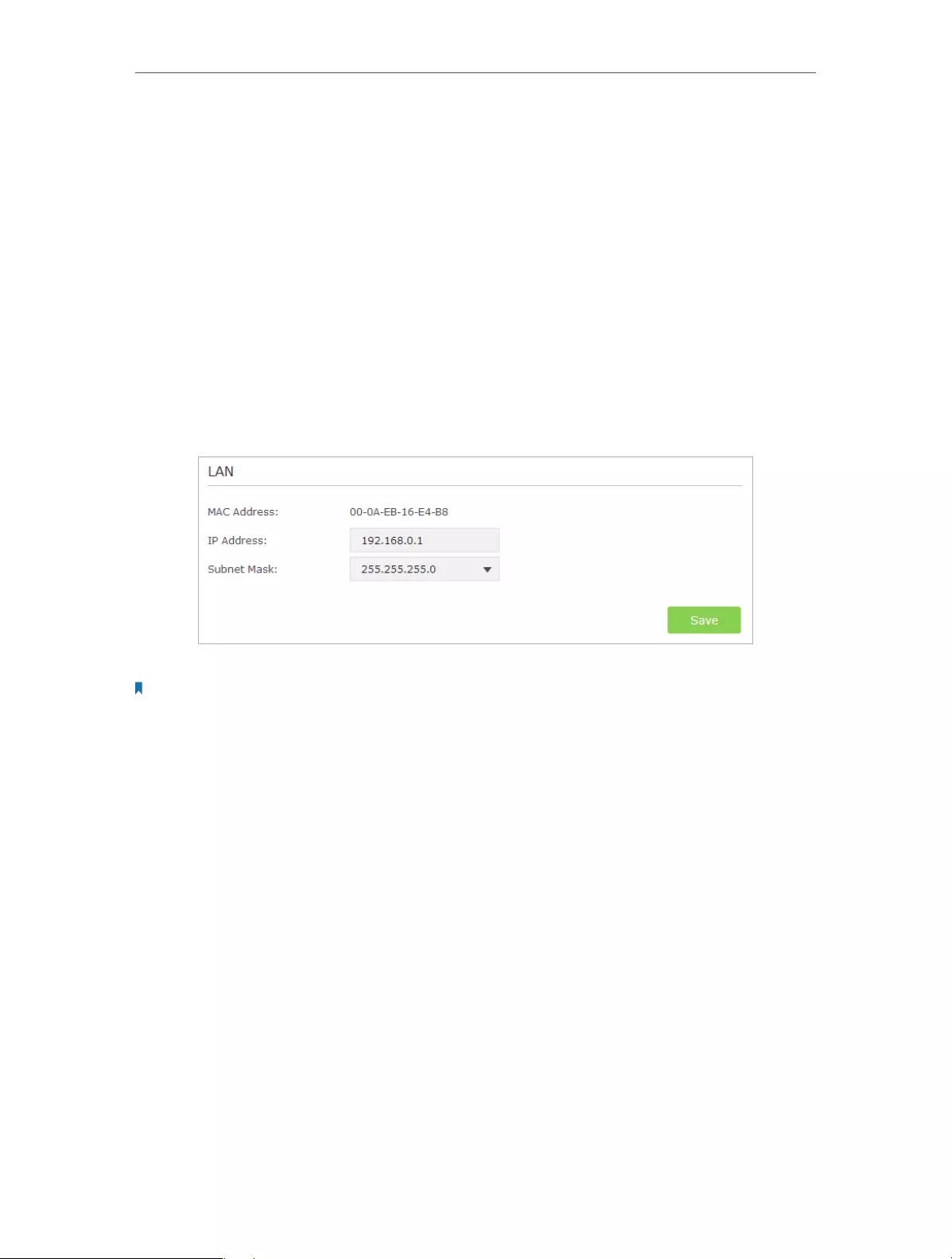
10. 1. Change the LAN Settings
The router is preset with a default LAN IP 192.168.0.1, which you can use to log in to
its web management page. The LAN IP address together with the Subnet Mask also
defines the subnet that the connected devices are on. If the IP address conflicts with
another device on your local network or your network requires a specific IP subnet, you
can change it.
1. Visit http://tplinkwifi.net, and log in with the username and password you set for the
router.
2. Go to Advanced > Network > LAN.
3. Type in a new IP Address appropriate to your needs. And leave the Subnet Mask as
the default settings.
4. Click Save.
Note:
If you have set the Virtual Server, DMZ or DHCP address reservation, and the new LAN IP address is not in the same
subnet with the old one, then you should reconfigure these features.
10. 2. Configure to Support IPTV Service
Configure IPTV setup to enable Internet/IPTV/Phone service
provided by my Internet Service Provider (ISP).
1. Visit http://tplinkwifi.net, and log in with the username and
password you set for the router.
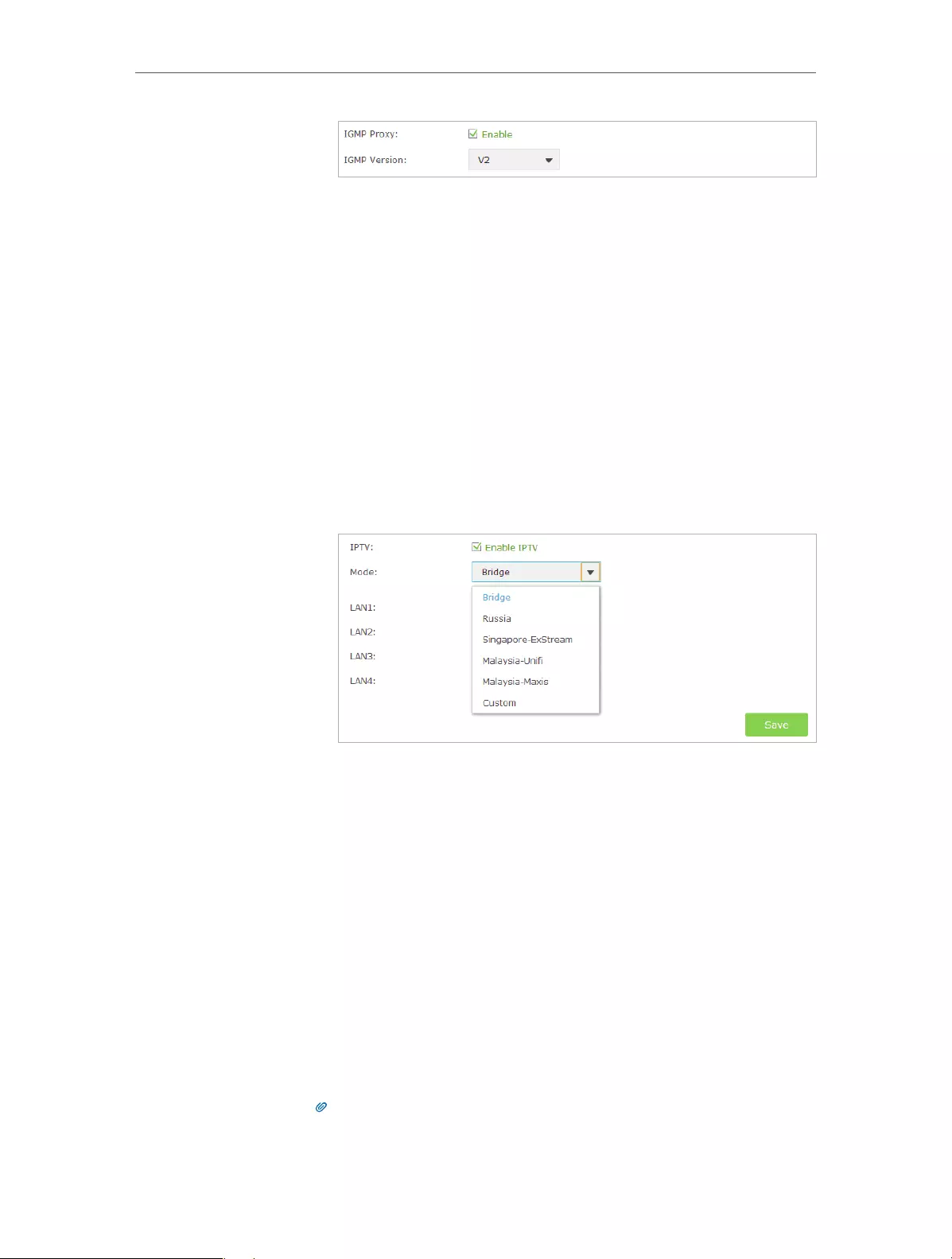
2. Go to Advanced > Network > IPTV.
3. If your ISP provides the networking service based on IGMP
technology, e.g., British Telecom(BT) and Talk Talk in UK:
1 ) Tick the IGMP Proxy checkbox and select the IGMP
Version, either V2 or V3, as required by your ISP.
I want to:
How can
I do that?
49
Chapter 10 Customize Your Network Settings
2 ) Click Save.
3 ) After configuring IGMP proxy, IPTV can work behind your
router now. You can connect your set-top box to any of
the router’s Ethernet port.
If IGMP is not the technology your ISP applies to provide
IPTV service:
1 ) Tick Enable IPTV.
2 ) Select the appropriate Mode according to your ISP.
• Select Bridge if your ISP is not listed and no other
parameters are required, and then skip to Step 4.
• Select Custom if your ISP is not listed but provides
necessary parameters.
3 ) After you have selected a mode, the necessary parameters
are predetermined. You can perform other configuration,
e.g. enter the IPTV Multicast VLAN ID and select the IPTV
Multicast VLAN Priority in Russia mode according to your
ISP.
4 ) For Russia, Singapore-ExStream, Malaysia-Unifi and
Malaysia-Maxis mode, connect the set-top box to the
predetermined LAN port. For Bridge and Custom mode,
select the LAN type and connect the set-top box to the
corresponding port.
5 ) Click Save.
Your IPTV setup is done now! You may need to configure your
set-top box before enjoying your TV.
Tips
Qos and IPTV cannot be enabled at the same time.
Done!
50
Chapter 10 Customize Your Network Settings
10. 3. Specify DHCP Server Settings
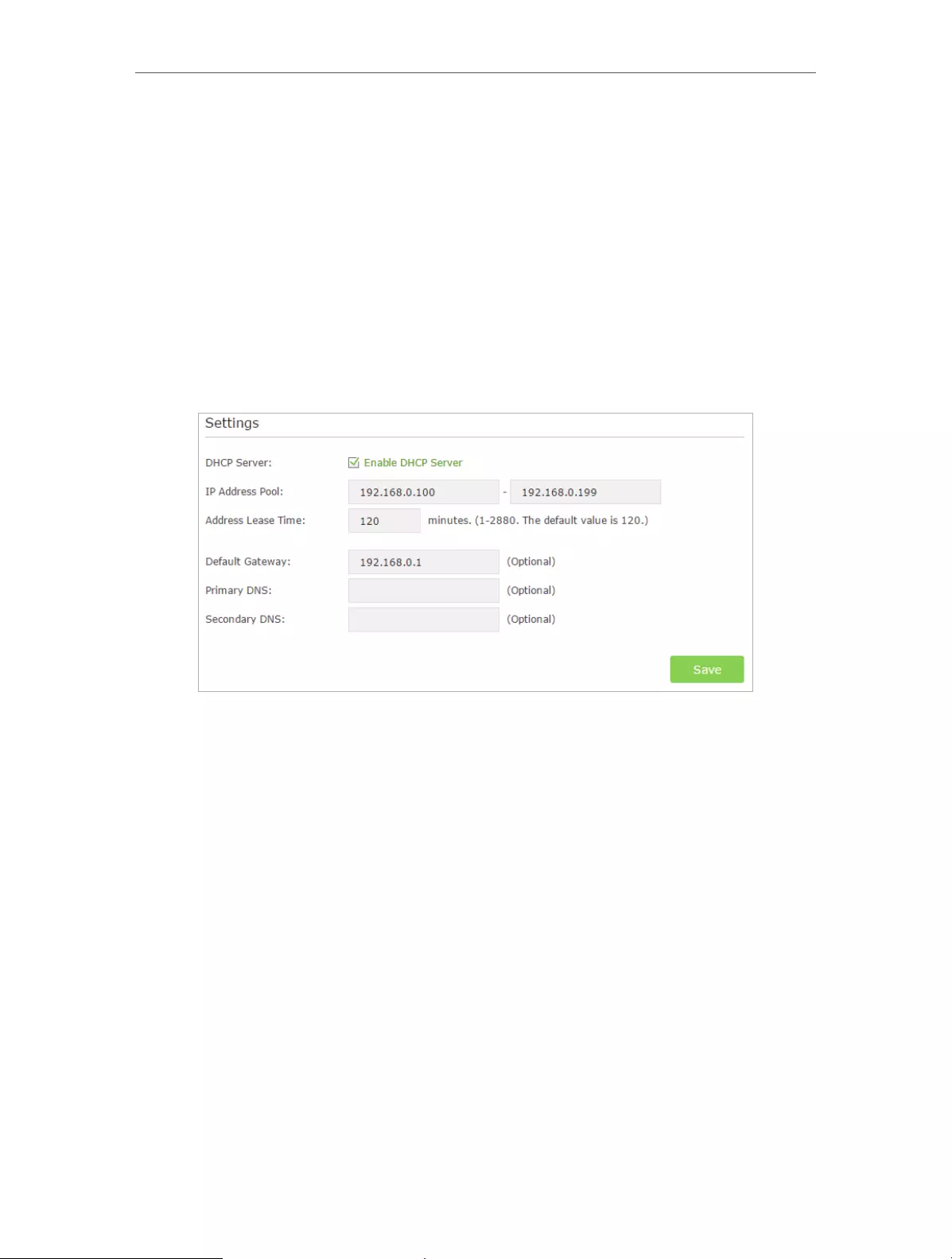
By default, the DHCP (Dynamic Host Configuration Protocol) Server is enabled and the
router acts as a DHCP server; it dynamically assigns TCP/IP parameters to client devices
from the IP Address Pool. You can change the settings of the DHCP Server if necessary,
and you can reserve LAN IP addresses for specified client devices.
1. Visit http://tplinkwifi.net, and log in with the username and password you set for the
router.
2. Go to Advanced > Network > DHCP Server.
¾To specify the IP address that the router assigns:
1. Make sure that the Enable DHCP Server checkbox is selected.
2. Enter the starting and ending IP addresses in the IP Address Pool.
3. Enter other parameters if the ISP offers, the Default Gateway is automatically filled
and is the same as the LAN IP address of the router.
4. Click Save.
¾To reserve an IP address for a specified client device:
1. Click Add in the Address Reservation section.

51
Chapter 10 Customize Your Network Settings
2. Click View Exsiting Devices or enter the MAC address of the client device.
3. Enter the IP address to reserve for the client device.
4. Enter the Description for this entry.
5. Tick the Enable This Entry checkbox and click OK.
10. 4. Set Up a Dynamic DNS Service Account
Most ISPs assign a dynamic IP address to the router and you can use this IP address
to access your router remotely. However, the IP address can change any time and
you don’t know when it changes. In this case, you might apply the DDNS (Dynamic
Domain Name Server) feature on the router to allow you and your friends to access
your router and local servers (FTP, HTTP, etc.) using domain name without checking and
remembering the IP address.
Note:
DDNS does not work if the ISP assigns a private WAN IP address (such as 192.168.1.x) to the router.
To set up DDNS, please follow the instructions below:
1. Visit http://tplinkwifi.net, and log in with the username and password you set for the
router.
2. Go to Advanced > Network > Dynamic DNS.
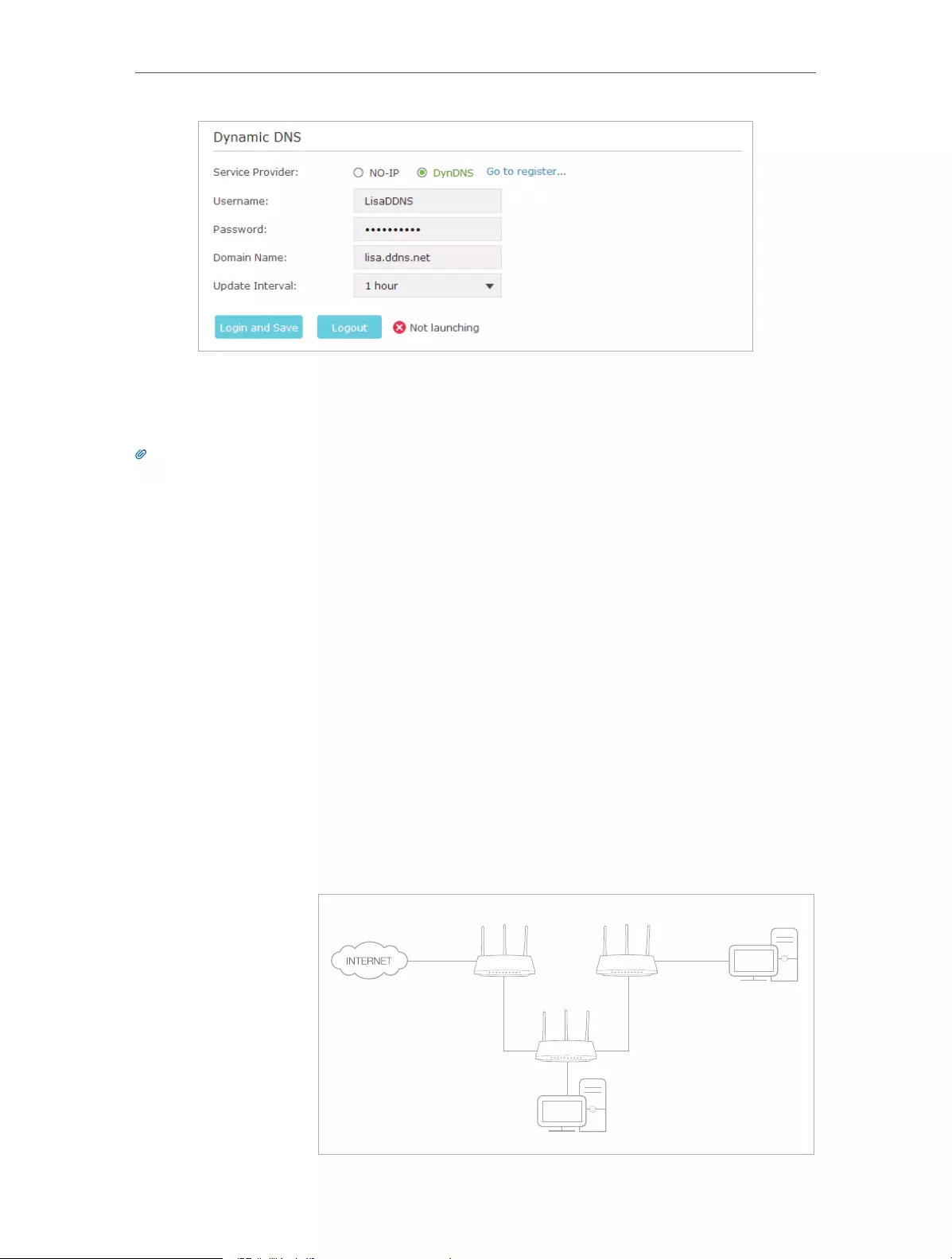
3. Select the DDNS Service Provider (NO-IP or DynDNS). If you don’t have a DDNS
account, select a service provider and click Go to register.
52
Chapter 10 Customize Your Network Settings
4. Enter the username, password and domain name of the account (such as
lisadns.ddns.net).
5. Click Login and Save.
Tips:
If you want to use a new DDNS account, please logout first, and then login with the new account.
10. 5. Create Static Routes
Static routing is a form of routing that is configured manually by a network administrator
or a user by adding entries into a routing table. The manually-configured routing
information guides the router in forwarding data packets to the specific destination.
Visit multiple networks and servers at the same time.
For example, in a small office, my PC can surf the Internet, but
I also want to visit my company’s network. Now I have a switch
and another router. I connect the devices as shown in the
following figure so that the physical connection between my
PC and my company’s server is established. To surf the Internet
and visit my company’s network at the same time, I need to
configure the static routing.
PC 1
PC 2
Router 2
Router 1
Router 3
LAN: 192.168.0.1
192.168.0.100
LAN: 192.168.0.2
WAN: 172.30.30.100
172.30.30.1
I want to:
53
Chapter 10 Customize Your Network Settings
1. Change the router’s LAN IP addresses to two different IP
addresses on the same subnet. Disable Router 2’s DHCP
function.
2. Visit http://tplinkwifi.net, and log in with the username and
password you set for the router.
3. Go to Network > Advanced Routing.
4. Click Add and finish the settings according to the following
explanations:
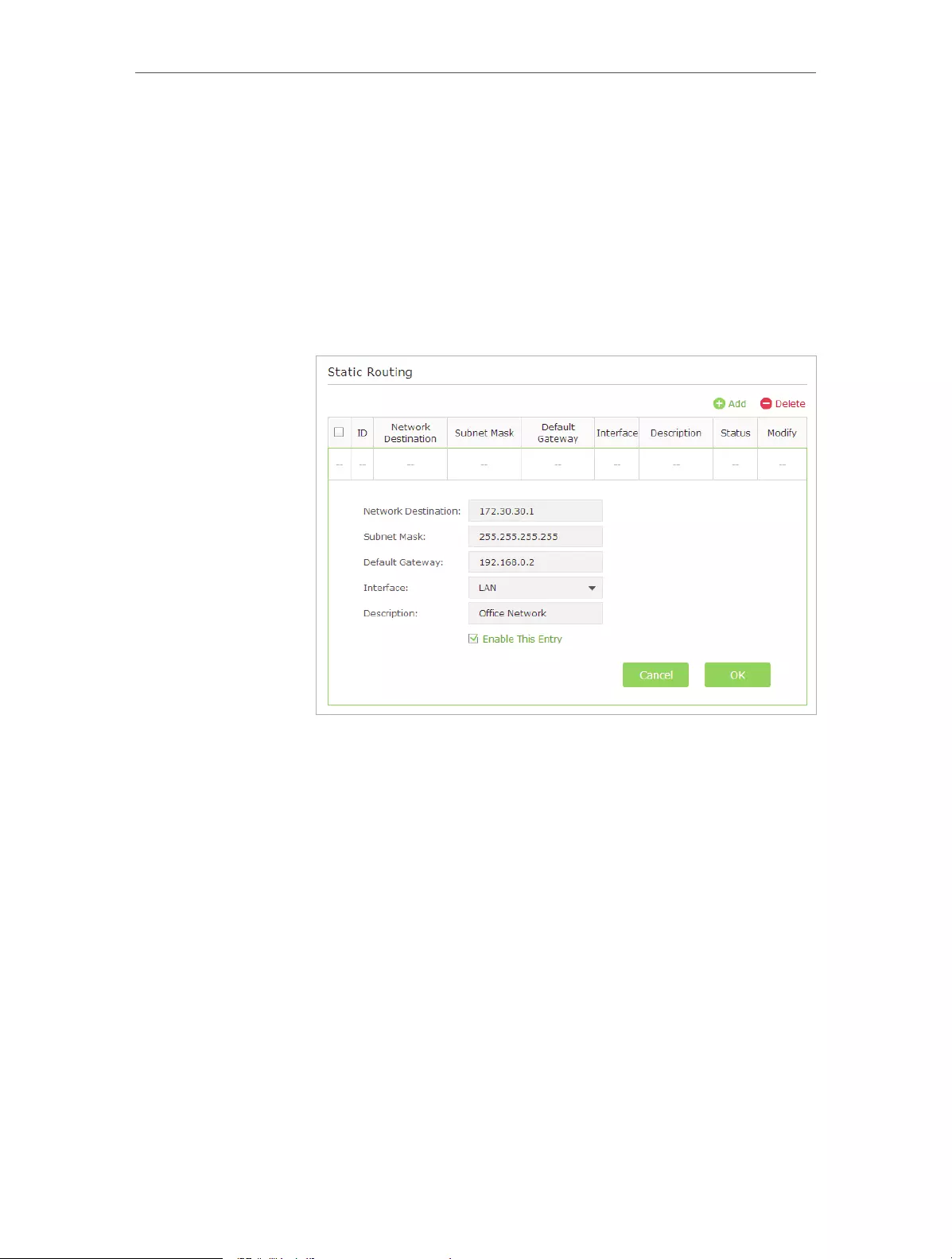
Network Destination: The destination IP address that you want
to assign to a static route. This IP address cannot be on the same
subnet with the WAN IP or LAN IP of the router. In the example,
the IP address of the company network is the destination IP
address, so here enter 172.30.30.1.
Subnet Mask: Determines the destination network with the
destination IP address. If the destination is a single IP address,
enter 255.255.255.255; otherwise, enter the subnet mask of
the corresponding network IP. In the example, the destination
network is a single IP, so here enter 255.255.255.255.
Default Gateway: The IP address of the gateway device to which
the data packets will be sent. This IP address must be on the
same subnet with the router’s IP which sends out data. In the
example, the data packets will be sent to the LAN port of Router
2 and then to the Server, so the default gateway should be
192.168.0.2.
How can
I do that?
54
Chapter 10 Customize Your Network Settings
Interface: Determined by the port (WAN/LAN) that sends out
data packets. In the example, the data are sent to the gateway
through the LAN port, so LAN should be selected.
Description: Enter a description for this static routing entry.
5. Click OK.
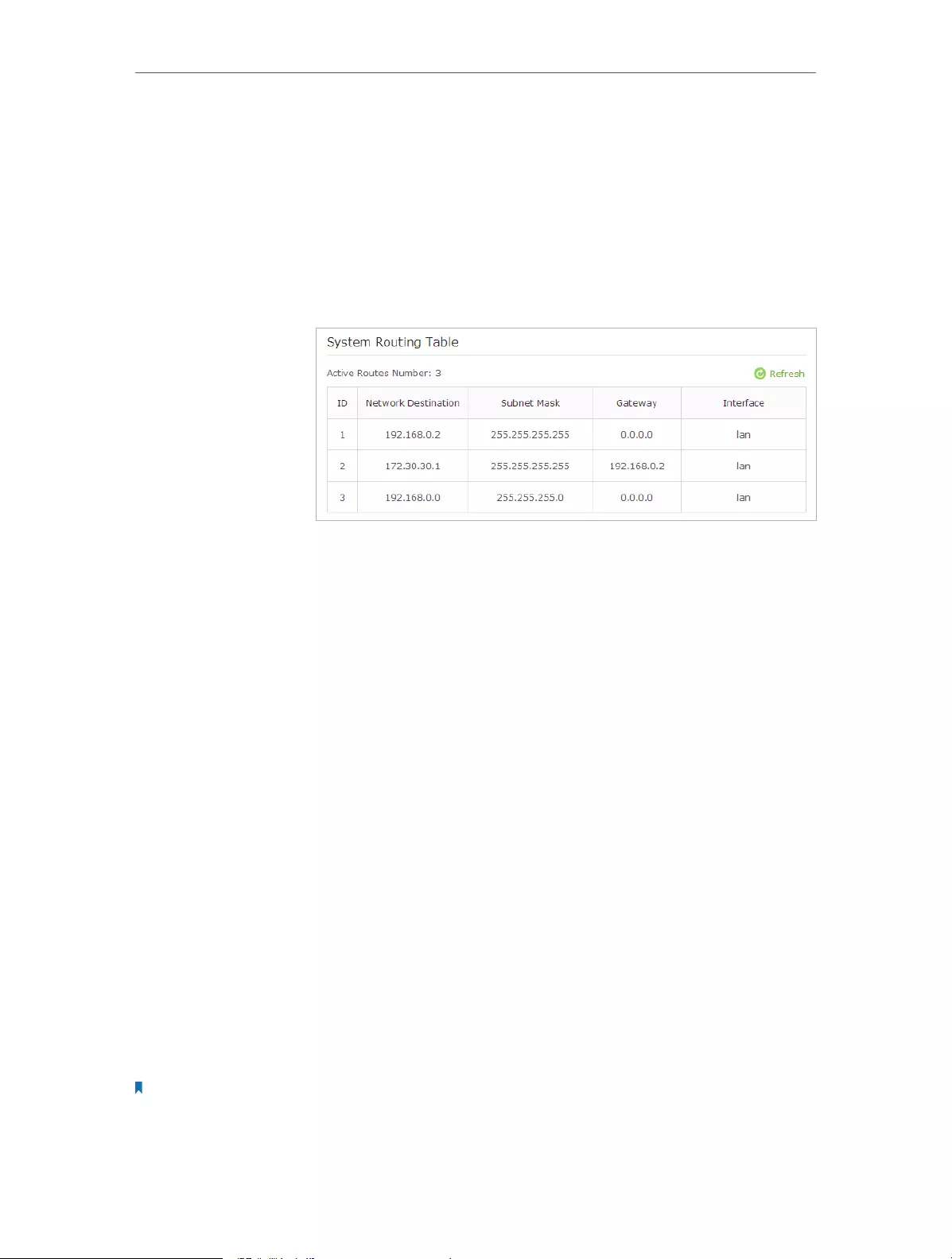
6. Check the System Routing Table below. If you can find the
entry you’ve set, the static routing is set successfully.
Open a web browser on your PC. Enter the company server’s IP
address to visit the company network.
10. 6. Specify Wireless Settings
The router’s wireless network name (SSID) and password, and security option are preset
in the factory. The preset SSID and password can be found on the label of the router.
You can customize the wireless settings according to your needs.
Visit http://tplinkwifi.net, and log in with the username and password you set for the
router.
¾To enable or disable the wireless function:
1. Go to Basic > Wireless.
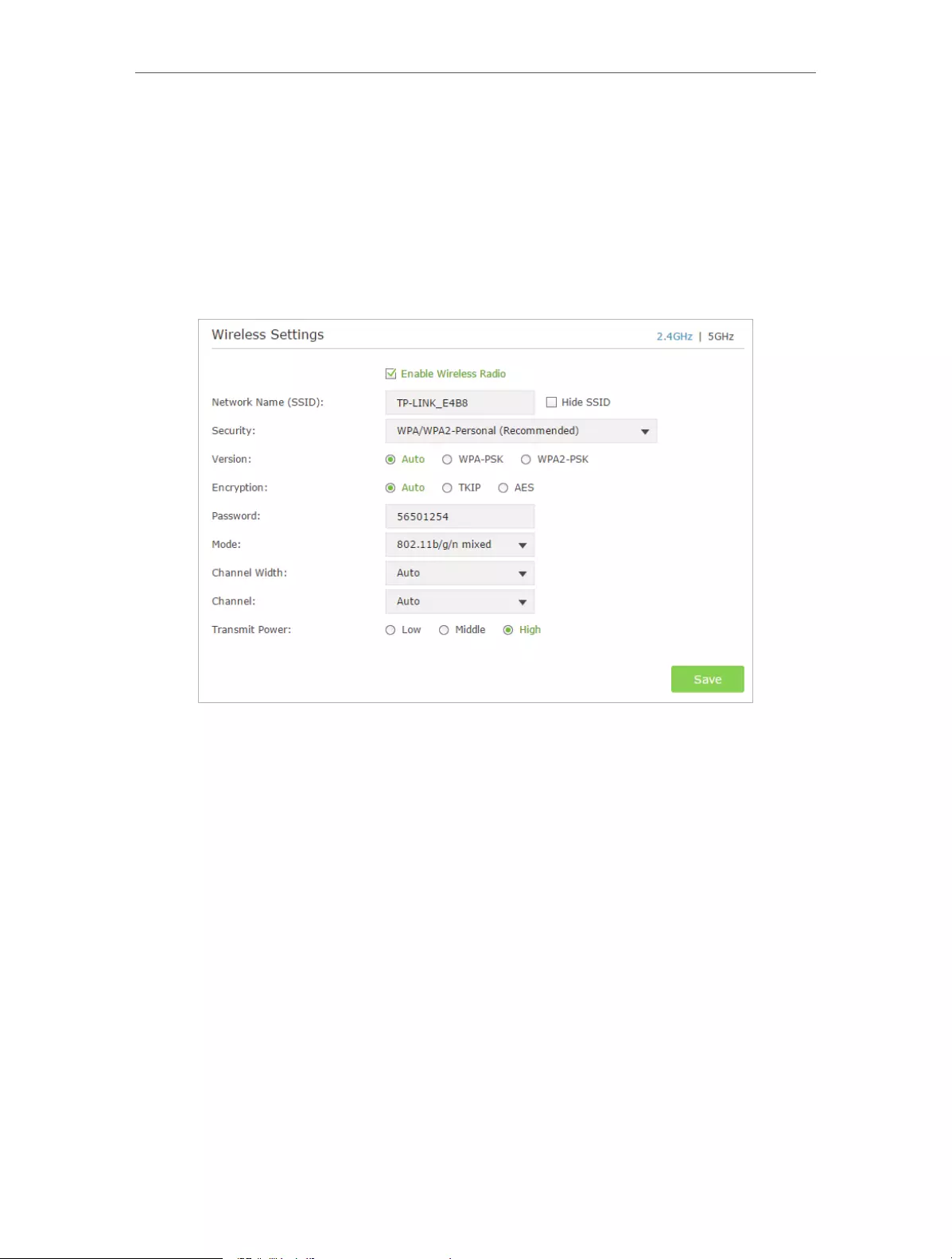
2. The wireless radio is enabled by default, if you want to disable the wireless function of
the router, just clear the Enable Wireless Radio checkbox. In this case, all the wireless
settings will be invalid.
¾To change the wireless network name (SSID) and wireless password:
1. Go to Basic > Wireless.
2. Create a new SSID in Network Name (SSID) and customize the password for the
network in Password. The value is case-sensitive.
Note:
If you change the wireless settings with a wireless device, you will be disconnected when the settings are effective.
Please write down the new SSID and password for future use.
Done!
55
Chapter 10 Customize Your Network Settings
¾To hide SSID:
1. Go to Basic > Wireless.
2. Select Hide SSID, and your SSID won’t display when you scan for local wireless
networks on your wireless device and you need to manually join the network.
¾To change the security option:
1. Go to Advanced > Wireless > Wireless Settings.
2. Select the wireless network 2.4GHz or 5GHz.
3. Select an option from the Security drop-down list. We recommend you don’t change
the default settings unless necessary. If you select other options, configure the
related parameters according to the help page.
In addition
• Mode — Select a transmission mode according to your wireless client devices. It is
recommended to just leave it as default.
• Channel Width — Select a channel width (bandwidth) for the wireless network.
• Channel — Select an operating channel for the wireless network. It is recommended
to leave the channel to Auto, if you are not experiencing the intermittent wireless
connection issue.
• Transmit Power — Select either High, Middle or Low to specify the data transmit power.
The default and recommended setting is High.
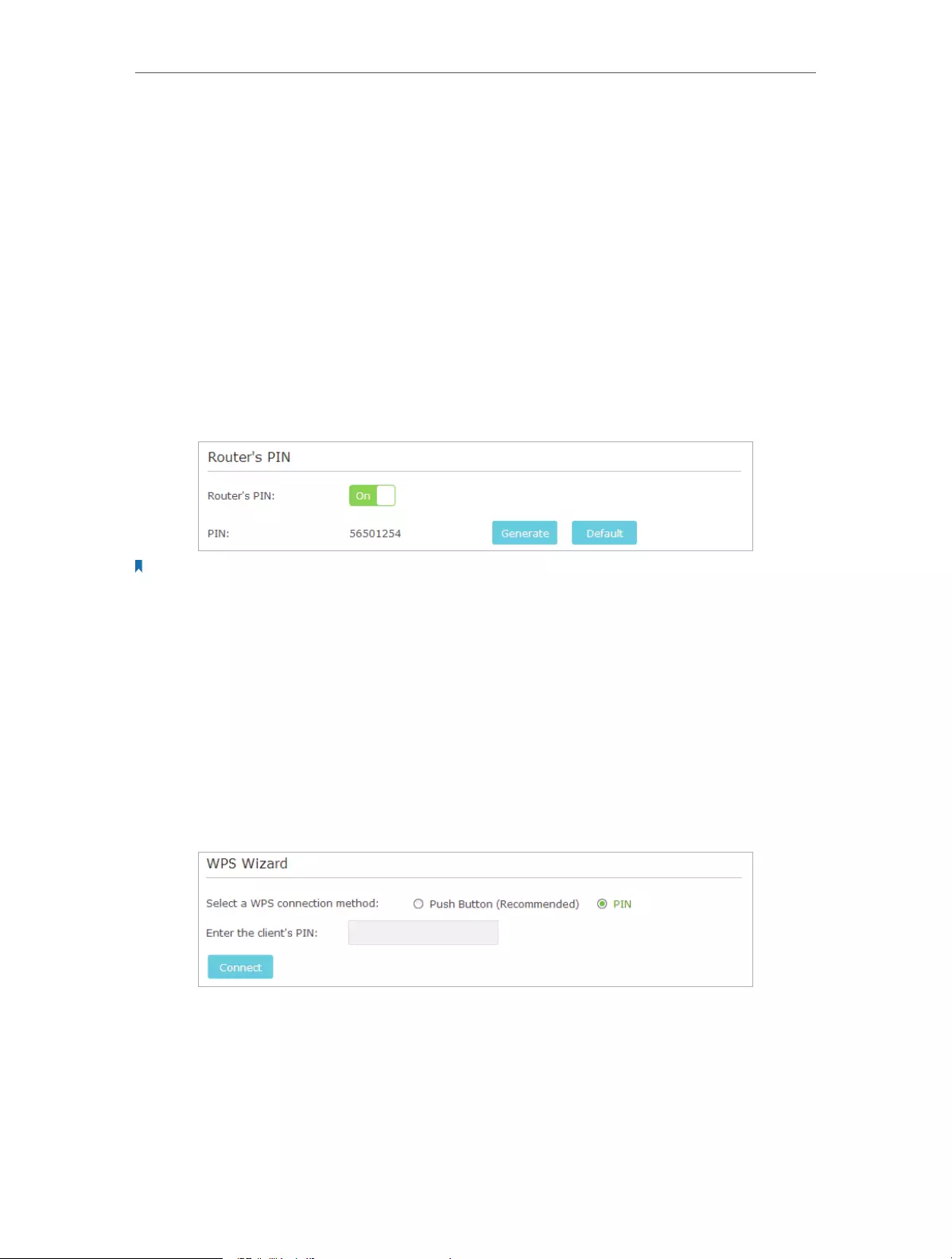
56
Chapter 10 Customize Your Network Settings
10. 7. Use WPS for Wireless Connection
Wi-Fi Protected Setup (WPS) provides an easier approach to set up a security-protected
Wi-Fi connection.
1. Visit http://tplinkwifi.net, and log in with the username and password you set for the
router.
2. Go to Advanced > Wireless > WPS .
10. 7. 1. Set the Router’s PIN
Router’s PIN is enabled by default to allow wireless devices to connect to the router
using the PIN. You can use the default one or generate a new one.
Note:
1. If you want to enable/disable the WPS feature, go to System Tools > System Parameters > WPS, select or clear the
Enable WPS check box.
2. PIN (Personal Identification Number) is an eight-character identification number preset to each router. WPS
supported devices can connect to your router with the PIN. The default PIN is printed on the label of the router.
10. 7. 2. Use the WPS Wizard for Wi-Fi Connections
1. Select a setup method:
• Push Button(Recommended): Click Connect on the screen. Within two
minutes, press the WPS button on the client device.
• PIN: Enter the client’s PIN, and click Connect.
2. Success will appear on the above screen and the WPS LED on the router will keep on
for five minutes if the client has been successfully added to the network.
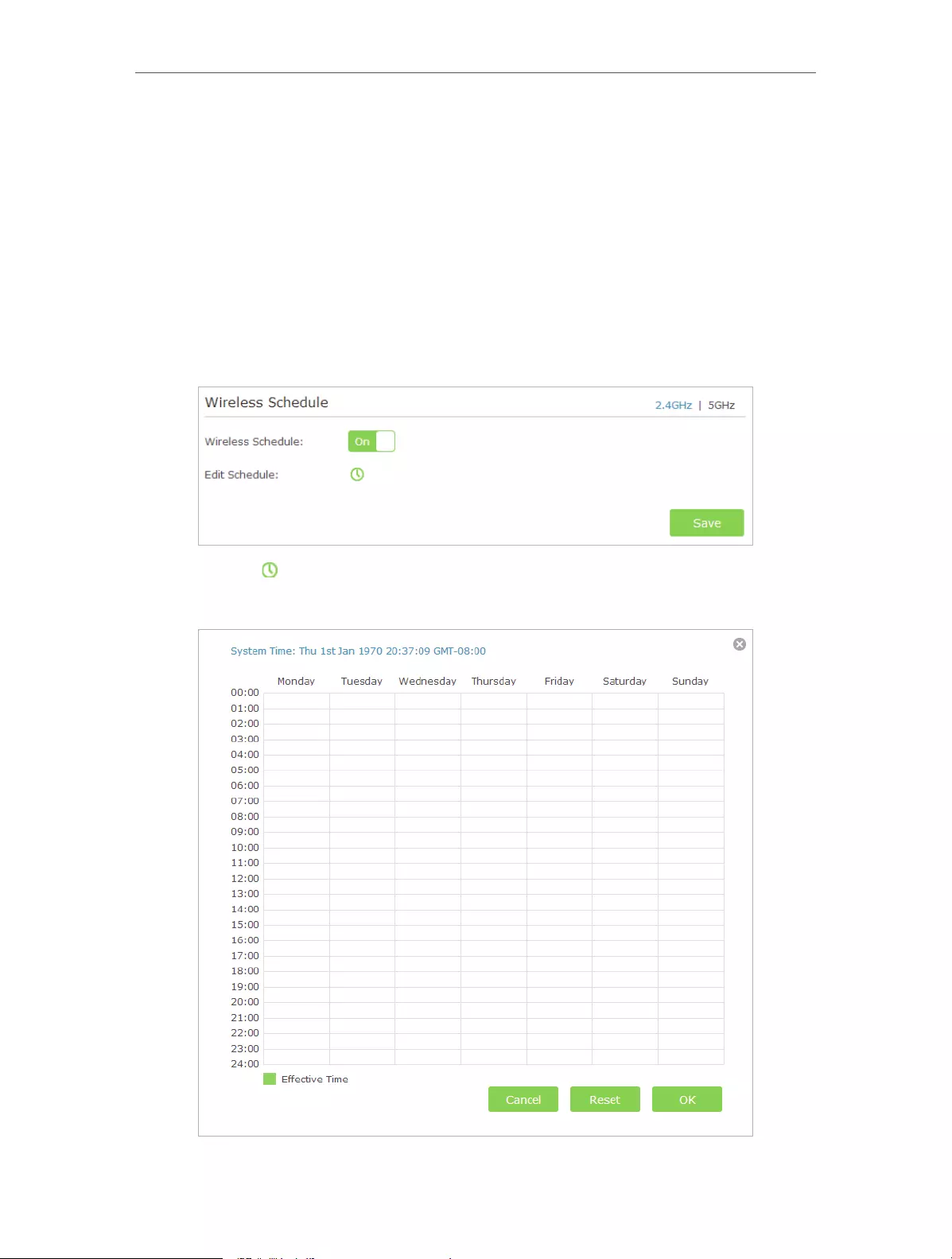
57
Chapter 10 Customize Your Network Settings
10. 8. Schedule Your Wireless Function
The wireless network can be automatically off at a specific time when you do not need
the wireless connection.
1. Visit http://tplinkwifi.net, and log in with the username and password you set for the
router.
2. Go to Advanced > Wireless > Wireless Schedule.
3. Select 2.4GHz or 5GHz to change the corresponding settings.
4. Toggle On to enable the Wireless Schedule feature.
5. Click the icon to set the Effective Time. Drag the cursor over the cells to choose the
period during which you need the wireless off automatically, and click OK.

58
Chapter 10 Customize Your Network Settings
6. Click Save.
7. If you also want to set wireless off time for other band(s), please repeat the steps
above.
Note:
1. The Effective Time Schedule is based on the time of the router. You can go to Advanced > System Tools > Time
Settings to modify the time.
2. The wireless LED will be off if the corresponding wireless network is disabled.
3. The wireless network will be automatically turned on after the time period you set.

Chapter 11
Manage the Router
This chapter will show you the configuration for managing and maintaining your router.
This chapter includes the following sections:
• Set Up System Time
• Test the Network Connectivity
• Upgrade the Firmware
• Backup and Restore Configuration Settings
• Change the Administrator Account
• Password Recovery
• Local Management
• Remote Management
• System Log
• Monitor the Internet Traffic Statistics
• Control LEDs

60
Chapter 11 Manage the Router
11. 1. Set Up System Time
System time is the time displayed while the router is running. The system time you
configure here will be used for other time-based functions like Parental Controls. You
can choose the way you prefer to obtain the system time.
Visit http://tplinkwifi.net, and log in with the username and password you set for the
router. Go to Advanced > System Tools > Time Settings.
¾To get time from the Internet:
1. In the Set Time field, select Get automatically from the Internet.
2. Select your local Time Zone from the drop-down list.
3. In the NTP Server I fileld, enter the IP address or domain name of your desired NTP
Server.
4. In the NTP Server II fileld, enter the IP address or domain name of the second NTP
Server. (Optional)
5. Click Obtain to get the current Internet time and click Save.
¾To manually set the date and time:
1. In the Set Time field, select Manually.
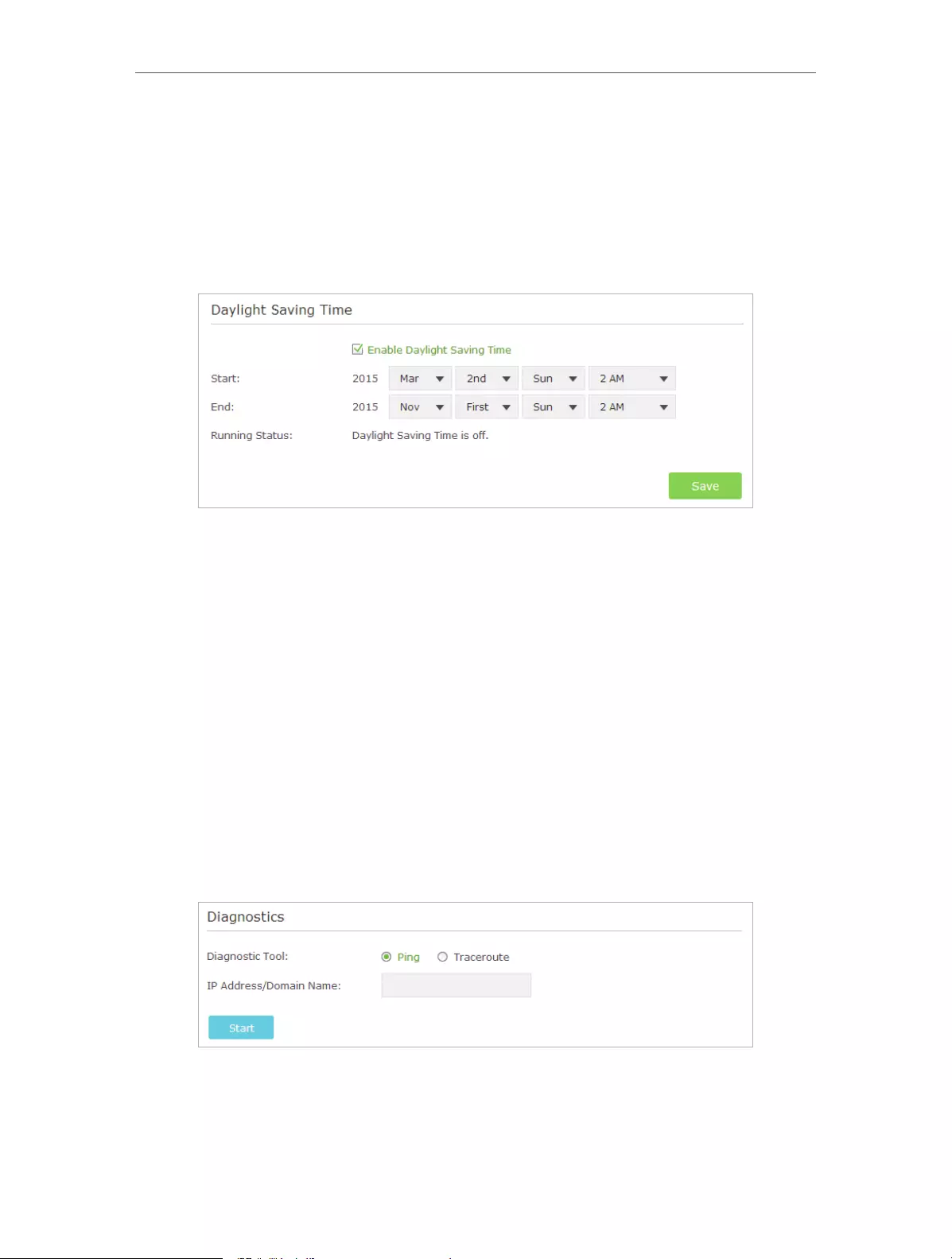
61
Chapter 11 Manage the Router
2. Set the current Date (In MM/DD/YYYY format).
3. Set the current Time (In HH/MM/SS format).
4. Click Save.
¾To set up Daylight Saving Time:
1. Select Enable Daylight Saving Time.
2. Select the correct Start date and time when daylight saving time starts at your local
time zone.
3. Select the correct End date and time when daylight saving time ends at your local
time zone.
4. Click Save.
11. 2. Test the Network Connectivity
Diagnostics is used to test the connectivity between the router and the host or other
network devices.
1. Visit http://tplinkwifi.net, and log in with the username and password you set for the
router.
2. Go to Advanced > System Tools > Diagnostics.
3. Enter the information with the help of page tips:
1 ) Choose Ping or Traceroute as the diagnostic tool to test the connectivity;
• Ping is used to test the connectivity between the router and the tested host,
and measure the round-trip time.

62
Chapter 11 Manage the Router
• Traceroute is used to display the route (path) your router has passed to reach
the tested host, and measure transit delays of packets across an Internet
Protocol network.
2 ) Enter the IP Address or Domain Name of the tested host.
4. Click Start to begin the diagnostics.
Tips:
Click Advanced, you can modify the ping count, ping packet size or the Traceroute Max TTL. It’s recommended to
keep the default value.
The figure below indicates the proper connection between the router and the Yahoo
server (www.Yahoo.com) tested through Ping.
The figure below indicates the proper connection between the router and the Yahoo
server (www.Yahoo.com) tested through Traceroute.
11. 3. Upgrade the Firmware
TP-LINK aims at providing better network experience for users.
We will inform you throught the web management page if there’s any update firmware
available for your router. Also, the latest firmware will be released at TP-LINK official
website, you can download it from the Support page of our website www.tp-link.com
for free.
Note:
1. Make sure you remove all attached USB storage devices from the router before the firmware upgrade to prevent
data loss.
2. Backup your router configuration before firmware upgrade.
3. Do NOT turn off the router during the firmware upgrade.
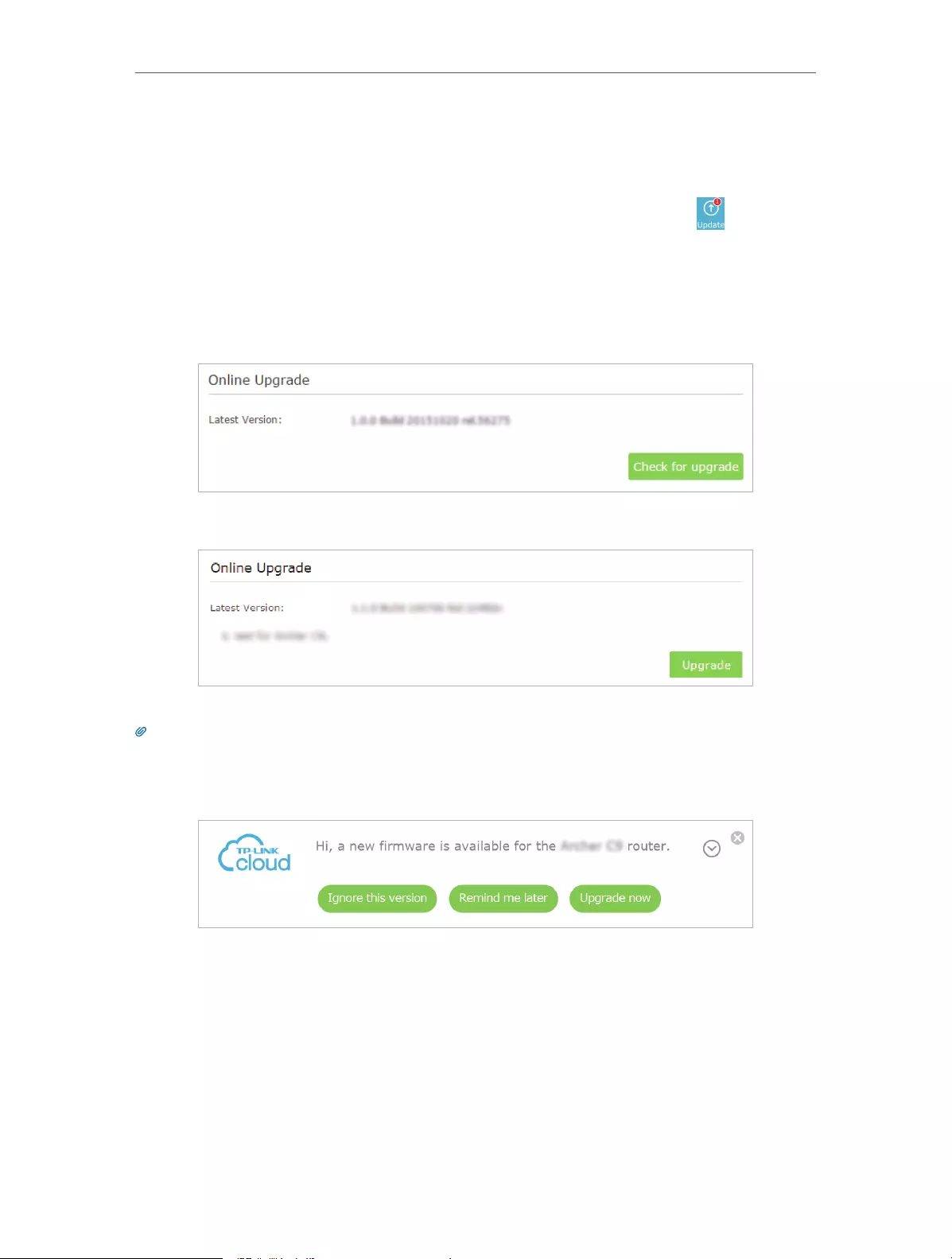
63
Chapter 11 Manage the Router
11. 3. 1. Online Upgrade
1. Visit http://tplinkwifi.net, and log in with the username and password you’ve set for
the router.
2. When the latest firmware is available for your router, the update icon will display
in the top-right corner of the page. Click the icon to go to the Firmware Upgrade
page.
Alternatively, you can go to Advanced > System Tools > Firmware Upgrade, and click
Check for upgrade to see whether the latest firmware is released.
3. Focus on the Online Upgrade section, and click Upgrade.
4. Wait a few moments for the upgrade and reboot to complete.
Tips:
If there’s a new and important firmware update for your router, you will see the notification (similar as shown below)
on your computer as long as a web browser is opened. Click Upgrade now, and log into the web management page
with the username and password you set for the router. You will see the Firmware Upgrade page.
11. 3. 2. Local Upgrade
1. Download the latest firmware file for the router from www.tp-link.com.
2. Visit http://tplinkwifi.net, and log in with the username and password you set for the
router.
3. Go to Advanced > System Tools > Firmware Upgrade.
4. Focus on the Device Information section. Make sure the downloaded firmware file is
matched with the Hardware Version.
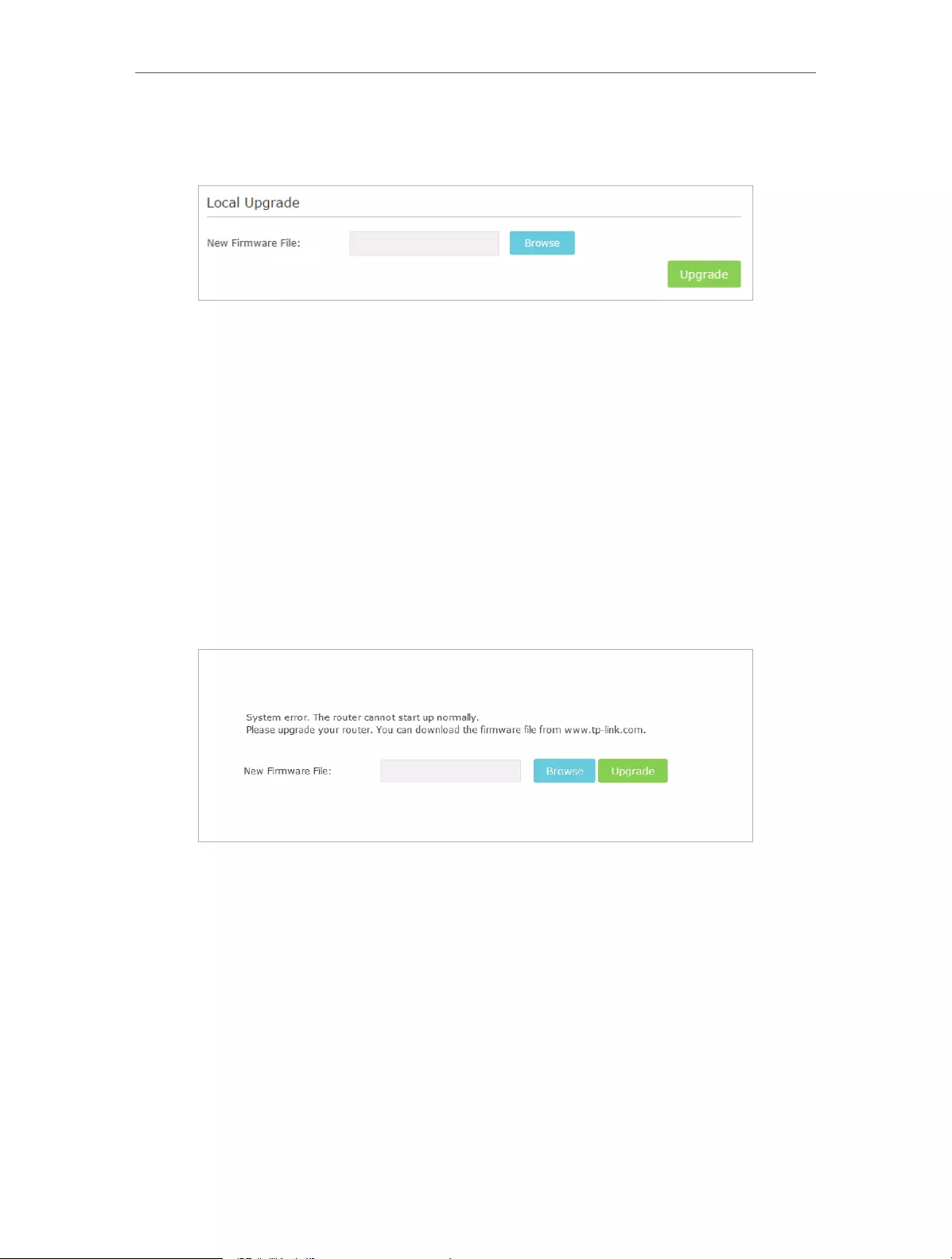
64
Chapter 11 Manage the Router
5. Focus on the Local Upgrade section. Click Browse to locate the downloaded new
firmware file, and click Upgrade.
6. Wait a few moments for the upgrade and reboot to complete.
11. 3. 3. Restore Interrupted Upgrade after Power Failure
If your router cannot start up after an upgrade interruption due to power failure, do
follow the steps below to restore the interrupted upgrade. Otherwise, your router
cannot work again.
1. Make sure you have the latest firmware file in your computer. If not, try another way
to connect your computer to the Internet and download the latest firmware file from
www.tp-link.com.
2. Connect your computer to the router with an Ethernet cable.
3. Visit 192.168.0.1 and you will see the following upgrade page.
4. Click Browse and select the downloaded firmware file.
5. Click Upgrade and wait for a few minutes until the router completes the upgrading
and restarts.
11. 4. Backup and Restore Configuration Settings
The configuration settings are stored as a configuration file in the router. You can
backup the configuration file to your computer for future use and restore the router to
a previous settings from the backup file when needed. Moreover, if necessary you can
erase the current settings and reset the router to the default factory settings.
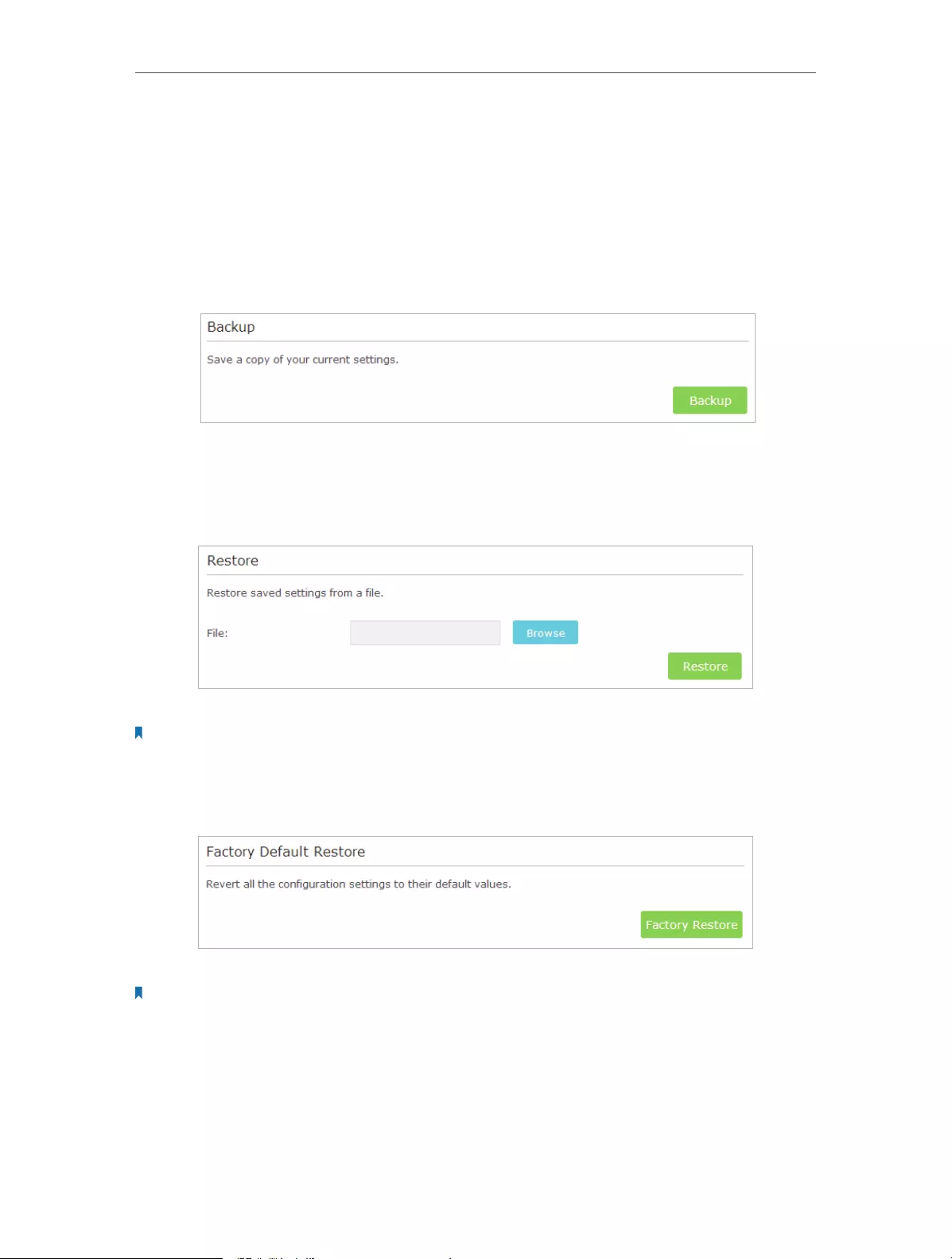
65
Chapter 11 Manage the Router
1. Visit http://tplinkwifi.net, and log in with the username and password you set for the
router.
2. Go to Advanced > System Tools > Backup & Restore.
¾To backup configuration settings:
Click Backup to save a copy of the current settings to your local computer. A ‘.bin’ file of
the current settings will be stored to your computer.
¾To restore configuration settings:
1. Click Browse to locate the backup configuration file stored on your computer, and
click Restore.
2. Wait a few moments for the restoring and rebooting.
Note: During the restoring process, do not turn off or reset the router.
¾To reset the router to factory default settings:
1. Click Factory Restore to reset the router.
2. Wait a few moments for the resetting and rebooting.
Note:
1. During the resetting process, do not turn off or reset the router.
2. We strongly recommend you backup the current configuration settings before resetting the router.
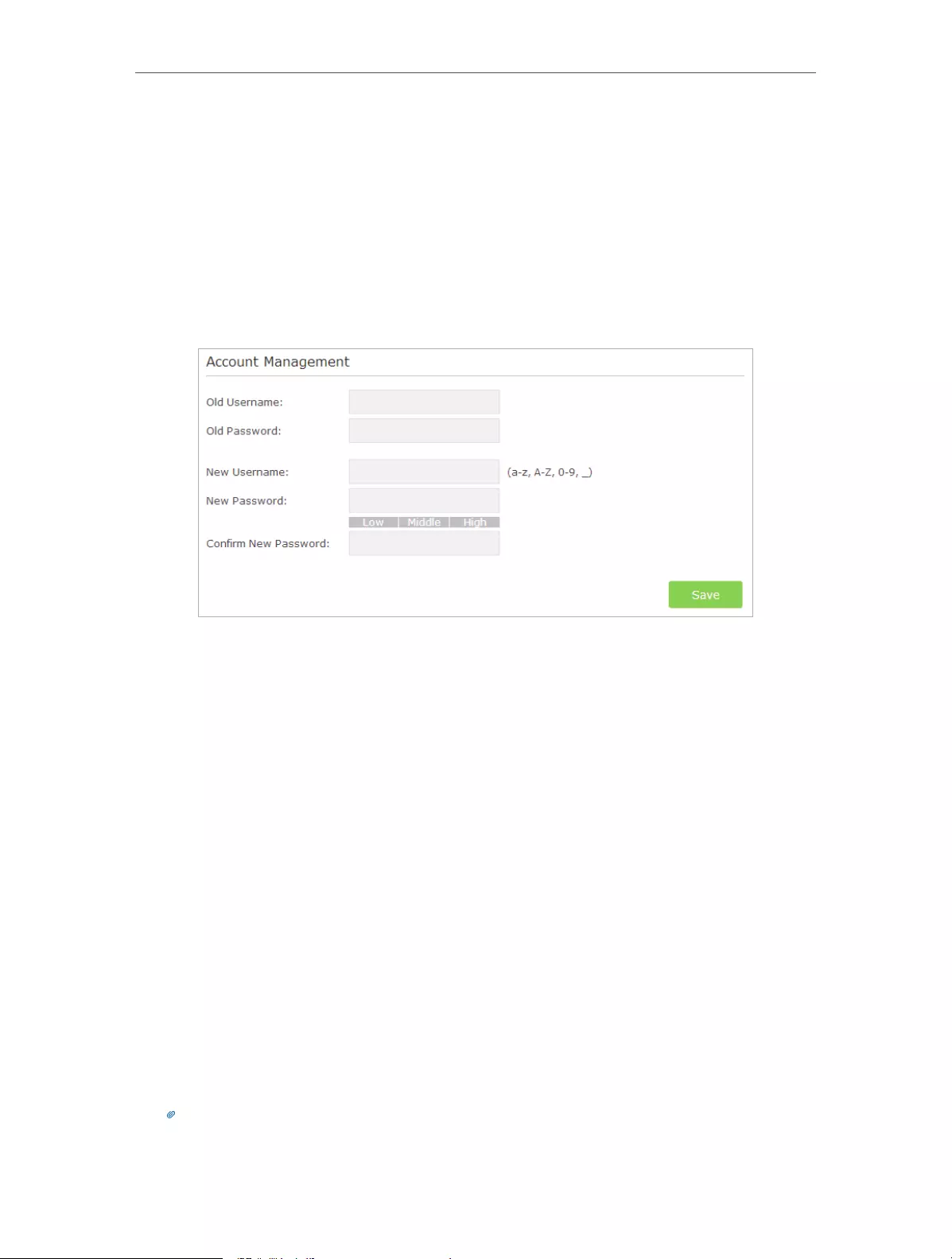
66
Chapter 11 Manage the Router
11. 5. Change the Administrator Account
The account management feature allows you to change your login username and
password of the web management page.
1. Visit http://tplinkwifi.net, and log in with the username and password you set for the
router.
2. Go to Advanced > System Tools > Administration and focus on the Account
Management section.
3. Enter the old username and old password. Enter the new username and enter the
new password twice (both case-sensitive). Click Save.
4. Use the new username and password for the following logins.
11. 6. Password Recovery
This feature allows you to recover your default login username and password in case
you forget them.
1. Visit http://tplinkwifi.net, and log in with the username and password you set for the
router.
2. Go to Advanced > System Tools > Administration and focus on the Password Recovery
section.
3. Select the Enable Password Recovery checkbox.
4. Specify a mailbox (From) for sending the recovery letter and enter its SMTP Server
address. Specify a mailbox (To) for receiving the recovery letter. If the mailbox (From)
to send the recovery letter requires encryption, select Enable Authentication and
enter its username and password.
Tips:
• SMTP server is available for users in most webmail systems. For example, the SMTP server address of Gmail
is smtp.gmail.com. You can refer to their Help page to learn the SMTP server address.
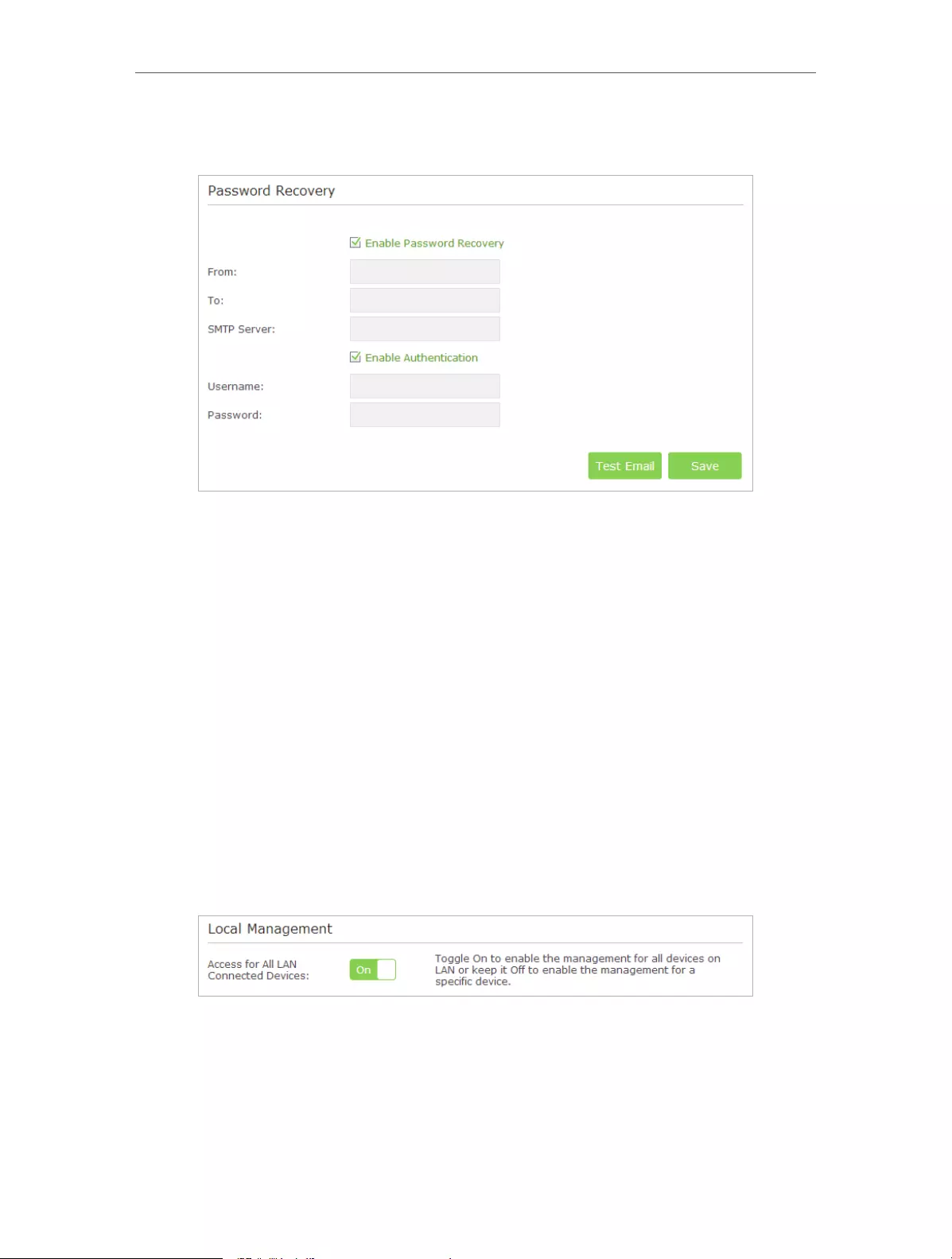
67
Chapter 11 Manage the Router
• Generally, Enable Authentication should be selected if the login of the mailbox requires username and
password.
5. Click Save.
You can click Test Email to test whether the configuration is successful. To recover the
default login username and password, please refer to FAQ.
11. 7. Local Management
This feature allows you to limit the number of client devices on your LAN from accessing
the router by using the MAC address-based authentication.
1. Visit http://tplinkwifi.net, and log in with the username and password you set for the
router.
2. Go to Advanced > System Tools > Administration and complete the settings In Local
Management section according to your needs.
• Allow all LAN connected devices to manage the router:
Toggle on Access for All LAN Connected Devices.
• Allow specific devices to manage the router:
1 ) Toggle off Access for All LAN Connected Devices.
2 ) Click Add.
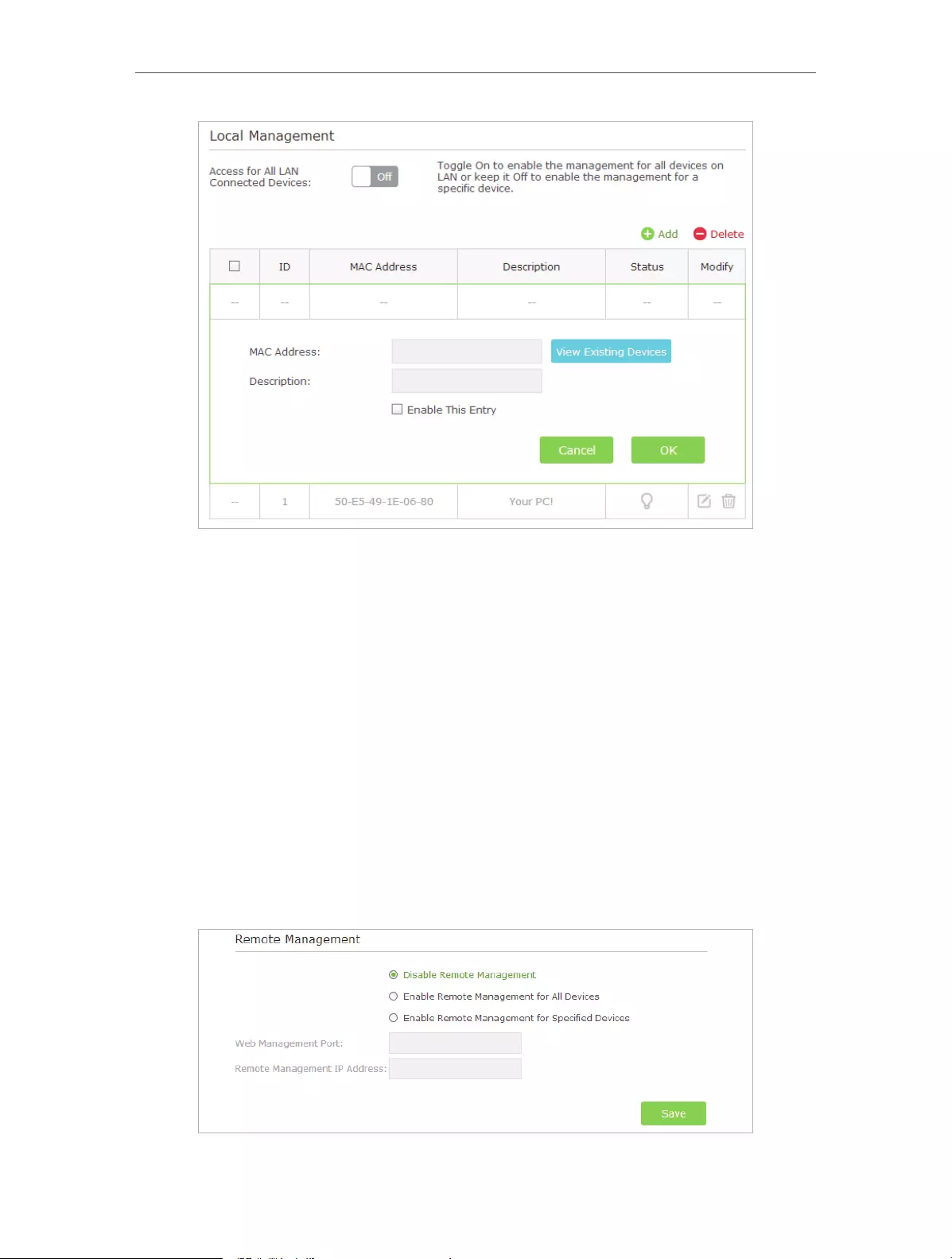
68
Chapter 11 Manage the Router
3 ) Click View Existing Devices and select the device to manage the router from
the Existing Devices list, or enter the MAC address of the device manually.
4 ) Specify a Description for this entry.
5 ) Tick the Enable This Entry checkbox.
6 ) Click OK.
11. 8. Remote Management
This feature allows you to control remote devices’ authority to manage the router.
1. Visit http://tplinkwifi.net, and log in with the username and password you set for the
router.
2. Go to Advanced > System Tools > Administration and complete the settings in
Remote Management section according to your needs.

69
Chapter 11 Manage the Router
• Forbid all devices to manage the router remotely: Select Disable Remote
Management and click Save.
• Allow all devices to manage the router remotely:
1 ) Select Enable Remote Management for All Devices.
2 ) Enter Web Management Port (1024-65535 or 80).
3 ) Click Save.
Devices on the Internet can log in to http://Router’s WAN IP address:port number (such as
http://113.116.60.229:1024) to manage the router.
Tips:
1. You can find the WAN IP address of the router on Basic > Network Maps > Internet.
2. The router’s WAN IP is usually a dynamic IP. Please refer to Set Up a Dynamic DNS Service Account if you want to log
in to the router through a domain name.
• Allow specific devices to manage the router remotely:
1 ) Select Enable Remote Management for Specified Devices.
2 ) Enter Web Management Port (1024-65535 or 80).
3 ) In Remote Management IP address, enter the IP address of the remote device
to manage the router.
4 ) Click Save.
Devices using this WAN IP can manage the router by logging in to http://Router’s WAN
IP:port number (such as http://113.116.60.229:1024).
Tips:
The router’s WAN IP is usually a dynamic IP. Please refer to Set Up a Dynamic DNS Service Account if you want to log in
to the router through a domain name.
11. 9. System Log
When the router does not work properly, you can save the system log and send it to the
technical support for troubleshooting.
¾To Save the System Log in Local:
1. Visit http://tplinkwifi.net, and log in with the username and password you set for the
router.
2. Go to Advanced > System Tools > System Log.
3. Choose the type and level of the system logs according to your need.
4. Click Save Log to save the system logs to local.

70
Chapter 11 Manage the Router
¾To Send the System Log to a Mailbox at a Fixed Time:
For example, I want to check my router’s working status at a fixed time every day,
however, it’s too troublesome to log in to the web interface every time I want to go
checking. It would be great if the system logs could be sent to my mailbox at 8 a.m.
every day.
1. Visit http://tplinkwifi.net, and log in with the username and password you set for the
router.
2. Go to Advanced > System Tools > System Log.
3. Click Mail Settings.
4. Enter the information with the help of page tips:
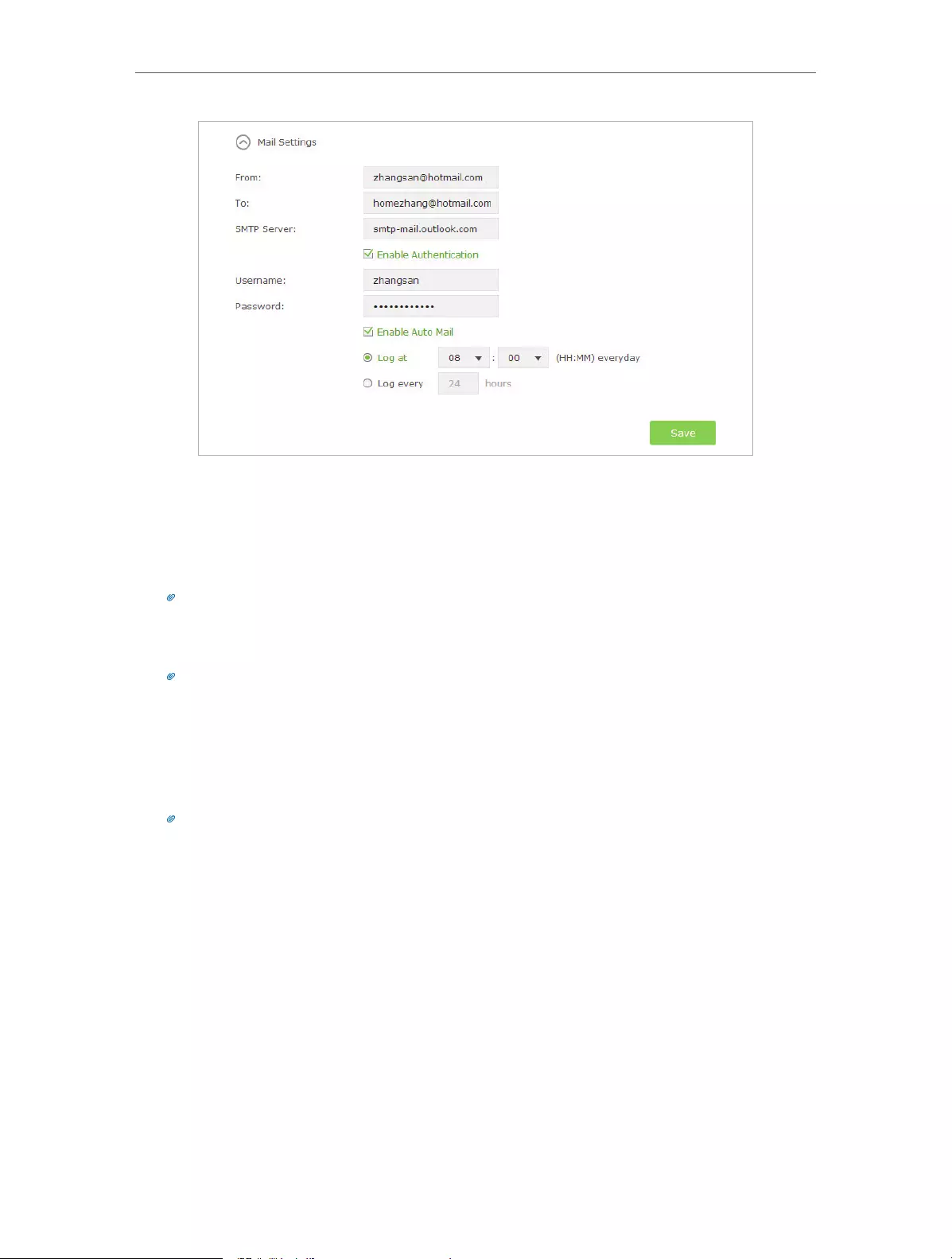
71
Chapter 11 Manage the Router
1 ) From: Enter the email address used for sending the system log.
2 ) To: Enter the recipient’s email address, which can be the same as or different
from the sender’s email address.
3 ) SMTP Server: Enter the SMTP server address.
Tips: SMTP server is available for users in most webmail systems. For example, the SMTP server address of
Hotmail is smtp-mail.outlook.com. You can refer to their Help page to learn the SMTP server address.
4 ) Select Enable Authentication.
Tips: Generally, Enable Authentication should be selected if the login of the mailbox requires username and
password.
5 ) Username: Enter the email address used for sending the system log.
6 ) Password: Enter the password to login the sender’s email address.
7 ) Select Enable Auto Mail.
Tips: The router will send the system log to the designated email address if this option is enabled.
8 ) Set a fixed time. The recipient will receive the system log sent at this time every
day.
5. Click Save.
11. 10. Monitor the Internet Traffic Statistics
The Traffic Statistics page displays the network traffic of the LAN, WAN and WLAN sent
and received packets, allows you to monitor the volume of Internet traffic statistics.
1. Visit http://tplinkwifi.net, and log in with the username and password you set for the
router.
2. Go to Advanced > System Tools > Traffic Statistics.
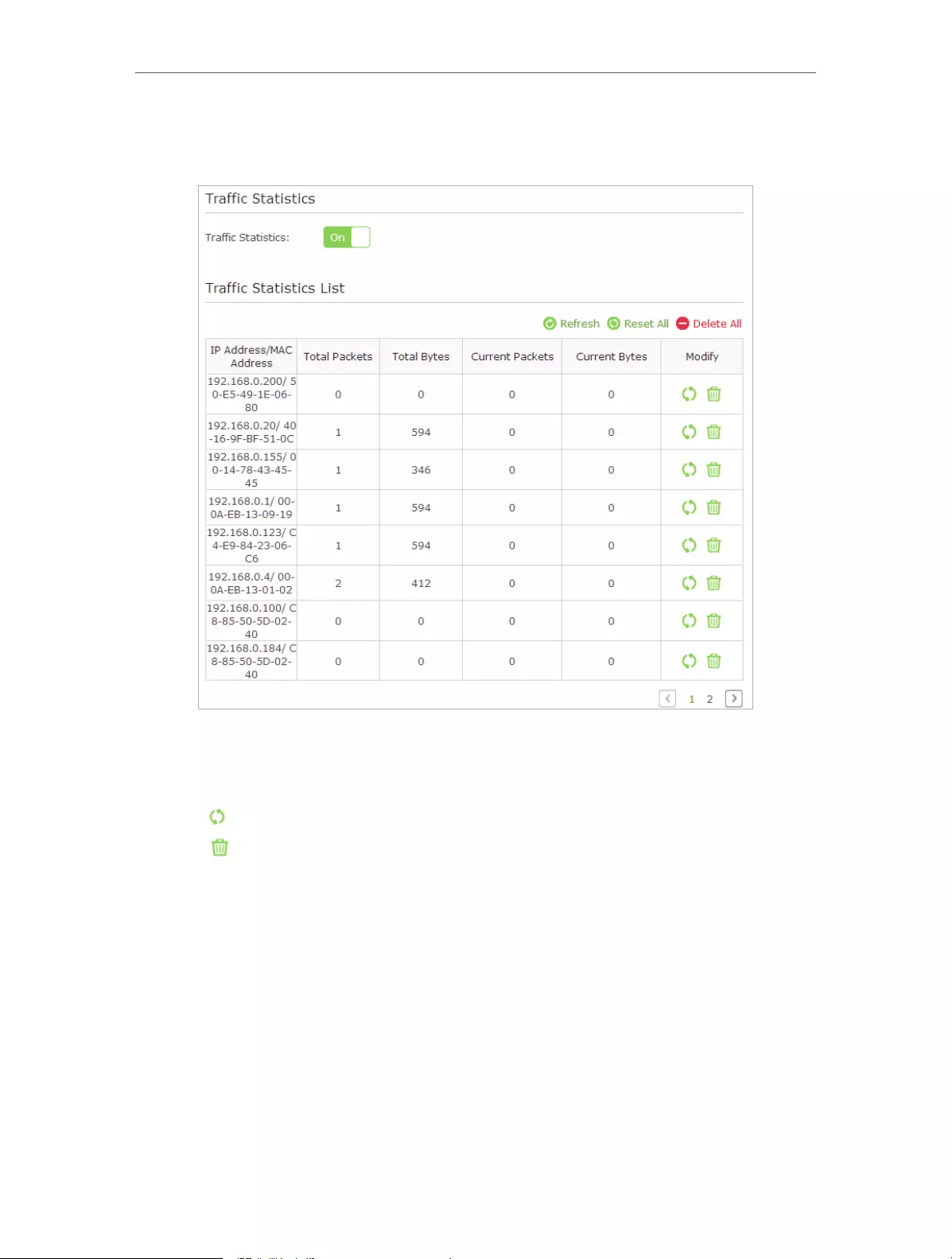
72
Chapter 11 Manage the Router
3. Toggle on Traffic Statistics, and then you can monitor the traffic statistics in Traffic
Statistics List section.
Click Refresh to update the statistic information on the page.
Click Reset All to reset all statistic values in the list to zero.
Click Delete All to delete all statistic information in the list.
Click to reset the statistic information of the specific device.
Click to delete the specific device item in the list.
11. 11. Control LEDs
The router LEDs indicate router activities and behavior. You can turn on or turn off the
LEDs from the web management page.
¾To turn on or off the LEDs:
• Press the LED button on the router (if available) about 2 seconds to turn on or
off the LEDs.
• Visit http://tplinkwifi.net, and log in with the username and password you set
for the router. Click the LED icon on the top right of the page.
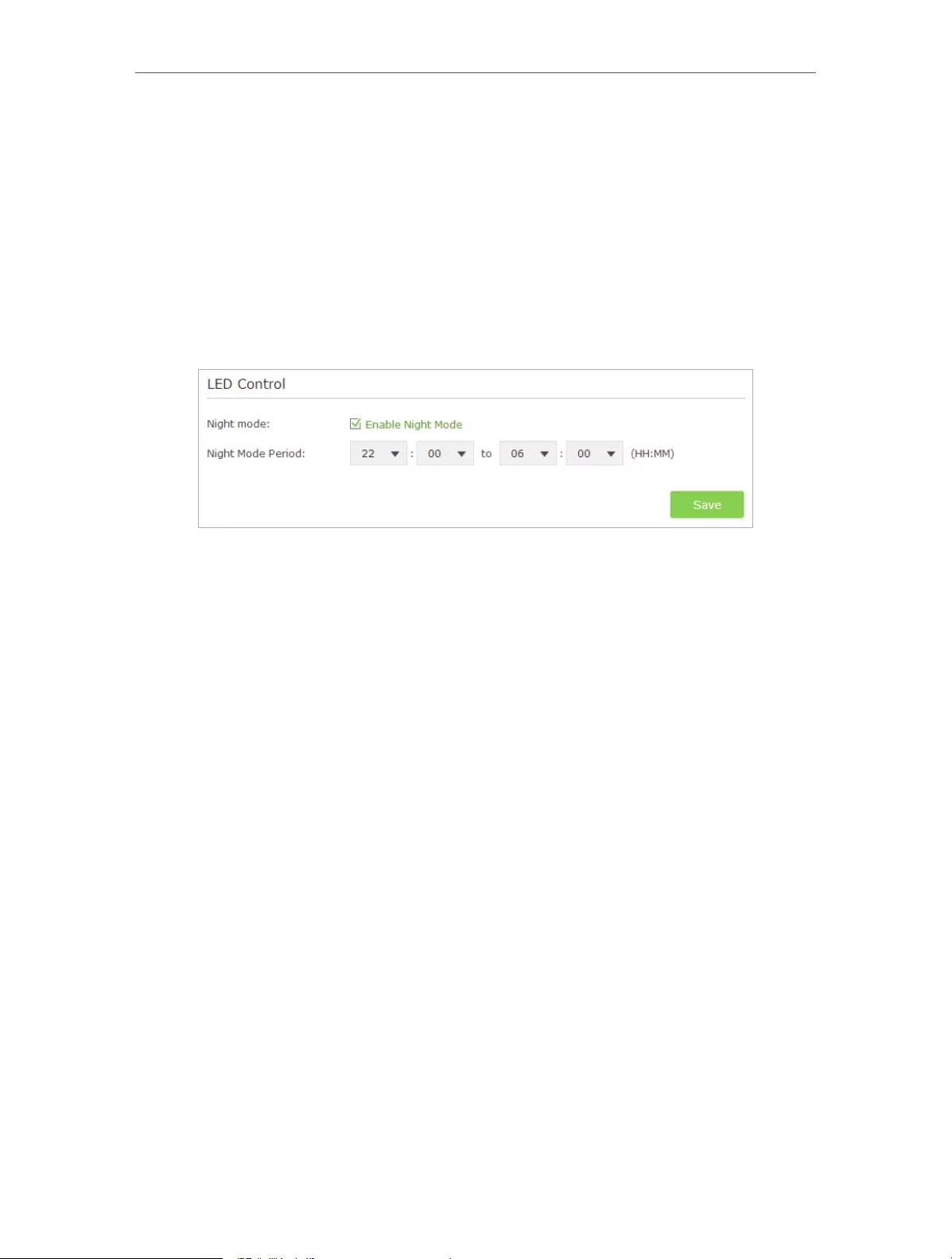
73
Chapter 11 Manage the Router
¾To turn off LEDs during Night Mode Period:
1 ) Visit http://tplinkwifi.net, and log in with the username and password you set
for the router.
2 ) Go to Advanced > System Tools > System Parameters.
3 ) In the LED Control section, select the Enable Night Mode checkbox.
4 ) Specify a time period in the Night Mode Period according to your need, and the
LEDs will be off during this period.
5 ) Click Save to make the settings effective.

74
COPYRIGHT & TRADEMARKS
Specifications are subject to change without notice. is a registered trademark
of TP-LINK TECHNOLOGIES CO., LTD. Other brands and product names are trademarks
or registered trademarks of their respective holders.
No part of the specifications may be reproduced in any form or by any means or
used to make any derivative such as translation, transformation, or adaptation
without permission from TP-LINK TECHNOLOGIES CO., LTD. Copyright © 2016 TP-LINK
TECHNOLOGIES CO., LTD. All rights reserved.

75
FCC STATEMENT
This equipment has been tested and found to comply with the limits for a Class B
digital device, pursuant to part 15 of the FCC Rules. These limits are designed to provide
reasonable protection against harmful interference in a residential installation. This
equipment generates, uses and can radiate radio frequency energy and, if not installed
and used in accordance with the instructions, may cause harmful interference to radio
communications. However, there is no guarantee that interference will not occur in a
particular installation. If this equipment does cause harmful interference to radio or
television reception, which can be determined by turning the equipment off and on,
the user is encouraged to try to correct the interference by one or more of the following
measures:
• Reorient or relocate the receiving antenna.
• Increase the separation between the equipment and receiver.
• Connect the equipment into an outlet on a circuit different from that to which the
receiver is connected.
• Consult the dealer or an experienced radio/ TV technician for help.
This device complies with part 15 of the FCC Rules. Operation is subject to the following
two conditions:
1. This device may not cause harmful interference.
2. This device must accept any interference received, including interference that may
cause undesired operation.
Any changes or modifications not expressly approved by the party responsible for
compliance could void the user’s authority to operate the equipment.
Note: The manufacturer is not responsible for any radio or TV interference caused by
unauthorized modifications to this equipment. Such modifications could void the
user’s authority to operate the equipment.
FCC RF Radiation Exposure Statement
This equipment complies with FCC RF radiation exposure limits set forth for an
uncontrolled environment. This device and its antenna must not be co-located or
operating in conjunction with any other antenna or transmitter.
“To comply with FCC RF exposure compliance requirements, this grant is applicable to
only Mobile Configurations. The antennas used for this transmitter must be installed to
provide a separation distance of at least 20 cm from all persons and must not be co—
located or operating in conjunction with any other antenna or transmitter.”
The device is restricted in indoor environment only.

76
For product available in the USA/Canada market, only channel 1~11 can be operated.
Selection of other channels is not possible.
CE Mark Warning
This is a class B product. In a domestic environment, this product may cause radio
interference, in which case the user may be required to take adequate measures.
RF Exposure Information
This device meets the EU requirements (1999/519/EC) on the limitation of exposure of
the general public to electromagnetic fields by way of health protection.
The device complies with RF specifications when the device used at 20 cm from your
body.
Restricted to indoor use.
Canadian Compliance Statement
This device complies with Industry Canada license-exempt RSS standard(s). Operation
is subject to the following two conditions:
1. This device may not cause interference, and
2. This device must accept any interference, including interference that may cause
undesired operation of the device.
Cet appareil est conforme aux norms CNR exemptes de licence d’Industrie Canada. Le
fonctionnement est soumis aux deux conditions suivantes:
1. cet appareil ne doit pas provoquer d’interférences et
2. cet appareil doit accepter toute interférence, y compris celles susceptibles de
provoquer un fonctionnement non souhaité de l’appareil.
Caution:
The device for operation in the band 5150–5250 MHz is only for indoor use to reduce
the potential for harmful interference to co-channel mobile satellite systems;
Avertissement:
Le dispositif fonctionnant dans la bande 5150-5250 MHz est réservé uniquement pour
une utilisation à l’intérieur afin de réduire les risques de brouillage préjudiciable aux
systèmes de satellites mobiles utilisant les mêmes canaux;
Radiation Exposure Statement:
This equipment complies with IC radiation exposure limits set forth for an uncontrolled
environment. This equipment should be installed and operated with minimum distance
20cm between the radiator & your body.

77
Déclaration d’exposition aux radiations:
Cet équipement est conforme aux limites d’exposition aux rayonnements IC établies
pour un environnement non contrôlé. Cet équipement doit être installé et utilisé avec
un minimum de 20 cm de distance entre la source de rayonnement et votre corps.
Industry Canada Statement
CAN ICES-3 (B)/NMB-3(B)
Korea Warning Statements:
당해 무선설비는 운용중 전파혼신 가능성이 있음.
NCC Notice & BSMI Notice:
注意!
依據 低功率電波輻射性電機管理辦法
第十二條 經型式認證合格之低功率射頻電機,非經許可,公司、商號或使用者均
不得擅自變更頻率、加大功率或變更原設計之特性或功能。
第十四條 低功率射頻電機之使用不得影響飛航安全及干擾合法通行;經發現有干
擾現象時,應立即停用,並改善至無干擾時方得繼續使用。前項合法通信,指依
電信規定作業之無線電信。低功率射頻電機需忍受合法通信或工業、科學以及醫
療用電波輻射性電機設備之干擾。
減少電磁波影響,請妥適使用。
安全諮詢及注意事項
• 請使用原裝電源供應器或只能按照本產品注明的電源類型使用本產品。
• 清潔本產品之前請先拔掉電源線。請勿使用液體、噴霧清潔劑或濕布進行
清潔。
• 注意防潮,請勿將水或其他液體潑灑到本產品上。
• 插槽與開口供通風使用,以確保本產品的操作可靠並防止過熱,請勿堵塞
或覆蓋開口。
• 請勿將本產品置放於靠近熱源的地方。除非有正常的通風,否則不可放在
密閉位置中。
• 請不要私自打開機殼,不要嘗試自行維修本產品,請由授權的專業人士進
行此項工作。
Продукт сертифіковано згідно с правилами системи УкрСЕПРО на відповідність
вимогам нормативних документів та вимогам, що передбачені чинними
законодавчими актами України.
78
Safety Information
• When product has power button, the power button is one of the way to shut off the
product; when there is no power button, the only way to completely shut off power
is to disconnect the product or the power adapter from the power source.
• Don’t disassemble the product, or make repairs yourself. You run the risk of electric
shock and voiding the limited warranty. If you need service, please contact us.
• Avoid water and wet locations.
• Adapter shall be installed near the equipment and shall be easily accessible.
• The plug considered as disconnect device of adapter.
• Use only power supplies which are provided by manufacturer and in the original
packing of this product. If you have any questions, please don’t hesitate to contactus
us.
For EU/EFTA, this product can be used in the following countries:
AT BE BG CH CY CZ DE DK
EE ES FI FR GB GR HR HU
IE IS IT LI LT LU LV MT
NL NO PL PT RO SE SI SK
Explanations of the symbols on the product label
Symbol Explanation
DC voltage
RECYCLING
This product bears the selective sorting symbol for Waste electrical and electronic equipment
(WEEE). This means that this product must be handled pursuant to European directive 2012/19/
EU in order to be recycled or dismantled to minimize its impact on the environment.
User has the choice to give his product to a competent recycling organization or to the retailer
when he buys a new electrical or electronic equipment.

79
FAQ
Q1. What can I do if I forgot my wireless password?
The default wireless password is printed on the label of the router. If the password has
been altered, please connect your computer to the router using a cable and follow the
steps below:
1. Visit http://tplinkwifi.net.
2. Go to Advanced > Wireless > Wireless Settings to retrieve or reset your wireless
password.
Q2. What can I do if I forgot my login password of the web management
page?
The default username and password of the web management page are admin (in
lowercase). If your router supports Password Recovery and you have enabled it,
please follow the steps below to reset the password without resetting the router:
Note: Make sure the Internet access is available before using this method.
1. Visit http://tplinkwifi.net.
2. Click Forgot password > Send Code, the verification code will be sent to the mailbox
you set.
3. Log into your mailbox to copy the verification code.
4. Paste the verification code on the window which pops up in Step 2.
5. Click Confirm (the default login username and password will be reset as admin after
the click).
6. Use admin (in lowercase) as both username and password to login.
Tips: Please refer to Password Recovery to learn how to configure Password Recovery.
If you have altered the username and password but Password Recovery is disabled:
1. Reset the router to factory default settings: press and hold the Reset button for about
7 seconds and then release;
2. Visit http://tplinkwifi.net, enter admin (in lowercase) as both username and password
to login.
Note: You’ll need to reconfigure the router to surf the Internet once the router is reset, and please mark down your
new password for future use.
Q3. I cannot log into the router’s web management page, what can I do?
This can happen for a variety of reasons. Please try the methods below to login again.
• Make sure the router connect to the computer correctly and the corresponding LED
indicator(s) light up.
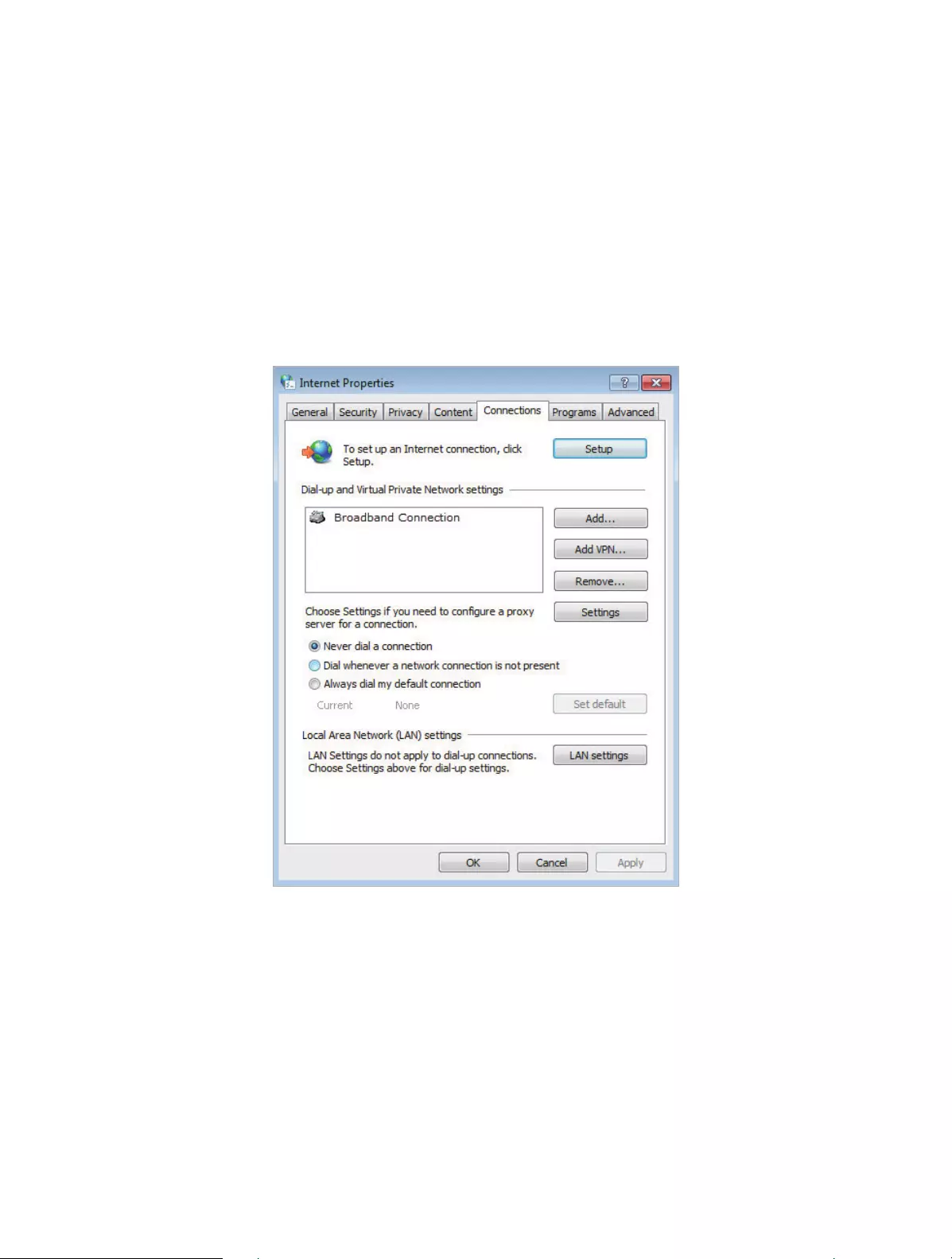
80
• Make sure the IP address of your computer is configured as Obtain an IP address
automatically and Obtain DNS server address automatically.
• Make sure you enter the correct IP address to login: http://tplinkwifi.net.
• Check your computer’s settings:
1 ) Go to Start > Control Panel > Network and Internet, and click View network status
and tasks.
2 ) Click Internet Options on the bottom left.
3 ) Click Connections and select Never dial a connection.
4 ) Click LAN settings and deselect the following three options and click OK.

81
5 ) Go to Advanced > Restore advanced settings, click OK to save the settings.
• Use another web browser or computer to login again.
• Reset the router to factory default settings and try again. If login still fails, please
contact the technical support.
Note: You’ll need to reconfigure the router to surf the Internet once the router is reset.

82
Q4. How to use the WDS Bridging function to extend my wireless
network?
For example, my house covers a large area. The wireless coverage of the router I’m using
(the root router) is limited. I want to use an extended router to extend the wireless
network of the root router.
Note:
• WDS bridging only requires configuration on the extended router.
• WDS bridging function can be enabled either in 2.4GHz frequency or 5GHz frequency for a dual-band router. We
use the WDS bridging function in 2.4GHz frequency as example.
1. Visit http://tplinkwifi.net, and log into with the username and password you set for
the router.
2. Configure the IP address of the router:
1 ) Go to Advanced > Network > LAN, configure the IP address of the extended
router to be in the same subnet with the root router; (For example, the IP
address of the root router is 192.168.0.1, the IP address of the extended router
can be 192.168.0.2~192.168.0.254. We take 192.168.0.2 as example.)
2 ) Click Save.
Note: Log into the web management page again if the IP address of the router is altered.
3. Survey the SSID to be bridged:
1 ) Go to Advanced > System Tools > System Parameters and focus on the 2.4GHz
WDS section, click Enable WDS Bridging.
2 ) Click Survey, locate the root router’s SSID and click Choose (Here we take
TP-LINK_2512 as example).
3 ) If the root router has wireless password, you should enter the wireless password
of the root router.
4 ) Click Save.

83
4. Disable DHCP:
1 ) Go to Network > DHCP Server.
2 ) Deselect Enable DHCP Server and click Save.
Now you can go to Advanced > Status > Wireless to check the WDS status. When the
WDS status is Run, it means WDS bridging is successfully built.
Q5. I cannot access the Internet even though the configuration is
finished, what can I do?
1. Visit http://tplinkwifi.net.
2. Go to Advanced > Status to check Internet status:
As the follow picture shows, if IP Address is a valid one, please try the methods
below and try again:
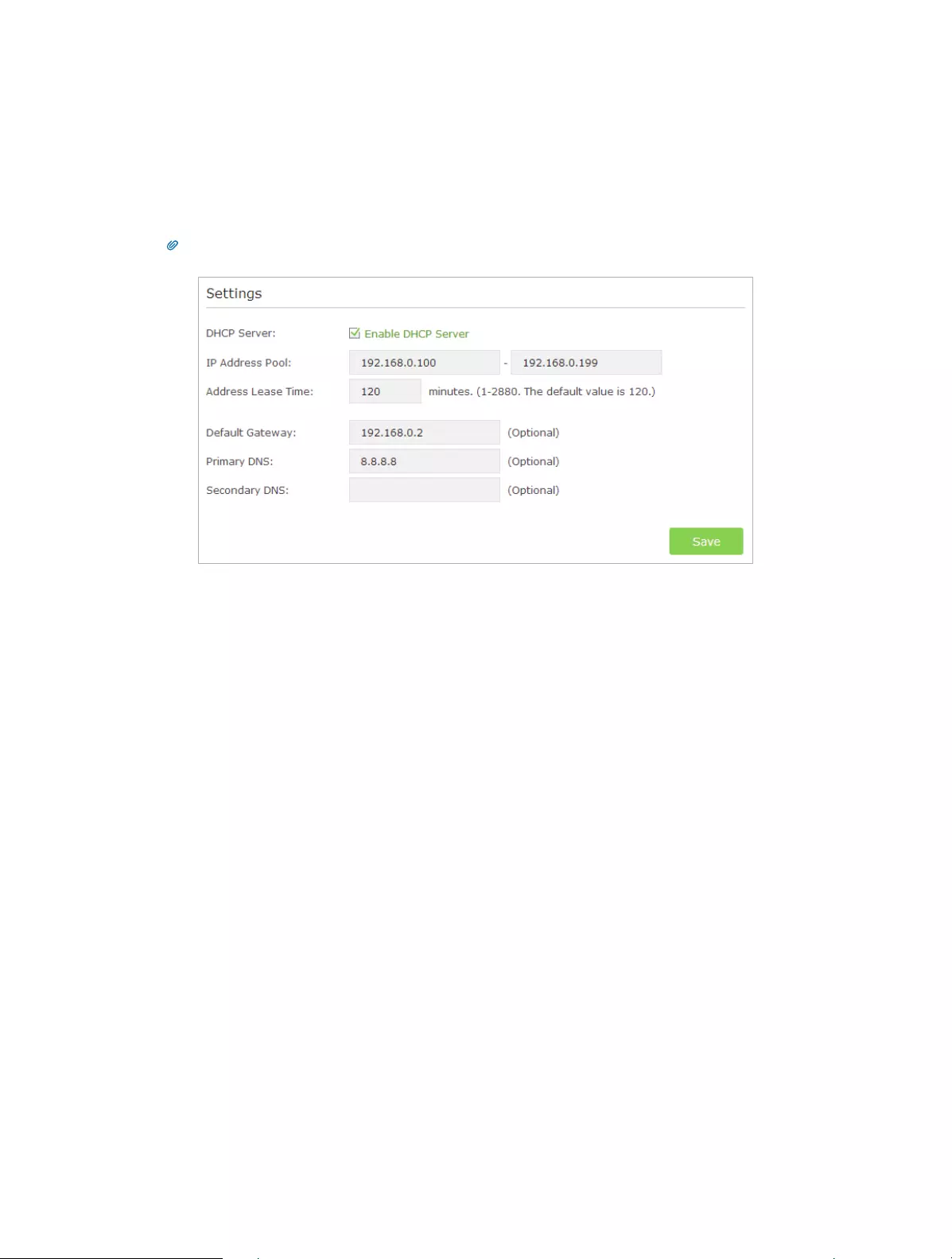
84
• Your computer might not recognize any DNS server addresses, please manually
configure DNS server.
1 ) Go to Advanced > Network > DHCP Server.
2 ) Enter 8.8.8.8 as Primary DNS, click Save.
Tips: 8.8.8.8 is a safe and public DNS server operated by Google.
• Power cycle the modem and the TP-LINK router.
1 ) Power off your modem and TP-LINK router, leave them off for 1 minute.
2 ) Power on your modem first, wait about 2 minutes until it gets a solid cable or
Internet light.
3 ) Power back TP-LINK router.
4 ) Wait another 1 or 2 minutes and check the Internet access.
• Reset the router to factory default settings and reconfigure the router.
• Upgrade the firmware of the router.
• Check the TCP/IP settings on the particular device if all other devices can get Internet
from the router.
As the picture below shows, if the IP Address is 0.0.0.0, please try the methods below
and try again:

85
• Make sure the physical connection between the router and the modem is proper
• Clone the MAC address of your computer.
1 ) Visit http://tplinkwifi.net, and log in with the username and password you set
for the router.
2 ) Go to Advanced > Network > Internet and focus on the MAC Clone section.
3 ) Choose an option to your need (Enter the MAC address if Use Custom MAC
Address is selected), and click Save.
Tips:
• Some ISP will register the MAC address of your computer when you access the Internet for the first time
through their Cable modem, if you add a router into your network to share your Internet connection, the
ISP will not accept it as the MAC address is changed, so we need to clone your computer’s MAC address to
the router.
• The MAC addresses of a computer in wired connection and wireless connection are different.
• Modify the LAN IP address of the router.
Note:
Most TP-LINK routers use 192.168.0.1/192.168.1.1 as their default LAN IP address, it may conflict with the IP
range of your existent ADSL modem/router. If so, the router is not able to communicate with your modem
and cause you can’t access the Internet. To resolve this problem, we need to change the LAN IP address of the
router to avoid such conflict, for example, 192.168.2.1.
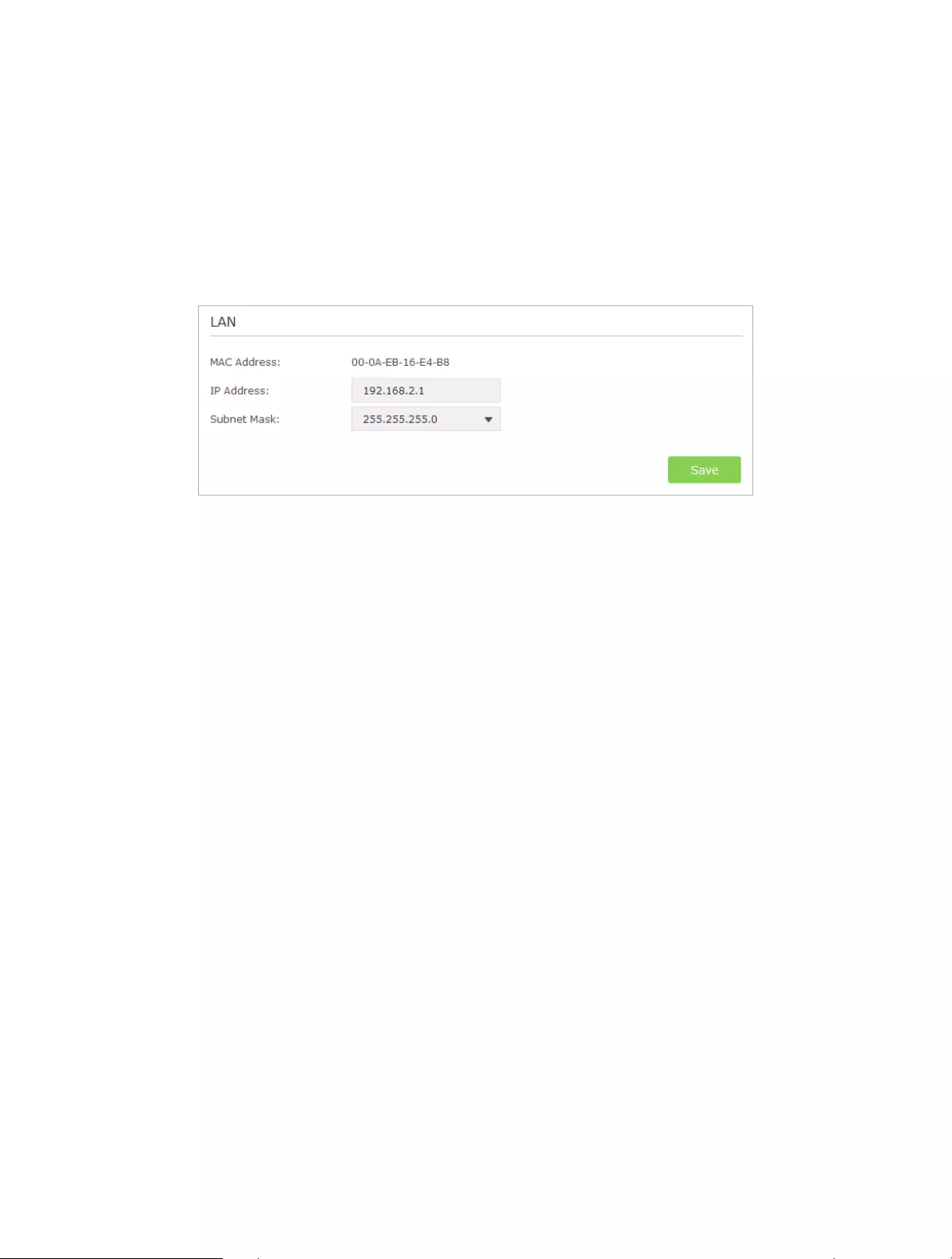
86
1 ) Visit http://tplinkwifi.net, and log in with the username and password you set
for the router.
2 ) Go to Advanced > Network > LAN.
3 ) Modify the LAN IP address as the follow picture shows. Here we take 192.168.2.1
as an example.
4 ) Click Save.
• Power cycle the modem and the TP-LINK router.
1 ) Power off your modem and TP-LINK router, leave them off for 1 minute.
2 ) Power on your modem first, wait about 2 minutes until it get a solid cable or
Internet light.
3 ) Power back TP-LINK router.
4 ) Wait another 1 or 2 minutes and check the Internet access.
• Double check the Internet Connection Type.
1 ) Confirm your Internet Connection Type, which can be learned from the ISP.
2 ) Visit http://tplinkwifi.net, and log in with the username and password you set
for the router.
3 ) Go to Advanced > Network > Internet.
4 ) Select your Internet Connection Type and fill in other parameters with the help
of page tips.
5 ) Click Save.
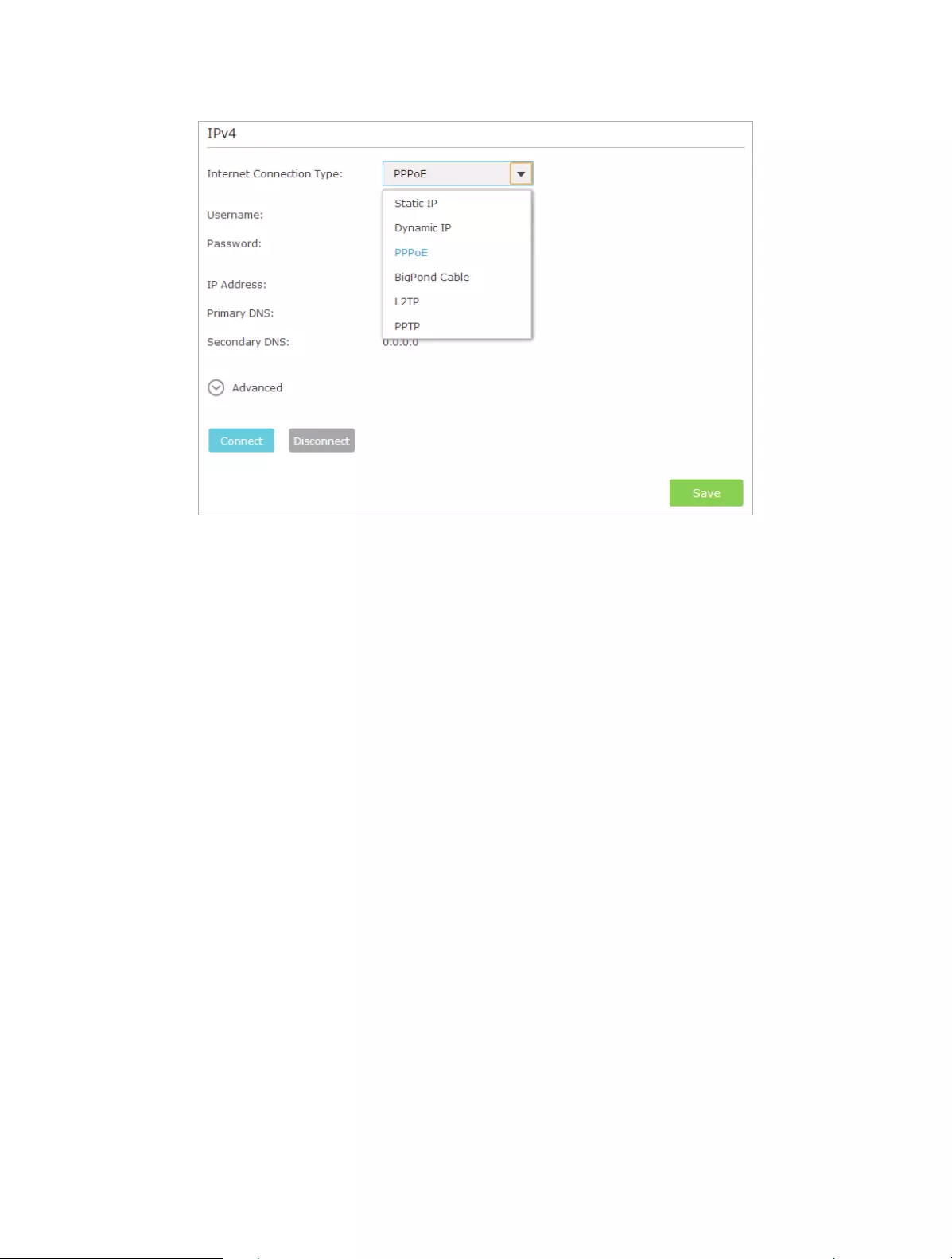
87
6 ) Power cycle the modem and the TP-LINK router again.
• Please upgrade the firmware of the router.
If you’ve tried every method above but cannot access the Internet, please contact the
technical support.
Q6. I cannot find my wireless network or I cannot connect the wireless
network, what can I do?
If you fail to find any wireless network, please follow the steps below:
• Make sure the wireless function of your device is enabled if you’re using a laptop
with built-in wireless adapter. You can refer to the relevant document or contact the
laptop manufacturer.
• Make sure the wireless adapter driver is installed successfully and the wireless adapter
is enabled.
• On Windows 7
1 ) If you see the message No connections are available, it is usually because the
wireless function is disabled or blocked somehow.
2 ) Clicking on Troubleshoot and windows might be able to fix the problem by
itself.
• On Windows XP
1 ) If you see the message Windows cannot configure this wireless connection, this
is usually because windows configuration utility is disabled or you are running
another wireless configuration tool to connect the wireless.
2 ) Exit the wireless configuration tool (the TP-LINK Utility, for example).

88
3 ) Select and right click on My Computer on desktop, select Manage to open
Computer Management window.
4 ) Expand Services and Applications > Services, find and locate Wireless Zero
Configuration in the Services list on the right side.
5 ) Right click Wireless Zero Configuration, and then select Properties.
6 ) Change Startup type to Automatic, click on Start button and make sure the
Service status is Started. And then click OK.
If you can find other wireless network except your own, please follow the steps
below:
• Check the WLAN LED indicator on your wireless router/modem.
• Make sure your computer/device is still in the range of your router/modem, move
closer if it is currently too far away.
• Go to Advanced > Wireless > Wireless Settings, and check the wireless settings, double
check your Wireless Network Name and SSID is not hided.
If you can find your wireless network but fail to connect, please follow the steps
below:
• Authenticating problem/password mismatch:
1 ) Sometimes you will be asked to type in a PIN number when you connect to
the wireless network for the first time. This PIN number is different from the
Wireless Password/Network Security Key, usually you can only find it on the
label of your router.
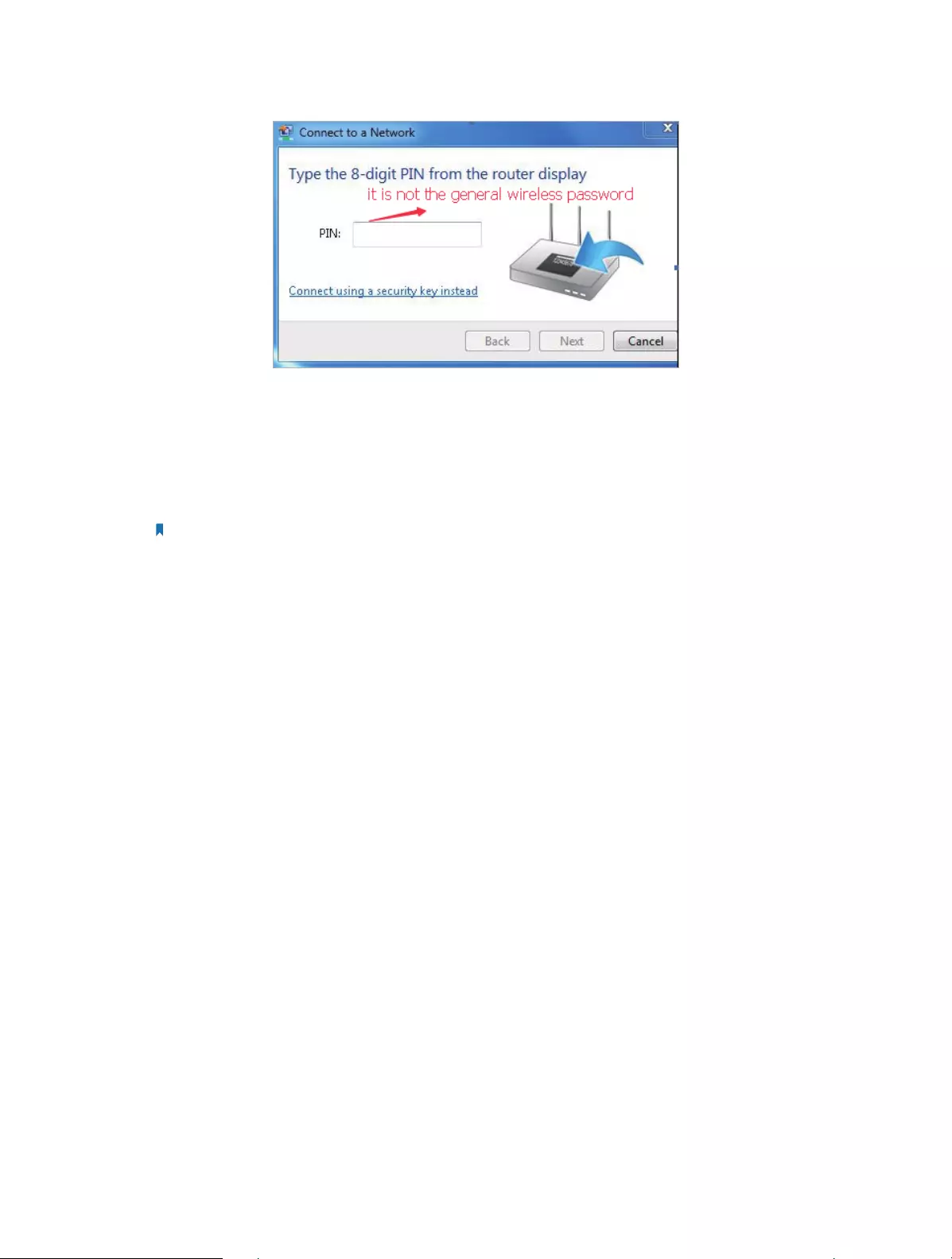
89
2 ) If you cannot find the PIN or PIN failed, you may choose Connecting using a
security key instead, and then type in the Wireless Password/Network Security
Key.
3 ) If it continues to show note of Network Security Key Mismatch, it is suggested
to confirm the wireless password of your wireless router.
Note: Wireless Password/Network Security Key is case sensitive.
• Windows unable to connect to XXXX / Can not join this network / Taking longer
than usual to connect to this network:
• Check the wireless signal strength of your network, if it is weak (1~3 bars),
please move the router closer and try again.
• Change the wireless Channel of the router to 1,6,or 11 to reduce interference
from other networks.
• Re-install or update the driver for your wireless adapter of the computer.
Обзор роутера TP-Link Archer поможет вам сделать правильный выбор. Функциональные возможности прибора разнообразны.
Содержание
Сегодня мы подробно рассмотрим роутер TP-Link Archer C20. Это универсальная модель, которая отлично подходит для работы дома и в офисе. Обзор роутера TP-Link Archer поможет вам сделать правильный выбор. Функциональные возможности прибора разнообразны. Устройство обладает многими опциями, которые заслуживают внимания. Подойдет для подключения интернета в частный дом.
Роутер ТП-Линк Арчер С20: характеристики
Модель Archer C20 AC750 – это двухдиапазонный беспроводной маршрутизатор. Это устройство предназначается для организации локальной сети. Прибор рассчитан на поддержку множества опций. Преимущество модели в способности работать в двух диапазонах. Скорость соединения на частоте 5 Ггц составляет 433 Мбит/сек. Изменение назначения кнопок не предусмотрено производителем. Также роутер Арчер С20 невозможно использовать в качестве торрент-клиента. Визуально устройство смотрится привлекательно.
У модели стильный дизайн. Верх модели темно-синего цвета, фактура глянцевая. Нижняя часть корпуса – бежевая матовая. Среди других моделей девайс сильно отличается внешним видом. Роутер Archer C20 оснащен 3 антеннами для беспроводной сети Wi-Fi. Прибор относится к классу Wireless маршрутизаторов. По отзывам пользователей, сигнал отличается стабильностью и не пропадает. На задней части корпуса производитель разместил 4 разъема LAN. Скорость каждого порта сто Мбит/сек. Имеется один порт для кабеля поставщика услуг – WAN. Здесь же расположен USB порт. Кнопка сброса и включения размещены на задней стороне корпуса. Через порт USB пользователи подключают 3G/4G модемы. Сюда же можно подключить другие девайсы.
Как подключить устройство
Комплект помимо самого роутера включает:
- сетевой кабель;
- шнур питания;
- инструкцию;
- установочный диск.
Настройку следует начинать с установки маршрутизатора в подходящем месте. Желательно подобрать такое место, с которого сигналы будут равномерно поступать во все комнаты дома. Шнур питания нужно подсоединить к роутеру и розетке. Сетевой кабель подключается к маршрутизатору и рабочей станции. В порт WAN устанавливаем кабель поставщика услуг. Теперь можно переходить к настройкам.
Вход в веб-интерфейс и автонастройка
Для настроек нам нужно попасть в меню роутера ТП-Линк С20. Снизу на устройстве должна быть прикреплена этикетка. На ней вы увидите данные для входа. Запускаем на компьютере любой браузер и вписываем адрес роутера. Перед вами появится окно с предложением пройти авторизацию. Для нового прибора используем данные admin для полей логин и пароль.
Если вы хотите использовать функцию автонастройки, найдите в меню раздел «Быстрая настройка». Следуйте указаниям мастера настройки. Также потребуется указать страну и город, тип подключения и провайдера. Тип подключения можно уточнить в договоре на оказание услуг. Поскольку роутер работает в двух диапазонах, пользователю будет предложено выбрать режим работы. Эксперты рекомендуют подключать сразу два рабочих диапазона.
Настроить беспроводную сеть нужно в последнюю очередь. Здесь выставляются базовые параметры. Все время нужно кликать на кнопку «Далее». Проверяем правильность введенных данных. Сохраняем внесенные изменения. Устройство выполнит перезапуск и будет работать с новыми настройками. С автоматической настройкой справятся даже новички.
Подключаемся к интернету вручную
Продвинутые юзеры редко пользуются функцией автоматической настройки. Если вы хотите настроить роутер конкретно под свои задачи, можно воспользоваться ручными настройками. Заходим в главное меню, здесь нас будет интересовать категория «Сеть». Далее выбираем подраздел WAN. Тут все параметры будут зависеть от поставщика услуг.
Ниже рассмотрим, какие значения нужно указать для разных провайдеров:
- «Ростелеком» и «Дом.ру». Эти провайдеры работают с протоколом PPPoE. Именно этот пункт нам нужно выбрать в меню WAN. Из договора выписываем логин и пароль. Вводим эти значения в соответствующие поля. Как альтернативное соединение выберите графу «Динамический IP». Подключение должно быть всегда активным. Сохраните изменения и выполните перезапуск роутера.
- Билайн. К интернету вы подключаетесь через протокол L2TP. Логин и пароль прописываем те, что указаны в вашем письменном соглашении. Не забудьте выбрать опцию, чтобы автоматически получать IP-адреса. Подключение должно быть всегда активным. Обязательно указываем название сервера. Все данные прописаны в договоре. После внесения изменений сохраняем новые настройки и перезапускаем девайс.
- Этот поставщик услуг работает с динамическими IP. Параметры IP-адреса, маски подсети и шлюза дает поставщик услуг. Вам нужно выбрать подменю «Клонирование». Запишите физический адрес прибора и сообщите его своему провайдеру. После регистрации этого адреса вы получите доступ к интернету.
Подключаемся через мобильные сети
Archer AC 750 оснащен USB разъемом. В этот порт вы можете подключить 3G и 4G модемы. В соответствующем разделе панели управления нужно выставить настройки. Указывается страна и наименование провайдера. По отзывам пользователей, роутер превосходно работает со многими моделями мобильных модемов. После внесения изменений в параметры конфигурация маршрутизатор нужно перезагрузить. Тогда новые настройки вступят в силу.
Настройка Wi-Fi
Модель Арчер С20 рассчитана на поддержку работы беспроводной сети в двух диапазонах. По умолчанию 2,4 Ггц. и 5 Ггц активированы. Для каждой частоты в веб-интерфейсе есть собственная вкладка с настройками. В категории, посвященной Wi-Fi, вы можете придумать любое название для своей сети. Пункт «Режим» ответственный за стандарт, по которому функционирует модуль Wi-Fi. Номер канала и его ширину желательно переключить на «Авто». Для защиты беспроводной сети следует выбрать WPA/WPA2.
Придумайте надежный пароль, чтобы обезопасить свою сеть. Пароль должен состоять минимум из 8 символов. Маршрутизатор имеет специальную опцию – создание гостевой сети. Ее применение даст возможность ограничивать доступ других пользователей роутера от сети владельца. Настроить гостевую сеть можно в одноименном разделе. Нужно выбрать, в каком диапазоне будет функционировать гостевая сеть. Пароль к этой сети нужно придумать отдельно.
Режим репитера и другие функции
Роутер Арчер может работать как репитер. Необходимо оба маршрутизатора настроить на один канал связи. Затем включается функция WDS. При необходимости вы можете подключать беспроводные точки доступа. Модель поддерживает опцию IPTV. Настроить ее можно через веб-интерфейс устройства. Заходим в категорию «Сеть» и выбираем IPTV. Протокол IPv6 также поддерживается этой моделью. Функцию можно активировать только в том случае, если ваш провайдер работает с IPv6. Функция «Родительский контроль» даст возможность ограничивать доступ к некоторым веб-ресурсам. Если вы подключили к роутеру принтер, потребуется выполнить настройки. В панели управления находим раздел «Настройка USB». Здесь нужно выбрать «Принт-сервер». Выбираем позицию «Онлайн».
Вероятные проблемы
Все неполадки, которые могут возникать с роутером, делятся на аппаратные и программные. В первом случае потребуется произвести замену компонентов маршрутизатора. Программные сбои чаще удается устранить путем перезагрузки или сброса настроек до заводских. Выполнить сброс можно двумя способами. Первый метод предполагает использование специальной кнопки. Нажимаем острым предметом на кнопку RESET и удерживаем ее в течение двадцати секунд. Когда индикатор замигает, сброс будет успешно выполнен. Второй метод предполагает работу в панели управления. В соответствующем разделе меню находим пункт «Заводские настройки». Здесь нас будет интересовать опция «Восстановить».
Как обновить прошивку
Периодически сетевое устройство нужно обновлять. Файл с прошивкой можно скачивать только с проверенных источников. Лучше всего воспользоваться сайтом производителя. После скачивания файла с микропрограммным обеспечением, заходим в веб-интерфейс. Нам понадобится раздел «Системные инструменты». Потом выбираем пункт «Обновление». Далее нужно указать путь к скачанному файлу. Кликаем на кнопку «Обновить». Ждем около пяти минут. После успешной перепрошивки роутер выполнит перезагрузку.
Преимущества и недостатки модели
Устройство Арчер С20 – это достаточно бюджетный вариант. Но он обладает расширенными возможностями.
Какие преимущества можно выделить:
- Работа в двух диапазонах.
- Возможность настроить гостевую сеть.
- Надежная защита от сетевых атак.
- Наличие USB разъема.
- Наличие трех антенн.
- Поддержка IPv6.
Среди недостатков:
- Небольшой объем оперативки.
Несмотря на наличие минусов, устройство пользуется большой популярностью среди российских пользователей.
Расчетное время чтения: < 1 мин
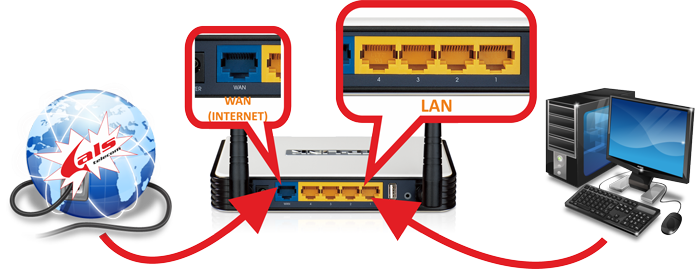
Под данную инструкцию попадают практически все модели Wi-Fi роутеров TP-Link, в зависимости от модели и версии прошивки, расположение некоторых настроек может отличаться от данной инструкции, но принцип настройки на всех роутерах один и тот же.
Данная инструкция предоставляется как есть, администрация сайта не несет ответственности за неправильные действия пользователя при настройке, если Вы не уверены в своих действиях, лучше обратитесь к специалисту..
В процессе настройки вам будет предложено несколько раз перезагрузить роутер, отказываемся, перезагрузку выполним по завершению всех настроек.
Рекомендации.
1. По умолчанию, Логин admin, пароль admin.
2. Курьеры-настройщики должны в настройках изменять пароль на Серийный номер, указанный на коробке (S/N). При перенастройке рекомендуется также использовать в качестве пароля на роутер и wi-fi S/N (серийный номер).
3. Сброс настроек роутера производится путем нажатия и удержания кнопки Reset на задней панели роутера в течении 10 секунд.
Авторизация.
Для того, что бы попасть в веб-интерфейс роутера, необходимо открыть ваш Интернет браузер и в строке адреса набрать http://192.168.0.1, User Name admin , Password – admin (при условии, что роутер имеет заводские настройки, и его IP не менялся).
Смена заводского пароля.
- В целях безопасности рекомендуется сменить заводской пароль.
- По умолчанию: Логин admin, пароль admin.
- В интерфейсе роутера необходимо зайти во вкладку Системные инструменты, и выбрать Пароль.
- В поле Предыдущее имя пользователя введите admin, Предыдущий пароль введите admin.
- В поля Новое имя пользователя, Новый пароль, Подтвердите пароль введите новый логин (можно оставить прежний «аdmin»), а также новый пароль, и повтор пароля.
- Затем нажмите кнопку «Сохранить».
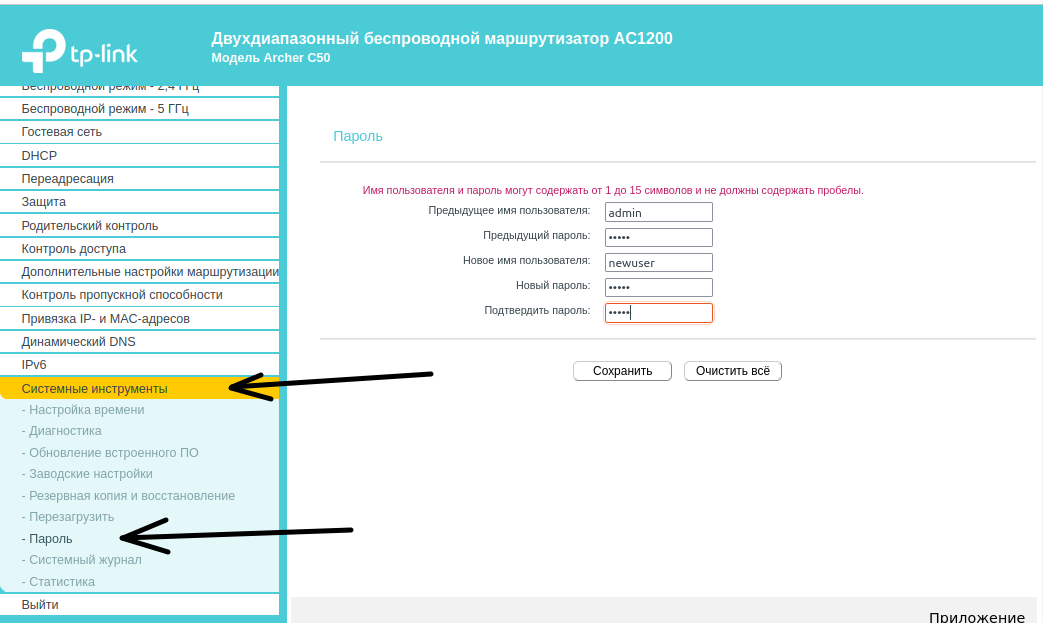
В интерфейсе маршрутизатора необходимо выбрать вкладку слева «Беспроводной режим», в открывшемся списке выбираем «Настройки беспроводного режима».
Выставляем параметры следующим образом:
1. Поле «Имя сети беспроводной сети»: вводим название беспроводной сети;
2. Канал: Авто;
3. Режим: 11bgn смешанный;
4. Ширина канала: Авто;
5. Ставим галки: «Включить беспроводное вещание роутера» и «Включить широковещание SSID».
6. Нажимаем ниже кнопку «Сохранить».
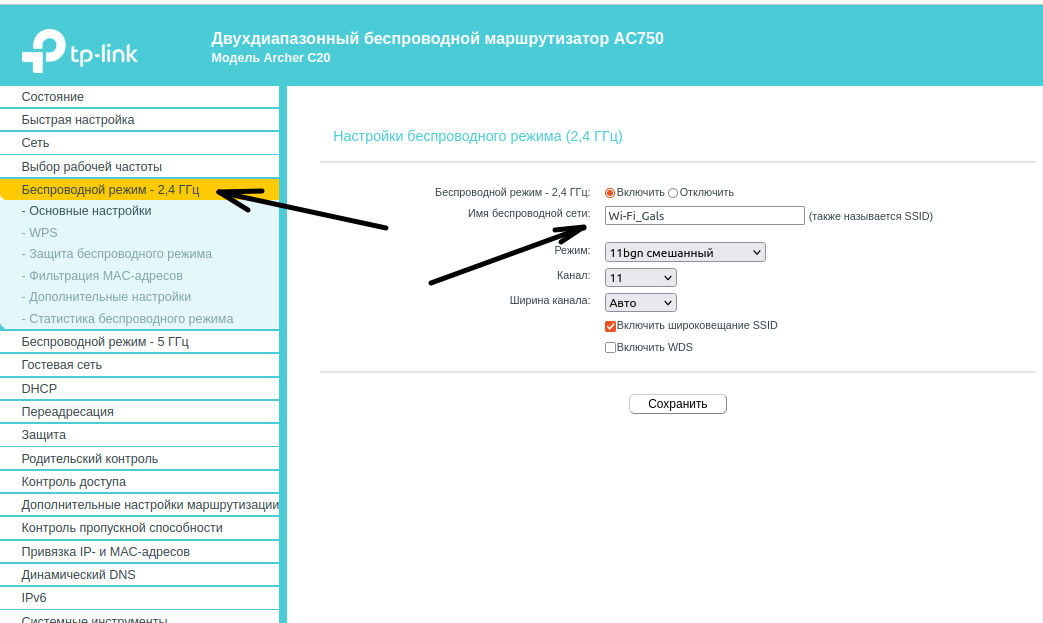
Те же манипуляции проводите и с разделом «Беспроводной режим — 5 ГГЦ»
Установка пароля на беспроводной режим
Слева в меню выбираем «Беспроводной режим», далее «Защита беспроводного режима» и выставляем параметры:
1. Устанавливаем точку на WPA-Personal/WPA2-Personal;
2. Версия: WPA2-Personal;
3. Шифрование: Автоматическая;
4. Пароль PSK: здесь необходимо ввести любой набор цифр, длиной от 8 до 63. Их также необходимо запомнить, чтобы Вы могли указать их при подключении к сети.
5. Нажимаем ниже кнопку «Сохранить».
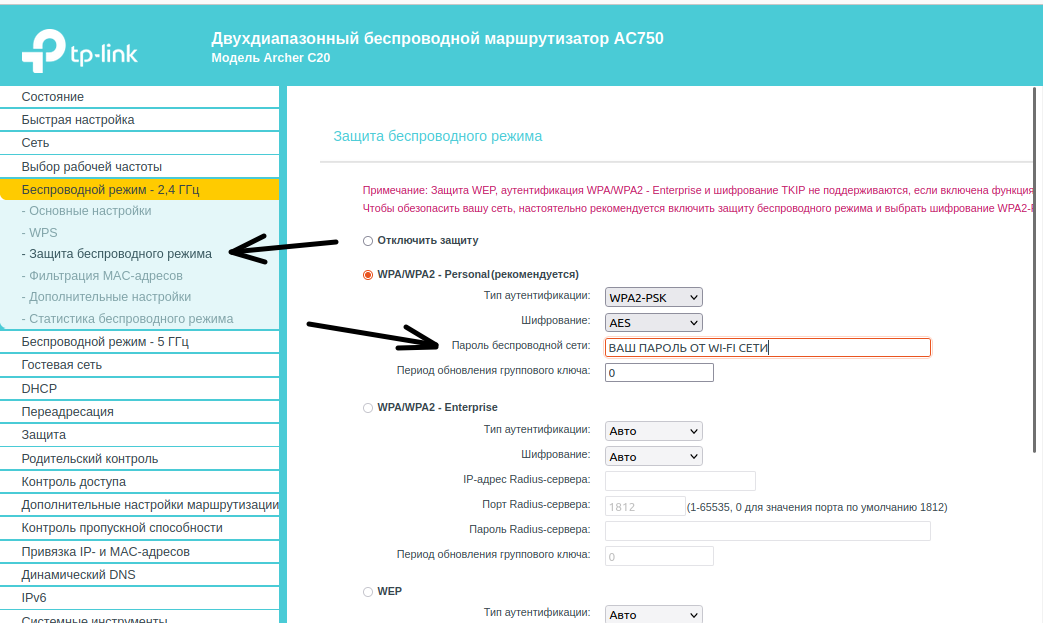
Настройка подключения к Интернет.
Настройка PPPoE подключения.
- Слева выбираем меню Сеть, далее WAN;
- Тип WAN соединения: PPPoE / Россия PPPoE;
- В строку «Имя пользователя»: Необходимо ввести Ваш логин из договора;
- В строки «Пароль» и «Подтвердите пароль»: Необходимо ввести Ваш пароль из договора;
- Вторичное подключение: Включить;
- Режим WAN подключения: Подключить автоматически;
- Нажимаем кнопку «Сохранить».
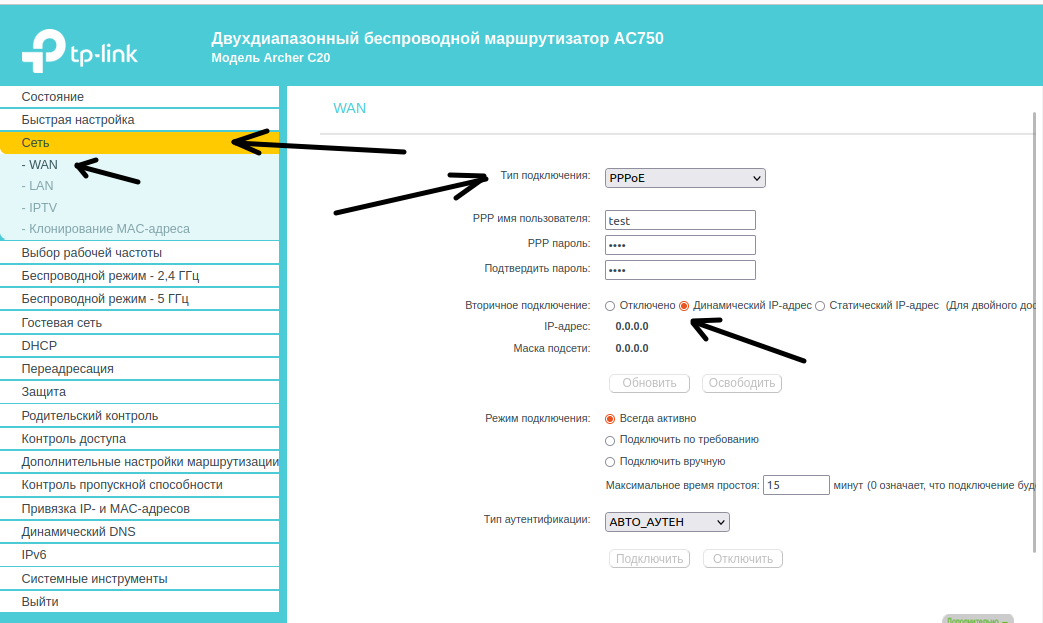
Далее нажимаем кнопку «Дополнительно» и прописываем DNS сервера 10.0.0.19 и 10.0.0.5.
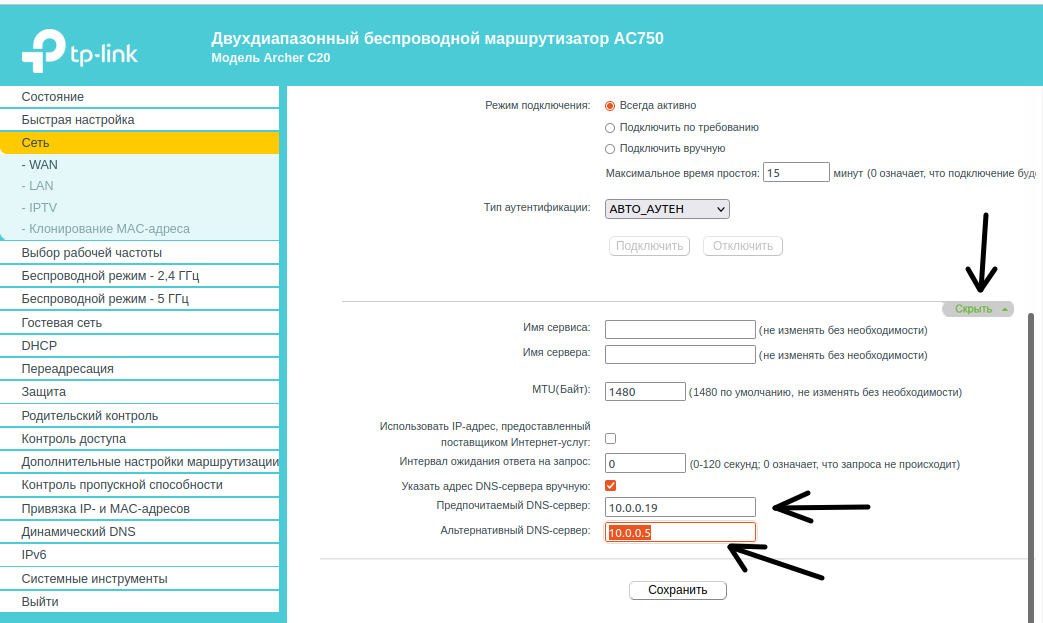
Настройка DHCP.
- Слева выбираем меню DHCP, далее Настройки DHCP;
- Вбиваем Первичный DNS: 10.0.0.19
- Вбиваем Вторичный DNS: 10.0.0.5
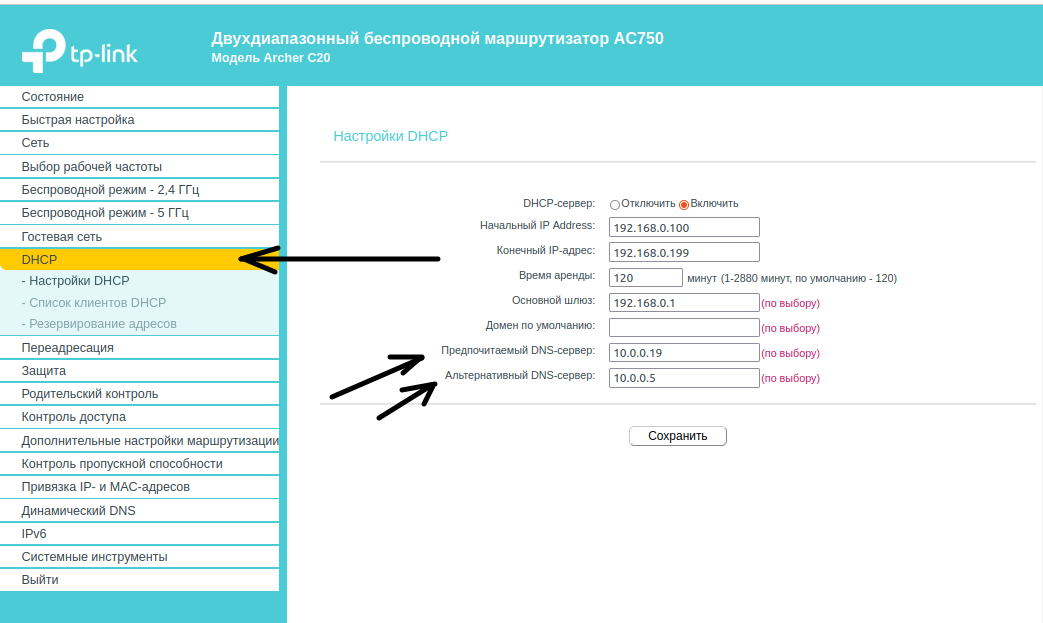
Завершение
Настройка завершена, можно перезагрузить роутер. Заходим в Системные настройки, Перезагрузка и нажимаем кнопку Перезагрузка. Роутер будет перезагружен и настройки вступят в силу.
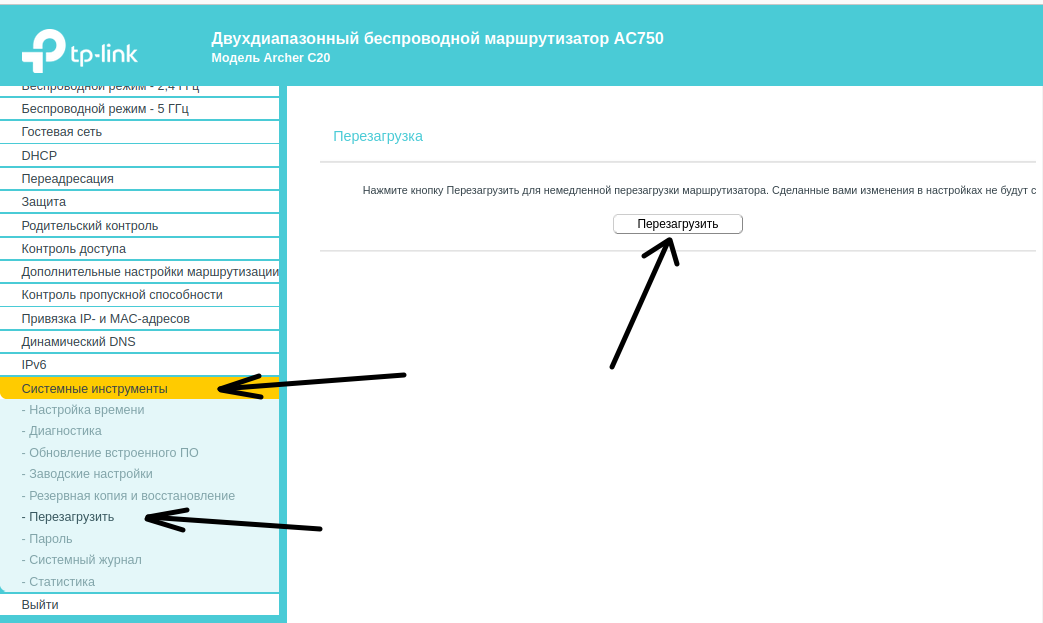
После настройки роутера, обратитесь в службу технической поддержки для привязки MAC адреса Вашего роутера.
Сохранение/восстановление настроек роутера.
После проведения настройки, рекомендуется сохранить их, чтобы в случае возникновения проблем, можно было их восстановить. Для этого необходимо зайти во вкладку Системные инструменты, меню Резервная копия и восстановление.
— Для сохранения текущих настроек роутера необходимо нажать кнопку Резервная копия. Файл с настройками будет сохранен в указанное место на жёстком диске.
— Для восстановления настроек настроек из файла, необходимо нажать кнопку выбора файла, указать путь к файлу с настройками, затем нажать кнопку Восстановить.